ACT English & Reading study guide · Chapter 9
What Can the Evidence Really Prove?
Chapter 8
A friend tells you a new restaurant is excellent, because they had one great meal there. A review site shows you four hundred ratings. A different friend mentions that service is slow specifically on weekends. None of these sources is useless, and none of them is lying to you. They just support different-sized claims. One great meal can prove that one meal was good. It cannot prove that every customer has the same experience, and it doesn't tell you anything at all about weekend service specifically.
You already know how to weigh sources like this against each other, informally, whenever you're trying to decide whether to trust a claim: how much does this specific piece of evidence actually establish, and what would it take to prove something bigger than that.
ACT turns that same everyday judgment into questions about claims, evidence, and reasoning, sometimes drawn from a single passage, sometimes from two passages that address a related topic, and sometimes from a passage paired with a chart, graph, or table. The question is always some version of the same thing: what does this specific piece of evidence actually earn, and what happens to that claim once a second source, or a visual, is added to the picture. ACT groups this under Integration of Knowledge and Ideas.
Passages used in this chapter
Two short original passages are used throughout this chapter, along with one figure, as worked examples and again in the practice set at the end. Passage E and Passage F address a related topic from two different authors. Read each passage on its own before comparing them, and examine Figure 1 only after you have read both passages.
Guided passage E
The Case for Canopy
(Original paired practice passage and dataset. Place names, pilot details, and numerical results are constructed for test-preparation use.)
Cities facing rising summer temperatures have no shortage of proposed fixes, but few deserve the priority currently being given to expanding urban tree canopy. Reflective roofing, permeable pavement, and misting stations all have their advocates, and each can play a supporting role. None of them, however, should be allowed to crowd out what the evidence increasingly suggests is the single most cost-effective long-term intervention available to city planners: getting more trees into the ground, and keeping them there.
The strongest evidence for this position comes from Fairhaven's four-year pilot program, which tracked peak summer surface temperatures across fifty-six neighborhoods, fourteen in each of four intervention groups. Neighborhoods that received expanded tree canopy alone saw meaningfully larger average temperature reductions than those that received reflective roofing alone. Trees, unlike reflective surfaces, do more than bounce heat away; they actively cool the surrounding air through evapotranspiration, provide shade that reduces the temperature of the pavement and buildings beneath them, and continue delivering these benefits for decades after the initial planting cost has been paid.
Critics of canopy-first strategies typically raise two objections. The first is cost: a mature tree canopy takes years to establish, and newly planted trees require irrigation, protection from pests, and replacement when they fail to survive, all of which carry ongoing expense that reflective roofing, installed once, mostly avoids. The second objection is reliability: unlike a roof coating, a tree is a living thing, vulnerable to drought, disease, and the simple bad luck of an unusually harsh season, which makes canopy programs a less predictable investment than manufactured alternatives.
Both objections have real force, and this essay does not dismiss them. Canopy programs are genuinely more expensive to establish and maintain in their early years than reflective roofing, and their outcomes are genuinely less uniform, as even Fairhaven's own pilot data show. But the appropriate response to a slower, less predictable investment with a larger long-term payoff is not to abandon it in favor of a faster, more uniform one with a smaller payoff; it is to budget for the years the investment takes to mature, and to treat canopy expansion as what it actually is: an infrastructure commitment, not a one-time purchase. Cities that have made this shift in framing, treating trees as the long-term backbone of a heat-reduction strategy rather than a decorative supplement to more "serious" engineering solutions, are the cities most likely to still be seeing returns on that investment decades from now.
Guided passage F
What the Roof Can and Cannot Do
I have spent the better part of a decade designing reflective and green roofing systems for municipal buildings, and I want to say plainly, before anything else: I am not opposed to trees. I am opposed to a framing, increasingly common in city planning circles, that treats tree canopy as the default answer to urban heat and every other intervention as a secondary supplement to it. That framing gets the engineering backward.
Reflective roofing has one significant advantage that no amount of canopy enthusiasm should obscure: it works immediately, uniformly, and predictably. A newly coated roof begins reflecting solar radiation the day the coating is applied, at a rate that varies little from building to building and does not depend on soil quality, water availability, or the survival of a young tree through its vulnerable first several years. For a city trying to reduce heat-related illness this summer, not in fifteen years, that immediacy is not a minor convenience; it may be the difference that matters most.
None of this means canopy expansion is a poor investment; the same Fairhaven data that canopy advocates cite shows real, if more variable, cooling benefits from tree planting, and I have no quarrel with the finding that combining both interventions produced the largest reductions recorded in the pilot. My disagreement is narrower than a wholesale rejection of trees: it is with the specific claim that canopy expansion deserves to be treated as the primary strategy, with other interventions relegated to supporting roles. The Fairhaven data, read carefully, supports a different conclusion, one its canopy-focused advocates tend to underemphasize: the combined approach outperformed either intervention alone by a wide margin, which suggests that trees and reflective surfaces are functioning as complements, not as a hierarchy with one clearly superior member.
A city with the patience and budget to wait fifteen years for a mature canopy, and the resources to maintain reflective roofing in the meantime, should absolutely do both. But a city forced to choose where its next dollar goes, this year, facing a heat emergency it cannot wait out, should not be told that the "real" solution is the slower one. Immediacy is not a lesser virtue than durability; it is a different one, suited to a different part of the problem, and a genuinely evidence-based heat strategy would treat both interventions as answering different questions rather than competing for the same crown.
Figure 1: Compare the visual with the claims in both passages.
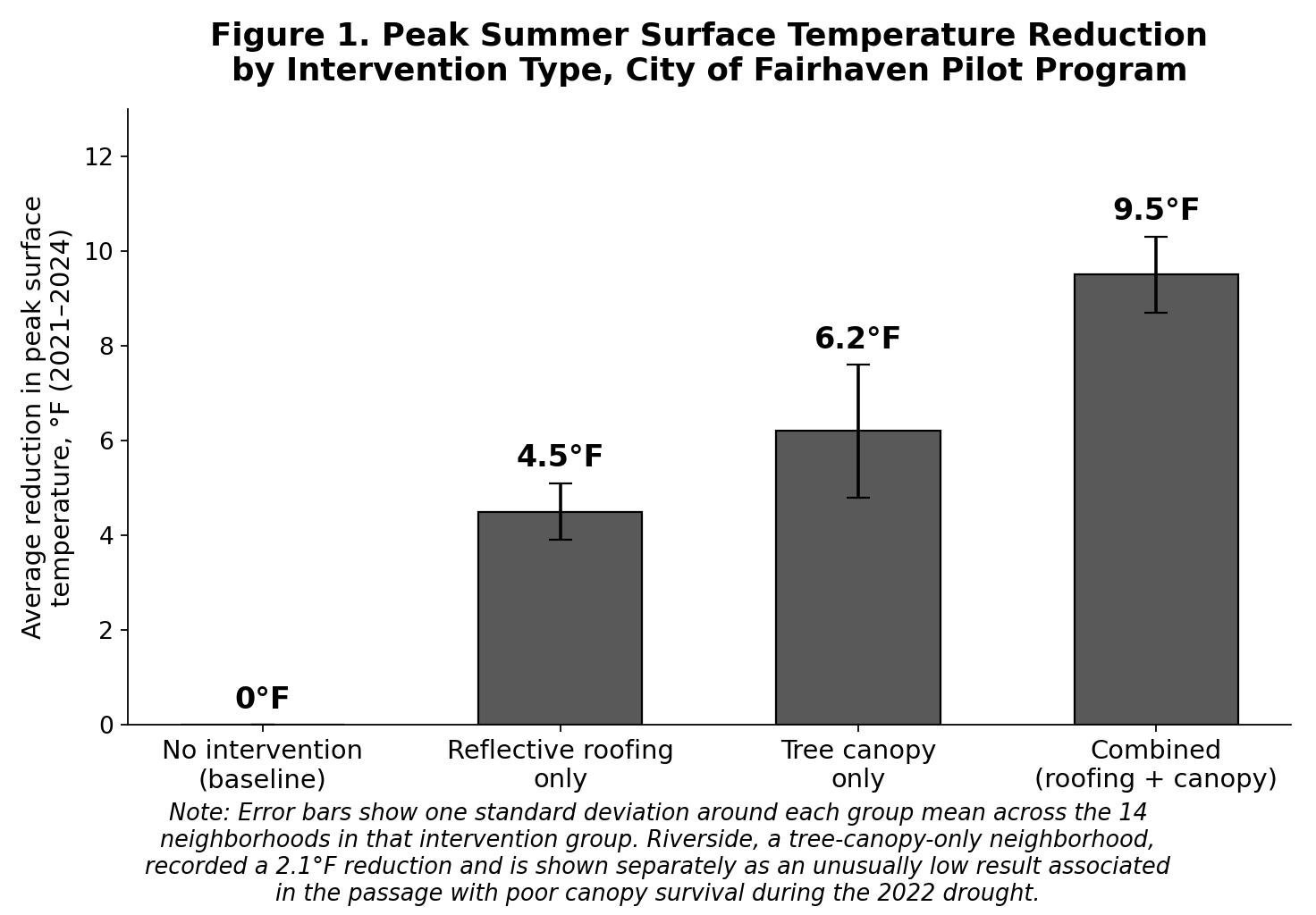
Identify the claim, who owns it, and what pushes against it.
Before evaluating whether a passage's evidence is any good, identify exactly what claim that evidence is supposed to support. Evidence cannot be judged in a vacuum; the same piece of evidence can be strong support for one claim and weak or irrelevant support for a different, nearby claim, which means naming the claim first is not a preliminary formality but the step that makes evidence evaluation possible at all.
Separate the subject from what the author is claiming about it. A topic names what a passage is about; a claim takes a position or makes an assertion about that topic, something that could, in principle, be argued against. "Urban tree canopy" is a topic. "Urban tree canopy deserves priority over other heat-reduction strategies" is a claim. Confusing the two produces answers that correctly identify what a passage discusses without identifying what it actually argues, which is a different and more demanding task.
Find the position the writer is directly trying to establish.
Passage E states directly: "few deserve the priority currently being given to expanding urban tree canopy... None of them, however, should be allowed to crowd out what the evidence increasingly suggests is the single most cost-effective long-term intervention available to city planners."
The topic is urban heat-reduction strategies. The central claim, stated directly, is more specific and arguable: tree canopy expansion deserves priority over competing interventions as the primary long-term strategy. A choice describing the passage's topic as "urban heat reduction methods" would be accurate but would not answer a question asking for the passage's central claim.
Distinguish the central claim from a supporting claim. A passage's central claim is the position the whole argument is built to support; a secondary or supporting claim is a smaller assertion that helps build the case for the central claim but is not, itself, the passage's main point. A secondary claim can sometimes sound broader or more dramatic than the central claim, which is exactly what makes mistaking one for the other a persistent trap.
Separate a supporting claim from the passage's main claim.
Passage E asserts, in support of its central claim, that trees "actively cool the surrounding air through evapotranspiration" and "continue delivering these benefits for decades after the initial planting cost has been paid."
This is a secondary claim: a specific assertion about why trees are effective, offered in service of the passage's central claim that canopy expansion deserves priority. A reader who mistakes this vivid, specific claim about evapotranspiration for the passage's central claim has swapped a supporting point for the main argument it was built to support.
Track who owns each claim. Every claim in a passage belongs to someone: the author, a quoted expert, an opposing group, a cited study, or, in a paired-passage set, one specific author rather than the other. Correctly attributing a claim to its actual owner, rather than assuming every claim belongs to the passage's author, is required before that claim can be evaluated or compared to anything else.
Keep each claim attached to the source that actually makes it.
Passage E states that critics raise concerns about cost and reliability, specifically that "a tree is a living thing, vulnerable to drought, disease, and the simple bad luck of an unusually harsh season."
This claim belongs to the canopy program's critics, not to Passage E's author, who reports the objection accurately and even grants that it "has real force" before ultimately arguing that it does not outweigh the long-term case for canopy investment. A question asking what Passage E's author believes about tree reliability should not be answered using this sentence alone, since it represents an objection the author is reporting and responding to, not asserting as their own view.
Find the counterclaim before following the response to it. A counterclaim is an opposing position the author acknowledges, and it has to be identified clearly before evaluating how the author responds to it: whether the author rebuts it, concedes part of it, qualifies it, or leaves it unresolved. Skipping past the counterclaim itself and jumping straight to the author's response risks misunderstanding what, exactly, is being conceded or rejected.
Separate a counterclaim from the author's own position. A counterclaim belongs to whoever raises it, typically an opposing voice the author is representing fairly before responding, and it should never be mistaken for a position the author personally holds, even when the author describes that counterclaim in detailed, sympathetic terms. An author can present an opposing view accurately and even generously without endorsing it.
Follow how the argument changes after the counterclaim. An argument does not always simply reject a counterclaim outright; it can concede part of the counterclaim's force while maintaining its overall position, and tracking exactly what gets conceded and what remains defended is necessary to understand the argument's actual final shape, rather than assuming every counterclaim ends in total refutation.
Identify the objection first, then ask how the writer answers it.
Passage E explicitly states, "Both objections have real force, and this essay does not dismiss them. Canopy programs are genuinely more expensive to establish and maintain... and their outcomes are genuinely less uniform," before concluding, "the appropriate response... is not to abandon it... it is to budget for the years the investment takes to mature."
A reader who assumes the author must fully refute the counterclaim, rejecting the claims about cost and unpredictability as false, would misread this passage; the author explicitly concedes both points are genuinely true. What the author rejects is not the truth of the objections but the conclusion that those objections should be drawn from them, that the cost and unpredictability should lead a city to abandon canopy investment rather than budget appropriately for it. The argument's real shape is partial concession followed by a redirected conclusion, not outright denial.
Ask what each piece of evidence actually proves.
Before deciding whether a piece of evidence supports a claim, state plainly what that evidence, on its own, actually establishes. This is a check against the common failure of noticing that evidence sits near a claim and assuming, without further checking, that it therefore supports that specific claim.
Ask which claim this evidence is meant to support.
Passage E cites the finding that "neighborhoods that received expanded tree canopy alone saw meaningfully larger average temperature reductions than those that received reflective roofing alone."
On its own, this evidence establishes a comparison between two single interventions, canopy alone versus roofing alone, in this specific pilot program. It does not, by itself, establish that canopy expansion is more cost-effective, more reliable, or superior to a combined approach; those are separate claims that would each require their own supporting evidence, not automatically supplied by this one comparison.
Keep relevant evidence tied to the exact claim. Evidence is relevant only when it actually bears on the specific claim being evaluated, not merely when it is true, interesting, and generally related to the passage's topic. A piece of evidence can be entirely accurate and still fail to support the exact claim a question is asking about.
Related evidence is not useful unless it bears on the exact claim.
If a question asked what evidence Passage F offers for the claim that reflective roofing "works immediately," the detail that Passage F's author has "spent the better part of a decade designing reflective and green roofing systems" would be true and related to the passage's general subject, but it is a credential establishing the author's expertise, not evidence establishing the immediacy of the roofing's effect. The actual evidence for immediacy is the specific claim that follows: a coated roof "begins reflecting solar radiation the day the coating is applied."
Separate strong evidence from a large amount of evidence. The quantity of evidence a passage offers is not, by itself, a measure of that evidence's strength, and a claim supported by several weak or loosely related pieces of evidence is not thereby better supported than a claim backed by one precise, directly relevant piece. Evaluating evidence requires checking its quality and its fit to the claim, not counting how many sentences are devoted to it.
Ask whether the evidence is enough for the size of the claim. Evidence has to be evaluated not only for whether it is relevant and sound but for whether its scope and amount actually justify the scope of the claim it is being used to support. Evidence that is entirely relevant and entirely accurate can still be insufficient if the claim it supports is broader than what that evidence, by itself, can establish.
Ask whether the evidence is enough for the size of the claim.
Passage F cites the Fairhaven pilot's finding about combined interventions to support the claim that "trees and reflective surfaces are functioning as complements, not as a hierarchy with one clearly superior member."
The pilot data, drawn from one city's fourteen neighborhoods over four years, is relevant and directly on point for this specific comparative claim. Whether that same evidence would be sufficient for a much broader claim, that trees and reflective surfaces function as complements in cities generally, is a separate question; a single pilot program's data may be sufficient for a claim scoped to that pilot's own findings while still being insufficient, on its own, for a sweeping generalization beyond it.
Notice when the evidence supports only part of the claim. A multi-part claim can be only partially supported by the evidence a passage offers, with one component well established and another component simply asserted alongside it without direct support. Recognizing this partial coverage prevents treating an argument as fully proven when only a portion of it actually is.
Use the passage to test the argument's reasoning. Evaluating an argument's reasoning means checking whether its conclusion actually follows from its stated evidence and premises, not whether the conclusion sounds reasonable or matches a reader's own prior views. A reasoning flaw is a gap between what the evidence establishes and what the argument claims that evidence proves, and finding that gap requires comparing the two directly.
Find the unsupported step between the evidence and the conclusion.
Suppose a version of Passage E argued that because canopy-only neighborhoods outperformed roofing-only neighborhods, cities should abandon reflective roofing programs entirely.
The evidence, a comparison between canopy-alone and roofing-alone outcomes, partly supports a claim about relative effectiveness between those two specific options. It does not support the broader conclusion that roofing programs should be abandoned entirely, since the same data, and Passage E's own actual argument, shows combined interventions outperforming either single approach, undermining rather than supporting an "abandon roofing" conclusion. The premises here would partly support the conclusion's general direction while leaving an unsupported logical bridge to its most extreme version.
Strengthen the exact claim the question names. A strengthen question requires identifying precisely which claim the question is asking about and what new information would make that specific claim more likely to be true, based on the inferential link the argument already depends on. New information that supports a different, related claim, without touching the actual claim named in the question, does not strengthen the argument the question is asking about.
Choose new information that makes the exact claim more likely.
Suppose new information revealed that Fairhaven's combined-intervention neighborhoods also reported the lowest rates of heat-related hospital visits during the pilot period.
This new information would most directly strengthen Passage F's specific claim that combined interventions function as complements producing the strongest outcomes, since it adds an additional, independent measure, health outcomes rather than just surface temperature, pointing toward the same conclusion. It would do comparatively little to strengthen Passage E's narrower claim that canopy alone deserves priority over other interventions, since the new information specifically involves the combined approach, not canopy alone.
Weaken the link the argument depends on. A weaken question is most effectively answered by identifying the specific inferential link an argument depends on, the exact step connecting its evidence to its conclusion, and finding new information that damages that link specifically, rather than information that must first be interpreted as proving the argument's conclusion is the opposite of true.
Choose new information that damages the link between evidence and claim.
Suppose new information revealed that Fairhaven's reflective roofing was replaced with a new, more effective coating partway through the pilot, meaning the reflective-roofing group's results reflect roughly half the years using an older, less effective product.
This would weaken Passage E's implicit comparison between canopy and roofing effectiveness, not by proving canopy is ineffective, but by damaging the reliability of the specific comparison the author's evidence depends on: if the roofing group's own results were artificially lowered by using an outdated coating for part of the study, the reported gap between canopy and roofing outcomes may not reflect a fair comparison between the two interventions as they currently exist. The new information does not need to prove reflective roofing is actually superior; it only needs to undermine the specific comparison the argument relies on.
Distinguish a fact from an opinion. A fact is a statement presented as verifiable information, something that could, in principle, be checked against external evidence and confirmed or disconfirmed. An opinion is a belief or evaluation that is not itself established as fact, even when it may be widely shared or strongly felt. The presence of a number in a statement does not automatically make it a fact, and the absence of one does not automatically make a statement an opinion.
Separate a verifiable statement from a personal judgment.
Passage E states that Fairhaven's pilot program "tracked peak summer surface temperatures across fourteen neighborhoods," a verifiable, factual claim about what the program did, distinct from the passage's evaluative claim that tree canopy "deserves priority" over other interventions, which is a position the passage argues for rather than a fact it reports.
A reader who treats every numerically specific statement in Passage E as equally factual, without distinguishing the verifiable details of the pilot's design from the passage's own evaluative argument built on top of those details, will have trouble separating what the passage establishes from what it is trying to persuade the reader of.
Recognize a reasoned judgment that uses evidence. A reasoned judgment is a distinct category from both fact and pure opinion: it is an evaluative conclusion that is grounded in evidence and reasoning, rather than either a bare verifiable fact or an unsupported preference. Treating every evaluative-sounding statement as a mere opinion, with no distinction for whether it is actually backed by evidence, collapses a distinction this test specifically tests.
A judgment can be evidence-based without becoming a fact.
Passage F's claim that "the combined approach outperformed either intervention alone by a wide margin, which suggests that trees and reflective surfaces are functioning as complements, not as a hierarchy" is not a bare, verifiable fact, since it involves interpretation, and it is not a pure opinion untethered from evidence, since it is explicitly grounded in the pilot's comparative data.
This is a reasoned judgment: an evaluative conclusion, but one built directly on cited evidence rather than asserted as a simple preference. A fact/opinion question that offered only "fact" or "opinion" as choices for this statement would be testing exactly the oversimplified binary this mechanism is built to move past.
Compare the sources only after each one is clear.
Before comparing two passages, understand the first one entirely on its own terms: its central claim, its supporting evidence, its counterclaims, and its author's specific position. This applies to whichever passage a paired-passage question set presents first, regardless of how it happens to be labeled. Treating the two passages as a blended, undifferentiated whole from the very first read is what causes claims from one passage to get attributed to the other.
Read Passage B on its own first. The same discipline applies to the second passage: map its central claim, evidence, and position independently, without yet asking how it relates to the first. Only once both passages are individually clear does comparing them become a reliable process rather than a guess based on a vague, blended impression of "what both passages were generally about."
Keep each passage's claims and evidence separate. Throughout this process, keep track of which passage each specific claim, piece of evidence, or counterclaim actually belongs to. A detail from Passage E should not casually migrate into your understanding of what Passage F argues, even when the two passages address closely related material, and confusing the two sources is one of the most common errors on cross-text questions.
Name the relationship before comparing the passages. Once both passages are individually clear, state in your own words what kind of relationship connects them before looking at any answer choices: full agreement, outright disagreement, partial agreement with qualification, an extension of one point by the other, a shared conclusion reached through different evidence, or a difference in emphasis rather than substance. Naming this relationship first prevents defaulting to a simple agree-or-disagree framing that may not actually fit.
Find where the passages agree. Identifying genuine points of agreement between two passages requires locating a specific claim both authors actually affirm, not simply noticing that both passages address the same general subject.
State the exact point on which the two passages agree or differ.
Both Passage E and Passage F affirm that Fairhaven's combined intervention, tree canopy plus reflective roofing, produced the largest temperature reductions recorded in the pilot program.
This is genuine agreement: both authors cite and accept this specific finding, even though they go on to draw different emphases and recommendations from it. A comparison question asking where the two passages agree should point to this shared acceptance of the combined-intervention finding, not to the broader topic of urban heat, which both passages address but do not necessarily agree about in every respect.
Find the exact point where the passages differ. Locating a genuine disagreement between two passages requires identifying the specific claim on which the authors actually take different positions, distinguished from surrounding material both authors might agree on.
Compare how the two authors or narrators view the same issue.
Passage E's author argues that tree canopy expansion "deserves priority" as the primary long-term heat-reduction strategy, while Passage F's author explicitly objects to "a framing... that treats tree canopy as the default answer... and every other intervention as a secondary supplement to it."
This is the exact point of difference: not whether canopy expansion is valuable, which both authors accept, but whether it deserves to be treated as the primary, priority strategy rather than one of two complementary approaches. Locating this precise point of difference is more useful than a vague sense that "the authors disagree about trees," which does not capture what they actually disagree about.
Recognize partial agreement and qualification. Two passages often relate to each other through partial agreement or qualification rather than a clean binary of agreeing or disagreeing, with one author accepting most of another's claim while narrowing, complicating, or adding a condition to it. Treating every cross-text relationship as either full agreement or full disagreement misses this common and specifically tested middle case.
Notice when a source partly agrees while limiting the claim.
Passage F's author states directly, "None of this means canopy expansion is a poor investment... My disagreement is narrower than a wholesale rejection of trees."
This is qualification, not disagreement: Passage F's author accepts the value of canopy expansion and even the specific Fairhaven findings Passage E cites, while narrowing the disagreement specifically to whether canopy deserves top priority over other interventions rather than equal, complementary status. A choice describing the two passages as being in fundamental disagreement about the value of tree canopy would miss this qualification and overstate how far apart the two authors actually are.
Use one passage to test a claim made in the other. One passage's specific evidence or argument can be used to evaluate a claim made in the other passage, testing whether the first passage's material actually supports, challenges, or is simply neutral toward the second passage's position. This relationship can be indirect, requiring a reader to connect a detail in one text to a claim in the other rather than finding an explicit cross-reference.
Use one passage only when it actually provides evidence for the other passage's claim.
Passage F's specific detail that reflective roofing "begins reflecting solar radiation the day the coating is applied" indirectly challenges an implicit assumption in Passage E's argument, that a slower, longer-term investment is worth prioritizing over faster alternatives, by supplying a concrete reason immediacy might matter for reasons Passage E's argument does not directly address, such as an ongoing heat emergency a city cannot wait out.
Passage E never mentions this specific point directly, and Passage F never explicitly states that it is responding to Passage E's argument about long-term priority; the connection has to be made by the reader, using Passage F's specific evidence to test the strength of an assumption underlying Passage E's case.
Combine evidence from both passages only after each source is clear. A full cross-text synthesis question requires drawing on specific evidence from both passages together, not answering from just one source while ignoring the other, and this kind of synthesis should only be attempted once each passage's individual claims and evidence are already clearly mapped.
Draw only the conclusion that becomes supportable when both sources are combined.
A question asking what conclusion is best supported by considering both passages together might be answered: the Fairhaven pilot data, as reported consistently across both passages, supports treating tree canopy and reflective roofing as complementary interventions whose combination outperforms either alone, even though the two authors disagree about which single intervention, if a city can only afford one, should receive priority.
This synthesis draws specifically on Passage E's data about the combined intervention's results, Passage F's explicit framing of the two interventions as complements, and both authors' shared acceptance of the combined finding, while still accurately representing the genuine point of disagreement that remains between them. An answer drawing only on Passage E, or only on Passage F, would not be a true synthesis, however accurate it was as a description of one passage alone.
Read the visual at the same scope and precision as the text.
Before interpreting what a graph shows, read its title and its axis labels first, since these establish exactly what is being measured, over what period, and for what population, information that controls every subsequent interpretation of the visual's shape.
Check the axes, units, categories, and legend. A visual's axes specify the scale and units the data is measured in, its categories specify what is being compared, and its legend, when present, specifies what each color, pattern, or symbol represents. Skipping this step and jumping straight to the visual's overall shape risks misreading what the visual actually displays, especially when an axis does not start at zero or uses an unfamiliar scale.
Describe the visual before connecting it to the passage. Before asking what a visual means for a passage's argument, describe plainly what the visual itself shows: which category has the highest or lowest value, what the general pattern is, and whether any data point breaks from that pattern. This description should be possible without reference to the passage at all, since the visual has its own content independent of any text describing it.
Read the figure before using the passage to interpret it.
Figure 1 shows that the combined intervention produced the largest average reduction in peak surface temperature, 9.5°F, compared to 6.2°F for tree canopy alone, 4.5°F for reflective roofing alone, and 0°F for no intervention.
This description uses only the figure itself: its labeled values and its categories, without yet drawing any connection to what either passage argues about those results. A visual-alone question can be answered directly from this kind of description, without needing to consult the surrounding text at all.
Match the graph to the exact claim in the text. Once the visual is described on its own terms, the next step is identifying precisely which claim in the passage the visual is being used to evaluate, since a visual can be relevant to one specific claim in a passage while being only loosely connected, or entirely unconnected, to other claims the same passage makes.
Notice when the visual confirms the passage. A visual confirms a textual claim when the data it displays directly matches what the passage asserts, using the same variable, population, and scope the passage is actually claiming something about.
Check whether the figure measures the exact claim made in the text.
Passage E's claim that canopy-only neighborhoods "saw meaningfully larger average temperature reductions than those that received reflective roofing alone" is directly confirmed by Figure 1's reported values: 6.2°F for canopy alone compared to 4.5°F for roofing alone.
The figure's specific values, for the specific two categories the passage's claim compares, match what the passage asserts, making this a clear case of visual confirmation rather than a case requiring careful qualification.
Notice when the visual qualifies the passage. A visual can support a passage's general claim while also narrowing, complicating, or adding a condition to it, revealing detail the prose alone does not convey. A visual that qualifies a claim is not contradicting it; it is adding precision or an exception the text's general statement leaves out.
Decide whether the visual weakens, limits, or directly contradicts the claim.
Passage E describes canopy programs' outcomes as "genuinely less uniform" than reflective roofing's, and Figure 1 qualifies this general claim with a specific detail: the wider error bars for the tree-canopy-only group than for the roofing-only group, together with the separately noted Riverside result of 2.1°F, add specific evidence that canopy outcomes varied more across neighborhoods in this constructed pilot.
This is qualification, not contradiction: the figure supports the passage's general claim about variability while adding a specific, textually unstated detail, exactly which neighborhood underperformed and roughly why, that sharpens rather than undermines the passage's point.
Notice when the visual contradicts the passage. A visual contradicts a passage when the data it displays does not match what the passage claims about that same variable, population, and scope, and recognizing a genuine contradiction requires checking that the visual and the text are actually measuring the same thing before concluding they disagree.
Check whether the text and visual cover the same population, time, and variable.
If a passage claimed that reflective roofing "outperformed all other single interventions" in the Fairhaven pilot, Figure 1 would directly contradict that specific claim, since it shows tree canopy alone, at 6.2°F, outperforming reflective roofing alone, at 4.5°F, on the same measure, over the same period, for the same pilot program. Before concluding this is a genuine contradiction, however, a careful reader would confirm that the passage's claim and the figure's data are describing the same variable, peak surface temperature reduction, and the same scope, single interventions only, rather than assuming a contradiction where the text and visual are actually measuring different things.
Keep correlation separate from causation. A visual showing that one variable rises alongside another establishes an association, not a proven causal mechanism, unless the passage's text or the visual's own design specifically establishes causation, for instance through a controlled comparison. Treating a visual trend as automatic proof of a causal claim beyond what the data or text actually support is a specific and commonly tested error.
Do not turn an association in the data into proof of cause.
Figure 1 shows an association between intervention type and temperature reduction in the Fairhaven pilot. The passage does not state that neighborhoods were randomly assigned or otherwise controlled in a way that would isolate intervention type as the cause. The figure therefore supports a comparative association within this pilot, not a definitive causal claim.
A broader causal claim, such as asserting that tree canopy expansion would produce an identical, guaranteed temperature reduction in any city regardless of climate, soil, or baseline conditions, would overreach beyond what even this well-designed pilot's data can support on its own, since the study's causal design is scoped specifically to Fairhaven's own conditions during this particular four-year period.
Match the precision of the answer to the precision of the data. An answer choice should claim no more precision than the visual actually supports, and when a visual displays approximate values, ranges, or error bars, an answer asserting an exact, specific figure beyond what the visual actually shows overstates the data's precision.
Do not claim more numerical precision than the figure provides.
Figure 1 reports the tree-canopy-only group's average reduction as 6.2°F with a range extending from roughly 4.8°F to 7.6°F across neighborhoods; a question asking for the "typical" reduction in this group is best answered using the reported average, 6.2°F, rather than by asserting that every neighborhood in the group experienced exactly that reduction, or by treating the endpoints of the range as if they were the typical value.
Respecting the visual's own precision, an average with a stated range of neighborhood-level variation, rather than reading more exactness into it than it actually offers, prevents both understating and overstating what the data supports.
When text and visual seem to disagree, identify exactly what each one measures. When a passage's claim and a visual's data appear to conflict, the first step is not to decide which source is more trustworthy, but to check precisely what each one measures: the same variable, the same population, the same time window, and the same scope. Many apparent contradictions between text and visual resolve once this precise comparison reveals that the two sources were never actually measuring the same thing in the first place.
Match the scope of the text claim to the scope of the visual.
If a hypothetical passage claimed that "canopy expansion produces the most dramatic results within the first year," while Figure 1's data is explicitly drawn from an average across the full 2021–2024 period, the apparent tension between a "first year" claim and a four-year average is not necessarily a genuine contradiction requiring one source to be wrong; it may simply mean the figure, as displayed, cannot confirm or deny a first-year-specific claim at all, since it measures something at a different time scope than the claim addresses.
Identifying this scope mismatch, rather than assuming the text and visual are making incompatible claims about the same thing, is the reliable way to resolve an apparent text-visual disagreement.
Combine claims, texts, and visuals without mixing their evidence.
A full Integration of Knowledge and Ideas question set draws on every mechanism in this chapter at once: identifying claims and their owners, weighing evidence for relevance and sufficiency, tracking how an argument handles a counterclaim, comparing two passages only after each is separately clear, and connecting a visual to the exact claim it bears on. The discipline that carries across all of it is the same discipline this chapter opened with: name the specific claim, the specific evidence, and the specific source before deciding how they relate to each other.
Compare literary passages on one specific dimension at a time.
Paired literary synthesis is not two separate comprehension exercises followed by one comparison question. The student must first preserve each passage as its own system, then identify a meaningful comparison dimension, then integrate evidence from both texts without forcing them into false symmetry. The hardest questions often ask for a conclusion that neither passage states alone but that becomes supportable once details from both are considered together.
Build two independent readings before comparing. Read Passage A for its own character relationships, structure, turning point, and theme. Do the same for Passage B. Do not begin by searching for a similarity. A premature comparison encourages vague labels such as "both are about family" that erase the specific work each text is doing.
Compare on one dimension at a time. A useful comparison names the dimension first: response to loss, treatment of responsibility, narrator distance, use of an object, structure of the ending, or another specific feature. "Both passages are similar" is not a conclusion. "Both use an ordinary object to make a character confront a relationship, but one object carries inherited obligation while the other exposes avoidance" is a comparison.
Distinguish shared situation from shared meaning. Two passages may place characters in similar situations and still develop different ideas. A character who returns an inherited object and a character who keeps one may both be responding to grief, but the opposite actions can express different understandings of what remembering requires.
Track how each character changes, not only where each begins. A cross-text character question often depends on movement. Compare initial belief to final belief in each passage. Two characters may start from opposite positions and move toward similar conclusions, or start similarly and diverge.
Compare narrator distance and knowledge. A first-person retrospective narrator can interpret earlier behavior directly. A third-person limited narrator may reveal a character more indirectly through action, perception, and withheld thought. Differences in narrative access affect what each passage can state openly and what must be inferred.
Mini-drill. If Passage A's adult first-person narrator says, "I know now why I lied," while Passage B's third-person narration only shows a character hiding a letter and avoiding a question, Passage A gives explicit retrospective interpretation; Passage B requires inference from behavior. A synthesis question about motive must respect that difference in certainty.
Compare the job of a repeated object or image. An object can function differently across passages even when both objects are inherited, damaged, repaired, or repeatedly handled. Ask what the object makes visible about the character, what changes in its meaning, and whether the passage treats keeping, repairing, discarding, or returning it as significant.
Mini-drill. Passage A: a character repairs a damaged watch because refusing to let it fail has become a way of refusing to accept a parent's death. Passage B: a character repairs a damaged chair so a younger sibling can continue using it. Both repair an inherited object. The comparison is not "both value tradition." In A, repair functions as resistance to loss; in B, repair functions as practical continuity.
Use structure as evidence for theme. A passage that ends with a decisive action may frame change as a choice. A passage that ends with an unresolved observation may frame change as recognition without resolution. When comparing themes, the ending matters because it shows what the text permits the character to settle and what remains unsettled.
Mini-drill. If one passage ends with an action and the other with a question, both may involve recognition, but only the first clearly resolves what the character will do. A choice claiming that both characters reach complete resolution would overstate the second passage.
A synthesis must be true of both passages. A tempting choice may describe Passage A perfectly and Passage B only loosely. That is not synthesis. Test each clause of the answer against both passages separately before accepting the combined statement.
Do not confuse contrast with contradiction. Two texts can emphasize different aspects of the same larger idea without opposing each other. If one passage shows that preserving an object can become avoidance and another shows that preserving an object can become care, the passages do not necessarily disagree about preservation. They may instead show that the meaning of keeping something depends on why and how it is kept.
The strongest cross-text inference often uses a shared principle. After identifying the differences, ask what broader principle can explain both. The correct synthesis is usually narrower than a universal moral but broader than a summary of either individual plot.
Mini-drill. Passage A ends with a character giving away a coat that belonged to a deceased relative. Passage B ends with a character deciding to keep a handwritten recipe. The actions differ, but both can support the broader idea that remembrance depends on choosing what relationship to have with the past, not automatically keeping or discarding every object connected to it.
Practice with passages you have already studied.
Answer each question using Passage E, Passage F, and Figure 1 as indicated. Locate the specific textual or graphical evidence that supports your choice before selecting it.
Questions 1–10: Passage E only
Question 1
- A. Cities are spending too much money on urban heat-reduction programs.
- B. Urban tree canopy expansion deserves priority as the most cost-effective long-term strategy for reducing summer heat, ahead of competing interventions.
- C. Fairhaven's pilot program tracked temperature across fourteen neighborhoods.
- D. Reflective roofing and permeable pavement are ineffective at reducing heat.
Show the answer and explanation
Question 2
- A. Reflective roofing is a superior long-term investment compared to tree canopy.
- B. Tree canopy expansion should be abandoned in favor of reflective roofing.
- C. Cities facing heat emergencies should rely exclusively on immediate interventions.
- D. Reflective roofing and tree canopy should be treated as complementary interventions serving different needs, rather than ranking one as primary and the other as secondary.
Show the answer and explanation
Question 3
- A. Trees continue delivering cooling benefits for decades after the initial planting cost has been paid.
- B. Urban tree canopy deserves priority over competing heat-reduction strategies.
- C. Cities should treat canopy expansion as an infrastructure commitment.
- D. The appropriate response to a slower investment is to budget for it rather than abandon it.
Show the answer and explanation
Question 4
- A. Passage E's author, stated as their own settled view
- B. Passage F's author
- C. Critics of canopy-first strategies, as reported by Passage E's author
- D. The Fairhaven pilot program's official report
Show the answer and explanation
Question 5
- A. That canopy expansion is more cost-effective than reflective roofing.
- B. That, within this pilot program, canopy-only interventions produced larger average temperature reductions than roofing-only interventions.
- C. That combined interventions are superior to either single intervention.
- D. That reflective roofing is an unreliable heat-reduction method.
Show the answer and explanation
Question 6
- A. The author has designed reflective and green roofing systems for a decade.
- B. Fairhaven's pilot program lasted four years.
- C. Combined interventions produced the largest reductions in the pilot.
- D. A coated roof begins reflecting solar radiation the day the coating is applied.
Show the answer and explanation
Question 7
- A. Yes, because the combined-intervention group outperformed both single-intervention groups on the figure's temperature measure, which supports that interpretation within the pilot.
- B. No, because one city can never support any comparative interpretation.
- C. Yes, because any favorable data proves any conclusion.
- D. No, because the pilot did not include a fifth intervention type.
Show the answer and explanation
Question 8
- A. The premise about canopy outperforming roofing is factually false.
- B. The argument fails to define what a "neighborhood" is.
- C. The conclusion overreaches beyond what the comparison supports, since the same data shows combined interventions outperforming canopy alone, undermining rather than supporting a call to eliminate roofing entirely.
- D. The argument does not mention Fairhaven by name.
Show the answer and explanation
Question 9
- A. That reflective roofing is scientifically ineffective.
- B. That canopy programs are more expensive to establish and less reliable/uniform than reflective roofing.
- C. That Fairhaven's pilot program was poorly designed.
- D. That urban heat is not actually a significant problem.
Show the answer and explanation
Question 10
- A. By denying that canopy programs are more expensive or less predictable than roofing.
- B. By conceding the point entirely and abandoning the case for canopy expansion.
- C. By arguing that reflective roofing is equally expensive.
- D. By conceding both points are genuinely true while arguing the appropriate response is to budget for canopy's longer timeline rather than abandon the investment.
Show the answer and explanation
Questions 11–14: Compare Passage E and Passage F
Question 11
- A. Fairhaven's pilot program tracked peak summer surface temperatures across fourteen neighborhoods.
- B. Tree canopy deserves priority over other heat-reduction strategies.
- C. Trees are a better long-term investment than reflective roofing.
- D. Canopy expansion is the single most cost-effective intervention available.
Show the answer and explanation
Question 12
- A. a bare, verifiable fact requiring no interpretation
- B. a pure opinion unconnected to any evidence
- C. a reasoned judgment: an evaluative conclusion grounded directly in the pilot's comparative data
- D. a claim that cannot be classified using the passage's information
Show the answer and explanation
Question 13
- A. Reflective roofing coatings have become cheaper to manufacture since 2020.
- B. Combined-intervention neighborhoods also reported the lowest rates of heat-related hospital visits during the pilot period.
- C. Tree canopy programs require ongoing municipal budget approval.
- D. Some cities have delayed canopy expansion programs due to funding gaps.
Show the answer and explanation
Question 14
- A. Some neighborhoods use both interventions together.
- B. Fairhaven is a mid-sized city in a temperate climate.
- C. Tree planting requires city council approval.
- D. The reflective roofing group's results reflect roughly half the study period using an older, less effective coating than the one currently available.
Show the answer and explanation
Questions 15–18: Use both passages together
Question 15
- A. That Fairhaven's combined intervention (tree canopy plus reflective roofing) produced the largest recorded temperature reductions.
- B. That reflective roofing should be the city's top budget priority.
- C. That tree canopy programs are not worth the maintenance cost.
- D. That the Fairhaven pilot program should be discontinued.
Show the answer and explanation
Question 16
- A. Full agreement: Passage F's author also believes canopy deserves top priority.
- B. Full disagreement: Passage F's author believes canopy expansion is a poor investment.
- C. Partial agreement with qualification: Passage F's author accepts canopy expansion's value but specifically objects to treating it as the primary strategy over reflective roofing.
- D. No relationship: the two passages do not address the same claim.
Show the answer and explanation
Question 17
- A. It directly restates a claim Passage E also makes about roofing.
- B. It indirectly challenges Passage E's explicit priority argument for the slower long-term investment by supplying a reason immediacy might matter that Passage E's argument does not address.
- C. It has no bearing on Passage E's argument at all.
- D. It directly refutes Passage E's claim about canopy's cooling mechanism.
Show the answer and explanation
Question 18
- A. Passage E and Passage F fully agree on every point, including which intervention deserves budget priority.
- B. The Fairhaven pilot data is unreliable because the two authors interpret it differently.
- C. Only Passage F's evidence should be trusted, since its author has professional design experience.
- D. Both authors accept that combined interventions produced the strongest results in the Fairhaven pilot, while disagreeing about which single intervention should receive priority when a city cannot fund both.
Show the answer and explanation
Questions 19–26: Use Figure 1 with the passages as needed
Question 19
- A. 4.5°F
- B. 6.2°F
- C. 9.5°F
- D. 2.1°F
Show the answer and explanation
Question 20
- A. Every single neighborhood in every intervention group showed identical temperature reductions.
- B. Reflective roofing produced greater reductions than tree canopy in every neighborhood.
- C. Average reductions increased from no intervention, to single interventions, to the combined intervention, though individual neighborhood results varied within each group.
- D. Temperature reductions decreased as more interventions were added.
Show the answer and explanation
Question 21
- A. No, because the figure only shows the combined intervention's results.
- B. Yes, the figure's reported values, 6.2°F for canopy alone versus 4.5°F for roofing alone, directly confirm this specific comparison.
- C. No, because the figure measures a different variable than the one Passage E discusses.
- D. Yes, but only because the figure's title mentions "reduction."
Show the answer and explanation
Question 22
- A. It contradicts the claim, showing canopy outcomes are perfectly uniform.
- B. It has no bearing on this specific claim.
- C. It contradicts the claim by showing canopy always underperforms roofing.
- D. It supports and sharpens the claim, showing wider error bars for canopy-only neighborhoods than roofing-only neighborhoods and separately identifying Riverside as an unusually low canopy-only result.
Show the answer and explanation
Question 23
- A. The figure would contradict this specific claim, since it shows tree canopy alone (6.2°F) outperforming reflective roofing alone (4.5°F) on the same measure.
- B. The figure would confirm this claim, since reflective roofing shows a positive reduction.
- C. The figure cannot be compared to this claim at all.
- D. The figure would qualify but not contradict this claim.
Show the answer and explanation
Question 24
- A. A universal law guaranteeing identical results in any city.
- B. No relationship of any kind between intervention and temperature reduction.
- C. A comparative association in this pilot, with larger average reductions in the canopy-only group than roofing-only and the largest average reduction in the combined group.
- D. Proof that intervention type alone caused every observed temperature difference.
Show the answer and explanation
Question 25
- A. Every neighborhood in the tree-canopy-only group experienced exactly a 6.2°F reduction.
- B. The group average was 6.2°F, and the displayed error bars indicate more neighborhood-level variation than in the roofing-only group; the note also identifies Riverside as an unusually low result.
- C. The tree-canopy-only group's typical reduction was exactly the upper error-bar value.
- D. The tree-canopy-only group's typical reduction was exactly the lower error-bar value.
Show the answer and explanation
Question 26
- A. It would weaken Passage E's argument by proving canopy expansion never works during droughts.
- B. It would have no bearing on any claim in Passage E.
- C. It would strengthen Passage F's argument that reflective roofing should be prioritized over canopy.
- D. It would weaken one piece of evidence for the unpredictability objection by showing that Riverside's unusually poor result was temporary rather than persistent.
Show the answer and explanation
Second VQI practice: single passage with a data table
The passage above pairs two full essays with one figure. Real ACT visual-and-quantitative-integration items also appear with a single passage and a table of numbers rather than a chart, and the reasoning required is the same: read the visual on its own terms first, identify exactly what it measures, and only then decide what it does or does not support about the passage's claims.
Shift Work and the Body's Clock
Human circadian rhythms are strongly organized by the light-dark cycle. Night work and rotating schedules can place sleep, meals, and activity at times that conflict with those internal rhythms, creating different degrees of circadian misalignment depending on the schedule and the worker's pattern of light exposure and sleep.
The core problem is not simply tiredness. The body's circadian system regulates far more than sleep: core temperature, cortisol release, insulin sensitivity, and digestive function all follow a roughly 24-hour internal clock keyed primarily to light exposure. A worker who sleeps during daylight and eats meals at what the body still registers as 2 a.m. is not merely inconvenienced; several of these systems are, to varying degrees, actively working against the schedule being asked of them.
Not all shift patterns produce this mismatch equally. Researchers distinguish between rotating shifts, where a worker cycles through different schedules across weeks, and fixed night shifts, where a worker consistently works and sleeps at the same reversed hours. A fixed schedule, however unusual, at least allows the circadian system to partially adjust over time. A rotating schedule may change again before full adjustment occurs, especially when the rotation is rapid, which can make repeated circadian readjustment more difficult than maintaining one stable schedule, which is why occupational health researchers increasingly describe rotating shifts, not night work generally, as the more physiologically costly pattern.
The table below summarizes findings from a multi-year survey of shift workers across four schedule types, tracking self-reported sleep quality, self-reported digestive complaints, and the percentage of workers with elevated resting heart rate measured during the survey period.
(Constructed practice dataset for VQI reasoning; values are illustrative and are not presented as findings from a named published study.)
Table 1. Health Indicators by Shift Schedule Type (n = 2,400 workers, multi-site survey)
| Schedule type | Avg. sleep quality (1–10) | Reported digestive complaints (%) | Elevated resting heart rate (%) |
|---|---|---|---|
| Standard day shift | 7.2 | 11% | 8% |
| Fixed night shift | 5.8 | 19% | 14% |
| Rotating shift (slow rotation, 2–3 weeks per schedule) | 5.1 | 27% | 21% |
| Rotating shift (rapid rotation, 2–3 days per schedule) | 4.3 | 34% | 29% |
The pattern in the table is not simply "night work is worse than day work," though that comparison holds. Within night work itself, the table shows a further gradient: fixed night shifts consistently outperform both rotating categories on all three measures, and slow rotation consistently outperforms rapid rotation. This finer gradient is exactly what the passage's claim about rotating schedules being more physiologically costly than night work generally would predict, and it is a distinction a reader who only compared "day versus night" would miss entirely.
None of this means every worker on a rotating schedule experiences serious harm, or that fixed schedules are risk-free; fixed night shift workers still report meaningfully worse outcomes than day-shift workers on every measure in the table. The finding is comparative and graded, not a simple safe/unsafe line.
Question 1
- A. Standard day shift
- B. Fixed night shift
- C. Rotating shift (slow rotation)
- D. Rotating shift (rapid rotation)
Show the answer and explanation
Question 2
- A. Faster rotation is associated with worse outcomes on all three measures.
- B. Faster rotation is associated with better outcomes on all three measures.
- C. Rotation speed shows no consistent relationship with the three measures.
- D. Faster rotation improves sleep quality but worsens the other two measures.
Show the answer and explanation
Question 3
- A. Standard day shift compared with fixed night shift
- B. Fixed night shift compared with both rotating categories
- C. Slow rotation compared with rapid rotation only
- D. Standard day shift compared with rapid rotation only
Show the answer and explanation
Question 4
- A. They report zero digestive complaints.
- B. They have the lowest reported digestive complaints and elevated resting heart rate among the four groups.
- C. They have better sleep quality than fixed night shift workers, but worse than rotating shift workers.
- D. Their outcomes cannot be compared with the other three groups because they follow a different schedule type.
Show the answer and explanation
Question 5
- A. To prove that all night shift work is equally harmful regardless of schedule structure
- B. To show that the specific structure of a night-work schedule is associated with meaningful differences in the reported and measured outcomes, beyond a simple day-versus-night comparison
- C. To argue that fixed night shifts should be banned
- D. To suggest that rotating shifts are actually safer once workers adjust
Show the answer and explanation
Question 6
- A. Core temperature regulation
- B. Cortisol release
- C. Insulin sensitivity
- D. Visual acuity
Show the answer and explanation
Question 7
- A. The table contradicts the passage's central claim about rotating shifts.
- B. The table provides quantitative support for the graded distinction the passage draws between schedule types.
- C. The table is unrelated to the passage's argument and serves only as general background.
- D. The table proves that shift work causes permanent health damage.
Show the answer and explanation
Question 8
- A. The fact that four schedule types are listed at all
- B. The fact that fixed night shift workers report worse outcomes than day-shift workers on every measure, despite fixed schedules being described as the least costly night-work pattern
- C. The fact that sleep quality is measured on a 10-point scale
- D. The fact that the survey included 2,400 workers
Show the answer and explanation
Question 9
- A. It would contradict the passage's argument entirely.
- B. It would be consistent with the passage's framework, since a split shift keeps a worker on a roughly day-oriented schedule and would be expected to fall between standard day shift and fixed night shift.
- C. It would prove that all shift types produce identical outcomes.
- D. It would show that schedule structure has no effect on health outcomes.
Show the answer and explanation
Now compare two unseen literary passages.
The two passages below are new and are read together. Nothing earlier in this book has discussed their content. Read Passage A for its own characters, structure, and theme; then read Passage B the same way; only then work through the questions, which require evidence from both texts.
Paired passage A: The cedar box
After my mother died, everyone wanted me to take the cedar box. This surprised me because nobody had wanted it while she was alive.
It was not an elegant thing. The lid had warped so that one corner never closed completely, and a dark ring from a coffee cup marked the top. My mother kept sewing thread in it, along with spare buttons, receipts, a screwdriver too small to be useful, and three foreign coins she had once said were worth "either nothing or a fortune, depending on whether your uncle is telling the story." The box lived beneath the telephone table for as long as I can remember.
At the funeral lunch, my aunt touched the lid and said, "That should go with you." My brother nodded too quickly. I understood the arrangement immediately: I was the daughter who lived closest, the daughter who had handled the hospital forms, the daughter who had answered the calls at two in the morning. Apparently I was now also the daughter who took custody of the objects nobody could throw away.
I put the box in my car because refusing it would have required a conversation I did not have the energy to begin.
For six months it stayed in the trunk. I heard it slide when I turned corners. Once, braking hard at a yellow light, I heard the screwdriver and coins jump inside it, a small wooden complaint from behind me. I began taking wider turns.
Eventually winter came, and I needed the trunk for bags of salt. I carried the box into my apartment and set it on the floor beside the coat closet. From there it moved to the dining table, then the bookshelf, then the top of my dresser. I was not displaying it. I was failing to decide where it belonged.
One Sunday I opened it. The thread had tangled around the screwdriver. Most of the receipts were for groceries and pharmacy purchases from the final year of my mother's life. I had expected, without admitting it, to find something else: a note, perhaps, or a photograph I had forgotten, some object that would make the box's promotion from household clutter to inheritance feel justified.
There was nothing like that. There were twelve shirt buttons, none matching. There was a coupon expired in 2018. There were the three coins. There was a thimble with a dent along one side where my mother used to bite it while concentrating, a habit I had mocked when I was a teenager and copied without noticing when I learned to sew.
I put the thimble on my finger. It was too small.
That should have disappointed me. Instead it was the first thing in the box that felt accurate.
I threw away the receipts. I put the screwdriver in the kitchen drawer and the buttons with my own sewing things. I gave the coins to my brother's son, who immediately decided they were pirate money. I kept the thimble.
The next week my aunt called and asked where I had placed "your mother's box." Her voice made the phrase sound ceremonial.
"I got rid of it," I said.
There was a silence large enough to contain an accusation.
"The box?" she asked.
"The box."
I did not explain about the thimble. I knew she would think I had confused the container with the inheritance. Maybe I had. But by then I had begun to suspect that grief could make ordinary objects heavy simply because nobody wanted to be the person who set them down.
Paired passage B: Inventory
Malik made the list because lists were what he trusted when rooms became too full of feeling.
Kitchen: six dinner plates, five bowls, electric kettle, chipped blue mug, two frying pans, one stockpot. Living room: sofa, lamp, bookcase, television, rug. Bedroom: bed frame, mattress, cedar wardrobe, three boxes of clothes. He wrote each item in a narrow notebook while his older sister Nia wrapped glasses in newspaper behind him.
"You are not listing the spoons," she said.
"I was not going to list the spoons."
"You listed the kettle."
"The kettle works."
Nia folded a sheet of newspaper around a glass. "A moving defense."
The apartment had belonged to their father, though belonged was already becoming inaccurate. The landlord expected the keys Monday. Their father had been gone five weeks. Malik had spent four of those weeks telling everyone that Saturday would be easier if they treated it like a job.
By noon, the list had become a set of decisions. Nia wanted the bookcase. Malik wanted the lamp because it had stood beside the chair where their father read. Neither wanted the sofa. They argued briefly about the blue mug because both remembered it on the kitchen table every morning, and then stopped arguing because the mug had a crack through the handle and neither of them actually needed another mug.
Malik wrote DONATE beside it.
Nia looked at the word. "Seriously?"
"It's broken."
"So?"
"So we have to finish."
She picked up the mug but did not pack it. Instead she set it on the windowsill.
In the bedroom closet, behind winter coats, Malik found a paper shopping bag full of cassette tapes. Their father had recorded them himself from the radio: songs cut off by announcers, weather reports trapped between tracks, fragments of commercials from stores that no longer existed. Malik remembered the tapes from long drives when he was small. He also remembered hating them by the time he was thirteen.
He did not write them on the list.
"What's in the bag?" Nia called from the hall.
"Nothing useful."
He heard the answer after he said it. Useful. Working kettle. Broken mug. Finish the job.
He carried the bag into the living room and set it beside the lamp.
Nia came in holding the mug. "I glued it," she said.
The repair was terrible. A pale ridge of dried adhesive ran along the handle, and the two sides did not meet evenly.
"You can't drink from that."
"I know."
"Then what is it for?"
Nia shrugged. "Maybe not everything has to be for something."
Malik looked at his notebook. The page had two columns now, KEEP and DONATE, though he did not remember drawing the line between them. He crossed out the word beside the mug. Then he added CASSETTE TAPES under KEEP.
He did not stop making the list. He simply stopped pretending the list could make the decisions for him.
Questions 1–20: Use both literary passages
Question 1
- A. Both narrators conclude that every object associated with a deceased parent should be preserved.
- B. Both passages show characters discovering that practical categories alone cannot determine what an inherited object should mean or whether it should be kept.
- C. Both passages argue that damaged household objects are more valuable than undamaged ones.
- D. Both characters initially want to keep every object they encounter.
Show the answer and explanation
Question 2
- A. The narrator of Passage A resists being assigned responsibility for objects, while Malik in Passage B initially tries to manage the objects by turning them into an orderly decision system.
- B. The narrator of Passage A values every object immediately, while Malik refuses to touch any of them.
- C. The narrator of Passage A is mainly concerned with money, while Malik is mainly concerned with historical research.
- D. The narrator of Passage A wants to donate everything, while Malik wants to preserve everything.
Show the answer and explanation
Question 3
- A. The thimble in Passage A and the mug in Passage B both become valuable because they can still perform their original practical function.
- B. The thimble helps the narrator preserve a specific, personal connection after discarding the larger box, while the mug helps Nia resist Malik's rule that a broken object has no reason to be kept.
- C. Both objects prove that the deceased parents deliberately left secret messages for their children.
- D. Both objects are restored perfectly before the passages end.
Show the answer and explanation
Question 4
- A. Both passages ultimately reject all practical considerations as meaningless.
- B. Both passages suggest that usefulness is one legitimate consideration but an inadequate measure of emotional significance by itself.
- C. Passage A values usefulness, whereas Passage B treats usefulness as the only valid criterion.
- D. Neither passage connects usefulness to the characters' decisions.
Show the answer and explanation
Question 5
- A. Passage A uses a retrospective first-person narrator who interprets her own earlier behavior directly, while Passage B uses third-person narration closely aligned with Malik's perceptions and thoughts.
- B. Passage A is third-person omniscient, while Passage B is first-person retrospective.
- C. Both passages are narrated by the deceased parent.
- D. Both passages use objective narration that reveals no character thoughts.
Show the answer and explanation
Question 6
- A. Passage A can state the narrator's later interpretation of her behavior explicitly, while Passage B shows Malik's shift more indirectly through what he notices, says, and changes on the list.
- B. Passage B can reveal Nia's private thoughts more directly than Passage A reveals its narrator's thoughts.
- C. Passage A prevents the reader from knowing why the narrator acts, while Passage B explains every character's motive completely.
- D. The point-of-view difference has no effect on how change is presented.
Show the answer and explanation
Question 7
- A. Both introduce unrelated new events after each protagonist's conflict has already been resolved.
- B. Both create a final test of the protagonist's emerging view: the narrator must defend separating memory from the box, while Malik must confront an object that violates his usefulness-based sorting rule.
- C. Both reveal that the protagonists have misunderstood which parent owned the objects.
- D. Both return the protagonists to exactly their original positions.
Show the answer and explanation
Question 8
- A. Both present keeping an object as automatically healthier than discarding it.
- B. Passage A treats selective keeping as meaningful only after the narrator lets go of the container and most contents; Passage B treats keeping as meaningful once Malik stops using practicality as the sole criterion.
- C. Passage A condemns keeping objects, while Passage B praises hoarding.
- D. Both passages end with the protagonists keeping every object connected to the parent.
Show the answer and explanation
Question 9
- A. Grief is resolved once a family agrees on who owns each object.
- B. The meaning of inherited objects depends less on whether they are kept or discarded than on the reasoning and relationship the living person brings to the choice.
- C. Practical objects carry less memory than decorative objects.
- D. Family members usually agree about which possessions matter most.
Show the answer and explanation
Question 10
- A. Both initially try to avoid making any decisions at all.
- B. The narrator in Passage A delays deciding where the box belongs, while Malik makes decisions rapidly but initially relies on categories that let him avoid examining why particular objects matter.
- C. Malik delays every decision, while the narrator of Passage A immediately sorts the box.
- D. Both depend entirely on another family member to make the final decisions.
Show the answer and explanation
Question 11
- A. In both, lightly comic details soften but do not erase the grief surrounding the objects.
- B. In both, humor proves the characters do not care about the deceased parent.
- C. In Passage A humor appears only in dialogue, while Passage B contains no humor.
- D. In both, humor is used mainly to criticize strangers.
Show the answer and explanation
Question 12
- A. The aunt in Passage A and Nia in Passage B both provide direct philosophical explanations that the protagonists simply accept.
- B. Other family members create pressure or resistance that exposes the protagonists' assumptions, but the protagonists must revise those assumptions themselves.
- C. Both protagonists change only after another family member orders them to do so.
- D. Family members are incidental and have no effect on either passage.
Show the answer and explanation
Question 13
- A. Memory becomes more accurate when every physical object is preserved.
- B. Objects can carry memory, but the passages distinguish the remembered relationship from the physical container or practical condition of the object itself.
- C. Damaged objects create false memories and should be discarded.
- D. Memory matters only when two siblings remember an object the same way.
Show the answer and explanation
Question 14
- A. Both endings reject organization and practical action entirely.
- B. Both endings preserve a practical activity but change its meaning: the narrator can keep one object without treating the whole box as sacred, and Malik can keep listing without pretending the categories are emotionally neutral.
- C. Both endings show the protagonists abandoning all possessions.
- D. Both endings resolve grief completely.
Show the answer and explanation
Question 15
- A. Passage A emphasizes the burden created when others assign symbolic importance to an object, while Passage B emphasizes the limitation of a self-created system that tries to make emotionally difficult choices feel objective.
- B. Passage A is about grief, while Passage B is only about moving furniture.
- C. Passage A argues for keeping objects, while Passage B argues against keeping them.
- D. Passage A values family memory, while Passage B rejects it.
Show the answer and explanation
Question 16
- A. She would likely insist that every object connected to a parent belongs under KEEP.
- B. She would likely accept the usefulness of sorting while questioning whether the categories alone can determine what deserves to remain.
- C. She would likely argue that all inherited objects should be thrown away immediately.
- D. She would likely refuse to make any distinction among the objects.
Show the answer and explanation
Question 17
- A. He would likely see the choice as incoherent because the box contained the thimble.
- B. He would likely understand that an object can be kept for a reason that does not depend on practical usefulness or on preserving the entire collection around it.
- C. He would likely insist that the thimble be donated because it is too small.
- D. He would likely conclude that the narrator had forgotten her mother.
Show the answer and explanation
Question 18
- A. Both passages end by assigning high monetary value to the objects.
- B. Both passages distinguish between treating objects as automatic substitutes for the deceased and allowing particular objects to carry chosen, specific forms of connection.
- C. Both passages show that every object should be repaired.
- D. Both passages argue that families should avoid discussing possessions after a death.
Show the answer and explanation
Question 19
- A. In Passage A, recognition develops when the narrator finds an ordinary thimble more truthful than the box's inherited ceremonial status; in Passage B, Malik's recognition develops when he hears his own word "useful" and later confronts the repaired mug.
- B. Both protagonists change because they discover valuable money hidden among the possessions.
- C. Both recognition moments occur when another character explains exactly what the protagonist has done wrong.
- D. Neither protagonist recognizes any limitation in the original approach.
Show the answer and explanation
Question 20
- A. Grief becomes manageable only when possessions are distributed according to strict rules.
- B. Both protagonists initially use a form of control, delay and displacement in Passage A, categorization in Passage B, to avoid the full emotional meaning of choosing; each moves toward a more deliberate acceptance that the choice itself cannot be made neutral.
- C. Both protagonists lose control because other family members take the important objects away.
- D. The passages show that control and grief are unrelated.
Show the answer and explanation
Part III: Vocabulary