Start with the restaurant
A friend tells you a new restaurant is excellent because they had one great meal there. A review site shows you four hundred ratings. A different friend mentions that service is slow, but only on weekends. None of these sources is useless, and none is lying to you. They simply support different-sized claims. One great meal proves that one meal was good. It does not prove that every customer has the same experience, and it says nothing at all about weekend service.
You already weigh sources this way in daily life: how much does this specific piece of evidence actually establish, and what would it take to prove something bigger? ACT turns that everyday judgment into questions about claims, evidence, and reasoning. The questions come from a single passage, from two passages on a related topic, or from a passage paired with a chart, graph, or table. Whatever the format, the question is some version of one thing: what does this piece of evidence actually earn, and what happens to the claim once a second source or a visual is added? ACT groups this under Integration of Knowledge and Ideas.
The practice set for this chapter is built on two short essays about the same city and one figure. Passage E, "The Case for Canopy," argues that expanding urban tree canopy deserves priority over other ways of cooling cities. Passage F, "What the Roof Can and Cannot Do," is written by a roofing engineer who is not against trees but objects to ranking canopy first. Both cite the same four-year Fairhaven pilot, which measured peak summer surface temperatures in fifty-six neighborhoods, fourteen in each of four groups: no intervention, reflective roofing only, tree canopy only, and both combined. Figure 1 reports the results. Every worked example below comes from that material.
Step 1: Name the claim, who owns it, and what pushes against it
Evidence cannot be judged in a vacuum. The same fact can be strong support for one claim and irrelevant to a nearby one, so naming the claim comes first. It is not a formality; it is the step that makes evaluating evidence possible.
Separate the topic from the claim. A topic names what a passage is about. A claim takes a position that someone could argue against. "Urban tree canopy" is a topic. "Urban tree canopy deserves priority over other heat-reduction strategies" is a claim. A choice that says Passage E is about "urban heat reduction methods" is accurate, but it does not answer a question that asks for the central claim.
Separate the central claim from supporting claims. The central claim is the position the whole argument is built to support. A supporting claim is a smaller assertion that helps build the case. Passage E says trees "actively cool the surrounding air through evapotranspiration" and keep delivering benefits "for decades after the initial planting cost has been paid." That is vivid and specific, which is exactly why it tempts students to call it the main point. It is a reason offered in service of the main point.
Track who owns each claim. Every claim belongs to someone: the author, a quoted expert, an opposing group, a cited study, or, in a paired set, one specific author rather than the other. Passage E says a tree is "vulnerable to drought, disease, and the simple bad luck of an unusually harsh season." That sentence belongs to the critics of canopy-first strategies. Passage E's author reports it, even grants that it "has real force," and then argues it does not settle the matter. A question about what the author believes should not be answered from that sentence alone.
Find the counterclaim, then follow the response. A counterclaim is an opposing position the author acknowledges. Identify it first, then ask how the author handles it: rebut it, concede part of it, qualify it, or leave it open. Passage E does not call the critics wrong. It concedes that canopy programs cost more early on and give less uniform results, then argues the right response is to budget for the years the investment takes to mature. What the author rejects is not the truth of the objections but the conclusion drawn from them. The shape of that argument is partial concession followed by a redirected conclusion, not outright denial.
Step 2: Ask what each piece of evidence actually proves
Before deciding whether evidence supports a claim, state plainly what that evidence establishes on its own. This guards against the most common failure: noticing that evidence sits near a claim and assuming it supports that claim.
Worked example. Passage E cites the finding that canopy-only neighborhoods saw larger average temperature reductions than roofing-only neighborhoods. On its own, that establishes a comparison between two single interventions in this pilot. It does not by itself establish that canopy is more cost-effective, more reliable, or better than a combined approach. Each of those is a separate claim that needs its own evidence.
Relevant is not the same as true. Suppose a question asks what evidence Passage F offers for the claim that reflective roofing "works immediately." The author's decade of experience designing roofing systems is true and related, but it is a credential. The evidence for immediacy is the specific statement that a coated roof "begins reflecting solar radiation the day the coating is applied."
Strong is not the same as plentiful. A claim backed by several loosely related details is not better supported than a claim backed by one precise, directly relevant fact. Judge quality and fit, not the number of sentences devoted to the point.
Is it enough for the size of the claim? Passage F uses the pilot's combined-intervention result to argue that trees and reflective surfaces act as complements. That evidence is relevant and on point for that comparison within the pilot. It would not, on its own, justify a sweeping claim about every city. A multi-part claim can also be partly supported: one component established, another merely asserted next to it.
Find the unsupported step. Suppose someone argued that because canopy-only neighborhoods beat roofing-only neighborhoods, cities should abandon reflective roofing entirely. The premise is accurate. The conclusion leaps past it, because the same data show the combined approach beating either alone. The flaw is a gap between what the evidence establishes and what the argument claims it proves, not a factual error in the premise.
Strengthen and weaken questions. First pin down exactly which claim the question names. To strengthen, choose new information that makes that exact claim more likely. For example, if the combined neighborhoods also had the fewest heat-related hospital visits, that adds an independent measure pointing the same way, so it strengthens Passage F's complement claim far more than Passage E's canopy-alone claim. To weaken, find the link the argument depends on and damage that link. If the roofing group used an older, weaker coating for half the study, the canopy-versus-roofing gap may not be a fair comparison. The new information does not have to prove roofing is superior; it only has to undermine the specific comparison the argument relies on.
Fact, reasoned judgment, and opinion
A fact is a statement that could in principle be checked: Fairhaven's pilot tracked peak summer surface temperatures. An opinion is a belief or evaluation not established as fact: canopy "deserves priority." A reasoned judgment sits between them. It is an evaluative conclusion grounded in evidence. Passage F's statement that the combined approach outperformed either alone "by a wide margin, which suggests that trees and reflective surfaces are functioning as complements" is not a bare fact, because "complements" is an interpretation, and it is not a bare opinion, because it rests on the pilot data. A number in a sentence does not make the sentence a fact, and the absence of a number does not make it an opinion.
Step 3: Compare the sources only after each one is clear
Read the first passage entirely on its own terms: central claim, evidence, counterclaims, position. Then do the same for the second. Treating two passages as one blended impression is what causes a claim from one to be credited to the other. Keep a running note of which passage owns each claim.
Name the relationship before you look at the choices. Is it full agreement, outright disagreement, partial agreement with qualification, an extension of one point by the other, a shared conclusion reached through different evidence, or a difference of emphasis? Naming it first stops you from defaulting to a simple agree-or-disagree frame that may not fit.
Where E and F agree. Both accept that the combined intervention produced the largest reductions in the pilot. That is a specific claim both authors affirm. "Both address urban heat" is only a shared topic.
Where they differ. Not on whether canopy is valuable (both accept that) but on whether it deserves to be ranked as the primary strategy, with other interventions in supporting roles, or whether the two should be treated as complementary. "The authors disagree about trees" is too vague to be useful.
Partial agreement and qualification. Passage F says, "None of this means canopy expansion is a poor investment," and describes its disagreement as "narrower than a wholesale rejection of trees." That is qualification, not opposition. A choice that calls the passages fundamentally opposed overstates how far apart they are.
Use one passage to test the other. Passage F's point that a roof starts working the day it is coated indirectly challenges an assumption beneath Passage E's case: that a slower, longer-term payoff should win. Neither passage mentions the other, so the reader has to make the connection.
Synthesis must draw on both. A good cross-text conclusion here is that, as both passages report, the combination outperformed either intervention alone, even though the authors disagree about which single option a city should fund first if it can afford only one. An answer that is true of only one passage is a description, not a synthesis.
Step 4: Read the visual at the same scope and precision as the text
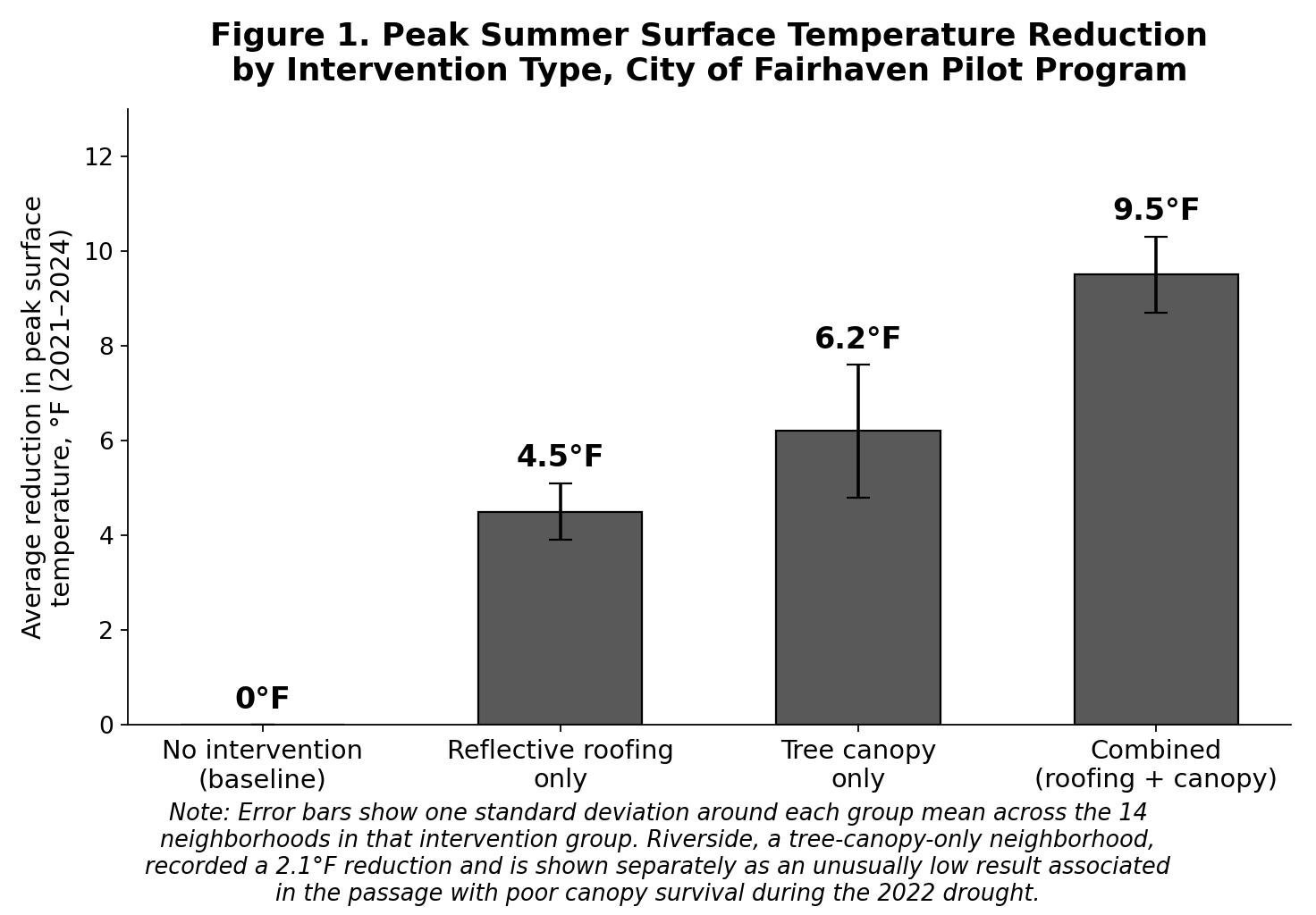
Titles, axes, units, and notes first. These establish what is measured, over what period, and for whom. Figure 1 measures the average reduction in peak surface temperature in degrees Fahrenheit, 2021 to 2024, by intervention group. The note explains that the error bars show one standard deviation across the fourteen neighborhoods in each group and reports Riverside separately.
Describe the visual before connecting it to the text. In plain words: the combined group shows the largest average reduction (9.5°F), then canopy alone (6.2°F), then roofing alone (4.5°F), then no intervention (0°F). You can say that without reading either passage.
Then ask how it relates to a specific claim. There are four relationships to check:
- Confirms. Passage E says canopy-only neighborhoods saw larger average reductions than roofing-only ones. The figure shows 6.2°F versus 4.5°F, the same variable and the same groups.
- Qualifies. Passage E says canopy outcomes are "genuinely less uniform." The figure supports that and adds detail: wider error bars for the canopy group and the separate low Riverside result of 2.1°F. Adding precision is not contradicting.
- Contradicts. If a passage claimed roofing "outperformed all other single interventions," the figure would directly contradict it, since canopy alone beat roofing alone on the same measure. Before calling it a contradiction, confirm that the text and the figure measure the same variable and scope.
- Cannot say. If a claim concerns something the figure does not measure, such as results in the first year when the figure shows a four-year average, the figure neither confirms nor denies it. Apparent disagreements often dissolve once you compare what each source measures: the same variable, population, time window, and scope.
Association is not proof of cause. Figure 1 shows an association between intervention type and temperature reduction in this pilot. Unless the text establishes random assignment or a similarly controlled design, treat the figure as support for a comparison within the pilot, not proof that intervention type caused every difference, and certainly not proof of identical results in any city.
Match the precision of your answer to the data. The canopy-only group averaged 6.2°F, with a spread of roughly 4.8°F to 7.6°F. The typical value is the average. Do not say every neighborhood got exactly 6.2°F, and do not treat an error-bar endpoint as the typical value.
The same habits work on a table. Read the title and column headings first. Describe the pattern (which row is highest, which direction a column moves). Then ask whether the passage's claim is the same size as what the table shows. A table of survey percentages can show a graded pattern across groups; it cannot, by itself, prove causation or permanent harm.
Paired literary passages: one dimension at a time
Paired literary sets are not two separate comprehension exercises followed by a comparison. First preserve each passage as its own system: characters, structure, turning point, theme. Do not hunt for similarities on the first read, because early comparison produces vague labels like "both are about family" that erase what each text is doing.
Name the dimension first. Response to loss, treatment of responsibility, narrator distance, the job of an object, the structure of an ending. "Both passages are similar" is not a conclusion. "Both use an ordinary object to make a character confront a relationship, but one carries inherited obligation while the other exposes avoidance" is.
Shared situation is not shared meaning. A character who returns an inherited object and one who keeps one may both be grieving, yet their opposite actions can express different ideas about what remembering requires.
Track movement. Compare each character's initial belief with the final one. Two characters can start apart and converge, or start together and diverge.
Narrator distance changes what is certain. If an adult first-person narrator says, "I know now why I lied," that is explicit interpretation. If a third-person narrator only shows a character hiding a letter and dodging a question, the motive must be inferred. A synthesis question about motive has to respect that difference in certainty.
Compare the job of a repeated object. If one character repairs a damaged watch because letting it fail feels like accepting a parent's death, and another repairs a chair so a sibling can keep using it, the comparison is not "both value tradition." In the first, repair is resistance to loss; in the second, it is practical continuity.
Use structure as evidence for theme. An ending on a decisive action frames change as a choice. An ending on an open question frames it as recognition without resolution. A choice claiming both characters reach complete resolution would overstate the second.
A synthesis must be true of both passages. Test each clause of an answer against each passage separately. Do not confuse contrast with contradiction: one text can show that keeping an object becomes avoidance and another that it becomes care, and the two need not disagree. The strongest cross-text inference usually names a shared principle that is narrower than a universal moral and broader than either plot. For example, if one passage ends with a character giving away a relative's coat and another with a character keeping a handwritten recipe, both can support the idea that remembrance depends on choosing what relationship to have with the past, not on automatically keeping or discarding.
Checklist for any evidence or synthesis question
- Name the exact claim the question is about, and who owns it.
- State what the evidence proves by itself, in this scope.
- Compare the size of the evidence with the size of the claim.
- For paired sources, map each one separately, name the relationship, then combine.
- For a visual, describe it alone, check that variable, population, time, and scope match the text, and keep association separate from cause.
- Choose the answer that claims no more, and no less, than the sources support.