ACT Math study guide · Chapter 2
Diagnostic Test
▸ What this diagnostic is for
This is a 45-question diagnostic sampling all six current reporting categories at roughly their current proportions. Its purpose is not a scaled score. Its purpose is a skills map: which testing points are already solid, and which ones deserve extra attention as you work through the Parts that follow.
Work it under timed conditions if you can: 50 minutes, calculator permitted throughout. But the skills map at the end matters more than the clock.
▸ Questions
Question 1
- A. Irrational
- B. Imaginary
- C. Rational (equal to 7)
- D. Undefined
Question 2
- F. 14 − 5i
- G. −14 + 5i
- H. 14 + 5i
- J. 5 + 14i
Question 3
- A. −1
- B. −i
- C. i
- D. 1
Question 4
- F. x^(2/9)
- G. x
- H. x²
- J. x^(1/3)
Question 5
- A. 10
- B. 14
- C. 8
- D. 2
Question 6
- F. 3
- G. 9
- H. −5
- J. 5
Question 7
- A. x > −3
- B. x < 3
- C. x > 3
- D. x < −3
Question 8
- F. 2
- G. 5
- H. 3
- J. 4
Question 9
- A. x = 2, 4
- B. x = 2, −4
- C. x = −2, 4
- D. x = −2, −4
Question 10
- F. 31; two real solutions
- G. −31; one real solution
- H. 31; no solutions
- J. −31; two complex solutions
Question 11
- A. x = 3 or x = −4
- B. x = 3 only
- C. x = −3 or x = 4
- D. x = 4 only
Question 12
- F. 1
- G. −1
- H. 5
- J. 3
Question 13
- A. x = 5, −5
- B. x = −3, 3
- C. x = 0, 2, −2
- D. x = 4, −4
Question 14
- F. 12
- G. 10
- H. 8
- J. 14
Question 15
- A. 4
- B. 9
- C. 6
- D. 5
Question 16
- F. x = −3, 2
- G. x = 3, −2
- H. x = 6, −1
- J. x = −6, 1
Question 17
- A. Up on both ends
- B. Down on the right, up on the left
- C. Down on both ends
- D. Up on the right, down on the left
Question 18
- F. x = −2
- G. x = 2
- H. x = −5
- J. x = 5
Question 19
- A. (x + 5) ⁄ 2
- B. 2x + 5
- C. (x − 5) ⁄ 2
- D. (x + 2) ⁄ 5
Question 20
- F. 4
- G. 3
- H. 1
- J. 0
Question 21
- A. 34
- B. 44
- C. 9
- D. 39
Question 22
- F. 75°
- G. 65°
- H. 85°
- J. 105°
Question 23
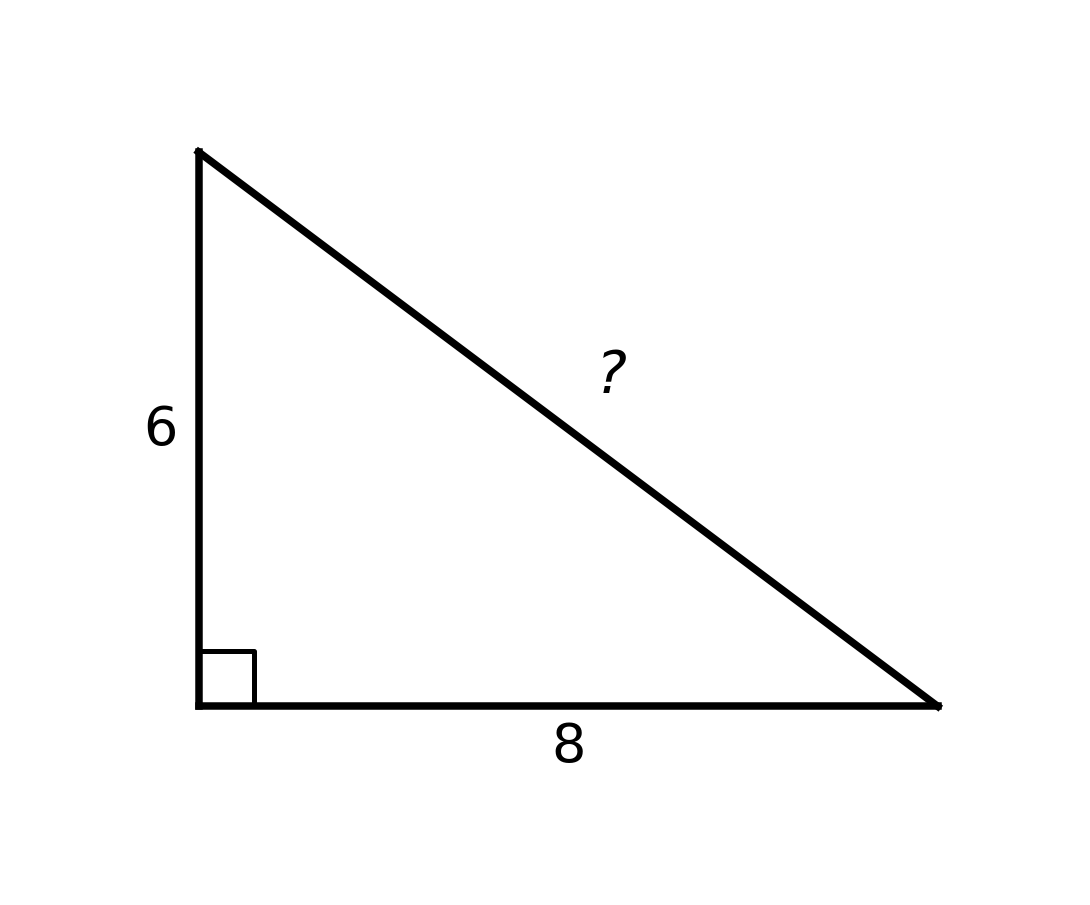
- A. 10
- B. 14
- C. 48
- D. 7
Question 24
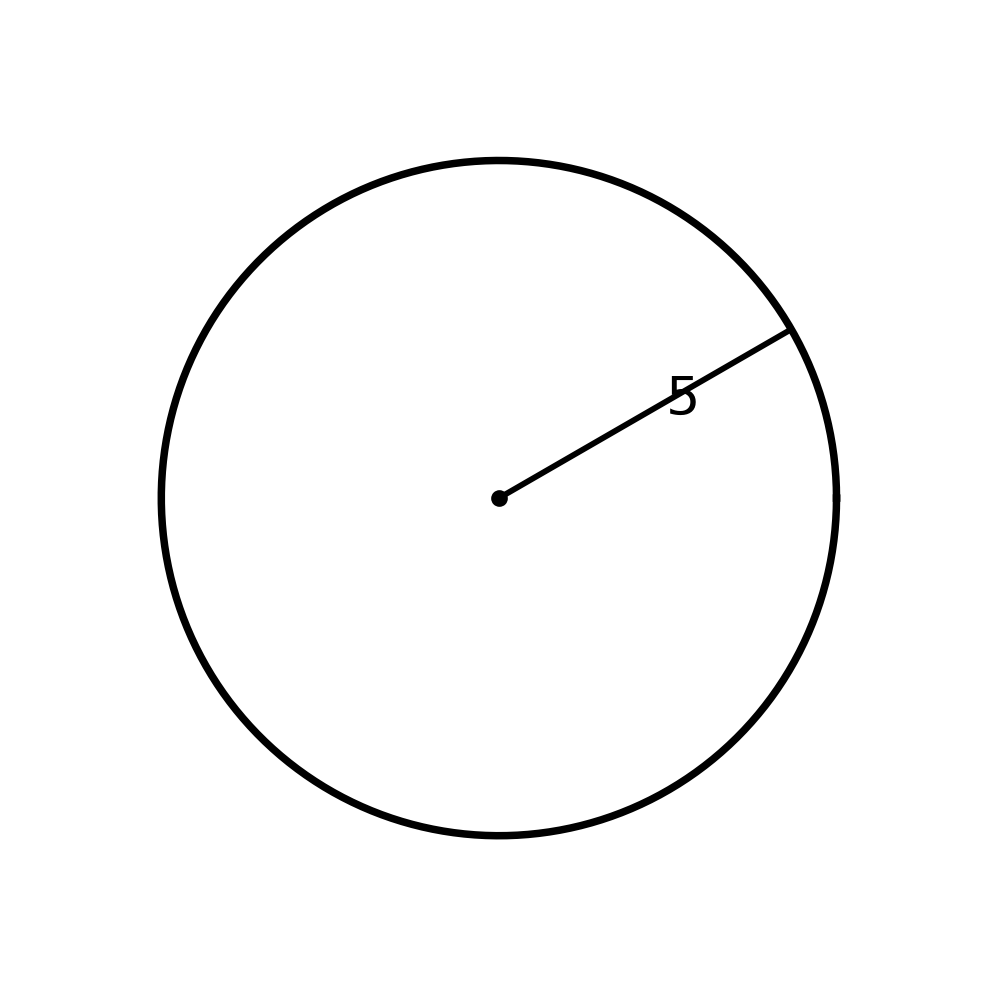
- F. 5π
- G. 10π
- H. 25π
- J. 20π
Question 25
- A. 12
- B. 15
- C. 10
- D. 20
Question 26
- F. 14
- G. 40
- H. 20
- J. 24
Question 27
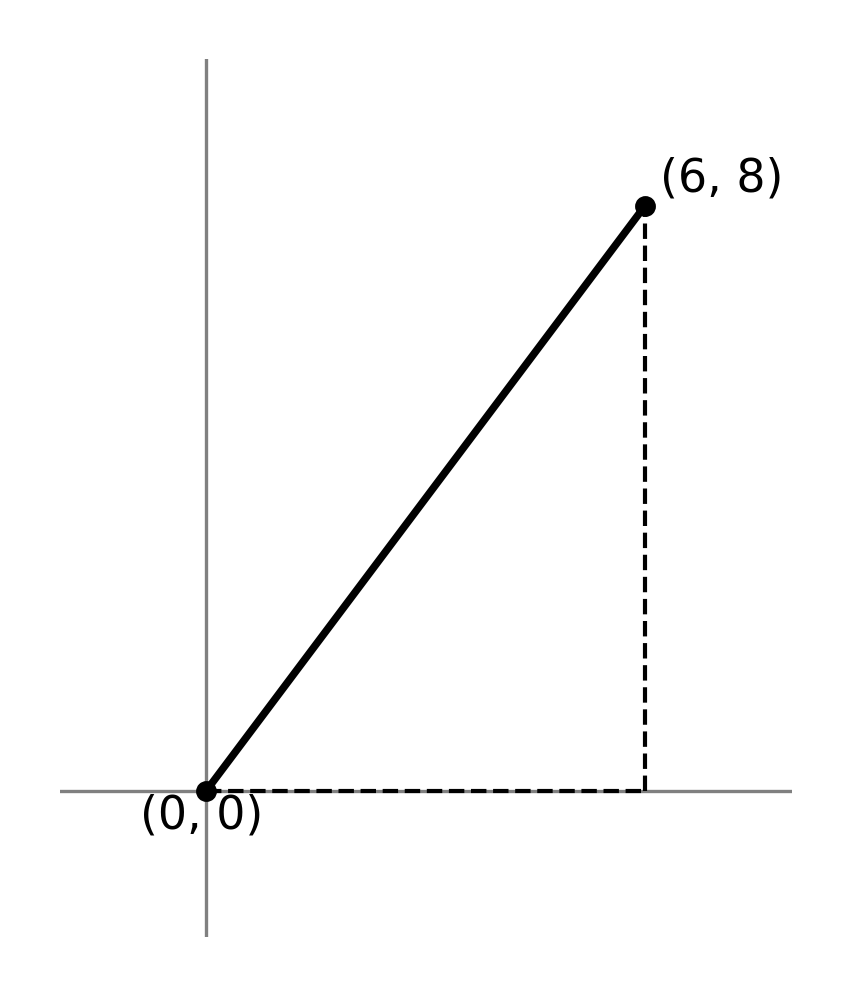
- A. 14
- B. 10
- C. 48
- D. 7
Question 28
- F. √3/2
- G. 1/2
- H. 1
- J. √2/2
Question 29
- A. 12
- B. 60
- C. 35
- D. 47
Question 30
- F. 11
- G. 10
- H. 14
- J. 55
Question 31
- A. 1/3
- B. 1/2
- C. 1/6
- D. 1/4
Question 32
- F. 0.9
- G. 0.1
- H. 0.2
- J. 0.5
Question 33
- A. 9
- B. 7
- C. 4
- D. 6.6
Question 34
- F. Set P
- G. Set Q
- H. They have the same range
- J. Cannot be determined
Question 35
- A. 12
- B. 6
- C. 8
- D. 4
Question 36
- F. 45
- G. 20
- H. 15
- J. 30
Question 37
- A. 10%
- B. 20%
- C. 25%
- D. 15%
Question 38
- F. 90
- G. 45
- H. 540
- J. 60
Question 39
- A. 60
- B. 15
- C. 72
- D. 50
Question 40
- F. 3.4
- G. 3.5
- H. 3.6
- J. 3.7
Question 41
- A. 53.33
- B. 60
- C. 50
- D. 55
Question 42
- F. 11
- G. 13
- H. 9
- J. 15
Question 43
- A. 9
- B. 15
- C. 12
- D. 6
Question 44
- F. 5
- G. 50%
- H. 0.5
- J. 10
Question 45
- A. $63
- B. $60
- C. $64
- D. $56
▸ Answers and Explanations
Show the answers and explanations
1: C. √49 = 7. A number that can be written as a ratio of integers is rational, so √49 is rational. Choice A assumes any square root is irrational without checking whether the radicand is a perfect square. (Real & Complex #s)
2: H. Distribute, then replace i² with −1: 2 + 8i − 3i − 12i² = 2 + 5i + 12 = 14 + 5i. Choice F flips the sign on the cross terms during distribution, giving 14 − 5i instead of 14 + 5i. (Real & Complex #s)
3: C. For powers of i, divide the exponent by 4 and use the remainder: i¹⁷ = i¹⁶·i = (i⁴)⁴·i = 1·i = i. Choice A treats the exponent as landing on i² = −1 instead of i¹ = i, a one-step slip in the remainder. (Real & Complex #s)
4: G. Multiplying powers with the same base adds the exponents: 2/3 + 1/3 = 1, so the result is x. Choice F multiplies the exponents instead of adding them, treating the product rule as if it required multiplication. (Exponents/Radicals)
5: A. The determinant of [[a, b], [c, d]] is ad − bc: (4)(3) − (1)(2) = 12 − 2 = 10. Choice B adds the two products instead of subtracting, computing (4)(3) + (1)(2) = 14. (Vectors/Matrices)
6: J. Gather the x-terms: 5x − 2x = 12 + 3, so 3x = 15, giving x = 5. Choice F divides 15 by the wrong coefficient, using 5 instead of 3. (Linear Equations)
7: D. Subtract 5 from both sides: −2x > 6. Dividing by a negative number reverses the inequality: x < −3. Choice A keeps the inequality direction unchanged, the result of not flipping the sign when dividing by −2. (Linear Inequalities)
8: J. Adding the two equations eliminates y: 3x = 9, so x = 3; substituting back gives y = 1, and x + y = 4. Choice G computes x + 2y instead of the requested x + y. (Systems)
9: A. Factor: (x − 2)(x − 4) = 0, giving x = 2 or x = 4. Choice C reverses the sign on one root only. (Quadratics)
10: J. The discriminant of ax² + bx + c = 0 is b² − 4ac: 9 − 4(2)(5) = 9 − 40 = −31. A negative discriminant means two complex solutions. Choice F reports the discriminant with the sign reversed, along with the real-solution conclusion a positive discriminant would produce. (Discriminant)
11: A. An absolute value equation splits into two cases: 2x + 1 = 7 gives x = 3, and 2x + 1 = −7 gives x = −4. Choice C reverses the sign of both solutions. (Absolute Value)
12: F. Rewrite 27 as a power of 3 so both sides share a base: 3^(x+2) = 3³. Set the exponents equal: x + 2 = 3, giving x = 1. Choice G reports the exponent value 3 itself instead of solving for x. (Exp. Equations)
13: C. Factor out x, then factor the remaining difference of squares: x(x² − 4) = x(x − 2)(x + 2) = 0, giving x = 0, 2, or −2. Choice A treats the constant 4 as if it belonged under a root, giving x = 0, 4, −4 instead of x = 0, 2, −2. (Poly. Equations)
14: G. Substitute x = 4 directly: 3(4) − 2 = 12 − 2 = 10. Choice F adds the constant instead of subtracting it. (Evaluation)
15: D. Composition evaluates the inner function first: g(2) = 2² = 4, then f(4) = 4 + 1 = 5. Choice A reverses the order of composition, computing g(f(2)) instead of f(g(2)). (Composition)
16: G. Factor: (x − 3)(x + 2) = 0, giving x = 3 or x = −2. Choice F reverses the sign of both roots. (Zeros)
17: B. Odd degree with a negative leading coefficient means the ends point in opposite directions, falling on the right: as x → ∞, f → −∞; as x → −∞, f → ∞. Choice D treats the leading coefficient as positive instead of negative, reversing the conclusion. (End Behavior)
18: J. No factor cancels from (x+2)/(x−5). The denominator is zero at x=5, so that remaining denominator zero gives the vertical asymptote x=5. Choice G reports where the numerator equals zero instead of the denominator. (Rational Fns)
19: A. Write the function as y = 2x − 5, swap x and y, then solve for the new y: x = 2y − 5, so y = (x + 5)/2. Choice C drops the sign on the constant while solving for the new y, giving (x − 5)/2 instead of (x + 5)/2. (Inverse Fns)
20: H. Since 1 ≥ 1, the condition for the second piece is met: p(1) = (1)² = 1. Choice F applies the first piece, x + 3, misreading which condition x = 1 satisfies. (Piecewise Fns)
21: D. The nth term of an arithmetic sequence is aₙ = a₁ + (n − 1)d: a₈ = 4 + (8 − 1)(5) = 4 + 35 = 39. Choice A uses 8 instead of (8 − 1) as the number of steps, an off-by-one error in the sequence formula. (Sequences)
22: F. The interior angles of a triangle sum to 180°: 180 − 40 − 65 = 75°. Choice H subtracts only one of the two given angles from 180°. (Triangles)
23: A. The Pythagorean theorem gives the hypotenuse: √(6² + 8²) = √100 = 10. Choice B adds the two legs directly (6+8=14) instead of applying the Pythagorean theorem. (Right Triangles)
24: G. The circumference of a circle is 2πr: 2π(5) = 10π. Choice F omits the factor of 2 in the circumference formula, using πr instead of 2πr. (Circles)
25: B. Similar triangles scale every side by the same factor: 6 × (5/2) = 15. Choice A applies the scale factor backward, multiplying by 2/5 instead of 5/2. (Similarity)
26: H. The area of a triangle is (1/2)(base)(height): (1/2)(10)(4) = 20. Choice F omits the 1/2 factor, computing the area as if for a rectangle instead of a triangle. (Area)
27: B. The distance formula is the Pythagorean theorem applied to coordinates: √(6² + 8²) = √100 = 10. Choice A adds the coordinate values directly instead of applying the distance formula. (Coord. Geometry)
28: J. sin(45°) = √2/2, a standard unit-circle value. Choice F reports the standard value for a different angle, 60°, instead of 45°. (Trigonometry)
29: B. The volume of a rectangular prism is length × width × height: 3 × 4 × 5 = 60. Choice A adds the three dimensions instead of multiplying them. (Volume)
30: F. The mean is the sum of the values divided by the count: (4 + 8 + 10 + 14 + 19)/5 = 55/5 = 11. Choice J reports the sum of the values without dividing by the count. (Center & Spread)
31: C. One outcome (rolling a 3) out of six equally likely outcomes: 1/6. Choice A treats two outcomes as favorable instead of the single value requested. (Probability)
32: H. For independent events, P(A and B) equals the product of the individual probabilities: 0.5 × 0.4 = 0.2. Choice F adds the two probabilities instead of multiplying them, a common independent-events error. (Probability)
33: B. Order the values first: 2, 4, 7, 9, 11. The median is the middle value: 7. Choice D reports the mean of the data set instead of the median. (Center & Spread)
34: G. Range equals maximum minus minimum. Set P has range 60 − 40 = 20, while Set Q has range 90 − 10 = 80. Set Q therefore has the greater range. Choice F reverses the comparison. (Center & Spread)
35: B. Order does not matter when choosing a committee, so this is a combination: ₄C₂ = (4×3)/(2×1) = 6. Choice A treats the selection as if order mattered, computing a permutation instead of a combination. (Probability)
36: J. Finding a percent of a number means multiplying by its decimal form: 0.20 × 150 = 30. Choice F reports the percentage value itself, 20, instead of computing 20% of 150. (Percentages)
37: C. Percent change is the change in value divided by the original value: (50 − 40)/40 × 100 = 25%. Choice A reports the raw difference, 10, instead of converting it to a percent of the original value. (Percent Change)
38: J. A unit rate is the total divided by the number of units: 180 ÷ 3 = 60 miles per hour. Choice F divides by 2 instead of 3, misreading the number of hours. (Rates)
39: A. Since 1 foot equals 12 inches: 5 × 12 = 60 inches. Choice C multiplies by 12 using 6 feet instead of the given 5 feet. (Unit Conversion)
40: H. A weighted average multiplies each value by its weight before dividing by the total weight: (2×3.0 + 3×4.0)/(2+3) = 18/5 = 3.6. Choice G reports the simple average of 3.0 and 4.0, ignoring that the credit hours are not equal. (Weighted Avg)
41: A. Average speed is total distance divided by total time, not the average of the two speeds: time = 80/40 + 80/80 = 2 + 1 = 3 hours; average speed = 160/3 ≈ 53.33. Choice B is the simple average of 40 and 80, ignoring that more time was spent at the slower speed. (Average Speed)
42: G. Recover the total by multiplying the average by the count, then subtract the known values: total = 10×3 = 30; 30 − (8+9) = 13. Choice H reports one of the given values instead of the missing third value. (Missing-Value Avg)
43: C. Cross-multiply: 9x = 4(27) = 108, so x = 12. Choice A reports one of the given numbers in the proportion instead of solving for x. (Proportions)
44: F. A percentage point difference is the raw subtraction of the two percentages: 15 − 10 = 5 percentage points. Choice G reports the percent increase relative to the original value (5/10×100=50%) instead of the raw percentage-point difference. (Pctg. Points)
45: A. Apply the discount first, then the tax: 80 × 0.75 = 60; 60 × 1.05 = $63. Choice C uses a 30% discount instead of the given 25%, before applying the tax. (Multi-Step Chain)
▸ Using your diagnostic skills map
Group your missed questions by skill tag before doing anything else. A single miss may come from a rule, setup, arithmetic, or timing error. When several misses point to the same skill or the same failure mechanism, return to that chapter before adding more practice. Use the explanations to identify what failed instead of relying on the raw number missed alone.
Study in this order. First, close any gaps in Linear Equations and Systems, Quadratic Equations, Other Types of Equations, Absolute Value, Function Notation and Composition, and Rates, Percentages, and Proportions. These chapters are used inside almost every other chapter in this book, so a gap here causes errors in geometry and statistics questions that have nothing to do with algebra on the surface. Second, close gaps in Lines, Angles, and Triangles, Right Triangles and Trigonometry, Circles and Conic Sections, Coordinate Geometry, Center and Spread, and Probability. Third, close gaps in Real and Complex Numbers, Vectors and Matrices, Logarithms, Trigonometry Beyond Right Triangles, and Circle Theorems. These are tested less often than the first two groups, so a small number of misses here does not require the same depth of review; reread the specific chapter and rework its practice set once.
If the misses cluster on equations, inequalities, systems, quadratics, exponents, or radicals: reread the matching Part II chapter, then rework every practice question you missed in it. These skills reappear inside function, geometry, and word-problem questions, so an algebra gap shows up as wrong answers in chapters that look unrelated.
If the misses cluster on function notation, graphs, tables, transformations, inverses, or recursive rules: reread Function Notation and Composition and Function Transformations and Piecewise Functions. Then redo the same skill using a different representation than the one you missed: if you missed a graph question, practice the equation version of the same skill next, and the reverse.
If the misses cluster on rates, ratios, percentages, averages, units, area, or volume: reread Rates, Percentages, and Proportions, Measurement and Unit Conversion, and Averages in Context. Practice writing the relationship as an equation before calculating anything, since the setup is usually where these questions are missed, not the arithmetic.
If the misses cluster on triangles, circles, similarity, coordinate geometry, 3D figures, or trigonometry: reread Lines, Angles, and Triangles, Congruence and Similarity, Right Triangles and Trigonometry, and Circles and Conic Sections. For each missed question, redraw the figure and label only what was actually given before choosing a formula.
If the misses cluster on probability, counting, distributions, box plots, expected value, or samples: reread Probability, Center and Spread, and Study Design and Sampling. For each missed question, write out the full sample space or the exact population being described before calculating a probability or a statistic.
If the misses cluster on matrices, vectors, complex numbers, conics, logarithms, or non-right triangles: reread the specific chapter that covers that topic (Vectors and Matrices, Real and Complex Numbers, Circles and Conic Sections, Logarithms, or Trigonometry Beyond Right Triangles) and rework its practice set from the start. These chapters are short by design, so a full reread takes less time than it did for algebra or geometry.
If you knew the rule but still missed the question: figure out which of three things happened before you move on. If the setup was hard to see, redo the same skill in a different representation (word problem instead of equation, graph instead of table) until the starting step is automatic. If a step of the algebra, arithmetic, sign, or calculator entry was wrong, redo the exact same question slowly and find the specific step that changed the answer. If the question took too long but you got it right, redo it timed using a different method (graphing instead of algebra, or testing the answer choices instead of solving directly) and compare the time.
After finishing a chapter reread, close the loop before moving to the next skill: solve three new questions on that skill without looking at your notes or the original solution. If all three are correct and the setup is clear without notes, move on. If a question is missed, identify the cause and review the specific rule or example that addresses it before trying another fresh problem. A full reread is necessary only when the underlying method remains uncertain.