ACT Math study guide · Chapter 35
Normal Distributions and Z-Scores
A normal distribution is symmetric and bell-shaped, centered at its mean. The empirical rule describes how data spreads out around that mean: about 68% of values fall within 1 standard deviation, about 95% fall within 2 standard deviations, and about 99.7% fall within 3 standard deviations, shown below.
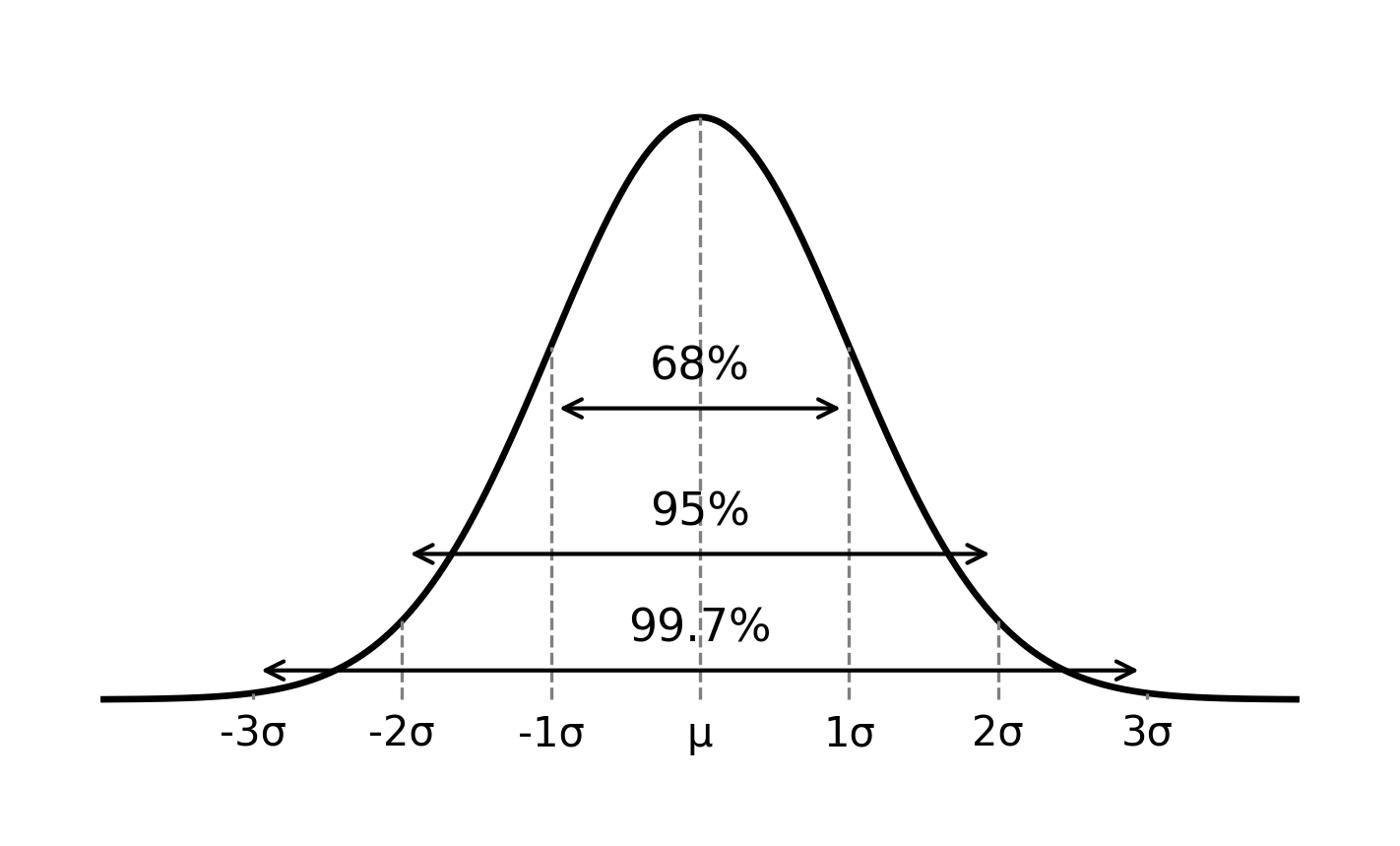
The 68–95–99.7 rule is a normal-distribution approximation, not a universal rule for every data set. Use it only when the distribution is stated or reasonably described as normal, or approximately normal. Knowing only a mean and a standard deviation is not enough by itself to assume the empirical rule applies; a strongly skewed distribution with the same mean and standard deviation would not follow this same 68-95-99.7 pattern.
A z-score measures how many standard deviations a value sits from the mean. The formula is z = (x − μ)/σ, where x is the data value, μ is the mean, and σ is the standard deviation. A positive z-score means the value is above the mean; a negative z-score means it's below. Reversing the formula, x = μ + zσ, recovers the original value from a known z-score.
Z-scores make it possible to compare values from two different distributions on the same scale. A student who scores higher relative to their own test's mean and spread has the higher z-score, even if their raw score is numerically lower than someone else's.
Where this appears as a model: two scores from different tests compared fairly. A score of 82 on a test with mean 75 and standard deviation 5 has a z-score of 1.4; a score of 88 on a test with mean 80 and standard deviation 6 has a z-score of about 1.33. The first score is relatively higher, despite being numerically lower than the second.
▸ Applying the empirical rule
Worked Example A distribution is normal with mean 500 and standard deviation 80. Approximately what percent of values fall between 420 and 580?
Determine how many standard deviations each boundary is from the mean.
420 is 1σ below the mean; 580 is 1σ above the mean
About 68% of values fall within 1 standard deviation of the mean
▸ Computing and using a z-score
Worked Example A distribution has mean 72 and standard deviation 9. Find the z-score for a value of 90, and interpret it.
Apply the z-score formula directly.
z = (90 − 72)/9 = 2
The value 90 is 2 standard deviations above the mean
Worked Example A distribution has mean 82 and standard deviation 6. Find the percent of values between 70 and 94.
Recognize. Both boundaries are the same distance from the mean. Find how many standard deviations away each one is before applying the empirical rule.
Set up.
70 is (82−70)/6 = 2 standard deviations below the mean
94 is (94−82)/6 = 2 standard deviations above the mean
Solve.
Both boundaries are 2 standard deviations from the mean
About 95% of values fall within 2 standard deviations
Check. 2 standard deviations corresponds to the 95% rule, not the 68% (1 SD) or 99.7% (3 SD) rule.
Best route. Direct application of the empirical rule. No calculator is needed.
Common error. Assuming the 68% rule applies just because the interval looks similar in width, without actually computing how many standard deviations away each boundary sits.
▸ Practice
Question 1
- A. −2
- B. 15
- C. 30
- D. 2
Question 2
- F. 1
- G. 8
- H. −8
- J. −1
Question 3
- A. 68%
- B. 95%
- C. 50%
- D. 99.7%
Question 4
- F. 34%
- G. 99.7%
- H. 95%
- J. 68%
Question 5
- A. 501.5
- B. 350
- C. 650
- D. 600
Question 6
- F. −20
- G. 50
- H. 40
- J. 80
Question 7
- A. 95%
- B. 34%
- C. 68%
- D. 99.7%
Question 8
- F. Student A
- G. They scored the same
- H. Student B
- J. Cannot be determined
Question 9
- A. 84%
- B. 16%
- C. 32%
- D. 68%
Question 10
- F. 1
- G. −1
- H. −25
- J. 25
Question 11
- A. 34%
- B. 68%
- C. 99.7%
- D. 95%
Question 12
- F. 108
- G. 132
- H. 112
- J. 128
Question 13
- A. 25
- B. 55
- C. 70
- D. 46
Question 14
- F. 84%
- G. 68%
- H. 32%
- J. 16%
Question 15
- A. 99.7%
- B. 68%
- C. 50%
- D. 95%
Question 16
- F. 81
- G. 75
- H. 72
- J. 84
Question 17
- A. 5%
- B. 97.5%
- C. 2.5%
- D. 16%
Question 18
- F. Cannot be determined
- G. Student A
- H. Student B
- J. They are equal
Question 19
- A. 95%
- B. 99.7%
- C. 68%
- D. 34%
Question 20
- F. 2
- G. 14
- H. −2
- J. 7
▸ Answers and Explanations
Show the answers and explanations
1: D. A z-score measures how many standard deviations a value is from the mean: z = (x−μ)/σ = (130−100)/15 = 2. Choice C reports the raw difference (130−100=30) without dividing by the standard deviation.
2: J. z = (x−μ)/σ = (42−50)/8 = −1. Choice F drops the negative sign, reporting the absolute value of the z-score instead.
3: A. 65 and 75 are each exactly 1 standard deviation from the mean of 70. The empirical rule states that about 68% of values fall within 1 standard deviation of the mean. Choice B applies the 2-standard-deviation percentage (95%) instead of the 1-standard-deviation percentage.
4: H. 160 and 240 are each exactly 2 standard deviations from the mean of 200. The empirical rule states that about 95% of values fall within 2 standard deviations of the mean. Choice F applies the 1-standard-deviation percentage (68%) instead of the 2-standard-deviation percentage.
5: C. A value is recovered from a z-score using x = μ + zσ: x = 500 + 1.5(100) = 650. Choice B subtracts instead of adding the scaled z-score, computing 500−150 instead of 500+150.
6: H. x = μ + zσ = 60 + (−2)(10) = 40. Choice J adds instead of subtracts, treating the negative z-score as if it were positive.
7: A. 68 and 92 are each exactly 2 standard deviations from the mean of 80. The empirical rule states that about 95% of values fall within 2 standard deviations of the mean. Choice C applies the 1-standard-deviation percentage (68%) instead of the 2-standard-deviation percentage.
8: F. Student A's z-score is (85−75)/10 = 1. Student B's z-score is (90−80)/20 = 0.5. Since 1 > 0.5, Student A scored higher relative to their own test. Choice H compares the raw scores (85 vs. 90) directly instead of comparing each student's position relative to their own test's mean and spread.
9: B. 50 is 1 standard deviation above the mean of 45. Since 68% of values fall within 1 standard deviation, 32% fall outside it, split evenly between the two tails: 32%/2 = 16% above 50. Choice A reports the percentage below 50 (84%) instead of the percentage above it.
10: G. z = (x−μ)/σ = (275−300)/25 = −1. Choice F drops the negative sign, reporting the absolute value of the z-score instead.
11: D. 54 and 70 are each exactly 2 standard deviations from the mean of 62. The empirical rule states that about 95% of values fall within 2 standard deviations of the mean. Choice B applies the 1-standard-deviation percentage (68%) instead of the 2-standard-deviation percentage.
12: F. x = μ + zσ = 120 + (−1.5)(8) = 120 − 12 = 108. Choice G adds instead of subtracts, treating the negative z-score as if it were positive.
13: B. x = μ + zσ = 40 + 2.5(6) = 40 + 15 = 55. Choice A subtracts instead of adding the scaled z-score, computing 40−15 instead of 40+15.
14: J. 410 is 1 standard deviation below the mean of 500. Since 68% of values fall within 1 standard deviation, 32% fall outside it, split evenly between the two tails: 32%/2 = 16% below 410. Choice F reports the percentage above 410 (84%) instead of the percentage below it.
15: B. 22 and 28 are each exactly 1 standard deviation from the mean of 25. The empirical rule states that about 68% of values fall within 1 standard deviation of the mean. Choice A applies the 3-standard-deviation percentage (99.7%) instead of the 1-standard-deviation percentage.
16: G. x = μ + zσ = 78 + (−0.5)(6) = 78 − 3 = 75. Choice F adds instead of subtracts, treating the negative z-score as if it were positive.
17: C. 174 is 2 standard deviations above the mean of 150. Since 95% of values fall within 2 standard deviations, 5% fall outside it, split evenly between the two tails: 5%/2 = 2.5% above 174. Choice A reports the full percentage outside 2 standard deviations (5%) without splitting it between the two tails.
18: G. Student A's z-score is (70−60)/5 = 2. Student B's z-score is (85−70)/10 = 1.5. Since 2 > 1.5, Student A has the higher z-score. Choice J assumes the comparison cannot be made without a shared scale, overlooking that z-scores are already standardized for exactly this kind of comparison.
19: A. 30 and 50 are each exactly 2 standard deviations from the mean of 40. The empirical rule states that about 95% of values fall within 2 standard deviations of the mean. Choice C applies the 1-standard-deviation percentage (68%) instead of the 2-standard-deviation percentage.
20: F. z = (x−μ)/σ = (82−68)/7 = 2. Choice G reports the raw difference (82−68=14) without dividing by the standard deviation.