Angles and arcs
An inscribed angle, with its vertex on the circle, is always half the central angle that intercepts the same arc, shown below. A direct consequence is that any angle inscribed in a semicircle, with a diameter as one side, always measures , and any two inscribed angles that intercept the same arc are equal to each other.
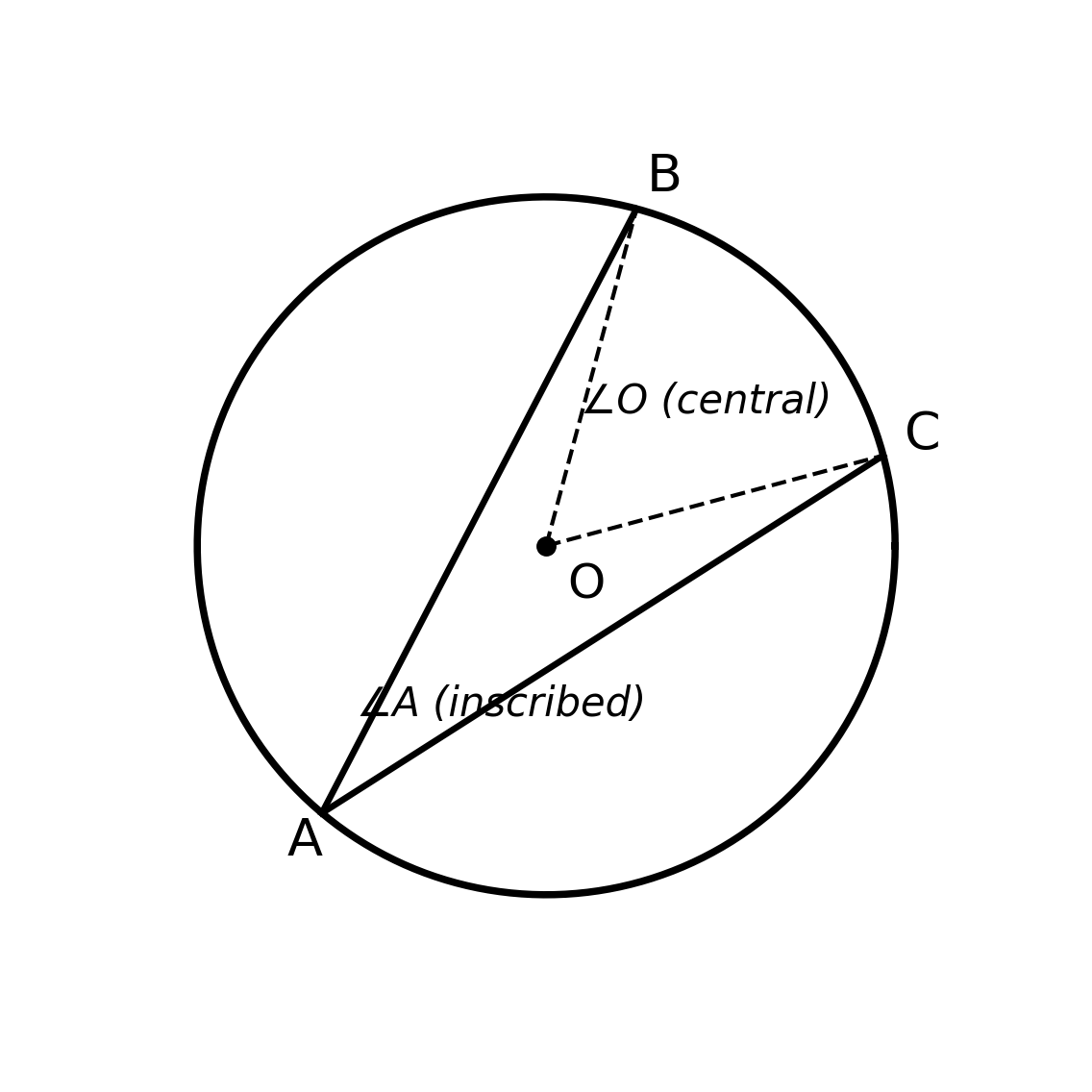
In the figure, the inscribed angle at and the central angle at both intercept arc . The central angle equals the arc; the inscribed angle is half of it.
Tangents
A tangent line touches a circle at exactly one point. A tangent-chord angle, formed where a tangent meets a chord at that point of tangency, equals half the intercepted arc, the same relationship as an inscribed angle. Two tangent segments drawn from the same external point to a circle are always equal in length. A tangent is also perpendicular to the radius drawn to the point of tangency.
Chords, secants, and tangents
Chords, secants, and tangents that intersect inside or outside a circle follow three distinct relationships, and mixing them up is the most common error on this topic.
- Two chords intersecting inside a circle: the products of their segments are equal.
- Two secants meeting outside a circle: the angle formed equals half the difference of the intercepted arcs, and the products of each external part times its whole length are equal.
- A tangent and a secant meeting outside a circle: the tangent length squared equals the external part times the whole secant length.
Two chords crossing inside a circle also form an angle equal to half the sum of the two arcs it and its vertical angle intercept. When a tangent and a secant form an angle outside the circle, the angle is one-half the difference of the intercepted arcs, just as for two secants from an external point.
Match the picture to the relationship
Before calculating anything, identify what the figure actually shows. The table matches each visual signal to its relationship, so recognition happens before arithmetic, not during it.
| What the figure shows | Relationship to apply |
|---|---|
| The center of the circle is involved in the angle | A central angle equals its intercepted arc |
| The angle's vertex sits on the circle itself | An inscribed angle is half its intercepted arc |
| Two chords cross inside the circle | The products of each chord's two segments are equal |
| Two secants meet at a point outside the circle | External segment whole secant is equal for both secants |
| A tangent and a secant share the same exterior point | Tangent = external secant whole secant |
| A tangent meets a radius at the point of tangency | The angle between them is |
Do not try to memorize these as one giant circle formula. Matching the picture to the correct relationship is the actual skill; once that match is made, the calculation itself is usually short.
Where this appears as a model
Picture a support beam across a circular structure. A circular window with a beam creating an inscribed angle across a arc has a beam angle of , half the arc it intercepts.
Inscribed and central angles
Worked example. A central angle measures . Find the measure of an inscribed angle that intercepts the same arc.
An inscribed angle is half the central angle intercepting the same arc.
Intersecting chords
Worked example. Two chords intersect inside a circle. The segments of one chord measure 6 and 10; the segments of the other measure 5 and . Find .
The products of the two chords' segments are equal.
, so and .
Tangent and secant from an external point
Worked example. A tangent segment of length 6 and a secant are drawn from the same point outside a circle. The external part of the secant measures 4. Find the whole length of the secant.
Tangent equals the external part times the whole secant length.
, so and .
Worked example. A tangent segment of length 12 and a secant are drawn from the same point outside a circle. The secant's external part measures 8. Find the length of the secant's internal (far) segment.
Recognize. This is a tangent-secant relationship: tangent equals the external part times the whole secant length. The question asks for the internal segment, not the whole length, so an extra step remains after finding the whole.
Set up. .
Solve. , so the whole length is 18. The internal segment is .
Check. External whole , which matches the original relationship.
Best route. Hand algebra. Straightforward once the tangent-secant relationship is recognized.
Common error. Stopping at the whole secant length (18) instead of subtracting the external part to find the requested internal segment (10).
Strategy summary
- Ask first: where is the vertex? At the center, on the circle, inside the circle, or outside the circle?
- Angles with the vertex on the circle use half the arc; vertex inside uses half the sum; vertex outside uses half the difference.
- Segment problems always set products equal. Square the tangent, and always read what the question asks for: whole length, external part, or internal part.