How to use this benchmark
The benchmark is fixed-form. It is not an adaptive test, and its raw score is not an official SAT score conversion. Its purpose is to show whether the mathematics remains usable when everything is mixed: the topic is no longer named, the clock is running, and the next question gives no hint about which chapter it came from.
Take it after the mastery and advanced practice sets are complete. It is two modules of 22 questions under real timing, and its value is in the whole experience: sustaining focus across 70 minutes, pacing through a module, recovering from a hard question, and executing the grid-in and calculator habits without thinking.
Test directions and timing for Module 2
Math, 22 questions, 35 minutes. The questions in this module address a range of math skills. Unless stated otherwise, all variables represent real numbers, all figures lie in a plane, and figures are drawn to scale. For multiple-choice questions, choose the best of the four answer choices. For the student-produced response (grid-in) questions, which are Questions 17 to 22, work out the answer and enter it yourself.
- Enter an integer, a decimal, or a fraction; a fraction need not be reduced.
- Mixed numbers such as 3 1/2 must be entered as 7/2 or 3.5.
- If an answer is a repeating decimal, fill the entire field.
- Do not enter symbols such as a percent sign, comma, or dollar sign.
Average pace is a little over a minute and a half per question. Work in two passes: answer what you can solve without strain, flag anything that resists and move on, then return to the flagged questions with the time you saved.
For every error, identify the cause
Checking which answers were right and wrong is scorekeeping, not review. For every question that was wrong, guessed, right but uncertain, or right but slow, sort the cause into one of five kinds:
- Concept: the mathematics itself was missing. Return to the chapter tagged to the question and relearn it.
- Representation: the mathematics was known but a table, graph, wording, or diagram hid it. Revisit that form in the mastery sets.
- Route: the method chosen was too long. Revisit the relevant route-selection habit.
- Execution: the method was right, but the algebra or calculator work failed. Drill the accuracy checks until they are automatic.
- Target: the work solved a quantity the question did not ask for. Re-read the last line before committing an answer.
A concept error and an execution error look identical on the answer key, but they call for completely different fixes. The cycle below is the whole method in one picture.
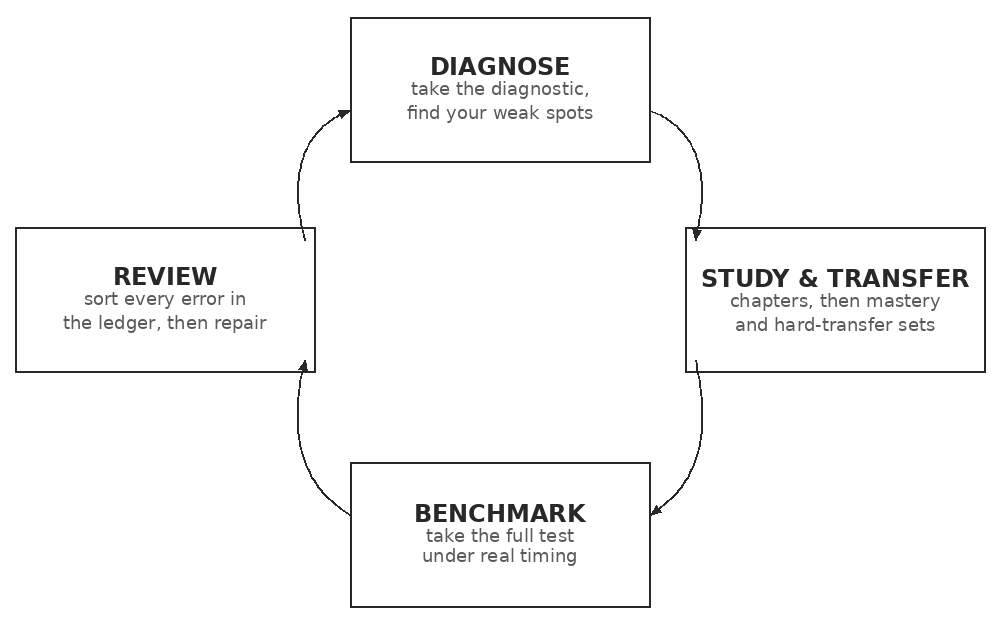
The practice cycle: diagnose to find weak spots, study the chapters and work the mastery and advanced practice sets, take the benchmark under real timing, then sort every error by its cause and repair, before returning to fresh mastery work or Bluebook practice rather than retaking this same test.
Score both modules against the key, then use the answer explanations to find the exact skill behind each miss. Tally the questions you answered wrong by domain across both modules: a cluster in one domain points to where focused review will help most, while scattered single errors point to accuracy habits. This fixed test uses a somewhat harder Module 2 to approximate one possible higher-difficulty route; it cannot reproduce the real adaptive routing, which depends on your own Module 1 performance.