DIAGNOSTIC
Diagnostic Test
One module · 22 questions · 35 minutes
Twenty-two questions, one module, thirty-five minutes. Take it once, under time, then let what you answer wrong point you to the chapters that close the gap.
Before you begin
Time: give yourself 35 minutes for all 22 questions.
Tools: a calculator is allowed throughout, and the reference sheet of formulas is available.
Format: questions 1 through 16 are multiple-choice; questions 17 through 22 are grid-ins, where you produce your own answer.
After: score with the answer key, then use the skills map to route every answer you marked wrong to the section that teaches it.
| 1 |
 Mark for Review |
If 3(2x − 4) = 5x − 6, what is the value of x?
 |
2 |
 |
−6 |
 |
4 |
 |
6 |
| 2 |
Mark for Review |
A line in the xy-plane passes through the points (−2, 5) and (4, −7). What is the slope of the line?
|
−2 |
|
2 |
|
−1/2 |
|
−12 |
| 3 |
Mark for Review |
A jacket originally priced at 80 dollars is discounted by 35 percent. What is the sale price of the jacket?
|
28 dollars |
|
45 dollars |
|
52 dollars |
|
65 dollars |
| 4 |
Mark for Review |
The function f is defined by f(x) = 2x2 − 3x + 1. What is the value of f(−2)?
|
3 |
|
15 |
|
11 |
|
−1 |
| 5 |
Mark for Review |
If 2x + y = 11 and x − y = 1, what is the value of x?
|
3 |
|
5 |
|
7 |
|
4 |
| 6 |
Mark for Review |
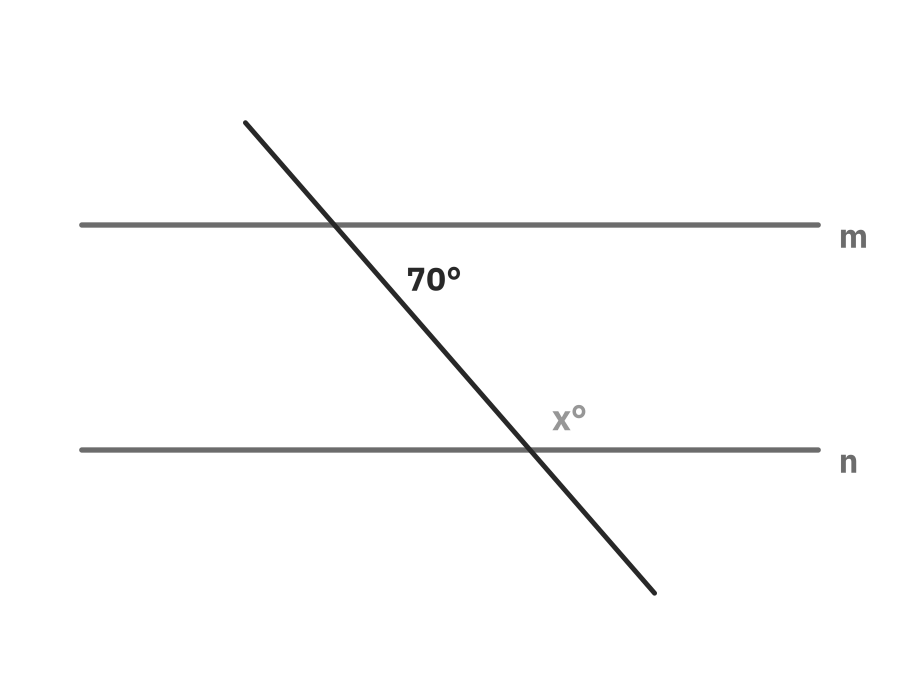
In the figure, lines m and n are parallel and are cut by a transversal. What is the value of x?
|
110 |
|
70 |
|
20 |
|
140 |
| 7 |
Mark for Review |
Which of the following is a solution to the equation x2 − 2x − 15 = 0?
|
−5 |
|
3 |
|
−3 |
|
15 |
| 8 |
Mark for Review |
How many integer values of x satisfy the inequality |x − 3| < 4?
|
5 |
|
7 |
|
6 |
|
8 |
| 9 |
Mark for Review |
The list 2, 5, 5, 8, 10 has one additional value appended to it. If the mean of the six resulting numbers is 7, what is the value that was appended?
|
7 |
|
10 |
|
14 |
|
12 |
| 10 |
Mark for Review |
A population of bacteria doubles every 3 hours. If the population starts at 500, what is the population after 12 hours?
|
2,000 |
|
4,000 |
|
8,000 |
|
16,000 |
| 11 |
Mark for Review |
A theater sells adult tickets for 12 dollars and child tickets for 8 dollars. On a night when 200 tickets were sold for a total of 2,040 dollars, how many child tickets were sold?
|
90 |
|
75 |
|
110 |
|
125 |
| 12 |
Mark for Review |
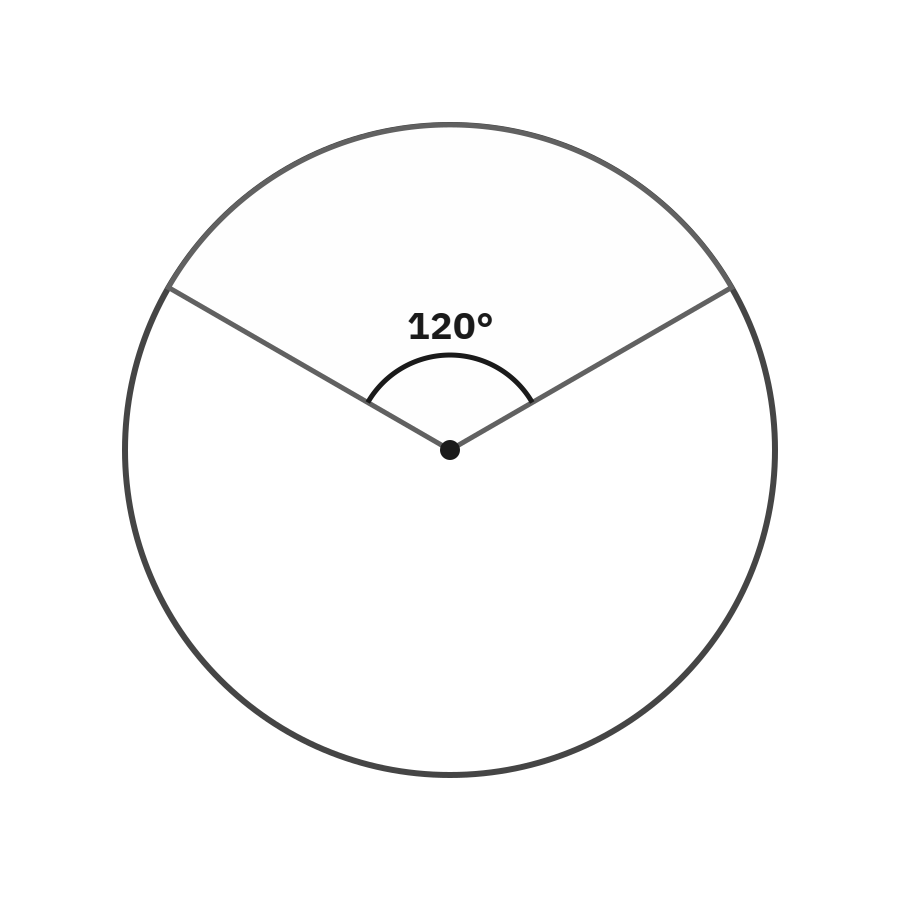
In the figure, a sector of a circle has a central angle of 120 degrees and an area of 12π. What is the radius of the circle?
|
4 |
|
6 |
|
9 |
|
12 |
| 13 |
Mark for Review |
The function f is defined by f(x) = (x − 3)2 − 4. What is the sum of all values of x for which f(x) = 0?
|
1 |
|
5 |
|
−4 |
|
6 |
| 14 |
Mark for Review |
A candle burns at a constant rate. After 2 hours it is 18 centimeters tall, and after 5 hours it is 12 centimeters tall. What was the height of the candle, in centimeters, before it began burning?
|
22 |
|
20 |
|
21 |
|
24 |
| 15 |
Mark for Review |
For x ≠ −3, which of the following is equivalent to (2x2 + 7x + 3)/(x + 3)?
|
2x + 3 |
|
x + 1 |
|
2x + 1 |
|
2x − 1 |
| 16 |
Mark for Review |
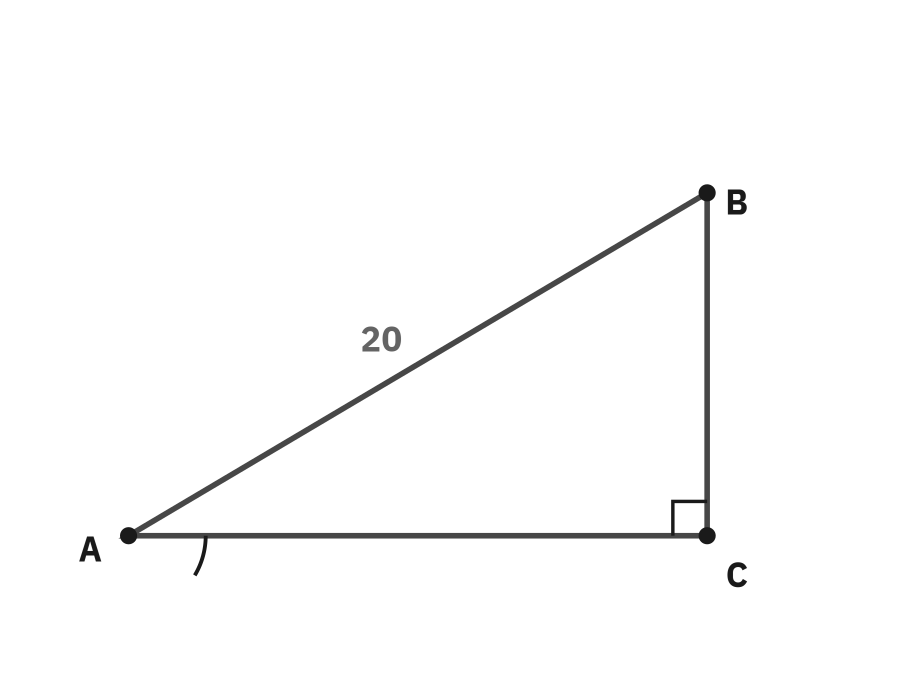
In right triangle ABC, the right angle is at C. If sin A = 3/5 and the hypotenuse AB has length 20, what is the length of BC?
|
9 |
|
12 |
|
15 |
|
16 |
Student-produced responses · Questions 17–22
Work out each answer and record it in the grid. Enter an integer, a decimal, or a fraction; a fraction need not be reduced. Mixed numbers such as 3 1/2 must be entered as 7/2 or 3.5. If an answer is a repeating decimal, fill the entire field. Do not enter symbols such as a percent sign, comma, or dollar sign.
| 17 |
Mark for Review |
If (x/4) + (x/6) = 5, what is the value of x?
Record your answer in the grid.
| 18 |
Mark for Review |
In the equation x2 + kx + 9 = 0, where k is a constant, the equation has exactly one real solution. What is a positive value of k?
Record your answer in the grid.
| 19 |
Mark for Review |
A quantity increases from 250 to 320. What is the percent increase? (Disregard the percent sign when gridding your answer.)
Record your answer in the grid.
| 20 |
Mark for Review |
The function g is defined by g(x) = 3 · 2x. For what value of x is g(x) = 96?
Record your answer in the grid.
| 21 |
Mark for Review |
A 20-liter mixture is 30 percent acid. How many liters of pure acid must be added so that the resulting mixture is 50 percent acid?
Record your answer in the grid.
| 22 |
Mark for Review |
In the xy-plane, the graph of x2 + y2 − 6x + 8y + 9 = 0 is a circle. What is the radius of the circle?
Record your answer in the grid.
DIAGNOSTIC
Answers, skills map, and solutions
Score the diagnostic and build your review plan
Score your test against the key, then read the skills map: every question you answered wrong names the exact section of this book that teaches it, turning a raw score into a short, specific study plan.
▸ Diagnostic skills map by SAT Math domain
Find each question you answered wrong in the table below. Its row names the domain the question belongs to and the section that teaches it; go there first. Review any question you answered wrong, guessed on, or got right but felt uncertain about or spent too long on; a right answer reached slowly or by luck still belongs in your review, not just the rows marked wrong.
| Q |
Key |
Domain |
Section to review |
| 1 |
D · 6 |
Algebra |
Forms, solving linear equations |
| 2 |
A · −2 |
Algebra |
Rate and starting amount, slope |
| 3 |
C · 52 |
Data Analysis |
Percentages |
| 4 |
B · 15 |
Advanced Math |
Functions, evaluating |
| 5 |
D · 4 |
Algebra |
Systems of equations |
| 6 |
A · 110 |
Geometry & Trig |
Angles: parallel lines |
| 7 |
C · −3 |
Advanced Math |
Quadratics, factoring |
| 8 |
B · 7 |
Advanced Math |
Inequalities: absolute value |
| 9 |
D · 12 |
Data Analysis |
One-variable data: the mean |
| 10 |
C · 8,000 |
Advanced Math |
Exponential growth |
| 11 |
A · 90 |
Algebra |
Systems: word problems |
| 12 |
B · 6 |
Geometry & Trig |
Circles: sectors |
| 13 |
D · 6 |
Advanced Math |
Quadratics: vertex form and zeros |
| 14 |
A · 22 |
Algebra |
Rate and starting amount, modeling |
| 15 |
C · 2x+1 |
Advanced Math |
Equivalent expressions, factoring |
| 16 |
B · 12 |
Geometry & Trig |
Right triangles: trigonometry |
| 17 |
12 |
Algebra |
Forms: linear equations with fractions |
| 18 |
6 |
Advanced Math |
The discriminant |
| 19 |
28 |
Data Analysis |
Percentages: percent change |
| 20 |
5 |
Advanced Math |
Exponential growth, solving |
| 21 |
8 |
Algebra |
Systems: mixture problems |
| 22 |
4 |
Geometry & Trig |
Circles: the equation of a circle |
Questions 1–16 are multiple-choice; 17–22 are grid-ins.
▸ Diagnostic worked solutions by skill
1 LINEAR EQUATIONS D
This is a linear equation in one variable. Distribute, collect the x-terms, and isolate x. Distributing the 3 opens the left side to 6x − 12. Both sides are now linear in x, so gather them: subtracting 5x leaves x − 12 = −6, and adding 12 gives x = 6. The one place to move slowly is that first distribution: the 3 multiplies both the 2x and the −4, not the 2x alone.
2 SLOPE FROM TWO POINTS A
Slope is a single idea, how fast y changes as x moves, and it is read off any two points as the change in y over the change in x. Going from (−2, 5) to (4, −7), y falls by 12 while x rises by 6, so the slope is −12/6 = −2. Keep the order of the points the same top and bottom; subtracting the y-values one way and the x-values the other is the usual source of a sign error.
3 PERCENT DISCOUNT C
A discount hides a shortcut: taking 35 percent off is the same as keeping 65 percent, so one multiplication settles it instead of two steps. Sixty-five percent of 80 is 0.65 × 80 = 52 dollars. Stopping at the 28-dollar discount itself is the easy error; that is choice A, the part removed rather than the part that remains.
4 FUNCTION EVALUATION B
Evaluating a function is pure substitution: put −2 everywhere x appears and let the arithmetic finish. The main risk is sign handling: (−2)2 is +4, so 2(−2)2 = 8, and −3(−2) = +6. Adding, 8 + 6 + 1 = 15. The safe habit is to wrap −2 in parentheses before squaring; writing −22 drops the sign and points the wrong way.
5 SYSTEMS BY ELIMINATION D
Two equations, two unknowns, and these two are built for elimination, because the y-terms are already equal and opposite, +y and −y. Adding the equations straight down cancels y in one stroke: 3x = 12, so x = 4. There is no need to find y at all; the question asks only for x, and the structure hands it over directly.
6 PARALLEL-LINE ANGLES A
When a transversal crosses parallel lines, every angle it makes is one of just two sizes, and any two are either equal or supplementary. The 70° angle and x sit on the same side of the transversal, between the lines, same-side interior angles, and that pairing is supplementary, summing to 180. So x = 180 − 70 = 110. The figure rewards a moment of labeling: decide which relationship the two marked angles share before reaching for a number.
7 FACTORING A QUADRATIC C
A quadratic set to zero is asking which inputs make a product vanish, so factor it into the two numbers whose product is −15 and whose sum is −2: those are −5 and +3, giving (x − 5)(x + 3) = 0. A product is zero only when one factor is, so the solutions are 5 and −3. The answer list offers −3 (choice C). If factoring feels slow, testing each choice back in the equation reaches the same place.
8 ABSOLUTE-VALUE INEQUALITY B
An absolute-value inequality is a statement about distance: |x − 3| < 4 says x lies within 4 units of 3. Unfolding it gives −4 < x − 3 < 4, and adding 3 throughout opens it to −1 < x < 7. Now count the integers strictly inside: 0, 1, 2, 3, 4, 5, 6, seven of them. The strict < is what keeps −1 and 7 out; counting those endpoints is the easy way to arrive at 8 by accident.
9 THE MEAN AS A TOTAL D
A mean is a total in disguise, the sum shared out equally, so a question about an average is really a question about a sum. The five numbers add to 30. For six numbers to average 7, they must total 6 × 7 = 42. The appended value is whatever closes that gap: 42 − 30 = 12. Working through the totals is steadier than trying to average the numbers and adjust by feel.
10 EXPONENTIAL GROWTH C
Doubling is repeated multiplication, so the only quantity that matters is how many doublings occur. Twelve hours holds 12 ÷ 3 = 4 doubling periods, and four doublings multiply the population by 24 = 16. Starting from 500, that is 500 × 16 = 8,000. The common wrong turn is to grow additively, multiplying by 2 and then by the hours, but the exponent counts periods, not hours.
11 SYSTEMS WORD PROBLEM A
Two ticket types, two facts, a count and a total, so name the unknowns and let the equations pin them. With a + c = 200 and 12a + 8c = 2,040, substitute a = 200 − c into the money equation: 2,400 − 4c = 2,040. That collapses to 4c = 360, so c = 90 child tickets. The question asks for children; solving for adults and forgetting to switch back is the easy way to hand over the wrong number.
12 SECTOR AREA B
A sector is a slice of the whole circle, and its central angle says exactly what fraction: 120 out of 360 degrees is one third. So its area is one third of πr2, set equal to the given 12π. Then (1/3)πr2 = 12π, the π cancels, and r2 = 36, giving r = 6. The 120° central angle represents one third of the circle, so the sector equation follows directly.
13 VERTEX FORM & ZEROS D
Vertex form lays the parabola bare: f(x) = (x − 3)2 − 4 sits lowest at x = 3. Setting f(x) = 0 gives (x − 3)2 = 4, so x − 3 = ±2 and the roots are 1 and 5; their sum is 6. There is an even quicker read: a parabola's two roots are mirror images across the vertex line x = 3, so they average 3 and sum to 2 × 3 = 6. Seeing that symmetry turns a two-step solve into a single line.
14 LINEAR MODELING A
“Constant rate” is the signal for a linear model: a steady slope plus a starting height. The slope is the change in height over the change in time, (12 − 18)/(5 − 2) = −2 centimeters per hour, negative because the candle shrinks. Write the height as −2t + b and use the t = 2 reading: 18 = −2(2) + b, so b = 22. That b is precisely what the question wants: the height at t = 0, before any burning. The starting value is the intercept, not one of the measured points.
15 SIMPLIFYING A RATIONAL C
A rational expression simplifies only when the denominator hides inside the numerator as a factor, so factor first and look for the shared piece. The numerator 2x2 + 7x + 3 factors as (2x + 1)(x + 3), and the denominator is (x + 3). Canceling the common (x + 3) leaves 2x + 1. The note x ≠ −3 is what makes the cancellation legal, it keeps that denominator from being zero.
16 RIGHT-TRIANGLE TRIG B
Sine ties an angle to the side across from it and to the hypotenuse, opposite over hypotenuse, so the figure's job is to tell you which side is opposite. Angle A looks across the triangle to BC, so sin A = BC/AB = 3/5. With the hypotenuse AB = 20, that gives BC = (3/5)(20) = 12. The resulting 12-16-20 triangle is consistent with a scaled 3-4-5 triangle.
17 EQUATION WITH FRACTIONS 12
Two fractions of x add most easily once they share a denominator, and the smallest common one for 4 and 6 is 12. Rewritten, x/4 = 3x/12 and x/6 = 2x/12, so the left side becomes 5x/12 = 5. Multiplying both sides by 12 gives 5x = 60, and x = 12. Clearing the denominators at the start, multiplying the whole equation by 12, reaches the same place if you would rather skip the rewriting.
18 THE DISCRIMINANT 6
“Exactly one real solution” is the discriminant speaking: a quadratic has a single repeated root precisely when b2 − 4ac = 0. Here that is k2 − 4(1)(9) = 0, so k2 = 36 and k = ±6. The question asks for a positive value, so k = 6. The condition "exactly one real solution" requires the discriminant to equal zero.
19 PERCENT CHANGE 28
Percent change always measures the change against where you started, never where you ended. The increase is 320 − 250 = 70, and as a fraction of the original 250 that is 70/250 = 0.28, or 28 percent. Dividing by 320 instead is the most common wrong turn, it quietly answers a different question. The grid takes 28, with the percent sign left off as instructed.
20 EXPONENTIAL EQUATION 5
An equation with the unknown in the exponent wants the power isolated, then the bases matched. Dividing 3 · 2x = 96 by 3 gives 2x = 32. Since 32 is 25, the exponents must agree: x = 5.
21 MIXTURE PROBLEM 8
A mixture problem is bookkeeping on one ingredient: here, the acid. The starting mixture holds 0.30 × 20 = 6 liters of acid in 20 liters of liquid. Pouring in y liters of pure acid adds to both the acid and the total, so the new concentration is (6 + y)/(20 + y), set equal to 0.50. Clearing the fraction: 6 + y = 10 + 0.5y, which gives 0.5y = 4 and y = 8 liters. Tracking the acid and the total separately, rather than juggling percentages, keeps the equation honest.
22 EQUATION OF A CIRCLE 4
A circle hides inside a scrambled equation, and completing the square pulls its center and radius back into view. Group the terms: (x2 − 6x) + (y2 + 8y) = −9, then add the number that completes each square (9 for the x-group, 16 for the y-group) to both sides. That gives (x − 3)2 + (y + 4)2 = 16. The right side is r2, so r = √16 = 4. The amount you add is always the square of half the middle coefficient: 9 from half of −6, 16 from half of 8.
▸ Use the skills map to choose what to review next
Tally the questions you answered wrong by domain. A cluster in one domain (three wrong in Advanced Math, say) points to where a few hours of focused review will move your score the most. A scatter of single careless errors across domains points instead to the accuracy habits of Part V. Either way, the diagnostic has done its work: it has turned a score into a short, specific list of what to do next. Work that list, then take the first full-length test.