SAT Math study guide · Chapter 5
Linear Functions: Rate of Change and Initial Value
In a real situation a line says two things: how fast something changes, and where it began. Almost every linear word problem is asking you to name one of those two.
A linear function is the line from the last section, now carrying meaning. The algebra has not changed at all; what changes is that the numbers mean something (a cost, a distance, a temperature, a count) and the test mostly asks you to translate between the equation and the situation rather than to compute anything. Once you can name what each number stands for, the arithmetic that remains is small. So this section is almost entirely about reading: turning a slope into a rate, an intercept into a starting value, and a description into a model you can read back.
▸ Interpret rate of change and initial value in a linear function
Every linear model carries exactly two pieces of meaning, and they map directly onto the two features you already know. The slope is a rate of change: how much the output moves for each one-unit step in the input. The intercept is a starting value, the output at the moment the input is zero. Almost every interpretation question is asking you to attach one of those two meanings to one of the two numbers.
WORKED A cost model: C = 30 + 11n
Here C is the cost of an order in dollars and n is the number of items. Read each number as a meaning.
The 30 is the cost when n = 0: a fixed charge that exists before a single item is added, such as a setup or delivery fee. It is the starting value.
The 11 is the rate: each additional item adds eleven dollars. It is the slope, and it describes change, not a fixed amount.
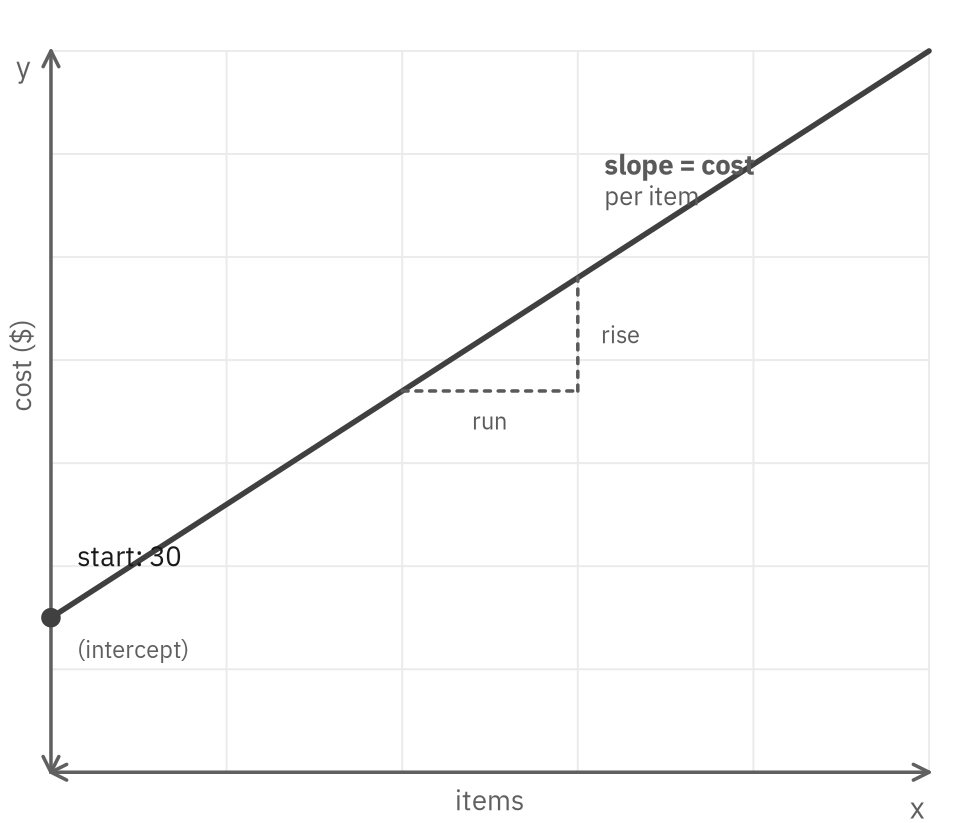
FIGURE 1 In a cost model the intercept is the fixed starting charge; the slope is the cost added per item.
So when a question asks what some number in a model represents, you are not being asked to calculate. You are being asked to decide whether that number is the rate or the start, and to say so in the language of the situation. That single decision answers the whole question.
A harder version attaches a condition to only one of the two pieces, and reading exactly which piece it touches is the graded difficulty.
WORKED A charge that taxes only part of the bill
A service charges a one-time setup fee of 42 dollars and 18 dollars per month. The monthly charge is taxed at 5 percent, but the setup fee is not. Which expression gives the total cost after m months?
The 42 is a fixed fee, untouched by the tax; the 18 is the rate, and tax applies only to the amount it generates.
Total = 42 + 18(1.05)m
The temptation is to tax the whole expression, 1.05(42 + 18m), which quietly taxes a fee the situation never subjects to tax. Reading exactly which term a condition modifies, not just that a condition exists, is what separates this from the basic version.
▸ Use units to interpret slope and initial value
The most reliable way to keep a rate and a starting value from getting confused is to attach units, because a rate and a starting value usually carry different units. A starting value carries the plain units of the output. A rate carries the output's units per one unit of the input: dollars per item, gallons per minute, miles per hour. Naming the units out loud usually settles which number is which before any thinking is required.
WORKED Naming the units
In d = 3 + 55t, where d is distance in miles and t is time in hours:
the intercept 3 is measured in miles, a head start already travelled at t = 0;
the slope 55 is measured in miles per hour, the speed. Only one of the two can be a speed, and its units say so.
This is also why the wrong answer to an interpretation question is so often the other feature, stated correctly. A model has only two numbers to talk about, and the tempting choice usually describes the one you were not asked for. Reading the units of the requested number first keeps you on the right one.
▸ Solve a linear model for input or output
Once a model is in hand, the test asks you to read it in two directions. Forward is a prediction: put in an input, get out an output. Backward is the reverse: you are told the output and asked for the input that produces it. The backward direction is where careful reading matters most, because it is easy to answer the forward question by reflex when the backward one was asked.
WORKED A draining tank: V = 4000 - 50t
V is volume in gallons, t is time in minutes.
Forward: the volume after 30 minutes: V = 4000 - 50(30) = 4000 - 1500 = 2500 gallons.
Backward: the time when only 1500 gallons remain: set V = 1500, so 1500 = 4000 - 50t, giving 50t = 2500 and t = 50 minutes.
Same model, two opposite readings. The forward one substitutes; the backward one solves.
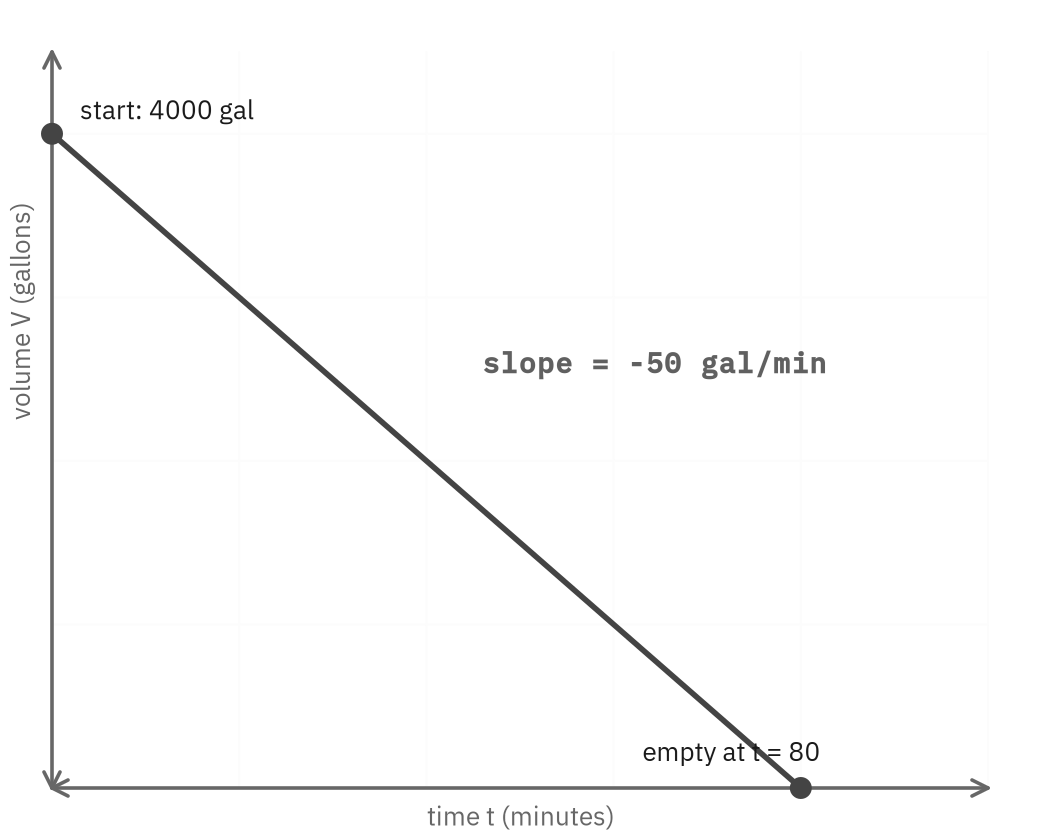
FIGURE 2 Forward reading predicts a volume from a time; backward reading solves for the time that gives a volume.
Before you compute, settle which direction the question wants and which object it asks for: a time or a volume, an input or an output. That is the same requested-object care from the craft chapters, applied to a word problem: the value you found is only an answer if it is the value that was asked for.
▸ Distinguish interpolation from extrapolation in linear models
A linear model is a description of a situation, and it is believable only over the range where the situation actually behaves linearly. Read literally, the algebra will happily produce values far outside that range, and they are nonsense. Part of high-level care is knowing where a model is meant to apply and refusing to follow it past the edge.
WORKED The edge of the tank model
V = 4000 - 50t falls to zero when 4000 - 50t = 0, that is at t = 80 minutes.
For t beyond 80 the formula returns a negative volume, which no tank can hold. The model is trustworthy only for 0 ≤ t ≤ 80; past that edge it has stopped describing anything real.
The starting value deserves the same scrutiny. Sometimes the input zero is a real moment the intercept genuinely describes, the tank at the instant draining begins. Other times zero sits outside the believable range, and the intercept is only a mathematical artifact of extending the line back to an axis it never really reaches. The question usually tells you which; your job is to notice.
▸ Compute average rate of change from two points
A preview: the worked example just ahead uses a nonlinear function on purpose, since that is where average rate of change actually earns its name. The skill itself belongs to Advanced Math’s nonlinear functions, previewed here because the formula is easy to state now and worth having in hand before that chapter arrives.
“Rate of change” and “slope” are the same idea, and for a linear model that rate is constant; it is the slope, everywhere, over every interval. The phrase becomes worth pausing on only when a function is not linear, because then the rate genuinely varies, and the test asks for the average rate of change across a stated interval. That average is just the slope of the straight line joining the two endpoints: the change in output over the change in input.
average rate of change on [a, b] = (f(b) - f(a)) / (b - a)
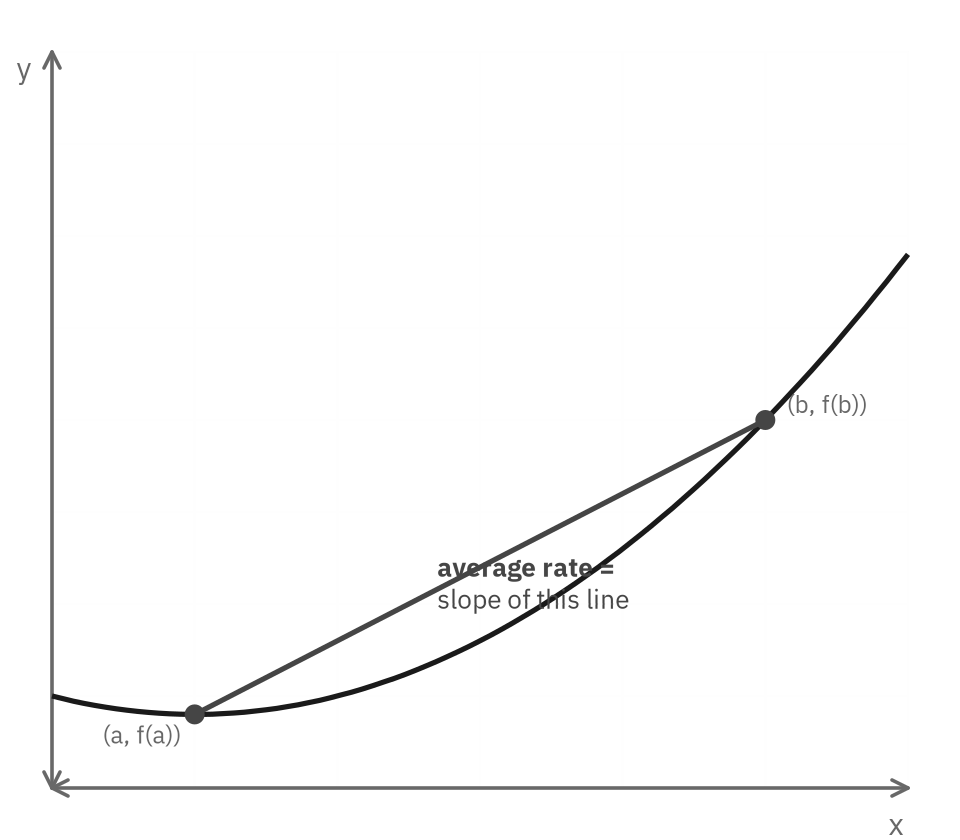
FIGURE 3 Average rate of change over an interval is the slope of the line through the two endpoints, even when the curve between them bends.
WORKED Average rate from a table
A function has f(1) = 2, f(3) = 10, and f(5) = 26: values that curve upward, so the function is not linear.
Its average rate of change over [1, 5] is still a single slope between the endpoints:
(f(5) - f(1)) / (5 - 1) = (26 - 2) / 4 = 24/4 = 6
Note what this is not: it is not the rate at any one input, and not a value of the function. It is the overall climb across the interval, spread evenly.
▸ Create a linear function from a verbal description
The reverse skill, turning a sentence into a model, is the same translation run backward, and it comes down to one sorting task: separate the part that is fixed from the part that happens per unit. The fixed part is the intercept; the per-unit part is the slope; the thing the per-unit part is counted against is the input variable.
WORKED A service charge
“A technician charges a flat fee of 45 dollars plus 60 dollars for each hour of work.”
The flat fee is fixed, attached to nothing that varies: the intercept, 45. The 60 is attached to each hour, the rate. Letting h be hours of work:
C = 45 + 60h
WORKED A subscription
“A service costs 12 dollars a month plus 2 dollars for each additional screen.”
Fixed monthly cost is the intercept; the per-screen charge is the rate. Letting s be the number of additional screens:
C = 12 + 2s
The hardest part is rarely the algebra; it is defining the variable precisely. “Additional screens” is not the same as “screens,” and a careful definition keeps the model honest.
▸ Create and interpret linear functions from tables and graphs
A model does not always arrive as an equation. Often it is a table or a graph, and the same two features are waiting to be read. From a table, the rate is the change in output for each step in input, and the starting value is the output when the input is zero; read directly if the table reaches zero, or recovered by stepping backward.
WORKED From a table to a model
A monthly cost is recorded as the months pass:
t = 0, 1, 2, 3 cost = 50, 65, 80, 95
Each one-month step raises the cost by 15, so the rate is 15 dollars per month. At t = 0 the cost is 50, the starting value. The model is therefore:
C = 50 + 15t
From a graph the reading is the same (slope for the rate, intercept for the start) only now you read them off the axes in the situation's own units.
▸ Compare rates and initial values across linear models
When two linear models describe competing situations (two plans, two routes, two rates) the comparison is, once again, a comparison of the two features. The one with the larger slope grows faster; the one with the larger intercept starts higher. Those two facts together tell you the whole story of how the models relate as the input grows.
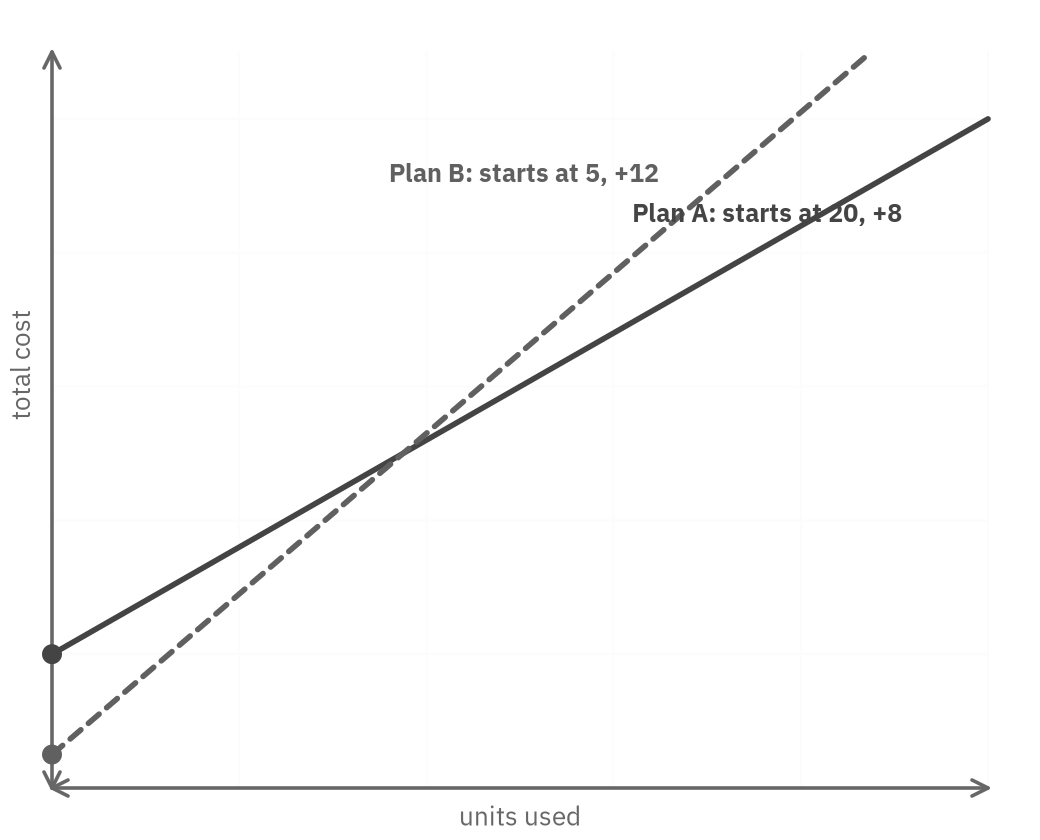
FIGURE 4 Two plans: the higher intercept starts ahead; the steeper slope eventually overtakes it.
WORKED Two plans
Plan A: C = 20 + 8x. Plan B: C = 5 + 12x.
Plan A starts higher, its intercept 20 exceeds Plan B's 5, so for small x it costs more.
Plan B grows faster, its slope 12 exceeds 8, so as x increases, B's cost climbs more steeply and eventually overtakes A.
There is a single input where the two are equal, after which B is the larger. Finding that exact crossing point is a system of equations, which is the work of the next section; here it is enough to read which grows faster and which starts higher.
Hand / Desmos / Hybrid: if the exact crossing point itself is what a question wants, graphing both models as lines and clicking their intersection reads off both the input and output at once, often faster than setting up and solving the system algebraically.
▸ Practice: linear functions
Question 1
- A. the starting volume
- B. gallons drained each minute
- C. minutes until empty
- D. the volume after one minute
Question 2
- A. the cost per mile
- B. a fixed base cost
- C. the total cost
- D. the number of miles
Question 3
- A. dollars
- B. hours
- C. dollars per hour
- D. hours per dollar
4. A car's distance from home is d = 12 + 4t (miles, with t in hours). How far is it after 5 hours? (grid-in)
5. For the same model d = 12 + 4t, after how many hours is the car 40 miles from home? (grid-in)
6. A pool empties according to V = 6000 - 75t gallons. At what time t (minutes) is the pool empty? (grid-in)
7. A function has f(2) = 7 and f(6) = 23. What is its average rate of change over the interval from 2 to 6? (grid-in)
Question 8
- A. C = 25 + 30m
- B. C = 30 + 25m
- C. C = 25m + 30
- D. C = 55m
9. A monthly cost is 80, 92, 104, 116 at months 0, 1, 2, 3. What is the monthly rate, in dollars? (grid-in)
10. For the same table, what is the cost at month 0: the starting value, in dollars? (grid-in)
Question 11
- A. Plan A
- B. Plan B
- C. they are equal
- D. cannot be determined
Question 12
- A. Plan A
- B. Plan B
- C. they increase at the same rate
- D. Plan B, then Plan A
13. A model predicts C = 100 - 4n, where cost cannot be negative. What is the largest value of n for which the model still makes sense? (grid-in)
Question 14
- A. 70 + 0.20m
- B. 70 + 0.20(m - 100)
- C. 70 + 0.20(m + 100)
- D. 0.20(m - 100)
Question 15
- A. 80 + 20h
- B. 64 + 20h
- C. 80 + 25h
- D. 64 + 25h
▸ Solutions: linear functions
Show the answers and explanations
1: B. In V = 500 - 25t the starting volume is the intercept 500; the -25 is the rate: twenty-five gallons leave each minute, the units being gallons per minute. The minus sign marks a decrease, which fits a draining tank. Choice A names the intercept instead of the rate.
2: B. The 40 is the cost at m = 0, before any distance, a fixed base cost. The cost per mile is the slope 0.15. Choice A describes the slope, the feature not asked for.
3: C. A rate carries the output's units per one unit of input, so the slope 1.5 is in dollars per hour. The intercept 8 would be in plain dollars; the rate cannot be.
4: 32. Read forward: d = 12 + 4(5) = 12 + 20 = 32 miles. This substitutes the input to get the output.
5: 7. Read backward: set d = 40, so 40 = 12 + 4t, giving 4t = 28 and t = 7 hours. The question asked for the time, not a distance.
6: 80. Empty means V = 0: 0 = 6000 - 75t, so 75t = 6000 and t = 80 minutes. Beyond t = 80 the model would predict a negative volume and no longer applies.
7: 4. The average rate of change is the slope between the endpoints: (23 - 7)/(6 - 2) = 16/4 = 4. It is the overall change spread across the interval, not a value of the function.
Show the answers and explanations
8: A. The fixed joining fee is the intercept and the monthly charge is the rate, so C = 25 + 30m. Choice B swaps the two, charging a 30-dollar fee and 25 per month, the same numbers in the wrong roles.
9: 12. Each one-month step raises the cost from 80 to 92 to 104 to 116, a steady increase of 12 dollars per month, the rate.
10: 80. The starting value is the cost at month 0, read straight from the table as 80 dollars. It is the intercept of the model C = 80 + 12t.
Show the answers and explanations
11: B. The starting cost is the intercept. Plan B's intercept 30 exceeds Plan A's 15, so Plan B starts higher. (Plan A, with the larger slope, grows faster, a different comparison.)
12: A. Faster increase means the larger slope. Plan A's slope 10 exceeds Plan B's 5, so Plan A's cost climbs more steeply as x grows.
13: 25. Cost stays nonnegative while 100 - 4n ≥ 0, that is n ≤ 25. At n = 25 the cost is exactly zero; for any larger n the model would predict a negative cost and stops describing the situation. So the largest sensible value is 25.
Show the answers and explanations
14: B. The first 100 miles are free, so only the miles beyond that threshold, m - 100, are charged at the per-mile rate, on top of the flat $70: 70 + 0.20(m - 100). Choice A charges every mile, ignoring the free first 100.
15: A. The discount applies only to the hourly charge, not the flat fee. Discounting $25 by 20 percent gives a new rate of 25(0.80) = 20 dollars per hour, so the total is 80 + 20h. Choice B mistakenly discounts the flat fee as well.
▸ Linear functions: chapter summary
A linear model holds a rate and a starting value, and almost every question about one is asking you to translate: to say which number is the rate and which is the start, in the right units, and to read the model forward to a prediction or backward to an input. The arithmetic is rarely the difficulty. Naming the meaning, respecting the units, and refusing to trust the model past the edge of the situation it describes: that is how a line is read in the world.