SAT Math study guide · Chapter 20
Lines, Angles, and Triangles
PART IV · GEOMETRY AND TRIGONOMETRY
Geometry and Trigonometry
Introduction
The final domain returns to the oldest mathematics of all: the study of shape and space. Geometry and Trigonometry asks about angles and triangles, circles and solids, and figures placed on the coordinate plane, and it carries one piece of good news you should hear before anything else. The reference sheet supplies circle, rectangle, and triangle area formulas; the Pythagorean theorem and two special right-triangle diagrams; and volume formulas for a rectangular prism, cylinder, sphere, cone, and pyramid. That sheet does not hand you everything, though: angle relationships, circle theorems, and similarity and congruence conditions are not printed anywhere, and those you still need to know cold. The work of this domain is twofold: using what the sheet supplies, and recalling the relationship that is not to connect what you are given to what you want.
That reframes the whole domain. A geometry question is rarely a test of recall; it is a test of seeing. You are shown a figure, or a description of one, and asked to find a length, an angle, an area. The path to the answer is almost always a single relationship, an equation connecting what you know to what you want, and the skill is spotting which one. The handful of relationships worth carrying in your head, beyond the reference sheet, are few enough to list, and nearly everything in the domain is built from them.
Those generating facts are the spine of what follows. Angle relationships (angles on a line, around a point, inside a triangle, and across parallel lines) pin down unknown angles. The Pythagorean theorem, together with the two special right triangles, handles right-triangle lengths, and trigonometry extends that reach to any angle. Similarity, same shape at a different scale, turns one known figure into proportions that solve another. And π and radian measure connect a circle's angles to arc length, sector area, and coordinate relationships. From these few ideas, the entire domain unfolds.
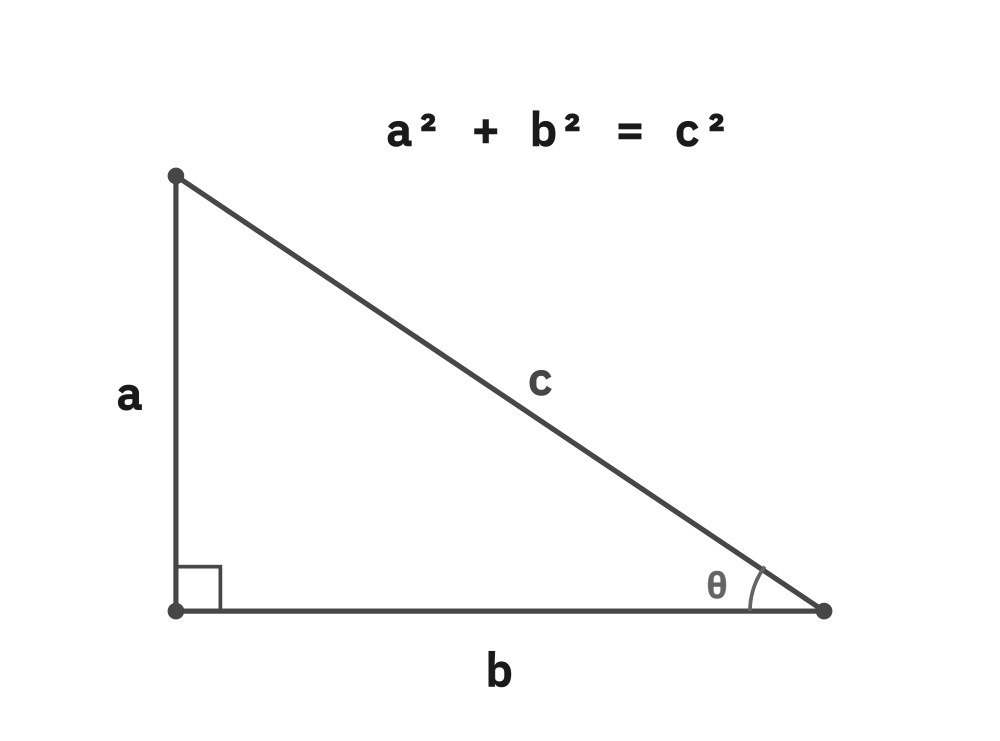
FIGURE 1 The workhorse of the domain. In a right triangle live both the Pythagorean theorem and the trigonometric ratios, the source of a large share of these questions.
The right triangle connects several tested skills: the Pythagorean theorem, special-triangle ratios, and trigonometric ratios. The Pythagorean theorem relates its three sides; the trigonometric ratios relate its sides to its angles. A surprising number of geometry questions reduce, sooner or later, to finding a right triangle hidden inside a larger figure and bringing one of these tools to bear on it.
Two working habits carry you through. First, draw and label: mark every length and angle you are given directly onto the figure, and add what you can immediately deduce, because a fully marked figure often shows its own answer. Second, find the connecting relationship: ask which single fact links the quantity you want to the quantities you have (an angle sum, the Pythagorean theorem, a proportion from similar figures, a trigonometric ratio, a circle relationship) and write it as an equation. Almost every problem in this domain yields to that two-step rhythm.
Here is the shape of what is ahead.
In this domain
Lines, angles, and triangles: angle relationships, parallel lines cut by a transversal, the triangle angle facts, and the triangle inequality.
Triangle similarity and congruence: same shape scaled or copied, and the proportions that find unknown lengths.
Right triangles and trigonometry: the Pythagorean theorem and its triples, the special right triangles, and the sine, cosine, and tangent ratios.
Circles: circumference and area, arcs and sectors, central and inscribed angles, radian measure, and the equation of a circle.
Area and volume: the areas of plane figures and the surface areas and volumes of solids.
Coordinate geometry across lines, distance, and circles: distance and midpoint, figures on the plane, and reasoning with their equations.
Because the formulas are handed to you, this domain rewards a calm, structural eye over raw memorization. Draw the figure, mark what you know, and look for the one relationship that closes the gap to what you want. Master that rhythm and the shapes stop being a gallery of separate facts and become what they are: a few simple ideas, applied again and again. We begin with the most basic of them, the angle.
GEOMETRY · 1
Lines, angles, and triangles
A handful of angle facts (equal here, supplementary there, summing to 180 inside a triangle) combine to unlock figures that look far more complicated than they are.
The domain begins with its smallest building block, the angle, and the rules that govern how angles relate when lines meet. Individually these rules are almost obvious; their power comes from combining them. A figure that looks dense with unknown angles usually yields to a short chain of simple facts (this angle equals that one, those two are supplementary, these three sum to a straight line) applied one after another until the unknown falls out. Learning the facts is quick; learning to chain them is the real work, and it is exactly what the harder questions demand.
▸ Use vertical, supplementary, and complementary angle relationships
Start with angles that share a vertex. Two angles are complementary if they sum to 90 degrees and supplementary if they sum to 180 degrees. Angles that together form a straight line are supplementary, a linear pair, and angles that completely surround a point sum to 360 degrees. When two lines cross, the opposite angles formed, called vertical angles, are always equal, and each pair of adjacent angles is supplementary.
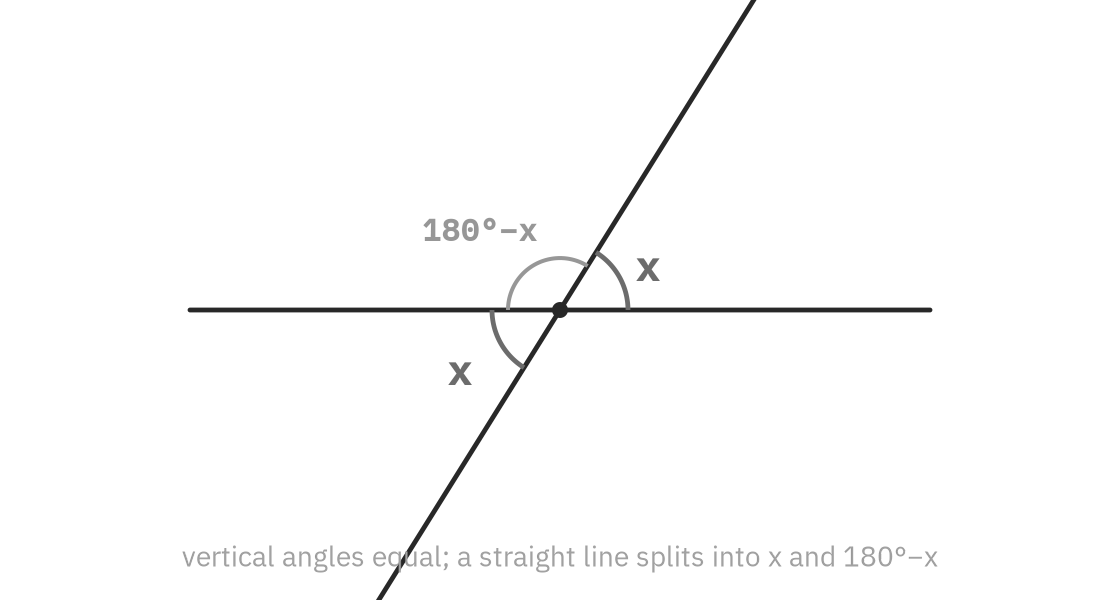
FIGURE 1 Two crossing lines: vertical angles are equal, and any two adjacent angles form a straight line, summing to 180 degrees.
WORKED Set up an angle equation
Two complementary angles are such that one is twice the other. Call them x and 2x:
x + 2x = 90 → 3x = 90 → x = 30.
So the angles are 30 and 60 degrees. Naming the unknown and writing the defining sum is the whole method.
▸ Use corresponding, alternate, and same-side angles with parallel lines
When a single line, a transversal, crosses two parallel lines, it creates eight angles, but only two distinct sizes among them, and a few named pairs tell you which are equal. These angle relationships are a common way parallel lines and transversals appear in SAT geometry.
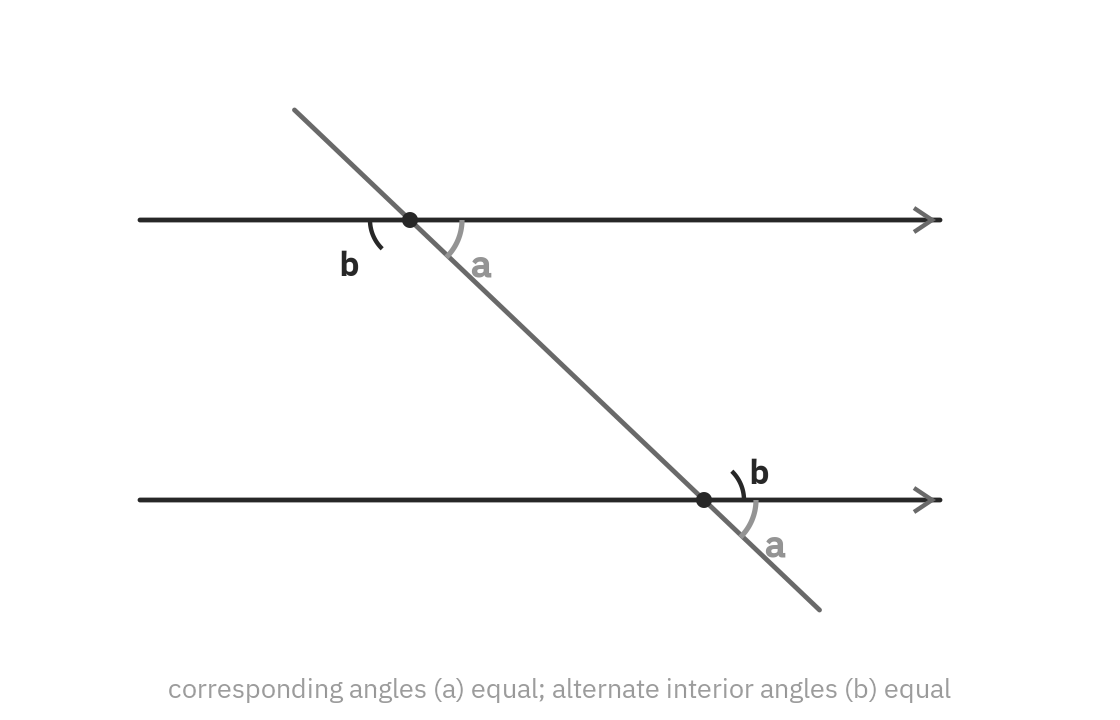
FIGURE 2 A transversal across parallel lines: corresponding angles (a) are equal, and alternate interior angles (b) are equal.
ANGLES ACROSS PARALLEL LINES
Corresponding angles (same position at each crossing): equal.
Alternate interior angles (opposite sides, between the lines): equal.
Alternate exterior angles (opposite sides, outside the lines): equal.
Same-side interior (co-interior) angles: supplementary: they sum to 180 degrees.
The practical upshot is that once you know any one of the eight angles, you know all eight: each is either equal to it or supplementary to it. Spotting whether two marked angles are an “equal” pair or a “supplementary” pair is the entire skill.
▸ Use triangle angle-sum and exterior-angle relationships
Three facts about a triangle's angles do an enormous amount of work. The three interior angles always sum to 180 degrees. An exterior angle, formed by extending one side, equals the sum of the two remote interior angles (the two it does not touch). And in an isosceles triangle the two base angles, opposite the equal sides, are themselves equal; an equilateral triangle, all sides equal, has three 60-degree angles.
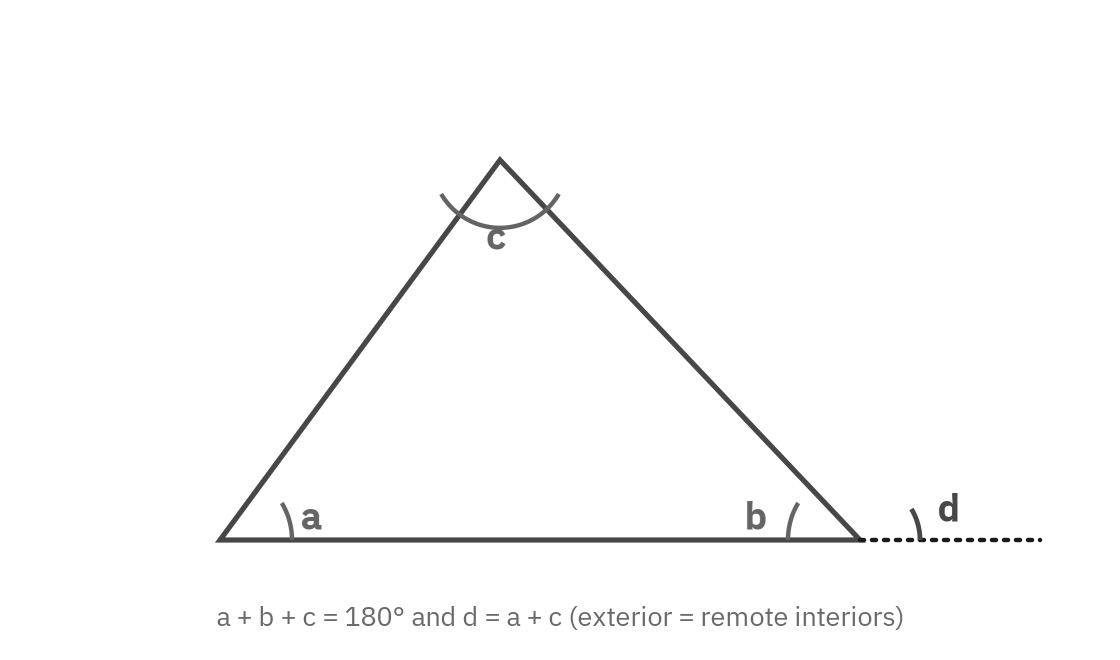
FIGURE 3 The interior angles sum to 180 degrees; an exterior angle equals the sum of the two remote interior angles.
WORKED Use the triangle angle facts
The angles of a triangle are in the ratio 2 : 3 : 4. Let them be 2x, 3x, 4x:
2x + 3x + 4x = 180 → 9x = 180 → x = 20.
The angles are 40, 60, and 80 degrees. The exterior-angle fact gives a shortcut elsewhere: an exterior angle of 110 degrees with one remote interior of 45 degrees forces the other remote interior to be 110 - 45 = 65 degrees, with no need for the third angle at all.
▸ Apply the triangle inequality
Not every trio of lengths can be the sides of a triangle. The triangle inequality says that the sum of any two sides must exceed the third: equivalently, the third side must be longer than the difference of the other two and shorter than their sum. This both tests whether three given lengths form a triangle and pins down the range of an unknown side.
WORKED Bound an unknown side
Two sides of a triangle are 7 and 12. The third side s must satisfy both inequalities:
12 - 7 < s < 12 + 7 → 5 < s < 19.
So s lies strictly between 5 and 19. If s must be a whole number, the possibilities run from 6 to 18, thirteen values in all.
▸ Combine line and triangle angle theorems
The hard questions hand you a figure where no single rule gives the answer, and the path is a chain: each fact you apply unlocks another angle, which feeds the next. The discipline is to mark every angle you can deduce the moment you deduce it, and keep going until the target appears. The two facts that most often link the steps are the linear pair (turning an exterior angle into an interior one) and the triangle sum.
WORKED Chase a multi-step angle
In a triangle, one interior angle is 64 degrees. At a second vertex, the exterior angle measures 140 degrees. Find the third interior angle.
First, the exterior angle and its interior angle form a linear pair, so the second interior angle is 180 - 140 = 40 degrees.
Now the triangle sum closes it out:
third angle = 180 - 64 - 40 = 76 degrees.
Two facts, applied in order (linear pair, then triangle sum) and the figure gives way.
▸ Practice: lines, angles, and triangles
Unless noted, give each angle measure in degrees.
1. Two complementary angles are in the ratio 2 : 3. What is the measure of the larger angle? (grid-in)
2. Two angles are supplementary. One measures (4x + 10) degrees and the other (6x) degrees. What is the value of x? (grid-in)
3. Two lines intersect. One angle measures (3x) degrees, and the angle vertical to it measures (x + 50) degrees. What is the measure of that angle? (grid-in)
4. Parallel lines are cut by a transversal. Two same-side interior angles measure (5x - 5) and (3x + 25) degrees. What is the value of x? (grid-in)
5. The interior angles of a triangle are in the ratio 3 : 4 : 5. What is the measure of the largest angle? (grid-in)
6. An exterior angle of a triangle measures 125 degrees, and one of its remote interior angles is 70 degrees. What is the measure of the other remote interior angle? (grid-in)
7. In an isosceles triangle, the angle between the two equal sides measures 40 degrees. What is the measure of each base angle? (grid-in)
8. Two sides of a triangle measure 7 and 12. How many integer values are possible for the length of the third side? (grid-in)
9. In a triangle, one angle is a right angle, and a second angle is twice the third. What is the measure of the smallest angle? (grid-in)
10. A transversal cuts two parallel lines. One interior angle measures 110 degrees. What is the measure of the same-side interior angle on the other parallel line? (grid-in)
11. Four angles meet at a point and completely surround it. Their measures are x, 2x, 3x, and 90 degrees. What is the value of x? (grid-in)
12. In a triangle, one interior angle is 64 degrees. At a second vertex, the exterior angle is 140 degrees. What is the measure of the third interior angle? (grid-in)
13. A transversal cuts two parallel lines. One angle measures (3x - 10) degrees, and its alternate exterior angle measures (2x + 30) degrees. What is the value of x? (grid-in)
Question 14
- A. 2, 3, 6
- B. 4, 5, 9
- C. 5, 7, 11
- D. 3, 4, 8
15. Line ℓ is parallel to line m. A transversal crosses line ℓ, making a 75° angle that opens upward and to the right of the crossing. The same transversal continues to line m, where it meets one side of a triangle at that crossing point; the triangle’s interior angle there opens upward and to the right in the same way. A second vertex of the triangle has an interior angle of 35°. What is the triangle’s third interior angle, in degrees? (grid-in)
16. Two sides of a triangle measure 9 and 14. If the third side has an integer length k, what is the greatest possible value of k? (grid-in)
Question 17
- A. The angles must be equal, since they look the same size
- B. The angles must be supplementary
- C. No relationship between the angles can be concluded from appearance alone
- D. The angles must both measure exactly 90°
▸ Solutions: lines, angles, and triangles
1: 54. Let the angles be 2x and 3x. Since they are complementary, 2x + 3x = 90, so x = 18 and the larger angle is 3x = 54 degrees.
2: 17. Supplementary angles sum to 180: (4x + 10) + 6x = 180, so 10x = 170 and x = 17.
3: 75. Vertical angles are equal: 3x = x + 50, so 2x = 50 and x = 25. The angle measures 3x = 75 degrees.
4: 20. Same-side interior angles are supplementary: (5x - 5) + (3x + 25) = 180, so 8x + 20 = 180 and x = 20.
5: 75. Let the angles be 3x, 4x, 5x. Then 12x = 180, so x = 15 and the largest is 5x = 75 degrees.
6: 55. An exterior angle equals the sum of the two remote interior angles, so the other is 125 - 70 = 55 degrees.
7: 70. The vertex angle is 40, leaving 180 - 40 = 140 for the two equal base angles, so each is 140 / 2 = 70 degrees.
8: 13. The third side s satisfies 12 - 7 < s < 12 + 7, that is 5 < s < 19. The integers from 6 to 18 inclusive give 18 - 6 + 1 = 13 values.
9: 30. The angles sum to 180 with one being 90, so the other two sum to 90. Letting them be 2y and y, 3y = 90, so y = 30, the smallest angle.
10: 70. Same-side interior angles are supplementary, so the angle on the other line is 180 - 110 = 70 degrees.
11: 45. Angles around a point sum to 360: x + 2x + 3x + 90 = 360, so 6x = 270 and x = 45.
12: 76. The exterior angle of 140 and its interior angle form a linear pair, so that interior angle is 40. Then the third angle is 180 - 64 - 40 = 76 degrees.
13: 40. Alternate exterior angles are equal: 3x - 10 = 2x + 30, so x = 40.
Show the answers and explanations
14: C. A triangle needs every pair of sides to sum to more than the third. Only 5, 7, 11 qualifies, since 5 + 7 = 12 > 11. The others do not qualify: 2 + 3 < 6, 4 + 5 = 9 is not greater than 9, and 3 + 4 < 8.
15: 70. An angle at the second crossing that opens in the same relative direction as the first is a corresponding angle, and corresponding angles across parallel lines are equal, so the triangle’s interior angle there is also 75°. With a second interior angle of 35°, the triangle sum gives the third angle: 180 - 75 - 35 = 70°. Recognizing the parallel-line relationship from its picture, rather than its name, is what unlocks the chain.
16: 22. The third side k must satisfy 14 - 9 < k < 14 + 9, that is 5 < k < 23. Since k must stay strictly below 23, the greatest integer value is 22.
Show the answers and explanations
17: C. Diagrams are not guaranteed to be drawn to scale, so appearance alone never establishes an angle relationship. Only a stated measure, a marking (such as tick marks for congruence or arrows for parallel lines), or a theorem that applies to the figure can justify a conclusion. With none of those given, no relationship between the two angles can be concluded.
▸ Lines, angles, and triangles: chapter summary
Angles obey a short list of rules: complementary and supplementary sums, vertical angles equal, the four parallel-line pairs, the triangle's 180-degree sum and its exterior-angle shortcut, and the triangle inequality bounds what side lengths are even possible. The harder items often require chaining two or more of these facts: mark each deduction, then use it to reach the next. Draw the figure, label relentlessly, and a crowded diagram resolves into a sequence of one-line facts.