SAT Math study guide · Chapter 12
Nonlinear Equations in One Variable
Solving a quadratic is a choice among a few reliable routes. Solving an equation with a radical or a fraction is the same, with one extra step that is never optional: checking.
Reading a quadratic was the work of the last two sections; solving one is the work of this one. There are several routes to a quadratic's roots, and a good solver chooses among them rather than forcing a single method onto every problem. Beyond quadratics, two other equation types appear, those with a variable under a radical and those with a variable in a denominator, and both are solved by clearing the obstacle away. That clearing comes with a catch that defines the section: removing a radical by squaring can manufacture a solution that was never really there, and clearing a fraction can let an excluded value slip back in as a false candidate, so a final check is part of the method, not a courtesy.
▸ Choose factoring, square-root method, completing the square, formula, or graphing
A quadratic equation can be solved four algebraic ways, and they all reach the same roots. Graphing offers a fifth, numerical route: a quick way to see or check the same solutions on Desmos. Factoring is fastest when the quadratic factors cleanly: the skill from the first section of this domain, finished by the zero-product idea. The square-root method fits when there is no middle term. Completing the square, from the quadratics section, always works and is how vertex form is found. And the quadratic formula works on every quadratic without exception, factorable or not. Choose the shortest valid method for the form of quadratic in front of you.
Four ways to solve a quadratic
Factoring: fast when it factors cleanly; finish with the zero-product idea.
Square root, for x2 = k and (x - h)2 = k, with no middle term in the way.
Completing the square: always works; also the path to vertex form.
Quadratic formula: works on every quadratic, factorable or not.
▸ Solve equations of the form (x-h)^2=k by square roots
When a quadratic has no middle term, or has been arranged into a perfect square equal to a number, the quickest route is to take the square root of both sides, remembering that a positive number has two square roots, one positive and one negative.
WORKED Solve (x - 3)² = 16
Take the square root of both sides, keeping both signs:
x - 3 = ±4
x = 3 + 4 = 7 or x = 3 - 4 = -1.
The ± is the whole point: dropping the negative root would discard half the answer.
The same move handles a bare squared term. From 2x2 = 50, divide to get x2 = 25, then take roots: x = ±5. A squared variable almost always carries two solutions, and the ± is how you keep both.
▸ Solve quadratic equations with the quadratic formula
The quadratic formula is the universal solver: for any equation ax2 + bx + c = 0, it produces the roots directly from the coefficients. It is worth memorizing cold, and worth recognizing that the discriminant from the previous section lives right inside it, under the square root.
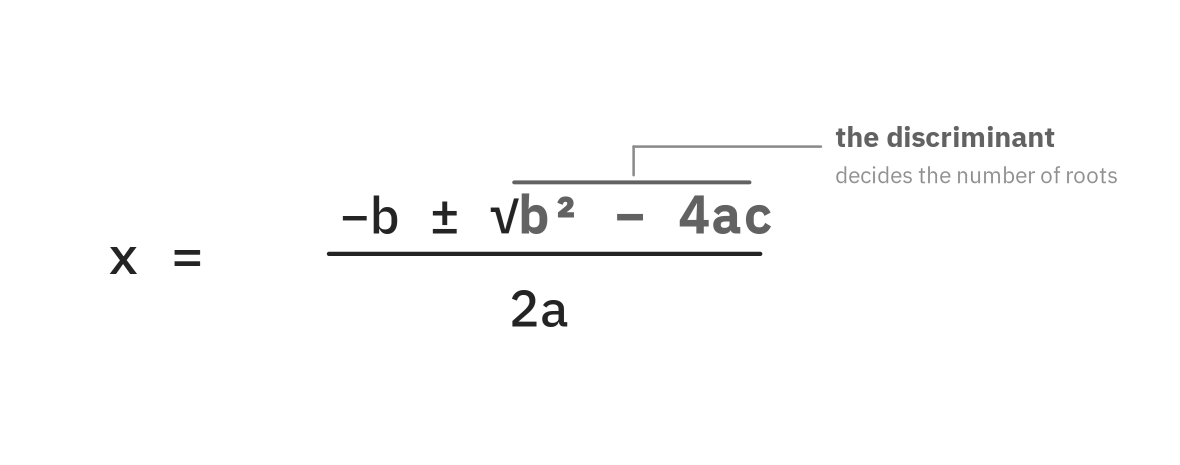
FIGURE 1 The quadratic formula, with the discriminant b² − 4ac sitting under the radical, the same number that counts the roots.
WORKED Solve 2x² + 3x - 2 = 0 with the formula
With a = 2, b = 3, c = -2, substitute into the formula:
x = (-3 ± √(32 - 4(2)(-2))) / (2(2))
x = (-3 ± √(9 + 16)) / 4 = (-3 ± √25) / 4 = (-3 ± 5) / 4
x = 2/4 = 1/2 or x = -8/4 = -2.
Here the discriminant was 25, a perfect square, so the roots came out rational; this one would have factored too.
The formula earns its keep when a quadratic does not factor nicely. Solving x2 - 4x - 3 = 0, the discriminant is 16 + 12 = 28, which is not a perfect square, so x = (4 ± √28)/2 = 2 ± √7, irrational roots that no factoring would have found. When a quadratic does not factor conveniently, the quadratic formula still applies.
▸ Solve radical equations and check for extraneous solutions
An equation with the variable under a square root is solved by undoing the root; isolate the radical on one side, then square both sides to remove it. But squaring is where the catch lives: it can introduce a solution that satisfies the squared equation yet fails the original. The reason is that squaring forgets signs, so it quietly accepts a reflected version of the equation along with the real one.
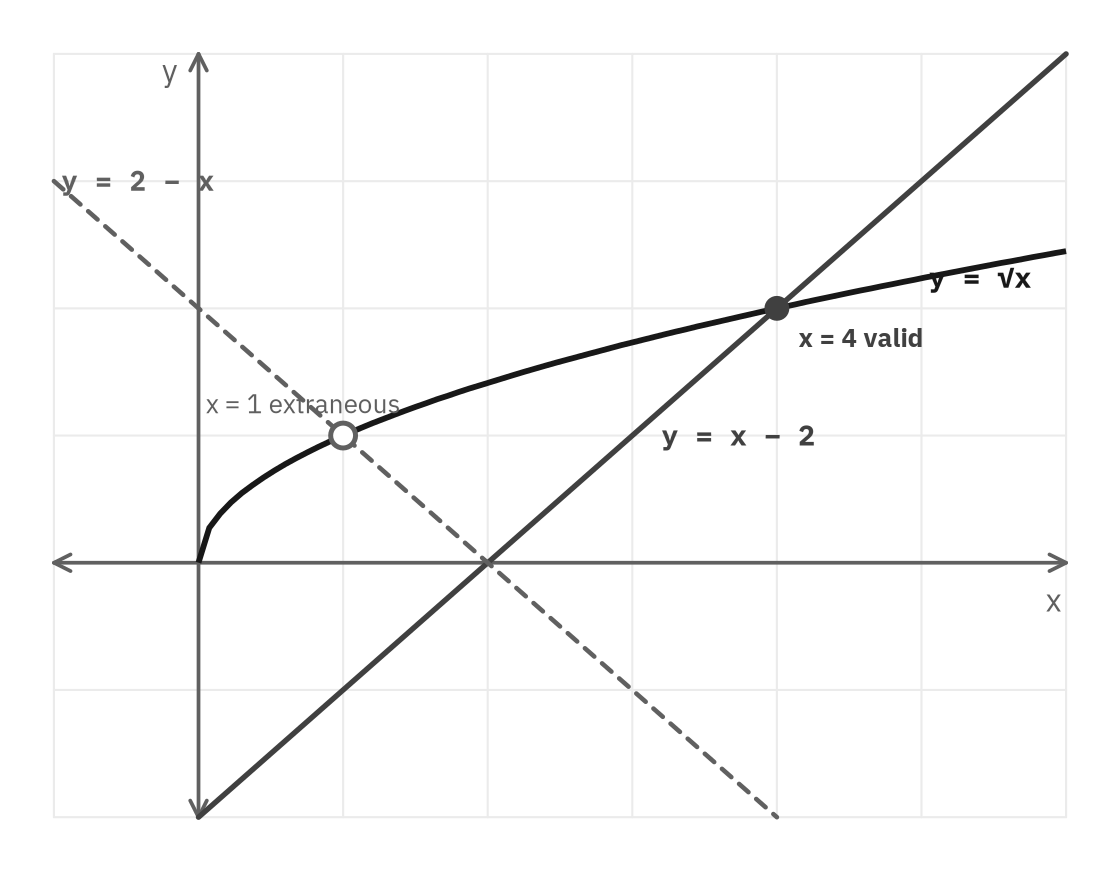
FIGURE 2 Squaring √x = x − 2 secretly also solves √x = 2 − x. The crossing at x = 4 is real; the crossing at x = 1 belongs to the reflection, extraneous.
WORKED Solve √x = x - 2
Square both sides to remove the radical:
x = (x - 2)2 = x2 - 4x + 4
x2 - 5x + 4 = 0 → (x - 1)(x - 4) = 0 → x = 1 or x = 4.
Now check both in the original. At x = 4: √4 = 2 and 4 - 2 = 2, true. At x = 1: √1 = 1 but 1 - 2 = -1, false.
So x = 4 is the only solution; x = 1 is extraneous, the phantom squaring introduced.
▸ Solve rational equations and enforce excluded values
An equation with the variable in a denominator is solved by clearing the fractions: multiply every term by the common denominator, which leaves an ordinary equation behind. Often that equation is quadratic. The catch here is the cousin of the radical one: any value that would have made an original denominator zero can never be a solution, no matter what the cleared equation says.
WORKED Solve x + 6/x = 5
Multiply every term by x to clear the fraction:
x2 + 6 = 5x → x2 - 5x + 6 = 0 → (x - 2)(x - 3) = 0
x = 2 or x = 3.
Neither makes the denominator x zero, so check confirms both: 2 + 3 = 5 and 3 + 2 = 5. Both are genuine.
WORKED When the candidate is excluded
x/(x - 1) = 1/(x - 1) + 2. Multiply through by (x - 1):
x = 1 + 2(x - 1) = 2x - 1 → x = 1.
But x = 1 makes the original denominators zero, so it cannot be a solution. The equation has no solution; the only candidate is excluded.
▸ Check candidate solutions created by squaring or denominator clearing
Two operations create extraneous solutions, and they are the two you just used. Squaring both sides can introduce a root from the reflected equation, a genuinely new solution the original relationship never had, because squaring is not reversible without extra sign information. Clearing a denominator works differently: multiplying by the denominator is a valid, reversible step everywhere that denominator is already nonzero, but the resulting equation no longer displays that exclusion, so a value the original forbade can resurface as an apparent candidate. Either way, for any equation involving a radical or a denominator, substituting your candidates back into the original is the last required step, not an optional flourish. A solution that fails the check is not an error in your algebra; it is a phantom the method was always going to produce, and discarding it is part of solving correctly.
▸ Use the zero-product property to preserve every solution
An equation with every term sharing a factor of x invites a tempting shortcut, dividing both sides by x, that quietly destroys a solution. Dividing by x assumes x is not zero, but x = 0 is often exactly one of the roots the equation has.
WORKED Keep the root that division would erase
What is the product of the distinct solutions to x³ − 7x² + 10x = 0?
Factor out the shared x instead of dividing it away:
x(x² − 7x + 10) = 0 → x(x − 5)(x − 2) = 0
The three solutions are x = 0, 5, and 2. Their product is 0. Dividing the original equation by x at the start would have silently discarded the root x = 0 and produced only 5 and 2, missing the zero entirely.
▸ Count solutions to a system from graph intersections
Not every system is two straight lines. A line can meet a parabola, or a circle, and the governing idea does not change: the solutions are the places where both equations hold at once. You find them by substituting one equation into the other, which collapses the pair into a single equation, and when that equation is quadratic, the number of solutions is the number of times the two graphs cross.
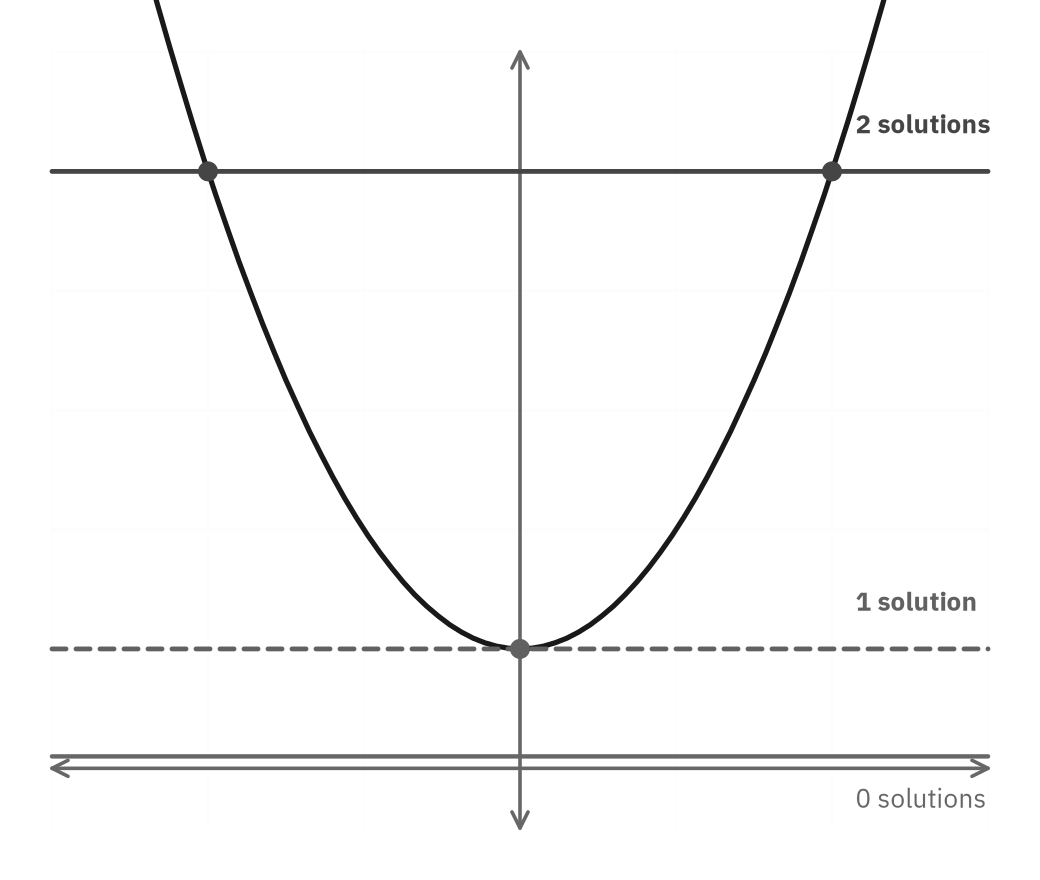
FIGURE 3 A line can cut a parabola twice, touch it once (tangent), or miss it entirely. The count is the number of shared solutions.
The number of crossings is read from the resulting quadratic the same way you read any quadratic's roots, through its discriminant. Two real roots means two intersections; one repeated root means the line is tangent, touching at a single point; no real root means they never meet.
WORKED A tangent condition
For what value of c is the line y = 6x + c tangent to y = x2?
Tangent means exactly one shared point. Set the expressions equal and gather to one side:
x2 = 6x + c → x2 - 6x - c = 0.
One repeated root requires the discriminant to be zero: (-6)2 - 4(1)(-c) = 0, so 36 + 4c = 0 and c = -9.
At c = -9 the line just grazes the parabola at a single point.
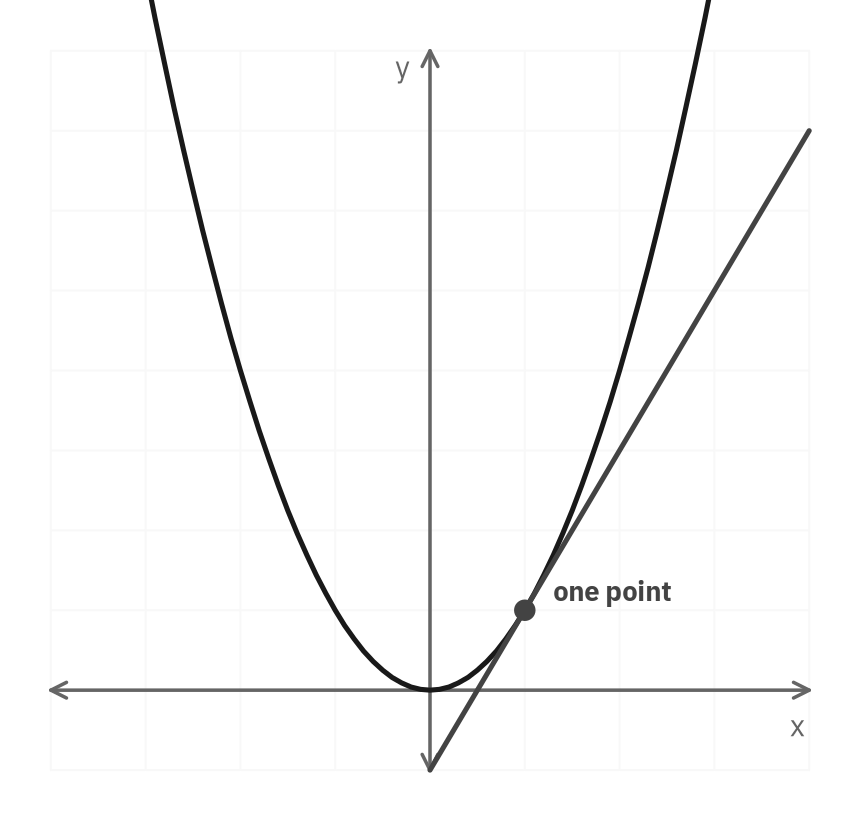
FIGURE 4 A tangent line meets the curve exactly once, the nonlinear face of “one solution.”
The discriminant itself gets its full treatment in the preceding quadratic-equations chapter; here it is simply the instrument that counts how many times two graphs can agree. The lesson that carries is the framing: a nonlinear system is still a question about where the restrictions meet, and substituting reduces that question to one you can already read.
WORKED A nonlinear system inside a word problem
A ball thrown from ground level follows the path h = -x² + 8x, where h is height and x is horizontal distance, both in feet. A drone holds a constant height of 12 feet along the same path. At what horizontal distances is the ball level with the drone?
The word problem is a system in disguise: the parabola h = -x² + 8x and the horizontal line h = 12. Set them equal, exactly as before.
-x² + 8x = 12 → x² - 8x + 12 = 0 → (x - 2)(x - 6) = 0
The ball reaches 12 feet twice, at x = 2 and x = 6, once on the way up and once on the way down. Both solutions are valid here since neither horizontal distance is negative; a context can rule out a root the algebra alone would accept just as easily as it accepted these two.
▸ Practice: nonlinear equations
Question 1
- A. 2 and 3
- B. -2 and -3
- C. 1 and 6
- D. 5 and 6
Question 2
- A. x = 7 only
- B. x = 7 or x = -1
- C. x = 19
- D. x = 4 or x = -4
Question 3
- A. x = 25
- B. x = 5 only
- C. x = 5 or x = -5
- D. x = ±25
Question 4
- A. 1 and -2
- B. 1/2 and -2
- C. 2 and -1
- D. -1/2 and 2
Question 5
- A. 2 ± √7
- B. 4 ± √7
- C. 2 ± √28
- D. -2 ± √7
6. Solve √x = x - 2, keeping only valid solutions. (grid-in)
7. Solve √(x + 5) = x - 1, keeping only valid solutions. (grid-in)
Question 8
- A. 1 and 6
- B. 2 and 3
- C. -2 and -3
- D. 6 only
Question 9
- A. two
- B. one
- C. none
- D. infinitely many
Question 10
- A. to save time
- B. because squaring can introduce extraneous solutions
- C. because radicals have no solutions
- D. it is never necessary
Question 11
- A. 2 and 4
- B. -4 and 2
- C. 4 and -2
- D. -2 and -4
Question 12
- A. ±6
- B. ±3
- C. ±2√3
- D. ±√6
13. Solve √(x + 6) = x, keeping only valid solutions. (grid-in)
Question 14
- A. x = 5 is the solution
- B. x = 5 is extraneous; there is no solution from it
- C. the equation has two solutions
- D. x = 5 should be doubled
15. Solve (x + 1)/(x - 2) = 2. (grid-in)
16. The quadratic x² + px + 16 = 0 has exactly one real solution, and p > 0. What is p? (grid-in)
17. The system y = x² and y = 8x + c has exactly one solution. What is c? (grid-in)
18. The system y = x² and y = k has exactly one solution. What is k? (grid-in)
▸ Solutions: nonlinear equations
Show the answers and explanations
1: A. Factor: (x - 2)(x - 3) = 0, so x = 2 or x = 3. The zero-product idea reads the roots straight off the factors. Choice B negates both, misreading the signs.
2: B. Take the square root of both sides: x - 3 = ±4, so x = 7 or x = -1. Choice A keeps only the positive root, discarding half the answer.
3: C. Divide by 2: x2 = 25, then take roots: x = ±5. Choice B forgets the negative root; choice A forgets to take the root at all.
4: B. With a = 2, b = 3, c = -2: x = (-3 ± √25)/4 = (-3 ± 5)/4, giving 1/2 and -2. Choice A drops the 2 in the denominator.
5: A. The discriminant is 16 + 12 = 28, not a perfect square, so x = (4 ± √28)/2 = 2 ± √7 after simplifying √28 = 2√7. The formula is required here, since the quadratic does not factor over the integers.
6: 4. Squaring gives x = (x - 2)2, so x2 - 5x + 4 = 0 and x = 1 or x = 4. Checking, x = 4 works (√4 = 2 = 4 - 2) but x = 1 fails (√1 = 1 ≠ -1). Only x = 4 is valid.
7: 4. Square: x + 5 = (x - 1)2 = x2 - 2x + 1, so x2 - 3x - 4 = 0 and (x - 4)(x + 1) = 0, giving x = 4 or x = -1. Checking, x = 4 works (√9 = 3 = 4 - 1) but x = -1 fails. Only x = 4 is valid.
Show the answers and explanations
8: B. Multiply by x: x2 - 5x + 6 = 0, so (x - 2)(x - 3) = 0 and x = 2 or x = 3. Both keep the denominator nonzero, so both are genuine.
9: C. Clearing the denominator gives x = 2x - 1, so x = 1, but x = 1 makes the original denominators zero and is excluded. With its only candidate forbidden, the equation has no solution.
10: B. Squaring both sides can introduce a solution from the reflected equation, one that satisfies the squared form but not the original. Checking is the step that discards such phantoms.
11: B. Factor: (x + 4)(x - 2) = 0, so x = -4 or x = 2. Choice C has both signs reversed, from mishandling the +4 and -2 in the factors.
12: C. Take roots: x = ±√12 = ±2√3, since √12 = √4 · √3 = 2√3. Choice A mistakes √12 for 6; the others mishandle the simplification.
13: 3. Squaring gives x + 6 = x², so x² - x - 6 = 0 = (x - 3)(x + 2). The candidates are 3 and -2. The original equation has a nonnegative square root equal to x, so x = -2 fails; x = 3 works.
Show the answers and explanations
14: B. A candidate that equals an excluded value cannot be a solution, so x = 5 is extraneous and contributes no solution. The cleared equation admitted it, but the original forbids it.
15: 5. The denominator requires x ≠ 2. Multiply both sides by x - 2: x + 1 = 2x - 4, so x = 5. This does not violate the excluded value, so 5 is valid.
16: 8. Exactly one real solution means the discriminant is zero: p² - 4(1)(16) = 0, so p² = 64 and p = ±8. The condition p > 0 selects p = 8.
17: -16. Set the expressions equal: x² = 8x + c, so x² - 8x - c = 0. One solution requires discriminant zero: 64 + 4c = 0, giving c = -16. At this value the line is tangent to the parabola.
18: 0. The horizontal line y = k meets y = x² exactly once only at the vertex, where k = 0. Any positive k meets the parabola twice; any negative k misses it entirely.
▸ Nonlinear equations: chapter summary
Solving a quadratic is choosing the lightest route (factoring when it is clean, the square root when there is no middle term, the formula when nothing else fits) and the formula, which carries the discriminant inside it, never fails. Radical and rational equations add one obstacle and one discipline: clear the radical by squaring or the fraction by multiplying, then check every candidate in the original, because squaring can introduce extraneous roots and denominator clearing can leave excluded values among the candidates. A solution that survives the check is real; one that fails it was never there. Keeping that final step is the difference between solving and merely rearranging.