How Digital SAT Math is organized
Knowing how Digital SAT Math is built, and how familiar skills can appear in different forms, makes preparation more efficient before test day.
SAT Math draws from a defined body of mathematics, yet its presentation can change sharply from one question to the next. A linear relationship may appear in a table, while a quadratic may need to be rewritten before its useful feature becomes visible. Geometry can turn into algebra before the calculation begins, and a percentage can depend on the correct base or time interval. Students frequently report that late in a higher-difficulty Module 2, familiar content appears in less direct forms, including parameter conditions, geometry that requires an intermediate relationship, longer contextual setups, and questions where Desmos helps only after the model is clear. The chapters ahead are organized for that kind of transfer.
Math has two 35-minute modules
The section has two 35-minute modules of 22 questions each. Each module contains 20 scored questions and 2 unscored pretest questions. Questions generally move from easier to harder. Most are multiple-choice, with the remainder entered as student-produced responses. A graphing calculator is available throughout.
Pacing should reflect the shape of the module. Early questions usually reward quick, accurate execution. Later questions may require another relationship to be established before the familiar calculation begins. Saving time early creates room for that work without forcing rushed guesses at the end.
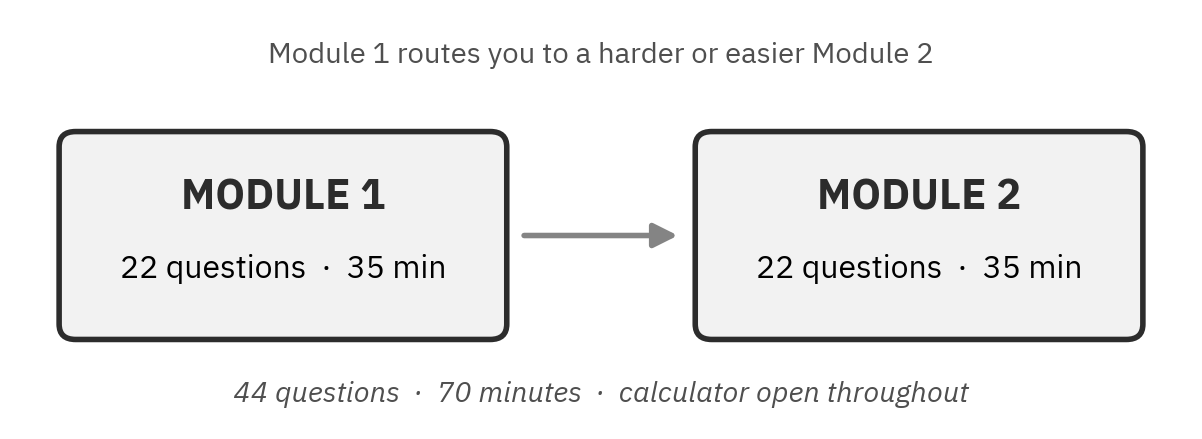
Figure 1. The Math section: two timed modules of twenty-two questions. Your work on the first decides the difficulty of the second.
Worked: When the unknown changes
A direct equation such as asks for . If is known to have solution , the task changes. Substitute the given solution: , so .
The arithmetic remains simple. The skill is reading the equation from a supplied condition and identifying which quantity must now be recovered.
Module 1 sets the difficulty mix of Module 2
Module 1 contains a range of difficulty. Performance there determines the difficulty distribution of Module 2. The higher-difficulty route still contains easier and medium questions alongside harder ones, so the feel of a single question reveals little about routing. Recent test-taker discussions show substantial variation even among students who believed they reached the higher route. Some describe a few demanding final questions; others describe a longer difficult stretch.
Protect accuracy in Module 1. Once Module 2 begins, use the question itself to decide the work and keep the clock for solving.
Worked: Systems and solution conditions
Suppose and . Rewriting the second equation gives .
If the system must have infinitely many solutions, the equations must represent the same line, so . If the condition is no solution, the equal slopes require different intercepts, so can be any value except . The central step is recognizing the condition imposed on the two lines.
What the Math section tests
The four domains are Algebra, Advanced Math, Problem-Solving and Data Analysis, and Geometry and Trigonometry. Algebra and Advanced Math account for most of the questions. Within those domains, the exam asks students to create and interpret relationships, rewrite expressions, connect representations, reason from conditions, model quantities, and apply geometric or statistical relationships.
Part I develops linear equations, functions, systems, and inequalities through equations, graphs, tables, and contexts. Advanced Math follows in Part II with equivalent expressions, functions, quadratics, nonlinear equations, and exponential models. Ratios, rates, units, percentages, data, probability, inference, and statistical claims are developed in Part III. Part IV covers angles, triangles, similarity, trigonometry, circles, coordinate geometry, area, and volume.
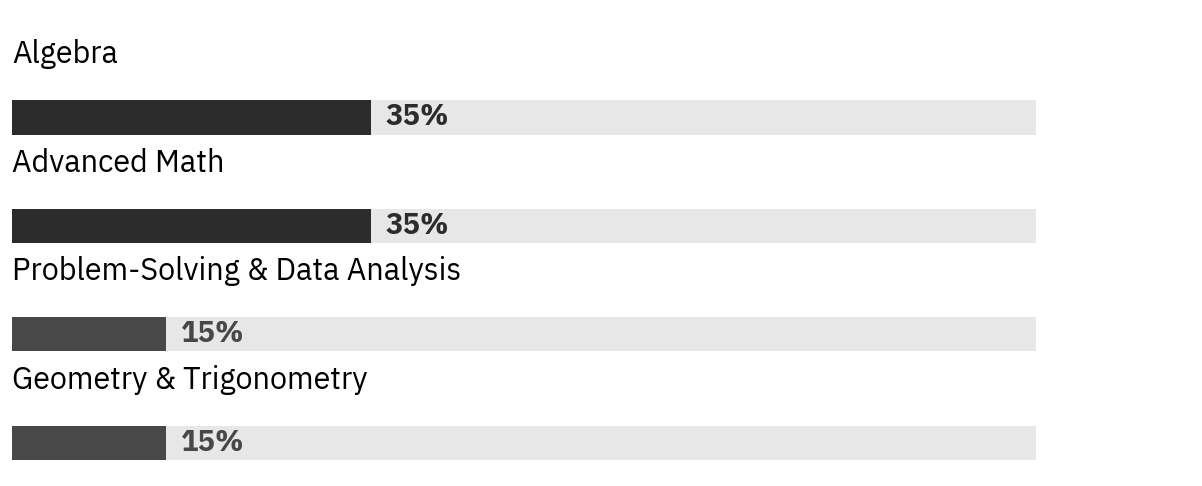
Figure 2. How the four areas share the questions. Algebra and Advanced Math together make up roughly two-thirds of them.
Worked: Choose the form that reveals the needed feature
For , factored form quickly reveals the zeros. A question about the minimum calls for another form: .
For a minimum-value question, the rewritten form exposes the needed feature immediately: the minimum value is . Advanced Math often rewards choosing the form that makes the requested information visible.
Contextual problems require translation
Roughly 30% of SAT Math questions are set in context. Recent students have described some of the slower questions as lengthy to parse even when the calculation itself was manageable. The setup can require a rate to be matched to its unit, a percentage to the correct reference quantity, or a growth factor to the correct number of intervals.
Read first for the relationship: what changes, what stays fixed, and what quantity is requested. Then pull out the numbers, units, and constraints needed for the model.
Worked: Repeated percentage change
A population starts at 480 and grows by 25% every 6 hours. After 18 hours, three growth periods have occurred. The model is .
If a quantity grows by 44% across two equal periods at a constant percentage rate, the total growth factor is . The one-period factor is , giving a 20% increase per period. Dividing 44% by two would miss the compounding.
Multiple-choice and student-produced responses
Student-produced responses remove the four answer choices and place more weight on the final target. A correct intermediate value can still produce a wrong response if the question asks for a related quantity. Enter the requested value in an allowed integer, fraction, or decimal form. Mixed numbers and extra symbols are omitted.
Worked: Answer the requested quantity
A square with area 72 has side length . If the requested quantity is the diagonal, use . The diagonal is .
The side length is valid work, but it is not the requested response. This distinction becomes increasingly important when a problem contains several linked steps.
Use a consistent decision process
Before calculating, identify the relationship, the requested quantity, and the most efficient reliable method. This sequence prevents two expensive errors: solving for a quantity the problem did not ask for and committing to a long method before checking whether the structure already exposes the answer.
Worked: Use structure before calculation
For , a question asking for the radius requires no expansion. The standard circle form gives , so .
A question about an intersection or tangent would call for different work. The target determines which information in the same equation matters.
Geometry often requires an intermediate relationship
Geometry appears repeatedly in recent reports of difficult Module 2 questions. The remembered topics vary across forms, including circles, triangles, coordinate geometry, area, and volume. The useful pattern is the reasoning demand: the requested measurement may be unavailable until similarity, a tangent property, a scale factor, a right-triangle relationship, or an equation supplies it.
Part IV therefore gives attention to the connection that comes before the calculation. That is where a short-looking geometry problem can become time-consuming.
Worked: Scale factors in area
Two similar triangles have corresponding side lengths in the ratio . If the smaller triangle has area 54, the area scale factor is .
The larger area is . A volume question would use the cube of the linear scale factor. The exponent follows the dimension of the quantity being scaled.
Choose Desmos when the representation fits
Students also report wide differences in calculator use. Some solve many questions efficiently with Desmos, while others find that late geometry or parameter problems still require substantial setup before the calculator becomes useful. Desmos can execute a model quickly once the mathematical relationship is clear.
Graphs are useful for intersections, zeros, and visual relationships. Tables can expose function values quickly, and regression can build a model from data. Hand work remains efficient when factoring, substitution, or a known form settles the question immediately. Part V develops this choice through Hand, Desmos, and Hybrid solutions.
Worked: Method choice within the same domain
The equation factors immediately as . Hand work gives the solutions in seconds.
When a less convenient quadratic and linear expression must be compared, graphing both sides can expose their intersections more efficiently. Method selection is part of execution.
Expect skills to appear in combination
Across recent administrations, students frequently report late Module 2 questions involving parameter conditions, circle and triangle relationships, coordinate geometry, percentage changes across intervals, regression or line-of-best-fit reasoning, and algebra embedded in longer contexts. The mix changes from form to form. Familiar skills may arrive with a changed unknown, an added relationship, or a representation that leaves the method unstated.
Later practice in this book becomes less labeled for that reason. Skills taught separately begin to appear together, so the mathematics of the question has to reveal the method.
Worked: Cross-domain reasoning
A rectangle has length , width , and area 60. The area condition produces , a quadratic equation.
After the valid value of is found, the perimeter still has to be calculated from . Geometry supplies the model, Advanced Math supplies the solution method, and the final step returns to the quantity requested.
Keep attention on the current question
An easy question in Module 2 provides no dependable information about the route. A difficult question early in a module does not establish it either. Students sitting for the same administration can receive different forms, and recent discussions show substantial differences in perceived difficulty and topic mix.
Once a module is underway, the routing decision is already fixed. Keep attention on the current question and the remaining time.
Start with the diagnostic
The next section is a 22-question diagnostic module mapped to the book's blueprint skills. Take it before review. For each miss, identify both the topic and the source of the error: missing content, a missed relationship, the wrong requested quantity, a slow setup, an overlooked calculator route, or an execution mistake.
Use the skills map to move directly to the section that addresses the weakness. After learning the skill, practice it in more than one form and confirm the gain under time.