ACT English & Reading study guide · Chapter 15
Full-Length Practice Test 1
Chapter 14
Practice Test 1 · English
Fifty questions in thirty-five minutes.
Work the five passages in any order. Answer every question, since nothing is deducted for a wrong one, and mark any question that is postponed so it can be found again in the final minutes.
The answer key and the explanations begin after the section. Do not open them until all fifty questions are done.
Passage I
· The Weather Ship
From 1947 until 1985 a ship lay at a fixed point in the North Atlantic, five hundred miles west of Ireland, with no purpose but to measure the weather. The station which was one of thirteen agreed by treaty was [1] known as Station India.
Every three hours the crew released a hydrogen balloon and tracks [2] its ascent by radar. Pressure, temperature, and humidity came down by radio from the instrument package, the figures were [3] coded and sent to Bracknell within the hour.
The ship held station in weather that would have sent any other vessel to shelter. Therefore, [4] she rode out a storm in January 1957 that kept her rails under water for the better part of three days. The crew’s [5] quarters lay below the waterline, and the motion never stopped.
Fitted with new instruments in 1962, the Admiralty sent the ship back on station [6] within a month. Satellites and drifting buoys made the manned stations redundant [7] by the middle of the 1980s, and the last vessel came home in 1985. Bracknell is a town in Berkshire with a population of about eighty thousand. [8]
The forty years of readings effected [9] the models that produce today’s forecasts, and nothing in orbit has replaced what those ships measured at the surface. [10]
A relief crew came out every four weeks by the ship that carried stores, and the two vessels lay alongside in whatever sea was running while men and boxes went across. In poor weather the transfer took a day and a half.
Passage II
· The Seed Library
A seed library lends seeds. A borrower takes a packet in spring, grows the crop, lets a few plants run to seed, and returns more than was taken. They [11] is a simple arrangement, and it works only if the returns come back true to type.
The library at Harlow began in 2013 with forty varieties in a card index. Borrowers were asked to record the date of sowing the germination rate and the date of harvest [12] on a slip that came with each packet.
Volunteers who run the library spend the winter cleaning seed, checking germination, and they update the index [13]. Germination is tested by rolling a hundred seeds in damp paper and counting what sprouts [14] after ten days.
Cross-pollination is the difficulty. For that reason, [15] the library lends beans and tomatoes freely, since both set seed without help from insects, while squash and brassicas go only to growers who agree to bag the flowers. Seed returned from an unbagged squash may carry pollen from any plant within a mile. A single variety of runner bean can supply a street. [16]
By 2019 the index hold [17] three hundred varieties, forty of them found nowhere in the commercial catalogues. The library’s stock of local beans is the largest in the county [18], and its records of germination now run to six seasons. On account of the fact that [19] the varieties are freely lent, none of them can be owned. [20]
Passage III
· The Case Against Late Fines
(Original practice passage; names and figures are constructed for test-preparation use.)
Public libraries have charged overdue fines for more than a century, and the justification has always sounded reasonable: a small daily penalty encourages patrons to return books promptly, protecting other readers waiting for the same title. The justification is reasonable. The evidence behind it is not. [21]
When the Redgrove library system eliminated fines system-wide in 2019, staff braced for a wave of unreturned books. Instead [22], the average number of days a book stayed overdue barely changed, while the number of patrons with blocked accounts, accounts frozen because unpaid fines had crossed a threshold, fell by eighty-three percent. Fines, it turned out, were not primarily changing behavior. [23] They were primarily excluding the patrons least able to pay them, without meaningfully speeding up anyone's returns.
Critics of fine elimination raise a fair concern: without a financial consequence, what actually motivates a patron to return a popular book other people are waiting for? [24] Redgrove's answer was to keep the pressure, replacing money with something with real teeth: a patron who does not return a requested item loses borrowing privileges until it comes back, a consequence with no fee attached and no minimum household income required [25]. The two approaches are not equally effective, but they are aimed at the same actual problem, availability, without fines' side effect of pricing low-income families out of the library entirely.
The fairness case against fines is not abstract [26]. A ten-cent daily fine on a two-week children's book, unremarkable to a household with disposable income, can become a genuine barrier to return, and then to future borrowing, for a family stretching every dollar. Libraries exist specifically to make information and literacy available regardless of income; a fee structure that quietly excludes the patrons with the least money is working against the institution's own stated purpose. [27]
None of this means libraries should stop caring whether books come back. [28] It means the caring should be aimed at the actual goal, availability of the collection, rather than at a punitive mechanism that Redgrove's own data suggests barely serves that goal while reliably serving a different, unwanted one [29]. A library board weighing this decision does not have to choose between an orderly collection and an accessible one. Redgrove's experience suggests it can have both, once it stops assuming a fine is the only tool capable of protecting either. [30]
Passage IV
· The Coppice
A coppice is a wood that is cut down on purpose. Hazel or ash is felled close to the ground, and the stump, called a stool sends up a dozen straight poles [31] over the following years.
The cycle runs from seven to twenty years depending on the crop wanted. Poles for hurdles are cut early, timber for handles is left longer [32]. Nothing is planted, and the stools go on producing for centuries; some in Suffolk are thought to be a thousand years old.
A cut stool looks dead for a season and is not. The following spring it throws twenty or thirty shoots together, and the difficulty is thinning them rather than encouraging them.
Coppicing have been [33] abandoned across most of England after 1900, when cheap imports ended the market for hurdles and charcoal. The woods what remained [34] grew tall and dark.
What returned the practice to favour was not nostalgia. A coppice cut in rotation holds a wood in every stage together: open ground, low scrub, and closing canopy. Butterflies use the first, nightingales the second, and dormice are users of the third [35]. A wood left alone offers only only [36] the last of these.
Even so, [37] the work is hard to fund. One cutting cycle can remain visible for decades, so a five-year grant ends long before the management it began. [38] A hurdle maker earns little, and grant schemes rarely cover a cycle longer than five years. Where coppicing has been restored, it is usually done [39] by volunteers under a management plan rather than by anyone making a living from it. [40]
Passage V
· The Sound Mirrors
Before radar, Britain listened for aircraft. Concrete dishes and curved walls were built along the coast between 1916 and 1930 these structures known as sound mirrors [41] concentrated engine noise onto a microphone at the focus.
The largest, at Denge in Kent, is a wall two hundred feet long. An operator was posted at the focus with a stethoscope, he could hear a bomber twenty miles out to sea [42].
Three sizes were built. The small dishes detected an aircraft at about eight miles, the twenty-foot bowls at fifteen, and the long wall at twenty-five, which in 1930 was about four minutes of warning.
Operators were selected by ear rather than by rank, and the best of them were often men who had played an instrument.
Standing in the shingle behind the wall, a visitor today can hear a conversation held at the far end [43]. The effect is exact and slightly unnerving.
The mirrors were the more useful of the several detection methods tried [44] in that decade, and they were obsolete within five years of being finished. The Air Ministry’s [45] trials in 1935 showed that radar gave more warning, in worse weather, and against faster aircraft. Work [46] on the mirrors stopped that year.
They were never demolished, owing to the fact that [47] they were too solid to be worth the effort. However, [48] they stand in the marsh at Denge behind a fence, reached by a causeway open a few days a year. Dungeness power station was built nearby in 1965. [49] [50]
Practice Test 1 · English Questions
Question 1
- A. NO CHANGE
- B. The station, which was one of thirteen agreed by treaty, was
- C. The station, which was one of thirteen agreed by treaty was
- D. The station which was one of thirteen agreed by treaty, was
Question 2
- F. NO CHANGE
- G. have tracked
- H. tracked
- J. is tracking
Question 3
- A. NO CHANGE
- B. package; the figures were
- C. package the figures were
- D. package, and, the figures were
Question 4
- F. NO CHANGE
- G. However,
- H. For example,
- J. In addition,
Question 5
- A. NO CHANGE
- B. crews
- C. crews’
- D. crew’s’
Question 6
- F. NO CHANGE
- G. the return of the ship was made
- H. there was a return to station
- J. the ship returned to station
Question 7
- A. NO CHANGE
- B. redundant and unnecessary
- C. redundant and no longer needed
- D. unnecessary as well as redundant
Question 8
- F. Kept, because it identifies where the readings were sent.
- G. Deleted, because it turns from the ships to a place mentioned only in passing.
- H. Kept, because it explains why the station closed in 1985.
- J. Deleted, because the population figure is now out of date.
Question 9
- A. NO CHANGE
- B. effect
- C. affected
- D. affect
Question 10
- F. Yes, because it explains how balloon soundings are taken.
- G. Yes, because it lists the countries that signed the treaty.
- H. No, because it follows one station rather than surveying the network.
- J. No, because it concentrates on instruments rather than on people.
Question 11
- A. NO CHANGE
- B. Those
- C. These
- D. It
Question 12
- F. NO CHANGE
- G. date of sowing, the germination rate and the date of harvest
- H. date of sowing the germination rate, and the date of harvest
- J. date of sowing, the germination rate, and the date of harvest
Question 13
- A. NO CHANGE
- B. to clean seed, checking germination, and updating the index
- C. cleaning seed, checking germination, and updating the index
- D. cleaning seed, to check germination, and updating the index
Question 14
- F. NO CHANGE
- G. happens
- H. occurs
- J. appears
Question 15
- A. NO CHANGE
- B. However,
- C. For example,
- D. In contrast,
Question 16
- F. where it is now
- G. at the beginning of the paragraph
- H. after the sentence about squash and brassicas
- J. after the sentence naming the difficulty
Question 17
- A. NO CHANGE
- B. held
- C. have held
- D. holds
Question 18
- F. NO CHANGE
- G. the larger in the county
- H. the most largest in the county
- J. larger than any in the county
Question 19
- A. NO CHANGE
- B. Because
- C. Due to the fact that
- D. In view of the fact that
Question 20
- F. the library should apply for charitable status
- G. commercial catalogues are shrinking every year
- H. germination testing is the hardest part of the work
- J. the varieties survive only while people keep growing them
Question 21
- A. NO CHANGE
- B. protecting other readers waiting for the same title, and the justification is reasonable, but the evidence behind it is not.
- C. protecting other readers waiting for the same title, a justification that is reasonable in principle but, as it turns out, not supported by the evidence.
- D. protecting other readers waiting for the same title; however, the evidence behind it is not reasonable.
Question 22
- F. NO CHANGE
- G. Everything proceeded normally.
- H. The results were completely unexpected by everyone involved.
- J. Nothing of note happened at first.
Question 23
- A. NO CHANGE
- B. Both of these findings were somewhat surprising to the research team.
- C. These two findings, taken together, were the most important part of the study.
- D. The library also made several other changes to its policies that year.
Question 24
- F. NO CHANGE
- G. Some critics disagree with libraries entirely.
- H. Nobody has ever asked this question before.
- J. Redgrove's staff had no answer to this problem.
Question 25
- A. NO CHANGE
- B. a consequence that is fair to everyone involved.
- C. a consequence that costs the library nothing to administer.
- D. a consequence some patrons found frustrating at first.
Question 26
- F. NO CHANGE
- G. Many people have strong opinions about library policy.
- H. Different libraries handle fines in different ways.
- J. Some families have more money than others.
Question 27
- A. NO CHANGE
- B. Libraries should consider adjusting their fine amounts.
- C. This is a problem that deserves further study.
- D. Most patrons pay their fines without difficulty.
Question 28
- F. NO CHANGE
- G. Libraries should abandon all consequences for late returns immediately.
- H. The collection will maintain itself without any policy at all.
- J. This proves fines have never worked anywhere.
Question 29
- A. NO CHANGE
- B. a mechanism that increases how many books a library owns
- C. a mechanism that helps libraries generate needed revenue
- D. a mechanism that most patrons say they support
Question 30
- F. NO CHANGE
- G. Libraries have many difficult decisions to make about policy every year.
- H. More research on library funding is needed before any changes are made.
- J. Redgrove is a mid-sized city with a well-funded library system.
Question 31
- A. NO CHANGE
- B. stool sends up, a dozen straight poles
- C. stool, sends up a dozen straight poles
- D. stool, sends up, a dozen straight poles
Question 32
- F. NO CHANGE
- G. early; timber for handles is left longer
- H. early, and timber for handles left longer
- J. early timber for handles is left longer
Question 33
- A. NO CHANGE
- B. were
- C. are
- D. was
Question 34
- F. NO CHANGE
- G. who remained
- H. that remained
- J. whom remained
Question 35
- A. NO CHANGE
- B. and the third is used by dormice
- C. and dormice the third
- D. and using the third are dormice
Question 36
- F. NO CHANGE
- G. merely only
- H. only
- J. solely only
Question 37
- A. NO CHANGE
- B. Therefore,
- C. For example,
- D. In addition,
Question 38
- F. where it is now
- G. after the sentence about grant schemes
- H. at the end of the paragraph
- J. in the paragraph that follows
Question 39
- A. NO CHANGE
- B. handled
- C. carried out
- D. achieved
Question 40
- F. grant schemes should run for longer than five years
- G. hurdle making is no longer a viable trade in England
- H. some coppice stools in Suffolk are a thousand years old
- J. a wood is kept alive by being cut rather than by being left alone
Question 41
- A. NO CHANGE
- B. 1930, these structures known as sound mirrors
- C. 1930; these structures, known as sound mirrors,
- D. 1930; these structures known as sound mirrors
Question 42
- F. NO CHANGE
- G. stethoscope, and he could hear
- H. stethoscope he could hear
- J. stethoscope, he could of heard
Question 43
- A. NO CHANGE
- B. a conversation held at the far end can be heard today
- C. it is possible today to hear a conversation at the far end
- D. conversations at the far end are audible to visitors today
Question 44
- F. NO CHANGE
- G. more useful than any detection method tried
- H. the most useful of the several detection methods tried
- J. the most usefullest of the detection methods tried
Question 45
- A. NO CHANGE
- B. Air Ministrys
- C. Air Ministries’
- D. Air Ministry’s’
Question 46
- F. NO CHANGE
- G. Working
- H. The work of
- J. Works
Question 47
- A. NO CHANGE
- B. due to the fact that
- C. on account of the fact that
- D. because
Question 48
- F. NO CHANGE
- G. Today
- H. Therefore
- J. For example
Question 49
- A. Deleted, because it introduces a structure unconnected to the mirrors.
- B. Kept, because it explains why the site is difficult to reach.
- C. Kept, because it dates the closure of the listening service.
- D. Deleted, because the power station is mentioned earlier.
Question 50
- F. Yes, because it gives the reason radar displaced the mirrors.
- G. Yes, because it lists the three sizes that were built.
- H. No, because it describes the mirrors without naming radar.
- J. No, because it concentrates on what survives at Denge.
Practice Test 1 · English Answers and Explanations
Answer key: 1. B 2. H 3. B 4. H 5. A 6. J 7. A 8. G 9. C 10. H 11. D 12. J 13. C 14. F 15. A 16. H 17. B 18. F 19. B 20. J 21. D 22. G 23. D 24. F 25. D 26. G 27. B 28. F 29. D 30. G 31. C 32. G 33. D 34. H 35. C 36. H 37. A 38. G 39. C 40. J 41. C 42. G 43. A 44. H 45. A 46. F 47. D 48. G 49. A 50. F
1. Key: B. The clause naming the treaty can be lifted out and leave a whole sentence, so it takes a comma at each end. A: Neither comma appears, so the removable clause is left unmarked at both of its ends. C: Only the opening comma appears, which leaves the pair of commas unfinished. D: Only the closing comma appears, which leaves the pair of commas unfinished.
2. Key: H. The paragraph reports a routine carried out in the past, so the past-tense verb fits the sentences around it. F: The present tense clashes with a paragraph written throughout in the past. G: The present perfect does not match the simple past used all around it. J: The present progressive places the action in a time the passage has left.
3. Key: B. Both halves are complete statements, so a semicolon joins them without requiring a linking word. A: A comma alone cannot join two statements that could each stand alone. C: Removing the mark runs the two statements together with no break at all. D: The second comma cuts the conjunction off from the clause it introduces.
4. Key: H. The storm is an instance of the weather described in the sentence before it, so the transition introduces an example. F: Therefore claims the storm followed from the ship holding its station. G: However sets the storm against the previous sentence, though it illustrates it. J: In addition treats the storm as a separate point rather than as an instance.
5. Key: A. One crew owns the quarters, so the singular possessive with the apostrophe before the s is correct. B: A plain plural shows no possession, though the quarters belong to the crew. C: The plural possessive supposes several crews aboard one single ship. D: This adds a second apostrophe to a form that already shows possession.
6. Key: J. The opening phrase describes what was fitted with instruments, so the ship has to follow the comma. F: This makes the Admiralty the thing fitted with new instruments in 1962. G: A return rather than the ship follows the phrase describing the ship. H: The construction delays the subject and leaves the phrase attached to nothing.
7. Key: A. One word carries the meaning, and each alternative says the same thing a second time. B: Redundant and unnecessary state the same condition twice in one phrase. C: No longer needed repeats what the word redundant has already said. D: This reverses the pair while keeping exactly the same duplication.
8. Key: G. The paragraph traces the end of the manned stations, and the size of a Berkshire town belongs to neither that account nor the essay. F: The destination is already given in the paragraph about the radio reports. H: The closure is attributed to satellites and buoys rather than to the town. J: Currency of the figure is not what makes the sentence unsuited here.
9. Key: C. The readings influenced models that already existed, and the verb meaning to influence is spelled with an a. A: Effected means brought about, which overstates what the readings did to existing models. B: Effect is the noun and cannot serve as the verb this sentence needs. D: Affect in the present tense clashes with a sentence written in the past.
10. Key: H. The essay stays with Station India from its first balloon to the last voyage, so it does not survey the thirteen stations as a network. F: The soundings occupy two sentences rather than serving as the essay’s subject. G: No country is named anywhere in the essay at any point in it. J: The essay describes the crew as well, so the stated reason misreads it.
11. Key: D. The pronoun stands for the single arrangement described above, so the singular form is the one that fits. A: They is plural and refers to nothing plural in the sentences before it. B: Those is plural and points to no plural noun anywhere in the passage. C: These is plural as well and matches nothing the paragraph has named.
12. Key: J. Three items in a series take a comma between them, including one before the conjunction that closes the list. F: A list of three items runs together with no commas separating them at all. G: The comma before and is missing from a series of three separate items. H: Only one comma appears, which leaves the first two items joined together.
13. Key: C. All three items in the series take the same form, so each of them begins with an -ing verb. A: The third item takes its own subject while the first two are -ing phrases. B: The first item becomes an infinitive while the others remain -ing phrases. D: The second item breaks the pattern that the first and third both keep.
14. Key: F. The count is of seeds that have germinated, and the exact word names that outcome rather than gesturing at it. G: Happens names no particular result and leaves the test without any measure. H: Occurs is equally vague about what the volunteers are counting after ten days. J: Appears describes visibility rather than the germination the test is measuring.
15. Key: A. The lending policy follows from the difficulty named in the sentence before it, so the transition marks a consequence. B: However sets the lending policy against the difficulty rather than following from it. C: For example promises an instance of cross-pollination rather than a response to it. D: In contrast marks an opposition that the two sentences do not contain.
16. Key: H. The sentence concerns beans, which the paragraph treats before it turns to squash, so it belongs with that part of the account. F: At the end of the paragraph the remark follows the squash it has nothing to do with. G: At the head of the paragraph it precedes the difficulty that gives it point. J: Immediately after the difficulty the crops lent freely have not yet been named.
17. Key: B. The index is singular and the sentence is set in a past year, so the past-tense singular verb agrees with it. A: Hold is the plural present form and matches neither the subject nor the tense. C: The present perfect does not fit a sentence anchored to the year 2019. D: Holds is present tense, though the sentence reports a state that existed in 2019.
18. Key: F. The stock is measured against every collection in the county, so the superlative form is the one that applies. G: The comparative needs a second term, and the sentence names a whole county rather than one rival collection. H: This stacks most onto a word that already carries the superlative ending. J: Than any in the county compares the stock against itself, since the stock is one of the county's own collections.
19. Key: B. A single conjunction states the cause, and the longer phrases add words without adding any meaning. A: On account of the fact that says in six words what a single word says. C: Due to the fact that repeats the same padding in slightly different wording. D: In view of the fact that is the same construction lengthened again.
20. Key: J. The essay turns on seed that must be grown out and returned each year, so a closing sentence about that dependence completes it. F: No question of legal status is raised anywhere in the essay at all. G: The catalogues appear once as a comparison rather than as a trend. H: Cross-pollination rather than germination is described as the difficulty here.
21. Key: C. This combines the two short sentences into one that preserves the concession-then-challenge structure, reasonable in principle, unsupported in practice, without the choppy repetition of "reasonable" that the original creates. Choice B keeps both original sentences essentially unchanged, just joined by "and," preserving the same repetitive structure. D introduces a logical error: it is the fine's justification, not "the evidence," that the passage calls unreasonable. A leaves the choppy, repetitive two-sentence structure as written.
22. Key: F. "Instead" directly signals the contrast between what staff expected and what the data actually showed, which the rest of the sentence immediately delivers. Choice H oversells the surprise before the specific data has been given, and duplicates the contrast "instead" already signals. G and J are both vaguer setups that don't specifically prepare the reader for a contrast with the "braced for a wave" expectation just stated.
23. Key: A. The sentence as written directly states the specific causal interpretation the two statistics support: overdue timing barely changed, but exclusion dropped sharply, meaning fines' main effect was exclusion, not behavior change. Choice C claims an importance ranking the passage never establishes elsewhere. B is vaguer and doesn't state what conclusion the statistics support. D introduces an unrelated claim about other policy changes never mentioned again.
24. Key: F. The sentence as written states a specific, fair version of the counterargument, motivation without a financial consequence, that the paragraph then directly answers with Redgrove's actual policy. Choice J contradicts the rest of the paragraph, which describes exactly the answer Redgrove staff developed. G is vague about what critics actually object to. H overstates the novelty of a concern the passage treats as a reasonable, ordinary question.
25. Key: A. The sentence as written names the specific mechanism, no fee, no income threshold, that directly answers the fairness problem the passage has been building throughout. Choice B asserts a conclusion without the specific reasoning that earns it. C introduces administrative cost, a consideration the passage never otherwise discusses. D introduces an emotional reaction unrelated to the fairness argument being made.
26. Key: F. "Not abstract" directly signals that a concrete example is about to follow, exactly what the next sentence supplies. Choice J states a fact the example will illustrate, but as a stand-alone sentence it doesn't perform the same signaling function the transition needs to do here. G and H are both generic statements that could precede almost any topic and do not specifically prepare the reader for a concrete illustration.
27. Key: A. This sentence directly ties the specific example back to the paragraph's opening claim, that a fee structure excluding low-income patrons works against the library's own core purpose, closing the paragraph's argument rather than introducing a new one. Choice B proposes a policy tweak the passage's actual argument, eliminating fines rather than adjusting them, does not support. C deflects into vague open-endedness after the paragraph has already made a specific claim. D contradicts the paragraph's own point about which patrons are actually affected.
28. Key: F. This choice correctly narrows the claim to what the essay actually argues, that caring about returns is fine, but the specific mechanism should change, without overstating it into eliminating all consequences or all policy, which the essay's own Redgrove example directly contradicts. G contradicts the passage's own description of Redgrove's borrowing-privileges consequence. H ignores that the essay explicitly describes an active policy replacing fines. J overgeneralizes a single case study into a universal, unsupported claim.
29. Key: A. This choice accurately names the "different, unwanted" outcome the passage's own evidence supports: exclusion of low-income patrons, not any of the alternative purposes the other choices propose. B and C both introduce goals, collection size and revenue, that the passage's Redgrove evidence never addresses at all. D introduces a patron-opinion claim the passage never makes or supports with evidence.
30. Key: F. This closing sentence directly restates the essay's central claim, that the assumed tradeoff between an orderly collection and an accessible one is false, in its most concentrated form, giving the essay a genuine conclusion rather than a generic closer. G is a generic statement that could end nearly any essay about policy. H calls for further study in a way the essay's own confident argument does not support. J introduces a new, unaddressed detail about Redgrove's funding that the essay never otherwise discusses.
31. Key: C. The naming phrase called a stool is set off by commas, so a closing comma follows the name before the verb. A: The appositive closes without the comma that the naming phrase requires. B: The comma separates the verb from the object that completes it. D: Two commas cut the verb away from both its subject and its object.
32. Key: G. Both halves are complete statements about different crops, so a semicolon joins them without a linking word. F: A comma by itself cannot hold two independent statements together. H: Dropping the verb leaves the second half without a working predicate. J: Removing the mark runs the two statements together with no break.
33. Key: D. The subject is coppicing, a single practice, and the sentence is set in the past, so the singular past verb agrees. A: Have been is plural and does not agree with the singular subject coppicing. B: Were is plural and matches neither the subject nor the singular practice named. C: Are is plural and present, though the sentence reports a change after 1900.
34. Key: H. The clause identifies which woods are meant, so the relative pronoun that introduces it. F: What cannot introduce a clause describing which woods the sentence means. G: Who refers to people rather than to the woods the sentence describes. J: Whom refers to people and is an object form besides, which fits neither.
35. Key: C. The first two items drop the repeated verb, so the third follows the same compressed pattern. A: The third item adds a subject and verb that the first two items omit. B: The item becomes a full clause while the others stay compressed. D: The inverted construction breaks the pattern the first two items set.
36. Key: H. One limiting word carries the meaning, and each alternative doubles or narrows it without cause. F: The doubled limiter states a narrow margin the sentence does not claim. G: Merely only doubles a single limiting word. J: Solely only repeats the same doubling in different words.
37. Key: A. The paragraph before praises the practice and this one names what prevents it, so the two stand against each other. B: Therefore claims the funding difficulty follows from the benefits described. C: For example promises an instance of the advantages set out before it. D: In addition treats the difficulty as a further benefit rather than a limit.
38. Key: G. The sentence explains why a five-year grant is too short, so it follows the sentence that gives the length of the grants. F: At the head of the paragraph the grants have not yet been mentioned. H: At the end it is separated from the funding it explains. J: The following paragraph has moved on from funding to another subject.
39. Key: C. The sentence describes work performed under a management plan, and the exact phrase names that activity. A: Done is vague about the kind of work that the volunteers perform. B: Handled suggests administration rather than the physical cutting that is described. D: Achieved names a result rather than the ongoing work under a plan.
40. Key: J. The essay opens on a wood cut down on purpose and closes on what cutting preserves, so that reversal is its central point. F: Funding appears as an obstacle rather than as the essay’s argument. G: The trade is one detail within the account of why coppicing lapsed. H: The age of the stools is an illustration rather than the point itself.
41. Key: C. A semicolon separates the two complete statements, and the naming phrase inside the second takes a comma at each end. A: Two complete statements run together with no punctuation between them at all. B: A comma splice joins the halves and the naming phrase is unmarked. D: The semicolon is right, though the naming phrase still lacks its commas.
42. Key: G. Two complete statements joined by a comma need a conjunction after it, and and supplies the link. F: Two statements that could stand alone need more than a comma between them. H: Could of is not a standard form, and the splice is left in place besides. J: Could of is not a standard form, and the splice remains unrepaired.
43. Key: A. The opening phrase describes a person standing behind the wall, so the visitor has to follow the comma. B: The conversation rather than the visitor follows the phrase describing a person standing. C: Beginning with it postpones the subject and strands the opening phrase. D: The conversations follow a phrase that describes someone standing in the shingle.
44. Key: H. Several methods are compared rather than two, so the superlative form is the one the sentence requires. F: The comparative needs a second term, and the sentence ranks this method among several rather than against one. G: Than any excludes the mirrors from the group they belong to. J: Most is stacked onto a word that already carries a superlative ending.
45. Key: A. One ministry owns the trials, so the singular possessive with the apostrophe before the s is correct. B: A plain plural shows no possession, though the trials belong to the ministry. C: The plural possessive supposes several ministries conducting the same trials. D: The extra apostrophe follows a form that already marks possession properly.
46. Key: F. The noun naming the activity serves as the subject, and the plain singular form is what the verb requires. G: The -ing form leaves the sentence without a subject that can take the verb. H: Of leaves the phrase incomplete and the sentence without a clear subject. J: The plural form does not agree with the singular verb that follows it.
47. Key: D. A single conjunction states the cause, and each alternative adds words without adding meaning. A: Owing to the fact that says in five words what one word says. B: Due to the fact that repeats the same padding in different wording. C: On account of the fact that lengthens the same construction again.
48. Key: G. The sentence moves from why the mirrors survived to where they stand now, so the transition marks time rather than contrast. F: However sets the present state against the survival, though it follows from it. H: Therefore claims the fence and the causeway follow from their solidity. J: For example promises an instance of why they were never demolished.
49. Key: A. The paragraph accounts for the survival of the mirrors and how they are reached, and a later power station belongs to neither. B: The causeway rather than the power station accounts for the access. C: The service ended in 1935, which the previous paragraph has already given. D: The station appears nowhere else, so repetition is not the trouble.
50. Key: F. The essay reports the 1935 trials showing radar gave more warning in worse weather, which is the reason the mirrors were abandoned. G: The three sizes describe the mirrors rather than their replacement. H: The essay names radar directly in the account of the 1935 trials. J: Denge occupies the closing paragraph rather than the whole essay.
Practice Test 1 · Reading
Thirty-six questions in forty minutes.
Four passages, nine questions each, and about ten minutes for a passage and its set. Work them in any order and leave no answer blank.
The answer key and the explanations begin after the section. Do not open them until all thirty-six questions are done.
Passage I
· Literary Narrative
The darkroom had been a coal store before their father converted it, and it still smelled faintly of coal under the fixer. Stephen had the boxes; Ivan had the shelves. They had agreed the division in the car without discussing it, in the way they agreed most things.
“There are forty years of negatives in here,” Stephen said.
“Thirty-eight.” Ivan was reading the spines of the developing tanks as though they might have changed. “He started in the summer I was born.”
They worked for an hour with the red safelight on, which neither of them mentioned and neither turned off. The enlarger came apart into three pieces and went into the boot of the car. The trays went into a crate. Stephen found a box of prints that had never been sorted, held one up to the safelight, and put it back without saying what it was.
The boxes were numbered in their father’s hand, and the numbers ran to two hundred and six. Stephen opened the first three and found them ordered by year and by subject, with a slip inside each listing what the sleeves contained. The fourth box held nothing but sleeves of a single field gate photographed in what appeared to be every month for a decade.
“You could take the enlarger,” Ivan said. “You have the room.”
The safelight made everything in the room the colour of a burn. Stephen had grown up with it and had forgotten, until that afternoon, that it was the light he thought of when he thought of his father: a man in a red room with his back turned, doing something that could not be interrupted.
“I have the room.” Stephen taped the crate. “I have not printed anything since I was nineteen.”
“No.”
“Neither have you.”
“He shot that gate two hundred times,” Stephen said. “Four hundred. There is another box.” Ivan did not look round. “He was working out what changed when nothing changed.”
“No,” Ivan said, and went back to the shelves. There was a run of contact sheets from 1994 that he set aside, and then a second run that he set aside as well, and by the time the shelves were empty the pile of things being kept had grown to the size of the pile going out.
At four o’clock their father’s neighbour knocked and asked whether they wanted the extractor fan, which he had helped to fit in 1986 and had wired badly, and which had worked without fault for thirty-two years. Stephen said they would keep it. The neighbour looked at the empty room for a while and said that the light in there had been on most nights until the spring.
“He kept the receipts,” Ivan said, from the far end of the shelves. “Paper, chemicals, everything. There is a book here that runs to last November.” Stephen came over and looked at the column of figures without reading them.
When he had gone Ivan said, “Most nights.”
“He was printing.”
“He told me he had stopped.” Ivan picked up the pile he had set aside and carried it out to the car, and when he came back he did not look at his brother, and he began sweeping a floor that was already clean.
Outside, the light had gone off the yard. Stephen carried the last crate to the car and stood with the boot open longer than the loading required, and when he came back in Ivan had finished sweeping and was standing in the middle of the empty room with the broom in both hands, and the safelight was still on.
Passage II
· Social Science
(Original practice passage; names, institutions, and numerical details are constructed for test-preparation use.)
In 2011 a primary school in a small English town started what its head teacher called a walking bus: an adult leading a line of children along a fixed route at a fixed time, picking up more children at marked stops. Within two years the number of cars arriving at the school gate between half past eight and nine had fallen by forty-one per cent.
The scheme is easy to describe and has been copied in several hundred schools, and the figure above is the one that appears in most accounts of it. The interesting part of the story is what the figure conceals.
The council had counted traffic at the gate before the scheme and after it, and the fall is real. But a second count, taken at four junctions half a mile out, found that total morning traffic in the area had dropped by only six per cent. Most of the cars that stopped arriving at the gate were still on the road. What had changed was that parents who had driven to the gate now drove to a walking-bus stop, or to work directly, having handed their children over on the way.
The mechanics of the scheme are worth setting out, because they explain both figures. A walking bus has a timetable and a route. It leaves a fixed point at a fixed minute and reaches the school gate eight or ten minutes later, and children join it at marked stops along the way. A parent who lives beyond walking distance can therefore drive to a stop rather than to the gate, hand the child to the leader, and continue. The car journey is shortened by perhaps four hundred metres and is not removed.
This is not an argument against the scheme. Removing forty per cent of the cars from a school gate at the moment when a hundred children are crossing is worth doing for its own sake, and the injury figures at that gate fell to zero in the four years that followed. It is an argument about which claim the evidence supports. A scheme that makes a gate safer is being reported as a scheme that reduces driving, and the two are different achievements requiring different evidence.
The distinction matters because the claims are used for different purposes. A council seeking to lower its transport emissions will fund what reduces driving. A council seeking to lower child casualties will fund what clears a gate. A scheme sold on the first and delivering the second will be judged a failure by the wrong measure, and may be withdrawn by an authority that never wanted the second thing.
There is a further wrinkle. The six per cent fall in area traffic is itself hard to attribute, since the period included a fuel price rise and the closure of a factory employing three hundred people. Neither of these was accounted for in the council’s report, and the report did not claim to account for them. Its authors described what they had measured and where they had measured it, which is more than most such reports manage.
What the walking bus demonstrates, then, is narrower and more useful than the headline suggests: that a well-run scheme can move the point at which a car journey ends, and that moving it two hundred metres from a school gate is enough to change what happens to the children walking through it.
None of this is an argument for measuring less. It is an argument for measuring the thing that the scheme was built to change, and for saying so in the sentence that reports the result. A council that had written its figure as a fall in cars at the gate rather than as a fall in driving would have described its own achievement accurately and would have been harder to disappoint.
Passage III
· Social Science
(Original practice passage; names, institutions, and numerical details are constructed for test-preparation use.)
The Fernbridge Public Library System has six branches, each historically open forty hours a week, Monday through Saturday, with no evening or Sunday service. In 2023, the system's board approved a six-month pilot in which each branch could choose to extend its hours: weekday evenings until 8 p.m., weekend afternoon hours, both, or neither, based on what each branch's own staffing allowed.
The pilot's stated purpose was straightforward: find out whether extended hours actually increase how much a library gets used, or whether visit counts simply redistribute across a fixed number of hours. Branch directors tracked total weekly visits throughout the pilot and reported them to the system office each month.
The results, shown in Figure 1, appear to answer the question clearly. Branches offering both extensions averaged 460 visits per week, more than triple the 150 recorded at the one branch that kept its original hours as an internal comparison point. Weekday-evening-only branches averaged 340, and weekend-afternoon-only branches averaged 210.
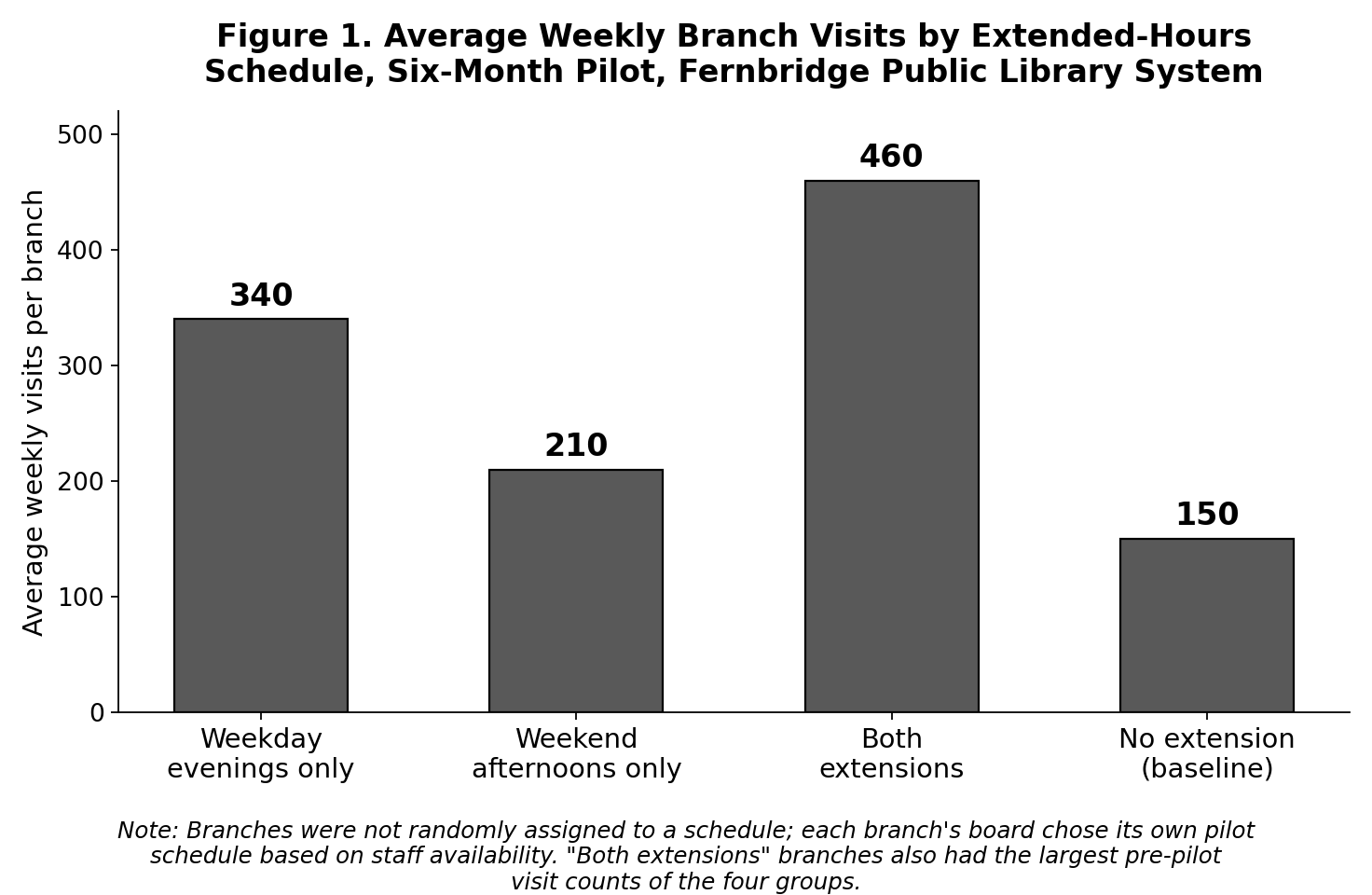
The comparison is not as clean as the bar heights suggest. Branches were not assigned a schedule at random. Each branch's own board chose its pilot schedule based on which staff members were willing and available to work extended shifts, and the two branches that chose to run both extensions were also, before the pilot began, the system's two busiest branches by a wide margin. A library that already draws more visitors has an obvious reason to find extending its hours worthwhile, and an obvious staffing advantage in doing so.
This does not mean the extended hours accomplished nothing. It means the figure cannot, by itself, separate two different explanations: that extended hours caused more visits, or that branches already positioned to attract more visits were also the ones most willing and able to extend their hours. Both explanations are consistent with every number in Figure 1.
A cleaner test would assign schedules to branches independent of their existing popularity, or at minimum compare each branch's own visit count before and after its specific schedule change, rather than comparing different branches' post-pilot totals to each other. The system office has proposed exactly that design for a second-phase pilot the following year.
None of this means the current results are worthless. They are a reasonable basis for choosing which schedule to test further, and a poor basis for concluding, on their own, that extending hours everywhere would triple a typical branch's traffic.
Passage IV
· Natural Science
(Original practice passage; names, institutions, and numerical details are constructed for test-preparation use.)
A desert ant leaves its nest, wanders several hundred metres over featureless ground in a path that doubles and loops, finds a dead insect, and then runs almost straight home. It does not retrace the outward path. It takes the direct line, which it has never travelled, and on arriving it begins a tight search at the point where the nest should be.
The ability is called path integration. The ant keeps a running record of the direction it has travelled and the distance covered, and combines the two into a single vector pointing back to the start. Direction comes from the sky. The ant reads the pattern of polarized light overhead, which changes with the position of the sun and remains readable when the sun itself is behind a dune.
Polarized light is worth explaining, since the ant’s use of it is not obvious. Sunlight scattering in the atmosphere becomes polarized in a pattern of bands centred on the sun, and the pattern holds across the whole sky. An eye able to detect the direction of polarization can therefore locate the sun from any patch of open sky, including a patch on the opposite horizon. The ant carries a specialized region at the top of each eye that does exactly this, and the region looks upward whatever the animal is doing.
Distance proved harder to explain. For decades the leading account was that the ant measured its own energy use, and the account survived because no one could think of a way to test it. Researchers tested the step-integrator hypothesis directly in a widely cited 2006 experiment.
The experiment that settled it is remembered for its directness. Ants were trained to run from a nest to a feeder twenty metres away. At the feeder, some had their legs lengthened by gluing on pig bristles, and others had their legs shortened by cutting the ends off. Both groups were then released to run home. The ants on lengthened legs overshot the nest by a predictable margin and began searching beyond it. The ants on shortened legs stopped short and searched in the wrong place. Ants that were caught and released without alteration ran the correct distance.
The result follows only if distance is measured in steps rather than in energy or in time. A longer leg covers more ground per step, so an ant counting an unchanged number of steps travels further than it intends. Energy expenditure would have given the opposite prediction, and elapsed time would have given no error at all.
The stride counter is not perfect and does not need to be. Errors accumulate over a long foraging run, and the tight search that an ant performs on arrival is what closes the remaining gap. The two systems work together: the vector brings the ant to within a metre or so, and the search pattern, a spiral of widening loops centred on the arrival point, covers the ground the vector could not.
What makes the desert ant a useful subject is the absence of alternatives. It forages on ground that offers few landmarks, at temperatures that destroy a scent trail within seconds, and alone rather than in a column. Anything it does to find its way home has to be carried inside the animal, which is why a system that would be hidden in another species is visible in this one.
One limit of the work should be stated. All of it concerns a genus of ants that forages alone in open desert, where a straight run home is possible and no scent trail would survive the heat. Ants that forage in forests, in columns, and along chemical trails solve the problem in other ways, and nothing in the stride-counting result applies to them.
Practice Test 1 · Reading Questions
Question 1
- A. the two brothers avoid discussing what the work means to them
- B. the brothers disagree about how the darkroom should be cleared
- C. Ivan resents having been given the harder part of the task
- D. Stephen has visited the darkroom more recently than Ivan has
Question 2
- F. indicate how long their father had been working in the room
- G. establish that Ivan is the more accurate of the two brothers
- H. show that Ivan has been counting the negatives as he works
- J. suggest that Stephen has forgotten when his brother was born
Question 3
- A. they have been estranged for a long period before this day
- B. Stephen takes responsibility for decisions that Ivan avoids
- C. they understand each other well enough to leave things unsaid
- D. Ivan has been the closer of the two to their father
Question 4
- F. that had never been sold to any buyer
- G. that had never been developed from the negatives
- H. that had never been shown to the two brothers
- J. that had never been arranged in any order
Question 5
- A. he cannot make out the image in the red light
- B. he intends to return for the box at a later date
- C. he does not want to say aloud what the print shows
- D. he has decided that the prints are of no value
Question 6
- F. a series of arguments that are resolved one after another
- G. a comparison of the two brothers’ memories of their father
- H. an account of how a darkroom is dismantled and packed
- J. a division of labour, an afternoon of work, and a disclosure at the end
Question 7
- A. the neighbour had been visiting their father most evenings
- B. their father had gone on printing after telling Ivan he had stopped
- C. the extractor fan had been left running through the winter
- D. Ivan had known about the printing and had said nothing
Question 8
- F. Ivan blames Stephen for not having visited their father
- G. Ivan has decided to take the contact sheets for himself
- H. Ivan doubts that the neighbour has remembered correctly
- J. Ivan is more affected by the disclosure than he is willing to show
Question 9
- A. two brothers quarrel over the division of their father’s possessions
- B. a photographer’s equipment is dispersed among family and neighbours
- C. two brothers clearing a room discover something their father had concealed
- D. a neighbour explains why a darkroom fell into disuse
Question 10
- F. walking buses reduce the total amount of driving in a town
- G. councils should stop funding schemes of this kind
- H. traffic counts taken at school gates are generally unreliable
- J. the scheme achieved something different from what it is credited with
Question 11
- A. the forty-one per cent fall in cars at the school gate
- B. the fall in injuries at the gate to zero over four years
- C. the count taken at four junctions half a mile from the school
- D. the closure of a factory employing three hundred people
Question 12
- F. by forty-one per cent
- G. by six per cent
- H. by thirty per cent
- J. not at all
Question 13
- A. introduce the injury figures that the rest of the passage explains
- B. argue that school gates should be closed to cars entirely
- C. concede the value of the scheme before disputing the claim made for it
- D. question whether the council counted the traffic correctly
Question 14
- F. councils rarely measure the effects of the schemes they fund
- G. emissions targets are more important than child safety
- H. walking buses work better in small towns than in large ones
- J. a scheme may be withdrawn because it was sold on the wrong benefit
Question 15
- A. a fuel price rise and a factory closure
- B. a change in the school’s catchment area
- C. roadworks on two of the four junctions
- D. an increase in the number of pupils enrolled
Question 16
- F. a chronological account of the scheme from 2011 to the present
- G. a reported success, the evidence that qualifies it, and what the case does show
- H. a comparison of several schools that adopted the same scheme
- J. a proposal followed by objections the author does not answer
Question 17
- A. a fold pressed into a sheet of paper
- B. an unexpected advantage of the scheme
- C. a mistake made by the council’s authors
- D. a small additional complication
Question 18
- F. praise the report for stating the limits of what it measured
- G. criticize the council for ignoring the factory closure
- H. explain why the six per cent figure should be discarded
- J. suggest that most council reports are deliberately misleading
Question 19
- A. Weekday evenings only
- B. Weekend afternoons only
- C. Both extensions
- D. No extension (baseline)
Question 20
- A. The pilot did not last long enough to produce reliable data.
- B. Branches were not randomly assigned to a schedule, and the branches that chose the most extensive schedule were already the system's busiest.
- C. The system office did not track visits accurately enough.
- D. Only six branches participated, which is too small a sample for any conclusion.
Question 21
- A. The figure proves that extended hours cause increased library visits.
- B. The figure shows a pattern consistent with extended hours increasing visits, but the same pattern is also consistent with busier branches simply being more likely to choose extended hours.
- C. The figure is unrelated to the passage's argument about causation.
- D. The figure proves that the pilot should be discontinued.
Question 22
- A. prove that extended hours have no effect on visit counts
- B. introduce a plausible alternative explanation for the pattern shown in Figure 1
- C. criticize the branch directors for choosing an unfair schedule
- D. suggest that busy branches should be closed
Question 23
- A. A larger total number of participating branches
- B. A way to separate the effect of the schedule from each branch's pre-existing popularity, such as random assignment or before-and-after comparison within the same branch
- C. A longer pilot period
- D. A survey asking patrons whether they liked the new hours
Question 24
- A. Weekend afternoon hours have no value compared to weekday evening hours.
- B. Their average visit count (210) was higher than the baseline branch's (150) but lower than either weekday-evening-only (340) or both-extensions branches (460).
- C. Weekend afternoon hours are inherently less popular than weekday evening hours in every library system.
- D. The weekend-afternoon schedule was tested at more branches than any other schedule.
Question 25
- A. It would have no bearing on the passage's argument, since the passage discusses only the first pilot.
- B. It would strengthen the case that extended hours themselves, not pre-existing popularity, drive the higher visit counts, since random assignment would remove the self-selection explanation.
- C. It would prove that all libraries should adopt both extensions immediately.
- D. It would disprove that library hours have any effect on visits.
Question 26
- A. The results are worthless and should be discarded entirely.
- B. The results are informative enough to guide which schedule to test further, but not strong enough alone to establish that extended hours caused the visit differences.
- C. The results conclusively prove that extended hours triple library use.
- D. The results are irrelevant because the pilot's methodology was fatally flawed from the start.
Question 27
- A. Libraries should never conduct pilot programs.
- B. A correlation observed under conditions where a factor was not randomly assigned can support more than one causal explanation.
- C. Visit counts are the only meaningful measure of a library's value.
- D. Branch directors cannot be trusted to report accurate data.
Question 28
- F. the scent trail left on the outward journey
- G. landmarks memorized during the outward run
- H. the pattern of polarized light in the sky
- J. the number of steps taken in each direction
Question 29
- A. stopped short of the nest and searched early
- B. overshot the nest and searched beyond it
- C. returned to the feeder rather than the nest
- D. ran the correct distance to the nest
Question 30
- F. a chronological history of research into insect navigation
- G. a behaviour, the mechanism proposed, the experiment, and its limits
- H. a comparison of desert ants with ants that forage in forests
- J. an argument that energy measurement explains the findings
Question 31
- A. the ants would have searched at the correct place
- B. the experiment would have produced no measurable error
- C. the shortened-leg group would have overshot instead
- D. the ants would have undershot rather than overshot the nest
Question 32
- F. builds up over the course of a run
- G. is corrected by the ant as it travels
- H. is measured against a fixed standard
- J. disappears once the nest is located
Question 33
- A. the ants on lengthened legs overshot by a predictable margin
- B. direction is read from polarized light in the sky
- C. the ants released without alteration ran the correct distance
- D. the search spiral is centred on the point of arrival
Question 34
- F. the vector alone is sufficient in most foraging runs
- G. the search pattern is used only when the vector fails
- H. the vector and the search pattern compensate for each other
- J. longer runs require a different navigational system
Question 35
- A. all ants that navigate without chemical trails
- B. a genus that forages alone in open desert
- C. ants that forage in columns along scent trails
- D. insects that read polarized light for direction
Question 36
- F. propose the next experiment that should be carried out
- G. state what the evidence does not extend to
- H. summarize the mechanism described in the earlier paragraphs
- J. question whether the bristle experiment was properly controlled
Practice Test 1 · Reading Answers and Explanations
Answer key: 1. A 2. F 3. C 4. J 5. C 6. J 7. B 8. J 9. C 10. J 11. C 12. G 13. C 14. J 15. A 16. G 17. D 18. F 19. D 20. H 21. A 22. F 23. B 24. F 25. D 26. F 27. B 28. H 29. B 30. G 31. D 32. F 33. C 34. H 35. B 36. G
1. Key: A. They agree the division without speaking, leave the safelight on without mentioning it, and answer each other in single words. B: They divide the work without argument and keep to the division throughout. C: No complaint about the division is made by either brother at any point. D: Nothing in the scene establishes when either brother last came here.
2. Key: F. Ivan corrects forty to thirty-eight and ties the figure to the summer he was born, which dates the father’s work exactly. G: The correction is a fact about their father rather than about Ivan’s accuracy. H: The number refers to years of work rather than to any counting of negatives. J: Stephen’s estimate concerns the years of photographs rather than Ivan’s birth.
3. Key: C. The division is settled without discussion, the safelight goes unmentioned, and a two-word exchange carries the point about printing. A: They arrive together and divide the work without needing to discuss it. B: Both brothers make decisions during the afternoon without deferring to each other. D: The passage gives no comparison of how close each brother was to him.
4. Key: J. The box holds prints that were never put in order, which is what the word describes in a room full of catalogued negatives. F: The prints are among their father’s possessions rather than goods for sale. G: Prints already exist, so the developing has plainly been done. H: Whether the brothers had seen them is not what the phrase describes.
5. Key: C. He lifts a print to the light, looks at it, and returns it without naming it, which is a decision to keep something to himself. A: He holds it up to the safelight, which indicates that he can see it. B: The box is left behind rather than marked for any later collection. D: He replaces it carefully rather than treating the box as worthless.
6. Key: J. The scene opens on who takes what, follows the clearing through the afternoon, and turns on what the neighbour says at four. F: No argument occurs between the brothers at any point in the scene. G: Their memories are never set against each other for comparison. H: The packing is the occasion for the scene rather than its organizing shape.
7. Key: B. The neighbour reports a light burning most nights until spring, and Ivan answers that their father had told him he had stopped. A: The neighbour reports the light rather than describing any visits. C: The fan is described as working well rather than as left running. D: His reaction to the neighbour’s remark indicates that the news is new to him.
8. Key: J. He carries the pile out without looking at his brother and sweeps a floor that is already clean. F: No accusation is made, and Stephen’s visits are never discussed. G: He set the sheets aside earlier, before the neighbour said anything. H: He repeats the neighbour’s phrase rather than questioning its accuracy.
9. Key: C. The clearing occupies the afternoon and the scene turns on the neighbour’s remark about the light burning most nights. A: The division is settled at the start and never becomes a quarrel. B: Only the fan goes to the neighbour, and the equipment stays with the brothers. D: The neighbour reports that the light was on rather than that work stopped.
10. Key: J. The gate emptied while area traffic barely moved, so the scheme made a crossing safer rather than reducing driving. F: The area count found most of the cars still on the road afterward. G: The author calls the scheme worth doing for its own sake. H: The gate count is described as real and is relied on throughout.
11. Key: C. Total traffic half a mile out fell only six per cent, which shows the cars had moved rather than disappeared. A: That figure is the claim being examined rather than the evidence against it. B: The injury figures support the safety benefit rather than testing the driving claim. D: The closure is raised as a complication in attributing the small area fall.
12. Key: G. The passage reports that total morning traffic at the four junctions dropped by six per cent over the period. F: That figure describes cars at the school gate rather than area traffic. H: No figure of this size appears anywhere in the passage. J: A fall of six per cent is reported, so the total did move.
13. Key: C. The paragraph states that the scheme is worth doing and that injuries fell, then separates that achievement from the reduction claim. A: The injury figures appear within the concession rather than as a new subject. B: No proposal about closing gates is made anywhere in the passage. D: The counts are accepted, and the argument concerns what they show.
14. Key: J. An authority funding emissions reductions will judge a safety scheme by a measure it was never designed to meet. F: The council here measured carefully and reported what it had measured. G: The passage sets the two aims side by side without ranking them. H: Town size is never discussed as a factor in the passage.
15. Key: A. The passage names a rise in fuel prices and the closure of a factory employing three hundred people. B: No change to the catchment is mentioned anywhere in the passage. C: Roadworks are not among the complications that the passage raises here. D: Enrolment is never given as a factor affecting the traffic count.
16. Key: G. The passage opens on the headline figure, produces the area count that qualifies it, and closes on the narrower claim it supports. F: The passage is organized by argument rather than by sequence of years. H: Only one school is examined at any point in the whole passage. J: The author raises and answers the objections rather than leaving them.
17. Key: D. The word introduces the fuel rise and the factory closure, which make the six per cent harder to attribute. A: The literal sense of a crease has no place in this argument. B: What follows makes the attribution harder rather than helping the case. C: The authors are praised for describing exactly what they had measured.
18. Key: F. The closing sentence of that paragraph says the authors described what they measured and where, which is more than most reports manage. G: The passage notes that the report did not claim to account for it. H: The figure is kept and treated as hard to attribute rather than discarded. J: Other reports are said to manage less rather than to mislead deliberately.
19. Key: C. The figure shows 460 average weekly visits for branches offering both extensions, the highest of the four bars. This is a direct table-reading question with no interpretation required.
20. Key: B. The passage explicitly identifies self-selection, combined with a pre-existing popularity difference, as the specific problem preventing a clean causal conclusion. A, C, and D are not concerns the passage actually raises.
21. Key: B. This matches the passage's own framing precisely: the data are consistent with more than one explanation, and the figure alone cannot distinguish between them. A and D both overstate what the figure can establish. C denies a connection the figure clearly supports.
22. Key: B. This detail is the specific evidence behind the passage's caution about causation: it supplies a concrete, plausible reason the "both extensions" branches might show high visit counts regardless of the schedule change itself. A overstates the point into a claim of zero effect. C and D both introduce judgments the passage never makes.
23. Key: B. The passage names this specific fix directly: random assignment or a within-branch before-and-after comparison, either of which would separate the schedule's effect from a branch's existing popularity. A, C, and D are all plausible-sounding improvements the passage does not actually propose.
24. Key: B. This is a direct, scoped comparison of the actual reported numbers, without generalizing beyond this pilot. A overstates a numeric difference into a claim of "no value." C generalizes a single pilot's result into a universal claim about all library systems. D is not supported; the passage does not report how many branches chose each schedule.
25. Key: B. Random assignment directly addresses the specific limitation the passage identifies, so a similar result under that design would rule out the self-selection explanation the passage raises, strengthening a causal reading. A ignores the passage's own forward-looking reference to a second-phase pilot. C and D both overstate a single design improvement into an absolute, universal conclusion.
26. Key: B. The passage explicitly states the results are "a reasonable basis for choosing which schedule to test further, and a poor basis" for a firm causal conclusion, precisely the measured, dual-sided position this choice describes. A and D both overstate the passage's criticism into total dismissal. C overstates what the passage says the results prove.
27. Key: B. This states the general methodological point the specific Fernbridge example is built to demonstrate. A, C, and D each import a judgment or scope the passage never states or supports.
28. Key: H. The passage states that direction comes from the sky, read as a pattern of polarized light overhead. F: Scent trails are mentioned only in the closing paragraph about other ants. G: Landmarks are never given as the source of directional information. J: Steps supply the distance rather than the direction of travel.
29. Key: B. Ants given lengthened legs travelled further than intended and began searching past the nest by a predictable margin. A: Stopping short describes the ants whose legs had been shortened. C: No group of ants returned to the feeder after being released. D: That result belongs to the ants that were released without alteration.
30. Key: G. The passage opens on the homeward run, sets out path integration, describes the bristle experiment, and closes on what it does not cover. F: Only two accounts are described, and the passage is organized by argument. H: Forest ants appear once at the close rather than being compared throughout. J: The energy account is the explanation that the experiment overturns.
31. Key: D. The passage states that energy expenditure would have given the opposite prediction from the result that was obtained. A: An unchanged search point is what the unaltered control group produced. B: That outcome is attributed to elapsed time rather than to energy use. C: The passage does not describe any prediction of that reversal.
32. Key: F. Small errors gather over a long foraging run, which is why the search pattern is needed on arrival. G: Correction happens on arrival through searching rather than during the run. H: No standard of comparison is described anywhere in the passage. J: The gathering of error precedes and explains the search behaviour.
33. Key: C. The unaltered group establishes that the handling and release rather than the leg change produced no error. A: That result shows an effect without ruling out other causes of it. B: Direction is a separate system from the distance measure under test. D: The spiral describes what happens after the vector has been run.
34. Key: H. The vector brings the ant within about a metre and the spiral covers the ground the vector could not. F: The passage states that the vector leaves a gap of about a metre. G: The search is described as routine on arrival rather than as a fallback. J: No second system is introduced for runs of greater length.
35. Key: B. The closing paragraph states that all the work concerns a genus foraging alone in open desert. A: The limit is stated more narrowly than that in the closing paragraph. C: Those ants are named as the case the findings do not cover. D: The limit concerns foraging habit rather than the light-reading ability.
36. Key: G. The final paragraph names the single genus studied and the foraging conditions to which the result is confined. F: No further experiment is proposed at any point in the passage. H: New material about other ants is introduced rather than summarized. J: The experiment is accepted, and its control is described approvingly.
My acquired vocabulary
Fill this in with words you missed or hesitated on anywhere in this test, English or Reading, not only from Chapter 9 material. The sentence it appeared in matters more than the word alone; write enough of it to remember why the word tripped you up.
| Word or phrase | Sentence it appeared in | What it meant here | What I confused it with |
|---|---|---|---|
My error log for this test
Use this alongside the acquired-vocabulary table above. Fill in one row per missed question from this test, English or Reading. The full method for using this log is taught in Chapter 10.
| Question / section | Choice I picked | Why it was actually wrong | Knowledge gap or execution error? | Rule or proof that resolves it |
|---|---|---|---|---|