ACT Math study guide · Chapter 25
Coordinate Geometry
The distance between two points is found with the distance formula, √[(x₂−x₁)²+(y₂−y₁)²], which is the Pythagorean theorem applied to coordinates. The midpoint of two points averages their x-coordinates and averages their y-coordinates separately: ((x₁+x₂)/2, (y₁+y₂)/2).
Parallel nonvertical lines share the same slope. For two nonvertical, nonhorizontal perpendicular lines, the slopes are negative reciprocals: a slope of 2/3 pairs with a perpendicular slope of −3/2. The special case is a horizontal line and a vertical line: slope 0 is perpendicular to an undefined slope, so the negative-reciprocal shortcut is not used there.
When a triangle's vertices are given as coordinates and two vertices share the same y-coordinate or the same x-coordinate, that shared side can be used directly as the base, and the perpendicular distance to the third vertex becomes the height, without needing the full distance formula on every side.
Where this appears as a model: two locations described by their positions. Two cell towers at (0,0) and (6,8), measured in miles, are 10 miles apart, found with the distance formula once each location is written as a coordinate point.
▸ Triangle area from coordinates
Worked Example Find the area of a triangle with vertices at (0, 0), (6, 0), and (3, 8), shown below.
The side from (0,0) to (6,0) lies along the x-axis and serves as the base.
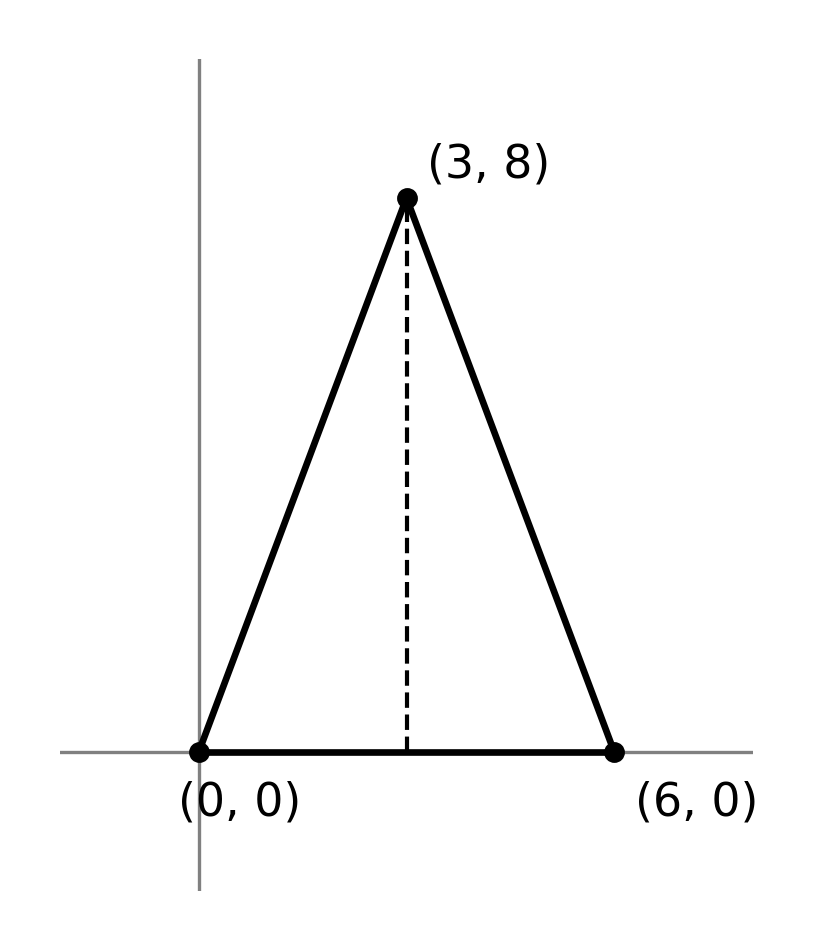
Base = 6, height = 8 (the y-coordinate of the third vertex)
Area = (1/2)(6)(8) = 24
▸ Parallel and perpendicular slopes
Worked Example A line has slope 5/6. Find the slope of a line perpendicular to it.
A perpendicular slope is the negative reciprocal.
−6/5
▸ Practice
Question 1
- A. 10
- B. 8
- C. 12
- D. 6
Question 2
- F. (3, −1)
- G. (4, 1)
- H. (8, −2)
- J. (4, −1)
Question 3
- A. 2
- B. −2
- C. 1/2
- D. −1/2
Question 4
- F. 3/4
- G. 4/3
- H. −3/4
- J. −4/3
Question 5
- A. y = 2x − 8
- B. y = −2x − 4
- C. y = −2x + 4
- D. y = −2x + 1
Question 6
- F. 15
- G. 30
- H. 21
- J. 18
Question 7
- A. 10
- B. 8
- C. 6
- D. 14
Question 8
- F. (1, 3)
- G. (−1, −3)
- H. (−1, 3)
- J. (1, −3)
Question 9
- A. 1
- B. −1
- C. −6
- D. 6
Question 10
- F. −2/5
- G. 5/2
- H. 2/5
- J. −5/2
Question 11
- A. 1/4
- B. −4
- C. 4
- D. −1/4
Question 12
- F. 48
- G. 24
- H. 18
- J. 30
Question 13
- A. 5
- B. −1
- C. −7
- D. 7
Question 14
- F. 9
- G. 13
- H. 15
- J. 17
Question 15
- A. 5
- B. 3
- C. 7
- D. 4
Question 16
- F. (2, −2)
- G. (2, 2)
- H. (−2, 2)
- J. (8, 4)
Question 17
- A. 0.5
- B. 9
- C. 6
- D. 1.5
Question 18
- F. 48
- G. 18
- H. 24
- J. 30
Question 19
- A. 8/5
- B. 5/8
- C. −8/5
- D. −5/8
Question 20
- F. 3/7
- G. 7/3
- H. −3/7
- J. −7/3
▸ Answers and Explanations
Show the answers and explanations
1: A. √[(4−(−2))²+(−5−3)²] = √[36+64] = √100 = 10. Choice B comes from an arithmetic slip while applying the distance formula.
2: J. [(1+7)/2, (−4+2)/2] = (4, −1). Choice F subtracts the two x-coordinates and divides by 2 instead of adding them.
3: B. (−3−5)/(6−2) = −8/4 = −2. Choice A drops the negative sign while computing the slope.
4: F. The negative reciprocal of −4/3 is 3/4. Choice G inverts the ratio without flipping the sign, reporting the reciprocal of −4/3 instead of the negative reciprocal.
5: C. A parallel line keeps the same slope, −2: y−(−2)=−2(x−3) simplifies to y=−2x+4. Choice A drops the negative sign on the slope, using a perpendicular-style sign error instead of keeping the slope the same for a parallel line.
6: F. The two legs along the grid lines serve as base (5) and height (6): area = (1/2)(5)(6) = 15. Choice G omits the 1/2 factor, computing the area as if for a rectangle instead of a triangle.
7: A. √[(7−1)²+(−3−5)²]=√[36+64]=√100=10. Choice B comes from an arithmetic slip while applying the distance formula.
8: J. [(4+(−2))/2, (−9+3)/2]=(1, −3). Choice F drops the negative sign while averaging the y-coordinates.
9: B. (2−8)/(9−3)=−6/6=−1. Choice A drops the negative sign while computing the slope.
10: F. A parallel line keeps the same slope: −2/5. Choice G reports the negative reciprocal, the perpendicular slope, instead of keeping the same slope required for a parallel line.
11: D. The negative reciprocal of 4 is −1/4. Choice A drops the negative sign on the reciprocal.
12: G. The horizontal side from (0,0) to (6,0) has length 6, serving as the base; the height, the vertical distance to (3,8), is 8. Area=(1/2)(6)(8)=24. Choice F omits the 1/2 factor, computing the area as if for a rectangle instead of a triangle.
13: C. Using point-slope form: y−(−1)=3(x−2), so y=3x−7; the y-intercept is −7. Choice A adds the slope-adjusted term instead of properly isolating y in point-slope form.
14: H. √[(5−(−4))²+(−10−2)²]=√[81+144]=√225=15. Choice F comes from an arithmetic slip while applying the distance formula.
15: A. √[(6−2)²+(2−(−1))²]=√[16+9]=√25=5. Choice B comes from an arithmetic slip while applying the distance formula.
16: G. [(10+(−6))/2, (−4+8)/2]=(2, 2). Choice F comes from a sign error while averaging the y-coordinates.
17: D. (7−(−2))/(10−4)=9/6=1.5. Choice A comes from an arithmetic slip while computing the slope.
18: H. The horizontal side from (1,1) to (7,1) has length 6, serving as the base; the height, the vertical distance to (4,9), is 8. Area=(1/2)(6)(8)=24. Choice F omits the 1/2 factor, computing the area as if for a rectangle instead of a triangle.
19: B. A parallel line keeps the same slope: 5/8. Choice A inverts the ratio instead of keeping the same slope required for a parallel line.
20: G. The negative reciprocal of −3/7 is 7/3. Choice F reports the reciprocal without accounting for the sign change required for a perpendicular slope.