ACT Math study guide · Chapter 24
Area and Volume
A rectangle's area is length times width; a triangle's area is one-half base times height; a trapezoid's area is the average of its two parallel bases times height. A cone's volume is one-third πr²h; a sphere's volume is four-thirds πr³; a rectangular prism's volume is length times width times height. Missing the coefficient in front of these formulas, the 1/3 or 4/3, is one of the most common errors on this topic.
A composite figure combines simple shapes, and its area or volume combines just as directly. When a shape is added onto another, add the two areas together. When a shape is removed or cut out, subtract its area from the original. Identifying which operation applies, addition or subtraction, is the actual skill; the individual area formulas are usually straightforward once that decision is made.
When two similar solids have a linear scale factor k, their volumes scale by k³, since volume is a three-dimensional measurement. This extends the same pattern used for area: length scales by k, area by k², and volume by k³.
Where this appears as a model: the material needed to build a container. A cylindrical can of radius 3 and height 10 requires 2π(3)²+2π(3)(10)≈245.04 square units of material, using surface area instead of volume because the question asks what covers the can, not what it holds.
▸ Composite figures: add or subtract
Worked Example A 10-by-6 rectangle has a quarter-circle of radius 4 cut from one corner, shown below. Find the remaining area.
The quarter-circle is removed, so subtract its area from the rectangle.
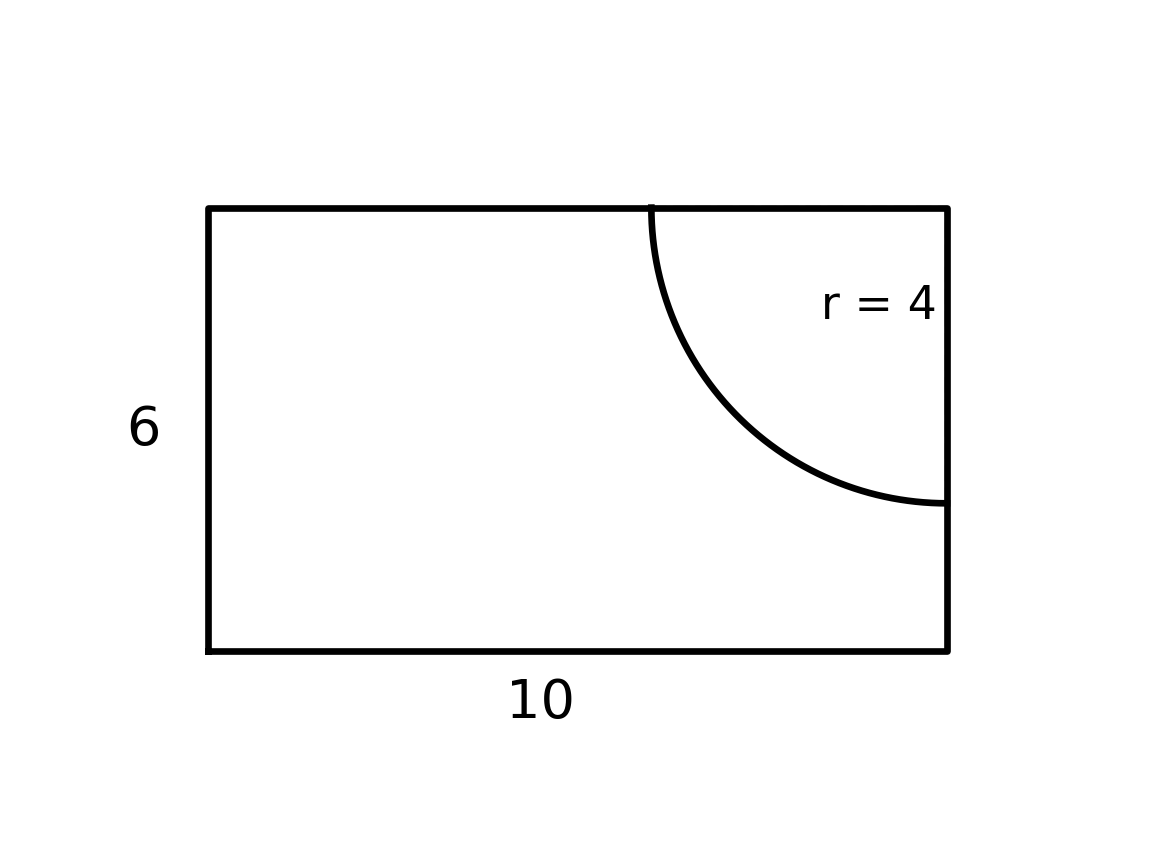
Rectangle area: 10 × 6 = 60
Quarter-circle area: (1/4)π(4)² ≈ 12.57
Remaining area: 60 − 12.57 ≈ 47.43
▸ Volume of similar solids
Worked Example Two similar solids have a linear scale factor of 3:1. The smaller solid has a volume of 20. Find the larger solid's volume.
Volume scales by the cube of the linear ratio.
(3/1)³ = 27
20 × 27 = 540
▸ Practice
Question 1
- A. 60
- B. 47.43
- C. 56
- D. 72.57
Question 2
- F. 226.19
- G. 37.70
- H. 100.53
- J. 75.40
Question 3
- A. 904.78
- B. 301.59
- C. 452.39
- D. 1206.37
Question 4
- F. 125
- G. 20
- H. 50
- J. 100
Question 5
- A. 44
- B. 110
- C. 35
- D. 55
Question 6
- F. 64
- G. 96
- H. 16
- J. 48
Question 7
- A. 116
- B. 126
- C. 136
- D. 146
Question 8
- F. 56
- G. 112
- H. 46
- J. 63
Question 9
- A. 144
- B. 80
- C. 128
- D. 112
Question 10
- F. 1526.81
- G. 3053.63
- H. 763.41
- J. 2290.22
Question 11
- A. 100π
- B. 60π
- C. 300π
- D. 20π
Question 12
- F. 200
- G. 180
- H. 190
- J. 220
Question 13
- A. 60.00
- B. 54.14
- C. 45.86
- D. 51.00
Question 14
- F. 301.59
- G. 401.92
- H. 276.46
- J. 351.86
Question 15
- A. 188
- B. 208
- C. 198
- D. 178
Question 16
- F. 180
- G. 29
- H. 90
- J. 100
Question 17
- A. 261.80
- B. 523.60
- C. 392.70
- D. 314.16
Question 18
- F. 112
- G. 126
- H. 140
- J. 252
Question 19
- A. 251.33
- B. 753.98
- C. 62.83
- D. 188.50
Question 20
- F. 256.00
- G. 78.54
- H. 177.46
- J. 334.54
▸ Answers and Explanations
Show the answers and explanations
1: B. Rectangle area 60, minus a quarter of π(4)² ≈ 12.57, gives approximately 47.43. Choice A reports the full rectangle area without subtracting the quarter-circle that was removed.
2: J. Cone volume = (1/3)πr²h = (1/3)π(9)(8) ≈ 75.40. Choice F omits the 1/3 factor in the cone volume formula, computing πr²h instead of (1/3)πr²h.
3: A. Sphere volume = (4/3)πr³ = (4/3)π(216) ≈ 904.78. Choice B mistakenly applies a 1/3 factor as if this were a cone instead of a sphere.
4: F. Volume scales by the cube of the linear ratio: (5/2)³ = 125/8, so 8 × 125/8 = 125. Choice G applies the linear ratio directly instead of cubing it for the volume scale factor.
5: D. Trapezoid area = (b₁ + b₂)/2 × h = (8+14)/2 × 5 = 55. Choice A comes from an arithmetic slip in the trapezoid area formula.
6: G. Surface area of a cube = 6s² = 6(16) = 96. Choice F computes the cube's volume (s³) instead of its surface area (6s²).
7: B. 14×9=126. Choice A comes from an arithmetic slip while multiplying 14 × 9.
8: F. (1/2)(16)(7)=56. Choice G omits the 1/2 factor, computing the area as if for a rectangle instead of a triangle.
9: D. (10+18)/2×8=112. Choice A uses only the larger base (18) multiplied by the height, without averaging with the smaller base.
10: G. (4/3)π(9)³≈3053.63. Choice F omits a factor of 2 somewhere in the sphere volume formula, giving half the correct value.
11: A. (1/3)π(5)²(12)=(1/3)π(300)=100π. Choice B comes from an arithmetic slip while applying the cone volume formula.
12: F. 5×4×10=200. Choice G comes from an arithmetic slip while multiplying the three dimensions.
13: C. Rectangle area: 10×6=60; semicircle area (r=3): 0.5×π×3²≈14.14; remaining≈45.86. Choice A reports the full rectangle area without subtracting the semicircle that was removed.
14: J. 2πr²+2πrh=2π(4)²+2π(4)(10)=2π(16+40)=2π(56)≈351.86. Choice F includes only one circular base instead of both, using πr²+2πrh instead of 2πr²+2πrh.
15: C. 18×11=198. Choice A comes from an arithmetic slip while multiplying 18 × 11.
16: H. (1/2)(20)(9)=90. Choice F omits the 1/2 factor, computing the area as if for a rectangle instead of a triangle.
17: B. (4/3)π(5)³≈523.60. Choice A omits a factor of 2 somewhere in the sphere volume formula, giving half the correct value.
18: G. (14+22)/2×7=126. Choice F averages the two bases incorrectly before multiplying by the height.
19: A. (1/3)π(4)²(15)≈251.33. Choice B omits the 1/3 factor in the cone volume formula, computing πr²h instead of (1/3)πr²h.
20: H. Square area: 16²=256; circle area: π(5)²≈78.54; remaining≈177.46. Choice F reports the full square area without subtracting the circle that was removed.
▸ A 3D composite solid
Worked Example A silo is shaped like a cylinder of radius 3 and height 10, topped with a cone of the same radius and height 4. Find the total volume, rounded to the nearest hundredth.
A 3D composite solid combines volumes the same way a 2D composite figure combines areas: identify each solid piece, then add or subtract.
Cylinder: π(3)²(10) = 90π ≈ 282.74
Cone: (1/3)π(3)²(4) = 12π ≈ 37.70
Total: 90π + 12π = 102π ≈ 320.44
Question 21
- A. 603.19
- B. 737.23
- C. 871.27
- D. 804.25
Show the answers and explanations
21: B. Cylinder: π(4)²(12) = 192π ≈ 603.19. Hemisphere: half of (4/3)π(4)³, which is (128/3)π ≈ 134.04. Total: 603.19+134.04=737.23. Choice A reports the cylinder alone, forgetting to add the hemisphere on top.