ACT Math study guide · Chapter 57
Full-Length Benchmark Test
This is a complete 45-question, 50-minute benchmark with four answer choices and broad coverage of the current enhanced ACT Math reporting categories. Questions are not labeled by chapter. ACT's current design framework specifies an overall increase in difficulty across the Math section. Treat that as a form-level pattern instead of a guarantee that every adjacent question is harder than the one before it; solve each question on its own merits and avoid overspending time simply because of its position.
Work this section in one sitting, under real timing, before checking anything. The skills map and full solutions that follow are for review afterward, not for reference during the test itself.
▸ Questions
1. Find 15% of 200.
A) 20 B) 15 C) 30 D) 45
2. Solve for x: 7x + 4 = 3x + 20.
F) 3 G) 5 H) 6 J) 4
3. Let f(x) = 5x + 1. Find f(3).
A) 15 B) 11 C) 6 D) 16
4. In the figure above, find the value of x.
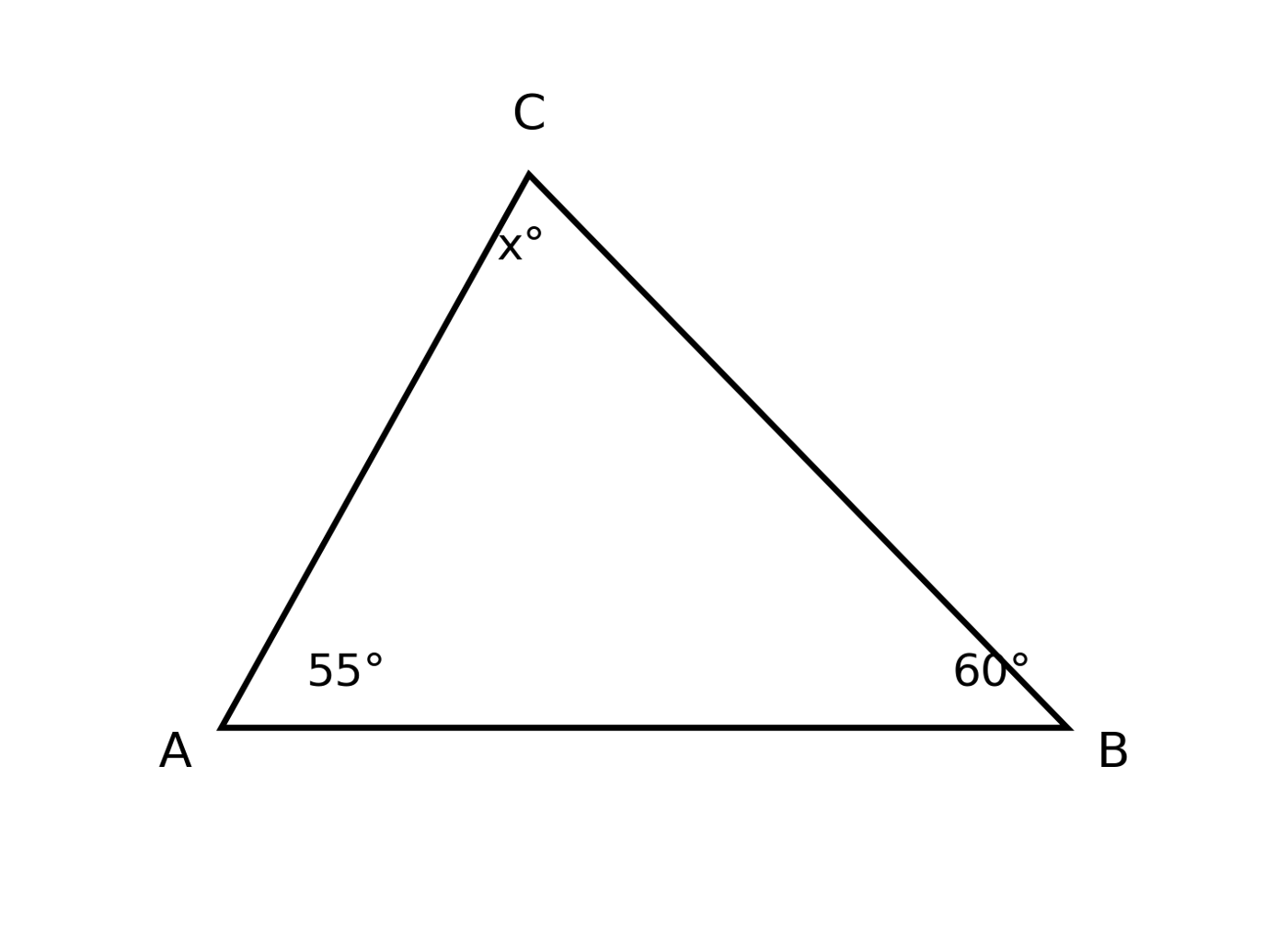
F) 55 G) 60 H) 70 J) 65
5. Find the mean of 3, 7, 11, 15, 19.
A) 15 B) 11 C) 19 D) 9
6. Simplify −√16.
F) 4 G) −2 H) 16 J) −4
7. A value rises from 90 to 120. Find the percent increase, to the nearest tenth.
A) 25% B) 30% C) 33.3% D) 40%
8. Solve the inequality 3x − 7 ≤ 11.
F) x ≤ 6 G) x ≥ 6 H) x ≤ 4 J) x ≥ 4
9. Let f(x) = x − 2 and g(x) = x². Find g(f(5)).
A) 3 B) 25 C) 9 D) 7
10. In the figure above, find the length of side BC.
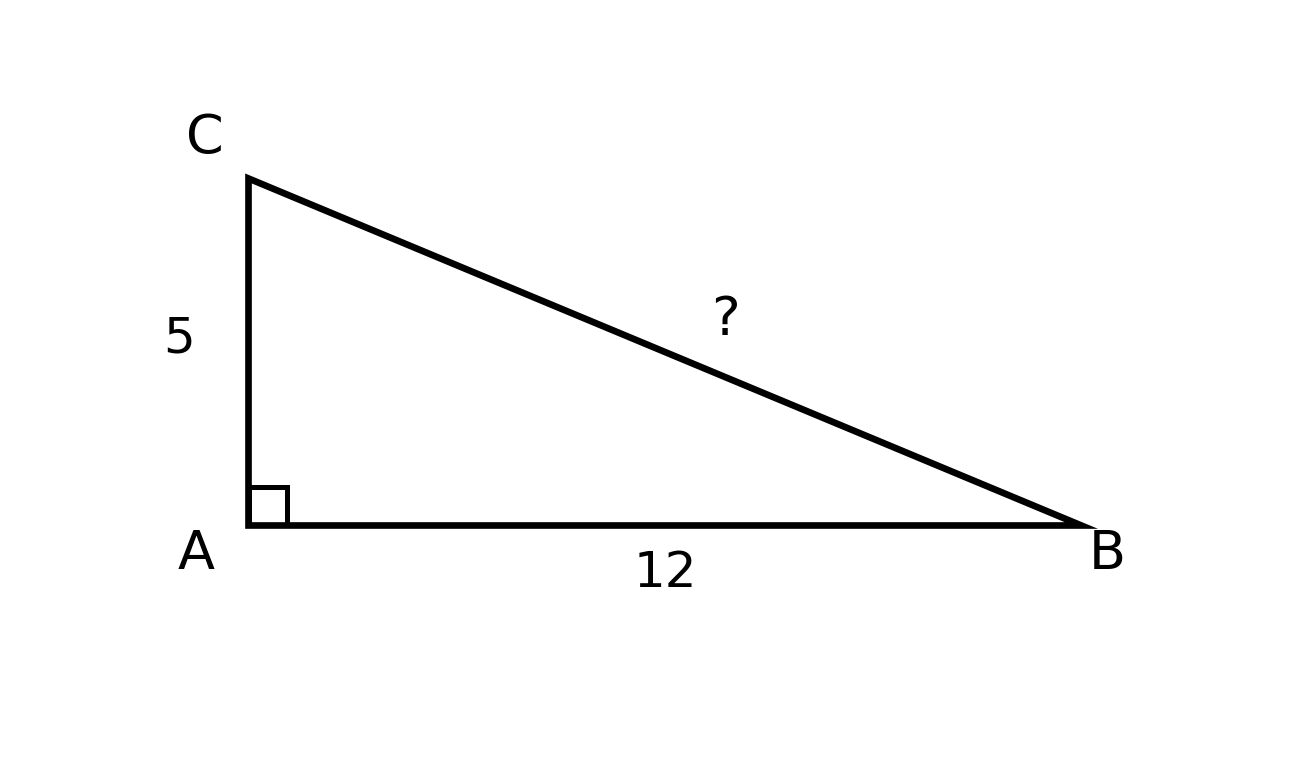
F) 17 G) 13 H) 60 J) 7
11. Find the median of 12, 5, 18, 9, 7.
A) 12 B) 9 C) 7 D) 10.2
12. A car travels 350 miles in 5 hours. Find its unit rate in miles per hour.
F) 350 G) 70 H) 75 J) 65
13. Simplify (5 + 2i) − (3 − 4i).
A) 8 − 2i B) 2 − 6i C) 2 + 6i D) −2 + 6i
14. Solve the system 3x − y = 10 and x + y = 6. Find x − y.
F) 6 G) 10 H) 2 J) −2
15. Find the zeros of f(x) = x² − 9.
A) 9, −9 B) 3 only C) −3, 3 D) −9, 9
16. Find the area of a circle with radius 6.
F) 36π G) 6π H) 72π J) 12π
17. Convert 9 feet to inches.
A) 108 B) 18 C) 72 D) 90
18. A fair six-sided die is rolled once. Find the probability of rolling an even number.
F) 1/3 G) 1/2 H) 2/3 J) 1/6
19. Solve by factoring: x² + 2x − 24 = 0.
A) x = 6, −4 B) x = −6, 4 C) x = −6, −4 D) x = 6, 4
20. Find the vertical asymptote of f(x) = (2x − 1) ⁄ (x + 4).
F) x = 4 G) x = 1/2 H) x = 2 J) x = −4
21. In the figure above, find the length of ST.
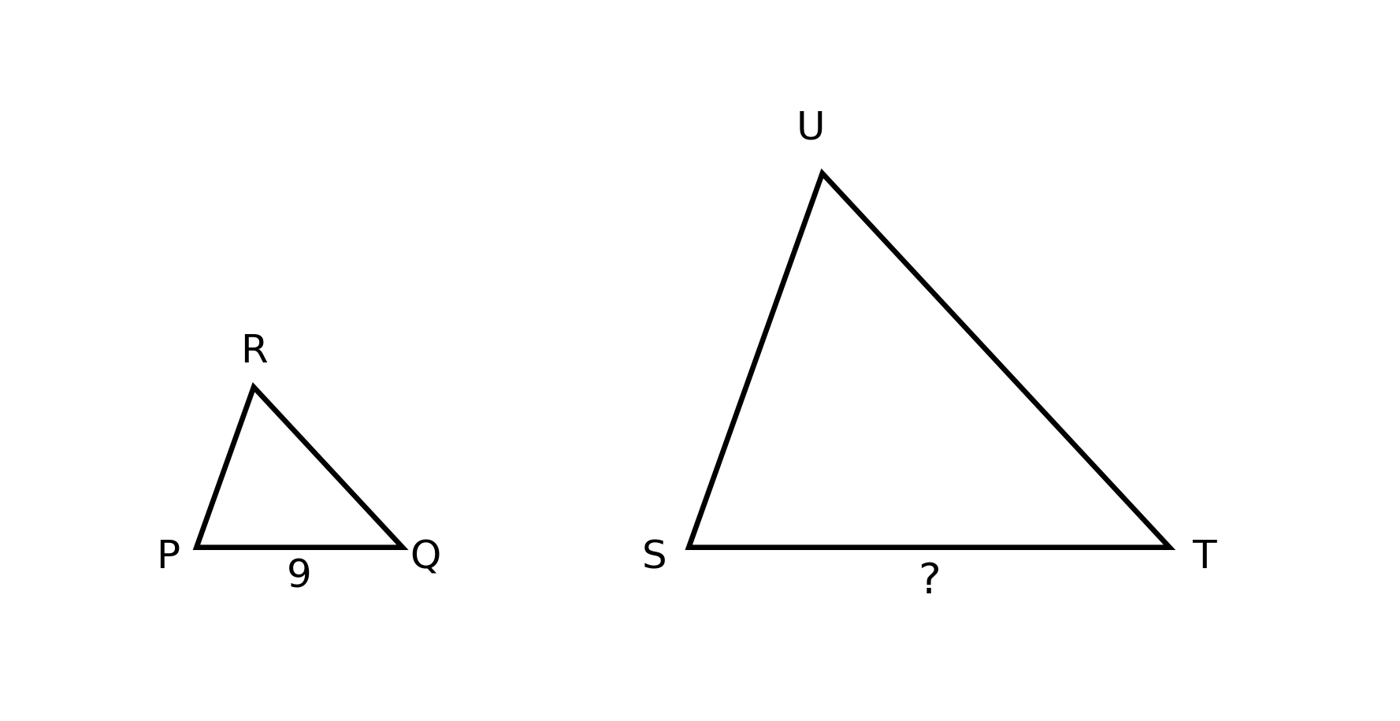
A) 21 B) 15 C) 12 D) 18
22. A grade is weighted 4 credit hours at 3.5 and 2 credit hours at 2.0. Find the weighted average.
F) 2.75 G) 3.25 H) 2.5 J) 3.0
23. Simplify (x³)^(2/3).
A) x² B) x^(3/2) C) x⁶ D) x^(2/3)
24. Four numbers have an average of 18. Three of them are 14, 20, and 22. Find the fourth.
F) 16 G) 20 H) 12 J) 8
25. Find the discriminant of x² − 4x + 7 = 0, and the number of real solutions.
A) 12; two real solutions B) −12; two complex solutions C) −12; one real solution D) 12; no solutions
26. Find the inverse of f(x) = (x − 3) ⁄ 4.
F) (x + 3) ⁄ 4 G) x ⁄ 4 − 3 H) 4x + 3 J) 4x − 3
27. Find the distance between (2, −1) and (−4, 7).
A) 6 B) 8 C) 10 D) 36
28. Events A and B are independent, with P(A) = 0.7 and P(B) = 0.6. Find P(A and B).
F) 1.3 G) 0.42 H) 0.13 J) 0.35
29. A trip covers 150 miles at 50 miles per hour, then 150 miles at 75 miles per hour. Find the average speed for the whole trip.
A) 62.5 B) 65 C) 55 D) 60
30. Solve |3x − 2| = 10.
F) x = 4 only G) x = −8/3 only H) x = 4 or x = −8/3 J) x = 4 or x = 8/3
31. A piecewise function is p(x) = 2x − 1 if x < 2, and p(x) = x² + 1 if x ≥ 2. Find p(2).
A) 3 B) 4 C) 1 D) 5
32. Find sin(60°).
F) 1/2 G) √2/2 H) √3/2 J) 1
33. Find the determinant of [[6, −2], [3, 4]].
A) 18 B) 24 C) 10 D) 30
34. 5 workers can complete a job in 12 days. At the same rate, how many days would 8 workers take?
F) 7.5 G) 19.2 H) 8.5 J) 6
35. In the figure above, find the interquartile range.
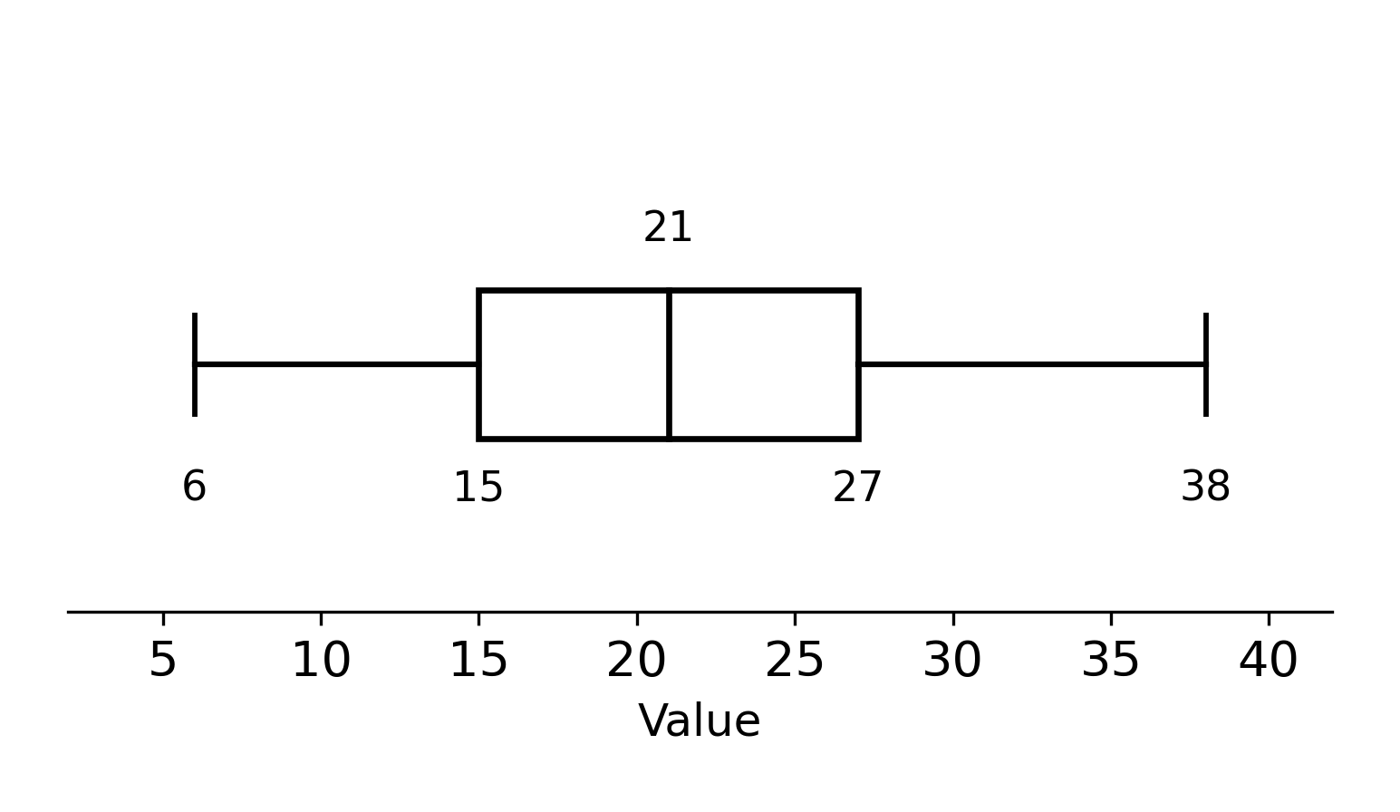
A) 12 B) 42 C) 15 D) 9
36. Solve 2^(3x−1) = 16.
F) 1 G) 3 H) 5/3 J) 5
37. An arithmetic sequence has a₁ = 10 and d = −3. Find a₁₂.
A) −23 B) −13 C) 23 D) −33
38. Find the volume of a cone with radius 4 and height 9.
F) 144π G) 48π H) 16π J) 36π
39. A rate rises from 22% to 28%. By how many percentage points did it increase?
A) 6% B) 6 C) 0.06 D) 27.3%
40. Divide: (7 + i) ÷ (2 − i).
F) (13 − 9i) ⁄ 5 G) (13 + 9i) ⁄ 5 H) (1 + 9i) ⁄ 5 J) (13 + i) ⁄ 5
41. In a survey, 90 people own dogs. Of those, 54 also own cats. Find the probability that a randomly chosen dog owner also owns a cat.
A) 0.36 B) 0.9 C) 0.54 D) 0.6
42. For what value(s) of k does x² + kx + 25 = 0 have exactly one real solution?
F) k = ±10 G) k = 10 only H) k = −10 only J) k = ±5
43. Let f(x) = x² and g(x) = 3x − 2. For what value(s) of x does f(g(x)) = 64?
A) x = 10/3 only B) x = 10/3 or x = −2 C) x = −2 only D) x = 8/3 or x = −2
44. Find the center and radius of the circle x² + y² − 10x + 6y + 18 = 0.
F) center (5, −3), r = 4 G) center (−5, 3), r = 4 H) center (5, −3), r = 16 J) center (−5, 3), r = 16
45. An item costs a store $120. It is marked up 30% to set the retail price, then discounted 20% from that retail price. Find the final price.
A) $124.80 B) $120 C) $115.20 D) $156
▸ Answers and Explanations
1: C. Finding a percent of a number means multiplying by its decimal form: 0.15 × 200 = 30. Choice A comes from using 10% instead of the given 15%. (IES – Percentages)
2: J. 4x = 16, so x = 4. Choice F comes from an arithmetic slip while solving for x. (Linear Equations)
3: D. 5(3)+1 = 16. Choice A reports 5×3 alone, forgetting to add 1. (Evaluation)
4: J. The interior angles of a triangle sum to 180°: 180 − 55 − 60 = 65°. Choice F reports one of the given angles instead of computing the third. (Triangles)
5: B. (3+7+11+15+19)÷5 = 55÷5 = 11. Choice A reports the largest value in the list instead of the mean. (Center & Spread)
6: J. √16 = 4, so −√16 = −4. Choice F drops the negative sign in front of the radical. (Real & Complex #s)
7: C. (120−90)÷90×100 ≈ 33.3%. Choice A divides by the new value (120) instead of the original value (90). (Percent Change)
8: F. 3x≤18, so x≤6. Choice G reverses the inequality direction. (Linear Inequalities)
9: C. f(5)=3, then g(3)=9. Choice A reports f(5) alone instead of completing the composition with g. (Composition)
10: G. The Pythagorean theorem gives the hypotenuse: √(5²+12²) = √169 = 13. Choice F adds the two legs directly (5+12=17) instead of applying the Pythagorean theorem. (Right Triangles)
11: B. Ordered: 5,7,9,12,18. The middle value is 9. Choice A reports a value adjacent to the true median instead of the middle value itself. (Center & Spread)
12: G. 350 ÷ 5 = 70. Choice F reports the total miles without dividing by the number of hours. (Rates)
13: C. 5−3=2 for the real part; 2−(−4)=6 for the imaginary part: 2+6i. Choice A adds the real parts instead of subtracting them. (Real & Complex #s)
14: H. Adding the equations gives 4x=16, x=4, y=2; x−y=2. Choice F reports x alone instead of completing the requested x−y. (Systems)
15: C. (x−3)(x+3)=0, giving x=±3. Choice A reports the constant 9 directly as the roots instead of taking its square root. (Zeros)
16: F. πr² = π(6)² = 36π. Choice G omits the squaring in the area formula, using πr instead of πr². (Circles)
17: A. 9 feet × 12 inches/foot = 108 inches. Choice B adds 9 and 12 instead of multiplying them. (Unit Conversion)
18: G. 3 of 6 outcomes (2, 4, 6) are even: 3/6 = 1/2. Choice F undercounts the even outcomes, finding only 2 of the 3 that qualify. (Probability)
19: B. (x+6)(x−4)=0, giving x=−6 or x=4. Choice C drops the sign on one root, reporting −4 instead of 4. (Quadratics)
20: J. No factor cancels from (2x−1)/(x+4). The denominator is zero at x=−4, so that remaining denominator zero gives the vertical asymptote x=−4. Choice F drops the negative sign on the denominator's zero. (Rational Fns)
21: A. Scale factor = 7/3; ST = 9 × 7/3 = 21. Choice B inverts the scale factor, multiplying by 3/7 instead of 7/3. (Similarity)
22: J. (4×3.5+2×2.0)÷6 = 18÷6 = 3.0. Choice F computes the simple average of the two GPAs instead of the weighted average by credit hours. (Weighted Avg)
23: A. Multiply exponents: 3 × 2/3 = 2, so the result is x². Choice B adds the exponents instead of multiplying them. (Exponents/Radicals)
24: F. Total = 18×4=72; 72−(14+20+22)=16. Choice G comes from an arithmetic slip while recovering the total or subtracting the known values. (Missing-Value Avg)
25: B. The discriminant of ax²+bx+c=0 is b²−4ac: 16−28=−12, negative, giving two complex solutions. Choice A drops the negative sign on the discriminant, along with the real-solution conclusion a positive discriminant would produce. (Discriminant)
26: H. Swap and solve: x=(y−3)/4, so y=4x+3. Choice F inverts the final step, leaving the expression in terms of division instead of solving for y. (Inverse Fns)
27: C. √[(2−(−4))²+(−1−7)²] = √[36+64] = √100 = 10. Choice A comes from an arithmetic slip while applying the distance formula. (Coord. Geometry)
28: G. For independent events, P(A and B) equals the product of the individual probabilities: 0.7 × 0.6 = 0.42. Choice F adds the two probabilities instead of multiplying them, a common independent-events error. (Probability)
29: D. Time: 150/50=3 hr and 150/75=2 hr; average speed = 300/5 = 60. Choice F averages the two speeds directly instead of using total distance divided by total time. (Average Speed)
30: H. 3x−2=10 gives x=4; 3x−2=−10 gives x=−8/3. Choice F reports only one of the two solutions, missing the second case. (Absolute Value)
31: D. Since 2≥2, use the second piece: (2)²+1=5. Choice A applies the first piece, 2x−1, misreading which condition x=2 satisfies. (Piecewise Fns)
32: H. sin(60°) = √3/2, a standard unit-circle value. Choice F reports cos(60°) instead of sin(60°). (Trigonometry)
33: D. The determinant of [[a,b],[c,d]] is ad−bc: (6)(4)−(−2)(3) = 24+6 = 30. Choice F drops the negative sign on one entry, computing 6×4−2×3 instead of 6×4−(−2)×3. (Vectors/Matrices)
34: F. This is an inverse proportion: 5×12=8×d, so d=60/8=7.5. Choice G sets up a direct proportion instead of recognizing that more workers means less time, an inverse relationship. (Proportions)
35: A. IQR = Q3 − Q1 = 27 − 15 = 12. Choice B adds Q1 and Q3 instead of subtracting Q1 from Q3. (Center & Spread)
36: H. 16=2⁴, so 3x−1=4, giving x=5/3. Choice G comes from an arithmetic slip while solving for x. (Exp. Equations)
37: A. The nth term of an arithmetic sequence is aₙ=a₁+(n−1)d: a₁₂ = 10 + (12−1)(−3) = 10−33 = −23. Choice B comes from an arithmetic slip while applying the sequence formula. (Sequences)
38: G. (1/3)πr²h = (1/3)π(16)(9) = 48π. Choice F omits the 1/3 factor in the cone volume formula, computing πr²h instead of (1/3)πr²h. (Volume)
39: B. 28 − 22 = 6 percentage points. Choice F mislabels the percentage-point value with a percent sign, treating points as if they were a percent. (Pctg. Points)
40: G. Multiply by the conjugate (2+i)/(2+i): (7+i)(2+i)÷(4+1) = (13+9i)÷5. Choice F drops the sign on the imaginary part while multiplying by the conjugate. (Real & Complex #s)
41: D. 54 ÷ 90 = 0.6. Choice A squares the correct ratio instead of reporting it directly. (Probability)
42: F. One real solution requires the discriminant to equal 0: k²−100=0, so k=±10. Choice G reports only the positive root, dropping the negative solution. (Discriminant)
43: B. (3x−2)²=64 gives 3x−2=±8, so x=10/3 or x=−2. Choice A reports only one of the two solutions, missing the second case. (Composition)
44: F. Completing the square: (x−5)²+(y+3)²=25+9−18=16, giving center (5,−3) and radius 4. Choice G reverses the sign of both center coordinates. (Circles)
45: A. Retail: 120×1.30=156. After the discount: 156×0.80=$124.80. Choice B reports the original cost, forgetting to apply either the markup or the discount. (Multi-Step Chain)
A skills map is only useful if you act on it. For every question missed, check the skill tag against where that topic is taught in this book. Was the miss recognition (you didn't know which chapter's tool applied), execution (you knew the route but the arithmetic or algebra broke down), or a genuine content gap (the underlying relationship was never solid)? The first two point back to targeted re-practice within the relevant chapter. The third points back to reading that chapter in full again, not just redoing its practice set.