ACT Math study guide · Chapter 20
Lines, Angles, and Triangles
When a transversal crosses two parallel lines, several angle pairs are created. Corresponding angles, in matching positions at each intersection, are equal. Vertical angles, formed across an intersection from each other, are always equal. Same-side interior angles, both between the parallel lines and on the same side of the transversal, are supplementary and sum to 180°.
A triangle's interior angles always sum to 180°. An exterior angle of a triangle equals the sum of the two remote interior angles, the two interior angles not adjacent to it. The triangle inequality requires that the sum of any two sides exceed the third; if it doesn't, no such triangle exists.
An isosceles triangle has two equal sides and two equal base angles, opposite those sides. Given the vertex angle, both base angles are found the same way: subtract the vertex angle from 180°, then divide by 2, since the two base angles are equal and all three angles sum to 180°.
Where this appears as a model: two real structures described as parallel. Two parallel beams cut by a third beam at a stated 65° angle determine every other angle in the figure once the correct angle relationship, such as corresponding or alternate interior angles, is identified.
▸ Parallel lines and a transversal
Worked Example Two parallel lines are cut by a transversal, shown below. One angle measures 128°. Find its same-side interior angle.
Same-side interior angles sum to 180°.
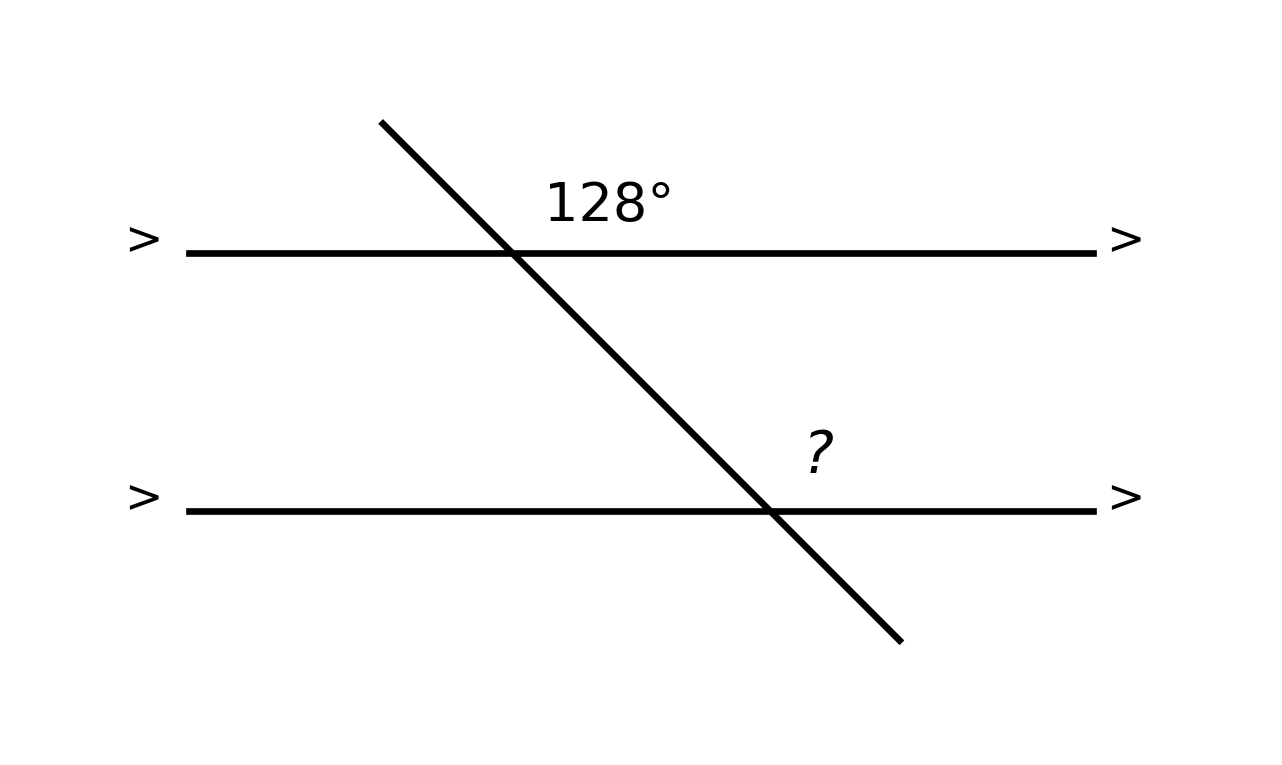
180 − 128 = 52°
▸ Isosceles triangles
Worked Example An isosceles triangle has a vertex angle of 40°, shown below. Find each base angle.
The two base angles are equal, and all three angles sum to 180°.
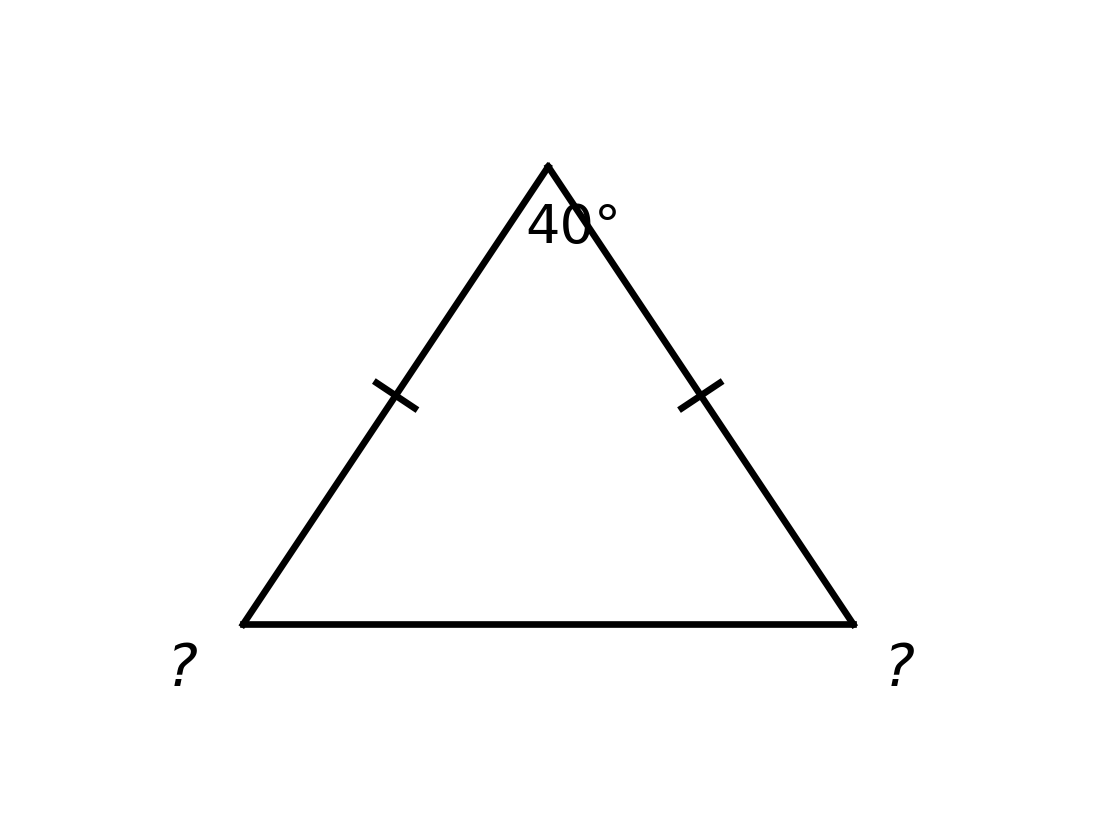
(180 − 40) ÷ 2 = 70°
▸ Practice
1. Two parallel lines are cut by a transversal. One angle measures 128°. Find its same-side interior angle.
A) 52° B) 128° C) 62° D) 38°
2. A triangle has interior angles of 35° and 85°. Find the third angle.
F) 50° G) 70° H) 65° J) 60°
3. A triangle's exterior angle has remote interior angles of 55° and 80°. Find the exterior angle.
A) 125° B) 145° C) 135° D) 115°
4. Can a triangle have sides of length 4, 7, and 12?
F) No G) Yes H) Only if it is a right triangle J) Only if it is isosceles
5. An isosceles triangle has a vertex angle of 40°. Find each base angle.
A) 70° B) 80° C) 60° D) 50°
6. Two parallel lines are cut by a transversal. One angle measures 110°. Find its corresponding angle.
F) 70° G) 110° H) 90° J) 100°
7. Two parallel lines are cut by a transversal. One angle measures 72°. Find its corresponding angle.
A) 108° B) 72° C) 18° D) 90°
8. A triangle's exterior angle has remote interior angles of 58° and 71°. Find the exterior angle.
F) 119° G) 139° H) 109° J) 129°
9. A triangle has interior angles of 42° and 89°. Find the third angle.
A) 59° B) 39° C) 49° D) 69°
10. Two parallel lines are cut by a transversal. One same-side interior angle measures 108°. Find the other.
F) 72° G) 108° H) 18° J) 90°
11. An isosceles triangle has a vertex angle of 52°. Find each base angle.
A) 40° B) 90° C) 80° D) 64°
12. A quadrilateral has three interior angles of 85°, 95°, and 110°. Find the fourth angle.
F) 70° G) 80° H) 90° J) 60°
13. Two lines intersect, forming a pair of vertical angles. One measures 63°. Find the other.
A) 117° B) 63° C) 27° D) 90°
14. A triangle's exterior angle measures 130°. One remote interior angle is 55°. Find the other remote interior angle.
F) 55° G) 75° H) 130° J) 65°
15. Two parallel lines are cut by a transversal. One same-side interior angle measures 125°. Find the other.
A) 125° B) 65° C) 115° D) 55°
16. An isosceles triangle has a vertex angle of 64°. Find each base angle.
F) 64° G) 116° H) 58° J) 52°
17. Can a triangle have sides of length 7, 10, and 18?
A) No B) Yes C) Only if it is a right triangle D) Only if it is isosceles
18. A triangle's exterior angle has remote interior angles of 48° and 63°. Find the exterior angle.
F) 101° G) 121° H) 111° J) 91°
19. A triangle has interior angles of 51° and 77°. Find the third angle.
A) 56° B) 52° C) 48° D) 58°
20. Two lines intersect, forming a pair of vertical angles. One measures 88°. Find the other.
F) 92° G) 88° H) 44° J) 180°
▸ Answers and Explanations
1: A. Same-side interior angles sum to 180°: 180 − 128 = 52°. Choice B reports the given angle itself instead of computing its same-side interior angle.
2: J. 180 − 35 − 85 = 60°. Choice F subtracts the two given angles from each other instead of subtracting both from 180°.
3: C. 55 + 80 = 135°. Choice A comes from an arithmetic slip while adding the two remote interior angles.
4: F. 4 + 7 = 11, which is not greater than 12, so the triangle inequality fails. Choice G assumes any three lengths form a triangle without checking the triangle inequality.
5: A. The two base angles are equal and, together with the vertex angle, sum to 180°: (180 − 40) ÷ 2 = 70°. Choice B doubles the vertex angle instead of subtracting it from 180° and dividing by 2.
6: G. Corresponding angles are equal: 110°. Choice F reports the supplementary angle (180−110=70°) instead of the corresponding angle, which is equal.
7: B. Corresponding angles, in matching positions at each intersection, are equal: 72°. Choice A reports the supplementary angle (180−72=108°) instead of the corresponding angle, which is equal.
8: J. 58+71=129°. Choice F comes from an arithmetic slip while adding the two remote interior angles.
9: C. 180−42−89=49°. Choice G comes from an arithmetic slip while subtracting both angles from 180°.
10: F. Same-side interior angles sum to 180°: 180−108=72°. Choice G reports the given angle itself instead of computing the other same-side interior angle.
11: D. The two base angles are equal and, together with the vertex angle, sum to 180°: (180−52)÷2=64°. Choice A reports the vertex angle itself instead of computing a base angle.
12: F. The four angles of a quadrilateral sum to 360°: 360−85−95−110=70°. Choice G comes from an arithmetic slip while subtracting the three given angles from 360°.
13: B. Vertical angles are always equal: 63°. Choice A reports the supplementary angle (180−63=117°) instead of the vertical angle, which is equal.
14: G. 130−55=75°. Choice F reports the given remote interior angle itself instead of computing the other one.
15: D. Same-side interior angles sum to 180°: 180−125=55°. Choice A reports the given angle itself instead of computing the other same-side interior angle.
16: H. The two base angles are equal and, together with the vertex angle, sum to 180°: (180−64)÷2=58°. Choice F reports the vertex angle itself instead of computing a base angle.
17: A. 7+10=17, which is not greater than 18, so the triangle inequality fails. Choice B assumes any three lengths form a triangle without checking the triangle inequality.
18: H. 48+63=111°. Choice F comes from an arithmetic slip while adding the two remote interior angles.
19: B. 180−51−77=52°. Choice A comes from an arithmetic slip while subtracting both angles from 180°.
20: G. Vertical angles are always equal: 88°. Choice F reports the supplementary angle (180−88=92°) instead of the vertical angle, which is equal.