ACT Math study guide · Chapter 21
Congruence and Similarity
Two triangles are similar when their corresponding angles are equal, which forces their corresponding sides to be proportional. The AA similarity criterion only requires two matching angle pairs, since the third pair is automatically equal once the first two match, given that a triangle's angles sum to 180°.
Similarity and congruence are not the same claim. Similar figures have the same shape but not necessarily the same size; congruent figures have both the same shape and the same size. Equal angles alone establish similarity, never congruence, since nothing about actual side lengths has been fixed.
When two figures are similar with a linear scale factor k, their perimeters scale by that same factor k, but their areas scale by k², since area is a two-dimensional measurement. Given an area ratio, the linear scale factor is recovered by taking the square root of that ratio, not the ratio itself.
Where this appears as a model: a height found using a shadow. A person 6 feet tall casting a 4-foot shadow stands beside a tree casting a 24-foot shadow; the tree is 36 feet tall, found once both objects and their shadows are recognized as similar triangles.
▸ Applying a scale factor
Worked Example Triangle ABC is similar to triangle DEF, shown below. AB = 5 and DE = 12.5. If BC = 8, find EF.
Find the scale factor from the given corresponding sides, then apply it.
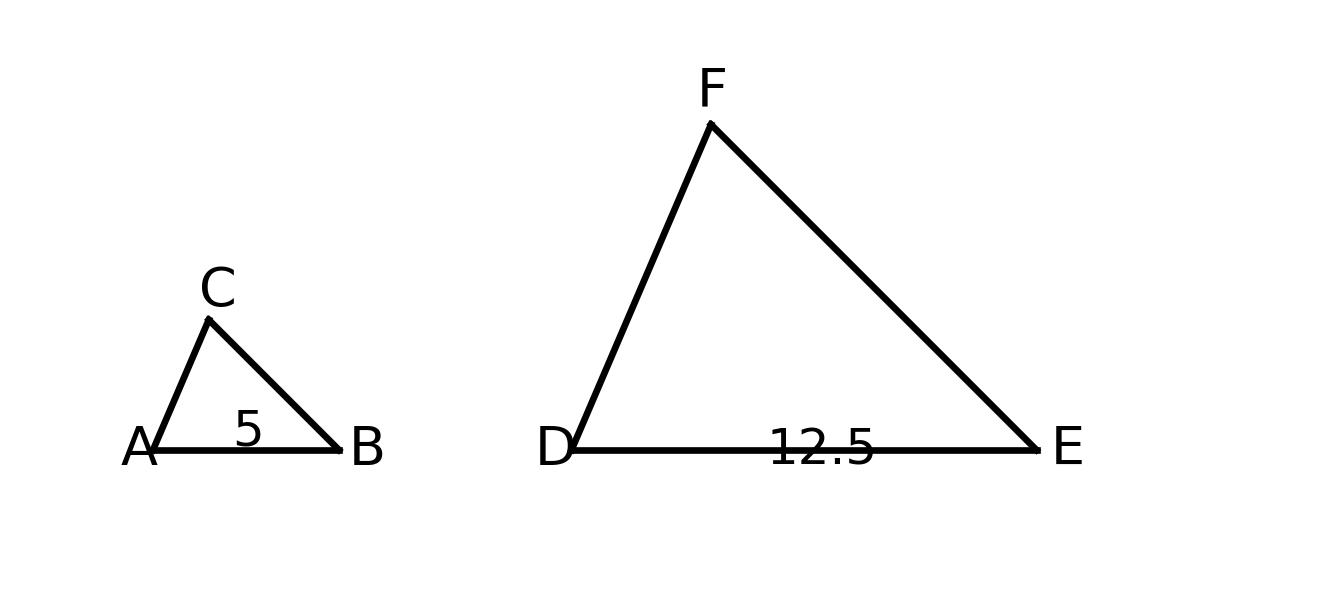
Scale factor = 12.5 ÷ 5 = 2.5, so EF = 8 × 2.5 = 20
▸ Area ratios and the linear scale factor
Worked Example Two similar figures have an area ratio of 9:16. Find their linear scale factor.
The linear scale factor is the square root of the area ratio.
√(9/16) = 3/4
▸ Practice
1. Triangle ABC is similar to triangle DEF. AB = 5, BC = 7, DE = 15. Find EF.
A) 15 B) 18 C) 35 D) 21
2. Two similar triangles have perimeters of 12 and 30. The smaller triangle has a side of length 4. Find the corresponding side of the larger triangle.
F) 8 G) 9 H) 10 J) 12
3. Two triangles each have a 50° angle and a 70° angle. What can be concluded?
A) They are congruent B) They are similar only if their sides are also proportional C) They are similar by AA D) Nothing can be concluded
4. Two similar triangles have corresponding sides in ratio 3:5. The larger triangle has a side of length 20. Find the corresponding side of the smaller triangle.
F) 12 G) 33.3 H) 12.5 J) 10
5. Two similar triangles have corresponding sides in ratio 2:3. The smaller triangle has area 16. Find the area of the larger triangle.
A) 36 B) 24 C) 32 D) 48
6. Two similar triangles have corresponding sides in ratio 4:7. The smaller triangle has perimeter 24. Find the perimeter of the larger triangle.
F) 36 G) 42 H) 48 J) 45
7. Two similar triangles have a side ratio of 3:8. The smaller triangle has a side of 12. Find the corresponding side of the larger triangle.
A) 24 B) 28 C) 32 D) 20
8. Two triangles each have a pair of congruent angles matching in two positions. What can be concluded?
F) They are congruent G) Neither congruent nor similar H) Similar only if a pair of sides is also given J) Similar by AA
9. Two similar triangles have a scale factor of 1.75. The smaller triangle has a perimeter of 40. Find the larger triangle's perimeter.
A) 70 B) 60 C) 65 D) 75
10. Two similar figures have corresponding sides in ratio 3:7. The smaller figure has area 18. Find the larger figure's area.
F) 78 G) 98 H) 88 J) 108
11. Two triangles share all three pairs of corresponding sides equal. Which congruence criterion applies?
A) AA B) SSS C) SAS D) ASA
12. Solve the proportion 5/8 = x/24 to find a missing side length x.
F) 12 G) 18 H) 20 J) 15
13. Two similar figures have an area ratio of 4:25. Find their linear scale factor.
A) 4/25 B) 2/5 C) 5/2 D) 2/25
14. Two similar rectangles have sides in ratio 2:3. The smaller rectangle has a diagonal of 10. Find the larger rectangle's diagonal.
F) 15 G) 20 H) 12 J) 18
15. Two similar triangles have a side ratio of 4:9. The smaller triangle has a side of 16. Find the corresponding side of the larger triangle.
A) 30 B) 36 C) 40 D) 33
16. Two triangles each have a 62° angle and a 45° angle. What can be concluded?
F) They are similar by AA G) They are congruent H) Neither similar nor congruent J) Similar only if a pair of sides is also given
17. Two similar figures have an area ratio of 121:36. Find their linear scale factor.
A) 11/6 B) 6/11 C) (6/11)² D) (11/6)²
18. Two triangles share two pairs of corresponding sides equal, but the given angle is not between them. What can be concluded?
F) Congruent by SSA G) Cannot be concluded from this alone H) Similar by AA J) Congruent by SAS
19. Solve the proportion 6/11 = x/55 to find a missing side length x.
A) 33 B) 27 C) 36 D) 30
20. Two similar triangles have a scale factor of 2.4. The smaller triangle has a perimeter of 25. Find the larger triangle's perimeter.
F) 52.5 G) 55 H) 60 J) 65
▸ Answers and Explanations
1: D. Scale factor = 15 ÷ 5 = 3, so EF = 7 × 3 = 21. Choice A reports DE itself instead of applying the scale factor to BC.
2: H. Scale factor = 30 ÷ 12 = 2.5, so the corresponding side is 4 × 2.5 = 10. Choice F comes from using an incorrect scale factor instead of 30÷12.
3: C. Two equal angle pairs guarantee AA similarity; nothing about side lengths has been established, so congruence cannot be concluded. Choice A confuses similarity with congruence; equal angles alone do not guarantee equal side lengths.
4: F. Scale factor from larger to smaller is 3/5, so 20 × 3/5 = 12. Choice G inverts the scale factor, multiplying by 5/3 instead of 3/5.
5: A. Area scales by the square of the linear ratio: (3/2)² = 9/4, so 16 × 9/4 = 36. Choice B applies the linear ratio directly instead of squaring it for the area scale factor.
6: G. Perimeter scales by the same ratio as any side, 7/4, so 24 × 7/4 = 42. Choice F comes from applying the ratio incorrectly instead of 24×7/4.
7: C. Scale factor=8/3; 12×8/3=32. Choice D adds the ratio values to the given side instead of multiplying by the scale factor.
8: J. Two equal angle pairs guarantee AA similarity; nothing about side lengths has been established. Choice F confuses similarity with congruence; equal angles alone do not guarantee equal side lengths.
9: A. Perimeter scales by the same factor as any side: 40×1.75=70. Choice B comes from using an incorrect scale factor instead of the given 1.75.
10: G. Area scales by the square of the linear ratio: (7/3)²=49/9; 18×49/9=98. Choice F comes from an arithmetic slip while squaring the ratio 7/3.
11: B. Three pairs of equal corresponding sides is the SSS congruence criterion. Choice A reports the similarity criterion (AA) instead of the matching congruence criterion, SSS.
12: J. Cross-multiply: 8x=5(24)=120, so x=15. Choice G comes from a cross-multiplication slip instead of 8x=120.
13: B. The linear scale factor is the square root of the area ratio: √(4/25)=2/5. Choice A reports the area ratio itself instead of taking its square root to find the linear ratio.
14: F. Scale factor=3/2; 10×3/2=15. Choice G doubles the given side instead of multiplying by the correct scale factor, 3/2.
15: B. Scale factor=9/4; 16×9/4=36. Choice A comes from an arithmetic slip while applying the scale factor 9/4.
16: F. Two equal angle pairs guarantee AA similarity; nothing about side lengths has been established. Choice G confuses similarity with congruence; equal angles alone do not guarantee equal side lengths.
17: A. The linear scale factor is the square root of the area ratio: √(121/36)=11/6. Choice D reports the area ratio itself, written as a squared expression, instead of taking the square root to find the linear ratio.
18: G. Two sides and a non-included angle (SSA) do not guarantee a unique triangle, so nothing can be concluded from this information alone. Choice F treats SSA as a valid congruence criterion, but two sides and a non-included angle do not guarantee a unique triangle.
19: D. Cross-multiply: 11x=6(55)=330, so x=30. Choice A comes from computing 6×55 as 363 instead of 330, a multiplication slip.
20: H. Perimeter scales by the same factor as any side: 25×2.4=60. Choice F comes from misreading the scale factor as 2.1 instead of 2.4.
▸ Additional congruence criteria: SAS and ASA/AAS
SSS and the SSA warning are not the only congruence criteria worth recognizing. SAS applies when two pairs of corresponding sides are equal and the included angle between them is also equal. ASA applies when two pairs of corresponding angles are equal and the included side between them is also equal; AAS applies when two angles and a non-included side match.
1. Two triangles have two pairs of corresponding sides equal, with the angle between those two sides also equal. Which congruence criterion applies?
A) AA B) SSS C) SAS D) SSA
2. Two triangles have two pairs of corresponding angles equal, along with the side between those two angles also equal. Which congruence criterion applies?
F) SAS G) SSS H) AA J) ASA
▸ Answers and Explanations
1: C. Two equal corresponding sides with the equal angle between them is the definition of SAS. Choice D describes SSA, where the equal angle is not between the two given sides, which does not guarantee congruence.
2: J. Two equal corresponding angles with the equal side between them is the definition of ASA. Choice F describes SAS, which requires two sides and an included angle instead of two angles and an included side.