Coordinate Geometry
Coordinate geometry puts shapes on a grid so that distances, midpoints, slopes, and areas can all be found with algebra. Four tools handle nearly every question: the distance formula, the midpoint formula, slope relationships, and the "use the grid lines as base and height" trick for triangles.
Distance and midpoint
The distance between two points is found with the distance formula,
,
which is just the Pythagorean theorem applied to coordinates: the horizontal change and the vertical change are the two legs, and the distance is the hypotenuse. Between and the horizontal change is and the vertical change is , so the distance is . Watch the negatives: subtract carefully, and remember that squaring removes the sign afterward.
The midpoint of two points averages their -coordinates and averages their -coordinates separately:
.
The midpoint of and is . A common wrong choice comes from subtracting instead of adding, which gives . If the midpoint and one endpoint are given, work backward: the midpoint's coordinate is the average, so the missing endpoint's coordinate is .
Slope, parallel lines, and perpendicular lines
Slope is rise over run: . Keep the subtraction in the same order on top and bottom. Through and the slope is . Dropping the negative sign is a typical wrong choice.
Parallel nonvertical lines share the same slope. For two nonvertical, nonhorizontal perpendicular lines, the slopes are negative reciprocals: a slope of pairs with a perpendicular slope of . To get a negative reciprocal, flip the fraction and change the sign; both steps are needed. The reciprocal alone, or the negative alone, will be on the answer list.
The special case is a horizontal line and a vertical line: slope is perpendicular to an undefined slope, so the negative-reciprocal shortcut is not used there.
Worked example: perpendicular slope
A line has slope . Find the slope of a line perpendicular to it. A perpendicular slope is the negative reciprocal, so the answer is .
Worked example: a parallel line through a point
Find the equation of the line through that is parallel to . A parallel line keeps the same slope, . Use point-slope form: , which simplifies to . A choice with slope is the trap for anyone who confuses parallel with perpendicular, and a choice with the right slope but the wrong intercept is the trap for anyone who skips the point-slope step.
Triangle area from coordinates
When a triangle's vertices are given as coordinates and two vertices share the same -coordinate or the same -coordinate, that shared side can be used directly as the base, and the perpendicular distance to the third vertex becomes the height, without needing the full distance formula on every side.
Worked example
Find the area of a triangle with vertices at , , and , shown below. The side from to lies along the -axis and serves as the base.
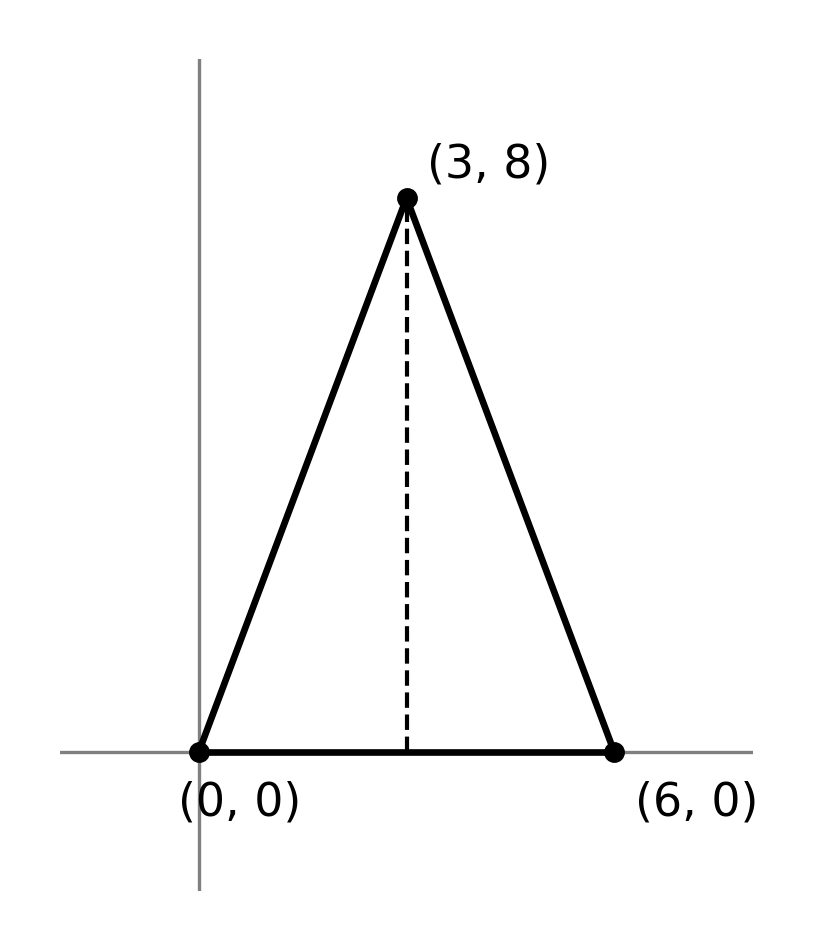
Base , height (the -coordinate of the third vertex). Area .
The height is the straight-up distance from the base to the third vertex, not the length of a slanted side. Forgetting the gives , which is the area of the rectangle around the triangle.
Where this appears as a model
Many word problems describe two locations by their positions. Two cell towers at and , measured in miles, are miles apart, found with the distance formula once each location is written as a coordinate point. The first step is always to translate the story into points.
Strategy summary
- Write each point as an ordered pair before doing anything else.
- Distance: subtract, square, add, square root. Midpoint: add and halve.
- Slope: keep the subtraction order consistent. Parallel means equal slopes; perpendicular means negative reciprocals.
- For triangle area, look for a horizontal or vertical side to use as the base.
- Sketch quickly. A rough picture catches sign errors, such as a negative slope that should be positive.