Area and Volume
Almost every area or volume question on the ACT comes down to two skills: knowing the formula and deciding how the pieces of a figure fit together. The formulas are short, so this lesson spends most of its time on the second skill.
The formulas to know cold
- Rectangle: area is length times width, .
- Triangle: area is one-half base times height, .
- Trapezoid: area is the average of the two parallel bases times the height, .
- Circle: area is .
- Rectangular prism: volume is length times width times height.
- Cylinder: volume is .
- Cone: volume is .
- Sphere: volume is .
Missing the coefficient in front of these formulas, the on the cone or the on the sphere, is one of the most common errors on this topic. Every wrong answer choice built from a missing coefficient is sitting on the answer list waiting for you. For example, a cone with radius 3 and height 8 has volume , and the choice is a trap for anyone who forgets the one-third.
Composite figures: add or subtract
A composite figure combines simple shapes, and its area or volume combines just as directly. When a shape is added onto another, add the two areas together. When a shape is removed or cut out, subtract its area from the original. Identifying which operation applies, addition or subtraction, is the actual skill; the individual area formulas are usually straightforward once that decision is made.
A good habit is to name the pieces before computing anything: "a rectangle, minus a quarter-circle." Writing that one phrase tells you the operation and the formulas you need.
Worked example: a quarter-circle cut from a rectangle
A 10-by-6 rectangle has a quarter-circle of radius 4 cut from one corner, shown below. Find the remaining area.
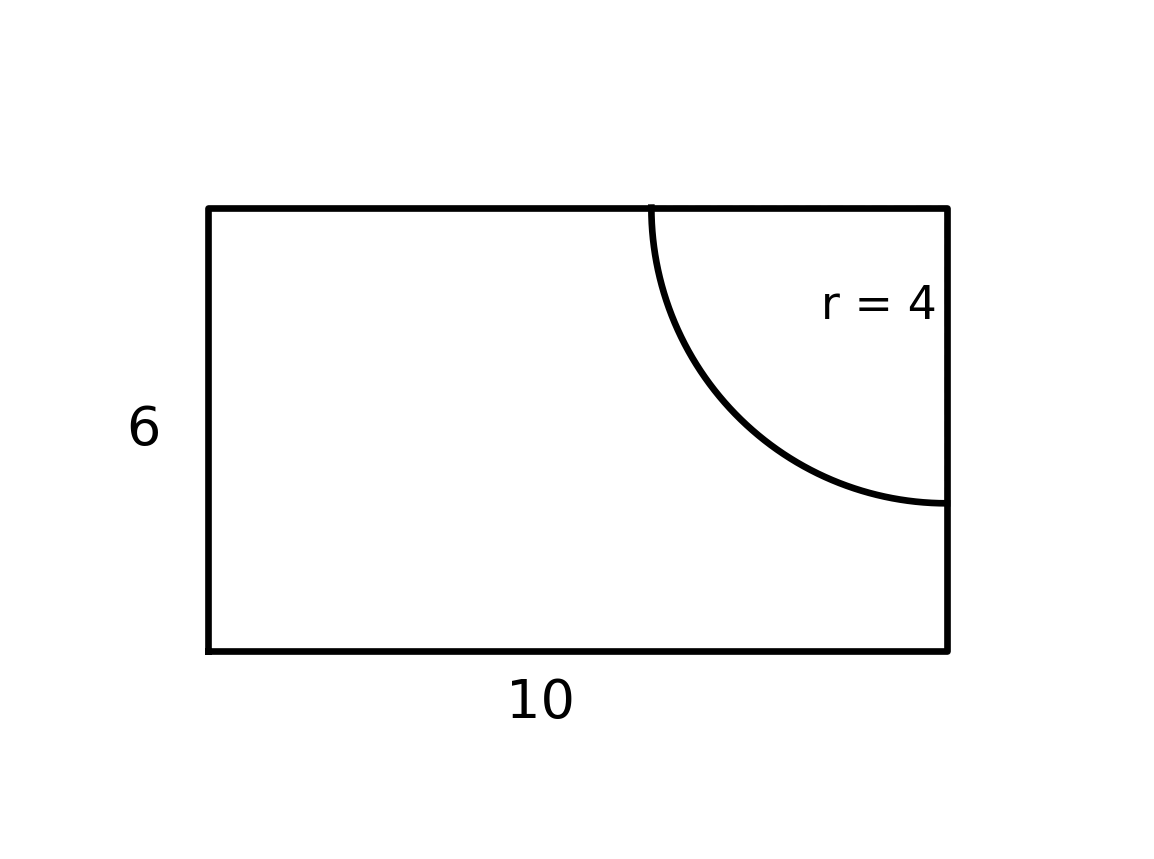
The quarter-circle is removed, so subtract its area from the rectangle.
Rectangle area:
Quarter-circle area:
Remaining area:
Notice what the wrong choices look like here. Reporting 60 means you forgot to subtract at all. Reporting means you added a piece that was supposed to be removed. Both appear on the answer list for this problem.
Volume of similar solids
When two similar solids have a linear scale factor , their volumes scale by , since volume is a three-dimensional measurement. This extends the same pattern used for area: lengths scale by , areas scale by , and volumes scale by .
Worked example
Two similar solids have a linear scale factor of 3:1. The smaller solid has a volume of 20. Find the larger solid's volume.
Volume scales by the cube of the linear ratio: , so the larger volume is .
If the ratio is not a whole number, cube the fraction. A ratio of 5:2 gives , so a solid of volume 8 becomes a solid of volume 125. The tempting wrong move is to multiply by the linear ratio itself, which gets you 20.
Surface area versus volume
Read the question for what it asks. Volume answers "how much does it hold?" Surface area answers "how much material covers it?" A cylindrical can of radius 3 and height 10 needs square units of material, because the question asks what covers the can, not what it holds.
- Cube: surface area is , volume is . For these are 96 and 64, and both are answer choices.
- Cylinder: surface area is . The two circular bases give . Leaving out one base is a common error.
Three-dimensional composite solids
A 3D composite solid combines volumes the same way a 2D composite figure combines areas: identify each solid piece, then add or subtract.
Worked example: a silo
A silo is shaped like a cylinder of radius 3 and height 10, topped with a cone of the same radius and height 4. Find the total volume, rounded to the nearest hundredth.
Cylinder:
Cone:
Total:
Notice that the cone's height, 4, is only the height of the cone, not the height of the whole silo. Always use each piece's own dimensions in its own formula. A hemisphere on top of a cylinder works the same way, using half of for the hemisphere.
Strategy summary
- Name the pieces and decide: add or subtract?
- Write each formula with its coefficient before substituting numbers.
- For similar figures, scale lengths by , areas by , volumes by .
- Check what is asked: area, surface area, or volume, and whether the answer should be exact (in terms of ) or rounded.
When the answer choices are in terms of , as in "," keep symbolic and do not convert to a decimal. When the choices are decimals, use the calculator's key and round only at the end.