Why geometry rewards a short list of facts
Part IV of the ACT Math test is Geometry, and its questions are built from a small set of relationships you can recall instantly. Each one turns a picture into an equation, usually a simple one. Your job on test day is to recognize which relationship the problem is hiding and then do the arithmetic carefully. This first chapter covers the angle facts that almost every later geometry question depends on.
Parallel lines and a transversal
When a transversal crosses two parallel lines, it creates eight angles, and they take only two different values: one acute measure and one obtuse measure, which add to . Three pairings do most of the work.
- Corresponding angles sit in matching positions at the two intersections (for example, both above the line and to the right of the transversal). They are equal.
- Vertical angles are formed across an intersection from each other. They are always equal, whether or not any lines are parallel.
- Same-side interior angles are both between the parallel lines and on the same side of the transversal. They are supplementary: they sum to .
A quick check: if two angles look like the same size, they are equal; if one looks acute and the other obtuse, they add to . Sketching the picture and judging "big or small" first protects you from the most common slip, which is reporting the supplement when the angles are equal (or the other way around).
Worked example: parallel lines and a transversal
Two parallel lines are cut by a transversal, shown below. One angle measures . Find its same-side interior angle.
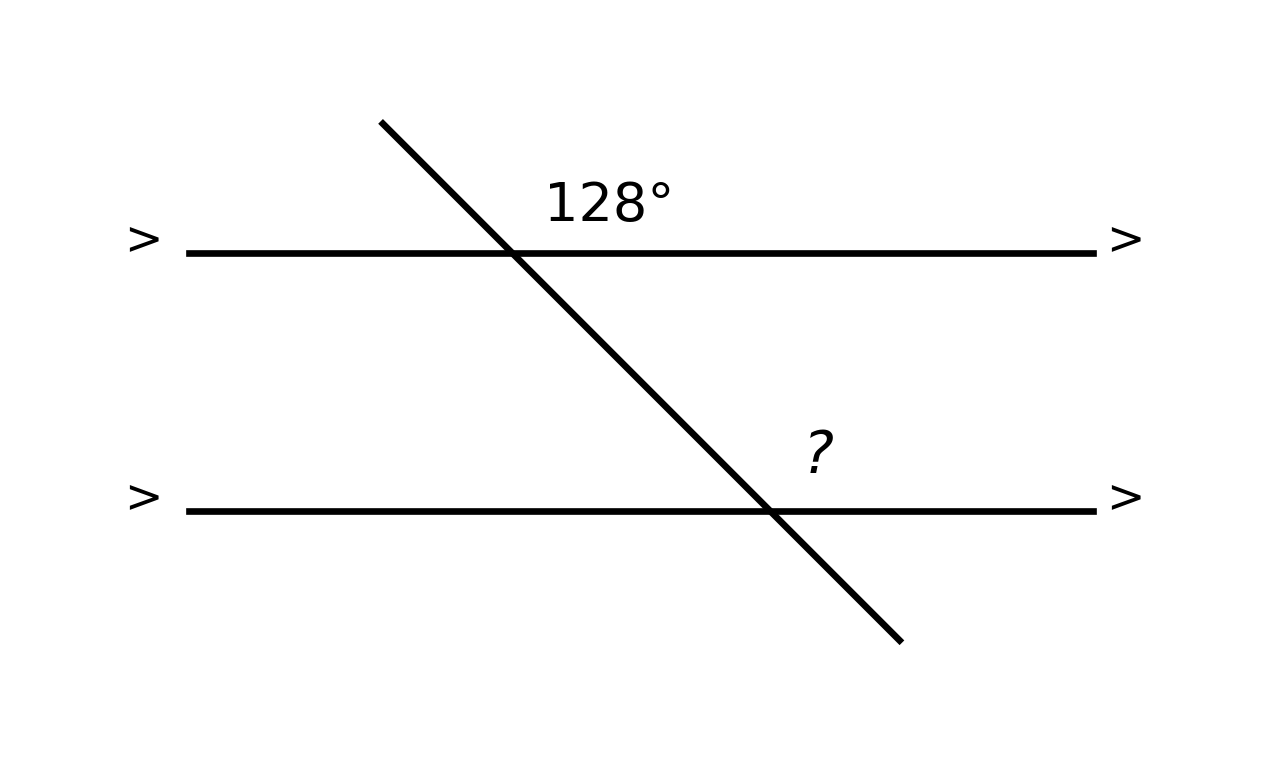
The angle lies above the top line, to the right of the transversal. The angle inside the strip next to it, below the top line and also to the right, forms a straight line with it, so that angle is . The angle marked "?" at the lower line is in the same position as the angle, so it is a corresponding angle and equals . As a check, the "?" angle and the angle are both inside the strip on the same side, and , exactly as same-side interior angles require.
The answer to the question as the practice sets ask it: same-side interior angles sum to , so .
Triangles
A triangle's interior angles always sum to . If two angles are known, subtract both from to find the third. Do the subtraction in one step: .
An exterior angle is formed by extending one side of a triangle. It equals the sum of the two remote interior angles, the two interior angles that are not adjacent to it. So an exterior angle with remote angles of and measures . Run it backward, too: if the exterior angle is and one remote angle is , the other is .
The triangle inequality says the sum of any two sides must exceed the third. You only need to test the two shorter sides against the longest: sides , , and fail because is not greater than . Sides , , and fail for the same reason, since . If a question asks which length could be the third side of a triangle with sides and , the answer lies strictly between and .
Isosceles triangles
An isosceles triangle has two equal sides and two equal base angles, which sit opposite those sides. Given the vertex angle (the angle between the equal sides), subtract it from and divide by .
Worked example: isosceles triangles
An isosceles triangle has a vertex angle of , shown below. Find each base angle.
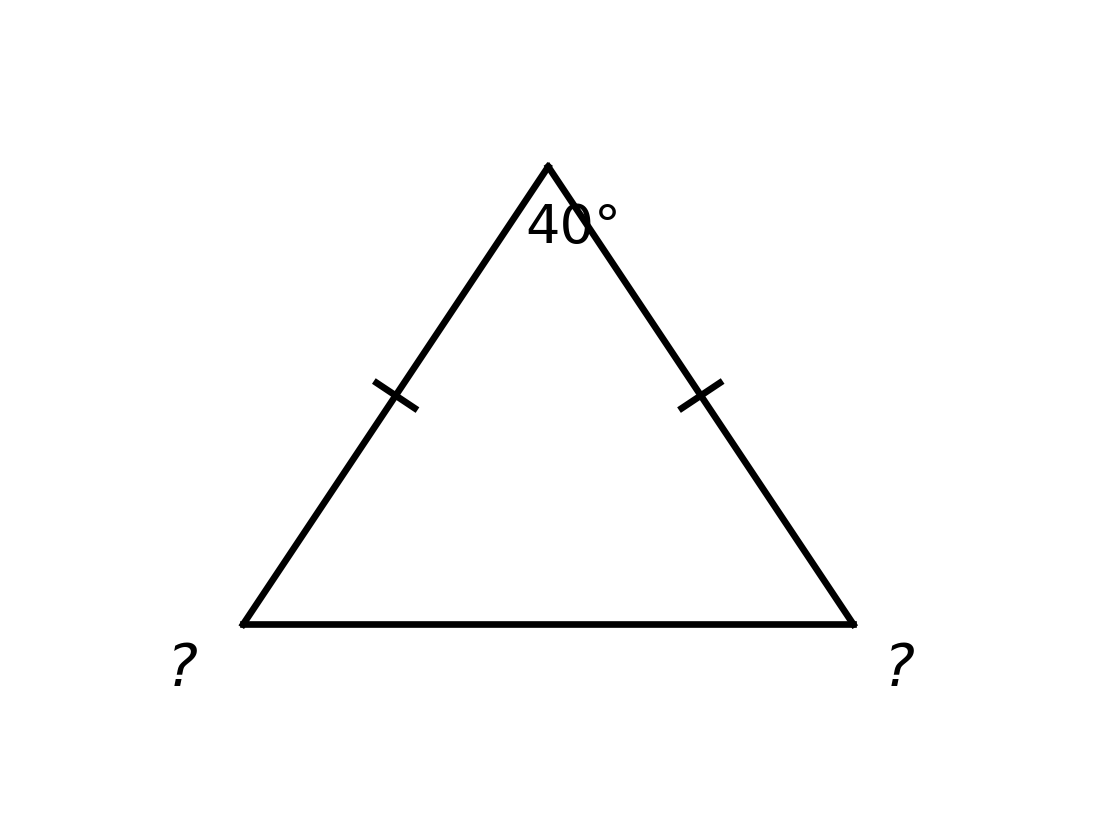
The two base angles are equal, and all three angles sum to :
Working the other direction is just as common: if a base angle is , the vertex angle is .
Quadrilaterals
The four interior angles of any quadrilateral sum to . With three angles of , , and , the fourth is . More generally, a polygon with sides has interior angles summing to degrees.
Where this appears as a model
The ACT often dresses these facts in a real setting. Two parallel beams cut by a third beam at a stated angle determine every other angle in the figure once you identify the correct relationship, whether corresponding, alternate interior, or same-side interior. Each angle is either or . Decide which relationship connects the angle you want to the one you were given, and the rest is subtraction.
Strategy checklist
- Sketch or annotate the figure, even if one is provided. Mark the given angle and the unknown angle.
- Ask: are these two angles equal (corresponding, vertical, base angles) or do they sum to (same-side interior, a straight line)?
- For triangles, use the angle sum of or the exterior-angle shortcut, whichever needs fewer steps.
- Check that your answer is reasonable: acute angles should be less than , and a triangle can have at most one obtuse angle.
- Beware of the "given angle itself" distractor. Answer choices often include the number from the problem statement, which is a trap when the question asks for a different angle.