Similar and congruent figures
Two triangles are similar when their corresponding angles are equal, and that forces their corresponding sides to be proportional. The AA criterion needs only two matching angle pairs: because a triangle's angles sum to , the third pair is automatically equal once the first two match.
Similarity and congruence are not the same claim. Similar figures have the same shape but not necessarily the same size. Congruent figures have both the same shape and the same size. Equal angles alone establish similarity, never congruence, because nothing about the actual side lengths has been fixed. If a question shows two triangles that each have a angle and a angle, the correct conclusion is "similar by AA," not "congruent."
Congruence criteria
To prove two triangles congruent, you need enough matching parts to lock in the shape and the size:
- SSS: all three pairs of corresponding sides are equal.
- SAS: two pairs of sides are equal and the angle between those sides is equal.
- ASA: two pairs of angles are equal and the side between those angles is equal.
- AAS: two pairs of angles are equal and a side that is not between them is equal.
Be careful with SSA (two sides and a non-included angle). It does not guarantee a unique triangle, so on its own it proves nothing. Also, AA is a similarity criterion, not a congruence criterion, so it never appears in a correct "congruent" answer.
Applying a scale factor
The scale factor is the ratio of corresponding sides, found from any pair where both lengths are known. Then every other length in the pair of figures follows from that one number. Always check which way you are going: multiply by to go from the smaller figure to the larger, and by to go from the larger to the smaller.
Worked example: finding a missing side
Triangle is similar to triangle , shown below. and . If , find .
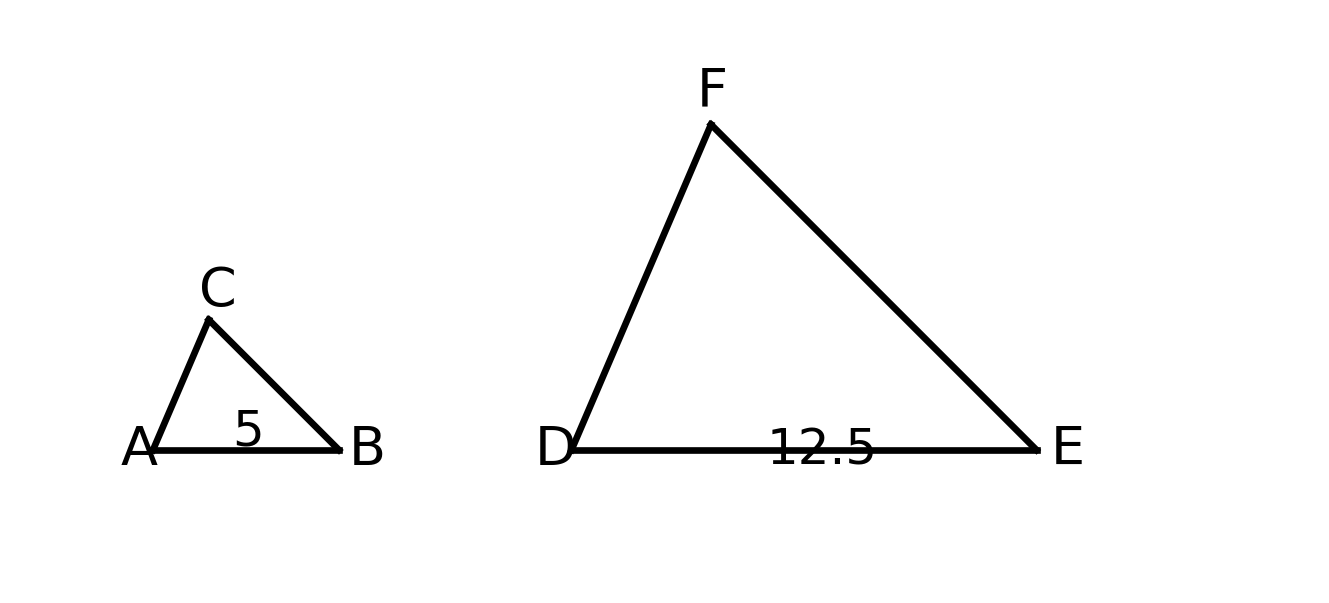
Find the scale factor from the given corresponding sides, then apply it.
Scale factor , so .
When the information is given as a proportion instead, cross-multiply. To solve , write , so . A quick way to catch a slip is to check that the scale factor applies the same way to both sides: and .
Setting up a proportion
Many similarity questions arrive as a proportion rather than a scale factor. Write each ratio with the same figure on top, matching corresponding sides: . Then cross-multiply. For similar triangles with , , and a corresponding , the scale factor is , so . Always confirm that the larger figure produces the larger number: if your answer for the bigger triangle is smaller than the given side of the smaller one, the ratio is upside down.
Perimeter and area ratios
When two figures are similar with a linear scale factor :
- every length, including perimeter, diagonals, heights, and radii, scales by ;
- area scales by , since area is a two-dimensional measurement;
- volume, in solids, scales by .
If the corresponding sides are in ratio , the areas are in ratio . A smaller triangle with area corresponds to a larger triangle with area . The most common error on these questions is applying the side ratio directly to an area.
Worked example: from an area ratio back to a scale factor
Two similar figures have an area ratio of . Find their linear scale factor.
The linear scale factor is the square root of the area ratio, not the ratio itself:
Going in this direction, take the square root. Going from a side ratio to an area, square.
Where this appears as a model
A height found using a shadow is a classic similar-triangle problem. A person feet tall casts a -foot shadow beside a tree that casts a -foot shadow. The person, the tree, and their shadows form two similar right triangles, because the sun's rays strike both at the same angle. The scale factor from shadow to shadow is , so the tree is feet tall.
Strategy checklist
- Decide first whether the problem is about similarity (same shape, proportional sides) or congruence (same shape and size).
- Find the scale factor from the one pair of corresponding sides where both lengths are known. Write it as larger over smaller (or the reverse) and note which direction you need.
- Match corresponding sides by their position relative to equal angles, not by the order the letters are listed.
- Lengths and perimeters scale by ; areas scale by ; recover from an area ratio with a square root.
- Estimate before you calculate: a larger figure's side must be bigger than the smaller figure's. An answer that goes the wrong way means you inverted the scale factor.