AP English Language study guide · Chapter 39
Practice Exam 1
This practice exam follows the current digital exam structure: 45 multiple-choice questions across five sets, followed by three free-response tasks. Time this exam using the official section timing. Because a printed or PDF practice exam cannot reproduce the Bluebook interface, also complete the official AP test preview in Bluebook at least once to practice the timer, Question Menu, Mark for Review, Highlights & Notes, Line Reader, Option Eliminator, and Zoom.
SECTION I: MULTIPLE CHOICE
45 Questions. Suggested time: 60 minutes.
Questions 1–12 refer to the following passage.
The following passage contains selected excerpts from Booker T. Washington's address at the Cotton States and International Exposition. Bracketed ellipses mark omitted material.
A ship lost at sea for many days suddenly sighted a friendly vessel. From the mast of the unfortunate vessel was seen a signal: “Water, water; we die of thirst!” The answer from the friendly vessel at once came back: “Cast down your bucket where you are.” A second time the signal, “Water, water; send us water!” ran up from the distressed vessel, and was answered: “Cast down your bucket where you are.” And a third and fourth signal for water was answered: “Cast down your bucket where you are.” The captain of the distressed vessel, at last heeding the injunction, cast down his bucket, and it came up full of fresh, sparkling water from the mouth of the Amazon River.
To those of my race who depend on bettering their condition in a foreign land, or who underestimate the importance of cultivating friendly relations with the Southern white man who is their next-door neighbor, I would say: “Cast down your bucket where you are” — cast it down in making friends in every manly way of the people of all races by whom we are surrounded. Cast it down in agriculture, mechanics, in commerce, in domestic service, and in the professions.
[Several sentences omitted.]
To those of the white race who look to the incoming of those of foreign birth and strange tongue and habits for the prosperity of the South, were I permitted I would repeat what I have said to my own race: “Cast down your bucket where you are.” Cast it down among the eight millions of Negroes whose habits you know, whose fidelity and love you have tested in days when to have proved treacherous meant the ruin of your firesides.
Booker T. Washington, address delivered at the Cotton States and International Exposition, Atlanta, Georgia, September 18, 1895
Question 1
- A. It provides a factual account of a specific historical maritime rescue the speaker witnessed
- B. It establishes an extended metaphor that the speaker will apply directly to two different audiences in the paragraphs that follow
- C. It functions as a digression unrelated to the speech's central argument
- D. It serves primarily to entertain the audience before the speech's serious content begins
Question 2
- A. It signals that the speaker is uncertain about the advice being given
- B. It indicates that the passage is quoting multiple different, unrelated sources
- C. It unifies the anecdote and the speaker's direct addresses to two different audiences under a single, repeated directive
- D. It functions primarily to fill space without contributing to the passage's argument
Question 3
- A. That the speaker's race should abandon agriculture entirely in favor of other professions
- B. That opportunity and relationship-building are available locally, in the surrounding region, rather than requiring migration elsewhere
- C. That the speaker's race should seek opportunity exclusively outside the South
- D. That relationships with the white population are unnecessary for success
Question 4
- A. It contradicts the claim made in the second paragraph
- B. It abandons the ship metaphor established in the first paragraph
- C. It applies the same central directive to a different, specifically named audience, extending the metaphor's application across the two groups
- D. It shifts to an entirely unrelated topic with no connection to the previous paragraphs
Question 5
- A. “A ship lost at sea for many days suddenly sighted a friendly vessel”
- B. “the captain of the distressed vessel, at last heeding the injunction”
- C. “whose fidelity and love you have tested in days when to have proved treacherous meant the ruin of your firesides”
- D. “a third and fourth signal for water was answered”
Question 6
- A. A statement of the speaker's central claim, followed by an anecdote that undermines it
- B. Two competing anecdotes followed by a single unified conclusion
- C. A direct address to a single audience with no shift in focus
- D. An illustrative anecdote establishes a central metaphor, followed by two selected applications of that metaphor to different audiences, with omitted material between the applications
Question 7
- A. It indicates that the speaker has been explicitly forbidden from speaking at all
- B. It signals the speaker's awareness of the social distance between himself and the audience being addressed in that section, framing the advice with a note of deference
- C. It signals a complete change of subject away from the ship metaphor
- D. It has no discernible function and could be removed without affecting the passage's meaning
Question 8
- A. “friendly vessel”
- B. “bettering their condition”
- C. “the mouth of the Amazon River”
- D. “Water, water; we die of thirst!”
Question 9
- A. It creates confusion about who is speaking at each point in the passage
- B. It moves the passage from an illustrative, distanced example toward a direct, personal application of that example's lesson to the speaker's actual audience
- C. It has no meaningful effect on how the passage functions
- D. It signals that the anecdote was fabricated while the direct address is factual
Question 10
- A. The passage never mentions agriculture at all
- B. It overstates the passage's actual claim, which lists agriculture as one of several areas of opportunity rather than arguing for its superiority over the others
- C. The passage argues the opposite, that agriculture should be entirely avoided
- D. This is an accurate description of the passage's central purpose
Question 11
- A. Both paragraphs address the exact same audience with no distinction between them
- B. The third paragraph addresses an audience outside the United States entirely
- C. The third paragraph addresses a different racial group than the second paragraph, applying the same metaphor to counsel against dependence on immigrant labor rather than emigration
- D. The third paragraph abandons the concept of audience entirely and becomes a general statement
Question 12
- A. It establishes that the ship was actually located near a well-known geographic landmark for purely informational purposes
- B. It confirms that the resource the distressed ship needed was available locally all along, reinforcing the passage's central claim that opportunity is often closer than it initially appears
- C. It contradicts the anecdote's earlier claim that the ship was lost at sea
- D. It has no connection to the passage's argument about opportunity in paragraphs two and three
Questions 13–24 refer to the following passage.
In the woods, we return to reason and faith. There I feel that nothing can befall me in life,—no disgrace, no calamity (leaving me my eyes), which nature cannot repair. Standing on the bare ground,—my head bathed by the blithe air and uplifted into infinite space,—all mean egotism vanishes. I become a transparent eyeball; I am nothing; I see all; the currents of the Universal Being circulate through me; I am part or particle of God.
The name of the nearest friend sounds then foreign and accidental: to be brothers, to be acquaintances, master or servant, is then a trifle and a disturbance. I am the lover of uncontained and immortal beauty. In the wilderness, I find something more dear and connate than in streets or villages. In the tranquil landscape, and especially in the distant line of the horizon, man beholds somewhat as beautiful as his own nature.
Ralph Waldo Emerson, Nature, 1836
Question 13
- A. That the woods restore a capacity for reason and faith the speaker implies has been diminished elsewhere
- B. That the woods are physically dangerous compared to human settlements
- C. That the woods should be avoided by most people
- D. That the woods are identical in every respect to streets and villages
Question 14
- A. It introduces an entirely new topic unrelated to the sentence's main claim
- B. It contradicts the sentence's claim about nature's restorative power
- C. It qualifies the speaker's claim about nature's power to repair loss, acknowledging one specific limit to that power
- D. It has no bearing on the sentence's meaning and could be removed without effect
Question 15
- A. A state of pure perception in which the speaker's individual identity dissolves while awareness of the surrounding world remains total
- B. A literal physical transformation the speaker believes has occurred
- C. A complaint about impaired eyesight while in the woods
- D. A criticism of other people's inability to appreciate nature
Question 16
- A. It contradicts the claims made in the sentences immediately before it
- B. It is entirely unrelated to the passage's discussion of the woods
- C. It introduces the passage's central claim for the first time
- D. It represents the culminating claim in an escalating sequence, moving from vanished egotism, to dissolved identity, to total perception, to spiritual union
Question 17
- A. “I am the lover of uncontained and immortal beauty”
- B. “man beholds somewhat as beautiful as his own nature”
- C. “In the wilderness, I find something more dear and connate”
- D. “to be brothers, to be acquaintances, master or servant, is then a trifle and a disturbance”
Question 18
- A. The first paragraph builds toward a climactic spiritual claim, and the second paragraph extends that claim's implications for the speaker's relationship to other people and to landscape generally
- B. The second paragraph directly refutes the claims made in the first paragraph
- C. The two paragraphs address completely unrelated subjects
- D. The first paragraph is a direct response to a claim made in the second paragraph
Question 19
- A. “egotism,” describing what vanishes as the speaker stands in the woods
- B. “air,” describing what bathes the speaker's head
- C. “ground,” describing where the speaker stands
- D. “space,” describing what the speaker is uplifted into
Question 20
- A. The structure signals that the speaker is uncertain about what is being described
- B. The structure has no discernible effect on the passage's meaning
- C. The structure indicates that the sentence is grammatically incomplete
- D. The parallel short clauses present the transformation as a rapid sequence of increasingly radical claims: altered perception, diminished individual self, and expanded awareness
Question 21
- A. The passage does mention camping equipment specifically
- B. This is an accurate description of the passage's central purpose
- C. It fundamentally misreads the passage's actual purpose, which describes a spiritual and perceptual experience rather than offering any practical survival guidance
- D. The passage argues against ever entering the woods at all
Question 22
- A. It abandons the passage's earlier claims entirely in favor of an unrelated observation
- B. It directly contradicts the claim made in the passage's opening sentence
- C. It introduces a specific, named individual as an example
- D. It extends the passage's spiritual claims into an aesthetic one, suggesting a parallel between the beauty found in landscape and an inherent beauty within human nature itself
Question 23
- A. That streets and villages are entirely without value or interest
- B. That wilderness and human settlements offer identical experiences
- C. That the speaker finds something in the wilderness more personally significant and closely connected to himself than what is found in streets or villages
- D. That the speaker has never visited a village or street
Question 24
- A. They indicate that this phrase should be read as a completely separate, unrelated sentence
- B. They signal that the passage contains a printing or transcription error
- C. They have no different function than a period would in the same location
- D. They set off the descriptive phrase as a distinct, suspended moment within the sentence, visually isolating the physical description before the sentence resolves into its climactic claim
Questions 25–32 refer to the following passage.
The following is a draft of a proposal to a city council. Some sentences are numbered for questions that follow.
“Proposal: Municipal Broadband Expansion. [1] Roughly eighteen percent of households in the city's eastern neighborhoods currently lack access to broadband internet service at speeds sufficient for remote work or online coursework. [2] Private providers have cited low projected returns as their reason for not extending fiber infrastructure into these neighborhoods. [3] A municipal broadband utility, funded initially through a bond measure and later self-sustaining through subscriber fees, would close this gap within an estimated three years. [4] Some council members have questioned whether the city should take on the financial risk of operating a utility outside its traditional service areas. [5] That concern is reasonable, and the proposal addresses it by structuring the bond as a revenue bond repaid through subscriber fees rather than general tax funds, limiting the city's exposure if adoption is slower than projected. [6] The city's water utility, established in 1947, has operated without interruption for over seventy-five years. [7] Comparable municipal broadband projects in similarly sized cities have completed neighborhood buildouts within three to five years of launch, though the time required to reach operating break-even has varied by system. [8] Closing the connectivity gap would not resolve every economic disparity between neighborhoods, but it would remove one concrete, addressable barrier to remote work and educational access for thousands of residents.”
Original passage: proposal to a city council
Question 25
- A. Internet access is very important in today's connected world.
- B. Many households would probably benefit from better internet somehow.
- C. Roughly eighteen percent of households in the city's eastern neighborhoods currently lack access to broadband internet service at speeds sufficient for remote work or online coursework.
- D. The internet has changed dramatically since it was first invented.
Question 26
- A. A municipal broadband utility, funded initially through a bond measure and later self-sustaining through subscriber fees, would close this gap within an estimated three years.
- B. A municipal broadband utility, funded initially through a bond measure and later self-sustaining through subscriber fees, would close this gap over a projected multi-year buildout consistent with comparable municipal projects.
- C. A municipal broadband utility would close this gap immediately upon approval of the bond measure.
- D. A municipal broadband utility would definitely and permanently solve all connectivity problems in the city forever.
Question 27
- A. It is factually inaccurate about the water utility's founding
- B. It is accurate but irrelevant to the specific financial-risk concern sentence [5] is addressing, interrupting the paragraph's focused response to that concern
- C. It contradicts sentence [4]
- D. It uses inappropriate tone for a council proposal
Question 28
- A. Like these comparable projects, this proposal's projected multi-year timeline for closing the coverage gap falls within the range of buildout times reported by similarly sized municipal systems.
- B. Comparable municipal broadband projects in similarly sized cities have completed neighborhood buildouts within three to five years of launch, though the time required to reach operating break-even has varied by system.
- C. Other cities have also built broadband networks at various points in the past.
- D. Broadband technology continues to improve every year across the industry.
Question 29
- A. Closing the connectivity gap would solve every economic problem facing the eastern neighborhoods.
- B. Closing the connectivity gap might help a small number of residents in some limited circumstances.
- C. Closing the connectivity gap is the single most urgent issue facing the city council today.
- D. Closing the connectivity gap would not resolve every economic disparity between neighborhoods, but it would remove one concrete, addressable barrier to remote work and educational access for thousands of residents.
Question 30
- A. “Similar revenue-bond structures have been used successfully to fund municipal utilities in several other sectors.”
- B. “The city's finance director has reviewed the proposed bond structure and confirmed its consistency with municipal best practices.”
- C. “However, comparable revenue-supported utility projects have sometimes missed subscriber forecasts, forcing cities to restructure debt or delay planned service expansion.”
- D. “This structure ensures that general tax revenue remains available for the city's other budget priorities.”
Question 31
- A. Private providers have refused to serve these neighborhoods because they do not care about underserved communities.
- B. Private providers are secretly conspiring to keep these neighborhoods disconnected permanently.
- C. Private providers have never considered serving these neighborhoods at all.
- D. Private providers have cited low projected returns as their reason for not extending fiber infrastructure into these neighborhoods.
Question 32
- A. It shifts the proposal's purpose from persuasion to pure technical documentation
- B. It weakens the proposal by admitting the plan has any risk at all
- C. It has no effect on how the council is likely to receive the proposal
- D. Acknowledging the financial-risk concern accurately before addressing it directly builds credibility with a council audience likely to raise or share that same concern, rather than leaving it for the audience to raise unaddressed
Questions 33–40 refer to the following passage.
The following is a draft of an internal memo proposing a workplace mosquito-control initiative for a company with an outdoor campus. Some sentences are numbered for questions that follow.
“Memo: Proposed Outdoor Pest Management Update. [1] Employee reports of mosquito activity near the campus courtyard, which is a courtyard that several departments specifically requested be made more usable, have increased notably over the past two summers. [2] The facilities team has identified a nearby retention pond as a likely breeding source, standing water that current maintenance schedules do not address between scheduled inspections. [3] Adopting a biweekly larvicide treatment schedule for the pond would target mosquito populations before they reach the courtyard, using a targeted approach, more effective than the current broad perimeter spraying and less disruptive to the pollinator garden staff have specifically requested be preserved. [4] Some employees have raised concerns about chemical treatments near a garden used partly for a children's summer program. [5] The larvicide under consideration is specifically formulated to target mosquito larvae, and does not affect pollinators such as bees which the pollinator garden was established to support. [6] The facilities budget currently allocates funds for quarterly perimeter spraying. [7] Switching to targeted larvicide treatment is projected to cost less annually than the current perimeter spraying program while addressing the problem at its source rather than after adult mosquitoes have already dispersed across the campus.”
Original passage: internal facilities memo
Question 33
- A. Employee reports of mosquito activity near the campus courtyard have increased notably over the past two summers.
- B. Employee reports of mosquito activity near the campus courtyard, which is a courtyard, have increased notably over the past two summers.
- C. Employee reports of mosquito activity near the campus courtyard, whose improved usability several departments have specifically requested, have increased notably over the past two summers.
- D. Employee reports of mosquito activity near the campus courtyard requested by several departments have increased notably over the past two summers requested.
Question 34
- A. The facilities team has identified a nearby retention pond, whose standing water current maintenance schedules do not address between scheduled inspections, as a likely breeding source.
- B. The facilities team has identified a nearby retention pond as a likely breeding source, standing water that current maintenance schedules do not address between scheduled inspections.
- C. Standing water that current maintenance schedules do not address, the facilities team has identified a nearby retention pond as a likely breeding source.
- D. The facilities team has identified a nearby retention pond as a likely breeding source between scheduled inspections that current maintenance schedules do not address standing water.
Question 35
- A. Adopting a biweekly larvicide treatment schedule for the pond would target mosquito populations before they reach the courtyard, using an approach more targeted than the current broad perimeter spraying and less disruptive to the pollinator garden staff have specifically requested be preserved.
- B. Adopting a biweekly larvicide treatment schedule for the pond would target mosquito populations before they reach the courtyard. This approach is more targeted than the current broad perimeter spraying and less disruptive to the pollinator garden staff have specifically requested be preserved.
- C. Adopting a biweekly larvicide treatment schedule for the pond would target mosquito populations before they reach the courtyard, using a targeted approach, more effective than the current broad perimeter spraying and less disruptive to the pollinator garden staff have specifically requested be preserved.
- D. Adopting a biweekly larvicide treatment schedule for the pond, using a targeted approach more effective and less disruptive, would target mosquito populations before they reach the courtyard the pollinator garden staff have specifically requested be preserved.
Question 36
- A. Sentence [7] directly compares the new approach's cost to the current program's cost, so placing the current budget detail immediately before that comparison would let the reader evaluate the claim without needing to look back several sentences
- B. Sentence [6] contains a factual error that needs correction before it can be moved
- C. Moving sentence [6] would have no effect on the passage's clarity
- D. Sentence [6] should be deleted entirely rather than moved
Question 37
- A. The larvicide under consideration is specifically formulated to target mosquito larvae and does not affect pollinators such as bees, which the pollinator garden was established to support.
- B. Bees are not affected by the larvicide under consideration, which is specifically formulated to target mosquito larvae.
- C. The larvicide under consideration targets mosquito larvae.
- D. Mosquito larvae are targeted by the larvicide under consideration, which was formulated specifically for this purpose.
Question 38
- A. “The children's summer program has been very popular with employees' families in recent years.”
- B. “The manufacturer's safety data has been independently reviewed by the facilities team's pest management consultant, who confirmed its selective targeting of mosquito larvae.”
- C. “The pollinator garden was originally planted five years ago as a separate initiative.”
- D. “Mosquitoes can carry several diseases that pose risks to human health.”
Question 39
- A. “This treatment will completely eliminate all mosquitoes from the entire region surrounding the campus.”
- B. “This treatment targets the identified breeding source before mosquitoes reach the courtyard.”
- C. “This treatment is projected to cost less annually than the current spraying program.”
- D. “This treatment does not affect the pollinators the garden was established to support.”
Question 40
- A. Safety concerns should always be discussed before financial concerns in every proposal, regardless of the proposal's purpose or evidence
- B. It shifts the memo's purpose from a proposal to a general safety bulletin
- C. It has no effect on how the reader is likely to receive the rest of the memo
- D. Because a safety objection could prevent adoption of the proposal regardless of its cost, resolving that feasibility concern first clears the way for the later budget comparison to matter
Questions 41–45 refer to the following passage.
The following is a draft of a short memo announcing an update to a company's data retention policy. Some sentences are numbered for questions that follow.
“Memo: Data Retention Policy Update. [1] Beginning next quarter, customer records inactive for more than five years will be archived to secure offline storage rather than remaining in the active database indefinitely. [2] This change responds to a recent audit that found the active database contained records for customers who had not engaged with our services in over a decade, records, that increased both storage costs and potential exposure in the event of a data incident. [3] Archived records remain retrievable within two business days upon a verified customer request. [4] Department heads should notify any team members who regularly query historical customer data of this change before the archival process begins. [5] This policy will reduce active database size by approximately thirty percent.”
Original passage: internal policy memo
Question 41
- A. Beginning next quarter, customer records inactive for more than five years will be archived to secure offline storage rather than remaining in the active database indefinitely.
- B. Soon, some old customer records will be moved somewhere else.
- C. Customer data policies are always changing in response to new circumstances.
- D. Records will eventually be archived if certain conditions are met at some point.
Question 42
- A. This change responds to a recent audit that found the active database contained records for customers who had not engaged with our services in over a decade, records that increased both storage costs and potential exposure in the event of a data incident.
- B. This change responds to a recent audit that found the active database contained records for customers who had not engaged with our services in over a decade, records, that increased both storage costs and potential exposure in the event of a data incident.
- C. This change responds to a recent audit that found the active database contained records for customers who had not engaged with our services in over a decade records that increased both storage costs and potential exposure in the event of a data incident.
- D. This change responds to a recent audit that found the active database contained records for customers who had not engaged with our services in over a decade; records, that increased both storage costs and potential exposure in the event of a data incident.
Question 43
- A. Archived records remain retrievable within two business days upon a verified customer request.
- B. Archived records remain retrievable within two business days after a customer's identity has been verified through the standard account-verification process and a retrieval request has been submitted to IT.
- C. Archived records can probably be retrieved fairly quickly if needed.
- D. Archived records are gone once they have been archived.
Question 44
- A. Immediately after sentence [1], because the size reduction quantifies the policy's impact before the memo turns to the audit rationale and retrieval procedure
- B. Sentence [5] contains a factual error that needs correction before it can be moved
- C. Moving sentence [5] would have no effect on the memo's clarity or usefulness
- D. Sentence [5] should be deleted entirely rather than moved
Question 45
- A. Department heads should notify any team members who regularly query historical customer data of this change before the archival process begins.
- B. Team members should be notified by someone before the archival process begins.
- C. Department heads should notify, before the archival process begins, any team members on their staff who regularly query historical customer data.
- D. Notification of the archival process change should happen at some point for relevant staff.
SECTION I: ANSWERS AND EXPLANATIONS
Show the answers and explanations
1. Correct answer: B
A: The anecdote is presented as an illustrative story, not as an eyewitness account of a specific event the speaker experienced personally.
B (correct): The anecdote's central image, being told to seek resources close at hand rather than searching elsewhere, is explicitly transferred onto both racial audiences the speaker goes on to address, making this its primary structural function.
C: The anecdote is directly and explicitly connected to the speech's central argument, not a digression, since both following paragraphs draw on its central image.
D: While vivid, the anecdote's primary function is structural and argumentative, establishing the metaphor the following paragraphs depend on, not simply providing entertainment.
2. Correct answer: C
A: Repetition of a confident directive does not signal uncertainty; if anything, the repetition reinforces the speaker's confidence in the advice.
B: The repeated phrase originates with the speaker's own extended use of the anecdote's central line; it is not attributed to multiple unrelated sources.
C (correct): The repeated phrase is the specific mechanism connecting the anecdote to the speaker's advice for each audience, giving the passage a consistent, unifying directive across its different sections.
D: The repetition is functionally central to the passage's argument, not filler, since it is the specific mechanism connecting the metaphor to its two applications.
3. Correct answer: B
A: The passage does not counsel abandoning agriculture; it lists agriculture as one of several areas, alongside mechanics, commerce, domestic service, and the professions, where the bucket should be cast down.
B (correct): This paraphrases the second paragraph's specific claim, applying the “cast down your bucket where you are” directive to counsel against seeking betterment in “a foreign land.”
C: This directly contradicts the passage's actual claim, which counsels against depending on “bettering condition in a foreign land” and instead recommends looking to the immediate surroundings.
D: This contradicts the passage, which specifically recommends “making friends in every manly way of the people of all races,” treating relationship-building as important, not unnecessary.
4. Correct answer: C
A: The third paragraph does not contradict the second; it explicitly repeats and extends the same directive to a different audience.
B: The third paragraph continues rather than abandons the metaphor, repeating the exact phrase “cast down your bucket where you are” from the anecdote.
C (correct): The third paragraph explicitly signals this relationship with “I would repeat what I have said to my own race,” applying the identical directive to a new, specifically identified audience.
D: The third paragraph remains closely connected to the previous paragraphs through the repeated directive and its continued application of the same central metaphor.
5. Correct answer: C
A: This sentence establishes the anecdote's setting and does not itself provide evidence about the relationship between the two specific racial groups addressed later.
B: This sentence describes an action within the anecdote itself and does not directly address the relationship between the two racial groups the speaker later addresses.
C (correct): This phrase, addressed to the white audience, specifically frames the other race's historical conduct as protective of the white audience's own households, directly supporting a claim of interdependence rather than competition.
D: This sentence describes the repeated signal within the anecdote and does not provide evidence about the relationship between the two racial groups.
6. Correct answer: D
A: The excerpts do not open with a direct claim later undermined by the anecdote; the anecdote comes first and establishes the metaphor that supports, rather than undermines, the claims that follow.
B: The excerpts contain only one anecdote, not two competing ones, followed by two parallel applications rather than a single conclusion.
C: The excerpts explicitly shift the direct address between two different, specifically named audiences, not a single unchanging one.
D (correct): This accurately traces the excerpts' visible structure: the anecdote in the first excerpt, followed by the metaphor's application first to “my race” and then, after the marked omission, to “the white race.”
7. Correct answer: B
A: The phrase is a conventional marker of deference within an ongoing address, not a literal statement that the speaker has been forbidden to speak; the speech continues immediately after it.
B (correct): This phrase acknowledges a boundary the speaker is aware of before offering advice to an audience he addresses with more caution than his own race, a nuance a careful reader should notice in the shift between the two paragraphs.
C: The metaphor continues immediately after this phrase, with the repeated directive “cast down your bucket where you are,” so no change of subject occurs.
D: This phrase carries a specific rhetorical function, marking a shift in the speaker's tone toward a different audience, and removing it would flatten that distinction.
8. Correct answer: D
A: This phrase identifies the rescuing ship but does not itself carry the anecdote's physical urgency; it describes a disposition, not a life-or-death need.
B: This phrase belongs to the second excerpt's discussion of migration, not the ship anecdote, and carries no physical urgency of its own.
C: This phrase supplies geographic detail about where the water came from; it does not itself create the anecdote's urgency.
D (correct): The distress cry directly states the life-or-death need that gives the later bucket metaphor its force.
9. Correct answer: B
A: The shift is a deliberate, clearly marked rhetorical structure moving from anecdote to direct address, not a source of confusion about speaker identity.
B (correct): This shift in grammatical person tracks a shift in rhetorical function: the anecdote is presented at a narrative distance, while the direct address that follows applies its lesson personally and immediately to those actually listening.
C: This shift meaningfully changes the passage's rhetorical function, moving from distanced illustration to direct, personal application, which is a significant effect, not a neutral one.
D: The shift in grammatical person does not comment on the factual status of either section; both serve the speaker's argument regardless of their narrative distance.
10. Correct answer: B
A: The passage does mention agriculture explicitly, so this claim about the passage's omission is factually incorrect.
B (correct): The passage names agriculture alongside “mechanics, in commerce, in domestic service, and in the professions” as parallel areas of opportunity, not as a claim that agriculture is superior to the others.
C: The passage does not argue against agriculture; it includes agriculture as one of the areas where opportunity can be found.
D: This claim significantly overstates and narrows what the passage actually argues, which concerns a broader range of opportunity, not a specific hierarchy favoring agriculture.
11. Correct answer: C
A: The passage explicitly distinguishes between “my race” in the second paragraph and “the white race” in the third paragraph, two clearly different audiences.
B: The third paragraph addresses “those of the white race” within the same regional context as the rest of the speech, not an audience outside the country.
C (correct): The third paragraph shifts its address to “those of the white race” and a concern about “those of foreign birth,” a distinct audience and concern from the second paragraph's address to “my race” regarding emigration.
D: The third paragraph maintains a specifically addressed audience, “those of the white race,” rather than becoming a general, unaddressed statement.
12. Correct answer: B
A: While geographically specific, this detail's primary function is argumentative, confirming the anecdote's central point about local resources, not simply providing incidental geographic information.
B (correct): This detail delivers the anecdote's payoff: the water source was local and available the entire time, which is the exact insight the speaker transfers onto both audiences' search for opportunity.
C: This detail does not contradict the ship being lost; it explains why local water was available despite the ship's location, which supports rather than contradicts the anecdote's premise.
D: This detail is directly connected to the passage's larger argument, since it is the specific payoff of the metaphor both later paragraphs apply to their respective audiences.
13. Correct answer: A
A (correct): The opening sentence, “in the woods, we return to reason and faith,” directly states this restorative claim, and the word “return” implies these capacities existed before and were lost or diminished outside the woods.
B: The passage does not describe the woods as dangerous; it describes them as restorative and spiritually significant, the opposite of a claim about danger.
C: This directly contradicts the passage, which describes the woods in positive, even reverent terms and does not counsel avoidance.
D: The second paragraph explicitly distinguishes the wilderness from “streets or villages,” contradicting a claim that they are identical.
14. Correct answer: C
A: This phrase remains directly connected to the sentence's claim about nature's restorative power; it qualifies rather than departs from that claim.
B: The phrase qualifies rather than contradicts the claim; it specifies a condition under which the broader claim holds, rather than negating it.
C (correct): This parenthetical narrows an otherwise sweeping claim, that nature can repair any “disgrace” or “calamity,” by specifying one condition, the retention of sight, on which that repair depends.
D: Removing this phrase would leave the claim about nature's restorative power entirely unqualified, changing the sentence's precise meaning.
15. Correct answer: A
A (correct): The surrounding text, “I am nothing; I see all,” directly supports this reading: transparency suggests the disappearance of a bounded self, while the eyeball's function, seeing, remains total and unobstructed.
B: The passage's context, describing an experience of expanded perception and spiritual connection, indicates this is figurative language, not a claim of literal physical transformation.
C: This metaphor conveys heightened, total perception, “I see all,” not impaired vision; it is the opposite of a complaint about sight.
D: This metaphor describes the speaker's own internal experience; it does not make any claim about other people's perceptions or abilities.
16. Correct answer: D
A: This sentence extends rather than contradicts the preceding claims; it represents the logical culmination of the sequence describing the speaker's dissolving self and expanding perception.
B: This sentence is the culminating claim of the passage's extended description of the speaker's experience in the woods, directly related rather than unrelated to it.
C: The passage's central claim about the woods' restorative and spiritually significant effect is introduced in the opening sentence; this sentence builds toward a culmination of that claim rather than introducing it.
D (correct): The sequence “all mean egotism vanishes,” “I am nothing,” “I see all,” and finally “I am part or particle of God” builds in a clear escalating progression toward this culminating spiritual claim.
17. Correct answer: D
A: This sentence addresses the speaker's relationship to beauty, not social distinctions or relationships between people.
B: This sentence addresses a comparison between landscape and human nature in a general sense, not specifically the loss of significance in social distinctions.
C: This sentence compares wilderness to other settings in general terms and does not specifically address social distinctions like the named relationship categories.
D (correct): This sentence explicitly names several specific social relationships and categories, then directly states that they become insignificant, “a trifle,” providing direct evidence for this claim.
18. Correct answer: A
A (correct): The first paragraph's escalating sequence culminates in “part or particle of God,” and the second paragraph explicitly extends this state's consequences, first to social relationships and then to a broader claim about landscape and human nature.
B: The second paragraph builds on and extends the first paragraph's claims rather than refuting them; both paragraphs develop the same continuous idea.
C: Both paragraphs are closely connected, describing consequences and extensions of the same described spiritual and perceptual state introduced in the first paragraph.
D: This reverses the passage's actual sequence; the first paragraph precedes and sets up the claims extended in the second paragraph, not the reverse.
19. Correct answer: A
A (correct): “Egotism” carries a specific connotation of excessive self-regard that a more neutral word like “self” or “identity” would not carry, fitting the passage's larger claim about dissolving individual self-importance.
B: This is a largely neutral, literal word describing the physical atmosphere, without the specific connotation of self-importance that “egotism” carries.
C: This is a neutral, literal word for the physical surface the speaker stands on, without any particular connotation related to self-importance.
D: This is a largely neutral word describing physical extent, without the specific connotation of self-regard carried by “egotism.”
20. Correct answer: D
A: The confident, declarative, rapid-fire structure of these short clauses conveys certainty and immediacy, not uncertainty.
B: This structural choice meaningfully reinforces the passage's description of a sudden, total transformation; it is not without effect.
C: Each clause is an independent, grammatically complete clause; the structure is a deliberate stylistic choice, not an indication of incompleteness.
D (correct): Each clause names a specific, escalating claim, first altered perception, then diminished selfhood, then total awareness, and the parallel short structure presents them as a rapid, connected sequence rather than a single elaborated idea.
21. Correct answer: C
A: No camping equipment or practical survival details are mentioned anywhere in this passage.
B: This significantly misreads the passage, which addresses a spiritual and perceptual experience, not practical wilderness survival guidance.
C (correct): Nothing in the passage addresses practical survival skills or instructions; its content concerns a spiritual, perceptual transformation, making this claim a significant misreading of the passage's actual purpose.
D: This misreads the passage, which describes the woods and wilderness in overwhelmingly positive, even reverent terms, not as something to be avoided.
22. Correct answer: D
A: This sentence extends rather than abandons the passage's earlier claims, drawing a related aesthetic parallel consistent with the passage's overall spiritual and perceptual themes.
B: This sentence is consistent with, not contradictory to, the passage's opening claim about the restorative and significant power of the natural world.
C: This sentence uses “man” as a general term, not a reference to any specific, named individual.
D (correct): This sentence draws a specific comparison between external landscape and “his own nature,” extending the passage's earlier claims about spiritual union into a related claim about aesthetic correspondence.
23. Correct answer: C
A: The passage states a comparative preference for wilderness but does not claim streets and villages are entirely without value; this overstates the passage's actual, more measured claim.
B: This contradicts the passage's explicit comparative claim, which distinguishes wilderness as offering something “more dear and connate” than settlements.
C (correct): This directly paraphrases the specific comparative claim in “in the wilderness, I find something more dear and connate than in streets or villages,” which names both settings and states a clear preference.
D: The passage's comparative language implies familiarity with both settings; it does not claim the speaker has never visited a village or street.
24. Correct answer: D
A: The em-dashes keep this phrase integrated within the same sentence, setting it off for emphasis, rather than separating it into an unrelated, standalone sentence.
B: Em-dashes are a deliberate, common stylistic choice in this kind of elevated nineteenth-century prose, not an indication of an error.
C: A period would end the sentence entirely, while the em-dashes keep the descriptive phrase integrated within the larger sentence while still setting it apart, which is a meaningfully different function.
D (correct): The em-dashes create a more pronounced separation than commas would, visually isolating this descriptive phrase and building anticipation before the sentence's climactic claim that “all mean egotism vanishes.”
25. Correct answer: C
A: This vague, generic statement provides no specific data or concrete consequence a council would need to evaluate a specific infrastructure investment.
B: This vague, hedged statement lacks the specific figures and concrete consequences necessary to establish the proposal's purpose for a decision-making audience.
C (correct): This version supplies a specific, verifiable figure and names concrete consequences, remote work and coursework access, giving the council audience the kind of quantified problem statement a significant infrastructure decision requires.
D: This historical generalization does not establish the specific, current problem this proposal addresses, unrelated to the eastern neighborhoods' current connectivity gap.
26. Correct answer: B
A: Compare this claim to a version that more precisely reflects the passage's actual evidentiary support, given the comparable-project data cited later in sentence [7].
B (correct): This version ties the timeline claim explicitly to the comparable-project evidence cited later in the passage, avoiding an unsupported specific figure while still providing a reasonably scoped claim.
C: This overstates the claim; infrastructure buildout requires time, and the passage's own evidence about comparable projects does not support an immediate, instantaneous resolution.
D: This sweeping, absolute claim vastly overstates what a specific infrastructure project addressing one identified gap can support.
27. Correct answer: B
A: Nothing suggests this historical detail is inaccurate; the problem is its lack of connection to the specific financial-risk argument being made at this point.
B (correct): The water utility's general operating longevity does not address the specific bond-structure and revenue mechanism sentence [5] describes; even if true, it does not connect to the specific claim being built at this point in the passage.
C: This sentence does not contradict sentence [4]'s concern; it simply fails to provide relevant evidence for the specific bond-structure response the passage is building.
D: This sentence's tone is not the issue; the issue is that it does not connect to the specific claim about financial risk the passage needs supported at this point.
28. Correct answer: A
A (correct): A is correct because it connects like with like: the comparable evidence concerns buildout time, the same outcome sentence [3] projects. Do not use operating break-even data to prove a coverage-construction timeline.
B: This is the original sentence; it provides relevant evidence but leaves the connection to the earlier timeline claim in sentence [3] implicit rather than explicit.
C: This vague restatement loses the specific comparative figures the original sentence provides, weakening rather than strengthening the connection to the timeline claim.
D: This shifts to a general statement about technology trends rather than connecting the comparable-project evidence to the passage's specific timeline claim.
29. Correct answer: D
A: This vastly overstates the proposal's likely impact; a broadband gap is one specific barrier among many possible economic disparities, not the sole cause of every economic problem.
B: This significantly undersells the proposal's documented impact, given the specific eighteen percent figure and thousands of residents cited earlier in the passage.
C: This overstated superlative claim exceeds what the passage's evidence, focused specifically on one connectivity gap, can support relative to all other possible city priorities.
D (correct): This version explicitly acknowledges the proposal's limits while still stating a specific, earned claim about its concrete benefit, avoiding both overstatement and understatement.
30. Correct answer: C
A: This sentence would support rather than undermine the paragraph's response, adding further evidence that the bond structure described is a proven, reliable approach.
B: This sentence would strengthen rather than undermine the paragraph's response, adding institutional confirmation of the financial approach's soundness.
C (correct): This sentence directly reintroduces the revenue-risk problem the paragraph has just tried to contain. It does so without making the inaccurate claim that taxpayers automatically become legally responsible for a revenue-bond shortfall.
D: This sentence reinforces rather than undermines the paragraph's point about limited financial exposure, extending the same reassurance sentence [5] already provides.
31. Correct answer: D
A: This attributes an unsupported motive, indifference, to the providers that goes beyond the specific, stated reason, low projected returns, the passage actually provides evidence for.
B: This introduces an unsupported, speculative claim about deliberate coordination that has no basis in the passage's actual evidence about stated business reasoning.
C: This claim that providers never considered the neighborhoods contradicts the passage's own statement that providers evaluated and then cited a specific reason for not proceeding.
D (correct): This version accurately attributes a specific, stated reason to the providers without speculating about additional, unstated motives the passage has no evidence for.
32. Correct answer: D
A: The proposal remains persuasive throughout; addressing a concern directly is a persuasive strategy for a skeptical audience, not an abandonment of persuasive purpose.
B: Addressing a real, reasonable concern directly, rather than concealing it, strengthens rather than weakens credibility with a careful, deliberative audience like a city council.
C: This understates the real persuasive value of proactively and fairly addressing a concern the specific audience is likely to hold, which this chapter's broader guidance treats as a meaningful persuasive strategy.
D (correct): For an audience of decision-makers likely to weigh financial risk carefully, proactively and fairly addressing this concern, rather than ignoring it, strengthens the proposal's credibility and persuasive force.
33. Correct answer: C
A: This cuts the specific claim about departmental requests for usability entirely, losing meaning the passage may need for its persuasive case, rather than simply trimming redundant wording.
B: This barely shortens the redundant construction and still leaves an awkward, circular phrase, “which is a courtyard,” in place.
C (correct): This revision removes the redundant construction while keeping the specific claim about the departments' request.
D: This introduces a new redundancy by repeating “requested” at the sentence's end, rather than removing the original redundant construction.
34. Correct answer: A
A (correct): This revision explicitly attaches the modifying detail to “a nearby retention pond” using a relative clause, clarifying the relationship that was left ambiguous by the loosely appended phrase in the original.
B: This is the original sentence, in which the appositive phrase “standing water that current maintenance schedules do not address” is loosely attached at the sentence's end, creating ambiguity about what it modifies.
C: This reordering creates an even less clear opening, since the modifying phrase now precedes any mention of the pond it is meant to describe.
D: This garbled word order creates a confusing, nearly ungrammatical sentence rather than clarifying the intended modifier relationship.
35. Correct answer: B
A: This is very close to the original sentence's structure and does not resolve its underlying grammatical inconsistency; compare it to a version that fully resolves the mismatched comparison.
B (correct): Splitting this into two sentences resolves the original's tangled comparative structure, letting each clause state its comparison clearly rather than forcing multiple comparisons into one overloaded sentence.
C: This is the original sentence, which contains an unclear, overloaded comparative structure combining multiple comparisons awkwardly within one clause.
D: This reordering creates a new, more severe ambiguity about what “the pollinator garden staff have specifically requested be preserved” is meant to modify.
36. Correct answer: A
A (correct): Since sentence [7] makes a direct cost comparison, positioning the relevant budget detail immediately before it would keep the comparison's two terms close together, making the claim easier to evaluate.
B: Nothing indicates sentence [6] contains a factual error; the issue is its position relative to the comparison it supports, not its accuracy.
C: Moving this sentence would measurably improve clarity by placing directly comparable information adjacent to each other, rather than separated by an unrelated concern about the pollinator garden.
D: This sentence provides necessary context for the cost comparison in sentence [7]; deleting it would remove information the following sentence's claim depends on.
37. Correct answer: A
A (correct): This version places the reassurance about pollinator safety at the end of the sentence, the position of greatest emphasis, directly responding to the concern about the garden raised in sentence [4].
B: This reordering moves the pollinator reassurance to the sentence's beginning rather than its end, reducing the emphasis this specific point deserves given its role responding to sentence [4]'s concern.
C: This cuts the specific reassurance about pollinators entirely, losing the exact information needed to respond to the concern raised in sentence [4].
D: This passive construction buries the pollinator-safety reassurance entirely, omitting the specific detail about bees that directly responds to sentence [4]'s concern.
38. Correct answer: B
A: This sentence provides background about the program's popularity but does not add any evidence addressing the specific safety concern raised in sentence [4].
B (correct): This sentence adds a specific, credible verification step directly relevant to the safety concern, strengthening the reassurance sentence [5] already provides with independent confirmation.
C: This historical detail about the garden's origin does not address the safety concern about chemical treatment raised in sentence [4].
D: While relevant to the general problem the memo addresses, this sentence does not respond to the specific safety concern about chemical treatment near the children's program raised in sentence [4].
39. Correct answer: A
A (correct): This claim vastly overstates the passage's actual, more modest claim about targeting the specific breeding source near the courtyard, extending it to complete elimination across an entire region.
B: This claim is appropriately scoped to what the passage's evidence about the specific retention pond and treatment approach actually supports.
C: This claim is directly supported by sentence [7]'s specific comparative cost projection, not an overstatement.
D: This claim is directly supported by sentence [5]'s specific statement about the larvicide's targeted formulation, not an overstatement.
40. Correct answer: D
A: No universal rule requires safety to come before cost in every proposal. Here, the order is justified by the specific dependency stated in D: if the proposed treatment is not acceptably safe, its lower cost cannot make the proposal viable.
B: The memo remains a proposal throughout; addressing this concern in a deliberate order is a persuasive strategy, not a shift in the document's fundamental purpose.
C: This understates the real logical value of ordering; addressing a concern that could block adoption entirely, before a more procedural point, follows from the proposal's own structure.
D (correct): This states the logical dependency directly: if the safety concern were left unresolved, the cost comparison would be irrelevant, since an unsafe proposal would not be adopted regardless of price.
41. Correct answer: A
A (correct): This version states a specific effective date, a specific inactivity threshold, and a specific destination for the archived data, giving an internal audience the concrete details needed to act on the change.
B: This vague version lacks the specific date, threshold, and destination an internal audience would need to prepare for or act on this policy change.
C: This generic statement does not state the specific policy change at all, providing no actionable information for an internal audience.
D: This vague, hedged version lacks the specific timeline and threshold needed for an internal audience to prepare for or act on the change.
42. Correct answer: A
A (correct): Removing the comma after the second “records” correctly joins it to the essential modifying clause “that increased both storage costs and potential exposure,” which identifies which records are meant rather than adding nonessential information.
B: This is the original sentence, in which the comma after the second “records” incorrectly sets off an essential identifying clause as though it were nonessential.
C: Removing the necessary comma before “records” entirely creates a confusing run-together phrase without any punctuation marking the appositive structure.
D: A semicolon here is grammatically incorrect, since what follows is not an independent clause; this creates a new punctuation error rather than correcting the original one.
43. Correct answer: B
A: This is the original sentence; compare it to a version that specifies who is responsible for initiating that verified request process.
B (correct): This revision specifies the actual verification and submission process, information department heads would need to correctly guide team members through the retrieval procedure this policy establishes.
C: This vague version loses the specific two-business-day timeframe and verification requirement, providing insufficient detail for implementation.
D: This directly contradicts the passage's claim that archived records remain retrievable, misrepresenting the actual policy.
44. Correct answer: A
A (correct): This placement follows the logical sequence the stem asks about directly: the policy is announced, its scale of impact is quantified, and only then does the memo turn to the rationale and procedural detail.
B: Nothing indicates sentence [5] contains a factual error; the question concerns its position relative to the other sentences, not its accuracy.
C: Reordering to place the scale of impact directly after the policy announcement changes the sequence a reader moves through, which does affect clarity.
D: This concrete figure provides useful context about the policy's scale; deleting it would remove information relevant to the memo's audience, not resolve a positioning question.
45. Correct answer: C
A: This is the original sentence; “any team members” leaves unstated whether the responsibility covers team members generally or specifically those reporting to each department head.
B: This vague passive construction removes clarity about who specifically is responsible for the notification, weakening the actionable instruction department heads need.
C (correct): This revision specifies that department heads are responsible for notifying members of their own staff specifically, rather than leaving the scope of “team members” unstated.
D: This vague, passive version loses both the specific responsible party and the specific timing the original instruction establishes.
SECTION II: FREE RESPONSE
3 Questions. Reading period: 15 minutes. Suggested writing time: 40 minutes per question. Total time: 2 hours 15 minutes.
Each response is scored on the current 6-point task-specific rubric: Thesis 1, Evidence and Commentary 4, Sophistication 1. Row C rewards sophistication demonstrated through a sustained, well-supported understanding of the rhetorical situation or argument. Depending on the task, this may appear through attention to tensions, limitations, implications, effective rhetorical choices, or a consistently vivid and persuasive style; an isolated “complex” sentence is not enough.
Question 1: Synthesis
Suggested time: 40 minutes. This question requires you to synthesize the sources provided into a coherent, defensible essay.
Prompt: Many municipal park systems are considering whether to charge an entry fee at popular parks to help fund maintenance and improvements. Write an essay that develops a position on whether a city's park system should charge an entry fee at its most heavily used parks.
Carefully read the following six sources, including the introductory information for each source. Write an essay that synthesizes material from at least three of the sources and develops your position on the question. In your response: present a defensible thesis; use evidence from at least three provided sources; identify the sources you use through quotation, paraphrase, or summary; explain how the evidence supports your line of reasoning; and use appropriate grammar and punctuation.
Practice-source note: Sources A–F in this packet are author-created simulations for exam practice. They are designed to be read and cited exactly as provided here; they should not be treated as independently verified real-world evidence outside this practice task.
Source A
Municipal parks are usually described as public goods: places maintained for recreation, exercise, gathering, and access to green space without requiring a separate purchase each time a resident enters. In many cities, general tax revenue remains the largest source of operating support, supplemented by grants, donations, concession income, facility rentals, and fees for specific activities such as boat launches or reserved athletic fields. That mix works best when routine maintenance costs are predictable. It becomes harder to sustain when a small number of heavily used parks require repeated trail repair, restroom upgrades, shoreline work, security, trash removal, and replacement of playground or athletic equipment.
Some park departments have responded by considering a general entry fee at their busiest locations. Supporters argue that a modest charge can connect a portion of maintenance spending to the people who use the highest-cost sites most intensively. They also argue that visitors from outside the city, who may contribute little through local taxes, can help pay for facilities they use. The proposal is often presented as a dedicated-revenue model: money collected at a park would be reserved for that park or for the system's most urgent maintenance projects.
The design of an entry-fee policy can vary considerably. A system may charge every visitor, charge only vehicles, charge only on high-demand weekends, exempt city residents, waive fees for low-income households, or combine a standard fee with free-admission days. Each choice changes both the revenue potential and the burden placed on frequent users. A five-dollar fee may be trivial for an occasional tourist and significant for a nearby family that visits several times each week.
The policy question therefore extends beyond whether parks need additional money. A city must decide whether general entry fees are an appropriate way to raise that money, which visitors should pay, what exemptions should exist, and how much of the collected revenue would remain after staffing and payment-processing costs. The same fee can function as a useful user charge for one visitor and as a barrier to routine access for another. A useful evaluation would therefore track more than dollars collected. It would also measure changes in visit frequency, the share of revenue spent on collection, use of waivers, and whether the maintenance projects promised to the public are actually completed. Those measures allow the city to judge the policy against both of its stated purposes: improving park conditions and preserving meaningful public access.
Source A: Author-created background summary for exam practice.
Source B
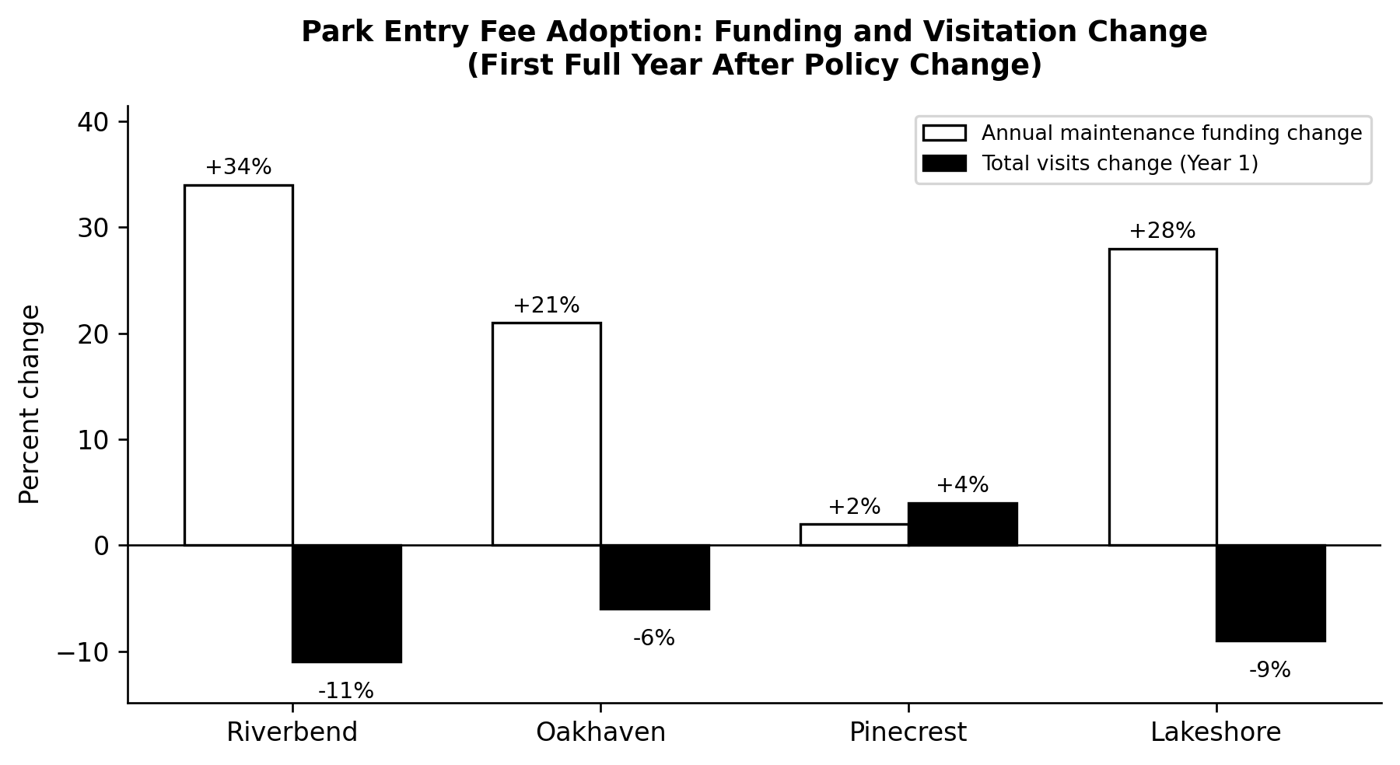
Source B: Author-created simulated data for instructional use, first full year after policy change.
Source C
At a public hearing on the proposed fee, one parent described how the neighborhood park fit into her family's routine. “My kids and I used to walk there almost every day after school,” she said. “It wasn't a special trip. It was the place we went when there was an hour before dinner and they needed to run around.” Because the family lived in an apartment without a yard, the park's open field, playground, and shaded walking path served as the easiest nearby place for outdoor time.
She said that a five-dollar entry charge did not seem large when she first heard the proposal. The effect changed when she calculated it as a recurring expense. Visiting four times in one week would cost twenty dollars, and a month of frequent visits could cost more than several other items in the family's recreation budget. “When every visit has a price attached, you start asking whether today is really the day to go,” she said. “That changes what a public park is in daily life.”
The parent also acknowledged the maintenance problem that led to the proposal. She had seen broken drinking fountains remain out of service for weeks, and she supported spending more on restrooms and playground repairs. She said she would be more comfortable with a parking fee because her family walks to the park, or with a resident pass that reduced the cost for people who use the park frequently. Free-admission days, she added, would help occasional visitors but would not fully protect families whose main concern was the cumulative cost of regular use.
Her objection was therefore not that parks should receive no new revenue. It was that the city should distinguish between visitors who treat the park as an occasional destination and residents for whom the park functions as part of the neighborhood's basic shared space. “I know the park needs money,” she concluded. “I just don't want the solution to make the families who use it most often feel like they have to ration being there.” She also asked the city to publish a one-year review if the fee is adopted, including how much money is collected, how much is spent collecting it, and whether visits decline among city residents. In her view, a fee should not become permanent simply because it is easy to collect; it should have to show that the maintenance benefit is large enough to justify the change in access.
Source C: Author-created composite testimony for exam practice.
Source D
Critics of general park-entry fees argue that the policy changes the relationship between residents and a public resource in ways that are easy to underestimate when the charge is described only as a small amount per visit. Residents already help fund parks through taxes, and many of the people who use neighborhood parks most often are not making a destination purchase. They may walk through a park on the way home, take children to a playground several times a week, or use a trail for routine exercise. For these users, a repeated fee can accumulate quickly even when the single-visit price appears modest.
The access concern is also unevenly distributed. Households with private yards, paid fitness memberships, or easy transportation to other recreation sites have substitutes that lower-income households may not have. A fee can therefore reduce use most among the people for whom a public park provides the least expensive nearby option for exercise and outdoor space. Critics argue that this conflicts with the civic rationale for maintaining parks through broad public funding in the first place.
A second concern is administrative efficiency. Entry fees require some combination of gates, payment systems, staff time, enforcement, signage, customer-service procedures, and a process for handling exemptions or disputes. The gross amount collected is not the same as the amount available for maintenance after those costs are paid. A system that raises visible revenue but spends a large share collecting it may be less efficient than a smaller increase in a broad tax, a parking charge, a local lodging assessment, or a dedicated transfer from the general fund.
Critics do not necessarily argue that every fee is inappropriate. Many accept charges for reserving a shelter, launching a boat, parking a vehicle, or participating in a specialized program because those charges are tied to a specific service or cost. Their objection is to making ordinary physical entry itself a routine transaction without first testing less restrictive ways to raise revenue. From this perspective, the strongest case for a fee would require evidence not only that parks need money, but that the proposed fee produces enough net revenue to justify the access cost and that practical protections keep the burden from falling most heavily on frequent local users. They also argue for a scheduled public review after the first year. If revenue is lower than projected, administrative costs are higher, or routine visits fall sharply, the city should be willing to revise or end the fee rather than treating adoption as irreversible. A funding mechanism, in this view, should be judged by its net effect on the park system, not by the visibility of the money collected at the gate.
Source D: Author-created policy critique for exam practice.
Source E
| Policy design | Who pays | Access protection | Main tradeoff |
|---|---|---|---|
| Universal gate fee | Every entrant | Income-based waiver and scheduled free days | Broadest revenue base; greatest risk of reducing routine access |
| Parking-only fee | Visitors arriving by vehicle | Walking and bicycle entry remain free; resident permits possible | Narrower revenue base; possible spillover parking |
| Tiered entry fee | Nonresidents pay full rate; residents pay less | Resident, low-income, child, or disability waiver options | More targeted burden; more verification and administration |
Source E: Author-created policy comparison graphic for exam practice.
Source F
A number of park systems have explored a middle approach that charges for vehicle access while keeping pedestrian and bicycle entry free. The reasoning is partly administrative and partly about access. A parking charge can be collected at a smaller number of entrances or lots, and it links the fee to a service that has direct costs, including pavement, lighting, snow removal, traffic control, and maintenance of parking areas. Visitors who arrive without using that infrastructure can continue to enter without paying.
The model also changes who is most likely to bear the charge. Nearby residents who walk or bike may retain free routine access, while visitors traveling from farther away are more likely to arrive by car and pay. Some systems pair the parking charge with an annual resident permit, a lower rate for city residents, or free parking for visitors who document a disability. Others charge only during peak seasons or on high-demand weekends, when crowding and traffic management costs are greatest.
A parking-only model does not eliminate every equity concern. Families who live too far away to walk or bike may have no practical alternative to driving, and neighborhoods with limited transit service can be affected differently from neighborhoods served by frequent buses or safe bicycle routes. The policy can also shift parking onto nearby residential streets if visitors try to avoid the charge. These effects depend on local geography and transportation options, so a city would need to study where displaced parking or access barriers are most likely to occur.
Supporters of the hybrid approach argue that it preserves a clearer distinction between access to the park itself and payment for an added service. It can generate revenue from high-volume destinations without requiring a gate charge from every person who enters. Opponents respond that the amount raised may be lower than a universal entry fee. The tradeoff is therefore straightforward: the city accepts a smaller potential revenue base in exchange for keeping ordinary nonvehicle access free and concentrating the charge on a narrower, more administratively identifiable activity. The approach can also be adjusted without changing the basic principle. A city can raise peak-day parking rates, offer annual passes, or preserve a small number of no-charge spaces for short visits. Those options give administrators several ways to manage demand and revenue while keeping the physical act of entering the park on foot or by bicycle free.
Source F: Author-created hybrid-policy summary for exam practice.
Question 2: Rhetorical Analysis
Suggested time: 40 minutes.
In the following author-created practice passage, Elena Marquez, director of a community science museum, addresses staff members, volunteers, and donors after a severe storm flooded part of the museum. Read the passage carefully. Then write an essay that analyzes the rhetorical choices Marquez makes to argue that the museum should rebuild differently rather than simply restore the building exactly as it was.
When the water came through the west doors, it did not ask which objects were rare and which were ordinary. It lifted the paper planets from the children's table, soaked the labels we had printed that morning, and left a brown line across the wall beneath the photograph of the first telescope donated to this museum. By sunrise, our building looked less like a place for discovery than a place that had been interrupted in the middle of a sentence.
I know why the fastest response is tempting. We have heard it all week: dry the rooms, replace the cases, put the exhibits back where they were, and open the doors as soon as possible. Reopening matters. Families have memberships they paid for. Teachers have field trips on their calendars. Staff members need the museum operating, and our donors deserve to see that their support produces action. I share that urgency. But urgency is not the same as haste, and restoration is not the same as resilience.
If we rebuild every vulnerable exhibit at the same height, return every electrical panel to the same wall, and store every archive box in the same basement, then we will have used a flood to prove only that we can repeat ourselves. We can do better than that. The storm has given us a harsh kind of map. It has shown us exactly where water travels, which doors fail first, which collections cannot be moved quickly, and which decisions become impossible once an alarm is already sounding.
Think about the child who stands under the suspended whale in our main hall and asks how something so enormous can move through water. We never answer by saying, “Because it always has.” We show forces, structures, adaptation. We ask the child to look again. A science museum that teaches adaptation in every gallery should be willing to practice it in its own building.
So I am asking us to reopen in stages. Move the archive and electrical systems above the flood line before the lower galleries return. Build the new children's lab with materials that can be lifted, cleaned, or replaced without destroying the entire room. Use the east entrance for the first phase, even if it means a smaller opening, while the west doors are redesigned. None of these choices is dramatic enough for a ribbon-cutting photograph. All of them make the next emergency less dramatic.
This plan will cost more now than simply putting each object back. That is the strongest argument against it, and we should say so plainly. Every dollar we spend on prevention is a dollar we cannot spend this year on a new exhibit. But the cheapest reconstruction is not cheap if we pay for it twice. We owe our donors a budget that counts more than the next six months, and we owe our staff a building that does not make the same failure predictable.
Most of all, we owe our visitors the kind of institution we claim to be. A museum is not a warehouse for facts that have already been settled. It is a place where evidence changes what we do next. The flood is evidence. Let us not frame it, label it, and then ignore it. Let us read it carefully, change the building accordingly, and reopen not as a copy of what stood here before, but as a museum that learned from what happened to it. If that means one gallery opens a month later, we should explain why. If it means an exhibit looks different because its cases can now be moved quickly, we should make that design choice visible. Our visitors come here to see evidence turned into knowledge. The rebuilding itself can show them what that process looks like when an institution applies it to itself.
Elena Marquez, author-created museum reopening address for exam practice.
Question 3: Argument
Suggested time: 40 minutes.
Prompt: Periods of extended solitude are sometimes described as essential to personal or intellectual growth, and at other times as an obstacle to it. Write an essay that argues your position on the value of solitude in an individual's personal or intellectual development.
In your response, you should do the following:
• Respond to the prompt with a thesis that presents a defensible position.
• Provide evidence to support your line of reasoning.
• Explain how the evidence supports your line of reasoning.
• Use appropriate grammar and punctuation in communicating your argument.
End of Practice Exam 1.