AP English Language study guide · Chapter 40
Practice Exam 2
This practice exam follows the same digital exam structure as Practice Exam 1, using entirely different sources. Time yourself using the official section timing: 60 minutes for the multiple-choice section and 2 hours 15 minutes for the free-response section, including the 15-minute reading period.
SECTION I: MULTIPLE CHOICE
45 Questions. Suggested time: 60 minutes.
Questions 1–12 refer to the following passage.
In the execution of such a plan, nothing is more essential, than that permanent, inveterate antipathies against particular Nations, and passionate attachments for others, should be excluded; and that, in place of them, just and amicable feelings towards all should be cultivated. The Nation, which indulges towards another an habitual hatred, or an habitual fondness, is in some degree a slave. It is a slave to its animosity or to its affection, either of which is sufficient to lead it astray from its duty and its interest.
Antipathy in one nation against another disposes each more readily to offer insult and injury, to lay hold of slight causes of umbrage, and to be haughty and intractable, when accidental or trifling occasions of dispute occur. Hence, frequent collisions, obstinate, envenomed, and bloody contests. The Nation, prompted by ill-will and resentment, sometimes impels to war the Government, contrary to the best calculations of policy. The Government sometimes participates in the national propensity, and adopts through passion what reason would reject; at other times, it makes the animosity of the nation subservient to projects of hostility instigated by pride, ambition, and other sinister and pernicious motives. The peace often, sometimes perhaps the liberty, of Nations has been the victim.
So likewise, a passionate attachment of one Nation for another produces a variety of evils. Sympathy for the favorite Nation, facilitating the illusion of an imaginary common interest in cases where no real common interest exists, and infusing into one the enmities of the other, betrays the former into a participation in the quarrels and wars of the latter without adequate inducement or justification.
George Washington, Farewell Address, published September 19, 1796
Question 1
- A. That nations should actively cultivate strong attachments to allied nations
- B. That such excessive feelings, in either direction, compromise a nation's independent judgment in the same way slavery compromises a person's freedom
- C. That hatred between nations is acceptable as long as it remains moderate
- D. That nations have no meaningful control over their feelings toward one another
Question 2
- A. It literally accuses specific nations of practicing slavery
- B. It has no particular rhetorical function beyond decoration
- C. It introduces a new topic unrelated to the passage's central claim
- D. It reframes excessive national feeling as a loss of the autonomous judgment the passage implies a nation should protect, using a comparison with strong negative connotations
Question 3
- A. “to lay hold of slight causes of umbrage”
- B. “the Nation, prompted by ill-will and resentment, sometimes impels to war the Government, contrary to the best calculations of policy”
- C. “just and amicable feelings towards all should be cultivated”
- D. “in place of them”
Question 4
- A. The third paragraph directly contradicts the argument developed in the second paragraph
- B. The third paragraph abandons the discussion of national feeling entirely
- C. The third paragraph introduces evidence unrelated to the passage's central claim
- D. The third paragraph applies the same underlying caution to the opposite extreme, a passionate attachment, that the second paragraph applied to antipathy
Question 5
- A. “illusion,” describing the imagined common interest a favored nation's sympathy creates
- B. “policy,” describing calculations that resentment can override
- C. “nation,” used throughout the passage
- D. “government,” describing the entity that sometimes participates in national propensity
Question 6
- A. A narrative account of a specific historical conflict between two named nations
- B. A list of unrelated observations about international relations with no connecting logic
- C. A general claim about the danger of excessive national feeling, followed by a detailed causal chain for one extreme, then a parallel treatment of the opposite extreme
- D. A rebuttal to a specific argument made by an opposing political figure
Question 7
- A. It suggests that all wars are equally justified regardless of their cause
- B. It has no specific function and could be removed without changing the sentence's meaning
- C. It shifts the passage's focus to domestic rather than foreign policy
- D. It specifies the particular danger of passionate attachment: that it can draw a nation into conflicts it has no genuine, independent reason to enter
Question 8
- A. The structure signals that the two sentences describe entirely unrelated nations
- B. The parallel construction, naming “the Nation” as the grammatical subject acted upon by its own feelings, reinforces the passage's consistent claim that national feeling drives national behavior in predictable, danger-producing ways
- C. The structure indicates a shift from a serious to a comedic tone
- D. The structure has no discernible rhetorical effect
Question 9
- A. The passage never mentions any relationships between nations
- B. This is an accurate description of the passage's central purpose
- C. It directly contradicts the passage's actual argument, which specifically warns against passionate attachment to a “favorite Nation” as a source of danger, not a recommended policy
- D. The passage argues that nations should have no relationships with each other at all
Question 10
- A. It contrasts foreign policy with domestic policy.
- B. It suggests that national resentment always produces good policy.
- C. It contrasts decisions driven by passion with decisions guided by deliberate judgment, reinforcing the passage's warning that strong national feeling can override reason.
- D. It argues that calculations have no place in government.
Question 11
- A. The clipped structure delivers the consequence of the preceding causal chain with heightened, immediate force, rather than softening it within a more elaborately subordinated sentence
- B. It indicates a printing error in the original document
- C. It signals that the passage's argument has become illogical at this point
- D. It has no effect on the passage's tone or emphasis
Question 12
- A. It has no connection to the passage's opening claim about nations becoming slaves to their feelings
- B. It contradicts the passage's later argument about passionate attachment
- C. It shifts the passage's focus away from national feeling entirely
- D. It demonstrates, step by step, exactly how an initially small national feeling can escalate into a serious, costly conflict, giving concrete substance to the passage's opening abstract warning about excessive feeling
Questions 13–24 refer to the following passage.
I went to the woods because I wished to live deliberately, to front only the essential facts of life, and see if I could not learn what it had to teach, and not, when I came to die, discover that I had not lived. I did not wish to live what was not life, living is so dear; nor did I wish to practise resignation, unless it was quite necessary.
I wanted to live deep and suck out all the marrow of life, to live so sturdily and Spartan-like as to put to rout all that was not life, to cut a broad swath and shave close, to drive life into a corner, and reduce it to its lowest terms, and, if it proved to be mean, why then to get the whole and genuine meanness of it, and publish its meanness to the world; or if it were sublime, to know it by experience, and be able to give a true account of it in my next excursion.
Henry David Thoreau, Walden, 1854
Question 13
- A. That he sought a deliberate confrontation with life's essential facts specifically to avoid later regretting an unexamined life
- B. That he wished to escape all human contact permanently
- C. That he intended to write a scientific study of forest ecosystems
- D. That he had no particular reason for the decision and acted on impulse
Question 14
- A. It indicates that the speaker found life to be financially expensive
- B. It provides the specific reason the speaker gives for not wishing to “live what was not life,” since the preciousness of life makes settling for an inauthentic version of it especially costly
- C. It contradicts the sentence's main claim about not wishing to live inauthentically
- D. It has no connection to the rest of the sentence
Question 15
- A. The parallel structure signals that the speaker is listing unrelated, disconnected activities
- B. The parallel structure indicates uncertainty about the speaker's actual intentions
- C. The parallel structure has no discernible effect on the passage's tone
- D. The accumulating parallel structure builds a sense of relentless, active intensity toward confronting life directly, reinforcing the paragraph's claim about wanting to “suck out all the marrow of life”
Question 16
- A. These phrases indicate the speaker has already decided life is definitely mean rather than sublime
- B. These phrases are unrelated to the sentence's main claim about experiencing life fully
- C. These parallel conditional clauses establish that the speaker's commitment to fully experiencing life applies regardless of whether the experience turns out to be base or exalted
- D. These phrases signal a shift to a completely different topic
Question 17
- A. “or if it were sublime”
- B. “in my next excursion”
- C. “to know it by experience”
- D. “to drive life into a corner, and reduce it to its lowest terms”
Question 18
- A. The second paragraph directly contradicts the motivation stated in the first paragraph
- B. The two paragraphs address entirely unrelated subjects
- C. The first paragraph is a direct response to a claim made in the second paragraph
- D. The first paragraph states the speaker's underlying motivation, and the second paragraph elaborates that motivation into a more specific, intensely stated method for pursuing it
Question 19
- A. “life,” used throughout the passage
- B. “suck,” as in “suck out all the marrow of life”
- C. “next,” describing the speaker's future excursion
- D. “account,” describing what the speaker hopes to give
Question 20
- A. The passage does mention specific building materials
- B. This is an accurate description of the passage's central purpose
- C. It fundamentally misreads the passage's actual purpose, which states a philosophical motivation for deliberate living rather than offering any practical construction guidance
- D. The passage argues against ever building any kind of shelter
Question 21
- A. They present deliberate living as a passive acceptance of whatever occurs
- B. They shift the passage toward literal agricultural instruction
- C. They weaken the speaker's claim by making his method sound uncertain
- D. They use forceful images of cutting and reduction to portray deliberate living as an effort to strip experience down to what is essential
Question 22
- A. It moves from specific details to an increasingly vague, general statement
- B. Both paragraphs maintain an identical level of specificity throughout
- C. It moves from a general statement of motivation to an increasingly specific, intensified series of images describing how that motivation will be pursued
- D. The passage's structure has no discernible pattern of specificity at all
Question 23
- A. By committing to fully experience and report on life honestly regardless of which extreme it turns out to resemble, the speaker demonstrates that the commitment to deliberate living is unconditional rather than dependent on a favorable outcome
- B. It shows that the speaker secretly hopes life will prove to be mean rather than sublime
- C. It contradicts the passage's opening claim about living deliberately
- D. It has no connection to the passage's central claim about deliberate living
Question 24
- A. It suggests the speaker intends to ignore all facts entirely
- B. It has no connection to the rest of the passage's argument
- C. It establishes that the speaker's goal is to confront life's fundamental realities directly, without the distraction of nonessential concerns, setting up the intensified pursuit of this goal in the second paragraph
- D. It indicates the speaker is primarily concerned with nonessential, trivial matters
Questions 25–32 refer to the following passage.
The following is a draft of a public-information article for a county health department. Some sentences are numbered for questions that follow.
“[1] Summer heat alerts are often written as though everyone can avoid high temperatures by staying indoors, but that advice is less useful for residents whose homes lack reliable air-conditioning. [2] During last July's longest heat advisory, county emergency departments recorded a sharp increase in heat-related visits among adults over sixty-five. [3] The county plans to open six cooling centers whenever the heat index is forecast to remain above 100°F for two consecutive days. [4] The centers will operate from noon to 8 p.m. in libraries and recreation buildings located along existing bus routes. [5] Last summer, some residents reported that they did not know which public buildings were open during heat emergencies until after the hottest hours had passed. [6] To address that problem, the county will publish a single live map listing open centers, hours, transit routes, and accessibility information. [7] The map will also be distributed through local clinics, senior-housing managers, and neighborhood organizations. [8] Cooling centers cannot eliminate the health risks created by extreme heat, but a predictable opening rule and one current location source can make a public resource easier to use when conditions become dangerous.”
Original passage: public-information article for a county health department
Question 25
- A. Heat is bad for everyone.
- B. People should stay indoors whenever it is hot.
- C. Heat alerts often recommend staying indoors, but that advice is less useful for residents whose homes lack reliable air-conditioning.
- D. Air-conditioning solves every heat-related health problem.
Question 26
- A. Many people enjoy summer weather.
- B. County records show that residents age sixty-five and older accounted for 41 percent of heat-related emergency visits during that advisory while representing 18 percent of the county population.
- C. Libraries contain books and public computers.
- D. Some residents prefer winter.
Question 27
- A. Immediately after sentence [6], where it extends the communication plan from the live map to the channels that will distribute it.
- B. Before sentence [1].
- C. Between sentences [2] and [3].
- D. After sentence [8].
Question 28
- A. Yet
- B. Likewise
- C. For example
- D. Therefore
Question 29
- A. The county will open six centers every day all summer.
- B. The county plans to open six cooling centers when forecasts meet the stated two-day heat-index threshold.
- C. Six centers will completely prevent heat illness.
- D. The centers might open at some point if needed.
Question 30
- A. Each site will provide drinking water, seating, restrooms, and a climate-controlled indoor space; the live map will identify wheelchair-accessible entrances.
- B. Recreation buildings have existed for many years.
- C. Heat can feel uncomfortable.
- D. Public buildings serve many purposes.
Question 31
- A. In order to address the problem that was previously mentioned above, the county will publish a map that is live and current.
- B. The county, because of the issue, will do a map.
- C. A live map will be published by the county in a way that addresses the issue.
- D. The county will publish one live map listing open centers, hours, transit routes, and accessibility information.
Question 32
- A. It introduces a new topic about climate policy.
- B. It limits the program's claim while explaining the practical benefit the preceding details can reasonably support.
- C. It contradicts the entire article.
- D. It repeats sentence [2] without adding anything.
Questions 33–40 refer to the following passage.
The following is a draft of a student editorial about later library hours during exam week. Some sentences are numbered for questions that follow.
“[1] Our campus library currently closes at 10 p.m., even during final-exam week, when study spaces elsewhere on campus are also heavily used. [2] A survey conducted by student government found that 64 percent of respondents had tried at least once to find a study space after 10 p.m. during the previous exam period. [3] Extending library hours until midnight for the final ten days of each semester would add two hours of staffed study space when demand is unusually high. [4] The strongest objection is staffing cost, especially because a quiet building still requires security and circulation coverage. [5] A limited pilot would answer that concern better than a permanent policy adopted without data. [6] For one exam period, the library could keep only the first floor open after 10 p.m. and track hourly entry counts, staffing expense, and safety incidents. [7] If late-night use is low, the university could end the pilot; if use is sustained, administrators would have campus-specific evidence for deciding whether the extra hours justify the cost. [8] The proposal therefore asks for a measured test of demand, not an indefinite expansion made on assumption alone.”
Original passage: student editorial on library hours
Question 33
- A. The survey proves every student needs the library after 10 p.m.
- B. Student government surveys are always perfectly representative.
- C. Because respondents chose whether to participate, the result shows demand among respondents but does not establish that 64 percent of all students need late-night space.
- D. The survey should be ignored because it was not national.
Question 34
- A. Extending hours would solve the campus study-space crisis completely.
- B. Extending library hours until midnight for the final ten days of each semester would add one more staffed study option during the period of highest demand.
- C. The library must stay open all night every night.
- D. Extra hours are obviously the only fair solution.
Question 35
- A. It changes the subject to library architecture.
- B. It dismisses the staffing concern without answering it.
- C. It converts the staffing objection into a reason for a limited pilot that can generate the missing cost-and-use evidence.
- D. It proves that staffing will be free.
Question 36
- A. Tracking staffing expense alongside hourly entry counts.
- B. Keeping the first floor open.
- C. Running the pilot during an exam period.
- D. Mentioning safety incidents.
Question 37
- A. The university can look at the numbers later.
- B. Students will probably like the pilot.
- C. The pilot should become permanent no matter what.
- D. If late-night use is low, end the pilot; if use is sustained, compare that demand with the measured staffing cost before deciding whether to continue it.
Question 38
- A. Libraries contain many kinds of books.
- B. Some students prefer coffee shops.
- C. Finals can be stressful.
- D. Administrators may also worry about late-night safety, which is why the pilot should track incidents and keep the open area limited to one staffed floor.
Question 39
- A. “Study spaces elsewhere on campus are also heavily used” if no evidence about those spaces is supplied or used later.
- B. The survey result in sentence [2].
- C. The staffing objection in sentence [4].
- D. The measurable pilot design in sentence [6].
Question 40
- A. Sentence [7] gives the evidence-based decision rule, and sentence [8] reframes the proposal as a reversible test rather than a permanent commitment.
- B. They introduce unrelated subjects.
- C. They contradict each other.
- D. They repeat the survey statistic.
Questions 41–45 refer to the following passage.
The following is a draft email to faculty announcing a change in the university writing center's appointment system. Some sentences are numbered for questions that follow.
“[1] Beginning October 1, students will book writing-center appointments through the campus scheduling portal rather than through the center's separate website. [2] Existing appointments will transfer automatically, so students who have already reserved a time do not need to book again. [3] The campus portal will show both in-person and online appointments in one calendar and will allow students to join a cancellation waitlist. [4] Faculty who link to the old booking page in a syllabus or course site should replace that link before October 1. [5] The old page will remain online for two weeks after the change, but it will redirect students to the campus portal rather than accept new appointments.”
Original passage: internal email announcing a scheduling change
Question 41
- A. Writing Center News
- B. An Update
- C. Scheduling Information
- D. Writing Center booking moves Oct. 1: update old course links
Question 42
- A. After sentence [5].
- B. Before sentence [1].
- C. Immediately after sentence [1], because it answers the most immediate concern created by the announced system change.
- D. Delete it.
Question 43
- A. Before October 1, replace any writing-center booking link in your syllabus or course site that points to the old page.
- B. Faculty members who may perhaps have links that could possibly point to a page should consider changes.
- C. Links are things that should be updated by faculty.
- D. There are old links in various places.
Question 44
- A. It introduces a second scheduling system.
- B. It describes the transition period and prevents readers from assuming the old page will continue accepting appointments.
- C. It makes sentence [1] unnecessary.
- D. It shifts the email to a discussion of writing pedagogy.
Question 45
- A. Writing is important across the curriculum.
- B. No action is needed unless your course materials link directly to the old booking page; student appointments already on the calendar will transfer automatically.
- C. Thank you for supporting students in every possible way.
- D. The writing center has served campus for many years.
SECTION I: ANSWERS AND EXPLANATIONS
Show the answers and explanations
1. Correct answer: B
A: This directly contradicts the passage, which recommends “just and amicable feelings towards all” rather than cultivating strong attachments to particular nations.
B (correct): The passage explicitly develops this comparison, stating that a nation indulging habitual hatred or fondness “is in some degree a slave” to that feeling, directly supporting this paraphrase.
C: The passage does not endorse moderate hatred; it recommends excluding “permanent, inveterate antipathies” entirely, not merely moderating them.
D: This contradicts the passage's implicit assumption that nations can and should “cultivate” specific feelings, which presumes some degree of control.
2. Correct answer: D
A: This is a figurative comparison illustrating a nation's relationship to its own excessive feelings, not a literal accusation about a specific practice within any named nation.
B: This metaphor performs specific rhetorical work, reframing excessive feeling as a loss of autonomy, rather than functioning as mere decoration.
C: This metaphor directly extends and reinforces the passage's central claim about the danger of excessive national feeling, not an unrelated topic.
D (correct): Slavery carries a strong connotation of lost autonomy and self-determination; applying this metaphor to a nation governed by its own excessive feelings reframes such feelings as a comparable loss of independent judgment.
3. Correct answer: B
A: This phrase describes a disposition toward taking offense, a precursor in the passage's reasoning chain, but does not itself state the connection to armed conflict as directly as the later sentence about war.
B (correct): This sentence explicitly and directly connects national ill-will to the specific outcome of war, providing direct evidence for the claim about antipathy leading to armed conflict.
C: This phrase states a recommendation rather than evidence connecting antipathy specifically to armed conflict.
D: This is a transitional phrase, not evidence connecting national antipathy to a specific consequence like armed conflict.
4. Correct answer: D
A: The third paragraph extends rather than contradicts the second paragraph's argument, applying the same underlying caution to a different, complementary extreme.
B: The third paragraph continues the discussion of national feeling, specifically addressing passionate attachment as a parallel case to the antipathy discussed in the second paragraph.
C: The third paragraph's evidence about passionate attachment is directly related to and extends the passage's central claim about the dangers of excessive national feeling.
D (correct): The third paragraph's opening, “so likewise,” explicitly signals a parallel treatment, extending the same fundamental caution from antipathy, the second paragraph's focus, to passionate attachment.
5. Correct answer: A
A (correct): “Illusion” carries a specific connotation of deceptive appearance, something that seems real but is not, fitting the passage's warning that sympathy for a favored nation can create a false sense of shared interest.
B: This is a comparatively neutral word describing a course of action or set of principles, without the specific connotation of deceptive appearance carried by “illusion.”
C: This is a neutral term for a political entity and does not carry any particular connotation of deceptive appearance.
D: This is a neutral institutional term without the specific connotation of deceptive appearance carried by “illusion.”
6. Correct answer: C
A: The passage does not narrate a specific historical conflict or name particular nations; it makes a general argument about national feeling in the abstract.
B: The passage's paragraphs are logically connected through a developing argument about excessive national feeling, not a list of unrelated observations.
C (correct): This accurately traces the passage's structure: paragraph one states the general claim, paragraph two traces antipathy's causal chain toward conflict, and paragraph three applies the same caution to passionate attachment.
D: The passage does not present itself as a direct rebuttal to a named opposing figure's specific argument; it develops a general claim about national feeling.
7. Correct answer: D
A: This phrase does the opposite, specifically distinguishing conflicts entered “without adequate inducement or justification” from presumably better-justified ones.
B: Removing this phrase would leave the sentence's claim about entanglement in conflict without its specific, defining qualification about the lack of independent justification.
C: This phrase remains focused on the passage's consistent subject, relations between nations, not domestic policy.
D (correct): This phrase specifies the precise nature of the harm passionate attachment creates, entanglement in conflicts lacking independent justification, giving the paragraph's claim its specific force.
8. Correct answer: B
A: Both sentences use “the Nation” as a general term for any nation experiencing these feelings, not as references to two specific, different, unrelated nations.
B (correct): This repeated structure consistently positions “the Nation” as subject to its own feelings across both paragraphs, reinforcing the passage's unified argument about the predictable dangers such feelings create.
C: Nothing about this parallel structure introduces humor; the passage maintains a serious, cautionary tone throughout.
D: This repeated structure measurably reinforces the passage's consistent argument about the dangers of national feeling, which is not without effect.
9. Correct answer: C
A: The passage extensively discusses relationships and feelings between nations, so this claim about omission is factually incorrect.
B: This significantly misreads the passage, which warns against rather than recommends passionate attachment to particular nations.
C (correct): The passage's third paragraph explicitly warns against passionate attachment to a favored nation, describing the “variety of evils” such attachment produces, the opposite of recommending such alliances.
D: The passage recommends “just and amicable feelings towards all,” not the absence of relationships entirely; this misreads the passage's actual, more measured claim.
10. Correct answer: C
A: The phrase does not distinguish between foreign and domestic policy; it concerns the relationship between passion and reasoned judgment within a single decision to go to war.
B: This contradicts the sentence, which presents resentment-driven war as running against, not producing, sound policy calculation.
C (correct): The phrase sets “ill-will and resentment” against “the best calculations of policy,” directly contrasting an emotionally driven decision with the reasoned judgment the passage warns can be overridden.
D: The passage does not argue against calculation in government; it warns that passion can override the calculations that should otherwise guide policy.
11. Correct answer: A
A (correct): This abrupt, compressed structure delivers the causal chain's grim consequence with an emphatic immediacy that a more fully elaborated, subordinated sentence would diminish.
B: This is a deliberate stylistic choice characteristic of formal eighteenth-century rhetorical prose, not an error.
C: The passage's logic remains clear and coherent at this point; the structure is a stylistic choice for emphasis, not a sign of illogic.
D: This structural choice meaningfully heightens the passage's emphasis at a critical point in its causal argument, which is not without effect.
12. Correct answer: D
A: This causal chain directly illustrates and supports the opening claim, providing the concrete mechanism by which excessive feeling actually compromises a nation's judgment and leads it into danger.
B: This causal chain about antipathy does not contradict the later, parallel argument about passionate attachment; the two extremes are treated as complementary illustrations of the same underlying danger.
C: This causal chain remains centrally focused on national feeling and its consequences, directly supporting rather than departing from the passage's consistent subject.
D (correct): This step-by-step causal chain transforms the passage's opening abstract claim into a concrete, traceable sequence of escalation, showing exactly how a national feeling could plausibly lead to the serious consequence of war.
13. Correct answer: A
A (correct): The sentence's structure, “not, when I came to die, discover that I had not lived,” explicitly frames this deliberate confrontation as motivated by the desire to avoid this specific future regret.
B: The passage does not claim a desire for permanent isolation from all human contact; its stated purpose concerns confronting “essential facts,” not escaping people specifically.
C: Nothing in the passage suggests a scientific research purpose; the stated purpose is personal and philosophical, concerning how to live.
D: This contradicts the passage, which states a specific, deliberate reason, “I wished to live deliberately,” directly opposed to an impulsive, unreasoned decision.
14. Correct answer: B
A: “Dear” here carries the connotation of preciousness or value, not a literal claim about financial cost, which fits the passage's philosophical rather than economic concern.
B (correct): This phrase functions as the sentence's stated justification: because living carries such value, wasting it on something “not life” would be an especially significant loss, which is why the speaker rejects that option.
C: This phrase supports rather than contradicts the main claim; it provides the reasoning behind the stated preference.
D: This phrase is directly connected to and supports the sentence's main claim, providing the specific reasoning behind it.
15. Correct answer: D
A: These phrases are closely thematically connected, all elaborating the same central idea of confronting life directly and intensely, not a list of disconnected activities.
B: The confident, escalating, active phrasing conveys determination and clarity of purpose, not uncertainty.
C: This structural choice meaningfully builds the passage's intense, determined tone, which is not without effect.
D (correct): This series of parallel infinitive phrases accumulates active, forceful verbs, building a rhythmic intensity that reinforces the paragraph's opening claim about wanting to engage life with maximum, deliberate intensity.
16. Correct answer: C
A: The parallel conditional structure, “if... or if,” presents both as open possibilities rather than a predetermined conclusion favoring one over the other.
B: These phrases are directly connected to the sentence's main claim, specifying that the commitment to full experience holds regardless of which outcome, mean or sublime, actually occurs.
C (correct): By presenting both possible outcomes, meanness and sublimity, in parallel conditional structure, the passage establishes that the speaker's stated commitment does not depend on which outcome actually occurs.
D: The passage remains focused on its consistent subject, the nature of the speaker's commitment to experiencing life fully, throughout this sentence.
17. Correct answer: D
A: This phrase concerns one possible outcome of the speaker's approach, not evidence about the manner, intense or passive, of that approach itself.
B: This phrase refers to a future account the speaker plans to give, not direct evidence about the intensity of the current approach to life.
C: While related to the passage's theme of direct engagement, this phrase is less specifically evidence of intensity than the more forceful “drive life into a corner” phrase.
D (correct): This phrase's active, forceful verbs, “drive” and “reduce,” directly convey an aggressive, deliberate approach to confronting life, providing direct evidence for a claim about intensity rather than passivity.
18. Correct answer: D
A: The second paragraph extends rather than contradicts the first paragraph's stated motivation, elaborating it with more specific, intense language.
B: Both paragraphs are closely connected, developing the same continuous idea about the speaker's deliberate approach to experiencing life fully.
C: This reverses the passage's actual sequence; the first paragraph's motivation precedes and sets up the elaboration that follows in the second paragraph.
D (correct): The first paragraph establishes the desire to “live deliberately” and confront “essential facts,” and the second paragraph builds on this by specifying, in more forceful, extended language, exactly how the speaker intends to pursue that goal.
19. Correct answer: B
A: This is the passage's general subject term and does not itself carry a specific connotation of extracting maximum value.
B (correct): “Suck,” applied to extracting marrow, carries a connotation of drawing out every available bit of nourishment or value, stronger than a neutral synonym like “take” or “get” would carry.
C: This is a neutral, sequential word without any particular connotation related to extracting value.
D: This is a comparatively neutral word for a report or description, without the specific connotation of extraction carried by “suck.”
20. Correct answer: C
A: No building materials or construction details are mentioned anywhere in this passage.
B: This significantly misreads the passage, which addresses philosophical motivation, not practical construction guidance.
C (correct): Nothing in this passage addresses cabin construction; its content concerns the speaker's philosophical motivation for seeking deliberate, intense engagement with life, making this claim a significant misreading.
D: The passage does not address shelter-building at all, for or against; this claim addresses a subject entirely absent from the passage.
21. Correct answer: D
A: These images describe an active, forceful engagement with life, not a passive acceptance of whatever happens to occur.
B: “Cut a broad swath and shave close” draws on a farming image, but the passage uses it figuratively to describe a mode of living, not to offer literal agricultural instruction.
C: These forceful, decisive images strengthen rather than weaken the claim; nothing about them suggests uncertainty.
D (correct): Both images convey a forceful paring away of the inessential, casting deliberate living as an active effort to reduce experience to its most essential terms.
22. Correct answer: C
A: This reverses the passage's actual movement, which goes from a more general statement toward increasingly specific, vivid elaboration, not the other way around.
B: The two paragraphs differ meaningfully in specificity, with the second paragraph elaborating the first's general motivation into much more vivid, specific imagery.
C (correct): The first paragraph states the general motivation in relatively measured terms, while the second paragraph escalates into a series of specific, intense, and vivid images elaborating exactly how that motivation will be enacted.
D: The passage's movement from general motivation to specific, intensified imagery is a discernible and meaningful structural pattern.
23. Correct answer: A
A (correct): This antithesis strengthens the central claim by showing the commitment is not contingent on life turning out well; the speaker commits to full, honest engagement whether the result is base or exalted, reinforcing the depth of the stated resolve.
B: Nothing in the passage's parallel, evenhanded treatment of both possibilities suggests the speaker secretly favors one outcome over the other.
C: This antithesis supports rather than contradicts the opening claim, reinforcing the unconditional nature of the speaker's commitment to deliberate living.
D: This antithesis is directly connected to and strengthens the passage's central claim, demonstrating the unconditional depth of the stated commitment.
24. Correct answer: C
A: This contradicts the phrase, which specifically emphasizes confronting facts, particularly “essential” ones, rather than ignoring facts altogether.
B: This phrase is directly connected to and sets up the passage's larger argument, particularly the intensified elaboration of this same goal in the second paragraph.
C (correct): This phrase states the specific, foundational goal, direct confrontation with fundamentals rather than distraction, that the second paragraph's escalating imagery then elaborates in more intense terms.
D: This directly contradicts the phrase, which specifically emphasizes “essential facts” rather than nonessential or trivial ones.
25. Correct answer: C
A: This drops the article's specific qualification entirely, losing the point that the advice is less useful for a particular group of residents.
B: This restates the generic advice the sentence is meant to qualify, rather than naming the specific access problem.
C (correct): This revision keeps the article's qualification and names the precise access problem, residents without reliable air-conditioning, rather than a vague general claim.
D: This overstates what air-conditioning accomplishes and drops the article's qualification about access entirely.
26. Correct answer: B
A: This unrelated, positive generalization about summer weather does not support the claim that older adults are a particular concern during heat advisories.
B (correct): This specific, sourced comparison directly supports the article's focus on older adults by showing their emergency visits far exceed their share of the population.
C: This describes library resources generally and has no bearing on the claim about older adults and heat-related emergency visits.
D: This unrelated preference has no bearing on the claim about older adults and heat-related emergency visits.
27. Correct answer: A
A (correct): Sentence [7] names additional distribution channels for the map just introduced in sentence [6], so placing it immediately after keeps the communication plan together.
B: Sentence [7] depends on the live map already being introduced; placing it before sentence [1] would leave “the map” with no antecedent.
C: This would insert a detail about distributing the map before the map itself, or the cooling centers, have been introduced.
D: Placing this detail after the article's concluding sentence would separate it from the communication plan it belongs with.
28. Correct answer: A
A (correct): “Yet” correctly signals a contrast: despite the centers and rule described in [3]–[4], residents still did not know which buildings were open.
B: “Likewise” signals similarity, but sentence [5] describes a problem that contrasts with, not resembles, the plan described in [3]–[4].
C: Sentence [5] does not illustrate sentences [3]–[4] with an example; it introduces a contrasting problem from a prior summer.
D: Sentence [5] does not follow as a consequence of [3]–[4]; it describes a past problem that motivates the response in sentence [6].
29. Correct answer: B
A: This drops the conditional heat-index trigger entirely, describing an unconditional daily operation the passage does not establish.
B (correct): This keeps the policy explicitly conditional on the stated forecast threshold, rather than implying centers open on a fixed schedule or that the county controls the weather.
C: This overstates the centers' effect into a guarantee about health outcomes, which the passage does not support.
D: This vague version loses the specific, stated heat-index threshold that makes the policy concrete.
30. Correct answer: A
A (correct): This adds specific, actionable details about what a resident will find at a center and how accessibility information will be available.
B: This historical detail does not help a reader decide whether or how to use a cooling center.
C: This vague statement adds no actionable information about the cooling centers themselves.
D: This generic statement does not help a reader act on the specific cooling-center information the article provides.
31. Correct answer: D
A: This padded version repeats “previously mentioned above” and “live and current” redundantly without adding information.
B: This drops the specific content of the map, hours, transit routes, and accessibility information, that a reader needs.
C: This vague passive construction loses the specific list of information the map will contain.
D (correct): This states the plan directly and keeps the specific list of information the map will contain, without padding.
32. Correct answer: B
A: Sentence [8] remains focused on the cooling-center program described throughout the article; it does not introduce climate policy as a new topic.
B (correct): Sentence [8] explicitly acknowledges what the program cannot do before stating the specific, more modest benefit the article's details actually support.
C: Sentence [8] is consistent with, not contradictory to, the article's earlier claims; it appropriately qualifies rather than reverses them.
D: Sentence [8] states a concluding, qualified claim about the program's value; it does not repeat the emergency-visit data from sentence [2].
33. Correct answer: C
A: This overstates what a voluntary-response survey can prove about the entire student body.
B: This unsupported generalization asserts the opposite of what a limitation statement should acknowledge.
C (correct): This correctly identifies self-selection as a limitation, distinguishing what the survey shows about respondents from what it can prove about the full student body.
D: This overreacts to a genuine limitation by dismissing the survey entirely, rather than stating what it can and cannot establish.
34. Correct answer: B
A: This overstates the proposal's effect into a complete solution the passage's evidence does not support.
B (correct): This states the concrete change without claiming it resolves every study-space problem on campus.
C: This proposes a much larger change than sentence [3] describes and is not supported by the passage's evidence.
D: This treats one option as the only fair solution without evidence ruling out alternatives.
35. Correct answer: C
A: Sentence [5] remains focused on the staffing objection and how to test it, not on the building's architecture.
B: Sentence [5] does not dismiss the concern; it proposes a specific way to generate evidence relevant to it.
C (correct): Sentence [5] reframes the objection as the reason a pilot is needed, turning a concern into the rationale for the proposed next step.
D: Sentence [5] makes no claim about the cost of staffing; it proposes a way to measure that cost.
36. Correct answer: A
A (correct): Pairing staffing expense with usage counts directly produces the cost-and-demand evidence needed to evaluate the staffing objection.
B: This limits the pilot's scope but does not itself generate evidence about staffing cost.
C: This sets the timing of the pilot but does not itself generate cost evidence.
D: Safety incidents are a separate tracked measure, not the detail that most directly addresses the staffing-cost objection.
37. Correct answer: D
A: This vague deferral states no actual rule for deciding whether to continue the pilot.
B: This predicts a reaction rather than stating a rule connecting evidence to a decision.
C: This ignores the conditional design of the pilot and commits to an outcome regardless of the evidence gathered.
D (correct): This states an explicit rule connecting the measured outcomes to a specific decision, matching the pilot's evidence-based design.
38. Correct answer: D
A: This unrelated detail does not raise or address any concern relevant to extending library hours.
B: This unrelated preference does not raise a reasonable concern about the proposal itself.
C: This general observation does not raise a specific, addressable concern about the pilot.
D (correct): This names a second reasonable concern, safety, and ties it directly to design features, incident tracking and a limited floor, already built into the pilot.
39. Correct answer: A
A (correct): This claim about other campus spaces is never supported with evidence or referenced again, making it the least necessary detail to the argument's development.
B: This sentence supplies the specific evidence of demand the rest of the editorial builds on and qualifies.
C: This sentence introduces the central objection the rest of the editorial is structured to address.
D: This sentence supplies the specific design that makes the proposal's evidence-based reasoning concrete.
40. Correct answer: A
A (correct): This describes the actual relationship: a specific rule for using the evidence, followed by a summary statement about what kind of proposal is being made.
B: Both sentences concern the same proposal and its evidence-based, reversible design; neither introduces an unrelated subject.
C: The two sentences are consistent: sentence [8] restates the reversible, evidence-based logic sentence [7] already establishes.
D: Neither sentence restates the specific survey figure from sentence [2].
41. Correct answer: D
A: This generic subject line gives no indication that faculty may need to take any specific action.
B: This vague subject line does not identify the topic or any required action.
C: This names a general topic but does not indicate that faculty may need to update a link before a specific date.
D (correct): This subject line states both the specific change and the specific action faculty may need to take, with a date.
42. Correct answer: C
A: Placing this reassurance after all other details delays answering the most immediate question the announcement raises.
B: Sentence [2] depends on the system change already being announced in sentence [1]; it cannot logically precede it.
C (correct): Readers who already have appointments will immediately wonder what happens to them; answering that right after the announcement addresses the most pressing question first.
D: This reassurance addresses a predictable concern and should be kept, not removed.
43. Correct answer: A
A (correct): This states a clear deadline and a specific, actionable instruction without unnecessary hedging.
B: This hedged, wordy version buries the specific instruction and removes the deadline.
C: This vague passive statement loses the specific deadline and the specific type of link involved.
D: This vague statement gives no actionable instruction or deadline at all.
44. Correct answer: B
A: The old page is not a second system going forward; it is a temporary redirect during the transition.
B (correct): This sentence specifically prevents a reasonable but incorrect assumption, that the old page still works, by stating its temporary redirect function.
C: Sentence [5] describes the transition period; it does not replace or duplicate the announcement in sentence [1].
D: The email remains focused on the scheduling change throughout; it does not shift to pedagogy.
45. Correct answer: B
A: This generic statement does not address any practical question a faculty member might have about the change.
B (correct): This closing sentence directly tells most faculty they need not act while restating the one condition that does require action, reducing avoidable questions.
C: This generic closing does not clarify who needs to act or what to do.
D: This unrelated historical detail does not address any practical question about the scheduling change.
SECTION II: FREE RESPONSE
3 Questions. Reading period: 15 minutes. Suggested writing time: 40 minutes per question. Total time: 2 hours 15 minutes.
Each response is scored on the current 6-point task-specific rubric: Thesis 1, Evidence and Commentary 4, Sophistication 1. Row C rewards sophistication demonstrated through a sustained, well-supported understanding of the rhetorical situation or argument. Depending on the task, this may appear through attention to tensions, limitations, implications, effective rhetorical choices, or a consistently vivid and persuasive style; an isolated “complex” sentence is not enough.
Question 1: Synthesis
Suggested time: 40 minutes. This question requires you to synthesize the sources provided into a coherent, defensible essay.
Prompt: Some public school districts require students to wear uniforms, while others leave clothing choices to students and families. Write an essay that develops a position on whether a public school district should require students to wear uniforms.
Carefully read the following six sources, including the introductory information for each source. Write an essay that synthesizes material from at least three of the sources and develops your position on the question. In your response: present a defensible thesis; use evidence from at least three provided sources; identify the sources you use through quotation, paraphrase, or summary; explain how the evidence supports your line of reasoning; and use appropriate grammar and punctuation.
Practice-source note: Sources A–F in this packet are author-created simulations for exam practice. They are designed to be read and cited exactly as provided here; they should not be treated as independently verified real-world evidence outside this practice task.
Source A
Public school uniform policies range from strict requirements for a single approved outfit to broader rules that specify only colors, garment types, or limits on logos. Districts that adopt them usually give several reasons. Some hope to reduce visible competition over clothing brands, some want to make dress-code enforcement more consistent, and some believe a common appearance can reduce distractions or make it easier to identify people who do not belong on campus. The policy can therefore be presented as a safety measure, a school-climate measure, or a simpler alternative to a long list of prohibited clothing rules.
Implementation, however, determines much of what students and families experience. A uniform that must be purchased from one vendor creates a different cost burden from a policy that allows ordinary shirts and pants in specified colors. A rule that provides several weeks to replace an outgrown garment differs from one that assigns an immediate disciplinary consequence. Districts also vary in whether they provide vouchers, loaner garments, used-uniform exchanges, or exemptions for religious and documented medical needs.
Supporters often emphasize predictability. Families know the range of acceptable clothing before the school year begins, and teachers or administrators do not have to make as many case-by-case judgments about whether a slogan, logo, or style violates a general dress code. Some parents also report that a narrower set of school clothes simplifies morning decisions and reduces pressure to buy trend-driven items specifically for school.
Critics focus on self-expression, cost, and discipline. Clothing can be one of the ways adolescents communicate identity, and a uniform rule can convert minor differences in socks, shoes, fit, or garment condition into school-rule violations. A policy intended to reduce distraction may create new interruptions if students are repeatedly removed from class for uniform enforcement. For that reason, the practical question is not simply whether a district has a uniform rule. It is what the rule requires, how families obtain the required clothing, what exceptions are available, and whether enforcement keeps students in class whenever possible. Districts can also define a review date before adoption. Tracking family assistance requests, disciplinary removals, student and parent complaints, and changes in ordinary dress-code incidents gives the school board evidence about how the rule functions in practice. Without that follow-up, a uniform policy can remain in place for years even if the original problem changes or the implementation creates costs that were not anticipated.
Source A: Author-created background summary for exam practice.
Source B
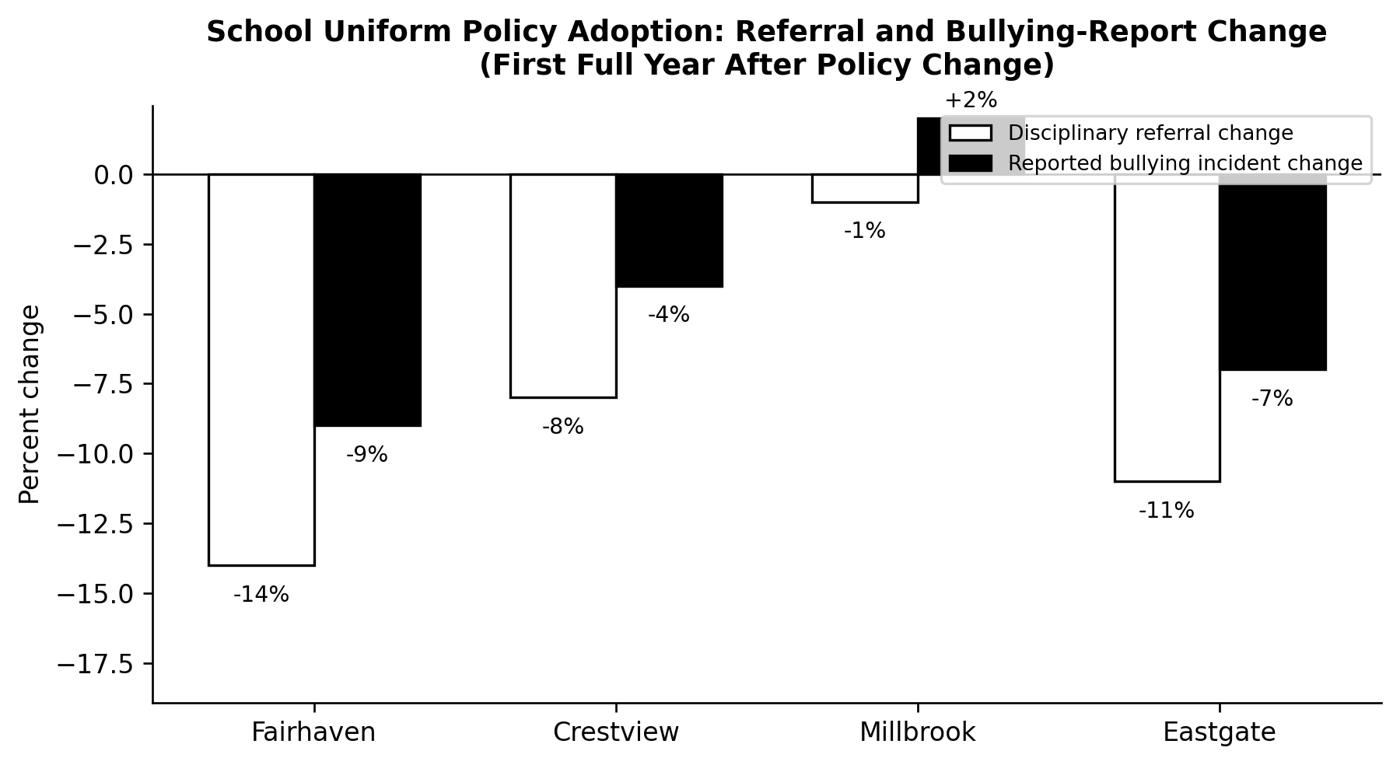
Source B: Author-created simulated data for instructional use, first full year after policy change.
Source C
At a district listening session, one parent described two different reactions to the same uniform policy. Her younger daughter had struggled with clothing decisions before the policy took effect. “Some mornings she changed shirts three or four times because she thought someone would say something about what she was wearing,” the parent said. “With the uniform, that part of the morning is calmer. She knows what goes on, and we leave the house.” The parent also said that buying a limited number of school outfits made it easier to plan laundry and reduced requests for new branded clothing during the school year.
Her older son experienced the policy differently. He had used clothing, especially jackets and graphic shirts, as a form of self-expression and felt that the uniform made school feel more restrictive. “He isn't trying to break rules,” she explained. “He just feels like one of the few choices that was his is now decided for him.” He began changing clothes immediately after school and repeatedly asked why a plain shirt in an unapproved color should be treated differently from the same shirt in an approved color.
Cost was also mixed. The basic uniform pieces were less expensive than some of the clothes the children previously wanted, but the family had to buy several items at once at the beginning of the year. When her son grew during the semester, replacing two pairs of required pants created an unplanned expense. The parent said a district exchange closet helped because she could donate smaller items and receive a larger size without paying full price again.
She did not view the family's experience as proof that uniforms were either good or bad for every student. The policy reduced one child's anxiety and morning conflict, while the other experienced it as a loss of autonomy. Her strongest recommendation was practical: keep approved clothing inexpensive, allow more than one retailer, provide an exchange or assistance program, and avoid removing students from class for small violations that can be corrected without losing instructional time. She also supported a student advisory group to review the policy after the first semester. Her children, she said, noticed practical problems adults missed, including how outerwear rules worked on cold mornings and how quickly approved pants became too short during growth spurts. A policy that affects students every day, she argued, should have a routine way to learn from those daily experiences.
Source C: Author-created composite testimony for exam practice.
Source D
Critics of mandatory school uniforms question whether a broad clothing requirement can be justified by benefits that vary from school to school. A uniform policy may make clothing differences less visible during the school day, but it does not remove the underlying differences in family income, social status, or peer relationships. Students can still compare shoes, phones, backpacks, transportation, extracurricular activities, and many other markers. Critics therefore warn against treating a change in clothing as if it automatically resolves bullying or socioeconomic pressure.
They also distinguish a uniform rule from a narrowly written safety or dress policy. A school can prohibit clothing that displays threats, interferes with identification, or creates a specific safety hazard without requiring every student to dress alike. From this perspective, the district should be able to explain what problem requires a uniform and why a less restrictive rule would not address it adequately.
Enforcement creates another concern. A policy that sends a student out of class for the wrong shade of shirt, an unavailable replacement garment, or a minor fit issue can impose an academic cost unrelated to the behavior the school is trying to improve. The burden may fall more heavily on students whose families have difficulty replacing lost, damaged, or outgrown items quickly. Critics therefore argue that any policy should separate access problems from willful refusal and should use assistance before discipline when the issue is cost.
The case against uniforms is not necessarily a claim that schools should have no clothing rules. Critics generally accept that schools may set reasonable standards connected to safety, disruption, or the educational environment. Their narrower argument is that a mandatory uniform should be evaluated as a specific intervention. The district should identify the problem it expects the rule to address, specify how success will be measured, compare the policy with less restrictive alternatives, and track whether enforcement creates new loss of instructional time. Without those steps, a uniform can become a highly visible policy whose effects are assumed rather than demonstrated. A scheduled evaluation also makes it possible to separate goals. If the district adopted uniforms to reduce dress-code disputes, it should count those disputes. If the goal was attendance or school climate, it should identify measures for those outcomes before the policy begins. The more ambitious the claimed benefit, critics argue, the more important it is to avoid treating the existence of the policy itself as evidence that the benefit occurred.
Source D: Author-created policy critique for exam practice.
Source E
| Decision point | Policy response |
|---|---|
| Family cannot readily purchase an approved item | Offer voucher, loaner garment, or uniform-exchange option before discipline |
| Religious or documented medical need conflicts with standard item | Use a defined review process and approve an alternative compliant garment when warranted |
| Minor correctable violation occurs during the school day | Use on-site correction or a loaner item before removing the student from instruction |
| Policy review at the end of the first year | Review assistance requests, instructional removals, complaints, and implementation costs before renewal |
Source E: Author-created uniform-policy implementation flow graphic for exam practice.
Source F
Some districts have adopted a modified uniform model that sets a limited palette and a few garment types without requiring an identical outfit or a single vendor. A policy might allow any solid-color polo or plain shirt in three approved colors and any plain pants, skirt, or shorts in two approved colors. Families can buy compliant clothing from ordinary retailers, use existing garments when they fit the rule, and choose among cuts and styles within the permitted range.
Supporters describe the model as an attempt to capture some of the predictability of a traditional uniform while reducing cost and preserving more individual choice. A student may choose a preferred color from the approved set, select long or short sleeves, layer approved garments, and use accessories that do not conflict with safety rules. Because the district is not tied to one supplier, families can compare prices and replace individual items as needed.
The looser model also changes enforcement. Staff members generally need to decide only whether an item falls within the approved colors and basic garment categories, not whether it matches a specific brand, fabric, or design. That can reduce disputes over small details. At the same time, the wider range leaves more room for disagreement about patterns, logos, outerwear, or what counts as a permitted shade, so the policy still needs examples and a clear process for correcting violations.
A modified model does not resolve the underlying debate about whether schools should regulate ordinary clothing choices at all. Students who object to uniforms on self-expression grounds may still view a restricted palette as unnecessary, while families who value a common appearance may see the model as too loose to achieve that purpose. Its main value is as a policy option between two extremes. It allows a district to test whether a simpler, less restrictive standard can meet its practical objectives before deciding that a single prescribed uniform is necessary. A district could pilot the approach for one academic year and review cost, disciplinary removals, requests for assistance, and student or family feedback before renewing it. Because the policy is easier to modify than a single-vendor uniform contract, colors or garment categories can be adjusted if specific rules prove expensive or difficult to enforce. The flexibility is therefore part of the model, not merely a compromise added after adoption.
Source F: Author-created modified-uniform summary for exam practice.
Question 2: Rhetorical Analysis
Suggested time: 40 minutes.
In the following author-created practice passage, engineer Jonah Bell addresses graduates of a technical institute entering fields that include engineering, nursing, and skilled trades. Read the passage carefully. Then write an essay that analyzes the rhetorical choices Bell makes to convey his view of the relationship between expertise, uncertainty, and professional judgment.
You are graduating into professions that people notice most when something has gone wrong. A bridge holds for years and no one calls the engineer. A patient takes the right medication for months and no one writes a headline about the nurse who caught the dosage error. A heating system keeps a school warm through January and no one gathers to applaud the technician who maintained it in October. Much of competent work is quiet because, when it succeeds, the emergency never arrives.
That quiet can tempt you into a dangerous idea: that expertise means having an answer before anyone else does. You have been rewarded for correct answers for a long time. Exams required them. Certification tests will require them. Employers will sometimes expect them before you have enough information to give them. But the most important sentence I learned to say in my first year as an engineer was not an answer. It was, “I don't know yet.”
I did not enjoy saying it. I was twenty-four, carrying a new degree and a hard hat that still looked new, and I thought uncertainty was something a professional was supposed to hide. During an equipment failure at a water-treatment plant, an older supervisor asked whether a damaged valve had caused the pressure change or whether the pressure change had damaged the valve. I started to choose the explanation that sounded more likely. He stopped me. “Which one can you prove?” he asked. I could prove neither. That admission felt like failure for about ten seconds. Then it became the beginning of the actual work.
We isolated the line. We checked the logs. We repeated measurements. We found that my first explanation was wrong. Nothing terrible happened because I had been uncertain. Something terrible might have happened if I had been certain too soon.
The lesson is not that confidence is bad or that every decision can wait for perfect information. Many of you will work in settings where delay has a cost. A nurse cannot postpone every choice. An electrician cannot leave a live hazard untouched while requesting one more study. A machinist cannot measure forever and never cut. Expertise requires action. It also requires knowing what your evidence can support at the moment you act.
That distinction will protect you from two opposite mistakes. One is paralysis: refusing to decide until every doubt disappears. The other is performance: acting certain because uncertainty feels embarrassing. Good professionals do neither. They state what they know, identify what they do not know, make the safest defensible decision, and remain willing to revise it when better evidence arrives.
You will be trusted with systems that other people cannot easily inspect. Most patients cannot audit a medication calculation. Most drivers cannot evaluate a bridge joint. Most homeowners cannot see whether a circuit was installed correctly behind a wall. That imbalance of knowledge gives you authority, but it also creates an obligation. The words “trust me” are weakest when they replace evidence and strongest when your habits have made them unnecessary.
So keep the competence you have earned here, but do not confuse competence with infallibility. Measure twice, yes. Check the chart again. Ask the second question. Call the colleague who has seen the problem before. And when the evidence changes, change with it. The diploma you receive today certifies what you have learned. Your professionalism will be shown by what you are still willing to learn after you leave this room. Years from now, the people who rely on your work may never know how many times you checked a measurement, questioned an assumption, or changed a plan before it reached them. That is fine. Professional judgment is not a performance for applause. It is the disciplined habit of making your confidence no larger than your evidence, then doing the work required to make both stronger.
Jonah Bell, author-created technical-institute commencement address for exam practice.
Question 3: Argument
Suggested time: 40 minutes.
Prompt: Educators and policymakers sometimes debate whether schools should place more emphasis on practical, job-ready skills or on broad, general knowledge across many subjects. Write an essay that argues your position on the extent to which formal education should prioritize practical skills over broad general knowledge.
In your response, you should do the following:
• Respond to the prompt with a thesis that presents a defensible position.
• Provide evidence to support your line of reasoning.
• Explain how the evidence supports your line of reasoning.
• Use appropriate grammar and punctuation in communicating your argument.
After Practice Exam 2
Check your Section I answers against the explanations beginning on the page following Set 5. For Section II, review your responses against the rubric summary at the start of this section, or return to Chapters 24, 29, and 34 for fully worked models of a strong response to each task type.
This completes both practice exams. Record four numbers before you leave the exam: Section I correct /45; Synthesis /6; Rhetorical Analysis /6; Argument /6. Then mark the skill category for every missed multiple-choice item and the rubric row that limited each essay. Compare Exam 1 with Exam 2 by those categories, not by a homemade 1–5 conversion. AP score cut points vary by exam form and year, so this book does not claim an official conversion from these practice scores.