AP US History study guide · Chapter 56
Practice Exam 1
PART V — FULL PRACTICE EXAMS · EXAM 1
This exam follows the same format, timing, and weighting as the exam described in Chapter 1. Complete it under timed conditions when possible. Explanations and the answer key follow the exam.
Section I, Part A: 55 Multiple-Choice Questions — 55 Minutes
| ORIGINAL PRACTICE ADAPTATION, BERLIN AIRLIFT, 1948. A fictionalized Berlin resident describes relying on American and British air deliveries during the Soviet blockade and interprets the steady arrival of Western aircraft as evidence that the city has not been abandoned. This is not a verbatim historical letter. |
Question 1
- A. The Berlin Airlift
- B. The Cuban Missile Crisis
- C. The Korean War
- D. The formation of NATO
Question 2
- A. Immediate military conflict between the United States and the Soviet Union over Berlin
- B. Western powers using sustained, dramatic commitment to demonstrate resolve without direct military confrontation
- C. Soviet cooperation with Western reconstruction efforts in Germany
- D. The complete absence of tension between former wartime allies
Question 3
- A. The United States avoided any involvement in postwar European affairs
- B. Berlin was of no strategic significance in the early Cold War
- C. Containment could involve sustained logistical commitment rather than only military or diplomatic action
- D. The Soviet Union and Western powers cooperated closely on Berlin’s status
| A 1636 Massachusetts Bay town record lists new arrivals for the year, noting family groups, occupations including farmers, coopers, and a minister, and the allocation of house lots surrounding a planned meetinghouse. |
Question 4
- A. Family-based migration and town-centered settlement organized around religious community
- B. Settlement patterns identical to the Chesapeake region
- C. Colonial administration entirely independent of religious considerations
- D. Migration composed primarily of unmarried indentured servants
Question 5
- A. Towns aimed at self-sufficient community life rather than single-crop export production
- B. New England colonies focused exclusively on the fur trade
- C. Skilled labor was prohibited in Puritan settlements
- D. Massachusetts Bay had no economic activity beyond subsistence farming
| ADAPTED FROM THE PEOPLE’S PARTY OMAHA PLATFORM, 1892. The platform condemns concentrated railroad and communications power and calls for public ownership of major transportation and communication systems. Wording is paraphrased for practice. |
Question 6
- A. Industrial workers’ demand for an eight-hour workday
- B. Farmers’ anger at railroad shipping rates and corporate control over agricultural markets
- C. Urban immigrants’ opposition to nativist legislation
- D. Southern planters’ resistance to Reconstruction policy
Question 7
- A. Advocating a return to a purely agrarian economy with no industry
- B. Supporting the gold standard as a solution to farmers’ debt problems
- C. Proposing direct federal intervention as an alternative to unregulated corporate power
- D. Calling for the abolition of the Interstate Commerce Commission
Question 8
- A. The Pendleton Civil Service Act
- B. The Sherman Antitrust Act’s early use against labor unions
- C. The founding of the American Federation of Labor
- D. The Interstate Commerce Act’s attempt to regulate railroad rates
| ORIGINAL PRACTICE ADAPTATION BASED ON CHEROKEE PETITIONS AGAINST REMOVAL, c. 1830. The passage summarizes Cherokee arguments that the nation had built schools, farms, courts, and a written constitution while U.S. officials still pressured it to surrender treaty-protected land. This is not a verbatim petition. |
Question 9
- A. The Indian Removal Act of 1830
- B. The Homestead Act
- C. The Dawes Act
- D. The Northwest Ordinance
Question 10
- A. Direct military alliance with European powers
- B. Demonstrating adaptation to Anglo-American institutional forms in hopes of securing legal protection
- C. Complete rejection of any interaction with American institutions
- D. Appeal to the Spanish crown for protection
Question 11
- A. Congress immediately granting the Cherokee Nation statehood
- B. The Supreme Court ruling against Cherokee sovereignty in every case
- C. Georgia continued resisting Cherokee sovereignty, while the federal executive did not force the state to comply with Worcester v. Georgia
- D. Full compliance with treaty guarantees by state and federal officials
| A 1933 radio address by President Roosevelt reassures listeners that the banking system is now safe, explaining in plain language how the recently passed Emergency Banking Act allows sound banks to reopen under federal oversight. |
Question 12
- A. Avoidance of any direct communication between the president and the public
- B. Opposition to federal banking regulation
- C. A focus exclusively on rural relief rather than banking reform
- D. Direct, accessible communication intended to restore public confidence in federal economic institutions
Question 13
- A. An expanded federal role in regulating and stabilizing the national economy
- B. A rejection of any federal role in banking
- C. Exclusive reliance on state governments for economic recovery
- D. Opposition to any new federal agencies
Question 14
- A. Roosevelt avoided public communication about economic policy
- B. The New Deal combined substantive policy change with direct public communication to rebuild trust in government institutions
- C. The Emergency Banking Act had no measurable effect on public confidence
- D. New Deal programs were uniformly popular with no organized opposition
| ORIGINAL PRACTICE ADAPTATION, SPANISH OBSERVATION OF A SOUTHWEST PUEBLO, LATE 1500s. A fictionalized Spanish observer expresses surprise at irrigated agriculture, planned settlement, and multi-story adobe construction. The passage is designed to test European assumptions about Indigenous complexity and is not a verbatim historical account. |
Question 15
- A. Spanish explorers rarely encountered permanent Native settlements
- B. Southwest societies had only recently adopted agriculture when contact occurred
- C. European writers often judged Native societies by preconceived assumptions that Indigenous complexity contradicted
- D. European accounts consistently praised Native political organization
Question 16
- A. Introduction of European livestock before sustained contact
- B. Missionary-directed farming programs established before 1580
- C. Trade with Mississippian mound-building societies
- D. The spread of maize cultivation northward supporting settled, complex societies
| ORIGINAL PRACTICE ADAPTATION, MISSISSIPPI WHITE-SUPREMACIST NEWSPAPER RHETORIC, 1875. A fictionalized editorial praises armed white political clubs for supposedly preserving order at polling places while obscuring the intimidation of Black voters and Republican organizers. This is not a verbatim newspaper quotation. |
Question 17
- A. Organized white paramilitary intimidation of Black voters during Reconstruction-era elections
- B. Peaceful and fully secure voting conditions for all Mississippi residents
- C. Federal military protection of polling places throughout the South
- D. Universal white support for Black political participation
Question 18
- A. Reconstruction ended primarily due to financial mismanagement by state governments
- B. Organized white supremacist violence and intimidation were major forces undermining Black voting and Republican governments during Reconstruction
- C. Federal troops remained active in the South throughout the 1870s without interruption
- D. Black political participation increased steadily throughout the decade with no resistance
Question 19
- A. The editorial provides no information about Mississippi politics
- B. The source is a neutral government document with no bias
- C. The source’s sympathetic framing of violence requires careful contextual reading against its literal claims
- D. The source was written by a federal Reconstruction official
| The Northwest Ordinance of 1787 states that “there shall be neither slavery nor involuntary servitude in the said territory” and further provides that new states formed from the territory shall be admitted “on an equal footing with the original states.” |
Question 20
- A. The Confederation government had no authority over western territories
- B. The Articles of Confederation created a strong national executive
- C. Slavery was abolished nationally under the Articles of Confederation
- D. Despite its weaknesses in taxation and commerce, the Confederation Congress could still produce durable, effective policy
Question 21
- A. That new territories might otherwise remain permanent colonies of the original states rather than becoming full partners
- B. That western settlers lacked any interest in eventual statehood
- C. That Native nations would automatically receive equal representation in Congress
- D. That France or Spain might legally claim the territory
Question 22
- A. It ended slavery throughout the United States immediately
- B. It created a regional boundary that would later intensify sectional debate over slavery’s expansion
- C. It had no lasting significance for later sectional conflict
- D. It applied equally to territories south of the Ohio River
| MARTIN LUTHER KING JR., ‘LETTER FROM BIRMINGHAM JAIL,’ 1963, adapted. King responds to white clergymen who urged patience and explains why nonviolent direct action is necessary when legal and political institutions repeatedly delay justice. |
Question 23
- A. Whether the movement should abandon nonviolence entirely for armed resistance
- B. Whether federal courts alone could resolve civil rights questions without activism
- C. Whether direct, immediate nonviolent protest or gradual legal and political change would more effectively secure civil rights
- D. Whether the movement should focus exclusively on voting rights
Question 24
- A. The movement relied exclusively on Supreme Court decisions for progress
- B. National leaders alone, without local organizing, produced the movement’s gains
- C. Nonviolent protest had no measurable effect on public opinion
- D. Local, sustained organizing and direct action, not court rulings alone, drove meaningful change
Question 25
- A. Civil rights activists strategically debated tactics as part of a sustained, decades-long organizing effort
- B. The civil rights movement began and ended within a single year
- C. All civil rights leaders agreed on identical tactics throughout the movement
- D. Legal change alone, without direct action, secured civil rights gains
| A table lists major labor conflicts and employer or government responses: the Great Railroad Strike of 1877 (state militias and federal troops used in several locations), the Homestead Strike of 1892 (company hired private security; state militia restored company control), and the Pullman Strike of 1894 (federal injunction and federal troops helped break the strike). |
Question 26
- A. Government authorities usually remained entirely neutral between employers and workers
- B. Major strikes often confronted employers who could draw on private force, courts, state power, or federal power
- C. Labor unions controlled most state governments by the 1890s
- D. Industrial conflict declined steadily after 1877
Question 27
- A. American Colonization Society
- B. Grange only
- C. Knights of Labor
- D. Federal Reserve Board
Question 28
- A. Dawes Act
- B. Chinese Exclusion Act
- C. Plessy v. Ferguson
- D. Wagner Act of 1935
| ORIGINAL PRACTICE ADAPTATION BASED ON 1906 MEATPACKING REFORM CAMPAIGNS. A fictionalized muckraking article describes unsanitary conditions in a Chicago meatpacking plant and calls for federal inspection of food sold to consumers. This is not a verbatim historical article. |
Question 29
- A. Using investigative journalism to expose problems and pressure government action
- B. Advocating exclusively for state-level rather than federal reform
- C. Opposing any government regulation of private industry
- D. Focusing reform efforts only on electoral procedure changes
Question 30
- A. The Sherman Antitrust Act
- B. Federal food and drug safety regulation
- C. The direct election of senators
- D. The Federal Reserve Act
Question 31
- A. Progressives were universally opposed to industrial capitalism itself
- B. Muckraking journalism had no measurable political effect
- C. Progressive reform often targeted the specific abuses of industrial capitalism through public exposure and government regulation
- D. Progressive reforms focused exclusively on rural rather than urban problems
| Ronald Reagan’s 1981 First Inaugural Address argues that “government is not the solution to our problem; government is the problem,” calling for reduced federal regulation and lower taxes to restore economic growth. |
Question 32
- A. Bipartisan consensus on expanding federal regulation
- B. The continuation of Great Society-style federal expansion
- C. Declining public interest in economic policy debates
- D. The rise of a conservative movement built on anti-regulatory and tax-cutting arguments
Question 33
- A. Barry Goldwater’s 1964 small-government conservatism
- B. Franklin Roosevelt’s New Deal philosophy
- C. Lyndon Johnson’s Great Society vision
- D. Woodrow Wilson’s Progressive-era regulatory approach
| An enslaved man’s 1723 court testimony in Virginia describes being sold twice since arriving in the colony, separated from family members each time, and now claims partial Native American descent that he argues should exempt him from lifelong bondage under colonial law. |
Question 34
- A. Enslaved people had no legal standing to testify in colonial courts
- B. Colonial law increasingly closed legal avenues to freedom that had existed earlier for people of mixed or non-African ancestry
- C. Racial slavery remained loosely defined throughout the colonial period
- D. Native American ancestry automatically guaranteed freedom under all colonial law
Question 35
- A. Colonial law required enslaved families to remain together
- B. Sale of enslaved people was rare before the nineteenth century
- C. Enslaved people were treated as movable property subject to sale regardless of family bonds
- D. Family separation only occurred during the Atlantic crossing, not within colonies
Question 36
- A. Calculating precise enslaved population statistics for Virginia in 1723
- B. Comparing Virginia and Massachusetts founding charters
- C. Determining the exact price of enslaved laborers in the 1720s
- D. Using a primary source to understand the lived experience behind a broader legal and economic pattern
| ORIGINAL PRACTICE ADAPTATION, BLACK ENLISTMENT AFTER EMANCIPATION, 1863. A fictionalized Union chaplain describes formerly enslaved men arriving at a Union camp and volunteering for military service because they want an active role in securing freedom. This is not a verbatim diary entry. |
Question 37
- A. The recruitment of Black soldiers into Union military service
- B. The immediate end of slavery throughout the entire United States
- C. Continued Union refusal to accept Black volunteers
- D. The relocation of freedpeople to colonies outside the United States
Question 38
- A. Black soldiers served only under direct compulsion
- B. Formerly enslaved people actively sought agency in securing their own freedom rather than passively awaiting it
- C. Freedpeople showed no interest in military service
- D. Union officers uniformly discouraged Black enlistment
Question 39
- A. That preserving the Union remained the war’s only objective throughout the conflict
- B. That the Emancipation Proclamation freed enslaved people in Union-controlled territory immediately
- C. That the war’s meaning expanded to include Black military participation and freedom as inseparable Union objectives
- D. That Black soldiers received full legal equality with white soldiers during the war
| A modern historian argues: The Constitution grew from a real crisis of national capacity under the Articles of Confederation, but it was also a negotiated political settlement among states and interests that disagreed over representation, commerce, western lands, and slavery. Calling the document only a response to weakness misses how much bargaining shaped the stronger government that emerged. |
Question 40
- A. The Confederation created a large standing army controlled by a president
- B. Congress prohibited settlement of western territories
- C. States gave up all authority over commerce to Congress
- D. Congress lacked an independent power to tax and struggled to meet national financial obligations
Question 41
- A. The Great Compromise creating different bases of representation in the House and Senate
- B. The absence of any compromise over representation
- C. The immediate abolition of slavery in every state
- D. The elimination of state governments
| An 1832 political cartoon depicts Andrew Jackson wielding a large veto pen against a many-headed serpent labeled with the names of state banks, while a crowd of ordinary citizens cheers from below a balcony. |
Question 42
- A. His support for the Second Bank of the United States
- B. His framing of the Bank War as a fight between ordinary citizens and concentrated financial privilege
- C. His opposition to the spoils system
- D. His consistent support for federal economic regulation
Question 43
- A. Universal suffrage regardless of race or gender
- B. Declining public interest in national politics
- C. The expansion of a more participatory, mass-based political culture that Jackson’s movement organized effectively
- D. Judicial dominance over executive power
Question 44
- A. An official U.S. Treasury Department document
- B. A Whig Party publication opposing Jackson
- C. A neutral government archive with no political viewpoint
- D. A pro-Jackson political publication supporting his reelection campaign
| ORIGINAL PRACTICE ADAPTATION BASED ON WORLD WAR I LIBERTY BOND PROPAGANDA, 1917. A government-style poster depicts a soldier and tells civilians that buying Liberty Bonds helps finance the war effort. The wording is original for this practice exam, not a verbatim historical poster caption. |
Question 45
- A. The financing of the war effort through appeals to civilian patriotism
- B. Mandatory rationing of consumer goods
- C. The military draft’s expansion in 1917
- D. Federal seizure of private industry
Question 46
- A. The Espionage Act’s prosecution of dissenters
- B. The Committee on Public Information’s broader propaganda campaign
- C. The Selective Service Act’s draft registration process
- D. The Treaty of Versailles negotiations
Question 47
- A. World War I required no domestic economic mobilization
- B. Liberty Bonds were purchased exclusively by wealthy Americans
- C. Wartime governments used mass persuasion to mobilize civilian financial and emotional support for military efforts
- D. Government propaganda was unnecessary given universal public support for the war
| ORIGINAL PRACTICE ADAPTATION, BOSTON NONIMPORTATION, 1768. A fictionalized Boston merchant writing to a London business partner complains that colonial nonimportation agreements have damaged trade while acknowledging how effectively the town has organized resistance to the Townshend duties. This is not a verbatim historical letter. |
Question 48
- A. The Proclamation of 1763
- B. The Stamp Act of 1765 specifically
- C. The Coercive Acts of 1774
- D. The Townshend Acts’ duties on imported goods
Question 49
- A. Coordinated economic pressure as a tool colonists reused across multiple imperial conflicts
- B. Colonial reliance on armed rebellion as the primary early resistance strategy
- C. Complete colonial unity with no internal disagreement over resistance tactics
- D. British merchants uniformly supporting colonial protest
Question 50
- A. All British merchants secretly supported American independence
- B. Even those economically harmed by resistance could recognize its organizational effectiveness
- C. Nonimportation agreements had no real economic impact
- D. Colonial merchants were uniformly opposed to resistance tactics
| An 1852 speech by an escaped enslaved person, delivered to a northern abolitionist audience, argues that a national holiday celebrating liberty only sharpens the contrast between the freedom the audience enjoys and the bondage still imposed on enslaved Americans. |
Question 51
- A. Advocating for gradual, compensated emancipation as the only acceptable approach
- B. Arguing that slavery was consistent with the nation’s founding principles
- C. Using widely shared national symbols to expose the contradiction between American ideals and the reality of slavery
- D. Focusing exclusively on economic arguments against slavery
Question 52
- A. The exclusion of Black Americans from abolitionist organizing
- B. The movement’s focus solely on colonization schemes
- C. Northern abolitionists’ reliance only on white speakers
- D. The rise of formerly enslaved people as some of the movement’s most powerful and credible voices
| A table shows the approximate share of the U.S. population living in urban places rising from 26% in 1870 to 35% in 1890 to 46% in 1910. |
Question 53
- A. Industrial employment and transportation networks that drew workers toward growing cities
- B. The decline of factory production after the Civil War
- C. Federal restrictions that prevented immigrants from settling in rural areas
- D. The collapse of commercial agriculture in the West
Question 54
- A. The disappearance of municipal corruption by 1870
- B. The rise of urban political machines that exchanged services and patronage for votes
- C. The immediate federal takeover of city governments
- D. The end of immigration from Europe
Question 55
- A. The movement for nullification during the Jacksonian era
- B. Anti-Federalist opposition to the Constitution
- C. Progressive campaigns for sanitation, housing reform, workplace safety, and municipal regulation
- D. The First Great Awakening
Section I, Part B: Short-Answer Questions — 40 Minutes
SHORT ANSWER: QUESTION 1
Secondary sources.
| Secondary Source A, original historical interpretation for this practice exam: The Constitution answered a national-capacity problem that the Articles of Confederation could not solve. Ratification showed that enough Americans were willing to authorize a government capable of taxing, regulating interstate and foreign commerce, and acting for the common defense, even when that required limiting complete state autonomy. Secondary Source B, original historical interpretation for this practice exam: Ratification was not a simple national triumph over local interests. The proposed Constitution faced intense opposition in several important states. Federalists secured victory partly by promising amendments and responding to fears that the new government might overpower states and threaten individual liberties. |
a) Briefly explain ONE piece of historical evidence that could be used to support Source A.
b) Briefly explain ONE piece of historical evidence that could be used to support Source B.
c) Briefly explain ONE additional piece of evidence relevant to the debate over ratification that is not already stated in either source.
SHORT ANSWER: QUESTION 2
Primary source.
| Primary source, adapted from Frederick Douglass, Rochester, New York, July 5, 1852: Douglass argues that a national celebration of liberty exposes a deep contradiction while millions of people remain enslaved. He presents American founding ideals as powerful principles and uses those principles to condemn the nation for failing to apply them to enslaved Black Americans. |
a) Briefly explain the point of view expressed in the source regarding the relationship between American ideals and slavery.
b) Briefly explain ONE specific historical development from the period 1830 to 1860 that helps explain the perspective expressed in the source.
c) Briefly explain ONE way this perspective influenced political developments in the decade after the speech was delivered.
SHORT ANSWER: QUESTION 3
Non-text source.
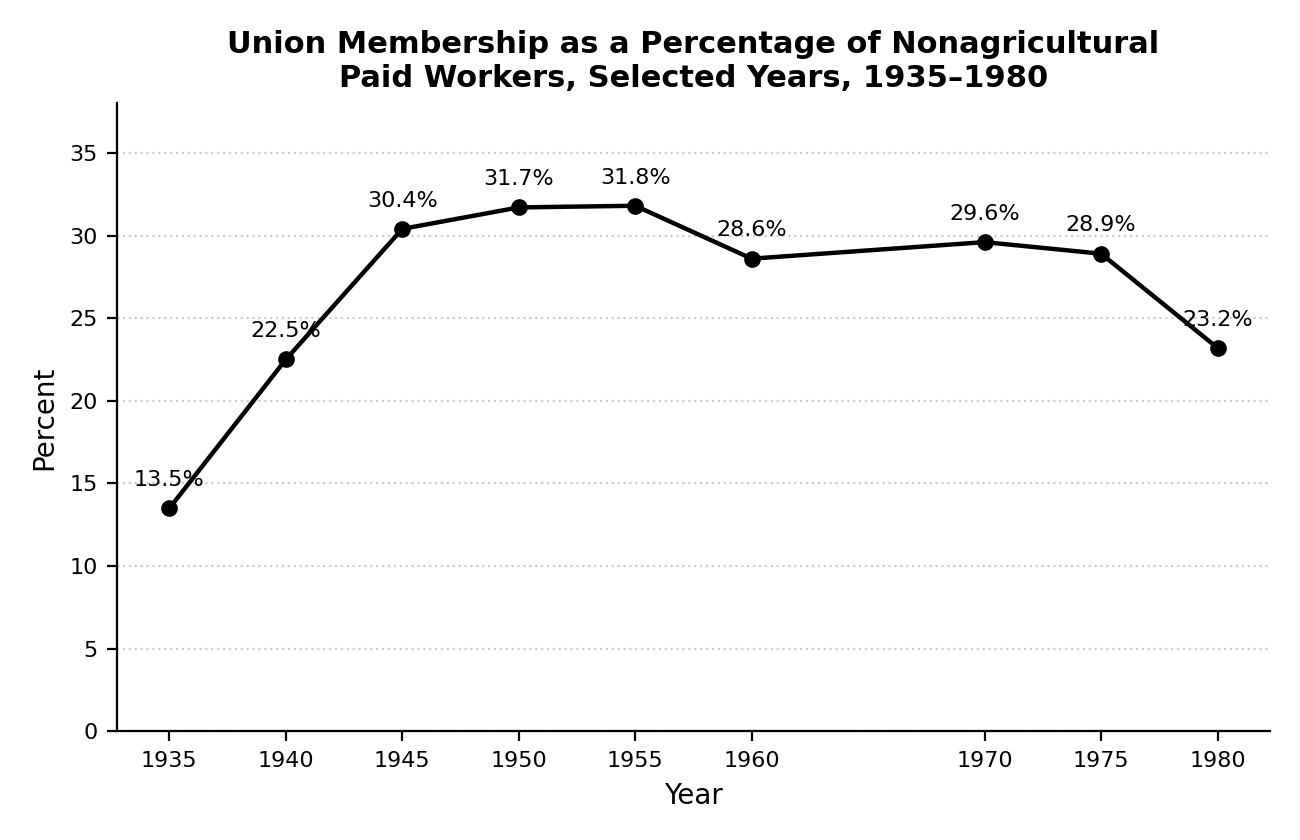
| Source: historical U.S. union-membership series compiled by Leo Troy and Neil Sheflin and reproduced in National Bureau of Economic Research historical tables. Values are shown as a percentage of nonagricultural paid workers. |
a) Briefly explain ONE historical development that helps account for the sharp rise in union membership between 1935 and 1945.
b) Briefly explain ONE historical development that helps account for the lower union-membership rate in 1980 than in the mid-1950s. c) Briefly explain ONE way the trend shown connects to a broader change or continuity in federal labor policy during the twentieth century.
Section II, Part A: Document-Based Question — 60 Minutes
Evaluate the extent to which federal Indian policy between 1830 and 1890 was shaped more by pressure for western land and resources than by any stated commitment to Native American welfare.
Document 1 (1830)
| Adapted from Andrew Jackson’s Second Annual Message to Congress. Jackson argues that moving Native peoples beyond existing state boundaries would reduce conflict with state governments and white settlers and would allow Native communities to continue under their own institutions. The policy is presented as protective even while it clears eastern land for state jurisdiction and settlement. |
Document 2 (1832)
| Adapted from Chief Justice John Marshall’s opinion in Worcester v. Georgia. Marshall describes the Cherokee Nation as a distinct political community whose territory is not subject to ordinary Georgia law. Relations with the Cherokee, he argues, fall under treaties and federal authority rather than unilateral state control. |
Document 3 (early 1830s)
| Adapted from Alexis de Tocqueville’s account of Choctaw removal near the Mississippi River. He describes families traveling west in severe winter conditions with children and possessions and notes the suffering that accompanied a process officials treated as lawful relocation. |
Document 4 (1862)
| Adapted from the Homestead Act. Eligible settlers could claim 160 acres of public land if they occupied and improved the land for the required period. The law used federal land policy to accelerate western settlement by individual households. |
Document 5 (1868)
| Adapted from the Treaty of Fort Laramie with the Lakota and other tribes. The agreement recognized the Great Sioux Reservation and restricted unauthorized white settlement in protected territory. The federal government formally promised to regulate access to the land. |
Document 6 (1874)
| Adapted from George A. Custer’s report on the Black Hills expedition. Custer describes the Black Hills as rich in resources and reports evidence of gold. The expedition’s findings intensified public and commercial interest in entering an area that federal treaty commitments had reserved for the Lakota. |
Document 7 (1887)
| Adapted from the General Allotment Act, commonly called the Dawes Act. The president could divide reservation land into individual allotments. After allotment, surplus land could be acquired by the federal government and opened to non-Native settlement, weakening collective tribal landholding. |
Section II, Part B: Long Essay Question — 40 Minutes
Between the mid-eighteenth century and the end of the nineteenth century, economic development repeatedly raised questions about national power. Debates over taxation, banking, commerce, western land, transportation, industrial growth, and corporate regulation required Americans to decide what the federal government should do.
Evaluate the extent to which economic change transformed the role of the federal government in the United States from 1754 to 1898.
You may focus on one or more developments within this period. You are not expected to address every decade.
Exam 1 Answer Key: Multiple Choice
| 1 | A | 2 | B | 3 | C | 4 | A | 5 | A |
| 6 | B | 7 | C | 8 | D | 9 | A | 10 | B |
| 11 | C | 12 | D | 13 | A | 14 | B | 15 | C |
| 16 | D | 17 | A | 18 | B | 19 | C | 20 | D |
| 21 | A | 22 | B | 23 | C | 24 | D | 25 | A |
| 26 | B | 27 | C | 28 | D | 29 | A | 30 | B |
| 31 | C | 32 | D | 33 | A | 34 | B | 35 | C |
| 36 | D | 37 | A | 38 | B | 39 | C | 40 | D |
| 41 | A | 42 | B | 43 | C | 44 | D | 45 | A |
| 46 | B | 47 | C | 48 | D | 49 | A | 50 | B |
| 51 | C | 52 | D | 53 | A | 54 | B | 55 | C |
Exam 1 SAQ Model Answers
Q1a: Shays’s Rebellion and interstate commercial problems helped Federalists argue that the Articles left the nation too weak to tax effectively, regulate commerce, or maintain order. That evidence supports Source A because it shows why a stronger national government could appear necessary.
Q1b: Ratification in Massachusetts, Virginia, and New York was closely contested, and Federalists promised amendments protecting individual rights. The later Bill of Rights supports Source B because concessions helped reduce opposition to the proposed government.
Q1c: The Federalist Papers defended the proposed Constitution in public, while Anti-Federalist essays such as Brutus warned that a large republic and powerful federal institutions could threaten liberty. Either body of writing demonstrates how contested the ratification debate remained.
Q2a: Douglass argues that American liberty and slavery are morally and politically incompatible. He uses the nation’s own founding ideals as a standard for condemning the continued enslavement of Black Americans.
Q2b: The Fugitive Slave Act of 1850 helps explain the speech. The law required stronger federal assistance in the return of alleged fugitives and angered many northerners, while abolitionists pointed to it as evidence that slavery affected the entire nation.
Q2c: Antislavery arguments helped widen northern resistance to the expansion and federal protection of slavery. That political climate contributed to the growth of the Republican Party in the 1850s and intensified sectional conflict before the Civil War.
Q3a: The Wagner Act of 1935 protected collective bargaining and created the National Labor Relations Board. Along with CIO organizing and wartime industrial demand, federal labor policy helped union membership rise sharply.
Q3b: Union density declined after the mid-1950s because manufacturing employment shifted, automation reduced some industrial jobs, right-to-work laws and employer resistance limited organizing in many regions, and service-sector employment grew. Taft-Hartley also constrained union power even before the decline became pronounced.
Q3c: The graph fits a broader twentieth-century change in federal labor policy. New Deal laws created stronger federal protection for organizing, while later policy and economic change placed greater limits on unions and shifted employment away from heavily unionized industries.
Exam 1 DBQ: Full Seven-Point Scoring Package
MODEL THESIS
Federal Indian policy from 1830 to 1890 was shaped primarily by demand for Native land and resources. Officials sometimes used the language of protection, treaty obligation, or assimilation, and federal courts occasionally recognized Native sovereignty, but removal, settler land policy, mining pressure, military coercion, and allotment repeatedly displaced those protections when valuable land or resources were at stake.
CONTEXTUALIZATION
Before 1830, U.S. expansion had already produced repeated conflicts over Native land through treaties, warfare, and federal settlement policy. The Market Revolution and growing white migration increased pressure on southeastern and western lands, creating the setting in which removal and later reservation policy developed.
DOCUMENT USE
Document 1 shows protective language used to justify removal. Document 2 shows federal legal recognition of Cherokee political status. Document 3 supplies evidence of the human cost of removal. Document 4 connects national land policy to settler expansion. Document 5 shows formal treaty protection of Lakota territory. Document 6 shows how resource discovery intensified pressure on protected land. Document 7 shows allotment breaking collective landholding and creating a path for non-Native settlement.
OUTSIDE EVIDENCE
Strong outside evidence includes the Indian Appropriations Act and reservation system, the Sand Creek Massacre, federal encouragement of buffalo destruction and military pressure on Plains nations, the Carlisle Indian Industrial School beginning in 1879, or the end of treaty making with Native nations in 1871. Do not repeat a fact already represented by a document and call it outside evidence.
SOURCING EXAMPLES
For Document 1, explain that Jackson was defending a controversial administration policy to Congress and therefore had reason to frame removal as protective. For Document 3, Tocqueville was an outside observer whose account can reveal the visible human effects of removal even though he was not a Cherokee participant. For Document 6, Custer’s military expedition was sent into a strategically contested region, and his report about gold helped make resource pressure more politically consequential. Any sourcing explanation must be tied to the argument, not merely labeled.
COMPLEX UNDERSTANDING ROUTE
A strong response can show change in method alongside continuity in purpose. Policy moved from southeastern removal to reservations, military confinement, and allotment, yet the transfer of Native land and authority remained a recurring outcome. The response can also acknowledge that legal protections and treaty commitments were real even when enforcement repeatedly gave way to settler and commercial pressure.
Exam 1 LEQ: Full Six-Point Scoring Package
MODEL THESIS
Economic change substantially enlarged the federal government’s role between 1754 and 1898, although the expansion was uneven. The national government moved from establishing basic authority over taxation, commerce, and public credit to actively shaping western settlement, transportation, wartime finance, and regulation of interstate corporations. Even by the 1890s, however, federal labor protection and direct regulation of working conditions remained limited.
CONTEXTUALIZATION
Before independence, Parliament regulated colonial commerce and raised revenue within an imperial system. The Revolution removed that authority, while weaknesses under the Articles of Confederation left the new nation with limited taxing and commercial power. Those problems helped make economic authority a central issue in the Constitution and the early republic.
EVIDENCE
Valid evidence can include the Constitution’s taxing and commerce powers; Hamilton’s financial program and the First Bank; the Second Bank and the Bank War; protective tariffs; federal land policy; internal-improvement debates; Marshall Court decisions affecting interstate commerce; the Homestead Act; Pacific Railway Acts; Civil War taxation and national banking; federal land grants; the Interstate Commerce Act; the Sherman Antitrust Act; federal intervention in major railroad strikes; or other accurate evidence tied to the argument.
REASONING
A strong response can use continuity and change to compare the limited national economic capacity of the Confederation era with the stronger fiscal and commercial state of the early republic and the more active land, infrastructure, and regulatory state of the late nineteenth century. A causation route can explain how war, territorial growth, national markets, railroads, and large corporations pulled federal power into areas that had previously been local or state concerns.
COMPLEX UNDERSTANDING ROUTE
The strongest answer should avoid a simple government-grew story. Federal activity expanded rapidly in banking, land, transportation, wartime finance, and interstate commerce while remaining weak in many areas of labor protection and social regulation. A sophisticated response can also distinguish policies that promoted economic growth from policies that regulated its consequences.
ACCEPTABLE NARROW ROUTES
A student may build the essay mainly around the founding and national fiscal system, federal promotion of western development and transportation, or the rise of national corporate regulation after the Civil War, as long as the thesis answers the full prompt and the evidence establishes change over time.
Exam 1: Full Multiple-Choice Answer Explanations
1. Answer A. The Berlin Airlift answered the Soviet blockade of West Berlin in 1948 and 1949. Western aircraft supplied the city without attacking Soviet forces, allowing the United States and its allies to demonstrate resolve while avoiding direct war.
2. Answer B. The resident’s language shows the political meaning of the airlift. Sustained flights signaled that the Western powers would not abandon West Berlin even though they were trying to avoid a shooting war with the Soviet Union.
3. Answer C. Containment did not always mean troop combat. The airlift used logistics, economic capacity, and alliance commitment to resist Soviet pressure, making it a strong example of noncombat containment.
4. Answer A. Family migration, planned house lots, multiple occupations, and a meetinghouse fit the New England town model. Chesapeake migration relied much more heavily on young servants and dispersed tobacco settlements.
5. Answer A. The range of occupations shows that New England towns aimed to sustain complex local communities, a pattern that differs from a single-export plantation economy built around one staple crop.
6. Answer B. Populists were especially angry about railroad rates, credit, and the power of corporations that connected farmers to distant markets. Those grievances turned market dependence into a political issue.
7. Answer C. Government ownership or strong public control of railroads and communications was a direct challenge to private corporate power, fitting the Populist belief that federal action should protect producers from concentrated economic control.
8. Answer D. The Interstate Commerce Act was the first major federal effort to regulate railroad practices and rates. Its early enforcement was limited, but it reflected the same pressure that appears in the Populist platform.
9. Answer A. The Cherokee petition responds directly to the removal policy authorized by the Indian Removal Act. It shows Native leaders using legal and political arguments to resist federal and state pressure on their land.
10. Answer B. Cherokee leaders adopted a written constitution, schools, literacy, and other institutions partly to demonstrate sovereignty and political capacity in terms U.S. officials claimed to respect. Adaptation was used as a strategy for legal protection, not as surrender of nationhood.
11. Answer C. Worcester v. Georgia recognized important limits on Georgia’s power over Cherokee territory, but Georgia resisted the ruling and the federal executive did not force compliance. Removal therefore continued despite a legal victory.
12. Answer D. Roosevelt’s radio address was designed to restore confidence after the banking crisis. Explaining policy in ordinary language was part of the administration’s effort to stop panic and make federal action credible to the public.
13. Answer A. Federal review of banks before reopening them shows the expanded national role in economic stabilization. The New Deal did not leave recovery entirely to private banks or state governments.
14. Answer B. The source combines policy and communication. Banking law changed the system, while Roosevelt’s direct explanation helped rebuild public confidence in those new federal measures.
15. Answer C. The surprise in the Spanish account reveals a European assumption that complex urban or agricultural societies did not fit preconceived images of Indigenous life. The source is useful precisely because it exposes the observer’s expectation as well as the settlement.
16. Answer D. Maize agriculture and irrigation supported permanent, densely organized communities in the Southwest. These systems developed before sustained European colonization and cannot be explained by European livestock or missionary farming.
17. Answer A. The editorial minimizes organized white supremacist intimidation. Reconstruction elections were shaped by violence from groups such as the Ku Klux Klan and other paramilitary organizations that targeted Black voters and Republican officials.
18. Answer B. Organized violence was a major force undermining Black political participation and Republican state governments. It interacted with economic problems, court decisions, political compromise, and declining northern commitment, so the explanation should remain multi-causal.
19. Answer C. A source that sympathizes with the violent actors cannot be read as neutral description. Its language must be compared with the broader political context and with evidence about intimidation and voting rights.
20. Answer D. The Northwest Ordinance shows that the Confederation government was capable of durable policy even while it lacked reliable taxing and commercial powers. That balance prevents the common error of describing the Articles as a complete failure.
21. Answer A. Equal footing meant future western states would enter the Union as states, not remain permanent dependencies of the original thirteen, helping establish a repeatable territorial expansion process.
22. Answer B. The ordinance prohibited slavery north of the Ohio River in the Northwest Territory. The regional restriction foreshadowed later disputes over whether federal law could limit slavery’s expansion into western territory.
23. Answer C. The letter defends immediate nonviolent direct action against a strategy of waiting for gradual change. The conflict is over timing and method within the struggle for civil rights, not over whether discrimination existed.
24. Answer D. Court rulings mattered, but campaigns succeeded through sustained local organizing, boycotts, demonstrations, fundraising, churches, student networks, and national pressure. The movement was not a sequence of isolated legal victories.
25. Answer A. The source shows that civil rights activists debated strategy inside a long movement. Tactical disagreement is evidence of political reasoning and organization, not proof that the movement lacked common objectives.
26. Answer B. Gilded Age workers often confronted employers backed by injunctions, militias, federal troops, or private security. The degree varied by dispute, but government neutrality was not the normal pattern in the major national strikes.
27. Answer C. The Knights of Labor sought a broad labor coalition that included many skilled and unskilled workers. The AFL later concentrated more heavily on skilled craft workers under Samuel Gompers.
28. Answer D. The Wagner Act protected collective bargaining and created a federal labor-relations system, marking a major twentieth-century break from the generally hostile federal posture visible in many Gilded Age labor conflicts.
29. Answer A. Muckrakers used investigative reporting to expose problems that reformers wanted government to address. Meatpacking conditions became a powerful example of how publicity could create pressure for regulation.
30. Answer B. Public concern over food and drug safety contributed to federal inspection and consumer-protection laws in 1906. The correct connection is to food-safety regulation, not monetary policy or election reform.
31. Answer C. Progressives often accepted industrial capitalism while trying to regulate its abuses. The source therefore supports reform through exposure and government action, not a universal Progressive rejection of markets.
32. Answer D. Reagan’s language fits the rise of modern conservatism, which emphasized tax reduction, deregulation, market solutions, and skepticism toward further growth of federal domestic programs.
33. Answer A. Barry Goldwater’s 1964 campaign articulated a small-government conservative critique that later became central to the Reagan coalition. New Deal and Great Society liberalism pointed in the opposite policy direction.
34. Answer B. The testimony shows colonial law hardening hereditary racial slavery and narrowing legal paths to freedom. Claims about ancestry mattered because legal status was increasingly defined through racialized statutes.
35. Answer C. Internal sale treated enslaved people as property that could be separated from spouses, parents, and children. The question tests the legal and economic system of colonial slavery, not only the later nineteenth-century interstate slave trade.
36. Answer D. A court testimony can reveal how a large legal institution affected an individual life. It does not by itself provide precise population statistics, but it adds lived evidence to a broader pattern.
37. Answer A. After the Emancipation Proclamation, federal policy authorized Black enlistment on a large scale. Black soldiers became a major source of Union manpower and tied emancipation more closely to military victory.
38. Answer B. The volunteers’ motives show agency. Enslaved and free Black Americans acted through flight, military service, organizing, and political pressure to make emancipation part of the war’s outcome.
39. Answer C. Black enlistment demonstrates that the Civil War’s meaning changed as preservation of the Union became inseparable from emancipation and Black participation in Union victory.
40. Answer D. Congress under the Articles lacked an independent power to tax and depended on state requisitions. Financial weakness and interstate problems therefore supported arguments for stronger national capacity.
41. Answer A. The Great Compromise created population-based representation in the House and equal state representation in the Senate. It is direct evidence that bargaining among competing state interests shaped the Constitution.
42. Answer B. Jackson presented the Bank as a privileged institution that concentrated financial power. The Bank War fit his political claim that executive action could defend ordinary white citizens against entrenched elites.
43. Answer C. Expanded white male voting and organized mass parties made elections more participatory for many white men. Jackson’s coalition used that broader electorate effectively.
44. Answer D. A cheering crowd and anti-Bank symbolism would most logically appear in a pro-Jackson publication. Source perspective must be inferred from the political message, not assumed neutral.
45. Answer A. Liberty Bonds financed the war by asking civilians to lend money to the federal government. Patriotic imagery turned a financial transaction into a civic contribution to the war effort.
46. Answer B. The Committee on Public Information also used mass persuasion to mobilize support for the war. Both campaigns relied heavily on patriotic appeals, since direct coercion alone cannot explain wartime mobilization.
47. Answer C. The poster demonstrates that wartime mobilization required civilian money, emotion, and participation as well as soldiers. Governments used modern mass communication to generate that support.
48. Answer D. The 1768 date and reference to recent import duties point to the Townshend Acts. The Stamp Act was earlier, while the Coercive Acts followed the Tea Party in 1774.
49. Answer A. Nonimportation turned consumer behavior and merchant coordination into political pressure. Colonists repeatedly used economic resistance before independence became the objective.
50. Answer B. The merchant is harmed by the boycott yet recognizes its organization, showing why source perspective can be mixed and why people affected negatively by a movement may still observe its effectiveness.
51. Answer C. Douglass uses founding ideals to expose the contradiction between national claims of liberty and the institution of slavery. That strategy made familiar patriotic language serve an abolitionist argument.
52. Answer D. Formerly enslaved speakers such as Douglass brought personal experience and public authority to abolitionism. Their voices challenged proslavery claims that enslaved people lacked political judgment or a desire for freedom.
53. Answer A. Industrial jobs and transportation networks drew people into growing cities. Urbanization was tied to factories, commerce, immigration, and internal migration, not to a collapse of all agriculture.
54. Answer B. Rapid urban growth strengthened political machines that exchanged services, jobs, and patronage for votes. Their power grew partly because cities expanded faster than formal welfare and administrative systems.
55. Answer C. Progressive reformers targeted sanitation, housing, workplace safety, corruption, and municipal regulation, campaigns that directly addressed problems created or intensified by dense industrial cities.