AP US History study guide · Chapter 57
Practice Exam 2
PART V — FULL PRACTICE EXAMS · EXAM 2
This exam follows the same format and timing as Exam 1, with different stimuli, topics, and period distribution. Complete it under timed conditions when possible. Explanations and the answer key follow the exam.
Section I, Part A: 55 Multiple-Choice Questions — 55 Minutes
| A 1987 joint statement following a superpower summit announces an agreement to eliminate an entire category of intermediate-range nuclear missiles, the first arms control treaty to require actual destruction of existing weapons rather than only limiting future production. |
Question 1
- A. Reagan-Gorbachev arms-control negotiations during the late-Cold-War thaw
- B. The original outbreak of the Cold War
- C. The Cuban Missile Crisis
- D. The Korean War armistice
Question 2
- A. Continued Soviet economic strength throughout the 1980s
- B. Gorbachev’s reform agenda, which included seeking reduced military tensions with the West
- C. Soviet withdrawal from all international diplomacy
- D. A unified Soviet Politburo opposed to any negotiation with the United States
Question 3
- A. American military pressure alone explains the treaty
- B. This treaty had no connection to the eventual end of the Cold War
- C. Diplomatic engagement combined with internal Soviet change contributed to easing Cold War tensions before the Soviet collapse
- D. Arms control negotiations began only after the Soviet Union dissolved
Question 4
- A. The two events addressed entirely unrelated nuclear issues
- B. Only the missile crisis involved any nuclear weapons at all
- C. This treaty preceded the Cuban Missile Crisis chronologically
- D. Both involved direct superpower negotiation over nuclear weapons, but this instance resulted in weapons reduction rather than crisis management alone
| A practice table summarizes several biological transfers after sustained Atlantic contact began: smallpox and other Eurasian pathogens moved from Europe and Africa to the Americas, producing severe epidemics in many Indigenous communities; maize and potatoes moved from the Americas to Europe and Africa, introducing new calorie-rich crops into Old World food systems; and horses and cattle moved from Europe to the Americas, introducing new forms of transport, land use, and animal husbandry. |
Question 5
- A. Many Native populations lacked prior exposure and therefore lacked population-level immunity to several Eurasian pathogens
- B. Native societies had already developed immunity to most Eurasian diseases
- C. Maize cultivation weakened immunity throughout the Americas
- D. Horses carried nearly all epidemic disease after 1492
Question 6
- A. Smallpox
- B. Maize and potatoes
- C. Cattle alone
- D. Horses alone
Question 7
- A. Biological exchange benefited both hemispheres in the same way
- B. The exchange involved crops but not animals or disease
- C. Sustained Atlantic contact transformed both hemispheres, but the demographic and ecological consequences were highly unequal
- D. The exchange had little effect outside the Caribbean
| Chief Justice Roger Taney’s 1857 opinion holds that a formerly enslaved man’s residence in free territory did not make him free, and further holds that Black Americans, free or enslaved, could not be citizens of the United States. |
Question 8
- A. Worcester v. Georgia
- B. Plessy v. Ferguson
- C. Marbury v. Madison
- D. Dred Scott v. Sandford
Question 9
- A. It declared the Missouri Compromise’s territorial slavery restriction unconstitutional
- B. It upheld the Missouri Compromise as constitutional
- C. It had no bearing on any congressional slavery legislation
- D. It reinstated the Wilmot Proviso
Question 10
- A. The Supreme Court consistently sided against slaveholding interests before the Civil War
- B. Judicial action closed off compromise options that had previously limited slavery’s expansion
- C. This ruling resolved sectional tension permanently
- D. Congress retained full authority to regulate slavery in the territories after this ruling
Question 11
- A. It caused the immediate collapse of the Republican Party
- B. It produced bipartisan agreement on slavery’s future
- C. It intensified support for the newly formed Republican Party’s platform against slavery’s expansion
- D. It had no measurable political effect
| A French Jesuit missionary’s 1650s account describes the Haudenosaunee Confederacy as governed by a council of representatives from five allied nations, who deliberate at length before reaching decisions that bind all member nations in matters of war and diplomacy. |
Question 12
- A. That Native nations never allied with one another
- B. That French missionaries had no contact with Native political systems
- C. That the Haudenosaunee Confederacy formed only after European contact
- D. That Native political organization was simple or lacked sophisticated deliberative institutions
Question 13
- A. Coordinating diplomacy and leverage among competing European powers
- B. Avoiding all contact with European traders
- C. Establishing permanent alliance with a single European power
- D. Eliminating internal disagreement among member nations
| A 1933 Agricultural Adjustment Administration pamphlet explains to farmers that the federal government will pay them to reduce production of certain crops, with the goal of raising prices that have collapsed since 1929. |
Question 14
- A. A policy of complete federal noninvolvement in agriculture
- B. Direct federal intervention in agricultural markets to address collapsed prices
- C. Elimination of all federal agricultural spending
- D. Encouragement of increased production to lower consumer prices
Question 15
- A. It was universally popular with no political controversy
- B. It had no effect on agricultural prices
- C. Paying farmers to reduce production seemed to contradict relieving hunger during a period of widespread need
- D. It applied exclusively to industrial rather than agricultural workers
Question 16
- A. The New Deal avoided any intervention in agricultural markets
- B. This program alone ended the Great Depression
- C. Agricultural policy was unrelated to the broader New Deal agenda
- D. New Deal programs expanded federal intervention into areas of the economy previously left to market forces
| An 1825 newspaper account celebrates the opening of a major canal, describing a flotilla of boats traveling from an inland lake to the Atlantic coast, and predicting that what once took weeks by wagon shall now take days by water, and the produce of the whole interior shall find its way to market. |
Question 17
- A. The opening of the Erie Canal
- B. The completion of the transcontinental railroad
- C. The construction of the National Road
- D. The invention of the steamboat
Question 18
- A. The decline of interstate commerce
- B. Cheaper transportation widening markets and pulling farmers into commercial agriculture
- C. A shift away from agricultural production entirely
- D. Federal ownership of all transportation infrastructure
Question 19
- A. Canal construction had no measurable economic effect
- B. Western farmers remained isolated from eastern markets throughout the antebellum period
- C. Transportation improvements were a primary driver of the Market Revolution’s economic integration
- D. This canal was the first transportation improvement in American history
| A 1962 White House transcript records advisors debating options for responding to Soviet missile installations detected ninety miles from the American coast, weighing a naval blockade against a direct military strike. |
Question 20
- A. The Berlin Blockade
- B. The Korean War
- C. The Bay of Pigs invasion
- D. The Cuban Missile Crisis
Question 21
- A. The tension between decisive action and avoiding direct military escalation between nuclear powers
- B. Complete Soviet-American cooperation on nuclear policy
- C. The absence of any diplomatic option during Cold War crises
- D. Congressional control over all Cold War military decisions
Question 22
- A. Containment never involved any risk of direct military conflict
- B. Containment sometimes required direct, high-stakes confrontation rather than only economic or diplomatic pressure
- C. This crisis had no connection to earlier containment policy
- D. The crisis was resolved through congressional declaration of war
| A map of eastern North America after 1763 shows Britain controlling former French territory east of the Mississippi River. A boundary follows the Appalachian Mountains, with most trans-Appalachian settlement marked as restricted by imperial policy. |
Question 23
- A. War of 1812
- B. Mexican-American War
- C. Seven Years’ War
- D. American Civil War
Question 24
- A. Encourage immediate colonial settlement in the Ohio Valley
- B. Transfer western territory to France
- C. Eliminate all imperial regulation of migration
- D. Limit western settlement in an effort to reduce frontier conflict and make the enlarged empire easier to manage
Question 25
- A. British victory created new debts, western responsibilities, and imperial rules that generated fresh conflict with colonists
- B. The end of the war removed all disagreement between Britain and its colonies
- C. France remained the dominant mainland power after 1763
- D. Colonial resistance began only after independence was declared
| An 1892 newspaper account describes armed Pinkerton agents arriving by barge at a Pennsylvania steel plant to escort strikebreakers past a crowd of striking workers, resulting in a violent confrontation with casualties on both sides. |
Question 26
- A. The Pullman Strike
- B. The Homestead Strike
- C. The Great Railroad Strike of 1877
- D. The Haymarket Affair
Question 27
- A. Consistent government intervention on behalf of striking workers
- B. The complete absence of violence in labor disputes of this era
- C. Employers’ use of private security forces to break strikes, often with state or tacit government support
- D. Universal public sympathy for striking workers
Question 28
- A. Labor unions achieved most of their goals without significant resistance
- B. Industrial employers had no meaningful power over local law enforcement
- C. This was the only violent labor conflict of the era
- D. Workers organizing against corporate power faced not only employers but often state power aligned against them
| The Declaration of Sentiments, adopted at an 1848 convention, states that the history of mankind is a history of repeated injuries and usurpations on the part of man toward woman, deliberately echoing the structure of an earlier founding document. |
Question 29
- A. The Seneca Falls Convention
- B. The Constitutional Convention
- C. The Hartford Convention
- D. The Second Continental Congress
Question 30
- A. Rejecting all connection to earlier American political tradition
- B. Using widely recognized revolutionary language to frame women’s rights as a natural extension of founding principles
- C. Arguing for a completely new system of government
- D. Focusing exclusively on economic rather than political grievances
Question 31
- A. A sudden, spontaneous movement with no prior organizing history
- B. Direct collaboration with the earlier Constitutional Convention
- C. Women’s extensive organizational work in abolitionist and other reform movements
- D. Exclusively religious revival activity with no reform connection
Question 32
- A. Married women’s right to own property
- B. Access to public education for women
- C. The right to divorce
- D. Women’s suffrage
| A 1919 State Department memo outlines American objections to specific provisions of a proposed peace treaty, particularly a clause committing member nations to collective military response against aggression. |
Question 33
- A. The League of Nations
- B. The United Nations
- C. NATO
- D. The World Trade Organization
Question 34
- A. That the treaty imposed insufficient penalties on Germany
- B. That collective security commitments would draw the United States into future foreign wars without full congressional control
- C. That the treaty failed to address colonial territories
- D. That the League of Nations lacked any American support
Question 35
- A. Immediate and unanimous American ratification of the treaty
- B. American withdrawal from all international diplomacy after 1919
- C. The U.S. Senate’s ultimate rejection of American membership in the League of Nations
- D. Wilson’s abandonment of the League of Nations concept before Paris
Question 36
- A. Isolationism versus pacifism
- B. Monarchism versus republicanism
- C. Federalism versus states’ rights
- D. Internationalist commitment to collective security versus a preference for national sovereignty over foreign entanglements
| A 1676 Virginia colonial council record describes an uprising of landless former servants and enslaved laborers, led by a wealthy planter, that burned Jamestown before colonial forces suppressed it. |
Question 37
- A. Frustration among landless former servants over land, political power, and frontier policy
- B. Religious conflict between Puritans and Anglicans
- C. Direct conflict between Virginia and Maryland over colonial boundaries
- D. Opposition to the Navigation Acts among Virginia merchants
Question 38
- A. Indentured servitude was immediately abolished
- B. Elite planters increasingly favored racial slavery over indentured servitude in the following decades
- C. Virginia adopted a fully wage-based labor system
- D. Landless former servants gained expanded political representation
Question 39
- A. That the uprising had no connection to labor conditions in Virginia
- B. That colonial councils never recorded information about unrest
- C. That this single event alone caused the shift toward racial slavery, rather than being one of several contributing pressures
- D. That enslaved laborers played no role in the uprising
| The Civil Rights Act of 1964 declares it unlawful to discriminate on the basis of race, color, religion, sex, or national origin in places of public accommodation and in employment. |
Question 40
- A. The first federal civil rights legislation in American history
- B. A law passed with no significant political opposition
- C. The final piece of civil rights legislation needed to end all discrimination
- D. The translation of years of local organizing and national pressure into enforceable federal law
Question 41
- A. Sex was added to Title VII through an amendment offered by Representative Howard W. Smith. Smith opposed the civil-rights bill and some contemporaries saw the amendment as a possible effort to complicate or defeat it, while women legislators and women’s-rights advocates also supported retaining the protection
- B. Complete legislative consensus on gender discrimination existed before 1964
- C. The law originally excluded employment discrimination entirely
- D. Women’s organizations had no involvement in the bill’s passage
Question 42
- A. The civil rights movement concluded entirely once this law passed
- B. Legislative achievement in 1964 did not mark the movement’s end, as organizing continued afterward
- C. This law addressed voting rights specifically
- D. The law had no connection to earlier organizing efforts
| An 1880s political cartoon shows a gate labeled Chinese Exclusion closing across the Pacific coast. A white labor organization holds a sign reading Protect American Labor, while a Chinese worker carrying tools stands outside the gate. |
Question 43
- A. A federal campaign encouraging unrestricted Chinese immigration
- B. The disappearance of ethnic conflict from western labor markets
- C. Anti-Chinese nativism fueled by racial prejudice and competition over labor
- D. A national policy granting automatic citizenship to Chinese laborers
Question 44
- A. Homestead Act of 1862
- B. Dawes Act of 1887
- C. Pendleton Civil Service Act of 1883
- D. Chinese Exclusion Act of 1882
Question 45
- A. National-origins quota laws of the 1920s
- B. Interstate Commerce Act
- C. Sherman Antitrust Act
- D. Social Security Act
| A 1787 Anti-Federalist pamphlet warns that the proposed Constitution’s federal judiciary and standing army will eventually swallow the states one by one, leaving only the shadow of local self-government behind. |
Question 46
- A. That the Constitution gave too much power to state governments
- B. That a strengthened national government would eventually overwhelm state authority and individual liberty
- C. That the Constitution failed to address slavery at all
- D. That the Articles of Confederation should be strengthened rather than replaced
Question 47
- A. The complete abandonment of the Constitution
- B. The creation of the Electoral College
- C. The addition of the Bill of Rights during the ratification process
- D. The Three-Fifths Compromise
Question 48
- A. All Americans agreed on the proper scope of federal power by 1787
- B. Anti-Federalists opposed any form of national government
- C. The ratification debate was resolved without any compromise
- D. The debate centered on how much national power a republic could safely hold without threatening liberty
Question 49
- A. Both reflect recurring anxiety about the proper balance between federal and state authority
- B. The two debates concerned entirely unrelated constitutional questions
- C. Only the nullification crisis involved any argument about states’ rights
- D. The pamphlet’s argument was fully resolved and never recurred
| A 1996 congressional debate transcript records a lawmaker arguing that replacing guaranteed federal cash assistance with state block grants and work requirements will reduce dependency, while an opposing lawmaker warns it will leave the most vulnerable families without a reliable safety net during downturns. |
Question 50
- A. The Social Security Act of 1935
- B. The 1996 welfare reform law
- C. The Great Society’s antipoverty programs
- D. The Affordable Care Act
Question 51
- A. Complete bipartisan consensus on federal welfare policy
- B. The absence of any debate over social policy in this period
- C. Genuine disagreement over how actively the federal government should guarantee economic security
- D. Agreement that federal cash assistance should be expanded rather than restructured
Question 52
- A. This was the first time federal social policy had ever been debated in Congress
- B. The debate marked universal agreement on ending all federal assistance programs
- C. Federal cash assistance programs began only in 1996
- D. Debates over the federal government’s proper role in economic security reach back to the New Deal and continued through the twentieth century
| President Lincoln’s January 1863 proclamation declares that enslaved people within specified rebelling states are, and henceforward shall be free, while explicitly exempting areas under Union control. |
Question 53
- A. Lincoln framed the proclamation as a wartime measure applying to areas still in rebellion, while leaving loyal slave states and exempted Union-controlled areas outside its immediate scope
- B. A belief that slavery was already ending in those areas
- C. A lack of legal authority to address slavery anywhere
- D. Agreement with Confederate leaders on slavery’s future
Question 54
- A. Immediate Confederate surrender
- B. Continued Union military advances into Confederate-held territory
- C. A formal constitutional amendment passed simultaneously
- D. British recognition of the Confederacy
Question 55
- A. Lincoln opposed ending slavery throughout the war
- B. The war’s aims remained unchanged from 1861 to 1865
- C. The war’s meaning expanded over time to make slavery’s destruction inseparable from Union victory
- D. This proclamation ended slavery throughout the entire United States immediately
Section I, Part B: Short-Answer Questions — 40 Minutes
SHORT ANSWER: QUESTION 1
Secondary sources.
| Secondary Source A, original historical interpretation for this practice exam: Jacksonian politics widened electoral participation among white men, strengthened mass party organization, and challenged institutions that many voters associated with concentrated privilege. The attack on the Second Bank became the clearest example of a democratic movement presenting itself as a defense of ordinary citizens against a powerful financial elite. Secondary Source B, original historical interpretation for this practice exam: The democratic claims of the Jacksonian era were sharply limited by race and gender. The same political order that celebrated white male participation supported Indian removal, accepted slavery, and excluded women and most Black Americans from formal political power. |
a) Briefly explain ONE piece of historical evidence that could be used to support Source A.
b) Briefly explain ONE piece of historical evidence that could be used to support Source B.
c) Briefly explain ONE additional piece of evidence relevant to evaluating Jacksonian democracy that is not already stated in either source.
SHORT ANSWER: QUESTION 2
Primary source.
| Primary source, adapted from President Richard Nixon’s November 1973 national address on the energy emergency: Nixon tells Americans that foreign oil supply interruptions have exposed the country’s vulnerability. He calls for immediate conservation and for a long-term national effort to reduce dependence on imported energy by expanding domestic production and developing alternative sources. |
a) Briefly explain the point of view expressed in the source regarding the energy crisis.
b) Briefly explain ONE specific historical development from the early 1970s that helps explain the concern expressed in the source.
c) Briefly explain ONE way the energy crisis affected American domestic or foreign policy later in the 1970s.
SHORT ANSWER: QUESTION 3
Non-text source.
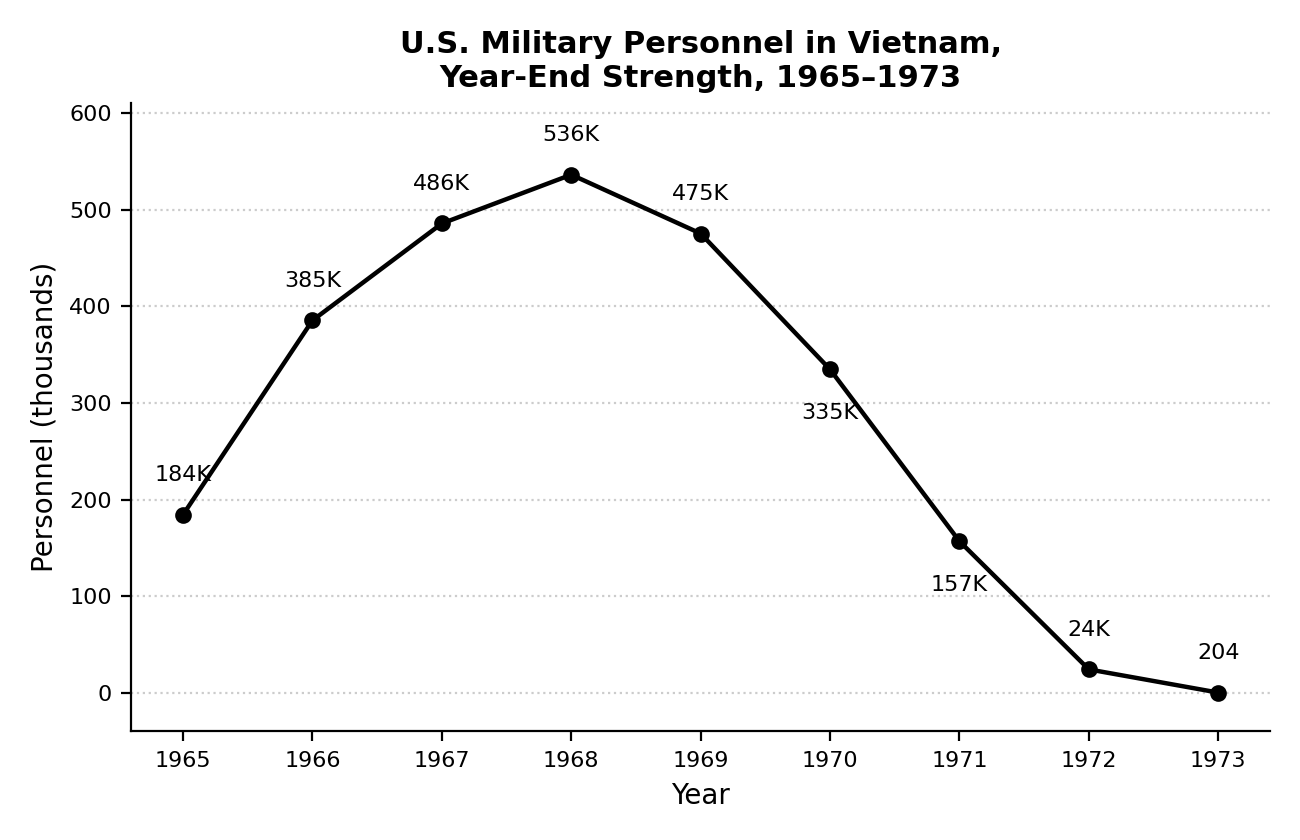
Source: U.S. Department of Defense year-end troop-strength data, reported in the Statistical Abstract of the United States.
a) Briefly explain ONE historical factor that helps account for the rise in U.S. troop levels between 1965 and 1968.
b) Briefly explain ONE historical factor that helps account for the decline in U.S. troop levels between 1969 and 1973.
c) Briefly explain ONE way the pattern shown connects to a broader change in American public opinion during this period.
Section II, Part A: Document-Based Question — 60 Minutes
Evaluate the extent to which the expansion of women’s roles in the paid workforce between 1890 and 1945 changed broader assumptions about women’s proper place in American society.
Document 1 (1898)
| Adapted from Charlotte Perkins Gilman, Women and Economics. Gilman argues that women’s economic dependence on husbands was a social arrangement rather than a natural requirement. She argues that productive work and economic independence would expand women’s ability to develop as individuals and members of society. |
Document 2 (1908)
| Adapted from the Supreme Court’s reasoning in Muller v. Oregon, upholding limits on women’s working hours. The opinion treats women’s physical condition and maternal role as reasons the state may impose special labor protections, reflecting the belief that women’s social function differed from men’s. |
Document 3 (1911)
| Adapted from Rose Schneiderman’s labor speech after the Triangle Shirtwaist Factory fire. Schneiderman argues that sympathy after industrial disasters was not enough. Women workers needed organization, stronger labor protections, and political pressure because dangerous workplaces would continue unless workers gained power to change them. |
Document 4 (1920)
| The Nineteenth Amendment to the U.S. Constitution. The amendment prohibits the United States or any state from denying or abridging a citizen’s right to vote on account of sex. It places women’s political citizenship under national constitutional protection. |
Document 5 (1938)
| Adapted from a U.S. Civil Service Commission report, Women in the Federal Service, discussing Section 213 of the Economy Act of 1932. During workforce reductions, married employees whose spouses also received federal pay were dismissed first. Although the law was written in sex-neutral language, the report states that it resulted in substantially more women than men losing federal positions. |
Document 6 (1900–1945)
| U.S. labor-force data, selected years. Women’s labor-force participation rose from roughly one-fifth of working-age women around 1900 to more than one-third during World War II. Historical definitions changed across the period, so the data are best used to show direction and scale rather than a perfectly uniform series. |
Document 7 (1943)
| Adapted from federal wartime recruitment material. With millions of men in military service and war production expanding, employers were urged to recruit and train women for industrial and technical jobs that had previously been treated as male work. The appeal presents women’s paid labor as necessary to national wartime production. |
Section II, Part B: Long Essay Question — 40 Minutes
From the early republic through World War II, reformers used organizations, elections, protest, constitutional amendments, and federal law to challenge limits on political participation. Abolition, Reconstruction, Populism, Progressivism, women’s suffrage, labor activism, and civil-rights organizing expanded participation for some Americans while exclusion persisted for others.
Evaluate the extent to which reform movements expanded political participation in the United States from 1800 to 1945.
You may focus on one or more reform movements within this period. You are not expected to discuss every movement or every decade.
Exam 2 Answer Key: Multiple Choice
| 1 | A | 2 | B | 3 | C | 4 | D | 5 | A |
| 6 | B | 7 | C | 8 | D | 9 | A | 10 | B |
| 11 | C | 12 | D | 13 | A | 14 | B | 15 | C |
| 16 | D | 17 | A | 18 | B | 19 | C | 20 | D |
| 21 | A | 22 | B | 23 | C | 24 | D | 25 | A |
| 26 | B | 27 | C | 28 | D | 29 | A | 30 | B |
| 31 | C | 32 | D | 33 | A | 34 | B | 35 | C |
| 36 | D | 37 | A | 38 | B | 39 | C | 40 | D |
| 41 | A | 42 | B | 43 | C | 44 | D | 45 | A |
| 46 | B | 47 | C | 48 | D | 49 | A | 50 | B |
| 51 | C | 52 | D | 53 | A | 54 | B | 55 | C |
Exam 2 SAQ Model Answers
Q1a: Expanded white male suffrage and the development of mass Democratic campaigning support Source A. Jackson’s Bank veto also let Democrats present the Second Bank as a privileged institution that concentrated economic power.
Q1b: The Indian Removal Act and the forced removal of the Cherokee support Source B. Jacksonian democracy expanded participation for many white men while federal policy attacked Native sovereignty and left slavery and women’s political exclusion intact.
Q1c: The nullification crisis is useful additional evidence. Jackson rejected South Carolina’s attempt to nullify a federal tariff and threatened enforcement, showing that Jacksonian politics combined popular rhetoric with a strong conception of presidential and federal authority when he believed the Union was at stake.
Q2a: Nixon presents the energy crisis as both an immediate shortage and a national-security vulnerability. His solution combines conservation with a longer effort to reduce dependence on imported oil.
Q2b: The Arab oil embargo after the 1973 Arab-Israeli war sharply reduced oil supplies to the United States and exposed growing dependence on imported petroleum. Rising world oil prices made the problem visible to consumers through shortages and higher gasoline prices.
Q2c: The crisis contributed to federal policies such as fuel-economy standards, creation of the Strategic Petroleum Reserve, and the Department of Energy in 1977. It also made energy security a larger part of U.S. foreign-policy planning in the Middle East.
Q3a: The Gulf of Tonkin Resolution in 1964 gave Johnson broad authority to escalate U.S. involvement, and his administration steadily increased troop commitments to prevent a communist victory in South Vietnam.
Q3b: Nixon’s Vietnamization policy shifted combat responsibility to South Vietnamese forces while U.S. troops withdrew, and the 1973 Paris Peace Accords formalized the end of direct American ground combat.
Q3c: The pattern reflects a widening credibility gap after Tet, mounting casualties, the draft, and sustained antiwar activism, all of which eroded public support for continued large-scale troop commitments.
Exam 2 DBQ: Full Seven-Point Scoring Package
MODEL THESIS
Women’s paid employment expanded substantially between 1890 and 1945 and made female wage work increasingly visible, especially in clerical work and wartime industry. That expansion challenged the assumption that women belonged only in the home, but it did not erase the domestic ideal. Employer marriage bars, consumer culture, occupational segregation, and the expectation that wartime jobs were temporary preserved strong limits on the change.
CONTEXTUALIZATION
Late-nineteenth-century industrialization had already drawn many young unmarried women into factories, domestic service, teaching, and office work, while middle-class culture continued to idealize women’s domestic role. Reform organizations and the women’s-rights movement also widened public participation before 1890.
DOCUMENT USE
Document 1 directly challenges economic dependence. Document 2 shows the persistence of legal reasoning built around motherhood and sex difference. Document 3 presents women workers as organized labor and political actors. Document 4 demonstrates a major expansion of formal political citizenship. Document 5 shows a Depression-era policy that reinforced the idea that one paid job should support one household and that married women’s employment was expendable. Document 6 demonstrates the long rise in women’s paid labor, especially during World War II. Document 7 shows the federal government actively recruiting women into jobs previously coded as male.
OUTSIDE EVIDENCE
Useful outside evidence includes the Women’s Trade Union League, clerical and teaching employment, the 1923 Equal Rights Amendment proposal, New Deal labor policies that sometimes reinforced a male-breadwinner model, or wartime child-care and Rosie the Riveter campaigns not already duplicated by a document.
SOURCING EXAMPLES
For Document 2, the Supreme Court was reviewing a state labor law, so the opinion reveals how legal protection could reinforce assumptions about women’s maternal role even while limiting employer power. For Document 3, Schneiderman spoke as a labor organizer after a deadly factory fire, giving her reason to emphasize worker organization rather than charity. For Document 7, wartime manpower officials needed to fill labor shortages, so the source strongly supports temporary acceptance of women in industrial work but does not by itself prove that employers or the government expected those changes to remain after the war.
COMPLEX UNDERSTANDING ROUTE
A strong response can distinguish class, race, marital status, and wartime from peacetime experience. It can argue that wage work broadened the range of socially visible female roles without producing one uniform or permanent redefinition of womanhood.
Exam 2 LEQ: Full Six-Point Scoring Package
MODEL THESIS
Reform movements substantially expanded political participation from 1800 to 1945 by challenging slavery, widening claims to citizenship, increasing direct voter influence, securing women’s suffrage, and strengthening organized political participation by workers. The gains were uneven because Jim Crow disfranchisement, racial violence, Native exclusion, and other legal or social barriers continued to block participation for large groups of Americans.
CONTEXTUALIZATION
At the beginning of the nineteenth century, voting rules were controlled mainly by states, slavery excluded millions from political citizenship, women lacked the vote, and Native nations stood outside the constitutional electorate. Expanding white male suffrage showed that political participation could widen while remaining sharply restricted by race and sex.
EVIDENCE
Useful evidence includes abolitionism; Seneca Falls; the Republican antislavery coalition; the Thirteenth, Fourteenth, and Fifteenth Amendments; Reconstruction governments; Enforcement Acts; Black officeholding; post-Reconstruction disfranchisement; Populist demands; initiative, referendum, recall, and direct primaries; the Seventeenth Amendment; the Nineteenth Amendment; NAACP legal activism; the Indian Citizenship Act of 1924; labor organizing and New Deal collective-bargaining protections; or other accurate evidence tied directly to political participation.
REASONING
Continuity and change is the most natural structure. The response should identify who gained access to voting, officeholding, organization, or federal protection and who remained excluded. Comparison can also work if the essay compares the reach and limits of different reform movements.
COMPLEX UNDERSTANDING ROUTE
A strong answer can show that legal expansion and actual access were not the same. Reconstruction amendments expanded constitutional rights while state violence and disfranchisement later narrowed them. Progressive reforms increased direct voter control in some areas while other reforms shifted authority toward commissions and experts. Women gained the vote nationally in 1920 while many Black women in the South still faced the same voting barriers imposed on Black men.
ACCEPTABLE NARROW ROUTES
A student may center the essay on race and citizenship, women’s political participation, democratic reforms associated with Populism and Progressivism, or organized labor and mass politics. The argument must still explain how the chosen developments answer the broad 1800–1945 prompt.
Exam 2: Full Multiple-Choice Answer Explanations
1. Answer A. The INF Treaty came from late-Cold-War negotiations between Ronald Reagan and Mikhail Gorbachev. It eliminated an entire class of intermediate-range missiles and marked a significant arms-control breakthrough.
2. Answer B. Gorbachev’s perestroika and glasnost reflected an effort to reform a strained Soviet system and reduce the burden of confrontation with the West. That internal change made deeper arms-control negotiations more possible.
3. Answer C. The treaty supports a multi-causal explanation for the Cold War’s end. U.S. pressure mattered, but diplomacy and major political and economic change inside the Soviet Union also reduced tensions before the USSR collapsed.
4. Answer D. Both the Cuban Missile Crisis and the INF process involved direct superpower negotiation over nuclear weapons. The difference is that the 1987 treaty permanently eliminated a missile category, while 1962 was primarily a crisis-management settlement.
5. Answer A. Eurasian diseases were especially destructive because many Native communities had no prior exposure to them and therefore lacked population-level immunity. Epidemic disease became one major factor in demographic collapse after contact.
6. Answer B. Maize and potatoes supplied dense calories and adapted to varied climates. Their movement into Europe and other Old World regions contributed to long-run dietary and population change.
7. Answer C. The Columbian Exchange changed crops, animals, disease environments, and economies on both sides of the Atlantic. Its effects were reciprocal, but they were not equal because disease devastated many Indigenous communities in ways the Old World did not experience.
8. Answer D. Chief Justice Roger Taney’s opinion is the Dred Scott decision. The ruling denied Dred Scott’s citizenship claim and also reached beyond his individual case to restrict congressional power over slavery in the territories.
9. Answer A. Dred Scott declared the Missouri Compromise’s territorial restriction unconstitutional. That ruling weakened one of Congress’s earlier tools for containing slavery’s expansion.
10. Answer B. By narrowing congressional authority and rejecting Black citizenship claims, the decision made compromise harder. It intensified sectional distrust and failed to settle the slavery question.
11. Answer C. Northern antislavery voters saw the ruling as evidence that proslavery interests had captured national institutions. That reaction strengthened the Republican Party’s campaign against the expansion of slavery.
12. Answer D. The Haudenosaunee Confederacy had a complex council and alliance structure. The account directly challenges the stereotype that Native political organization was simple or lacked deliberative institutions.
13. Answer A. A confederacy could coordinate diplomacy, war, and bargaining among member nations while dealing with European powers. That flexibility gave Native diplomats leverage in an imperial borderland.
14. Answer B. The AAA tried to raise farm prices by reducing production and paying participating farmers. That was direct federal intervention in agricultural markets, a sharp departure from older assumptions of limited national economic management.
15. Answer C. Reducing production while people faced hunger made the program morally and politically controversial. The policy aimed to raise farm income, but the method could appear inconsistent with immediate relief needs.
16. Answer D. AAA policy illustrates the broader New Deal expansion of federal responsibility for prices, production, relief, and market stabilization. It did not rely on private adjustment alone.
17. Answer A. The 1825 description fits the Erie Canal, which connected the Great Lakes region to the Hudson River and Atlantic markets. It became a central symbol of the Market Revolution.
18. Answer B. Lower transport costs widened markets and encouraged farmers to produce for sale beyond local communities. Transportation improvements therefore increased commercial specialization and regional exchange.
19. Answer C. Canals and later railroads integrated distant markets and accelerated the Market Revolution. The source is stronger evidence for economic integration than for a complete disappearance of local or agricultural production.
20. Answer D. The advisers are discussing the Cuban Missile Crisis of 1962. The confrontation began after U.S. reconnaissance identified Soviet nuclear missiles in Cuba.
21. Answer A. Kennedy’s advisers had to respond firmly while avoiding steps that could trigger nuclear war. The blockade option represented an attempt to create pressure without immediately attacking Soviet forces.
22. Answer B. Containment sometimes required high-risk confrontation, not only aid or diplomacy. Cuba shows how the Cold War could bring the superpowers close to direct military conflict.
23. Answer C. The map follows the Seven Years’ War, when Britain defeated France in North America and gained major territorial claims east of the Mississippi.
24. Answer D. The Proclamation Line of 1763 attempted to limit settlement west of the Appalachians. British officials hoped to reduce frontier conflict and the costs of governing a much larger empire.
25. Answer A. Victory in 1763 did not end imperial conflict. Debt, western administration, new settlement rules, and taxation generated fresh disputes between Britain and its colonies.
26. Answer B. The armed Pinkerton confrontation occurred during the Homestead Strike at Carnegie’s steel works in 1892. It became one of the best-known violent labor disputes of the Gilded Age.
27. Answer C. Homestead shows employers using private security and later state force to regain control. Major labor disputes often involved more than a simple employer-worker negotiation.
28. Answer D. Organized workers faced employers with access to courts, militias, troops, and private security. That imbalance helps explain why many late-nineteenth-century strikes failed even when worker grievances were substantial.
29. Answer A. The Declaration of Sentiments came from the Seneca Falls Convention of 1848. It adapted founding-era language to criticize women’s legal and political inequality.
30. Answer B. Echoing the Declaration of Independence made women’s rights appear as an extension of familiar American principles. The rhetorical strategy claimed continuity with the founding and did not reject it.
31. Answer C. Many women gained organizing experience in abolition, benevolent reform, and other voluntary associations. Those networks helped create the leadership and methods later used in women’s-rights activism.
32. Answer D. The demand for women’s suffrage was the most controversial political claim at Seneca Falls. It called for direct participation in formal politics, not only social or legal reform.
33. Answer A. The 1919 debate centered on the League of Nations, especially whether the United States should join a collective-security system created by the Versailles settlement.
34. Answer B. Opponents feared that League commitments could pull the United States into future conflicts and weaken Congress’s control over decisions about war. Their concern focused on sovereignty and constitutional authority.
35. Answer C. The Senate rejected U.S. membership in the League. The United States remained active economically and diplomatically, so the result should not be confused with complete withdrawal from world affairs.
36. Answer D. The debate opposed Wilsonian collective security to a stronger preference for national control over foreign commitments. It was not simply a conflict between war and pacifism.
37. Answer A. Bacon’s Rebellion reflected land hunger, political conflict, frontier violence, and anger among many land-poor former servants. It exposed instability in Chesapeake society.
38. Answer B. After 1676 Virginia’s labor system moved more heavily toward hereditary racial slavery as Atlantic slave markets expanded and elite planters sought a more controllable labor force. Bacon’s Rebellion was one contributing pressure, not a single cause.
39. Answer C. A historian should reject a one-event explanation. The transition to racial slavery developed through labor supply, law, demography, economics, and politics over several decades.
40. Answer D. The Civil Rights Act of 1964 converted years of organizing, litigation, protest, and political pressure into enforceable federal law covering public accommodations and employment discrimination.
41. Answer A. Sex entered Title VII through Howard Smith’s amendment. Smith opposed the civil-rights bill and some observers saw a poison-pill motive, but women legislators and women’s-rights advocates also supported keeping sex discrimination in the final law.
42. Answer B. The 1964 law was a major victory, not the end of the movement. Voting rights, housing, economic inequality, Black Power, and other campaigns remained central after its passage.
43. Answer C. The visual reflects anti-Chinese nativism in the West, where racial prejudice and labor competition contributed to demands for federal exclusion.
44. Answer D. The Chinese Exclusion Act of 1882 suspended the immigration of Chinese laborers and became a major federal step toward nationality-based exclusion.
45. Answer A. The quota laws of the 1920s expanded the federal restriction regime by using national-origins categories and barring or sharply limiting immigration from selected regions.
46. Answer B. Anti-Federalists feared that a powerful national government could absorb state authority and threaten liberty. Their concern was not opposition to all national government but to the scope of the proposed Constitution.
47. Answer C. The promised Bill of Rights addressed one of the central ratification objections by adding explicit protections for individual liberties. That concession helped secure support in closely divided states.
48. Answer D. The ratification fight asked how a republic could possess enough national power to govern without creating another source of tyranny. Both sides claimed to defend republican liberty.
49. Answer A. The nullification crisis revived arguments over the balance between state and federal authority. The constitutional setting had changed, but the underlying dispute over sovereignty and national power remained.
50. Answer B. The 1996 Personal Responsibility and Work Opportunity Reconciliation Act replaced the old AFDC entitlement with TANF block grants and work requirements. It marked a major restructuring of federal welfare policy.
51. Answer C. The debate centers on whether economic security should be guaranteed nationally or conditioned more heavily on state administration and work requirements. It is a dispute about the proper federal role, not the existence of poverty.
52. Answer D. Questions about federal responsibility for economic security run from the New Deal through the Great Society and later retrenchment. The 1996 debate belongs to that longer policy history.
53. Answer A. Lincoln justified emancipation as a wartime measure directed at areas still in rebellion. Loyal border states and specified Union-controlled areas were excluded, reflecting both legal war-powers reasoning and political constraints.
54. Answer B. Freedom under the proclamation expanded as Union armies advanced into Confederate territory. The document depended on military victory because it did not operate as a nationwide constitutional abolition of slavery.
55. Answer C. The proclamation transformed the war by making emancipation and Black enlistment part of Union victory. The Thirteenth Amendment later ended slavery nationally.