AP World History study guide · Chapter 14
Practice Exam 1
Practice Exam 1: Questions
Full-length practice exam. Take this exam without checking answers. Use a visible timer. Complete Section I, Part A in 55 minutes and Section I, Part B in 40 minutes. For Section II, allow 1 hour 40 minutes total, with about 60 minutes for the DBQ, including reading and planning time, and about 40 minutes for the LEQ. Answers and scoring guidance begin only after the final LEQ.
Section I, Part A: Multiple Choice (55 questions, 55 minutes)
Work through this section under a visible 55-minute timer. Questions are grouped by stimulus but not labeled by unit; the actual exam does not tell you which unit a question tests.
Stimulus 1 (Questions 1-4):
| Evidence 1: Administrative continuity in China |
|---|
| Song governments expanded the use of examinations based on Confucian learning to recruit officials. After the Mongol conquest, Yuan rulers altered the political hierarchy and reserved important positions for Mongols and other favored groups, yet they retained Chinese taxation, record keeping, and parts of the existing administrative system because these institutions remained useful for governing a large settled population. Constructed for practice; not an authentic historical quotation. |
| Evidence 2: Mansa Musa and trans-Saharan exchange |
|---|
| In 1324-1325, Mali's ruler Mansa Musa traveled on pilgrimage to Mecca with a large entourage and distributed substantial quantities of gold along the route. Contemporary reports of the journey drew wider attention to Mali's wealth and demonstrate the kingdom's connection to trans-Saharan commerce and the broader Islamic world. Constructed for practice; not an authentic historical quotation. |
Evidence 3: Delhi Sultanate religious landscape
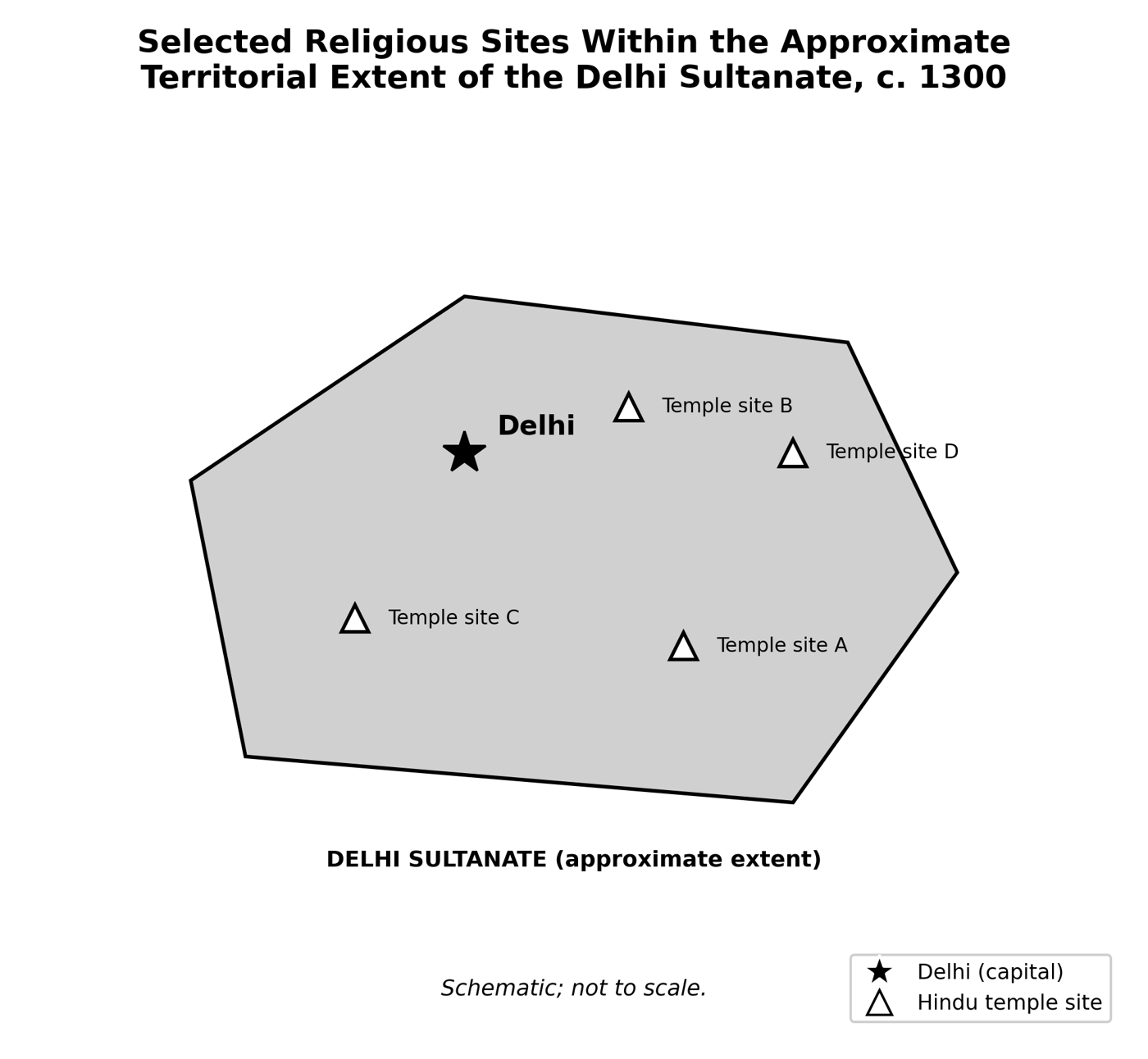
Question 1
- A. Education-linked administrative selection offered conquering dynasties a functioning system for governing an existing population
- B. Conquering dynasties always destroy prior administrative systems
- C. The examination system began only after the Mongol conquest
- D. Bureaucratic selection had no connection to governance effectiveness
Question 2
- A. Song
- B. Ming
- C. Tang
- D. Yuan
Question 3
- A. Only Mali's internal political structure
- B. Only Islamic religious conversion in West Africa
- C. Both Mali's trade-based state authority and West Africa's network integration into wider Islamic and trans-Saharan commerce
- D. Only the price of gold in Cairo markets
Question 4
- A. Muslim political rule could coexist with continued non-Muslim religious institutions, extending the same pattern of governance accommodating existing populations and networks seen in Evidence 1 and Evidence 2
- B. The Delhi Sultanate eliminated all non-Muslim religious practice
- C. Hindu temples existed only outside Sultanate territory
- D. The Sultanate had no defined territorial boundaries
Stimulus 2 (Questions 5-8):
| Evidence 1: Inca and Mexica administration |
|---|
| The Inca state required communities to provide labor through the mit'a system for roads, agriculture, military service, and state projects. The Mexica Empire more often required conquered or subordinate communities to deliver tribute in goods and labor while many local rulers remained in place. Constructed for practice; not an authentic historical quotation. |
| Evidence 2: Caravanserai on overland routes |
|---|
| Along major Silk Road corridors, rulers and local communities supported caravanserai where merchants and animals could rest, obtain supplies, and find protection. Such infrastructure lowered some of the risks of long-distance commerce and depended on political as well as private support. Constructed for practice; not an authentic historical quotation. |
| Evidence 3: Mongol political consolidation and trade |
|---|
| During the height of Mongol rule, large stretches of Eurasia came under related Mongol khanates. Merchants still faced danger and political boundaries, but in many regions they negotiated with fewer unrelated authorities than before the conquests, facilitating movement across established trade corridors. Constructed for practice; not an authentic historical quotation. |
| Evidence 4: Monsoon trade and Swahili ports |
|---|
| Seasonal monsoon winds made sailing schedules across the Indian Ocean predictable. Merchants often remained for months in ports while waiting for winds to reverse, encouraging repeated contact and settlement in coastal cities. On the East African coast, this interaction contributed to Swahili culture, which combined Bantu linguistic foundations with Islamic and Indian Ocean influences. Constructed for practice; not an authentic historical quotation. |
Question 5
- A. Total population size
- B. Method of incorporating conquered or subordinate populations into the state
- C. Distance from the Pacific coast
- D. Religious practices
Question 6
- A. Merchants traveled entirely without any political or communal support
- B. States and communities had no interest in long-distance trade
- C. Long-distance overland trade depended on organized infrastructural support, not merchant initiative alone
- D. Caravanserai existed only after 1450
Question 7
- A. Complete elimination of all Eurasian trade
- B. Increased ease and confidence of long-distance merchant movement across Mongol-controlled territory
- C. The end of the Silk Roads as a trade network
- D. Reduced demand for luxury goods
Question 8
- A. Trans-Saharan camel caravan technology
- B. Mongol political consolidation (Evidence 3)
- C. European naval cannon
- D. Continued Islamic and Indian Ocean commercial contact alongside Bantu linguistic foundations
Stimulus 3 (Questions 9-12):
| Evidence 1: Disease along connected routes |
|---|
| The plague that reached Black Sea and Mediterranean ports in the late 1340s traveled through regions tied together by commercial movement. The same networks that carried merchants, goods, and information could also carry pathogens between densely connected communities. Constructed for practice; not an authentic historical quotation. |
| Evidence 2: Two exchange systems |
|---|
| Across the Sahara, caravans moved salt southward from desert deposits and gold northward from West African producing regions. In the Indian Ocean, merchants used monsoon winds and maritime technology to move bulk and luxury goods among East Africa, the Middle East, South Asia, and Southeast Asia. Constructed for practice; not an authentic historical quotation. |
| Evidence 3: Two methods of building loyal service elites |
|---|
| Ottoman devshirme recruited some Christian boys from Balkan provinces for conversion, training, and imperial military or administrative service. Mughal emperor Akbar instead incorporated many Rajput rulers and warriors into imperial service while allowing them to retain important elements of local status and identity. Constructed for practice; not an authentic historical quotation. |
Question 9
- A. Connectivity's consequences included serious costs alongside its commercial benefits
- B. Trade networks had no effect on disease transmission
- C. The Black Death began independently of any trade network
- D. Only European populations were affected
Question 10
- A. Total distance traveled
- B. The religion of the merchants involved
- C. The year each network began
- D. The specific environmental and technological constraints shaping each network's transport method
Question 11
- A. Both eliminated all existing elites from any governing role
- B. Both required conversion to a shared imperial religion
- C. Both addressed a ruling state's need to staff administration and military service with personnel loyal to the center
- D. Neither system had any connection to military service
Question 12
- A. Whether either empire was located in Eurasia
- B. Whether existing local elites were bypassed (devshirme) or directly incorporated (Akbar's Rajput alliances)
- C. Whether either empire used gunpowder weapons
- D. Whether either empire practiced taxation
Stimulus 4 (Questions 13-16):
| Evidence 1: Safavid state identity |
|---|
| Safavid rulers made Twelver Shi'a Islam central to state identity after 1501 and promoted its institutions and conversion. The policy strengthened political-religious distinction from the neighboring Sunni Ottoman Empire. Constructed for practice; not an authentic historical quotation. |
Evidence 2: Qing chronology
| Year | Event |
|---|---|
| 1636 | Hong Taiji proclaims the Great Qing |
| 1644 | Manchu forces enter Beijing as Ming rule collapses |
Selected dates in early Qing state formation.
| Evidence 3: Ottoman and Safavid religious policy |
|---|
| The Ottoman state was officially Sunni but governed large Christian and Jewish populations through arrangements that permitted recognized religious communities substantial internal authority. Safavid rulers pursued a more active program of promoting Twelver Shi'ism within Iran. Constructed for practice; not an authentic historical quotation. |
Evidence 4: Mughal consolidation
| Year | Event |
|---|---|
| 1526 | Babur wins the First Battle of Panipat and establishes Mughal rule in northern India |
| 1556 | Akbar begins his reign |
| 1605 | Akbar dies |
From conquest to consolidation in the Mughal Empire.
Question 13
- A. The Battle of Panipat
- B. The fall of Constantinople
- C. The conquest of Mamluk Egypt
- D. The Battle of Çaldıran
Question 14
- A. Qing land-empire evidence is chronologically valid alongside the Ottoman, Safavid, and Mughal empires for a 1450-1750 prompt
- B. Discussing Safavid religious policy
- C. Comparing the Ottoman and Mughal empires to each other
- D. Referencing the Battle of Çaldıran
Question 15
- A. All gunpowder empires pursued identical religious strategies
- B. Religious policy had no connection to political legitimacy
- C. Religious policy varied meaningfully even among empires sharing comparable gunpowder military technology
- D. Only the Mughal Empire had any religious policy at all
Question 16
- A. Babur and Akbar ruled at the same time
- B. Babur founded Mughal rule in 1526, thirty years before Akbar's reign began in 1556
- C. Akbar founded the Mughal Empire himself
- D. The Mughal Empire began after both rulers had died
Stimulus 5 (Questions 17-19): Questions 17-19 refer to the schematic map below. The map shows major Indian Ocean trading centers and seasonal sailing patterns around 1400. It labels Kilwa on the East African coast, Calicut on India's southwest coast, Malacca at the strait linking the Indian Ocean and the South China Sea, and Guangzhou in southern China.
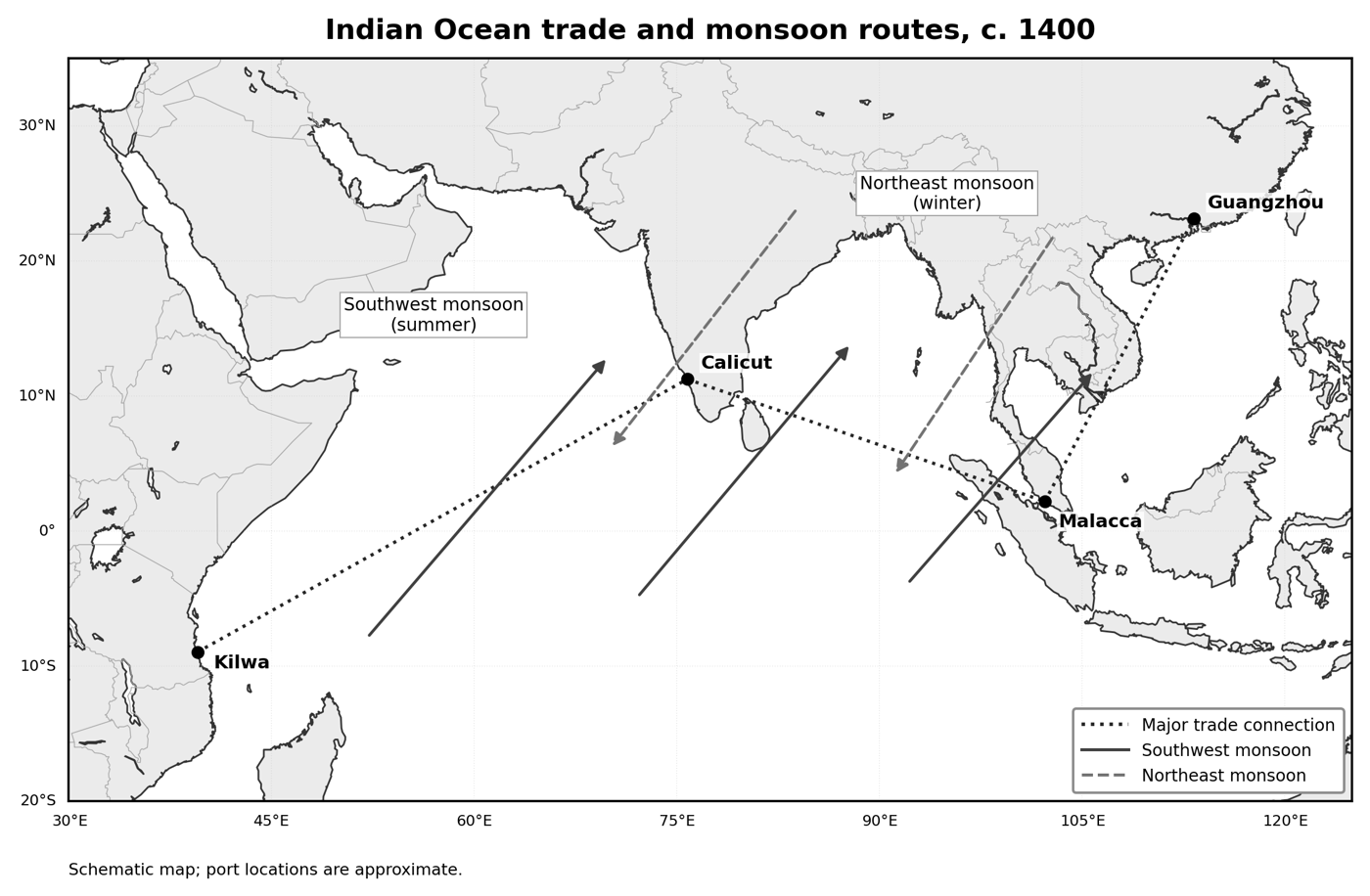
Question 17
- A. preventing merchants from traveling between regions
- B. creating predictable sailing seasons that shaped when merchants departed and returned
- C. eliminating the need for port cities
- D. limiting maritime commerce to European ships
Question 18
- A. controlled an important passage connecting Indian Ocean and East Asian commercial networks
- B. served as the capital of the Mongol Empire
- C. controlled the trans-Saharan gold trade
- D. prevented merchants from entering Southeast Asia
Question 19
- A. Trade depended on a single empire controlling the entire network
- B. Commercial exchange linked distant regions through ports, intermediary merchants, and knowledge of environmental conditions
- C. Long-distance maritime commerce had largely disappeared
- D. East Africa remained isolated from Asian commercial networks
Stimulus 6 (Questions 20-22):
Evidence 1: Columbian Exchange: population and crops
| Indicator | c. 1490 | c. 1550 | c. 1600 |
|---|---|---|---|
| Indigenous population index in selected American regions | 100 | 42 | 24 |
| Old World regions regularly cultivating American maize/potatoes | limited | expanding | widespread in several regions |
Synthetic practice data; values are illustrative and are not historical measurements.
| Evidence 2: Portuguese and Spanish imperial methods |
|---|
| Portuguese expansion in the Indian Ocean concentrated on fortified ports and naval control at strategic sites such as Goa and Malacca. Spanish expansion in the Americas relied more heavily on territorial conquest of the Mexica and Inca states followed by colonial administration over extensive inland populations. Constructed for practice; not an authentic historical quotation. |
| Evidence 3: VOC charter |
|---|
| Founded in 1602, the Dutch East India Company received a charter allowing it to conduct trade but also to negotiate treaties, build forts, maintain armed forces, and wage war in pursuit of Dutch commercial interests in Asia. Constructed for practice; not an authentic historical quotation. |
Question 20
- A. The exchange produced uniformly positive outcomes
- B. Population decline occurred only in Afro-Eurasia
- C. Crop diffusion had no measurable effect anywhere
- D. Disease-driven demographic collapse occurred alongside crop diffusion into new regions
Question 21
- A. Maritime empires used identical methods everywhere
- B. Maritime empires pursued different control methods depending on regional conditions and available resources
- C. Only Spain established any form of imperial control
- D. Portugal conquered the same territories as Spain
Question 22
- A. Identical to an ordinary private trading firm's authority
- B. Limited entirely to commercial transactions with no political authority
- C. Granting state-like powers to a chartered corporate entity alongside private investment
- D. Equivalent to later direct Dutch Crown colonial rule
Stimulus 7 (Questions 23-25):
| Evidence 1: Manila galleon system |
|---|
| After 1571, galleons linked Manila with Acapulco. American silver moved westward across the Pacific toward Asian markets, especially China, while Asian manufactured goods moved eastward through Manila toward Spanish America and beyond. Constructed for practice; not an authentic historical quotation. |
| Evidence 2: Afonso I of Kongo protests slave trading |
|---|
| In letters to the Portuguese crown in the 1520s, King Afonso I of Kongo complained that Portuguese merchants and their partners were seizing free people, including members of elite families, and selling them into slavery. He asked the Portuguese king to restrain the trade. Constructed for practice; not an authentic historical quotation. |
| Evidence 3: Colonial social classification |
|---|
| In Spanish American colonies, legal and social labels distinguished people according to ancestry, birthplace, and status. These classifications influenced taxation, officeholding, reputation, and access to privilege, even though lived identities were more complicated than official categories suggested. Constructed for practice; not an authentic historical quotation. |
Question 23
- A. Atlantic and Pacific trade circuits operated in total isolation
- B. Silver connected Atlantic and Pacific trade circuits into a single global system
- C. China had no interest in silver
- D. Manila had no commercial function
Question 24
- A. African rulers had no involvement in or reaction to the slave trade
- B. Kongo had no trade relationship with Portugal
- C. Afonso I supported unrestricted slave trading
- D. The slave trade produced political costs some African rulers actively opposed even within an ongoing trade relationship
Question 25
- A. A legally and socially codified hierarchy organized around ancestry and birthplace
- B. Identical to Ottoman religious hierarchies
- C. A purely informal custom with no legal standing
- D. Unconnected to colonial governance
Stimulus 8 (Questions 26-28):
| Evidence 1: Rights language and exclusion |
|---|
| The 1789 Declaration of the Rights of Man and of the Citizen asserted legal equality and national sovereignty. Revolutionary-era women writers then used the language of universal rights to challenge their own political exclusion. Constructed for practice; not an authentic historical quotation. |
| Evidence 2: Haiti and mainland Spanish America |
|---|
| The Haitian Revolution abolished slavery and colonial rule in Saint-Domingue and created an independent state in 1804. Many mainland Spanish American independence movements ended colonial political rule while preserving substantial social and economic hierarchies. Constructed for practice; not an authentic historical quotation. |
| Evidence 3: Conditions supporting British industrialization |
|---|
| Britain combined accessible coal, investment capital, expanding commercial networks, agricultural change, and access to overseas markets and raw materials. These conditions worked together to support early mechanized industrial growth. Constructed for practice; not an authentic historical quotation. |
Question 26
- A. Enlightenment rights language remained fixed to its original intended scope
- B. The reach of Enlightenment rights claims extended beyond what their original authors intended
- C. Women rejected Enlightenment thought entirely
- D. All revolutionary governments extended full rights to women
Question 27
- A. Shared revolutionary language did not produce uniform social outcomes
- B. All Atlantic revolutions produced identical social outcomes
- C. Only Haiti experienced any revolution in this period
- D. Latin American independence ended all social hierarchy
Question 28
- A. A single factor alone explains Britain's early industrialization
- B. Industrialization began simultaneously across all of Europe
- C. Britain had no advantages other states lacked
- D. Britain's early industrialization depended on several conditions acting together, not one factor alone
Stimulus 9 (Questions 29-31):
| Evidence 1: Iwakura Mission |
|---|
| From 1871 to 1873, senior Japanese officials traveled through the United States and Europe to study governments, schools, industry, military organization, and technology. The mission formed part of a broader Meiji effort to strengthen Japan through selective institutional borrowing. Constructed for practice; not an authentic historical quotation. |
| Evidence 2: Rail and telegraph expansion |
|---|
| During the nineteenth century, railway networks expanded the speed and volume of land transport while telegraph systems allowed messages to travel far faster than physical messengers. Both became important to industrial economies and imperial administration. Constructed for practice; not an authentic historical quotation. |
| Evidence 3: Responses to industrial conditions |
|---|
| Workers formed labor unions to press for wages and safer conditions. Marx and Engels issued the Communist Manifesto in 1848 calling for revolutionary class transformation. Reformers in several industrial states also sought factory laws regulating child labor, hours, and workplace conditions. Constructed for practice; not an authentic historical quotation. |
Question 29
- A. Japan rejected all foreign influence after the Meiji Restoration
- B. Industrialization outside Britain often involved deliberate, government-directed knowledge-gathering
- C. Meiji industrialization began before the Restoration itself
- D. The mission was purely a tourist excursion
Question 30
- A. The telegraph was never used for communication
- B. Exploration required no communication technology
- C. The telegraph originated in the Americas
- D. Telegraph networks spread mainly during the nineteenth century, not the sixteenth
Question 31
- A. All three arose as responses to industrial-era conditions such as low wages and unsafe work
- B. All three began in the twentieth century
- C. All three rejected any organized political action
- D. All three proposed identical solutions
Stimulus 10 (Questions 32-34):
| Evidence 1: Women's work and political status |
|---|
| Industrialization expanded women's wage labor in factories and other sectors, but legal and political rights did not expand at the same rate. In many states, women entered new forms of paid work decades before gaining equal voting or property rights. Constructed for practice; not an authentic historical quotation. |
| Evidence 2: Uneven industrialization |
|---|
| Some regions industrialized rapidly and exported manufactured goods, while many other regions remained major suppliers of cotton, minerals, foodstuffs, and other raw materials to industrial economies. Constructed for practice; not an authentic historical quotation. |
| Evidence 3: Imperial motives and rhetoric |
|---|
| Industrial states sought raw materials, markets, investment opportunities, and strategic routes overseas. Imperial advocates also used social-Darwinist claims and the language of a 'civilizing mission' to justify conquest and rule. Constructed for practice; not an authentic historical quotation. |
Question 32
- A. Economic participation and political rights changed at the same pace during this period
- B. Women's economic participation and political status changed at different paces during this period
- C. Women had no role in industrial labor
- D. Legal exclusion ended once factory work began
Question 33
- A. Industrialization's reach was uneven, with some regions industrializing directly and others remaining primarily suppliers
- B. Industrialization changed production everywhere identically
- C. No region experienced any industrial change
- D. Raw-material supply had no connection to industrial demand
Question 34
- A. Economic motives operated entirely separately from ideological justification
- B. Ideological rhetoric replaced any economic motive
- C. Neither factor influenced imperial expansion
- D. Economic motives for imperial expansion were paired with ideological justification, not left to stand alone
Stimulus 11 (Questions 35-37):
| Evidence 1: Battle of Adwa |
|---|
| In 1896, Ethiopian forces under Menelik II defeated an invading Italian army at Adwa. Ethiopia preserved its independence at a time when European powers were extending colonial rule across most of Africa. Constructed for practice; not an authentic historical quotation. |
| Evidence 2: Indian Rebellion of 1857 |
|---|
| The 1857 uprising against British power in India involved sepoy grievances, political resentment over annexations, fears about religious interference, and broader opposition to Company rule. Different participants entered the rebellion for different reasons. Constructed for practice; not an authentic historical quotation. |
| Evidence 3: Treaty-port concessions in Qing China |
|---|
| After defeat in the First Opium War, Qing China accepted treaty-port access and foreign commercial and legal privileges. China was not formally annexed, but these concessions reduced Qing control over trade and law in important areas. Constructed for practice; not an authentic historical quotation. |
Question 35
- A. European conquest was inevitable everywhere in Africa
- B. Ethiopia had no military capacity
- C. European conquest was not inevitable everywhere, complicating claims of guaranteed colonial success
- D. Italy never attempted any African conquest
Question 36
- A. The rebellion involved multiple combined grievances, not one isolated trigger
- B. No cartridge-related grievance existed
- C. The rebellion had no connection to East India Company rule
- D. The rebellion occurred after Crown rule had already begun
Question 37
- A. Formal colonial annexation
- B. Complete Chinese independence with no foreign influence
- C. Identical to British rule in India after 1858
- D. Informal empire, exercising economic and political influence without formal territorial annexation
Stimulus 12 (Questions 38-40): Adapted from Edward Linley Sambourne, "The Rhodes Colossus: Striding from Cape Town to Cairo," Punch, December 10, 1892. The original cartoon caricatured Cecil Rhodes spanning Africa while holding a telegraph line, referring to British ambitions for transportation and communication links from southern to northeastern Africa.
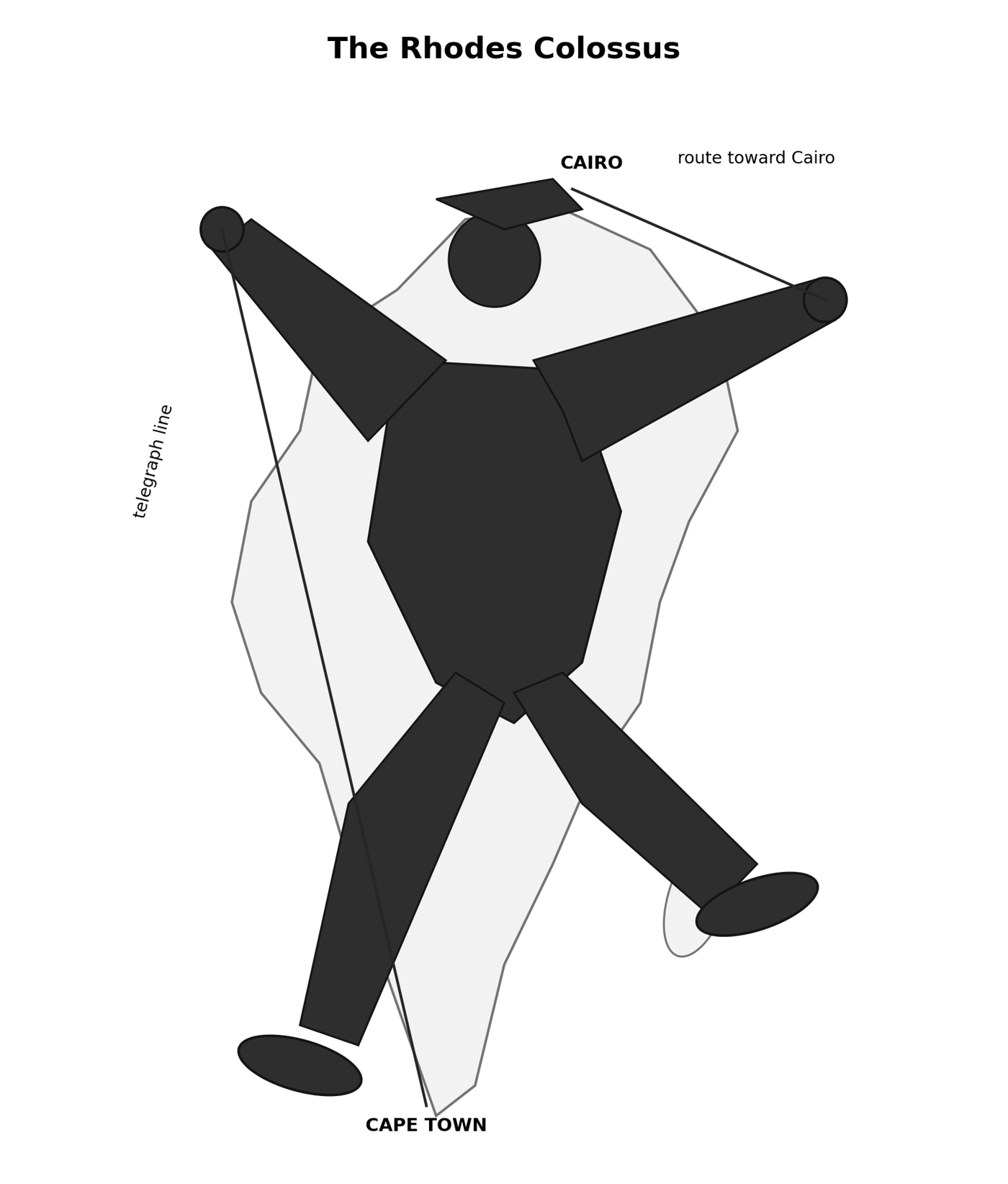
Question 38
- A. European retreat from overseas territorial expansion
- B. European imperial competition and expansion in Africa
- C. The collapse of industrial transportation networks
- D. African control of European colonial governments
Question 39
- A. industrial-era transportation and communication technology
- B. the decline of European commercial activity
- C. subsistence agriculture
- D. the abolition of territorial competition
Question 40
- A. Imperial boundaries were already fixed and uncontested across Africa
- B. Imperial ambition could be imagined in continent-spanning strategic and commercial terms
- C. African governments controlled European expansion plans
- D. Industrial technology reduced competition among imperial powers
Stimulus 13 (Questions 41-43):
| Evidence 1: China after the Qing collapse |
|---|
| The Qing dynasty fell in 1911, but the new republic did not immediately establish stable centralized authority. Political fragmentation and regional military power remained major problems in the years that followed. Constructed for practice; not an authentic historical quotation. |
| Evidence 2: Sarajevo as trigger |
|---|
| The assassination of Archduke Franz Ferdinand in June 1914 produced a diplomatic crisis that escalated through existing alliance commitments, military planning, nationalism, and great-power rivalry. Constructed for practice; not an authentic historical quotation. |
| Evidence 3: Colonial manpower in World War I |
|---|
| More than one million Indian soldiers and non-combatants served the British war effort during World War I, fighting or working in several theaters beyond South Asia. Constructed for practice; not an authentic historical quotation. |
Question 41
- A. The end of an old imperial order guaranteed a smooth transition to a new one
- B. China experienced no political change in 1911
- C. The Qing dynasty was never actually overthrown
- D. The end of an old imperial order did not guarantee a smooth transition to stability
Question 42
- A. The assassination alone was a sufficient cause of the war with no other contributing factor
- B. Alliance systems had no bearing on this crisis
- C. The assassination functioned as a trigger within deeper conditions of alliance commitment and rivalry already present
- D. No assassination actually occurred
Question 43
- A. World War I's global scope depended directly on colonial empires' manpower
- B. World War I involved only European populations
- C. India was not a British colonial territory during this period
- D. Colonial troops played no role in this war
Stimulus 14 (Questions 44-46):
Evidence 1: Expansion before the European war
| Year | Event |
|---|---|
| 1931 | Japan seizes Manchuria |
| 1937 | Full-scale Sino-Japanese War expands |
| 1939 | Germany invades Poland |
Selected expansionist actions before and at the start of the European phase of World War II.
| Evidence 2: State-organized mass atrocity |
|---|
| The Armenian genocide occurred during World War I under the Ottoman government. The Holocaust occurred during World War II under Nazi Germany. The events were historically distinct but both demonstrate the capacity of modern states to organize mass persecution and killing. Constructed for practice; not an authentic historical quotation. |
Evidence 3: Cold War alliance chronology
| Year | Event |
|---|---|
| 1949 | NATO founded |
| 1955 | West Germany enters NATO |
| 1955 | Warsaw Pact founded |
Selected Cold War alliance dates.
Question 44
- A. World War II began simultaneously in Asia and Europe
- B. Germany's invasion was the war's first act of aggression
- C. Expansionist aggression in Asia began years before the European conflict most narratives emphasize
- D. Japan's actions had no connection to World War II
Question 45
- A. State-organized mass atrocity was confined to a single conflict
- B. State-organized mass atrocity occurred across more than one conflict and targeted more than one population during this broader period
- C. Only the Holocaust involved deliberate state policy
- D. The Armenian genocide occurred after World War II
Question 46
- A. Both alliances formed simultaneously
- B. The Warsaw Pact formed before NATO
- C. Soviet bloc consolidation responded directly to a specific Western action, not a parallel simultaneous timeline
- D. Neither alliance had any connection to the other
Stimulus 15 (Questions 47-49):
| Evidence 1: Partition of British India |
|---|
| British rule in South Asia ended in 1947 with the creation of India and Pakistan. Partition was accompanied by mass migration across the new borders and severe communal violence. Constructed for practice; not an authentic historical quotation. |
| Evidence 2: Constraints after independence |
|---|
| Newly independent states often inherited colonial borders, commodity-dependent economies, and limited fiscal or administrative capacity. They also faced pressure from the United States and Soviet Union during the Cold War. Constructed for practice; not an authentic historical quotation. |
| Evidence 3: Gorbachev's reforms |
|---|
| Mikhail Gorbachev introduced glasnost and perestroika in the 1980s in an effort to reform and strengthen the Soviet system. The reforms loosened controls and contributed to political dynamics that ultimately moved beyond his original intentions. Constructed for practice; not an authentic historical quotation. |
Question 47
- A. Decolonization's immediate human costs could be severe even when independence ended formal colonial rule
- B. Indian independence produced no significant consequences
- C. Partition occurred without any migration
- D. All decolonization processes were identical to India's
Question 48
- A. Formal political independence automatically resolved all economic and structural challenges
- B. Colonial borders had no lasting effect after independence
- C. Formal political independence did not automatically resolve significant economic and structural challenges these states faced
- D. Cold War pressure had no bearing on newly independent states
Question 49
- A. These reforms successfully preserved the Soviet Union indefinitely
- B. Reforms intended to strengthen a political-economic system can instead accelerate its collapse
- C. Glasnost and perestroika had no connection to Soviet collapse
- D. These reforms were implemented before Gorbachev's leadership began
Stimulus 16 (Questions 50-52):
Evidence 1: End of the Cold War chronology
| Year | Event |
|---|---|
| 1989 | Berlin Wall opens |
| 1990 | Germany reunifies |
| 1991 | Soviet Union dissolves |
| Evidence 2: Transport and globalization |
|---|
| Standardized shipping containers reduced loading costs and made global supply chains more predictable, while commercial aviation accelerated the movement of people and high-value goods across long distances. Constructed for practice; not an authentic historical quotation. |
| Evidence 3: Two global health outcomes |
|---|
| Smallpox eradication was formally certified in 1980 after coordinated vaccination and surveillance. HIV/AIDS, by contrast, exposed persistent inequalities in prevention and access to treatment across countries and populations. Constructed for practice; not an authentic historical quotation. |
Question 50
- A. They occurred in the same year
- B. None of these events actually occurred
- C. They occurred as three distinct events across three consecutive years, not as one simultaneous event
- D. German reunification preceded the Berlin Wall's fall
Question 51
- A. Multiple distinct technologies, including shipping logistics, together reduced the cost and time of global exchange
- B. Only digital communication technology contributed to global economic integration
- C. Container shipping had no connection to global supply chains
- D. Global trade decreased during this period
Question 52
- A. All diseases were addressed with equal success
- B. Medical technology had no limits during this period
- C. Global public-health cooperation produced uneven outcomes depending on the specific disease and resources mobilized
- D. HIV/AIDS was eradicated using smallpox's methods
Stimulus 17 (Questions 53-55):
Evidence 1: GATT and WTO chronology
| Year | Event |
|---|---|
| 1948 | GATT enters into force |
| 1995 | World Trade Organization begins operating |
From postwar tariff negotiations to a broader trade institution.
| Evidence 2: Cultural hybridization |
|---|
| Global music, food, fashion, language, and media have often been adapted to local tastes and traditions. Transnational circulation therefore frequently produces blended cultural forms instead of a single uniform global culture. Constructed for practice; not an authentic historical quotation. |
| Evidence 3: Neo-colonial critique |
|---|
| Critics of neo-colonialism argue that formal political independence can coexist with continued economic dependence when poorer states remain heavily reliant on foreign capital, commodity exports, debt, or corporations based in wealthier states. Constructed for practice; not an authentic historical quotation. |
Question 53
- A. GATT and the WTO began operating in the same year
- B. International trade governance developed gradually through a specific institutional sequence, not as a single simultaneous creation
- C. The WTO existed before GATT
- D. Trade governance required no institutional development
Question 54
- A. Global cultural circulation produced genuinely new blended forms rather than simple replacement of local culture
- B. Cultural circulation had no effect on local traditions
- C. Global culture completely replaced all local cultures
- D. Local cultures had no influence on global cultural forms
Question 55
- A. The Bretton Woods conference
- B. Newly independent states' continued commodity dependence and Cold War pressure covered in the previous unit
- C. Smallpox eradication
- D. Cultural hybridization
Section I, Part B: Short-Answer Questions (3 questions, 40 minutes)
All three are required. Each uses source material and addresses a different period.
SAQ 1: Constructed secondary-source-style practice text (period: 1200-1450; not a published historian's interpretation). Source: a constructed historian's summary. "Political authority in the period before 1450 rested on varied foundations: administrative selection tied to education, control over long-distance trade, and religious or dynastic legitimacy, with no single model dominating across regions."
a) Identify one state from this period that built authority primarily through administrative selection tied to education.
b) Describe one specific feature of that state's administrative system.
c) Explain how a different state from this period built authority primarily through control over trade instead.
SAQ 2: Constructed primary-source-style practice text (period: 1750-1900; not an authentic historical document). Source: a constructed excerpt attributed to a British parliamentary witness describing factory conditions, c. 1840. "Children as young as eight work twelve-hour shifts tending machinery, and while wages have risen for some skilled workers, conditions in the mills remain a subject of continuing public concern."
a) Identify the economic transformation this source describes.
b) Describe one specific detail from the source illustrating this transformation's social cost.
c) Explain how this evidence connects to reform movements covered in this period.
SAQ 3: Non-text source (period: 1900-present).
| Year | Development |
|---|---|
| 1949 | NATO founded |
| 1955 | West Germany joins NATO |
| 1955 | Warsaw Pact founded |
a) Identify the general pattern shown regarding these two alliances' founding dates.
b) Describe one factor that explains the six-year gap between them.
c) Explain how this gap challenges an assumption that Cold War alliance formation was simultaneous or symmetrical.
Section II: Document-Based Question (60 minutes recommended, including
15-minute reading period)
Prompt: Evaluate the extent to which international economic institutions constrained state economic decision-making between 1944 and 2000.
Document 1. Constructed primary-source-style practice text, attributed to a delegate at the 1944 Bretton Woods conference: "These new institutions will require member states to accept common monetary rules, a surrender of some individual flexibility in exchange for collective stability none of us could guarantee alone."
Document 2. Constructed primary-source-style practice text, attributed to a postcolonial finance minister negotiating IMF loan terms, c. 1980: "Their conditions reach into our budget decisions as thoroughly as any domestic authority, a price we accept only because the alternative, no access to capital at all, is worse."
Document 3. Constructed primary-source-style practice text, attributed to a Ghanaian government economist describing World Bank structural-adjustment conditions, c. 1985: "The loan arrives with conditions attached to our own budget choices, conditions we did not draft and would not have chosen, accepted only because the alternative is no financing at all."
Document 4. Constructed primary-source-style practice text, attributed to a GATT trade negotiator, c. 1965: "We participate because the rules, once accepted, apply to all members equally, unlike arrangements imposed by a single dominant power."
Document 5. Constructed primary-source-style practice text, attributed to a Non-Aligned Movement economic declaration, c. 1973: "The current international economic order was built without our participation and serves interests other than our own; we call for structures that reflect the world as it now stands."
Document 6. Constructed primary-source-style practice text, attributed to a multinational corporation executive describing global supply-chain investment, c. 1990: "We locate production where conditions serve our interests, a decision no single government's preferences can fully override in a competitive global market."
Document 7. Constructed primary-source-style practice text, attributed to a WTO official describing dispute resolution, c. 1997: "Member states agree in advance to bind themselves to rulings they might not have reached through their own domestic processes alone, the price of predictable multilateral trade."
Section II: Long Essay Question (40 minutes recommended)
Introductory statement: Between 1450 and 1900, states expanded political control over distant territories and peoples through varied methods and for varied stated reasons, including access to trade, land, and resources; religious or ideological justification; and competition with rival states. Historians continue to debate how much weight economic motives deserve relative to these other factors across this long period.
Prompt: Evaluate the extent to which economic motives, rather than other factors, explain the expansion of political control over distant territories and peoples in the period from 1450 to 1900.
90-second evidence dump: Mali/trade-based authority (pre-1450 context for comparison). Portuguese port control, commercial motive. Spanish territorial conquest, mixed motive (religious + material). Plantation labor systems, direct economic driver. Industrial-era raw material demand, Unit 6. Social-Darwinist rhetoric, non-economic ideological factor operating alongside economic motive throughout.
Practice Exam 1: Answers and Explanations
Section I, Part A: Multiple Choice
Show the answers and explanations
1. A. B, C, and D each contradict the documented continuity and practical function of this administrative inheritance.
2. D. A, B, and C are each Han Chinese-ruled dynasties; only D reflects the Mongol-ruled adaptation this unit's evidence documents.
3. C. A, B, and D each isolate one narrow use rather than recognizing this event's documented dual function across two different arguments.
4. A. B, C, and D each contradict what the map directly shows about coexisting religious institutions within Sultanate territory.
5. B. A, C, and D are not the dimension this passage's contrast actually addresses; only B names the incorporation method both examples directly illustrate.
6. C. A, B, and D each contradict the documented infrastructural investment this passage describes.
7. B. A, C, and D each contradict or overstate what this specific political consolidation effect actually produced.
8. D. A, B, and C describe unrelated networks or technologies; only D names the specific combination this unit's evidence documents for Swahili cultural synthesis.
9. A. B, C, and D each contradict the documented connection and scope this passage establishes.
10. D. A, B, and C do not capture the actual comparative dimension, environmental and technological constraint, this unit's coverage of these networks establishes.
11. C. A, B, and D each misstate either the actual method or a shared function that doesn't fit both systems as described.
12. B. A, C, and D do not identify the actual documented contrast between these two administrative strategies.
13. D. A, B, and C describe Ottoman or Mughal military events unconnected to this specific Ottoman-Safavid religious rivalry.
14. A. B, C, and D describe legitimate but unrelated uses of this unit's evidence; only A states what this specific chronology detail actually establishes.
15. C. A, B, and D each contradict the documented variation and significance this unit establishes for religious policy among these empires.
16. B. A, C, and D each introduce a separate factual error rather than correctly stating this thirty-year sequence.
17. B. Monsoon winds were predictable seasonal patterns. Merchants timed voyages around those patterns, often remaining in port until winds shifted.
18. A. Malacca's position near the strait connecting the Indian Ocean with the South China Sea made it an important commercial center.
19. B. The map combines widely separated ports with seasonal sailing patterns, showing a network sustained by multiple commercial centers and environmental knowledge.
20. D. A, B, and C each misstate the mixed, bidirectional consequences this table and its context document.
21. B. A, C, and D each contradict this documented, region-specific variation in imperial method.
22. C. A, B, and D each misstate the VOC's distinctive combination of private and state-like powers.
23. B. A, C, and D each contradict this system's documented connective function across ocean basins.
24. D. A, B, and C each contradict the documented political opposition and continued relationship this evidence shows.
25. A. B, C, and D each misstate the casta system's actual documented legal character and function.
26. B. A, C, and D each contradict the documented extension and continued exclusion this evidence shows.
27. A. B, C, and D each contradict the specific documented contrast this passage establishes.
28. D. A, B, and C each contradict this passage's explicit combination-of-factors explanation.
29. B. A, C, and D each contradict this mission's documented purpose and its connection to the Restoration's actual timing.
30. D. A, B, and C each introduce an unsupported claim rather than identifying the actual chronology error.
31. A. B, C, and D each misstate either the timing or the actual diversity among these three responses.
32. B. A, C, and D each contradict the documented gap this passage establishes between economic and political change.
33. A. B, C, and D each contradict the documented, uneven pattern this passage establishes.
34. D. A, B, and C each contradict this passage's explicit pairing of economic motive and ideological rhetoric.
35. C. A, B, and D each contradict this battle's documented outcome and significance.
36. A. B, C, and D each introduce a separate factual error rather than identifying the actual oversimplification.
37. D. A, B, and C each misstate this specific informal-empire arrangement.
38. B. A, C, and D each contradict the documented imperial expansion this visual depicts.
39. A. B, C, and D each misstate what the telegraph line in this visual actually represents.
40. B. A, C, and D each contradict what this visual's exaggerated scale is actually meant to convey.
41. D. A, B, and C each contradict the documented, unstable aftermath this passage establishes.
42. C. A, B, and D each contradict this passage's explicit distinction between trigger and structural cause.
43. A. B, C, and D each contradict the documented scale of colonial mobilization this evidence establishes.
44. C. A, B, and D each contradict this documented, earlier Asian starting point for expansionist aggression.
45. B. A, C, and D each contradict the documented scope and chronology of mass atrocity this evidence establishes.
46. C. A, B, and D each contradict this documented sequence and its specific trigger.
47. A. B, C, and D each contradict the documented severity and specificity of partition's consequences.
48. C. A, B, and D each contradict the documented, unresolved challenges this passage establishes.
49. B. A, C, and D each contradict the documented, ultimately destabilizing effect these reforms had.
50. C. A, B, and D each misstate this documented, sequential three-year progression.
51. A. B, C, and D each isolate or dismiss a technology this passage shows worked alongside others.
52. C. A, B, and D each contradict this documented contrast between two very different public-health outcomes.
53. B. A, C, and D each contradict this documented sequence and gap between these two trade institutions.
54. A. B, C, and D each contradict the documented, blended outcome this passage establishes.
55. B. A, C, and D describe unrelated developments; only B directly connects to this critique's documented origin in postcolonial economic conditions.
Section I, Part B: Short-Answer Questions
Scoring notes. SAQ 1(c): an acceptable answer names Mali or Great Zimbabwe's trade-route control, connected to a specific mechanism (gold- salt exchange, Indian Ocean links), not just a restated label. SAQ 2(c): requires connecting the source's child-labor detail to a specific reform movement (factory laws, labor unions), not a generic "people were concerned" statement. SAQ 3(c): requires explicitly stating that a specific trigger (West Germany's alliance integration) explains the gap, challenging an assumption of automatic, symmetrical bloc formation.
Section II: Document-Based Question
Scoring Walkthrough
Thesis (1 pt). International economic institutions constrained state decision-making significantly, ranging from informal empire's coercive treaty-port concessions to formal, negotiated constraints under Bretton Woods institutions and the WTO, though the degree of state consent involved varied considerably between coerced and negotiated arrangements.
Contextualization (1 pt). Situate broadly: international economic governance developed unevenly across this period, from nineteenth-century coercive arrangements through deliberately negotiated postwar institutions to the WTO's more binding multilateral framework.
Evidence-address-topic (1 pt, 3+ docs). Accurately describing Documents 1, 3, and 7's institutional constraints meets this threshold.
Evidence-support-argument (1 pt, 4+ docs). For Document 2: An IMF loan's conditions reaching into domestic budget decisions demonstrates that formal sovereignty could coexist with substantial practical constraint on economic policy, extending this argument beyond Bretton Woods's original design intent to its lived postcolonial consequence.
Sourcing (1 pt, 2+ docs). For Document 3: A Ghanaian economist describing structural-adjustment conditions imposed as a precondition for financing, rather than negotiated among equals, reveals a form of economic constraint categorically different from the consent-based framing in Documents 1 and 7, making this source essential for distinguishing coerced from negotiated institutional constraint.
Outside evidence (1 pt). An acceptable example: The 1997-98 Asian financial crisis, in which the International Monetary Fund required South Korea and Indonesia to accept specific fiscal and structural reforms as a condition of emergency lending, extends this argument to a case where institutional constraint operated on a wealthier and more industrialized set of states, not only postcolonial or lower-income economies like those described in Documents 2 and 3.
Complexity (1 pt). Document 5's Non-Aligned critique reveals that institutional constraint was not experienced uniformly: states excluded from an institution's original design, unlike the Bretton Woods framers in Document 1, experienced that same institutional framework as externally imposed rather than collectively chosen, showing that the same institution could function as either negotiated constraint or imposed constraint depending on a state's position at its founding.
Section II: Long Essay Question
Scoring Walkthrough
Thesis (1 pt). Economic motives, including control over trade routes, raw materials, and coerced labor, drove much territorial and political expansion in this period, but ideological justification and strategic or religious motives operated alongside economic interest throughout, meaning economic motive alone does not fully explain this expansion.
Contextualization (1 pt). Situate broadly: this period's expansion occurred across multiple distinct phases, from early modern maritime and land-based empire-building through nineteenth-century industrial-era imperialism, with economic motive present in each phase in different forms.
Evidence-provide (1 pt, 2+). Portuguese fortified-port control established for commercial access; nineteenth-century industrial demand for raw materials driving formal and informal imperial expansion.
Evidence-use (1 pt). Portugal's establishment of fortified ports at Goa and Malacca rather than full territorial conquest demonstrates a specifically commercial logic: control sufficient to dominate trade without the greater cost of administering full territories, showing economic motive shaping not just whether expansion occurred but its specific form.
Reasoning (1 pt). Structure explicitly around the causal claim: economic motive as a driving but not exclusive cause, with ideological and strategic factors named as operating alongside it in each phase discussed, not appended as an afterthought.
Complexity (1 pt). Social-Darwinist and civilizing-mission rhetoric, documented as paired with economic motive rather than replacing it, demonstrates that expanding states required ideological justification even when their underlying motive was substantially economic, showing that economic interest and ideological framing were mutually reinforcing rather than competing explanations.