AP World History study guide · Chapter 15
Practice Exam 2
Practice Exam 2: Questions
Full-length practice exam. This exam uses a different regional and source mix from Practice Exam 1. No question, stimulus, or document should be visible with its answer while you are testing. Follow the same timing used on the current digital exam. Answers and scoring guidance begin only after the final LEQ.
Section I, Part A: Multiple Choice (55 questions, 55 minutes)
No stem, stimulus, or document is recycled from anywhere earlier in this book.
Stimulus 1 (Questions 1-4):
| Evidence 1: Political fragmentation within Dar al-Islam |
|---|
| After Abbasid central political authority declined, multiple Muslim states and dynasties governed different regions. Shared Islamic religious institutions, legal traditions, scholarship, and pilgrimage nevertheless continued to connect communities across political boundaries. Constructed for practice; not an authentic historical quotation. |
| Evidence 2: Islam in maritime Southeast Asia |
|---|
| Islam spread through many Southeast Asian port communities through merchant contact, conversion of local rulers, and participation in Indian Ocean trade networks. In places such as Sumatra, commercial and religious connections were more important to early expansion than large-scale military conquest. Constructed for practice; not an authentic historical quotation. |
| Evidence 3: Political authority in medieval Europe |
|---|
| Around 1200, authority in much of western Europe was divided among monarchs, nobles, chartered towns, and church institutions. This political fragmentation existed well before the Black Death reached Europe in the fourteenth century. Constructed for practice; not an authentic historical quotation. |
| Evidence 4: Relay trade on the Silk Roads |
|---|
| Luxury goods such as silk, textiles, and spices commonly moved through chains of merchants. Individual traders often handled one segment of a longer route, selling goods onward at commercial centers rather than traveling from one end of Eurasia to the other. Constructed for practice; not an authentic historical quotation. |
Question 1
- A. Political unity was required for cultural and religious connection across a region
- B. Islamic states shared no common legal tradition
- C. The Abbasid caliphate remained politically unified throughout this period
- D. Political fragmentation and shared religious connection could coexist rather than contradict each other
Question 2
- A. Song China's examination bureaucracy
- B. Mexica tribute demands
- C. The Delhi Sultanate's establishment through military conquest of northern India
- D. European feudal fragmentation
Question 3
- A. The Black Death caused this fragmentation directly
- B. European fragmentation predated the Black Death considerably; the plague instead altered labor and social relations within that existing structure
- C. No political fragmentation existed in medieval Europe
- D. The Black Death occurred before this fragmentation began
Question 4
- A. Goods moved through segmented merchant networks rather than single continuous journeys
- B. Individual merchants typically traveled the entire route from end to end
- C. No merchants were involved in this trade
- D. Luxury goods played no role in Silk Road commerce
Stimulus 2 (Questions 5-8):
| Evidence 1: Yuan governance |
|---|
| Yuan rulers retained useful Chinese taxation and administrative practices while reserving many high offices and privileges for Mongols and other favored non-Chinese groups. Their government therefore combined institutional continuity with a distinct conquest hierarchy. Constructed for practice; not an authentic historical quotation. |
| Evidence 2: Gold and salt across the Sahara |
|---|
| Caravans carried salt southward from Saharan deposits and gold northward from West African producing regions. The exchange linked zones with complementary resources. Constructed for practice; not an authentic historical quotation. |
| Evidence 3: Travelers and knowledge transfer |
|---|
| Merchants, diplomats, pilgrims, and scholars moving along long-distance routes carried geographic, religious, and cultural information to audiences who had never visited the regions being described. Constructed for practice; not an authentic historical quotation. |
| Evidence 4: Babur at Panipat |
|---|
| At the First Battle of Panipat in 1526, Babur used field artillery and mobile cavalry tactics against a numerically larger force of the Delhi Sultanate. His victory opened the way for Mughal rule in northern India. Constructed for practice; not an authentic historical quotation. |
Question 5
- A. Complete rejection of all existing administrative practices
- B. A blend of administrative continuity with a distinct ruling hierarchy
- C. Total assimilation into Chinese culture with no distinct Mongol identity retained
- D. Exclusive reliance on Mongol officials with no Chinese practices used
Question 6
- A. A single dominant commodity with no complementary trade
- B. Resources with no connection to regional geography
- C. Two complementary regional resources exchanged in opposite directions
- D. Goods moving in only one direction
Question 7
- A. Trade routes carried only material goods, never information
- B. Long-distance networks spread knowledge and cultural awareness alongside material goods
- C. Travelers had no effect on cultural knowledge
- D. Only merchants used these routes
Question 8
- A. Field artillery and cavalry tactics could offset numerical disadvantage
- B. Numerical superiority always determines battlefield outcomes
- C. Babur's forces vastly outnumbered his opponents
- D. This battle had no connection to Mughal state formation
Stimulus 3 (Questions 9-12):
| Evidence 1: Akbar's administration |
|---|
| Akbar strengthened Mughal rule through a ranked service system, revenue reform, and incorporation of regional elites. These measures helped turn Babur's initial conquest into a more stable imperial administration. Constructed for practice; not an authentic historical quotation. |
| Evidence 2: Safavid Shi'a identity |
|---|
| Safavid rulers promoted Twelver Shi'a Islam as a central element of state identity, strengthening distinction from neighboring Sunni powers. Constructed for practice; not an authentic historical quotation. |
| Evidence 3: Navigation and coercive naval power |
|---|
| Compasses, charts, sail designs, and knowledge of winds helped ships navigate long ocean routes. Cannon mounted on European ships served a different function: they enabled armed coercion and defense once ships reached commercial zones. Constructed for practice; not an authentic historical quotation. |
| Evidence 4: Introduced animals in the Americas |
|---|
| European colonization brought horses, cattle, and pigs to the Americas. These animals changed transportation, warfare, grazing patterns, food production, and land use in many regions. Constructed for practice; not an authentic historical quotation. |
Question 9
- A. A rejection of any systematic governance
- B. Identical to Babur's original conquest strategy
- C. A method for converting military conquest into stable, lasting administrative control
- D. Unconnected to Mughal state stability
Question 10
- A. Religious promotion could function as a deliberate tool sharpening political distinction from a rival state
- B. Religious identity had no connection to interstate rivalry in this period
- C. All neighboring states shared identical religious identities
- D. The Safavid state had no religious policy at all
Question 11
- A. Denying that European ships used cannon
- B. Confusing navigational capability with military enforcement capability as though they were the same technology
- C. Denying that navigation required any technology
- D. Claiming cannon enabled navigation directly
Question 12
- A. Only diseases moved between hemispheres
- B. American environments were unaffected by new species
- C. Introduced animals produced significant environmental and economic change in the Americas
- D. This exchange involved no animals
Stimulus 4 (Questions 13-16):
| Evidence 1: VOC and Manila galleon |
|---|
| The Dutch East India Company possessed chartered powers to wage war, make treaties, and establish fortified trading positions. The Manila galleon system primarily moved silver and Asian manufactured goods through a Spanish imperial trade route. Constructed for practice; not an authentic historical quotation. |
| Evidence 2: Mercantilist regulation |
|---|
| European states used tariffs, navigation laws, monopolies, and colonial trade restrictions to direct commerce toward the economic interests of the home state. Constructed for practice; not an authentic historical quotation. |
| Evidence 3: Women's labor and legal status |
|---|
| Economic expansion altered women's labor demands in many societies, but it did not produce uniform or simultaneous improvement in women's legal and political status. Constructed for practice; not an authentic historical quotation. |
| Evidence 4: Expanding rights debates |
|---|
| Revolutionary-era arguments about natural and universal rights were extended by critics to questions the original political settlements often left unresolved, including slavery, colonial status, and women's political exclusion. Constructed for practice; not an authentic historical quotation. |
Question 13
- A. Total distance from Europe
- B. The specific commodities exchanged
- C. The year each was established
- D. The degree of formal political or military authority each arrangement held, beyond pure commercial function
Question 14
- A. Encouraging unrestricted free trade among all states
- B. Having no connection to colonial economic policy
- C. Designed to direct colonial economic activity toward benefiting the home state specifically
- D. Eliminating all colonial trade entirely
Question 15
- A. Economic change and legal/political status changed at the same pace for women during this period
- B. Economic and legal/political change could proceed at different paces for the same population
- C. Women experienced no change in labor roles during this period
- D. Legal status improved uniformly for all women during this period
Question 16
- A. Enlightenment-era rights language could be extended to groups and issues beyond its original application
- B. Rights debates remained confined to their original narrow scope
- C. Slavery was never debated during this period
- D. Colonial status was unrelated to rights debates
Stimulus 5 (Questions 17-19): Questions 17-19 refer to the schematic map below. Circles mark selected NATO members, squares mark selected Warsaw Pact members, and triangles mark selected states outside both blocs in 1955.
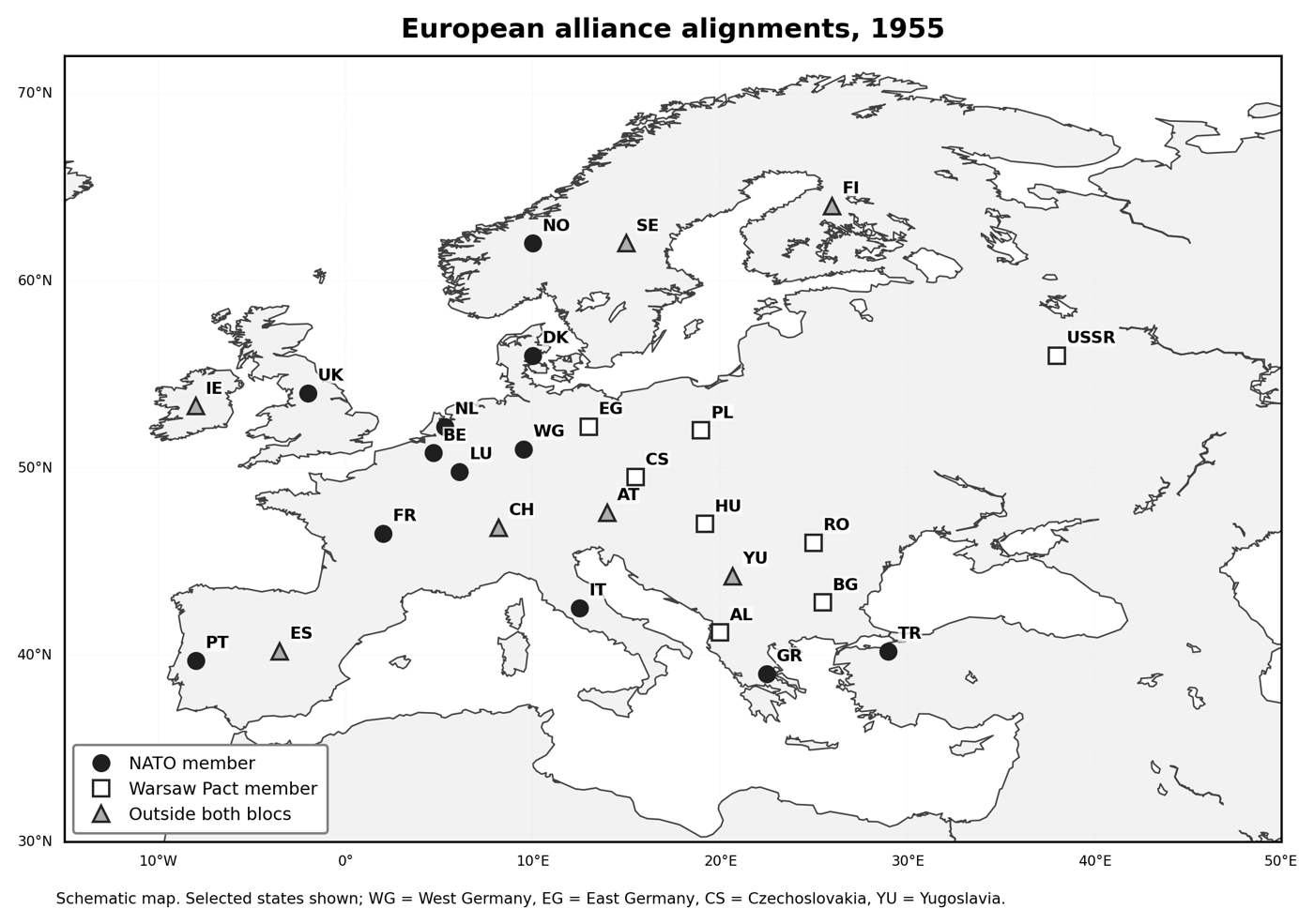
Question 17
- A. the disappearance of military alliances after World War II
- B. the division of much of Europe into rival Cold War security blocs
- C. the political unification of Europe under one government
- D. the end of Soviet influence in Eastern Europe
Question 18
- A. West Germany's admission to NATO
- B. the dissolution of NATO
- C. the end of the Soviet Union
- D. the beginning of European decolonization
Question 19
- A. every European state belonged to one of the two blocs
- B. Cold War rivalry strongly shaped Europe without producing perfectly uniform alliance membership
- C. neutrality disappeared after 1945
- D. Eastern and Western Europe had identical political systems
Stimulus 6 (Questions 20-22):
| Evidence 1: Finance and industrial investment |
|---|
| Industrial expansion encouraged new or enlarged financial institutions that pooled capital from many investors for railways, factories, mines, and other projects whose costs exceeded what most individual investors could supply alone. Constructed for practice; not an authentic historical quotation. |
| Evidence 2: Industrial cities |
|---|
| Rapid industrial urbanization produced dense working-class neighborhoods near factories while housing, sanitation, clean water, and transport infrastructure often struggled to keep pace with population growth. Constructed for practice; not an authentic historical quotation. |
| Evidence 3: Suez Canal |
|---|
| The Suez Canal opened in 1869, shortening the maritime route between Europe and the Indian Ocean. Its location increased Egypt's strategic importance to European commercial and imperial powers. Constructed for practice; not an authentic historical quotation. |
Question 20
- A. Industrial-era investment required no new financial institutions
- B. Investment remained limited entirely to individual wealthy investors acting alone
- C. Railways and factories required no capital investment
- D. Industrialization reorganized how large-scale ventures were financed, enabling investment beyond what individuals could manage alone
Question 21
- A. Urbanization produced no social or infrastructural consequences
- B. Cities remained unchanged despite industrial growth
- C. Factory-centered industrialization reshaped urban life in ways that created both new communities and new infrastructural challenges
- D. Working-class neighborhoods existed before industrialization began
Question 22
- A. Egypt had no strategic significance before or after 1869
- B. Infrastructure development could directly increase a region's strategic and imperial significance
- C. The Suez Canal had no connection to European imperial interest
- D. Strategic importance was unrelated to infrastructure
Stimulus 7 (Questions 23-25):
| Evidence 1: Berlin Conference |
|---|
| At the Berlin Conference of 1884-1885, European powers negotiated rules concerning territorial claims in Africa. African governments and peoples were not represented as equal participants in those negotiations. Constructed for practice; not an authentic historical quotation. |
| Evidence 2: Lalla Zaynab |
|---|
| In colonial Algeria in the 1890s, Lalla Zaynab used religious authority, property claims, petitions, and legal argument to resist French colonial encroachment. Constructed for practice; not an authentic historical quotation. |
| Evidence 3: Raw materials and manufactured imports |
|---|
| India, Egypt, and parts of Latin America increasingly supplied cotton, grain, minerals, and other raw materials to industrial markets while importing substantial quantities of manufactured goods. Constructed for practice; not an authentic historical quotation. |
Question 23
- A. African states and peoples participated fully in these negotiations
- B. No European negotiations over African territory occurred
- C. European territorial claims in Africa were determined through negotiations that excluded the affected African states and peoples
- D. African consent was required for this conference's decisions
Question 24
- A. The 1857 Indian Rebellion's armed uprising
- B. The Meiji Restoration
- C. The Battle of Adwa
- D. The Suez Canal's construction
Question 25
- A. These regions manufactured all their own goods domestically
- B. This trade pattern could discourage local industrial development even while deepening global economic integration
- C. Raw material export had no connection to industrial demand elsewhere
- D. This pattern occurred only after 1950
Stimulus 8 (Questions 26-28):
| Evidence 1: Treaty privileges in Qing China |
|---|
| Following military defeat, Qing China granted foreign powers treaty-port access, commercial concessions, and legal privileges that weakened state control over trade and law without converting all of China into a formal colony. Constructed for practice; not an authentic historical quotation. |
| Evidence 2: Drivers of migration |
|---|
| Population growth and land scarcity pushed many people to leave rural communities, while mines, plantations, railroads, factories, and expanding cities created new demand for labor across regional and international boundaries. Constructed for practice; not an authentic historical quotation. |
| Evidence 3: Remittance networks |
|---|
| Migrants frequently maintained ties to their places of origin by sending money, letters, information, and sometimes return migrants across borders, creating durable transnational networks. Constructed for practice; not an authentic historical quotation. |
Question 26
- A. Formal colonial annexation
- B. Complete state collapse with no continuing governance
- C. Total exclusion of foreign commercial interests
- D. Economic and legal influence exercised by foreign powers without formal territorial annexation
Question 27
- A. Multiple push and pull factors operating together to drive large-scale migration
- B. A single cause with no other contributing factor
- C. A pattern unconnected to industrial economic conditions
- D. A pattern limited entirely to one region
Question 28
- A. Migrants severed all connection to their regions of origin
- B. Remittance networks had no economic function
- C. Migrants maintained active transnational ties rather than severing connection to origin regions
- D. Only wealthy migrants maintained any connections abroad
Stimulus 9 (Questions 29-31):
| Evidence 1: Imperial collapse in the early twentieth century |
|---|
| Revolution, war, and internal political crisis contributed to the collapse or dismantling of the Russian and Ottoman imperial orders during and after World War I. Constructed for practice; not an authentic historical quotation. |
| Evidence 2: Rivalry before 1914 |
|---|
| Imperial competition, arms buildup, strategic planning, and alliance commitments increased distrust among major European powers before the assassination at Sarajevo. Constructed for practice; not an authentic historical quotation. |
| Evidence 3: World War I mobilization |
|---|
| More than one million Indian soldiers served the British war effort, while women across several combatant states expanded their work in industry, agriculture, transport, and nursing during World War I. Constructed for practice; not an authentic historical quotation. |
Question 29
- A. Older imperial orders could collapse under combined pressure from revolution, war, and internal crisis
- B. Only non-European empires experienced this kind of crisis
- C. The Russian and Ottoman empires remained stable throughout this period
- D. Imperial collapse had no connection to World War I
Question 30
- A. European powers experienced no tension before 1914
- B. Colonial and strategic competition contributed to conditions that made the 1914 crisis difficult to contain
- C. Colonial competition had no connection to the outbreak of war
- D. Tensions began only after the war started
Question 31
- A. World War I mobilized only male European soldiers
- B. Women played no role in World War I
- C. Colonial troops and women's labor were unrelated developments
- D. World War I's mobilization extended across colonial populations and gender roles simultaneously
Stimulus 10 (Questions 32-34):
| Evidence 1: New Economic Policy |
|---|
| Lenin's New Economic Policy, introduced in 1921, temporarily permitted limited private trade and small-scale market activity after revolution and civil war. Stalin later replaced this partial opening with centralized planning and forced collectivization. Constructed for practice; not an authentic historical quotation. |
| Evidence 2: Mandates after World War I |
|---|
| Former Ottoman territories were placed under British and French mandates. The system spoke of preparing peoples for self-government while leaving substantial administrative authority in foreign hands. Constructed for practice; not an authentic historical quotation. |
| Evidence 3: Collective security |
|---|
| The League of Nations was created after World War I to provide a forum for international cooperation and collective security. It lacked its own military force and ultimately failed to prevent major acts of aggression in the 1930s. Constructed for practice; not an authentic historical quotation. |
Question 32
- A. Soviet economic policy shifted significantly between different leaders within a relatively short period
- B. Soviet economic policy remained identical throughout this period
- C. Centralized planning existed before the New Economic Policy
- D. No economic policy change occurred in the Soviet Union
Question 33
- A. Self-determination was immediately and fully applied to these territories
- B. These territories became fully independent immediately after World War I
- C. The mandate system had no connection to later nationalist movements
- D. A documented contradiction between self-determination rhetoric and continued foreign control shaped colonized peoples' political responses
Question 34
- A. Successfully preventing any further German territorial expansion
- B. A policy that failed to prevent the escalation it was intended to avoid
- C. A policy adopted only after World War II had already begun
- D. A policy with no connection to preventing war
Stimulus 11 (Questions 35-37):
| Evidence 1: World War II home fronts |
|---|
| Governments rationed food and fuel, redirected factories toward military production, mobilized civilian labor, and recruited women into expanded industrial and service roles. The war therefore blurred the boundary between battlefield and home front. Constructed for practice; not an authentic historical quotation. |
| Evidence 2: Propaganda and exclusion |
|---|
| Nazi propaganda repeatedly portrayed Jews and other targeted groups as dangerous outsiders. Such messaging helped normalize exclusion and persecution before and during the Holocaust. Constructed for practice; not an authentic historical quotation. |
| Evidence 3: Wartime expansion of state power |
|---|
| Both world wars expanded government involvement in production, labor allocation, information, taxation, and social organization. Some institutions and expectations created during wartime persisted after fighting ended. Constructed for practice; not an authentic historical quotation. |
Question 35
- A. Civilian populations and economies were directly and extensively mobilized alongside military forces during World War II
- B. World War II affected only combatants on military fronts
- C. Women played no role in wartime economies
- D. Industrial production was unaffected by the war
Question 36
- A. Propaganda played no role in enabling mass atrocity
- B. The Holocaust occurred without any preceding ideological justification
- C. Deliberate ideological messaging helped normalize violence against targeted populations before and during its implementation
- D. Propaganda was used only after the atrocity had already occurred
Question 37
- A. Wartime government expansion ended completely once each war concluded
- B. Government control over economies had no connection to warfare
- C. This pattern applied only to defeated states
- D. World wars produced institutional changes in state power that persisted beyond the conflicts that produced them
Stimulus 12 (Questions 38-40):
| Evidence 1: Postwar division of Europe |
|---|
| After World War II, Soviet-backed governments consolidated in much of Eastern Europe while the United States and its allies supported reconstruction and political alignment in Western Europe. Constructed for practice; not an authentic historical quotation. |
| Evidence 2: Berlin Blockade and airlift |
|---|
| In 1948-1949, the Soviet Union blocked land access to the western sectors of Berlin. Western powers responded with a large airlift rather than direct military attack, turning Berlin into an early test of Cold War resolve. Constructed for practice; not an authentic historical quotation. |
| Evidence 3: Space race |
|---|
| American and Soviet achievements in rocketry, satellites, and human spaceflight became highly visible demonstrations of scientific capacity, military-related technology, and ideological prestige. Constructed for practice; not an authentic historical quotation. |
Question 38
- A. Europe remained politically unified after World War II
- B. Postwar Europe divided along lines connected to emerging superpower rivalry
- C. The Soviet Union had no influence in postwar Europe
- D. Western Europe rebuilt without any external involvement
Question 39
- A. Cold War tensions always led directly to military combat between superpowers
- B. No tension existed between the United States and Soviet Union in this period
- C. Berlin had no strategic significance during the Cold War
- D. Superpower rivalry could produce significant confrontation without direct military engagement between the superpowers themselves
Question 40
- A. Cold War competition extended into scientific and technological domains as a form of ideological prestige contest
- B. Cold War rivalry was expressed only through direct military conflict
- C. Science had no connection to Cold War politics
- D. Only one superpower engaged in scientific competition
Stimulus 13 (Questions 41-43): Adapted from Louis Dalrymple, "School Begins," Puck, January 25, 1899. The original cartoon depicts Uncle Sam as a teacher addressing figures labeled Cuba, Puerto Rico, Hawaii, and the Philippines during a period of rapid United States overseas expansion.
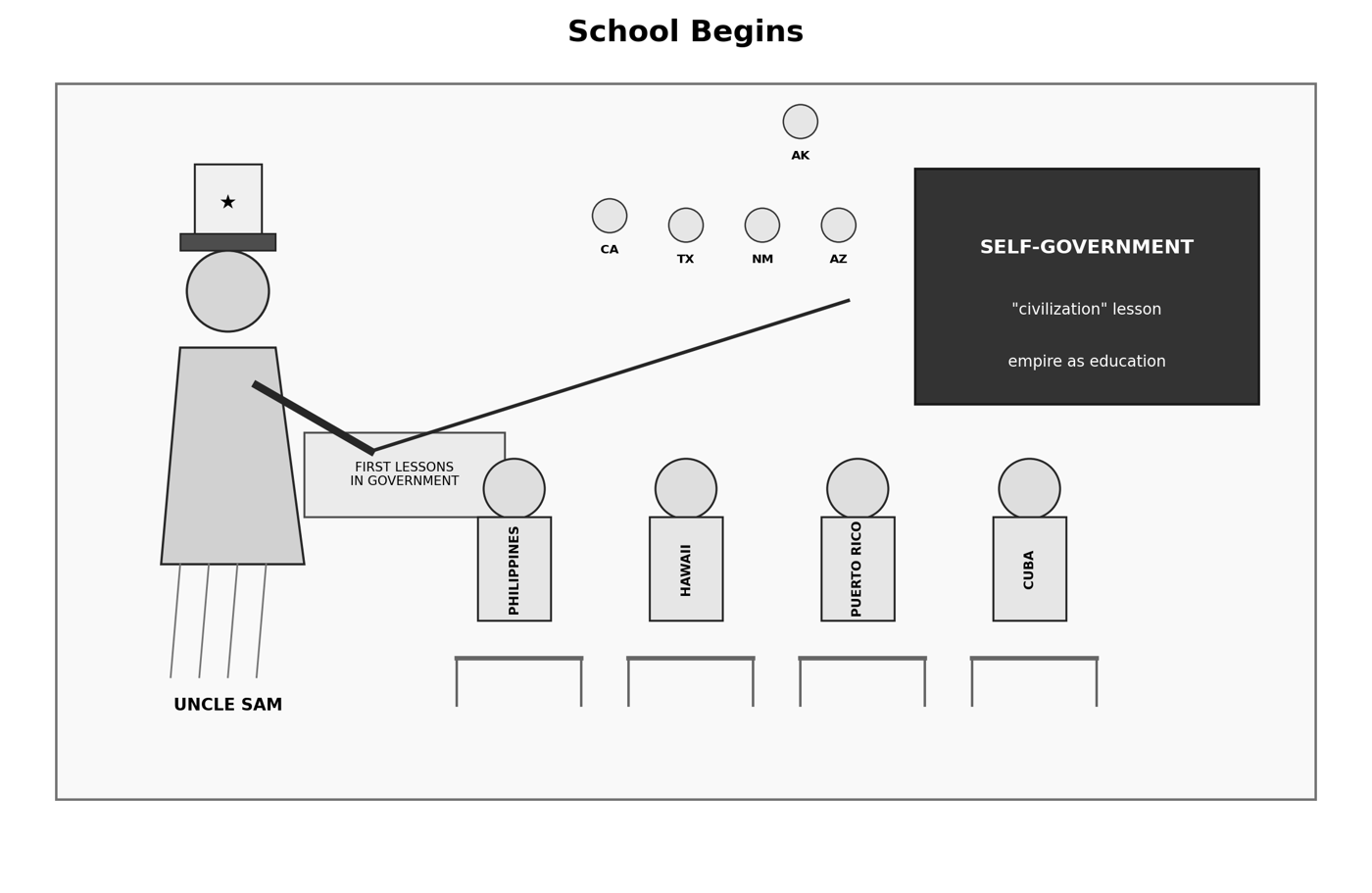
Question 41
- A. United States overseas expansion at the end of the nineteenth century
- B. Latin American independence from Spain in the early nineteenth century
- C. European decolonization after World War II
- D. the establishment of the League of Nations
Question 42
- A. Colonized peoples were already politically equal to imperial powers
- B. Imperial rule could be portrayed as a civilizing or educational mission
- C. Overseas expansion was unrelated to ideas about cultural hierarchy
- D. Imperial governments rejected claims of cultural superiority
Question 43
- A. relied only on arguments about access to raw materials
- B. could combine political expansion with paternalistic assumptions about colonized peoples
- C. had disappeared by the end of the nineteenth century
- D. was accepted without criticism throughout colonized societies
Stimulus 14 (Questions 44-46):
| Evidence 1: Social movements after 1945 |
|---|
| Feminist, student, civil-rights, and labor movements challenged different forms of gender inequality, racial hierarchy, authoritarianism, and traditional social norms across multiple countries in the decades after World War II. Constructed for practice; not an authentic historical quotation. |
| Evidence 2: Deng-era reform |
|---|
| From the late 1970s, Chinese economic reforms expanded market activity, foreign investment, and global trade while the Communist Party retained political control. Constructed for practice; not an authentic historical quotation. |
| Evidence 3: Digital communication |
|---|
| Internet and mobile communication networks made long-distance exchange of information nearly instantaneous and supported new forms of commerce, political organizing, social interaction, and cultural circulation. Constructed for practice; not an authentic historical quotation. |
Question 44
- A. Social movements challenging established hierarchies were confined to a single country
- B. No social movements existed during this period
- C. All these movements pursued identical goals
- D. Movements challenging established social and political hierarchies emerged across multiple countries during this period, addressing different specific forms of inequality
Question 45
- A. Economic liberalization could proceed without corresponding political liberalization
- B. Economic liberalization always requires corresponding political liberalization
- C. China rejected all market-oriented economic activity during this period
- D. Communist Party control ended once economic reforms began
Question 46
- A. Communication speed had no connection to global economic or political activity
- B. Digital networks compressed global communication in ways that enabled new forms of commerce and coordination
- C. Digital communication had no effect on organizing or coordination
- D. This technology existed before 1900
Stimulus 15 (Questions 47-49):
| Evidence 1: Environmental politics |
|---|
| Public concern over air and water pollution, nuclear risk, toxic waste, and deforestation contributed to environmental movements and new regulations in many countries during the late twentieth century. Constructed for practice; not an authentic historical quotation. |
| Evidence 2: Green Revolution |
|---|
| High-yield crop varieties, irrigation, fertilizers, and related agricultural technologies increased food production in many parts of Asia and Latin America, although access and environmental effects were uneven. Constructed for practice; not an authentic historical quotation. |
| Evidence 3: Multinational corporations |
|---|
| Large corporations increasingly organized production, sourcing, investment, and finance across national borders, placing different stages of a single supply chain in multiple countries. Constructed for practice; not an authentic historical quotation. |
Question 47
- A. A complete absence of environmental problems
- B. Government policies with no connection to environmental conditions
- C. Increasingly visible and politically salient environmental conditions
- D. Declining industrial production
Question 48
- A. This period's environmental story involved only damage, with no deliberate technological intervention to increase production
- B. Agricultural production decreased during this period
- C. Irrigation technology had no connection to food production
- D. This period's environmental story involved deliberate technological intervention to increase production, alongside environmental damage
Question 49
- A. Corporations operated entirely within single national economies
- B. Large firms increasingly structured their operations across national borders, taking advantage of reduced trade barriers
- C. International trade barriers increased during this period
- D. Multinational corporations had no connection to global supply chains
Stimulus 16 (Questions 50-52):
| Evidence 1: End of apartheid |
|---|
| Domestic resistance, strikes, political organizing, international activism, sanctions, and negotiation together contributed to the dismantling of apartheid and the establishment of multiracial elections in South Africa in 1994. Constructed for practice; not an authentic historical quotation. |
| Evidence 2: Global media and sport |
|---|
| International sporting competitions and media events created shared global audiences while athletes, teams, and broadcasts continued to express national and local identities. Constructed for practice; not an authentic historical quotation. |
| Evidence 3: State resistance to globalization |
|---|
| Governments have continued to use tariffs, local-content requirements, border controls, subsidies, and cultural policies to limit or shape foreign economic and cultural influence even as global exchange has expanded. Constructed for practice; not an authentic historical quotation. |
Question 50
- A. Apartheid ended through domestic resistance alone
- B. Apartheid ended through international pressure alone
- C. Ending apartheid required sustained action operating both inside and outside South Africa
- D. Apartheid ended without any negotiation process
Question 51
- A. Global cultural connection and national or local identity operated as opposing forces that could not coexist
- B. International sports events had no connection to national identity
- C. Only local, not global, audiences attended these events
- D. Global cultural connection and national or local identity could operate together rather than as opposing forces
Question 52
- A. Taking economic, political, and cultural forms simultaneously rather than one single unified form
- B. Taking a single unified form across all states and movements
- C. Occurring only in wealthy industrialized states
- D. Having no connection to globalization
Stimulus 17 (Questions 53-55):
| Evidence 1: United Nations and decolonization |
|---|
| United Nations bodies and resolutions gave anti-colonial movements diplomatic forums and a language of self-determination that they could use in pursuing their own political objectives. Constructed for practice; not an authentic historical quotation. |
| Evidence 2: Persistent state authority |
|---|
| Even as global markets and communication networks expanded, states continued to regulate citizenship, borders, currencies, taxation, and trade policy. Constructed for practice; not an authentic historical quotation. |
| Evidence 3: Uneven globalization |
|---|
| Global integration has generated new markets, technologies, and opportunities, but its benefits and costs have been distributed unevenly among countries and among social groups within the same country. Constructed for practice; not an authentic historical quotation. |
Question 53
- A. International institutions operated entirely apart from decolonization, with no connection to anti-colonial movements
- B. The United Nations opposed all decolonization movements
- C. International institutions actively supported specific anti-colonial political movements within the broader decolonization process
- D. Anti-colonial movements never engaged with international institutions
Question 54
- A. States lost all regulatory capacity as globalization intensified
- B. Global integration eliminated the need for state regulation entirely
- C. States never regulated borders or currencies at any point
- D. State control over specific domains persisted even as global integration intensified around and through these same states
Question 55
- A. Globalization produced new opportunities for some populations while leaving others facing continued or intensified disadvantage
- B. Global integration benefited all countries and populations equally
- C. Global integration had no measurable economic effects
- D. Only wealthy countries experienced any effects from global integration
Section I, Part B: Short-Answer Questions (3 questions, 40 minutes)
SAQ 1: Constructed secondary-source-style practice text (period: 1450-1750; not a published historian's interpretation). Source: a constructed historian's summary. "Land-based empires in this period legitimized their rule through varied combinations of military conquest, religious identity, and incorporation of existing local elites into imperial service."
a) Identify one land-based empire from this period.
b) Describe one specific method that empire used to legitimize its rule.
c) Explain how a different land-based empire from this period used a distinct combination of these methods.
SAQ 2: Constructed primary-source-style practice text (period: 1900-1950; not an authentic historical document). Source: a constructed excerpt attributed to a League of Nations mandate commissioner, c. 1925. "Local political organizing has intensified in the territories under our supervision, with petitions and formal complaints citing the gap between the self-determination we promised and the administrative control we continue to exercise."
a) Identify the specific gap this source describes.
b) Describe one consequence of this gap mentioned in the source.
c) Explain how this gap connects to nationalist movements covered elsewhere in this period.
SAQ 3: Non-text source (period: 1950-present).
| Year | Development |
|---|---|
| 1961 | First summit of the Non-Aligned Movement, Belgrade |
| 1974 | UN General Assembly adopts the Declaration on the Establishment of a New International Economic Order |
a) Identify the general relationship shown between these two dates.
b) Describe one factor that explains why over a decade separates these two developments.
c) Explain how this sequence demonstrates a shift from political to economic goals among postcolonial states.
Section II: Document-Based Question (60 minutes recommended, including
15-minute reading period)
Prompt: Evaluate the extent to which resistance movements, rather than negotiation alone, shaped the terms under which colonial or imperial control ended between 1850 and 2000.
Document 1. Constructed primary-source-style practice text, attributed to a British colonial official assessing the 1857 Indian Rebellion's aftermath, c. 1860: "The uprising has forced changes in how we govern this territory that negotiation alone would never have produced; direct Crown authority now replaces what the Company once managed loosely."
Document 2. Constructed primary-source-style practice text, attributed to an Ethiopian military commander addressing troops before the Battle of Adwa, 1896: "We do not negotiate our sovereignty from a position of weakness; we defend it, and only after defending it will any negotiation occur on terms we can accept."
Document 3. Constructed primary-source-style practice text, attributed to an African National Congress statement on anti-apartheid strategy, c. 1960: "Petitions alone have brought decades of promises without change; we now pursue every available means, including organized resistance, alongside continued negotiation."
Document 4. Constructed primary-source-style practice text, attributed to a French colonial administrator describing negotiations in West Africa, c. 1958: "We offer a path to self-government precisely because continued resistance elsewhere has made the cost of continued direct rule too high to sustain."
Document 5. Constructed primary-source-style practice text, attributed to a Vietnamese nationalist leader, c. 1954: "Diplomacy secured what decades of petitions could not, but diplomacy alone did not bring the other side to the table; years of armed struggle did that first."
Document 6. Constructed primary-source-style practice text, attributed to a British official reflecting on Kenyan independence negotiations, c. 1963: "Armed resistance in the countryside changed the calculation in London far more than any delegation's formal request ever did."
Document 7. Constructed primary-source-style practice text, attributed to a South African government minister announcing negotiations to end apartheid, c. 1990: "Continued instability has made clear that a negotiated transition, however difficult, now serves our interests better than continued confrontation."
Section II: Long Essay Question (40 minutes recommended)
Introductory statement: After World War II, states created a number of new international institutions intended to promote monetary stability, trade cooperation, collective security, and global health, among other stated goals. These institutions have operated with varying degrees of authority and success across different regions and different areas of policy in the decades since their founding.
Prompt: Evaluate the extent to which international institutions established in the period after World War II succeeded in their stated goals of promoting global cooperation and stability.
90-second evidence dump: UN founding 1945, diplomacy/decolonization support. Bretton Woods/IMF/World Bank, monetary stability goal. GATT/WTO, trade liberalization goal. WHO, smallpox eradication success vs HIV/AIDS limits. Non-Aligned Movement critique of unequal structures. Cold War bipolarity limiting UN Security Council effectiveness in some cases.
Practice Exam 2: Answers and Explanations
Section I, Part A: Multiple Choice
Show the answers and explanations
1. D. A, B, and C each contradict this passage's explicit description of fragmentation alongside continued connection.
2. C. A, B, and D describe unrelated processes; only C shares the same broad religious-political context while differing sharply in method.
3. B. A, C, and D each misstate the actual chronological relationship and causal direction this evidence establishes.
4. A. B, C, and D each contradict this passage's explicit description of segmented, relay-based trade organization.
5. B. A, C, and D each describe an extreme this passage's actual, blended arrangement does not support.
6. C. A, B, and D each misstate this network's actual, bidirectional, resource-complementary structure.
7. B. A, C, and D each contradict this passage's explicit description of knowledge transfer via these networks.
8. A. B, C, and D each contradict specific documented details of this battle and its outcome.
9. C. A, B, and D each misstate this reform's documented function in stabilizing Mughal rule.
10. A. B, C, and D each contradict this passage's explicit connection between religious promotion and political rivalry.
11. B. A, C, and D each misstate the actual distinction this passage draws between two related but separate technological functions.
12. C. A, B, and D each contradict this passage's explicit description of animal-driven transformation.
13. D. A, B, and C do not capture the actual comparative dimension, degree of political-military authority, this passage's contrast addresses.
14. C. A, B, and D each misstate mercantilism's actual documented regulatory goal.
15. B. A, C, and D each contradict this passage's explicit description of uneven, non-simultaneous change.
16. A. B, C, and D each contradict this passage's explicit description of expanding rights debates.
17. B. A, C, and D each contradict what the map actually shows about divided alliance blocs in 1955.
18. A. B, C, and D each misstate or postdate the actual documented trigger for the Warsaw Pact's founding.
19. B. A, C, and D each contradict what the map directly shows about nonaligned states persisting within Cold War Europe.
20. D. A, B, and C each contradict this passage's explicit description of pooled-capital financial innovation.
21. C. A, B, and D each contradict this passage's documented description of urban transformation and strain.
22. B. A, C, and D each contradict this passage's explicit description of infrastructure-driven strategic significance.
23. C. A, B, and D each contradict this conference's documented exclusionary character.
24. A. B, C, and D describe unrelated developments; only A offers a direct contrast in resistance method, armed versus institutional.
25. B. A, C, and D each contradict this passage's documented economic pattern and its developmental consequence.
26. D. A, B, and C each misstate this documented informal-empire arrangement.
27. A. B, C, and D each misstate the documented, multi-factor character of this migration pattern.
28. C. A, B, and D each contradict this passage's explicit description of sustained transnational connection.
29. A. B, C, and D each contradict this passage's documented description of multi-factor imperial collapse.
30. B. A, C, and D each contradict this passage's documented connection between prewar rivalry and the war's escalation.
31. D. A, B, and C each contradict this passage's documented, multidimensional mobilization pattern.
32. A. B, C, and D each contradict this passage's documented policy sequence and change.
33. D. A, B, and C each contradict this arrangement's documented contradiction and its political consequences.
34. B. A, C, and D each contradict this policy's documented intent and ultimate failure.
35. A. B, C, and D each contradict this passage's documented description of extensive civilian mobilization.
36. C. A, B, and D each contradict this passage's documented description of propaganda's normalizing function.
37. D. A, B, and C each contradict this passage's documented description of lasting institutional change.
38. B. A, C, and D each contradict this passage's documented description of superpower-aligned postwar division.
39. D. A, B, and C each contradict this episode's documented, non-combat character and its significance.
40. A. B, C, and D each contradict this passage's documented description of science as a Cold War prestige arena.
41. A. B, C, and D each place this visual in the wrong period or region relative to its actual documented context.
42. B. A, C, and D each contradict what the classroom metaphor is actually designed to convey.
43. B. A, C, and D each misstate what this visual demonstrates about the combination of expansion and paternalism.
44. D. A, B, and C each contradict this passage's documented, multi-country and multi-issue description.
45. A. B, C, and D each contradict this passage's documented description of economic reform without political change.
46. B. A, C, and D each contradict this passage's documented description of digital communication's transformative effect.
47. C. A, B, and D each misstate the actual, condition-driven origin of this activism.
48. D. A, B, and C each misstate or oversimplify this period's documented, mixed environmental and agricultural history.
49. B. A, C, and D each contradict this passage's documented description of cross-border corporate organization.
50. C. A, B, and D each isolate a single factor this passage shows operated in combination with others.
51. D. A, B, and C each contradict this passage's documented description of simultaneous global and local expression.
52. A. B, C, and D each understate or misstate the documented range of forms this resistance took.
53. C. A, B, and D each contradict this passage's documented description of institutional support for these movements.
54. D. A, B, and C each contradict this passage's documented description of persistent state regulatory capacity.
55. A. B, C, and D each contradict this passage's documented description of uneven distribution within and among countries.
Section I, Part B: Short-Answer Questions
Scoring notes. SAQ 1(c): an acceptable answer names a different empire (Ottoman, Safavid, or Mughal) and states its distinct combination of methods, not a restated label. SAQ 2(c): requires connecting the mandate system's specific contradiction to a named nationalist movement's documented response, not a generic statement. SAQ 3(c): requires explicitly stating that the Non-Aligned Movement's initial political diplomacy preceded and enabled a later, more specifically economic agenda, not simply restating both dates.
Section II: Document-Based Question
Scoring Walkthrough
Thesis (1 pt). Resistance movements, whether armed or organized nonviolent action, frequently created the conditions that made negotiation possible or necessary, meaning negotiation and resistance functioned together rather than as alternative paths to ending colonial or imperial control.
Contextualization (1 pt). Situate broadly: the balance between resistance and negotiation varied by period and region, but this pattern recurred across very different colonial relationships from the mid- nineteenth through late twentieth centuries.
Evidence-address-topic (1 pt, 3+ docs). Accurately describing Documents 1, 3, and 6's resistance-to-negotiation connections meets this threshold.
Evidence-support-argument (1 pt, 4+ docs). For Document 4: A French official directly citing the rising cost of resistance elsewhere as the reason for offering self-government demonstrates that resistance in one location could shift a colonial power's calculations even in negotiations occurring in a different specific territory.
Sourcing (1 pt, 2+ docs). For Document 7: A South African government minister announcing negotiations in 1990, after decades of resistance and sanctions, speaks from a position of acknowledging that continued confrontation had become costlier than negotiation, making this source particularly valuable for showing the government's own recognition of resistance's role in shifting its position.
Outside evidence (1 pt). An acceptable example: Algerian nationalists' sustained armed struggle against French rule, ending in independence in 1962, extends this argument to a case where prolonged resistance directly forced the actual termination of colonial control, not merely a change in how that control was administered, showing the same resistance-driven pattern operating at its strongest outcome.
Complexity (1 pt). Documents 2 and 7 reveal a significant contrast in outcome despite a shared pattern: Ethiopian resistance prevented conquest outright, while South African resistance eventually produced negotiated transition rather than outright victory, showing that resistance's role in shaping outcomes varied considerably even when the underlying dynamic, resistance shifting a dominant power's calculations, remained similar.
Section II: Long Essay Question
Scoring Walkthrough
Thesis (1 pt). International institutions established in the period after World War II achieved significant success in specific, well-defined goals, such as coordinated disease eradication, while achieving more limited or contested success in broader goals such as equitable global economic development, showing that institutional success varied considerably by the specific objective and population involved.
Contextualization (1 pt). Situate broadly: these institutions emerged from a specific postwar moment shaped by the experience of global conflict and a desire to prevent its recurrence, but operated afterward within continuing Cold War rivalry and postcolonial economic inequality.
Evidence-provide (1 pt, 2+). Smallpox eradication, certified complete in 1980 through WHO coordination; Non-Aligned Movement's critique of unequal global economic structures within Bretton Woods-derived institutions.
Evidence-use (1 pt). Smallpox eradication's near-universal success demonstrates that international coordination could achieve a well-defined, technically bounded goal effectively, while the persistence of the Non-Aligned critique decades after Bretton Woods institutions were established demonstrates that broader, more politically contested goals proved considerably harder to achieve through the same institutional framework.
Reasoning (1 pt). Structure explicitly around this contrast: technically bounded cooperation goals versus broader, politically contested equity goals, with a stated reason for the difference (clearer success metrics and fewer competing interests in disease eradication versus genuinely conflicting interests in global economic structure).
Complexity (1 pt). HIV/AIDS's demonstrated limits, occurring within the same broader international public-health framework that achieved smallpox eradication, complicates a simple success-or-failure judgment about these institutions, showing that institutional capacity for cooperation could vary significantly even within a single broad policy domain depending on the specific disease, resources, and political will involved.
Back Matter
Back matter
Page references below point to the first substantial discussion of each term and to selected later uses in practice and review.
Name and term index
Adwa, Battle of. 99, 175, 189, 210, 221.
Akbar. 48–49, 66, 173–174, 180–182, 205.
Apartheid. 137, 161, 219.
Berlin Conference. 99–100, 109, 113, 173, 210.
Berlin Wall. 138, 146, 174, 176, 194.
Bretton Woods conference. 153, 197, 200–201, 222, 226.
Çaldıran, Battle of. 47–48, 77, 173, 175, 182.
Columbian Exchange. 36, 62–63, 69–70, 183–184, 206.
Delhi Sultanate. 20–21, 48, 174–175, 178–179, 204–205.
Devshirme system. 54, 58–59.
Enlightenment. 79–80, 94, 172, 186, 208.
GATT / World Trade Organization. 153, 176, 195, 197, 222.
Great Leap Forward. 134–135, 174.
Haitian Revolution. 87–88, 94, 173, 186.
Iwakura Mission. 81, 114, 173, 175, 187.
Mandela, Nelson. 137, 147–149, 154, 161, 174.
Mansa Musa. 22, 44–45, 173, 175, 177.
Manila galleon system. 64, 70–71, 75, 185, 207.
Mongol Empire. 19, 177–180, 183, 198, 204–205.
NATO / Warsaw Pact. 133, 174–176, 192–193, 196, 208.
Non-Aligned Movement. 133, 174, 197, 221–222, 225.
Opium War, First. 83, 109, 112–113, 173, 189.
Safavid Empire. 47–54, 181–182, 198, 205–206, 225.
Sarajevo assassination. 115–116, 148, 174–175, 191, 212.
Smallpox eradication. 158, 175, 194, 196, 226.
Song dynasty. 19, 38, 173.
Suez Canal. 82, 113, 173, 175, 209–210.
Yuan dynasty. 19, 33–34, 38, 43, 173.
Evidence index: claims and examples
This index groups the book's recurring evidence by the argument or comparison it most often supports, for quick retrieval when planning an essay or short-answer response.
Administrative selection. Song examinations; Ottoman devshirme; Mughal incorporation of Rajput elites; Qing Eight Banner system.
Commercial power. Mali's gold trade; Great Zimbabwe; the Manila galleon system; the Suez Canal.
Industrialization strategy. Britain's coal and private capital; Meiji Japan's state-directed investment; Sergei Witte's Russian railway policy.
Imperial resistance. The Indian Rebellion of 1857; Lalla Zaynab's petitions; the Battle of Adwa; the Mahdist Wars.
Cold War chronology. NATO's founding in 1949; the Warsaw Pact's founding in 1955; the Berlin Wall's construction in 1961 and fall in 1989; German reunification in 1990; the Soviet Union's dissolution in 1991.
Global cooperation and its limits. The Bretton Woods institutions; GATT and the World Trade Organization; the World Health Organization's smallpox campaign; the Non-Aligned Movement.
Source Notes
The following sources were consulted in building this manuscript's historical content. All are used for factual verification; no source text or image is reproduced in this book beyond original, clearly labeled constructed documents used for DBQ and SAQ practice.
OpenStax World History, Volume 1 (openstax.org/books/world-history-volume-1): sections on Song China and the steppe peoples; medieval sub-Saharan Africa; East-West interactions in the early Middle Ages; Asia, North Africa, and Europe in the early fourteenth century; the Mongol Empire fragments; the Black Death from East to West; culture and society in medieval Africa; North Africa's Mediterranean and trans-Saharan connections.
OpenStax World History, Volume 2 (openstax.org/books/world-history-volume-2): sections spanning a connected Islamic world; the Ottoman and Safavid Empires; crossing the Atlantic; the Atlantic slave trade; colonial empires; capitalism and the First Industrial Revolution; revolutions in America, France, and Haiti; revolution for whom (Latin America); nationalism, liberalism, conservatism, and the political order; the Second Industrial Revolution; coerced and semicoerced labor; communities in diaspora; life in the industrial city; regulation, reform, and revolutionary ideologies; motives and means of imperialism; exploitation and resistance; the rise of a global economy; alliances, expansion, and conflict; total war; an unstable peace; the formation of the Soviet Union; the Great Depression; theaters of war; keeping the home fires burning; the Cold War begins; the spread of communism; global tensions and decolonization; resistance, civil rights, and democracy; a new world order; the Non-Aligned Movement; a global economy; science and technology for today's world.
Metropolitan Museum of Art, Heilbrunn Timeline of Art History (82nd-and-fifth.metmuseum.org): entries on the Ottoman Empire, the Safavid Empire, the Mughal Empire, Mesoamerica, the Andes, and Meiji-era Japan.
National Archives (UK) (nationalarchives.gov.uk): materials on Indian service in the First World War.
Library of Congress (loc.gov): materials on immigration to the United States, 1851-1900.
International Monetary Fund (imf.org): institutional history timeline.
College Board (apcentral.collegeboard.org): AP World History: Modern Course and Exam Description, effective Fall 2026; AP History Exam Updates for 2027; current exam specification and course audit requirements; released FRQs, scoring guidelines, and Chief Reader reports for 2023-2026.
Rights and Credits
All constructed DBQ, SAQ, and multiple-choice practice passages in this book were written for instructional use. When a constructed passage is attributed to a historical role, the attribution identifies an invented practice persona consistent with the period. It is not a verified quotation from a named historical individual. Authentic historical sources and public-domain visual adaptations are identified separately by creator, work, and date.
Visual-source practice includes original schematic maps created for this book and redrawn adaptations of public-domain historical cartoons. The Rhodes Colossus practice visual is adapted from Edward Linley Sambourne, Punch, December 10, 1892. The School Begins practice visual is adapted from Louis Dalrymple, Puck, January 25, 1899; the Library of Congress record lists no known restrictions on publication. The adaptations were redrawn for print legibility and are not facsimile reproductions.
This book was developed using the AP World History: Modern Course and Exam Description effective Fall 2026 and the College Board's current exam format update as controlling authorities for official content, skills, and exam architecture. AP® and Advanced Placement® are trademarks owned by the College Board, which was not involved in the production of, and does not endorse, this book.