AP World History study guide · Chapter 3
Unit 1: State Building and Belief Systems, c. 1200–1450
State building and belief systems, c. 1200-1450
Song China: examinations, commerce, and Neo-Confucianism
Around 1200, the Song dynasty had governed China since 960, and its approach to administration had already shaped how the region would be ruled for centuries afterward. Song rulers relied on a civilian bureaucracy staffed through competitive written examinations grounded in Confucian texts, rather than on hereditary aristocracy alone. Passing these examinations gave scholar-officials access to government positions, which tied political power to education in a way that persisted well beyond the Song period itself.
That system did not operate in isolation from economic change. Song China saw major population growth, expanding cities, and high levels of commercial activity, supported by advances in agriculture, iron production, and printing. Markets, currency use, and long-distance trade within China expanded alongside the examination system, so a government staffed by Confucian-trained officials was also administering one of the most commercially active societies in the world at the time.
Confucian ideas were not static during this period either. Neo-Confucian thought, developed and spread during the Song era, reinforced hierarchical relationships within the family and society while responding to the influence of Buddhism and Daoism, which had both gained ground in China in earlier centuries. Neo-Confucianism reasserted a social order built around defined roles: ruler and subject, father and son, husband and wife, while absorbing certain ideas about self-cultivation that Buddhist and Daoist thought had emphasized.
Use this evidence. A civilian bureaucracy selected through Confucian examinations demonstrates a state that tied administrative legitimacy to education rather than birth alone. Commercial and urban growth during the same period demonstrates that state capacity and economic dynamism were not opposed, a pairing worth comparing later to other empires in this unit. Neo-Confucianism demonstrates how a belief system can reinforce a social hierarchy while still absorbing outside influence.
Chronology check. The Song dynasty ran from 960 to 1279, so its governance and commercial patterns describe China before and slightly overlapping the start of this unit's period, not after 1450. Kublai Khan proclaimed the Yuan dynasty in 1271, and Mongol forces completed the conquest of the Southern Song in 1279, ending Song rule; these are two distinct dates, not one event. Song, Yuan, and Ming institutions should not be treated as interchangeable, though some administrative and commercial practices continued in modified form after conquest rather than disappearing outright.
Song China's influence extended well beyond its own borders and its own bureaucracy. Neighboring East Asian states adapted Chinese political and religious ideas without becoming identical societies. Korean states drew on Confucian political thought and examination-based administrative models while maintaining their own distinct institutions. Japanese elites borrowed Chinese writing systems, administrative concepts, and Buddhist traditions while developing separate political structures suited to their own context. Vietnam likewise drew on Chinese administrative and literary traditions while preserving a distinct political identity. Buddhism itself remained religiously diverse during this spread: Mahayana traditions held particular influence in China, Korea, and Japan, illustrating that a belief system could spread widely across a region without producing uniform practice everywhere it took root.
Use this evidence. Korean and Japanese adaptation of Chinese Confucian and Buddhist traditions demonstrates cultural diffusion that produced local modification rather than exact replication, a pattern distinct from direct political control.
Dar al-Islam: political fragmentation and shared religious networks
By 1200, no single ruler governed the Islamic world. After the political decline of Abbasid central authority, Dar al-Islam was governed by multiple regional states and dynasties, even as a shared religious and legal tradition continued to connect Muslim societies across those political boundaries. Political fragmentation and cultural connection operated at the same time, not as contradictions.
Turkic Muslim rulers established the Delhi Sultanate over much of northern India during this period, governing a large non-Muslim population under a Muslim ruling class. Sufism, a mystical tradition within Islam, spread alongside trade and missionary activity, often connecting with local practices in ways that helped Islam take root in new regions without requiring one centralized religious authority to direct that expansion.
Use this evidence. The Delhi Sultanate demonstrates a Muslim state governing a religiously diverse population, a pattern worth comparing to other states in this unit that also ruled over plural societies. Sufism's role in religious diffusion demonstrates that political unity is not a requirement for cultural or religious connection across a wide region.
Political fragmentation across Dar al-Islam took multiple concrete forms beyond the broad decline of Abbasid authority. The Seljuk dynasty and, later, the Mamluk sultanate based in Egypt were separate Muslim-ruled states that governed significant territory without unified political authority over Dar al-Islam as a whole, illustrating that "the Islamic world" during this period meant a connected religious and cultural sphere containing many distinct governments, not one empire. Political division did not stop intellectual exchange. Muslim scholars preserved, translated, and extended earlier Greek philosophical and scientific texts, and continued original work in mathematics, astronomy, and medicine, producing knowledge that circulated across Dar al-Islam's connected scholarly networks and, through contact zones including Muslim-ruled Iberia, eventually reached and influenced intellectual life in western Europe.
Use this evidence. The Seljuk and Mamluk states demonstrate that political fragmentation within Dar al-Islam involved multiple distinct governments, not simply a single empire in decline. Islamic intellectual transmission demonstrates that exchange across this period moved knowledge, not only goods or religious practice.
South and Southeast Asia: Hindu, Buddhist, and Islamic states
The Delhi Sultanate did more than establish Muslim political rule in northern India. It created a durable state that governed Hindu and other non-Muslim communities without erasing their religious or social institutions, producing a plural society under a single political authority. South Asia during this period was not a single religious or political story, however. The Vijayanagara Empire, founded in 1336 by the brothers Harihara and Bukka in the Deccan region of southern India, became a major Hindu-ruled state that resisted Muslim sultanates militarily while itself becoming a significant center of Hindu culture, temple architecture, and regional trade. Its existence alongside the Delhi Sultanate demonstrates that Hindu and Muslim political authority coexisted and competed within the same broad region during this period, not that one replaced the other.
Southeast Asia developed political authority through a similarly layered combination of Hindu, Buddhist, and, increasingly, Islamic influence. The Khmer Empire, centered at Angkor, used monumental temple complexes and large-scale water-management infrastructure to support a political and religious authority blending Hindu and Buddhist traditions. In maritime Southeast Asia, the Majapahit state linked political power to control over regional trade and a court culture drawing on both Hindu and Buddhist practice. Theravada Buddhism expanded significantly across parts of mainland Southeast Asia during this period, and Buddhist monastic institutions remained important centers of religious and social life independent of any single ruling dynasty. Islam expanded into parts of maritime Southeast Asia, including Sumatra, largely through merchant networks and port cities rather than conquest, adding a third major tradition to a region already shaped by Hindu and Buddhist state formation rather than replacing what existed before it. Ports across South and Southeast Asia grew by linking regional production, such as textiles and spices, to the wider Indian Ocean trading world.
Use this evidence. Vijayanagara demonstrates a Hindu state directly contesting Muslim political expansion in South Asia, a useful comparison to the Delhi Sultanate on the dimension of religious legitimacy. Angkor and Majapahit demonstrate that Southeast Asian states built authority through Hindu-Buddhist religious and monumental traditions well before Islam's later arrival in the region, and the spread of Islam through Southeast Asian ports demonstrates religious change driven by commercial contact layered onto, rather than erasing, existing traditions.
Mexica and Inca rule: tribute, labor, and conquest
In the Americas, large states organized political power without the livestock-based agriculture or wheeled transport common in Afro-Eurasia. The Mexica built a tribute-based empire centered on the city of Tenochtitlan, expanding through military conquest and alliances that required subordinate states to provide goods, labor, and tribute rather than direct administrative absorption. Further south, the Inca expanded outward from Cuzco through military conquest, an extensive road network, mandatory labor obligations known as mit'a, and provincial administration that integrated conquered populations into a centralized system.
Both states depended on intensive, environmentally adapted agriculture to support large populations, including raised-field and terrace farming systems suited to the specific landscapes they controlled.
Use this evidence. Mexica tribute demands and Inca labor obligations demonstrate two different methods of incorporating conquered populations into a single state, a contrast worth returning to when comparing land-based empires later in this book.
American political organization was not limited to these two large empires. In Mesoamerica, Maya political centers persisted as separate city-states rather than a single unified empire, illustrating a different, more decentralized model of political organization within the same broad region as the Mexica. Farther north, Cahokia, located near the Mississippi River, had developed into a major Mississippian urban and ceremonial center, with large earthen mounds and a substantial surrounding population, demonstrating that large-scale political and social organization in the Americas extended well beyond Mesoamerica and the Andes.
Use this evidence. Maya city-states demonstrate that Mesoamerican political organization included decentralized models alongside the Mexica's centralized tribute empire. Cahokia demonstrates that large-scale urban and ceremonial political organization in the Americas was not limited to the regions that later produced the Mexica and Inca empires.
African states: trade, religious legitimacy, and political power
Political power in parts of Africa during this period grew directly out of control over trade. Mali's rulers drew wealth and political influence from control over gold-producing regions and the trans-Saharan trade routes that carried that gold north in exchange for salt and other goods. Mansa Musa's pilgrimage to Mecca in 1324 to 1325 displayed Mali's wealth publicly and linked the empire visibly to the wider Islamic commercial and scholarly world. Further south and east, Great Zimbabwe grew as a political and commercial center, connected through interior trade networks to Indian Ocean commerce.
Use this evidence. Mali's control over gold and trade routes demonstrates how commercial control could generate political authority without requiring the bureaucratic examination systems used in Song China, a useful comparison point for this unit's synthesis.
Chronology check. Mansa Musa's pilgrimage occurred in 1324 to 1325, after Mali's earlier consolidation of power and well before the later rise of Songhai as the dominant power in the region. Placing this event in the 1400s or 1500s misplaces the evidence by decades to centuries depending on how far forward it is placed, and attributing it to Songhai assigns it to the wrong state entirely.
African state building was not confined to trade-based authority alone. In the Horn of Africa, Christian Ethiopia maintained a distinct political and religious tradition under the Solomonic dynasty, established in 1270, whose rulers claimed descent from the biblical King Solomon and the Queen of Sheba to legitimize their authority, connecting Ethiopian Christianity to the older Coptic Christian tradition in Egypt while developing distinct local religious and artistic practices. In West Africa, the Hausa built a group of independent city-states, including Kano and Katsina, that combined urban political authority with participation in trans-Saharan trade, illustrating a more decentralized, commercially oriented model of state building than Mali's larger centralized empire.
Use this evidence. Ethiopia demonstrates religious legitimacy functioning as a state-building tool outside both Dar al-Islam and Europe, connecting a Christian state to an older regional tradition through claimed dynastic descent. The Hausa city-states demonstrate that trans-Saharan trade could support decentralized, city-based political authority as well as the large centralized empire Mali represents, showing that African state systems developed through genuinely different combinations of trade, religion, and political scale.
Medieval Europe: divided political and religious authority
Political authority in much of medieval Europe remained divided among monarchs, regional nobles, towns, and church institutions, without the centralized bureaucratic administration found in Song China during the same period. This fragmentation shaped how power operated at every level, from local manorial control over land and labor to the church's independent authority over religious and some legal matters. Christianity shaped far more than religious practice alone during this period. The Catholic Church held independent legal and educational authority, ran its own court system for many matters, and functioned as a political actor in its own right, at times cooperating with and at other times competing against monarchs for authority. Jewish communities lived across much of Europe during this period, maintaining distinct religious and communal institutions even as they faced significant legal restrictions and periodic persecution in many kingdoms. Muslim-ruled territory in parts of the Iberian Peninsula also remained part of Europe's religious landscape during this period, connecting European Christian, Jewish, and Muslim communities to the wider Mediterranean and Dar al-Islam intellectual networks discussed earlier in this unit.
The Black Death, arriving in the mid-1300s, caused massive population loss across Europe and produced significant labor shortages. Those shortages altered wages, weakened some traditional labor obligations, and shifted social relations between landholders and laborers. At the same time, European towns and merchant networks continued to expand, with craft production and trade increasing alongside, rather than replacing, the continued agrarian manorial structure.
Use this evidence. The Catholic Church's independent legal and educational authority demonstrates religion functioning as a distinct source of political power in Europe, separate from and sometimes rivaling monarchical authority, a useful comparison to how religious authority operated differently in Dar al-Islam or Song China. European political fragmentation, compared with Song China's centralized bureaucracy, demonstrates that state building in this period did not follow one universal model, which is the exact comparison this unit's final section asks you to make explicit.
State-building methods across regions, c. 1200-1450
Across the regions covered in this unit, states organized political power through different combinations of centralized bureaucracy and decentralized authority. Song China relied on an examination-based civilian bureaucracy tied directly to the central government. Mali and the Inca built power through control over trade and labor obligations extended outward from a political center. European authority stayed divided among competing institutions, with no single body holding the kind of administrative control Song China exercised.
Belief systems shaped political legitimacy across every region in this unit, but they did so differently. Confucianism tied legitimacy to education and proper role fulfillment in China. Islam connected the Delhi Sultanate and Mali to a wider religious and commercial world even without political unity. Christianity gave European monarchs and the church separate, sometimes competing, sources of authority. Indigenous belief systems in the Americas reinforced the authority of Mexica and Inca rulers through claims tied to religious and cosmological roles.
Comparison dimension. When comparing any two states from this unit, name one shared dimension first: how each state incorporated conquered or governed populations, how each state generated revenue, or how each state's belief system reinforced political authority. A comparison built on that named dimension, rather than two separate summaries placed side by side, is what this unit's argumentation task requires.
Unit 1 practice: state building and belief systems
Multiple-choice practice (16 questions, 4 stimulus sets)
Set A: Questions 1-4
Synthetic data table: Song examination participation. Government positions increasingly depended on success in written examinations grounded in Confucian learning.
| Year | Examination candidates | Degree-holders |
|---|---|---|
| 1000 | 8,200 | 310 |
| 1050 | 10,600 | 390 |
| 1100 | 13,900 | 470 |
| 1150 | 16,700 | 550 |
| 1200 | 19,400 | 620 |
Synthetic practice data; values are illustrative and are not historical measurements.
Question 1
- A. Government office became open to any citizen regardless of wealth
- B. Access to office remained tied to hereditary aristocratic birth
- C. Education in Confucian texts became a path to political power
- D. Examinations replaced trade as the main source of state revenue
Show the answer and explanation
Question 2
- A. The Black Death labor shortage
- B. The Mongol conquest of Song territory
- C. The rise of the Delhi Sultanate
- D. Expansion of Neo-Confucian thought emphasizing proper social roles
Show the answer and explanation
Question 3
- A. Continued dependence on examination-selected officials for tax collection and provincial administration
- B. Population and urban growth data from Song cities
- C. Expansion of printing technology under the Song
- D. Records of long-distance trade along the Silk Roads
Show the answer and explanation
Question 4
- A. The Inca use of mit'a labor obligations for public works
- B. The Delhi Sultanate's reliance on a Turkic Muslim ruling class rather than an examination system
- C. Mali's control over trans-Saharan gold routes
- D. The Black Death's effect on European wages
Show the answer and explanation
Set B: Questions 5-8
Schematic map: Mali and trans-Saharan trade.
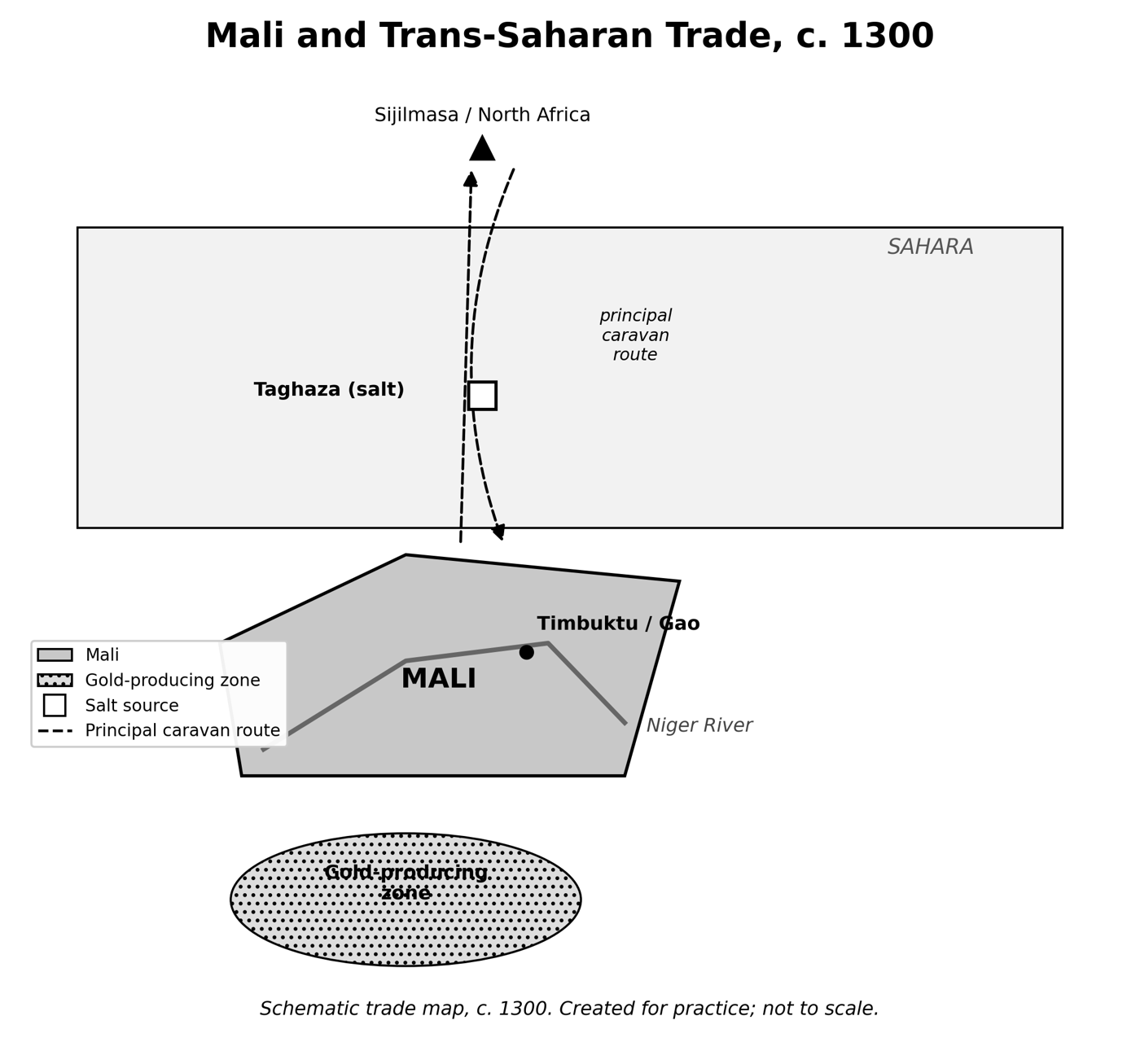
Question 5
- A. Mali's political power was reinforced by control over valuable trade routes
- B. Mali's rulers controlled territory disconnected from long-distance trade
- C. Mali relied primarily on agricultural taxation for state revenue
- D. Mali's territory was limited to the Mediterranean coastline
Show the answer and explanation
Question 6
- A. Population figures for Mali's capital
- B. A record of Mali's agricultural output
- C. Mansa Musa's 1324-1325 pilgrimage to Mecca, which publicly displayed Mali's gold wealth
- D. A description of Mali's climate
Show the answer and explanation
Question 7
- A. Fully supported, since the map shows only gold routes
- B. Unsupported, since the map shows no evidence of trade at all
- C. Partially supported, but only for the period after 1450
- D. An overreach, since the map shows trade routes but cannot establish that no other wealth source existed
Show the answer and explanation
Question 8
- A. Song China, through its examination bureaucracy
- B. Great Zimbabwe, through its connection to Indian Ocean trade networks
- C. The Delhi Sultanate, through military conquest of northern India
- D. The Inca, through mandatory labor obligations
Show the answer and explanation
Set C: Questions 9-12
Constructed administrative record, Delhi Sultanate, c. 1300.
> Revenue is collected from village landholders according to assessed > obligations. Local Hindu temple officials continue to oversee temple > property and customary affairs, while district officers report tax > receipts to the sultan's administration. Disputes not reserved for > the ruler's courts are often handled through established local > authorities.
Constructed for practice; not an authentic historical quotation.
Question 9
- A. Forced religious conversion of the entire population
- B. Complete replacement of local administrative structures
- C. Total exclusion of non-Muslims from economic life
- D. Governance of a religiously plural society under Muslim rule
Show the answer and explanation
Question 10
- A. The continued operation of Hindu temple administration
- B. The existence of a tax system
- C. The fact that the record is administrative in nature
- D. The general time period of the source
Show the answer and explanation
Question 11
- A. It guarantees the information is completely accurate
- B. It proves the ruler was tolerant of all religions
- C. It suggests a practical, governance-focused perspective rather than a doctrinal one, shaping what the source emphasizes
- D. It has no bearing on how the source should be used
Show the answer and explanation
Question 12
- A. The Mexica tribute system
- B. Islam's spread through merchant networks and port cities in Sumatra
- C. The Black Death's demographic effects in Europe
- D. Song China's examination bureaucracy
Show the answer and explanation
Set D: Questions 13-16
Constructed historian's summary.
> Around 1200, political authority in much of western Europe was > divided among kings, territorial nobles, chartered towns, and church > institutions. Monarchs exercised real power, but local lords > controlled land and labor, towns held legal privileges, and church > courts claimed jurisdiction over many religious and family matters. > This produced functioning government without the centralized civilian > bureaucracy found in Song China.
Question 13
- A. State building around 1200 did not follow one single organizational model
- B. Political fragmentation was universal across every society in this unit
- C. Europe had no functioning government of any kind
- D. Church authority in Europe exceeded that of any monarch
Show the answer and explanation
Question 14
- A. Mali's control over trans-Saharan trade
- B. The Inca road network
- C. The Delhi Sultanate's plural society
- D. Song China's centralized examination-based bureaucracy
Show the answer and explanation
Question 15
- A. Accurate, since the two developments occurred in the same region
- B. Reversed in emphasis, since fragmentation predated the Black Death by centuries and the plague instead altered labor and social relations within that existing structure
- C. Unsupported, since the Black Death had no economic effects
- D. Accurate, since the Black Death eliminated the church's authority
Show the answer and explanation
Question 16
- A. Total population size
- B. Distance from the Indian Ocean
- C. Degree of centralized administrative control
- D. Number of religious holidays observed
Show the answer and explanation
Short-answer practice: secondary, primary, and non-text sources
SAQ 1: Constructed secondary-source-style practice text (not a published historian's interpretation). Source: a constructed historian's summary. "Between 1200 and 1450, states across Afro-Eurasia and the Americas generated political authority through several distinct means: control over trade, military conquest and tribute, religious and educational legitimacy, and negotiated arrangements among competing regional powers. No single method dominated globally."
a) Identify one state discussed in this unit that generated political authority primarily through control over trade.
b) Describe one specific feature of that state's trade-based authority.
c) Explain how a different state in this unit generated political authority through a method other than trade control.
Scoring note: (a) Mali or Great Zimbabwe. (b) Requires a named specific feature (trans-Saharan gold/salt routes; Indian Ocean commercial links), not a restated label. (c) Requires evidence plus mechanism, for example Song China's examination bureaucracy tying office to education, not just naming "China" as an example.
SAQ 2: Constructed primary-source-style practice text (not an authentic historical document). Source: a constructed excerpt attributed to a Venetian merchant traveling through Delhi Sultanate territory, c. 1300, describing tax collection from local landholders alongside continued operation of Hindu temples and local courts.
a) Identify the type of state described in the source.
b) Describe one specific practice mentioned in the source that reflects how this state governed a religiously diverse population.
c) Explain why the author's position as a foreign merchant, rather than a local official, might shape what the source emphasizes or omits.
Scoring note: (c) requires connecting the author's outsider commercial perspective to a plausible effect on the account, for example an emphasis on taxation and trade conditions over religious or administrative detail a local official might have prioritized. Naming "bias" without this connection does not meet the threshold.
SAQ 3: Non-text source.
| Year | Urban population index |
|---|---|
| 1000 | 100 |
| 1050 | 116 |
| 1100 | 138 |
| 1150 | 160 |
| 1200 | 187 |
Synthetic practice data; values are illustrative and are not historical measurements.
a) Identify the general trend shown in the table.
b) Describe one development from this unit that helps explain this trend.
c) Explain how this economic trend related to the political system also operating in Song China during the same period.
Scoring note: (c) requires connecting commercial/urban growth to the examination-based bureaucracy, for example administrative capacity supporting and benefiting from a growing tax base, not two disconnected facts placed side by side.
DBQ practice: document use and sourcing (3-document set)
Prompt: To what extent did control over trade shape political power in African states from 1200 to 1450?
Document 1. Constructed primary-source-style practice text, attributed to a North African traveler describing a West African ruler's court, c. 1350: "The ruler's wealth is evident in the gold displayed at court, gold that arrives through traders crossing the desert from the south. His authority over these routes gives him command of resources unmatched by neighboring rulers who lack such access."
Document 2. Constructed primary-source-style practice text, attributed to a regional chronicle describing Great Zimbabwe, c. 1400: "The stone enclosures house a ruling elite whose position rests on their control of cattle and their connections to traders who carry goods toward the coast, where they are exchanged for items arriving from across the Indian Ocean."
Document 3. Constructed primary-source-style practice text, attributed to a royal account describing Mansa Musa's pilgrimage, c. 1325: "Along the route to Mecca, the ruler distributed gold so freely that its value in the markets he passed through fell noticeably for a period afterward."
Task A (document use, not summary): For Document 3, do not merely restate that gold was distributed. State what this document proves about the scale of Mali's wealth and connect it explicitly to the claim that trade control generated political authority visible even outside Mali's borders.
Task B (sourcing): For Document 1, explain why the author's position as a foreign traveler, rather than a local court official, shapes what this document can and cannot establish about the ruler's authority. Do not stop at identifying the author's role. State what that role does to the document's reliability for this specific argument.
Task C (outside evidence): Identify one piece of specific evidence from this unit, not drawn from these three documents, that could extend this argument to a state outside West and Southeast Africa.
Scoring note for Task C: An acceptable answer might cite Song China's commercial growth as a contrasting case where trade wealth developed alongside, rather than as the primary source of, political authority. A restatement of Document 1, 2, or 3 content does not satisfy the outside evidence requirement.
LEQ practice: evidence selection, thesis, and one body paragraph
Prompt: Evaluate the extent to which states in this period relied on military conquest, as opposed to other methods, to establish political authority.
90-second evidence dump: Inca conquest from Cuzco, mit'a labor, provincial administration. Mexica military conquest, tribute system, alliances. Delhi Sultanate established through conquest of northern India. Mali: not primarily conquest, trade and gold control. Song China: not conquest-based, examination bureaucracy. Great Zimbabwe: trade connections, not primarily military expansion.
Thesis: While military conquest was central to how the Inca and Mexica established political authority in the Americas, and to the Delhi Sultanate's establishment in South Asia, other Unit 1 states, including Mali and Song China, built comparable political authority primarily through control over trade and administrative selection rather than conquest, showing that military expansion was one method among several rather than a universal requirement for state power in this period.
One evidence paragraph: The Inca expanded outward from Cuzco through sustained military conquest, then secured that conquered territory through an extensive road network, mandatory labor obligations known as mit'a, and direct provincial administration. This combination allowed the Inca state to convert military success into lasting administrative control rather than temporary domination. Mali's rulers, by contrast, built comparable political authority without primarily relying on conquest, drawing wealth and influence instead from control over trans-Saharan gold and salt routes, a method that Mansa Musa's 1324-1325 pilgrimage displayed publicly to the wider Islamic world. The contrast between the Inca's conquest-and-labor model and Mali's trade-based model demonstrates that political authority in this period could be built through fundamentally different mechanisms depending on a state's available resources and geographic position.
Timed evidence recall (8 prompts)
1. Song governance, 960-1279, East Asia. What does it prove? A civilian bureaucracy tied political power to Confucian education rather than birth alone.
2. Song commercial growth, 11th-13th c., East Asia. What does it prove? Major economic and urban expansion predating European industrialization.
3. Delhi Sultanate, est. after 1200, South Asia. What does it prove? Muslim political rule governing a religiously plural population.
4. Sufism and trade diffusion, 1200-1450, South and Southeast Asia. What does it prove? Religious change spread through commerce and missionary contact, not only conquest.
5. Mexica tribute empire, centered on Tenochtitlan, Mesoamerica. What does it prove? Political control extended through tribute and alliance rather than direct administrative absorption.
6. Inca road network and mit'a, expanding from Cuzco, Andes. What does it prove? Conquest converted into lasting control through infrastructure and mandatory labor.
7. Mansa Musa's hajj, 1324-1325, Mali. What does it prove? Trade-based wealth translated into visible political and religious prestige beyond Mali's borders.
8. European political fragmentation, ongoing through 1200s, Europe. What does it prove? Divided authority among monarchs, nobles, towns, and church predated and was not caused by the later Black Death.
Comparison practice
Choose two states from this unit and compare them using exactly one of the following shared dimensions: method of incorporating governed populations, source of state revenue, or role of belief systems in political legitimacy. Write two to three sentences naming the dimension explicitly and explaining how each state's approach to it differed. A response that summarizes each state separately without naming and applying the shared dimension does not meet this task's requirement.