AP World History study guide · Chapter 4
Unit 2: Afro-Eurasian Trade Networks, c. 1200–1450
Afro-Eurasian trade networks, c. 1200-1450
Silk Roads: caravan trade, infrastructure, and merchant networks
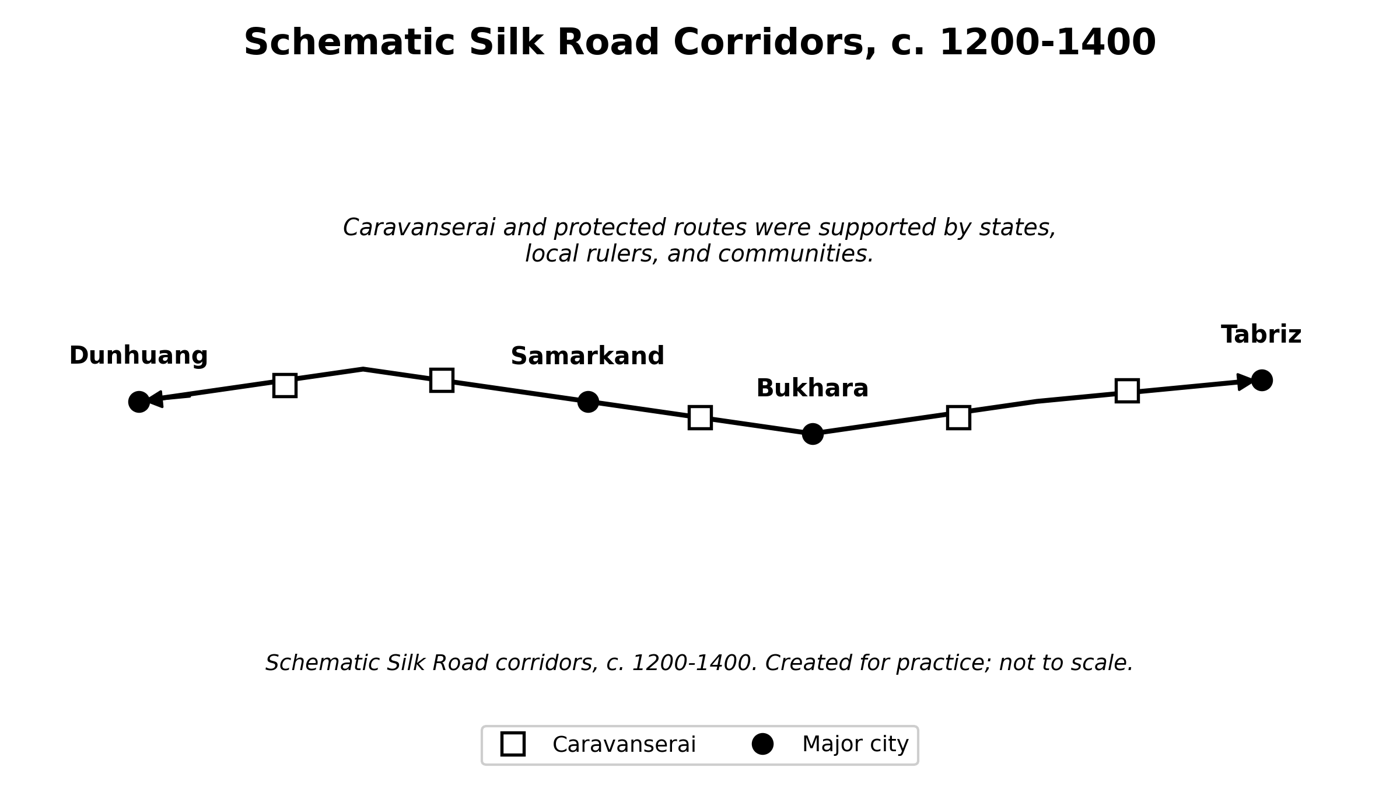
The Silk Roads were not one continuous road but a network of overland corridors and exchange centers linking communities across Eurasia. High-value goods such as silk, textiles, horses, spices, metals, and ceramics moved through chains of merchants who typically handled one segment of a much longer route rather than traveling its full length themselves. States and communities along these corridors supported this movement with infrastructure: caravanserai, forts, and way stations that gave merchants protection and rest across long, often difficult overland stretches.
Use this evidence. Caravanserai and protected corridors demonstrate that long-distance overland trade depended on political and infrastructural support, not merely on merchant initiative, a pattern worth comparing to how other networks in this unit were sustained.
Trade at this scale also depended on commercial practices, not only physical infrastructure. Merchants increasingly used bills of exchange and banking arrangements that let them move value across long distances without carrying large quantities of coin the entire way, reducing the risk of loss to theft or accident. In China, paper money supported a large-scale money economy that could move goods and credit more easily than metal currency alone. Trading cities such as Kashgar and Samarkand grew directly from this commercial activity, functioning as hubs where routes, markets, and merchant communities from different regions converged. Rising demand for luxury goods across Afro-Eurasia also reshaped production: Chinese, Persian, and Indian artisans expanded output of textiles and porcelain for export markets, and Chinese iron and steel production grew alongside this trade.
Use this evidence. Bills of exchange and paper money demonstrate that increased trade volume depended on financial innovation, not only safer roads. Kashgar and Samarkand demonstrate how a trading city could grow directly from its position within this network, and expanded textile and porcelain production demonstrates how demand in one region could reshape what another region actually produced.
Mongol rule: political consolidation and Eurasian exchange
Beginning with Chinggis Khan's proclamation as Great Khan in 1206, Mongol successors built the largest contiguous land empire in history through highly mobile armies and political consolidation across much of Eurasia. That political control, however violently achieved, created conditions that facilitated the movement of merchants, envoys, technologies, and knowledge across a vast span of territory that had previously been divided among many separate, often hostile, political authorities.
Kublai Khan's Yuan dynasty, established in China by 1271, illustrates how Mongol rulers adapted their approach once in power: the Yuan used existing Chinese taxation and administrative practices while reserving many high offices for Mongols and other non-Chinese officials, blending continuity with a distinct ruling hierarchy.
Use this evidence. Mongol-facilitated exchange demonstrates that political conquest, despite its destructive conduct, could still produce conditions enabling greater long-distance connectivity across Eurasia. This connectivity moved specific technologies and knowledge as well as merchants and goods: mathematical and medical knowledge developed in the Islamic world circulated more readily toward Europe through Mongol-linked networks, and Mongol administrations themselves adopted useful practices from the peoples they governed, including using the Uyghur script for administrative purposes rather than inventing an entirely new system.
Chronology check. Chinggis Khan's unification began in 1206, and the Mongols sacked Baghdad in 1258, ending unified Abbasid political authority there. The Yuan dynasty ran from 1271 to 1368, when the Ming dynasty succeeded it in China. Treating the Ming as a Mongol dynasty, or placing Mongol unification after 1300, misplaces this evidence by decades or more.
Indian Ocean trade: monsoon winds, ports, and maritime technology
Seasonal monsoon wind patterns shaped the timing and direction of Indian Ocean voyages, encouraging merchants to remain in port cities for months at a time while waiting for favorable winds to reverse. This predictable seasonal rhythm shaped where port cities grew and how merchant communities organized their commercial calendars around it. Maritime technology worked alongside this environmental knowledge to expand the network's reach: mariners used the compass and astrolabe for navigation, and larger ship designs, including dhows and large Asian vessels adapted to regional conditions, increased how much cargo a single voyage could carry over long distances.
This sustained contact produced durable diasporic merchant communities settled away from their regions of origin. Arab and Persian merchants established communities in East African ports, Chinese merchant communities appeared in parts of Southeast Asia, and Malay merchant communities participated across the Indian Ocean basin, often adopting local languages and social ties while maintaining their own commercial and religious connections.
Swahili coastal cities combined African cultural foundations with Islam and Indian Ocean commerce, exporting goods such as gold, ivory, and enslaved people in exchange for textiles, ceramics, and other goods arriving from across the ocean. Further east, port states in Sumatra, and later Malacca, which rose to prominence by around 1400 to 1450, gained influence by serving Indian Ocean and Southeast Asian shipping as strategic waypoints.
Use this evidence. The compass, astrolabe, and larger ship designs demonstrate that Indian Ocean trade's expanding range depended on technology working together with monsoon knowledge, not monsoon patterns alone. Diasporic merchant communities demonstrate a distinct cultural consequence of this network, separate from the state-building function Swahili cities and Malacca illustrate. Swahili cities demonstrate a coastal culture built directly from long-distance maritime connection, useful for comparing how trade shaped urban and cultural development differently than the caravanserai-supported Silk Roads.
Trans-Saharan trade: gold, salt, and caravan routes
Trans-Saharan caravans moved salt southward from Saharan sources and gold northward from West African goldfields, tying West African states directly to North African and wider Mediterranean commercial networks. This exchange depended on specific transport technology: improved camel saddles increased how much cargo and how many riders a camel could carry across desert terrain, and organized caravans, coordinated to travel together between wells, markets, and political authorities along the route, made crossing the Sahara at scale practical rather than merely possible. Mali's power depended partly on controlling the routes and commercial nodes linking gold-producing regions to these trans-Saharan networks, generating the wealth and influence covered earlier in this unit's companion coverage of Mali's state building.
Use this evidence. Camel saddle design and organized caravan logistics demonstrate that trans-Saharan trade's growth in volume and range depended on specific transportation technology, not only on the existence of complementary resources at either end of the route.
Mansa Musa's hajj, undertaken in 1324 to 1325, moved a large royal entourage and significant quantities of gold through North Africa on the way to Mecca, providing direct evidence of how deeply Mali's economy was integrated into this trans-Saharan and wider Islamic commercial network.
Use this evidence. The gold-salt exchange demonstrates a network organized around two complementary regional resources, a different structural logic than the luxury-goods relay system of the Silk Roads.
Religion, language, and urban growth along trade networks
Long-distance exchange carried more than goods. Buddhism, Islam, and other belief systems spread along commercial networks through merchants, missionaries, travelers, and diaspora communities settling in port cities and trading centers far from their places of origin. Swahili language and urban culture developed from Bantu linguistic and cultural foundations while incorporating Islamic and wider Indian Ocean influences, producing a distinct coastal culture shaped directly by sustained commercial contact.
Long-distance travelers, envoys, and scholars used the same connective routes to describe distant societies to audiences who would otherwise have had no direct knowledge of them, spreading geographic and cultural knowledge alongside goods and beliefs. Ibn Battuta, a Moroccan Muslim scholar, traveled an estimated 75,000 miles over roughly three decades in the fourteenth century, moving through North and West Africa, the Middle East, the Swahili coast, South Asia, and China, and his written account remains a detailed record of the connected societies he visited. Marco Polo's account of his travels from Italy to the Mongol court in China, though shaped by his own outsider perspective and commercial interests, became an influential European description of distant Eurasian societies that most of his readers would never see directly.
Use this evidence. Swahili cultural synthesis demonstrates that religious and cultural diffusion through trade produced genuinely new combined cultures, not simply the replacement of one culture by another. Ibn Battuta and Marco Polo demonstrate that individual travelers could function as a distinct channel of exchange, moving knowledge of distant societies along the same routes that carried goods, and their accounts are useful for source analysis precisely because each traveler's origin, faith, and purpose shaped what he chose to record.
Biological exchange: plague, crops, and ecological change
The same routes that connected merchants, goods, and ideas also connected disease environments that had previously been more separated. Plague spread across Afro-Eurasia through connected land and maritime routes, including Black Sea and Mediterranean commercial connections. The plague's devastating European and Mediterranean phase spread rapidly from 1347 into the early 1350s and killed a very large share of the affected population, while the wider plague pandemic had earlier and broader Afro-Eurasian histories beyond this specific European phase.
Long-distance exchange also spread crops and agricultural practices between regions, altering diets and land use patterns across Eurasia and Africa. Bananas, moved through Indian Ocean exchange, took root in parts of East Africa, where suitable growing conditions supported their spread and offered communities a food source not dependent on crops that grew less reliably in the same terrain. New rice varieties spread and increased agricultural output in parts of East Asia, and citrus crops moved around the Mediterranean through the same connected trade networks discussed throughout this unit. Expanding port cities concentrated populations and intensified demand for food, timber, and shipbuilding materials, producing ecological pressure tied directly to the growth of commerce itself.
Use this evidence. The Black Death demonstrates that connectivity carried serious costs alongside its benefits, a necessary complication when evaluating exchange networks rather than treating connection as straightforwardly positive. Banana diffusion into East Africa and new rice varieties in East Asia demonstrate a more constructive environmental consequence of the same connectivity, showing that exchange networks moved both destructive and productive biological change along the same routes.
Chronology check. The Black Death's devastating European and Mediterranean phase spread rapidly from 1347 into the early 1350s, well before the Columbian Exchange, which involves a separate and later set of disease exchanges between the Eastern and Western Hemispheres. Using Black Death evidence to describe the Columbian Exchange confuses two distinct disease events separated by more than a century.
Silk Roads, Indian Ocean, and trans-Saharan trade: a comparison
The Silk Roads, Indian Ocean routes, and trans-Saharan networks connected different regions through different transport technologies, geographies, and commodity mixes, and comparing them requires naming one shared dimension rather than describing each network separately. The Silk Roads depended on overland caravan transport and state-supported infrastructure across long, often arid, stretches. Indian Ocean trade depended on monsoon wind patterns and maritime technology suited to open-water crossings. Trans-Saharan trade depended on camel caravans crossing desert terrain between two complementary resource zones, salt and gold.
States and cities across all three networks supported exchange through protection, taxation, infrastructure such as roads, ports, and caravanserai, and legal or commercial institutions that reduced the risks merchants faced on long journeys. That shared pattern, political and infrastructural support for commerce, connects all three networks even though the specific form that support took differed by geography and transport technology.
Comparison dimension. When comparing any two networks from this unit, name the shared dimension first: transport technology and its geographic constraints, the specific commodities exchanged, or the form of political and infrastructural support that sustained the network. A comparison built on one of these named dimensions, not a side-by-side description of two networks, is what this unit's argumentation task requires.
Unit 2 practice: Afro-Eurasian trade networks
Multiple-choice practice (16 questions, 4 stimulus sets)
Set A: Questions 1-4
Schematic map: Silk Road support infrastructure.
Question 1
- A. Merchants typically traveled the entire route from end to end alone
- B. States and communities supported trade with protective infrastructure
- C. The Silk Roads functioned as a single continuous road
- D. Caravanserai existed only in one region of the network
Show the answer and explanation
Question 2
- A. Silk textiles
- B. Horses
- C. Ceramics
- D. Bulk grain shipped over thousands of miles
Show the answer and explanation
Question 3
- A. Caravanserai and protected corridors built with state or community support
- B. The variety of goods traded along the network
- C. The distance covered by Silk Road routes
- D. The number of merchants involved in a single transaction
Show the answer and explanation
Question 4
- A. Swahili coastal urbanization
- B. The trans-Saharan gold-salt exchange
- C. Mongol political consolidation across Eurasia
- D. The spread of Buddhism through merchant networks
Show the answer and explanation
Set B: Questions 5-8
Constructed historian's summary: Yuan administration.
> After the Mongol conquest of China, Yuan rulers retained many existing > Chinese taxation and record-keeping practices because they were useful > for governing a large settled population. At the same time, the > ruling hierarchy reserved many high offices and privileges for > Mongols and other non-Chinese groups. The result combined > administrative continuity with a distinct conquest elite.
Question 5
- A. A blend of administrative continuity with a distinct ruling hierarchy
- B. Total assimilation of Mongol rulers into Chinese culture
- C. Chinese officials holding exclusive control of the government
- D. Complete rejection of existing Chinese administrative practices
Show the answer and explanation
Question 6
- A. Correctly dating Yuan rule from 1271 to 1368
- B. Noting the Yuan followed the earlier Song dynasty
- C. Treating Ming dynasty administration as a continuation of the same Mongol Yuan system
- D. Placing the Yuan dynasty within the broader Mongol imperial period
Show the answer and explanation
Question 7
- A. Elimination of all regional trade networks in favor of one system
- B. Universal conversion of conquered populations to a single religion
- C. Complete abandonment of existing Silk Road infrastructure
- D. Political consolidation reducing the number of separate authorities merchants and travelers had to cross
Show the answer and explanation
Question 8
- A. The Black Death's later spread along connected trade routes
- B. Movement of merchants, envoys, technologies, and knowledge across Mongol-controlled Eurasian territory
- C. Mali's control of trans-Saharan gold routes
- D. Swahili city-states' Indian Ocean connections
Show the answer and explanation
Set C: Questions 9-12
Constructed historian's summary: Swahili coastal trade.
> Swahili coastal cities exported gold, ivory, and enslaved people to > merchants arriving through the Indian Ocean and imported textiles, > ceramics, and other manufactured goods. Seasonal monsoon winds shaped > when ships arrived and departed, encouraging merchants to remain in > port for extended periods. Commercial exchange and repeated > settlement helped produce a coastal culture combining Bantu > linguistic foundations with Islamic and wider Indian Ocean > influences.
Question 9
- A. Complete isolation of East African coastal economies from outside contact
- B. Exclusive reliance on overland rather than maritime transport
- C. Integration of East African coastal cities into a wider maritime commercial network
- D. Uniform culture across every Indian Ocean port with no regional variation
Show the answer and explanation
Question 10
- A. The specific goods available for exchange
- B. The seasonal timing and direction of voyages
- C. The language spoken in coastal cities
- D. The religious beliefs of merchants
Show the answer and explanation
Question 11
- A. Mongol political consolidation
- B. The trans-Saharan gold-salt exchange
- C. The Black Death's spread through Mediterranean trade
- D. Sumatra and Malacca's rise as influential Indian Ocean ports
Show the answer and explanation
Question 12
- A. Malacca rose to major prominence closer to 1400-1450, not at the start of this unit's period
- B. Malacca existed as a major port before 1200
- C. Malacca's rise had no connection to Indian Ocean shipping patterns
- D. Malacca predates Swahili coastal urbanization by several centuries
Show the answer and explanation
Set D: Questions 13-16
Constructed historian's summary: Black Death and connected routes.
> From 1347 into the early 1350s, plague spread rapidly through Black > Sea and Mediterranean ports linked to wider Afro-Eurasian trade > networks. The same routes that moved merchants, goods, and > information could also move pathogens between densely connected > communities. The epidemic therefore demonstrates that long-distance > connectivity carried serious costs alongside commercial and cultural > benefits.
Question 13
- A. Long-distance connectivity carried costs as well as benefits
- B. Trade networks had no effect on disease transmission
- C. The Black Death began in the Americas
- D. Connectivity only affected the wealthiest merchants
Show the answer and explanation
Question 14
- A. The two events occurred in the same decade
- B. Both events involve the exact same trade routes
- C. The Columbian Exchange did not involve disease
- D. The Black Death predates the Columbian Exchange by more than a century and involves a separate set of regions and routes
Show the answer and explanation
Question 15
- A. Complete cessation of long-distance trade after 1350
- B. Crop diffusion and altered land use between connected regions
- C. Uniform population decline across every connected region
- D. The disappearance of coastal port cities
Show the answer and explanation
Question 16
- A. The religion practiced by most merchants
- B. The specific year each network began
- C. Political and infrastructural support sustaining each network
- D. The total number of cities each network touched
Show the answer and explanation
Short-answer practice
SAQ 1: Constructed secondary-source-style practice text (not a published historian's interpretation). Source: a constructed historian's summary. "Between 1200 and 1450, overland, maritime, and trans-Saharan networks each connected distant regions through different transport technologies, but all three depended on political and infrastructural support to function at scale."
a) Identify one form of infrastructural support mentioned in this unit for any one of the three networks.
b) Describe how that support functioned for the network you identified.
c) Explain how a different network in this unit relied on a different form of support to achieve a similar function.
Scoring note: (c) requires a genuine second network and a stated similarity in function (enabling safe, sustained long-distance exchange), not a repeated example from part (a).
SAQ 2: Constructed primary-source-style practice text (not an authentic historical document). Source: a constructed excerpt attributed to a North African scholar describing Mansa Musa's 1324-1325 hajj, noting the scale of gold distributed along the route through Cairo.
a) Identify the trade network this evidence connects Mali to.
b) Describe one specific detail from the source that demonstrates Mali's integration into that network.
c) Explain why a scholar writing in Cairo, rather than in Mali itself, might describe this event with particular emphasis on its scale.
Scoring note: (c) requires connecting the author's outside vantage point to a plausible effect on emphasis, for example a visiting observer's focus on the dramatic scale of wealth displayed, distinct from an internal Malian account's likely emphasis.
SAQ 3: Non-text source.
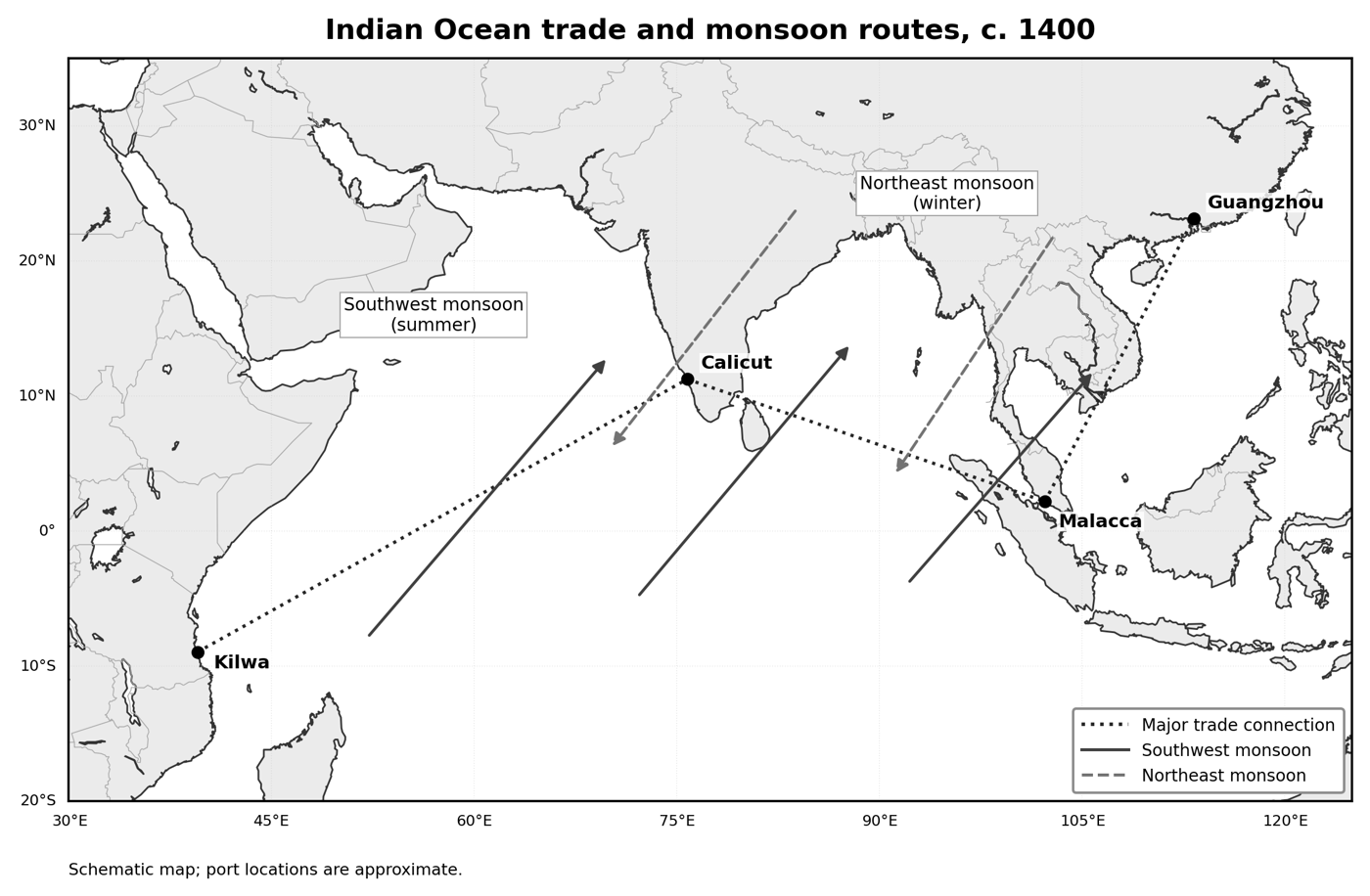
a) Identify the general pattern shown in the map.
b) Describe how this pattern shaped merchant behavior in Indian Ocean port cities.
c) Explain how this pattern helps account for the cultural blending seen in Swahili coastal cities.
Scoring note: (c) requires connecting extended seasonal port stays to genuine cultural mixing, not simply restating that Swahili culture was "diverse."
DBQ practice: document use and sourcing (3-document set)
Prompt: To what extent did political consolidation, rather than technology alone, enable long-distance exchange across Afro-Eurasia between 1200 and 1450?
Document 1. Constructed primary-source-style practice text, attributed to a merchant's account of travel through Mongol-controlled territory, c. 1280: "Where once a traveler faced a dozen tolls and as many hostile lords between one city and the next, under the Khan's rule a single authority now governs the road, and merchants move with far greater confidence."
Document 2. Constructed primary-source-style practice text, attributed to a Swahili coastal trader describing seasonal shipping patterns, c. 1300: "We wait here for the winds to turn, as our fathers did, and in that waiting our city has grown, filled with goods and people from across the sea."
Document 3. Constructed primary-source-style practice text, attributed to a royal chronicle describing caravan protection along trans-Saharan routes, c. 1350: "The ruler's agents guard the wells and the routes, and traders who once feared the crossing now travel in greater numbers, paying tribute for the safety this protection provides."
Task A (document use, not summary): For Document 1, do not merely restate that a single authority now governs the road. State what this document proves about the relationship between political consolidation and merchant confidence, and connect it explicitly to the prompt's claim.
Task B (sourcing): For Document 2, explain why the speaker's identity as a Swahili trader, rather than an outside visitor, shapes what this document can establish about monsoon-driven settlement patterns. State what that position does to the document's reliability for this specific argument.
Task C (outside evidence): Identify one piece of specific evidence from this unit, not drawn from these three documents, that could extend this argument to a network not directly represented in Documents 1-3.
Scoring note for Task C: An acceptable answer might cite Mali's control over trans-Saharan gold-salt exchange as a case of political authority sustaining a network's function, extending the argument beyond the Mongol and Indian Ocean examples already documented.
LEQ practice: evidence selection, thesis, and one body paragraph
Prompt: Evaluate the extent to which connectivity between 1200 and 1450 produced consequences beyond the exchange of goods.
90-second evidence dump: Black Death spread via connected routes, c. 1347-early 1350s. Crop diffusion altering diets/land use. Religious diffusion, Buddhism/Islam via merchants and missionaries. Swahili cultural synthesis from sustained contact. Knowledge transfer via travelers and scholars. Mongol political consolidation enabling movement. Caravanserai as infrastructure, not a consequence itself.
Thesis: While the exchange of goods drove the initial development of Afro-Eurasian trade networks between 1200 and 1450, connectivity along those same networks produced consequences reaching well beyond commerce, including the spread of disease, the diffusion of crops and religious beliefs, and the formation of genuinely new blended cultures in port cities, showing that these networks functioned as channels for far more than material goods.
One evidence paragraph: The Black Death's major Afro-Eurasian phase, spreading rapidly from 1347 into the early 1350s through the same connected Black Sea and Mediterranean routes that carried merchants and goods, demonstrating that the infrastructure enabling commercial exchange carried unintended and devastating consequences alongside its economic benefits. At the same time, connectivity produced more constructive outcomes: Swahili coastal cities developed a genuinely blended culture, combining Bantu linguistic and cultural foundations with Islamic and Indian Ocean influences absorbed through sustained commercial contact rather than conquest. Together, the Black Death's destructive spread and Swahili cultural synthesis show that the consequences of connectivity ranged from catastrophic to transformative, but in both cases extended well past the goods that initially moved along these routes.
Timed evidence recall (8 prompts)
1. Caravanserai, Silk Roads, Central Asia. What does it prove? States and communities supported overland trade with protective infrastructure.
2. Chinggis Khan proclaimed Great Khan, 1206, Central Asia. What does it prove? Mongol political consolidation began the process enabling later Eurasian exchange.
3. Yuan dynasty, 1271-1368, China. What does it prove? Mongol rulers blended administrative continuity with a distinct ruling hierarchy.
4. Monsoon wind patterns, seasonal, Indian Ocean. What does it prove? Maritime trade timing and merchant settlement depended on predictable environmental cycles.
5. Swahili city-states, ongoing, East African coast. What does it prove? Sustained maritime contact produced a genuinely blended coastal culture.
6. Trans-Saharan gold-salt exchange, ongoing, West/North Africa. What does it prove? Long-distance trade could organize around two complementary regional resources.
7. Black Death, c. 1347-1353, Europe and the Mediterranean. What does it prove? Connectivity carried serious costs alongside its commercial benefits.
8. Malacca's rise, c. 1400-1450, Southeast Asia. What does it prove? Port cities gained influence by serving as strategic waypoints in maritime shipping networks.
Comparison practice
Choose two of the three major exchange networks in this unit, Silk Roads, Indian Ocean trade, or trans-Saharan trade, and compare them using exactly one of the following shared dimensions: transport technology and its geographic constraints, the specific commodities exchanged, or the form of political and infrastructural support that sustained the network. Write two to three sentences naming the dimension explicitly and explaining how each network's approach to it differed. A response that summarizes each network separately without naming and applying the shared dimension does not meet this task's requirement.
Cumulative review: Units 1-2
No new historical content is introduced here. This checkpoint mixes retrieval from both units to build recall across a wider span before Unit 3 begins.
Mixed retrieval (6 items, timed):
1. What ties Song China's bureaucracy to state capacity? (Unit 1)
2. What does Mansa Musa's hajj prove about Mali, and in which unit's evidence does it appear twice, once as a state-building example and once as a network-integration example? (Units 1 and 2)
3. What does the Delhi Sultanate demonstrate about governing religious diversity? (Unit 1)
4. What did Mongol political consolidation enable across Eurasia? (Unit 2)
5. What does Swahili cultural synthesis demonstrate about trade's effects beyond commerce? (Unit 2)
6. What comparison dimension connects Song China's bureaucracy and medieval Europe's fragmented authority? (Unit 1)
Cross-unit comparison prompt: Mansa Musa's hajj appears in this book as evidence for two different claims: Mali's state-building through trade control (Unit 1) and trans-Saharan network integration (Unit 2). Explain, in two to three sentences, how the same historical event can serve two different argumentative functions depending on the claim being supported.
Mixed source sprint (8 minutes):
Source 1. The table below records the estimated number of camel-caravan crossings recorded at a major trans-Saharan market town in a sample fifty-year window, alongside the estimated annual volume of gold moving north through the same town.
| Period | Estimated caravan crossings per year | Estimated gold volume (relative index) |
|---|---|---|
| 1200-1250 | 40 | 100 |
| 1250-1300 | 65 | 160 |
| 1300-1350 | 90 | 230 |
1. Based on the table, what relationship between caravan traffic and gold volume does the data support?
2. Identify one piece of Unit 2 evidence, not shown in this table, that could help explain why both numbers increased together across this period.
Source 2. A short adapted historian's interpretation: "Song commercialization did not simply coexist with the examination bureaucracy; each fed the other, as growing tax revenue from trade funded the administrative apparatus that in turn kept markets orderly enough to keep growing."
3. Identify the historian's central claim.
4. Give one specific piece of Unit 1 evidence that supports or qualifies that claim.
Evidence transfer (5 minutes): Mansa Musa's hajj can support more than one argument. Write two one-sentence uses of the same event: one sentence using it as evidence for a claim about Mali's internal state power, and one sentence using it as evidence for a claim about trans-Saharan network integration. Then write one claim for which Mansa Musa's hajj would be poor evidence. That final sentence forces you to learn the boundary of the example, not only its uses.