AP World History study guide · Chapter 6
Unit 4: Maritime Expansion and the Columbian Exchange, c. 1450–1750
Maritime expansion and the Columbian Exchange, c. 1450-1750
Navigation, ship design, and long-distance ocean travel
European mariners combined and adapted several existing technologies to make sustained ocean voyages more feasible than they had been in earlier centuries. The magnetic compass, improved cartography, and lateen and square sail combinations allowed ships to sail more reliably across open water and against variable winds. Many of these technologies were not European inventions. The magnetic compass and gunpowder-based weaponry had Chinese origins, and Islamic and classical Mediterranean scholarship had preserved and extended navigational astronomy and cartographic knowledge that European sailors and shipbuilders drew on directly. This technological expansion depended on cross-cultural diffusion at least as much as on any single European innovation.
Ship design itself changed across the period as different states adapted vessels to different purposes. The caravel, small and highly maneuverable, suited close coastal exploration along unfamiliar shorelines, particularly for early Portuguese voyages down the West African coast. The carrack, a larger vessel with a deeper hull and multiple masts, could carry the food, water, and cargo needed for long ocean crossings and mounted cannon for defense. The Dutch fluyt, developed later in the sixteenth century, was built specifically to maximize cargo capacity with a smaller crew, making it central to the Dutch commercial empire's efficiency in the seventeenth century. Accumulated knowledge of Atlantic and Indian Ocean wind and current patterns, developed through repeated voyages, let mariners plan routes that used prevailing winds rather than fighting against them, turning individual successful voyages into a repeatable, reliable system of travel.
Naval cannon mounted directly on ships further strengthened Portuguese and other European efforts to seize strategic ports and protect maritime commerce once those routes were established, converting navigational reach into enforceable control over specific harbors and shipping lanes.
Use this evidence. The Chinese-origin compass and Islamic-preserved navigational astronomy demonstrate that European maritime expansion depended on absorbing existing Afro-Eurasian knowledge, not on isolated European invention. The caravel, carrack, and fluyt demonstrate that different ship designs served different specific purposes, from coastal exploration to cargo efficiency, rather than one "ship of exploration" doing every job. The combination of navigational technology and ship-mounted cannon demonstrates that European maritime expansion depended on both the ability to reach distant regions and the military capacity to control access to them once reached.
Portuguese and Spanish motives for maritime expansion
European states and merchants sought direct access to Asian trade, new sources of precious metals, opportunities for Christian expansion, and strategic advantage over rival states, motives that together pushed Portuguese and Spanish crowns to sponsor exploration voyages. Portuguese voyages around Africa, culminating in Vasco da Gama reaching India by sea in 1498, created a direct maritime route linking western Europe to Indian Ocean commerce without passing through Mediterranean and Middle Eastern intermediaries. Columbus's 1492 voyage, sponsored by the Spanish crown and aimed at reaching Asia by a westward route, instead initiated sustained contact between Europe and the Americas, accelerating conquest, settlement, and exchange across the Atlantic.
Use this evidence. Portuguese and Spanish state sponsorship demonstrates that this era's exploration was not simply individual initiative but a deliberate extension of state commercial and geopolitical strategy.
Chronology check. Columbus reached the Caribbean in 1492, not India or China as he initially believed, and da Gama reached India by an Africa-rounding sea route in 1498, a separate voyage from any Pacific crossing. Confusing either destination or route misplaces this evidence.
Portugal and Spain were not the only states sponsoring transoceanic exploration. England, France, and the Dutch Republic each sponsored voyages searching for a northern sea route to Asia across the North Atlantic, seeking to bypass the Iberian-controlled southern routes entirely. John Cabot's 1497 voyage explored the eastern coast of present- day Canada on England's behalf, and Henry Hudson's early seventeenth- century voyages searched unsuccessfully for a northwest passage through Arctic waters. These specific voyages did not achieve their original goal; no reliable northern sea route to Asia existed for ships of this period to use. The voyages nonetheless produced lasting consequences: they established the basis for English and French claims in North America, opened profitable fishing grounds, and created fur and timber trades that became significant sources of colonial wealth in their own right, showing that a failed original objective can still generate substantial and lasting historical consequences.
Use this evidence. Northern Atlantic exploration demonstrates that English, French, and Dutch states pursued a genuinely different geographic strategy than Iberian states, not merely a delayed copy of Portuguese and Spanish methods. The gap between these voyages' original goal and their actual long-term consequences demonstrates that a historical development's significance is not limited to whether it achieved its stated original purpose.
The Columbian Exchange: disease, crops, animals, and demography
Old World pathogens, including smallpox and measles, caused catastrophic mortality among Indigenous American populations that lacked prior exposure to these diseases, producing demographic collapse on a scale with few parallels in recorded history. Colonization also transferred disease vectors, not only diseases themselves: mosquitoes and rats carried aboard European ships spread to the Americas and helped establish malaria and other insect-borne illnesses in environments where they had not previously existed, adding a further, less visible channel of biological exchange alongside direct person-to-person disease transmission.
This exchange moved food crops and animals in multiple directions, not only from the Americas outward. Crops originating in the Americas, including maize, potatoes, and cassava, spread into Afro-Eurasia and contributed to long-term dietary and population changes there. European colonizers brought Afro-Eurasian grains, fruit trees, sugarcane, and domesticated animals, including horses, cattle, and pigs, to the Americas, transforming environments, transportation, warfare, and land use. Enslaved Africans, transported forcibly through the same expanding Atlantic system, carried specific African crops with them, including rice and okra, which took root in parts of the Americas and became lasting elements of regional diets, particularly in areas of concentrated plantation labor. Plantation crops such as sugarcane reorganized labor systems across the Americas in the same movement.
Use this evidence. Disease-driven demographic collapse demonstrates that this exchange's consequences were catastrophic as well as transformative, a necessary complication when evaluating the Columbian Exchange rather than treating it as uniformly beneficial. Mosquito- and rat-borne disease vectors demonstrate that this exchange moved indirect biological agents alongside crops, animals, and pathogens transmitted directly between people. Rice and okra carried by enslaved Africans demonstrate that the Columbian Exchange's crop movements were not a purely European-directed process; enslaved people were themselves unwilling agents of biological and cultural transfer within a system built on their own coercion.
Portuguese fortified ports and Spanish territorial empire
Portugal established fortified trading posts and naval control at selected strategic ports rather than attempting to conquer entire regions territorially, seizing Goa in 1510 and capturing Malacca in 1511 as anchoring points for an Indian Ocean trading network built on force and selective control rather than full territorial administration. Spanish forces took a different approach in the Americas, combining military technology with Indigenous alliances, the demographic effects of disease, and exploitation of internal political divisions to bring down the Aztec capital of Tenochtitlan in 1521 and to accelerate the conquest of the Inca state through the 1530s.
The Dutch East India Company, chartered in 1602, and the English East India Company, chartered in 1600, extended this pattern further by combining private investment with state-granted powers to wage war, make treaties, and control strategic ports and trade routes directly, without functioning merely as an ordinary private trading firm.
Use this evidence. Portugal's port-based strategy, compared with Spain's territorial conquest in the Americas, demonstrates that maritime empires pursued different methods of control depending on regional conditions and available resources, not one uniform imperial model.
Chronology check. Goa fell in 1510 and Malacca in 1511, decades after this unit's period begins in 1450, and Portuguese control functioned through fortified ports rather than continuous territorial rule across India. The fall of Tenochtitlan in 1521 resulted from a combination of factors, not disease alone. Chartered company powers, including the VOC's capacity to wage war and make treaties, should not be confused with later direct British Crown rule, which is a distinct and later arrangement.
European maritime expansion did not simply overwhelm Asian states. Ming China had already possessed the era's largest oceangoing fleet, demonstrated by Admiral Zheng He's expeditions reaching as far as East Africa in the early fifteenth century, before the Ming court chose to end official state-sponsored voyages and impose the haijin, a sea ban restricting private maritime trade and communication with foreign merchants. Tokugawa Japan adopted a comparable restrictive policy, often called sakoku, that limited European traders to a single controlled post at Nagasaki while continuing regulated trade with China and Korea. Both policies functioned as deliberate state strategies to limit the disruptive economic and religious effects of European-dominated maritime trade, not as an inability to compete with European technology. Despite these restrictions and the arrival of European maritime empires, existing Asian merchant networks continued operating throughout the Indian Ocean; Arab, Persian, Gujarati, and Southeast Asian merchants continued to carry the large majority of Indian Ocean commerce well after Portuguese, Dutch, and English ships appeared in the same waters, since European fortified ports controlled specific chokepoints rather than the entire network.
Use this evidence. Ming China's haijin and Tokugawa Japan's sakoku demonstrate that some Asian states responded to European maritime expansion with deliberate, chosen restriction rather than passive exposure, a strategy worth comparing directly to Portugal's fortified-port approach. The continued dominance of Arab, Persian, and Gujarati merchants in Indian Ocean trade after European arrival demonstrates that European maritime empires controlled specific strategic points within this network, not the network's overall volume or participants.
Silver, Manila, and the Pacific trade system
The transpacific galleon route linking the Philippines and New Spain began in 1565, after Spanish navigators found a workable eastward return route across the Pacific. Manila became the Spanish colonial capital in 1571 and thereafter became the principal Asian hub of this Manila- Acapulco trade, connecting American silver production directly to Chinese and other Asian markets and linking Atlantic and Pacific commercial circuits into a single global silver trade. Large-scale silver production in Spanish America entered both Atlantic and Pacific trade routes and reached Asian markets in substantial quantities, making silver one of the most consequential commodities moving through this period's expanded oceanic networks.
European states regulated this expanding trade through mercantilist policies: monopolies, tariffs, navigation rules, and colonial trade restrictions designed to channel wealth toward the home state rather than allowing colonies or rival powers to capture it freely.
Use this evidence. The Manila galleon system demonstrates that Atlantic and Pacific trade circuits, often studied separately, were directly connected through the movement of a single commodity, American silver, into Asian markets.
Chronology check. The transpacific galleon route began in 1565, and Manila became the Spanish colonial capital in 1571; do not use 1571 as the starting date for the trade route itself, and do not place either date before this unit's 1450 starting point.
Plantations, coerced labor, and Atlantic slavery
Colonial economies in the Americas relied on a changing mix of labor systems across this period, some newly introduced and some continued from earlier practice. Spanish colonizers initially organized Indigenous labor through the encomienda, which granted individual colonists the right to demand labor and tribute from a specified Indigenous population under a nominal obligation to provide protection and religious instruction; in practice, this functioned as coerced labor with little genuine reciprocity. As encomienda declined, partly due to Indigenous demographic collapse and partly due to reform pressure, Spanish administrators shifted toward the repartimiento, a rotating labor draft assigning workers directly through colonial officials, and the hacienda, a large private estate that increasingly relied on debt-based labor arrangements rather than a royal grant of people. In the Andes, Spanish authorities repurposed the Inca mit'a, an existing rotational labor obligation, to staff silver mines including Potosí, illustrating that colonial labor systems combined genuinely new arrangements with adapted continuities from before 1450 rather than replacing every prior practice. Sugar and other plantation commodities in the Caribbean and Brazil drove demand for coerced African labor on a massive scale, and chattel slavery, in which enslaved people and their descendants were treated as permanent, hereditary property, expanded dramatically as Indigenous labor pools collapsed under disease and harsh treatment.
This demand for labor produced direct political and demographic consequences extending into Africa itself, not only within the Americas. Afonso I, king of Kongo, complained directly to the Portuguese crown that slave traders were seizing his subjects and undermining his kingdom's internal authority and social stability, evidence that the slave trade's political costs extended into African states whose rulers sometimes actively opposed its methods even while participating in broader trade relationships with European powers. The scale of forced removal also reshaped demographic patterns within many West and Central African societies: because the trade disproportionately removed men, sex ratios in some affected regions skewed toward women, who took on an expanded share of agricultural labor and other economic and social roles traditionally shared with men in the communities the trade depended on capturing.
Use this evidence. The encomienda, repartimiento, hacienda, mit'a, and chattel slavery together demonstrate that colonial labor in the Americas combined newly created coercive systems with adapted continuities from before 1450, not a single uniform system imposed everywhere at once. Afonso I's complaint demonstrates that African rulers were not passive participants in this system but active political actors who could resist specific practices even within an ongoing commercial relationship. The demographic skew toward women in some slave-trade-affected African societies demonstrates a significant gendered consequence of the trade felt within Africa, separate from its consequences for enslaved people themselves in the Americas.
Resistance to colonial rule: Pueblo, Nzinga, and maroon communities
Imperial expansion repeatedly generated resistance from conquered peoples, regional elites, enslaved populations, and rival states throughout this period, and that resistance took genuinely different forms depending on who resisted and what they sought. Indigenous communities in present-day New Mexico rose up against Spanish colonial rule in the Pueblo Revolt of 1680, led by the religious leader Popé, who coordinated resistance across Pueblo communities that spoke different languages in response to forced labor and the suppression of Pueblo religious practices. The revolt successfully expelled Spanish colonizers from the region for roughly twelve years before Spain reconquered New Mexico in 1692. In West Central Africa, Queen Nzinga of Ndongo led sustained political and military resistance against Portuguese colonization, eventually establishing and ruling the state of Matamba as an independent regional power that continued to resist Portuguese encroachment. Escaped enslaved people formed maroon communities in parts of the Americas, sometimes negotiating with, fighting against, or otherwise resisting colonial authorities from territory they controlled outside direct colonial administration. Beyond these specific cases, early modern empires also repeatedly confronted challenges from provincial elites, religious dissenters, and dynastic rivals, meaning that resistance to imperial power took multiple forms depending on who was resisting and what they sought.
Use this evidence. The Pueblo Revolt demonstrates that Indigenous resistance could achieve real, if temporary, political success against a major colonial power, not only symbolic defiance. Queen Nzinga demonstrates that African resistance to European colonization could take the form of sustained state-level political and military leadership, not only local or individual opposition. Maroon communities demonstrate that resistance to slavery could take the form of sustained, organized community-building outside colonial control, not only individual acts of defiance. Comparing these three cases requires naming what each form of resistance actually achieved and for how long, since temporary success and permanent success are not the same outcome.
Colonial social hierarchies: race, status, and casta categories
Colonial societies in Spanish America developed a set of social categories known collectively as the casta system, which used ancestry, birthplace, and legal status to describe a person's position in colonial society and to shape access to certain rights, occupations, and social standing. This system was not a single fixed ladder applied uniformly and permanently across the empire. Casta labels varied by region and period, could be claimed, disputed, or purchased in some cases, and depended on local factors including wealth, reputation, and appearance as well as ancestry, so an individual's classification was not always stable or purely biological. Atlantic slavery created new racialized hierarchies as well, while enslaved and free Africans nonetheless formed families, religious communities, and networks of mutual support within and against these constraints. Economic expansion during this period changed labor demands broadly but did not produce a uniform improvement in women's legal or political status across colonial societies.
Social hierarchies changed in gunpowder-era land empires during this same period, through different mechanisms than colonial casta categories. Ottoman rulers generally allowed recognized Christian and Jewish communities varying degrees of local autonomy in religious and personal-status matters while requiring taxes and political loyalty; historians sometimes use "millet system" as shorthand for this arrangement, though a uniform, empire-wide system in the later nineteenth-century sense should not be projected unchanged onto the early modern empire. Mughal rule under Akbar incorporated Hindu elites such as the Rajputs directly into imperial administration and military service, allowing elite status to cross religious lines even as the broader population remained religiously and socially diverse. The Qing dynasty maintained a distinct legal and social status for the Manchu conquest elite through the Eight Banner system, while continuing to rely on the existing Chinese bureaucratic and examination system for much of civil administration, producing a hierarchy organized around conquest-elite status layered onto an inherited administrative structure.
Use this evidence. The casta system demonstrates colonial societies using ancestry- and status-based categories to structure social position, but those categories should be described as regionally variable and open to negotiation in specific cases, not as a single formal ladder fixed empire-wide. Comparing casta categories to the Ottoman millet system, Mughal elite incorporation, and Qing Banner status demonstrates that land-based empires and colonial societies both organized social hierarchy around group membership, but did so through genuinely different mechanisms worth naming explicitly in any comparison.
Continuity and change in trade, labor, and imperial rule after 1450
Long-standing Afro-Eurasian trade networks, including the Silk Roads and Indian Ocean routes covered earlier in this book, continued operating after 1450 even as new Atlantic and Pacific connections expanded the overall scale and reach of global exchange. Coerced labor also remained widespread across this period rather than beginning anew, but Atlantic plantation slavery expanded dramatically in scale and became increasingly tied to racial categorization in ways that distinguished it from earlier forms of coerced labor in this book's coverage.
Comparison dimension. When evaluating continuity and change across this unit, name the specific dimension first: which trade networks persisted versus which connections were genuinely new, or how coerced labor's scale and racial character changed even as coerced labor itself continued. A response that lists changes without identifying a persisting continuity does not meet this unit's continuity and change task.
Unit 4 practice: maritime expansion and the Columbian Exchange
Multiple-choice practice (24 questions, 6 stimulus sets)
Set A: Questions 1-4
Constructed historian's summary: maritime technology.
> European oceanic voyages after 1450 combined several technologies > that had developed across different regions. Mariners used improved > charts and the magnetic compass, while ship designs combined lateen > and square sails to improve maneuverability and ocean performance. > Armed sailing ships later added naval cannon, allowing some voyages > to support coercive control as well as navigation and commerce.
Question 1
- A. Ocean voyages required no new technology beyond what existed in 1200
- B. Cartography played no role in enabling exploration
- C. Sail design remained unchanged throughout this period
- D. Expansion depended on combining and adapting existing navigational technologies rather than one single invention
Show the answer and explanation
Question 2
- A. Measuring wind direction
- B. Improving cartographic accuracy
- C. Enforcing control over strategic ports and shipping lanes
- D. Replacing the magnetic compass
Show the answer and explanation
Question 3
- A. Direct access to Asian trade, precious metals, and strategic advantage over rivals combined to motivate state-sponsored voyages
- B. Portugal and Spain sought only religious goals with no commercial interest
- C. Individual sailors acted entirely without state support
- D. Exploration began only after 1500
Show the answer and explanation
Question 4
- A. Columbus never sailed west
- B. Columbus reached the Caribbean, not India or China, despite his own initial belief
- C. India was reached only by an entirely overland route in this period
- D. The Caribbean and India are the same region
Show the answer and explanation
Set B: Questions 5-8
Constructed historian's summary: da Gama's route.
> In 1498, Vasco da Gama reached India by sailing around the Cape of > Good Hope and across the Indian Ocean. The voyage gave Portuguese > merchants a direct sea route from Europe into Indian Ocean commerce > without relying on the established Mediterranean and Middle Eastern > intermediaries that had long connected European consumers to Asian > goods. Portuguese rulers treated the route as both a commercial > opportunity and a strategic advantage.
Question 5
- A. Eliminated the need for any further European exploration
- B. Connected Europe to the Americas
- C. Allowed Europe to bypass Mediterranean and Middle Eastern intermediaries in accessing Indian Ocean trade
- D. Was the first European contact with Asia in any form
Show the answer and explanation
Question 6
- A. Da Gama reached India in 1492
- B. Columbus reached the Caribbean in 1492, and da Gama reached India in 1498
- C. Columbus reached the Caribbean in 1498
- D. Both voyages occurred in the same year
Show the answer and explanation
Question 7
- A. Both voyages had identical destinations
- B. Both voyages involved no state sponsorship
- C. Both voyages were part of a single expedition
- D. Both voyages reflected competing state-sponsored efforts to secure trade advantage, despite reaching different destinations
Show the answer and explanation
Question 8
- A. Evidence of a shared, cooperative exploration program
- B. Evidence of no meaningful state involvement in exploration
- C. A reflection of state rivalry over commercial and strategic advantage
- D. Unrelated to either crown's commercial interests
Show the answer and explanation
Set C: Questions 9-12
Synthetic table: demographic decline and crop diffusion.
| Indicator | c. 1490 | c. 1550 | c. 1600 |
|---|---|---|---|
| Indigenous population index in selected American regions | 100 | 42 | 24 |
| Old World regions regularly cultivating American maize/potatoes | limited | expanding | widespread in several regions |
Synthetic practice data; values are illustrative and are not historical measurements. The purpose is to show simultaneous demographic collapse in the Americas and crop diffusion into Afro-Eurasia.
Question 9
- A. Disease-driven demographic collapse occurred alongside crop diffusion into new regions
- B. Population decline occurred exclusively in Afro-Eurasia
- C. American crops entering Afro-Eurasian diets occurred without any accompanying negative consequence elsewhere
- D. The exchange produced only positive outcomes for all populations involved
Show the answer and explanation
Question 10
- A. Complete cessation of Indigenous agricultural practice
- B. Old World animals, including horses and cattle, transformed American land use and transportation
- C. Uniform population growth across the Americas after 1492
- D. Elimination of any American environmental impact from new species
Show the answer and explanation
Question 11
- A. Fully supported, since diseases spread only within the Americas
- B. Supported only for the period before 1500
- C. Irrelevant to this unit's content
- D. Unsupported, since American crops spread into Afro-Eurasian diets and contributed to dietary and population changes there
Show the answer and explanation
Question 12
- A. Old World disease-driven mortality among Indigenous American populations lacking prior exposure
- B. The Manila galleon system's silver trade
- C. The devshirme system
- D. The Battle of Çaldıran
Show the answer and explanation
Set D: Questions 13-16
Constructed historian's comparison: Portuguese and Spanish imperial methods.
> Portuguese expansion in the Indian Ocean concentrated heavily on > fortified ports and naval control at strategic points such as Goa > and Malacca. Spanish expansion in the Americas relied more heavily on > territorial conquest of large states, including the Mexica and Inca, > followed by colonial administration over extensive inland > populations. Both were maritime empires, but they often built control > through different geographic and institutional strategies.
Question 13
- A. Portuguese and Spanish empires used identical methods everywhere
- B. Only Spain established any form of imperial control in this period
- C. Maritime empires pursued different methods of control depending on regional conditions and available resources
- D. Portugal conquered the same territories Spain did
Show the answer and explanation
Question 14
- A. Goa and Malacca fell to Portugal before 1450
- B. Both fell to Portugal in 1510 and 1511, decades after this unit's 1450 starting point, not at its start
- C. Spain, not Portugal, captured these ports
- D. These events occurred after 1600
Show the answer and explanation
Question 15
- A. Disease alone, with no other contributing cause
- B. Indigenous alliances alone, with no military or disease factor
- C. Spanish naval power alone
- D. Military technology, Indigenous alliances, disease effects, and exploitation of internal political divisions acting together
Show the answer and explanation
Question 16
- A. Corporate entities combining private investment with state-granted powers to wage war and make treaties
- B. Ordinary private firms without state-granted powers
- C. Identical in structure to later direct British Crown rule
- D. Entities restricted entirely to commercial activity with no military capacity
Show the answer and explanation
Set E: Questions 17-20
Constructed historian's summary: Manila galleon system.
> After Manila became a Spanish colonial capital in 1571, regular > galleon traffic linked the Philippines to Acapulco in New Spain. > American silver crossed the Pacific toward Asian markets, especially > China, while Asian manufactured goods moved eastward toward Spanish > America and beyond. The route connected Atlantic American silver > production to Pacific and East Asian commercial circuits.
Question 17
- A. Atlantic and Pacific trade circuits operated in complete isolation from each other
- B. Silver connected Atlantic and Pacific circuits into a single global trade system
- C. Chinese markets had no connection to American silver production
- D. Manila served no commercial function in this period
Show the answer and explanation
Question 18
- A. The galleon system operated continuously from 1450
- B. Silver trade began before Spanish colonization of the Americas
- C. Manila became a Spanish colonial capital only in 1571
- D. China had no interest in silver before 1571
Show the answer and explanation
Question 19
- A. Encouraging free trade between all rival empires
- B. Channeling colonial wealth toward the home state rather than colonies or rivals
- C. Eliminating colonial economic activity entirely
- D. Preventing any silver from leaving Spanish America
Show the answer and explanation
Question 20
- A. The slave trade produced political costs that some African rulers actively opposed even within an ongoing trade relationship
- B. African rulers had no involvement in or reaction to the slave trade
- C. Kongo had no trade relationship with Portugal
- D. Afonso I supported unrestricted slave trading
Show the answer and explanation
Set F: Questions 21-24
Constructed historian's summary: resistance and colonial hierarchy.
> Some enslaved people in the Americas escaped plantations and > settlements to form maroon communities beyond direct colonial > control, sometimes defending their independence for long periods. At > the same time, Spanish colonial societies developed legal and social > categories tied to ancestry, birthplace, and status, commonly > described through the casta system. One development demonstrates > resistance to coerced labor; the other demonstrates how colonial > rule formalized social hierarchy.
Question 21
- A. Enslaved people had no means of resisting colonial authority
- B. All enslaved people escaped successfully without exception
- C. Colonial authorities fully eliminated all resistance
- D. Resistance to slavery could take the form of sustained, organized community-building outside colonial control
Show the answer and explanation
Question 22
- A. A set of ancestry- and status-based categories that varied by region and period and could be negotiated or disputed in specific cases, not a single fixed ladder applied uniformly
- B. A purely informal set of social customs with no bearing on rights or standing
- C. Identical to religious hierarchies in Ottoman-governed territories
- D. A system with no connection to ancestry or birthplace
Show the answer and explanation
Question 23
- A. Women's legal status improved uniformly across all colonial societies
- B. Labor demands remained completely unchanged during this period
- C. Economic expansion changed labor demands without producing uniform improvement in women's legal or political status
- D. Gender had no bearing on labor roles in this period
Show the answer and explanation
Question 24
- A. Assuming both systems functioned identically
- B. Ignoring either system's actual structure
- C. Avoiding any direct comparison between them
- D. Naming the specific organizing principle each system used, such as ancestry and birthplace versus religious identity
Show the answer and explanation
Short-answer practice
SAQ 1: Constructed secondary-source-style practice text (not a published historian's interpretation). Source: a constructed historian's summary. "Between 1450 and 1750, European maritime expansion connected the Atlantic, Pacific, and existing Indian Ocean trade circuits into a more integrated global system, while producing severe demographic and social consequences across the Americas."
a) Identify one navigational or military technology that enabled this expansion.
b) Describe how that technology functioned in enabling expansion.
c) Explain how one specific consequence of this expansion affected a population beyond European colonizers themselves.
Scoring note: (c) requires a specific population and consequence (Indigenous demographic collapse, enslaved Africans, Kongo's political strain), not a generic reference to "negative effects."
SAQ 2: Constructed primary-source-style practice text (not an authentic historical document). Source: a constructed excerpt attributed to a Kongo royal official, addressed to the Portuguese crown, c. 1526, protesting that slave traders were seizing the king's subjects.
a) Identify the practice being protested in this source.
b) Describe one specific concern raised about this practice.
c) Explain why the source's position as a ruling monarchy's own official, rather than a private merchant, shapes what this source can establish about African political responses to the slave trade.
Scoring note: (c) requires connecting the official's royal authority to a plausible effect on the source's emphasis, such as a focus on threats to the kingdom's internal stability rather than purely commercial concerns.
SAQ 3: Non-text source.
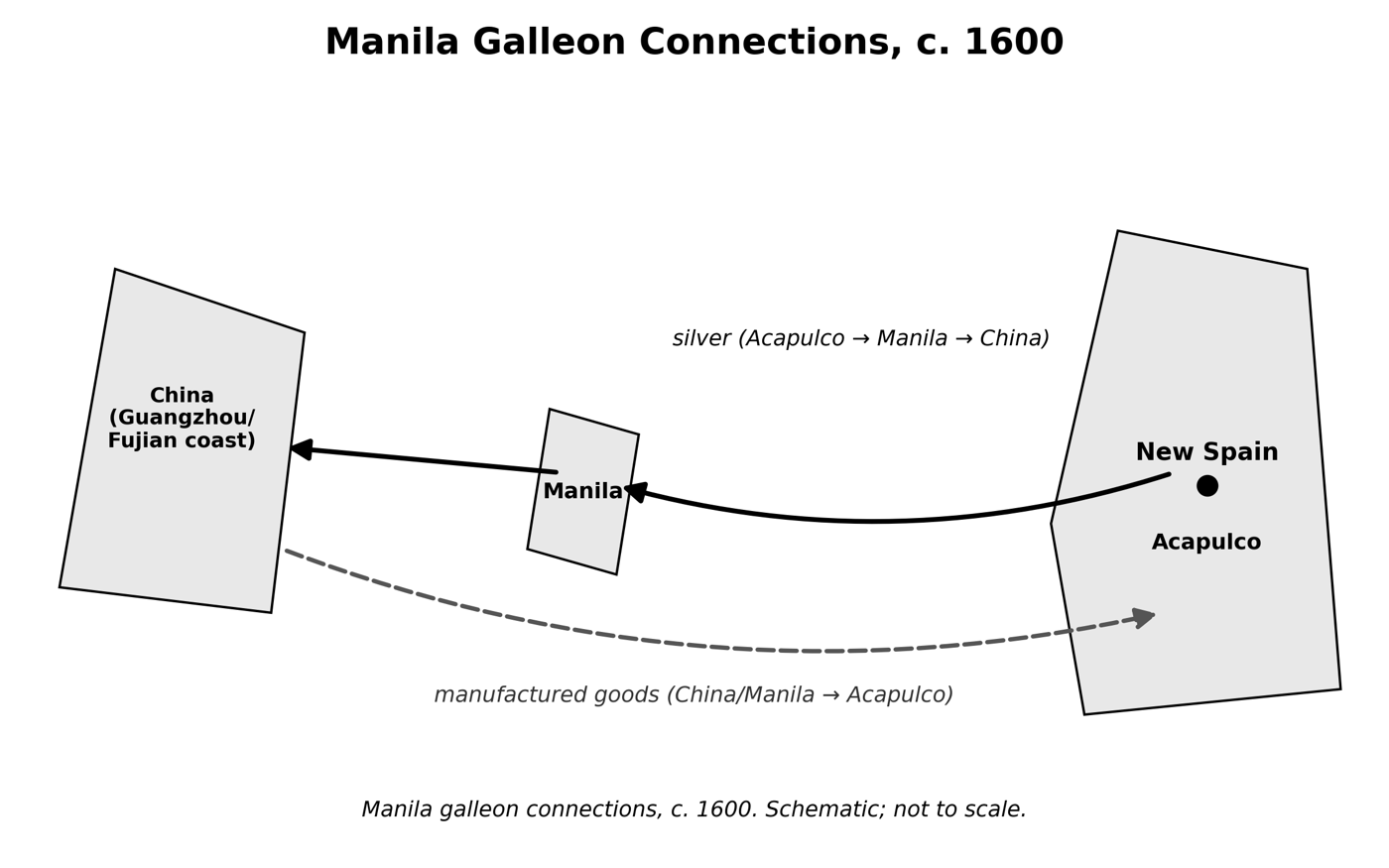
a) Identify the two ocean regions this trade route connects.
b) Describe one commodity that moved along this route based on this unit's evidence.
c) Explain how this route demonstrates a connection between Spanish American colonization and Asian markets.
Scoring note: (c) requires an explicit statement of the silver-to-China connection, not simply a restatement of the route's geography.
DBQ practice: document use and sourcing (4-document set)
Prompt: To what extent did maritime empires rely on force, rather than purely commercial negotiation, to establish control over trade after 1450?
Document 1. Constructed primary-source-style practice text, attributed to a Portuguese naval commander describing the capture of Malacca, 1511: "The port could not be secured through agreement alone. Only after our ships' guns silenced the harbor's defenses did the local rulers accept the terms we offered."
Document 2. Constructed primary-source-style practice text, attributed to a Dutch East India Company official, c. 1610: "Our charter grants us the right to make war, build forts, and negotiate treaties as a sovereign power would, powers no ordinary merchant company possesses."
Document 3. Constructed primary-source-style practice text, attributed to a Kongo royal official, addressed to the Portuguese crown, c. 1526: "Your traders seize my king's subjects by force, and this seizure undermines the authority he holds over his own kingdom, even as we maintain trade between our peoples."
Document 4. Constructed primary-source-style practice text, attributed to a Spanish colonial official describing silver shipments from Peru, c. 1580: "The mines produce more silver than our ships can easily carry, and this wealth flows outward to Manila and beyond, secured always by armed escort along the routes most vulnerable to raiders."
Task A (document use, not summary): For Document 1, do not merely restate that the port could not be secured through agreement alone. State what this document proves about the relationship between military force and commercial control, and connect it explicitly to the prompt's claim.
Task B (sourcing): For Document 3, explain why the official's position as a representative of a ruling monarchy whose kingdom continued trading with Portugal, rather than an outside critic, shapes what this document can establish about the coexistence of force and ongoing commercial relationships. State what that position does to the document's reliability for this specific argument.
Task C (outside evidence): Identify one piece of specific evidence from this unit, not drawn from these four documents, that could extend this argument to Spanish territorial conquest rather than Portuguese or Dutch port-based control.
Scoring note for Task C: An acceptable answer might cite the combination of military technology, Indigenous alliances, and disease effects in the fall of Tenochtitlan, extending the argument to a case of force operating alongside other factors in a different imperial context.
LEQ practice: evidence selection, thesis, and one body paragraph
Prompt: Evaluate the extent to which maritime empires' methods of establishing control varied by region between 1450 and 1750.
90-second evidence dump: Portugal, Goa/Malacca, fortified ports, not full conquest. Spain, Tenochtitlan/Inca, territorial conquest, disease + alliances + military tech. Dutch/English companies, chartered war-making powers. Manila galleon, commercial silver route, less direct conquest. Mercantilist regulation, economic control tool distinct from military conquest.
Thesis: While all major European maritime powers relied on some combination of force and commercial strategy to establish control after 1450, the specific method varied significantly by region, with Portugal pursuing fortified port control in the Indian Ocean, Spain pursuing direct territorial conquest in the Americas, and the Dutch and English combining chartered corporate power with selective military force in South and Southeast Asia, showing that maritime empire took multiple distinct forms rather than one uniform model.
One evidence paragraph: Portugal's capture of Goa in 1510 and Malacca in 1511 established naval and commercial control over strategic Indian Ocean ports without attempting full territorial conquest of the surrounding regions, a method suited to a trading network built on controlling chokepoints rather than administering large populations. Spanish conquest of the Aztec and Inca states followed a fundamentally different method, combining military technology, alliances with Indigenous groups opposed to existing imperial rule, and the demographic effects of disease to bring down entire territorial states and replace them with direct colonial administration. The contrast between Portugal's port-based strategy and Spain's territorial conquest demonstrates that maritime empire building responded to regional political conditions and available resources rather than following a single method across every context.
Timed evidence recall (12 prompts)
1. Magnetic compass and lateen sails, ongoing adaptation, Europe. What does it prove? Combined navigational technologies enabled sustained ocean voyages.
2. Vasco da Gama reaches India, 1498, Indian Ocean route. What does it prove? A direct maritime route bypassed Mediterranean and Middle Eastern intermediaries.
3. Columbus reaches the Caribbean, 1492, Atlantic. What does it prove? A westward voyage aimed at Asia instead initiated sustained Europe-Americas contact.
4. Old World disease, post-1492, Americas. What does it prove? Catastrophic demographic collapse among Indigenous populations lacking prior exposure.
5. American crops in Afro-Eurasia, ongoing after 1492, Afro-Eurasia. What does it prove? Exchange moved in multiple directions, not only from the Old World to the Americas.
6. Portuguese capture of Goa and Malacca, 1510-1511, Indian Ocean. What does it prove? Maritime empire could be built through fortified ports rather than full territorial conquest.
7. Fall of Tenochtitlan, 1521, Mesoamerica. What does it prove? Military technology, alliances, and disease combined to enable Spanish territorial conquest.
8. Dutch East India Company chartered, 1602, Netherlands/Asia. What does it prove? Chartered companies held state-like powers to wage war and make treaties.
9. Manila established, 1571, Philippines. What does it prove? A Spanish colonial capital anchored the trade route connecting American silver to Chinese markets.
10. Afonso I's protest to Portugal, c. 1526, Kongo. What does it prove? African rulers actively opposed specific slave-trade practices even within ongoing trade relationships.
11. Maroon communities, ongoing, Americas. What does it prove? Enslaved people built sustained, organized resistance communities outside colonial control.
12. Casta system, ongoing, Spanish America. What does it prove? A legally codified social hierarchy organized colonial society around ancestry and birthplace.
Comparison practice
Choose two maritime powers or systems from this unit, Portuguese port control, Spanish territorial conquest, or Dutch/English chartered companies, and compare them using exactly one of the following shared dimensions: method of establishing control, use of military force versus negotiation, or relationship to existing regional political structures. Write two to three sentences naming the dimension explicitly and explaining how each approach differed. A response that summarizes each power separately without naming and applying the shared dimension does not meet this task's requirement.
Cumulative review: Units 1-4
No new historical content is introduced here. This checkpoint mixes retrieval from all four units completed so far.
Mixed retrieval (8 items, timed):
1. What does Song China's examination bureaucracy prove about political legitimacy? (Unit 1)
2. What did Mongol political consolidation enable across Eurasia? (Unit 2)
3. What does the Battle of Çaldıran demonstrate about gunpowder technology and organization? (Unit 3)
4. What does the devshirme system demonstrate about Ottoman governance? (Unit 3)
5. What does Portuguese control of Goa and Malacca demonstrate about methods of maritime empire building? (Unit 4)
6. What does Afonso I's protest demonstrate about African political agency during the slave trade? (Unit 4)
7. Name one comparison dimension used in this book so far to compare two states or empires without simply summarizing each separately.
8. Name one chronology error this book has specifically warned against involving a dynasty or empire placed in the wrong century.
Cross-unit comparison prompt: Compare Ottoman incorporation of loyal personnel through the devshirme system (Unit 3) with Portuguese establishment of control through fortified ports rather than full territorial conquest (Unit 4). Name one dimension these two very different strategies share: the deliberate selection of a specific, resource-efficient method of control rather than the most total form available. Explain, in two to three sentences, why each empire might have chosen a selective strategy over a more total one.