AP World History study guide · Chapter 5
Unit 3: Land Empires, Gunpowder, and Imperial Rule, c. 1450–1750
Land empires, gunpowder, and imperial rule, c. 1450-1750
Gunpowder warfare and imperial expansion
Beginning in the traditional founding year of 1299, the Ottoman polity grew over the following centuries from a small Anatolian principality into one of the era's largest land-based empires, a transformation that accelerated once gunpowder weapons entered regular use. Ottoman, Safavid, Mughal, and Qing rulers each combined firearms and artillery with cavalry, infantry, and organized logistics to expand large land-based empires, giving these states a military advantage over rivals still relying primarily on earlier weapons technology. Gunpowder alone did not produce these empires; disciplined armies, state finance, and political organization converted military advantage into durable territorial control.
Several anchor dates mark this expansion clearly. Ottoman forces captured Constantinople in 1453, ending the Byzantine Empire and giving the Ottomans a capital at the crossing point between Europe and Asia. At Çaldıran in 1514, Ottoman field artillery and firearm-equipped Janissary infantry helped defeat Shah Ismail's largely cavalry-based Safavid force, which did not deploy comparable field artillery in the battle. In South Asia, Babur's victory at Panipat in 1526 used field artillery and mobile cavalry to defeat a numerically larger opposing force, establishing Mughal rule in northern India. In East Asia, Hong Taiji proclaimed the Great Qing in 1636; Manchu forces then took Beijing in 1644, ending Ming rule and establishing Qing rule at the former Ming capital, and the dynasty went on to expand Chinese territorial control into Central Asia, Tibet, and other regions well beyond the Ming heartland.
Use this evidence. Çaldıran shows that gunpowder weaponry created a decisive battlefield asymmetry, not a contest between comparably equipped forces: Ottoman possession, deployment, and tactical integration of artillery and firearms against a Safavid army lacking comparable field artillery produced a lopsided outcome, and Safavid rulers expanded their own use of firearms and artillery after this defeat. The Qing dynasty's 1636 proclamation and 1644 conquest of Beijing demonstrate that this same gunpowder-era expansion pattern extended into East Asia, not only the Islamic land empires most often associated with the term "gunpowder empires."
Chronology check. The Ottoman polity's traditional founding in 1299 did not mean sixteenth-century-scale control of the Balkans and Middle East existed from that date. The Safavid dynasty was established in 1501, not before 1450, and the Ottomans did not conquer Mamluk Egypt until 1517. Hong Taiji proclaimed the Great Qing in 1636, and Manchu forces conquered Beijing in 1644; both dates fall within this unit's 1450-1750 period and are required content for this unit, not a later or separate topic. Collapsing this into a single "1644 founding" date, or treating Qing evidence as chronologically invalid for a 1450-1750 land-empire prompt, are both errors to avoid.
Ottoman rule: military service, taxation, and religious diversity
Ottoman rulers governed a large, multiethnic and multireligious empire through provincial administration, negotiated tax arrangements, structured military service, and accommodation of religious communities rather than forced uniformity. One distinctive institution illustrates this approach directly: the devshirme system, through which the Ottoman state recruited some Christian boys from Balkan provinces for imperial service, including into the elite Janissary infantry corps, converting recruits to Islam and training them for military or administrative careers loyal directly to the sultan rather than to a hereditary aristocracy. The Ottoman state also drew substantial revenue through provincial taxation and tax farming, in which the right to collect taxes in a district was sold or assigned to an individual who then extracted that revenue directly from the population.
Use this evidence. The devshirme system demonstrates a method of building a loyal administrative and military class deliberately separate from existing hereditary elites, a strategy worth comparing to how the Mughal and Qing states incorporated personnel through different methods.
Safavid Iran: Twelver Shi'a Islam and state identity
The Safavid dynasty, established in 1501, unified Iran and made Twelver Shi'a Islam a central element of state identity and political legitimacy, promoting conversion among a population that had previously been predominantly Sunni. This religious identity sharpened political and religious distinctions between the Safavid state and its neighbors, particularly the Sunni Ottoman Empire, contributing directly to the rivalry that produced the Battle of Çaldıran in 1514.
Use this evidence. Safavid promotion of Twelver Shi'ism demonstrates religious identity functioning as a deliberate state-building tool, not merely a preexisting cultural fact, a pattern worth comparing to how Ottoman rulers used a different religious strategy in a more religiously diverse empire.
Mughal rule: Akbar, revenue reform, and Rajput incorporation
Mughal rule in northern India, established by Babur's victory at Panipat in 1526, was strengthened significantly under Akbar, who reigned from 1556 to 1605. Akbar expanded and stabilized Mughal authority through administrative reform, structured revenue systems, and a ranked system of military and administrative officials, while also incorporating Rajput and other local elites into imperial service through alliances and shared governance roles rather than displacement. Mughal revenue collection depended heavily on zamindars, local intermediaries who collected taxes from agricultural producers and passed a share upward to the imperial treasury, connecting distant imperial demands to local society. Akbar also pursued relative religious tolerance toward non-Muslim subjects, reducing some restrictions and cultivating alliances across religious communities as part of this broader strategy of imperial consolidation.
Use this evidence. Akbar's incorporation of Rajput elites demonstrates a strategy of alliance and shared governance, a clear contrast to the Ottoman devshirme system's approach of building a loyal class separate from existing hereditary elites, and a further contrast to how Qing rulers combined inherited bureaucracy with a distinct conquest elite.
Chronology check. Babur founded Mughal rule in 1526, and Akbar's reign began thirty years later in 1556. Placing Akbar's reforms before Babur's initial conquest, or treating the Delhi Sultanate and the Mughal Empire as the same state, misrepresents both the sequence and the distinct political identity of the Mughal dynasty.
Ottoman, Safavid, Mughal, and Qing rule: a comparison
Belief systems changed significantly across this period as well, beyond any single empire's internal policy. In western Europe, the Protestant Reformation, beginning with Martin Luther's 1517 challenge to Catholic Church authority, broke the religious unity of western Christianity and produced multiple new Protestant traditions. The Catholic Church responded with its own reform efforts, often called the Catholic Reformation, renewing missionary activity and institutional discipline. Together these movements did not shrink Christianity; both contributed to its continued growth and global spread even as western Christianity divided into competing branches. In South Asia, Sikhism developed during this same period in a setting shaped by ongoing interaction between Hindu and Islamic traditions in Punjab. Guru Nanak, working in the late fifteenth and early sixteenth centuries, taught a monotheistic faith that rejected the Hindu caste system, and later Sikh Gurus built the religion into a distinct tradition with its own institutions, one neither reducible to Hinduism nor to Islam. Sikh communities later faced persecution under some Mughal rulers, including the execution of a Sikh Guru under Emperor Aurangzeb, which contributed to the community's increasing militarization.
Use this evidence. The Protestant and Catholic Reformations demonstrate continuity and change within a single belief system, since Christianity both fractured and continued expanding globally during the same period. Sikhism demonstrates a genuinely new belief system emerging from sustained interaction between two existing traditions, a different pattern than the Sunni-Shi'a intensification covered under Safavid state-building.
The Ottoman, Safavid, Mughal, and Qing empires shared gunpowder-era military expansion and dynastic rule, but they differed in how they governed diverse populations, collected revenue, and legitimized their authority. Ottoman sultans combined a Sunni Muslim identity with pragmatic rule over large Christian and Jewish populations, using institutions like the devshirme system and provincial tax farming to build a loyal administrative class and a functioning revenue base. Safavid rulers took a sharply different path, making Twelver Shi'ism central to state identity and promoting active conversion, which deepened rather than softened religious distinction from neighboring states. Mughal rulers under Akbar pursued a third approach, incorporating local Hindu elites such as the Rajputs directly into imperial administration and military service while collecting revenue through zamindars and extending relative religious tolerance. Qing rulers, following the Manchu conquest of Beijing in 1644, took a fourth approach: retaining much of the existing Chinese bureaucratic and Confucian administrative system inherited from the Ming while simultaneously maintaining the Eight Banner system, a separate military and social structure that preserved a distinct status for the Manchu conquest elite. This combination let Qing emperors govern as legitimate holders of the Chinese imperial tradition while keeping the conquest elite's institutions intact.
Rulers across all four empires also worked to make their authority visible, not only administratively functional. Religious buildings, court ritual, and monumental architecture and art could present a ruler as legitimate, sacred, or powerful. Mughal architecture projected dynastic authority through major mosques and mausolea, and Qing imperial portraiture presented emperors within multiple cultural traditions simultaneously, reinforcing their claim to rule a diverse, multiethnic empire.
Comparison dimension. When comparing any two of these empires, name the shared dimension first: their method of incorporating diverse elites into governance, their method of collecting revenue, their use of religious identity or visual and architectural legitimation to build political authority, or their administrative structures for managing a multiethnic population. A comparison built on one of these named dimensions, not a side-by-side description of the empires involved, is what this unit's argumentation task requires.
Unit 3 practice: land empires and imperial rule
Multiple-choice practice (24 questions, 6 stimulus sets)
Set A: Questions 1-4
Timeline: gunpowder empires.
| Date | Event |
|---|---|
| 1453 | Ottoman capture of Constantinople |
| 1514 | Battle of Çaldıran: Ottoman victory over Safavid forces |
| 1526 | First Battle of Panipat: Babur defeats the Delhi Sultanate and establishes Mughal rule |
Question 1
- A. Each ended a European colonial empire
- B. Each involved the use of gunpowder weaponry in territorial expansion
- C. Each occurred in the same region of Eurasia
- D. Each established a new religious identity for the victor
Show the answer and explanation
Question 2
- A. Ottoman
- B. Safavid
- C. Mughal
- D. Qing
Show the answer and explanation
Question 3
- A. Constantinople fell after 1492, reversing the sequence
- B. Constantinople had no connection to Mediterranean trade
- C. The two events are separated by decades and involve multiple additional causes beyond this one conquest
- D. Columbus never referenced the Ottoman Empire
Show the answer and explanation
Question 4
- A. Religious rivalry between Sunni and Shi'a states could escalate into direct military conflict
- B. Gunpowder weaponry alone guaranteed victory regardless of organization
- C. Safavid forces held a permanent military advantage over the Ottomans
- D. The Mughal Empire intervened directly in this conflict
Show the answer and explanation
Set B: Questions 5-8
Constructed administrative description: Ottoman devshirme.
> Ottoman officials periodically recruited some Christian boys from > Balkan provinces, converted them to Islam, and trained them for > imperial service. Some entered the Janissary corps, while others > received education for administrative positions. Because their > advancement depended directly on the sultan, the system created > trained military and governing personnel tied closely to the central > state.
Question 5
- A. Forced conversion of the entire Christian population of the empire
- B. Complete exclusion of non-Muslims from any government role
- C. Reliance exclusively on hereditary Turkish nobility for administration
- D. Building a loyal administrative and military class separate from existing hereditary elites
Show the answer and explanation
Question 6
- A. Safavid promotion of Twelver Shi'ism
- B. Akbar's ranked system of military and administrative officials built partly through alliances with local elites
- C. The Battle of Panipat
- D. Ottoman capture of Constantinople
Show the answer and explanation
Question 7
- A. Whether existing elites were bypassed or directly incorporated into governance
- B. Whether the empire was located in Eurasia
- C. Whether gunpowder weapons were used
- D. Whether the empire practiced any form of taxation
Show the answer and explanation
Question 8
- A. Fully supported by the evidence
- B. Supported only for the period before 1453
- C. Unsupported, since devshirme recruits themselves became converted Muslim officials incorporated into the state, which is a form of Christian-origin participation in governance, not exclusion
- D. Irrelevant to the question of governance structure
Show the answer and explanation
Set C: Questions 9-12
Constructed historian's summary: Safavid religious policy.
> After the Safavid dynasty established power in Iran in 1501, its > rulers made Twelver Shi'a Islam central to state identity. The state > promoted Shi'a institutions and conversion in a population that had > previously been largely Sunni. This policy strengthened internal > political identity while sharpening religious distinction from > neighboring Sunni powers, especially the Ottoman Empire.
Question 9
- A. Religion functioning as a deliberate tool for constructing political identity and legitimacy
- B. Religion having no connection to political authority
- C. Religious identity remaining fixed and unchangeable over time
- D. All land empires in this unit sharing an identical religious policy
Show the answer and explanation
Question 10
- A. Safavid rule began before the Ottoman Empire existed
- B. Twelver Shi'ism was adopted only after 1600
- C. The Safavid dynasty was established in 1501, not before 1450
- D. The Safavids and Mughals were the same dynasty
Show the answer and explanation
Question 11
- A. Both empires enforced identical religious uniformity
- B. Ottoman sultans combined Sunni identity with governance over large Christian and Jewish populations, while Safavids promoted Shi'a conversion more directly within a more religiously uniform population
- C. Neither empire connected religion to political legitimacy
- D. The Safavids governed a larger non-Muslim population than the Ottomans
Show the answer and explanation
Question 12
- A. Akbar's religious tolerance policy
- B. The Battle of Panipat
- C. The devshirme system's creation
- D. The Battle of Çaldıran
Show the answer and explanation
Set D: Questions 13-16
Constructed historian's summary: Akbar and Mughal consolidation.
> During Akbar's reign from 1556 to 1605, Mughal government combined > military power with administrative reform. A ranked system of > officials tied service and revenue assignments to the imperial > center, while Rajput elites were incorporated into Mughal political > and military service. These policies helped transform conquest into > durable administration across a religiously and regionally diverse > empire.
Question 13
- A. Exclusion of all non-Muslim elites from imperial service
- B. Reliance solely on military conquest without administrative reform
- C. Alliance and shared governance with existing local elites
- D. Complete religious uniformity imposed on the empire
Show the answer and explanation
Question 14
- A. Akbar's reign began thirty years after Babur's founding conquest
- B. Babur and Akbar ruled simultaneously
- C. Akbar founded the Mughal Empire himself
- D. The Mughal Empire began after Akbar's death
Show the answer and explanation
Question 15
- A. The Battle of Çaldıran's military outcome
- B. Safavid religious promotion
- C. The 1453 capture of Constantinople
- D. The devshirme system's method of building a loyal class separate from hereditary elites
Show the answer and explanation
Question 16
- A. Identical to Safavid religious policy
- B. One part of a broader strategy of imperial consolidation through alliance-building
- C. A complete absence of any religious identity within the Mughal state
- D. Evidence that Islam played no role in Mughal state identity
Show the answer and explanation
Set E: Questions 17-20
Comparison table: Ottoman, Safavid, Mughal empires.
| Empire | Religious policy | Elite incorporation | Military expansion |
|---|---|---|---|
| Ottoman | Sunni state; accommodated recognized non-Muslim communities | Devshirme and service elites tied to the sultan | Artillery, infantry, cavalry |
| Safavid | Active promotion of Twelver Shi'a Islam | Tribal and court elites under a Shi'a monarchy | Gunpowder forces and cavalry |
| Mughal | Muslim dynasty ruling a Hindu-majority population; Akbar pursued broad accommodation | Rajput and other regional elites incorporated into imperial service | Field artillery, cavalry, infantry |
This is a comparison aid, not a complete description of each empire.
Question 17
- A. Ottoman
- B. Mughal
- C. All three equally
- D. Safavid
Show the answer and explanation
Question 18
- A. Safavid
- B. Ottoman
- C. Mughal
- D. None of the three empires incorporated local elites
Show the answer and explanation
Question 19
- A. Identical religious policy
- B. Use of gunpowder weaponry in territorial expansion
- C. Identical administrative structure
- D. Identical methods of elite incorporation
Show the answer and explanation
Question 20
- A. One named shared dimension applied explicitly to at least two empires
- B. Listing each empire's facts separately without connecting them
- C. Describing only the Ottoman Empire in detail
- D. Avoiding any reference to religious policy
Show the answer and explanation
Set F: Questions 21-24
Constructed historian's summary: Qing consolidation.
> Hong Taiji proclaimed the Great Qing in 1636, and Manchu forces > entered Beijing in 1644 as Ming rule collapsed. The Qing retained > much of the existing Chinese bureaucratic and taxation system because > it remained useful for governing the empire. At the same time, the > Eight Banner system preserved a distinct military and social > organization associated with the Manchu conquest elite.
Question 21
- A. Replacing all existing institutions immediately after conquest
- B. Governing without any permanent military organization
- C. Combining inherited administrative structures with institutions tied to the conquest elite
- D. Ending the prior examination-based bureaucracy entirely
Show the answer and explanation
Question 22
- A. Both eliminated the institutions of the populations they conquered
- B. Both combined inherited administrative practices with a separate institution securing personnel loyal specifically to the ruling dynasty
- C. Both required all subjects to follow one religious tradition
- D. Both relied on zamindars as the primary method of tax collection
Show the answer and explanation
Question 23
- A. The Qing state was proclaimed in 1636 and took Beijing in 1644, both dates within this unit's 1450-1750 period
- B. The Qing dynasty predates the Ottoman Empire's founding
- C. Qing expansion was complete before 1450
- D. The Qing dynasty is a twentieth-century state
Show the answer and explanation
Question 24
- A. Monsoon wind patterns shaping Indian Ocean trade
- B. Caravanserai supporting Silk Road merchants
- C. The Black Death's demographic effects
- D. Qing imperial portraiture presenting emperors within multiple cultural traditions simultaneously
Show the answer and explanation
Short-answer practice
SAQ 1: Constructed secondary-source-style practice text (not a published historian's interpretation). Source: a constructed historian's summary. "Between 1450 and 1750, the Ottoman, Safavid, and Mughal empires each combined gunpowder-enabled military expansion with distinct strategies for governing large, diverse populations."
a) Identify one gunpowder-era military event associated with one of these three empires.
b) Describe how that event contributed to the empire's territorial expansion.
c) Explain how a different one of the three empires used a distinct method to govern its diverse population once expansion had occurred.
Scoring note: (c) requires a specific governing method, such as the devshirme system or Akbar's alliance-building, connected to a stated function, not a generic reference to "diversity."
SAQ 2: Constructed primary-source-style practice text (not an authentic historical document). Source: a constructed excerpt attributed to an Ottoman provincial official describing the recruitment and training of devshirme-system administrators, c. 1550.
a) Identify the system described in this source.
b) Describe one specific feature of this system mentioned in the source.
c) Explain why an official directly responsible for administering this system might describe it in favorable terms.
Scoring note: (c) requires connecting the author's administrative position to a plausible effect on emphasis or tone, not a generic statement that all sources are biased.
SAQ 3: Non-text source.
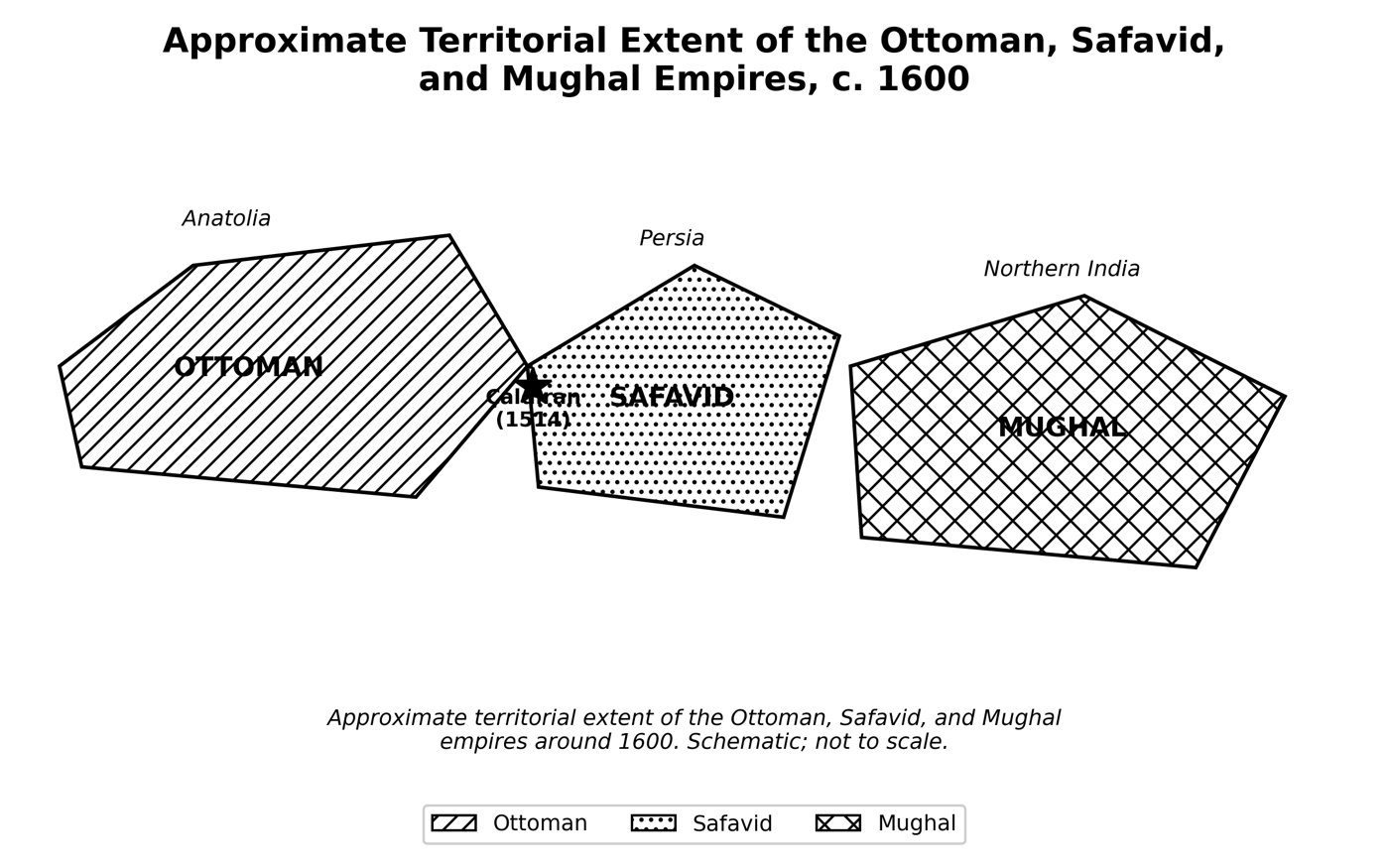
a) Identify which of the three empires occupied the largest connected territory shown on the map.
b) Describe one factor from this unit's evidence that helps explain that empire's territorial extent.
c) Explain how the map's depiction of adjacent Ottoman and Safavid territory connects to a specific conflict covered in this unit.
Scoring note: (c) requires a specific connection to the Battle of Çaldıran or the broader Sunni-Shi'a rivalry, not a vague reference to "tension between neighbors."
DBQ practice: document use and sourcing (4-document set)
Prompt: To what extent did religious policy shape how gunpowder empires governed diverse populations between 1450 and 1750?
Document 1. Constructed primary-source-style practice text, attributed to an Ottoman court chronicler, c. 1560: "The sultan protects the holy cities and upholds the Sunni faith, yet his provinces are home to many Christians and Jews who pay their taxes and follow their own laws in matters of faith."
Document 2. Constructed primary-source-style practice text, attributed to a Safavid religious scholar, c. 1550: "Since the founding of this dynasty, the true faith of the Twelve Imams has spread through the realm, and those who once followed other paths now increasingly embrace the Shi'a way."
Document 3. Constructed primary-source-style practice text, attributed to a Mughal court historian describing Akbar's reign, c. 1590: "The emperor draws his nobles from many faiths, seating Rajput commanders beside Muslim generals, and has lightened the burdens once placed upon his Hindu subjects."
Document 4. Constructed primary-source-style practice text, attributed to a European traveler describing the Ottoman Janissary corps, c. 1580: "These soldiers, raised from Christian families in the Balkans and trained from youth in the sultan's service, form the core of his infantry and owe loyalty to him alone."
Task A (document use, not summary): For Document 3, do not merely restate that Akbar drew nobles from many faiths. State what this document proves about the relationship between religious tolerance and political consolidation, and connect it explicitly to the prompt's claim.
Task B (sourcing): For Document 4, explain why the author's identity as a European traveler, rather than an Ottoman official, shapes what this document can establish about the devshirme system's function. State what that outside vantage point does to the document's reliability for this specific argument.
Task C (outside evidence): Identify one piece of specific evidence from this unit, not drawn from these four documents, that could extend this argument to address a policy of religious promotion rather than accommodation.
Scoring note for Task C: An acceptable answer might cite Safavid promotion of Twelver Shi'a conversion beyond what Document 2 alone states, extending the argument to a case of active religious promotion rather than the accommodation shown in Documents 1, 3, and 4.
LEQ practice: evidence selection, thesis, and one body paragraph
Prompt: Evaluate the extent to which religious policy, rather than military technology, explains differences among gunpowder empires' methods of governing diverse populations.
90-second evidence dump: Ottoman Sunni identity + accommodation of Christians/Jews. Safavid Twelver Shi'ism, active promotion, conversion. Mughal Akbar, relative tolerance, Rajput incorporation. Devshirme, separate loyal class, not religious accommodation itself. Çaldıran, religious rivalry driving conflict. Gunpowder shared by all three, does not explain governance differences by itself.
Thesis: While gunpowder weaponry enabled territorial expansion across the Ottoman, Safavid, and Mughal empires alike, religious policy, not military technology, explains the meaningful differences in how each empire governed its diverse population, since the Ottomans pursued pragmatic accommodation, the Safavids pursued active religious promotion, and the Mughals under Akbar pursued alliance-based tolerance, despite all three sharing comparable gunpowder-era military capability.
One evidence paragraph: The Ottoman Empire and the Safavid Empire both relied on gunpowder artillery and disciplined infantry to expand and defend their territories, evident in their shared military technology at the Battle of Çaldıran in 1514. Yet their approaches to governing religious diversity diverged sharply. Ottoman sultans maintained a Sunni identity while accommodating large Christian and Jewish populations through negotiated tax arrangements and legal autonomy in religious matters. Safavid rulers instead made Twelver Shi'ism central to state identity and actively promoted conversion among a population that had previously been mostly Sunni, using religion as a tool to sharpen political distinction from neighboring states rather than to manage existing diversity. Since both empires possessed comparable gunpowder technology, this difference in governing method demonstrates that religious policy, not military capability, accounts for the divergence between them.
Timed evidence recall (10 prompts)
1. Ottoman capture of Constantinople, 1453, Anatolia/Balkans. What does it prove? Gunpowder-enabled conquest gave the Ottomans a capital at a strategic crossing point.
2. Battle of Çaldıran, 1514, eastern Anatolia. What does it prove? Gunpowder technology alone did not determine outcomes without organization, and it deepened Ottoman-Safavid religious rivalry.
3. First Battle of Panipat, 1526, northern India. What does it prove? Field artillery and mobile cavalry established Mughal rule against a larger opposing force.
4. Devshirme system, ongoing under Ottoman rule, Balkans/Anatolia. What does it prove? The Ottoman state built a loyal administrative and military class separate from hereditary elites.
5. Safavid dynasty established, 1501, Iran. What does it prove? A new state used religious identity, Twelver Shi'ism, as a deliberate legitimacy-building tool.
6. Akbar's reign, 1556-1605, Mughal India. What does it prove? Administrative reform and alliance with local elites strengthened and stabilized imperial rule.
7. Ottoman conquest of Mamluk Egypt, 1517, Egypt/Middle East. What does it prove? Ottoman expansion extended control over key Islamic holy cities, reinforcing religious legitimacy claims.
8. Rajput incorporation into Mughal service, under Akbar, northern India. What does it prove? Local elites could be incorporated into imperial governance through alliance rather than displacement.
9. Janissary corps, Ottoman Empire, ongoing. What does it prove? A military institution could be built from converted recruits loyal directly to the ruler rather than to hereditary nobility.
10. Qing state proclaimed 1636 / Manchu conquest of Beijing 1644, China. What does it prove? A gunpowder-era land empire's expansion extended into East Asia, combining inherited Chinese bureaucracy with a separate conquest-elite institution, the Eight Banner system.
Comparison practice
Choose two of the four empires in this unit, Ottoman, Safavid, Mughal, or Qing, and compare them using exactly one of the following shared dimensions: method of incorporating diverse elites into governance, method of collecting revenue, use of religious or visual/architectural legitimation to build political authority, or administrative structures for managing a multiethnic population. Write two to three sentences naming the dimension explicitly and explaining how each empire's approach to it differed. A response that summarizes each empire separately without naming and applying the shared dimension does not meet this task's requirement.