AP World History study guide · Chapter 9
Unit 7: Global Conflict, Revolution, and Mass Violence, c. 1900–1945
Global conflict, revolution, and mass violence, c. 1900-1945
Imperial collapse and revolution in China, Russia, and the Ottoman Empire
War, nationalism, revolution, and imperial crisis weakened or destroyed several older political orders in the early twentieth century, including the Ottoman, Qing, Russian, and Austro-Hungarian empires, while the United States, Soviet Union, and Japan gained greater global influence during this same period. Revolution in 1911 ended Qing imperial rule in China and created a republic, though political fragmentation and competing movements followed rather than immediate stable governance. In Russia, the Bolsheviks seized power in 1917, and after a civil war built a new communist state that became the Soviet Union in 1922. Japan's earlier military victories over Qing China and then over Russia had already demonstrated the growing power of an industrializing non-Western state, signaling a broader shift in global power even before the world wars covered later in this unit.
Use this evidence. The Qing dynasty's 1911 collapse, followed by political fragmentation rather than immediate stability, demonstrates that the end of an old imperial order did not guarantee a smooth transition to a new one.
Chronology check. The First Sino-Japanese War, 1894 to 1895, and the Russo-Japanese War, 1904 to 1905, both predate World War I and should not be treated as Cold War or World War II-era evidence. The 1911 Qing collapse was not a communist revolution; China's communist movement, covered later in this book, develops separately and afterward. The 1917 Russian revolutions should not be treated as a postwar event, since they occurred while World War I was still underway.
Political crisis also challenged states outside the collapsing Eurasian empires during this same period. In Mexico, long rule under Porfirio Díaz concentrated political power and economic benefits among a narrow elite while many rural communities faced land loss and limited political participation. The Mexican Revolution began in 1910 as opposition to Díaz's fraudulent reelection expanded into competing revolutionary movements led by figures including Francisco Madero, Emiliano Zapata, and Pancho Villa, each pursuing a different vision of political and social change. The decade of conflict that followed eventually produced the Constitution of 1917, which asserted stronger state authority over land and subsoil resources, protected labor rights, and limited the political power of the Catholic Church. The Ottoman and Austro-Hungarian empires also disintegrated in direct connection with World War I, covered later in this unit, reshaping political boundaries across the Middle East and central and eastern Europe as new and reconfigured states emerged from their collapse.
Use this evidence. The Mexican Revolution demonstrates that early-twentieth-century challenges to existing political orders were not limited to imperial collapse in Eurasia; domestic political crisis could also produce revolutionary state restructuring in Latin America, driven by land and labor grievances rather than by the war that reshaped Europe and Asia. Ottoman and Austro-Hungarian dissolution demonstrates that a single global conflict could accelerate the collapse of multiple multinational imperial structures at once, not only one.
World War I origins: alliances, imperial rivalry, and Sarajevo
Competing alliance blocs, military planning, arms competition, imperial rivalry, and nationalist tensions made a regional crisis dangerous to contain by 1914, conditions that had been building for years before the war's actual outbreak. The assassination of Archduke Franz Ferdinand in Sarajevo triggered a diplomatic and military crisis in which Austria-Hungary, Serbia, Russia, and their respective allies were drawn into escalating confrontation through the alliance commitments each state had already made. Competition for colonies and strategic influence had already heightened distrust among the major European powers well before this crisis, meaning the assassination functioned as an immediate trigger rather than the war's underlying cause.
Use this evidence. The assassination at Sarajevo demonstrates the difference between an immediate trigger and a deeper structural cause, since the crisis became dangerous specifically because alliance commitments, military planning, and imperial rivalry had already made a regional dispute difficult to contain.
World War I: industrial weapons, mass armies, and colonial manpower
World War I mobilized mass armies, industrial production, colonial troops, and civilian economies on an unprecedented scale, combining industrial-era technology with warfare in ways that reshaped how the conflict was fought. Machine guns, artillery, poison gas, tanks, and aircraft increased firepower and casualties dramatically and contributed directly to the trench warfare and tactical stalemates that characterized much of the war's fighting. The war's manpower demands extended well beyond Europe itself: more than one million Indian soldiers and non-combatants served the British war effort, illustrating that this war's global mobilization drew directly on colonial populations and resources, not European populations alone.
Use this evidence. The mobilization of more than one million Indian soldiers and non-combatants demonstrates that World War I's global scope depended directly on colonial empires' manpower, connecting this war concretely to the imperial systems covered in the previous unit.
Chronology check. World War I ran from 1914 to 1918; tanks, gas, and aircraft belong to this industrial-era conflict and should not be treated as preindustrial warfare examples from an earlier period.
Industrial weapons explain only part of why World War I became so destructive and total in scope. Governments used conscription, rationing, war bonds, censorship, propaganda posters, newspapers, and intensified nationalist appeals to mobilize entire civilian populations, not soldiers alone, converting labor, money, and public emotion directly into military capacity. Colonial governments extended this mobilization well beyond their home territories, drawing troops, laborers, taxes, and raw materials from imperial possessions across Africa, Asia, and elsewhere.
Use this evidence. Wartime propaganda, rationing, and colonial recruitment demonstrate that World War I mobilized entire home fronts and colonial populations through political and economic means, not only battlefield weapons technology, a mechanism worth distinguishing clearly from the industrial hardware covered above.
War debts, the Great Depression, and expanding state control
War debts, reparations, inflation, disrupted trade, and financial fragility contributed to significant economic instability during the years following World War I, conditions that worsened sharply once the Great Depression began in 1929. The global economic crisis that followed produced unemployment, contracting trade, and political instability worldwide, and governments responded by expanding their role in economic life through sharply different political systems. In the United States, the New Deal used federal relief programs, financial regulation, and public-works spending to respond to economic collapse while preserving a market economy. Fascist governments in Italy and Germany used direct state direction, corporatist arrangements between government and industry, rearmament, and public works to channel production toward national goals under authoritarian control. In the Soviet Union, Lenin's New Economic Policy had temporarily allowed limited market activity before Stalin replaced it with Five-Year Plans and forced collectivization beginning around the end of the 1920s, using coercive centralized planning that came with severe human costs. Governments in Latin American states, including Brazil and Mexico, also expanded direct state direction of economic development during this same period. The important comparison is not that economic crisis produced one universal solution; it is that instability pushed governments operating under very different political systems toward a more active role in economic life.
Use this evidence. The New Deal, fascist corporatist intervention, and Soviet Five-Year Plans together demonstrate three genuinely different methods governments used to expand economic control during the same broad crisis. Compare the specific method and political system each government used before comparing the results those methods produced.
Chronology check. The Great Depression began in 1929, about eleven years after World War I ended in 1918, and should not be treated as a post-World War II event; its onset and worsening effects belong squarely to the interwar period this unit covers.
The postwar settlement, mandates, and the failure of collective security
Postwar settlements redrew borders, imposed mandates and reparations, and left many ethnic and national disputes unresolved, creating conditions that contributed directly to later instability. Former Ottoman territories were placed under British and French mandates, an arrangement that combined rhetoric about self-determination with continued foreign control, a contradiction that colonized and formerly colonized peoples noticed directly. This gap between wartime promises and postwar reality helped intensify nationalist and anti-colonial movements in places including India and China, where disappointment with unfulfilled self-determination promises fed into broader political mobilization. Meanwhile, Germany, Italy, and Japan increasingly challenged aspects of the postwar settlement itself and pursued openly expansionist goals during this same period.
Use this evidence. The mandate system's combination of self-determination rhetoric with continued foreign control demonstrates a specific contradiction that colonized peoples directly experienced and responded to, not an abstract postwar disappointment.
Territorial control after World War I combined genuine change with striking continuity. Germany lost its overseas colonies as a result of the war, but many of those territories did not become independent; Britain and France instead received control over them through the League of Nations mandate system, converting German colonial rule into British or French colonial rule rather than into self-government. Japan expanded its own imperial position during the same broader era, later establishing the puppet state of Manchukuo in Manchuria and promoting a Greater East Asia Co-Prosperity Sphere as its wartime empire expanded further. Anti-imperial resistance continued and grew throughout this period. The Indian National Congress pressed British colonial rule through mass politics and organized civil disobedience, while strikes, political congresses, and other organized resistance challenged French colonial rule in parts of West Africa.
Use this evidence. The transfer of German colonies to British and French mandate control demonstrates that a change in which specific power ruled a territory is not the same as a change from foreign to self-rule; state the dimension you are measuring, ruling power or actual political control, before calling this development change or continuity. The Indian National Congress and West African resistance movements demonstrate that anti-imperial political organizing continued and grew throughout the interwar period, not only after World War II.
Chronology check. The 1919 Treaty of Versailles created the League of Nations, not the United Nations, which was founded later, in 1945, after World War II; confusing these two international organizations misplaces this evidence by over two decades.
Japanese, Italian, and German expansion before World War II
German, Italian, and Japanese expansion, combined with weak collective-security responses from other major powers and unresolved interwar grievances, produced escalating international crises during the 1930s. Japan seized Manchuria in 1931 and expanded its war against China in 1937, reflecting resource, strategic, and nationalist motivations tied directly to Japan's own industrial and imperial ambitions. Adolf Hitler became German chancellor in 1933, and Depression-era economic pressures intensified political radicalization and resource-security concerns in several states during this same decade, conditions that Italian invasion of Ethiopia and eventual German invasion of Poland in 1939 escalated further. Britain and France's policy of accepting some German treaty violations and territorial expansion, seeking to avoid another war, failed to prevent the escalation these actions were meant to contain.
Use this evidence. Japan's 1931 seizure of Manchuria demonstrates that expansionist aggression in Asia began years before the European conflict most people associate with World War II's start, requiring a genuinely global rather than Europe-centered account of the war's origins.
Chronology check. Japan's seizure of Manchuria in 1931 was not a response to war already underway in Europe, since it predates the 1939 German invasion of Poland by eight years. Hitler's rise to power in 1933 occurred well before World War II began, not after.
World War II: total war, home fronts, and civilian mobilization
World War II combined mechanized land warfare, strategic bombing, naval-air power, and mass mobilization of both military and civilian resources across Europe, Asia, Africa, the Pacific, and the Americas, making it a genuinely global conflict rather than one centered on a single region. Governments rationed resources, redirected industry toward war production, mobilized women into industrial and other roles, and used propaganda extensively while civilian populations faced direct threats from bombing and occupation in ways that blurred the line between military and civilian experience of the war. The United States' use of atomic bombs against Hiroshima and Nagasaki in August 1945 introduced nuclear weapons into global conflict for the first time. The bombings contributed to the crisis that produced Japan's surrender at the end of the war and opened a new category of military technology whose consequences extended well beyond 1945.
Use this evidence. The atomic bombings demonstrate an event that contributed to the war's end while simultaneously opening a new chapter in military technology, a dual significance worth distinguishing when evaluating this evidence's use in different arguments. Treating the bombings as the sole cause of Japan's surrender overstates a single factor in a more complex crisis that also included the Soviet Union's entry into the Pacific war.
Chronology check. World War II ran from 1939 to 1945; nuclear weapons were not used or widely available throughout the war but only at its very end, in August 1945, and should not be treated as a common feature of the conflict before that date.
State-organized mass violence: Armenian genocide, Holodomor, and Holocaust
Mass atrocity during this period took multiple distinct forms across different states and conflicts, and this pattern continued well past the two world wars rather than ending with them. Ottoman authorities deported and killed large numbers of Armenians during World War I, a campaign widely recognized as genocide and occurring years before the atrocities of World War II. In Soviet Ukraine in the early 1930s, forced collectivization and harsh grain requisition under Stalin produced a man-made famine, the Holodomor, that killed millions even as the Soviet state continued exporting grain, a policy choice many historians and governments classify as genocide. Nazi Germany and its collaborators systematically persecuted and murdered six million Jews during the Holocaust, alongside millions of other victims including Roma people, disabled individuals, and other targeted groups, an atrocity organized through deliberate state policy and supported by propaganda that framed targeted groups as dangerous outsiders to normalize exclusion and violence. Japanese imperial warfare in China and elsewhere included mass killings, forced labor, and sexual violence against civilian populations, a distinct pattern of wartime atrocity connected to Japan's own expansionist campaign covered earlier in this unit. This pattern did not end in 1945. Under the Khmer Rouge in Cambodia from 1975 to 1979, radical agrarian ideology, forced labor, starvation, and executions killed roughly a quarter of the country's population, targeting intellectuals, ethnic minorities, and perceived class enemies. In Rwanda in 1994, extremist Hutu leaders and militias organized the genocide of the Tutsi minority and moderate Hutu opponents over roughly one hundred days, killing hundreds of thousands of people while the international community largely failed to intervene. These documented atrocities, among other factors, later contributed to the creation of the United Nations and the adoption of the Universal Declaration of Human Rights as an institutional response, though that response did not prevent the later cases this section covers.
Use this evidence. The Armenian genocide, the Holodomor, and the Holocaust demonstrate that mass atrocity organized through deliberate state policy was not confined to a single conflict, a single targeted group, or even a single decade before 1945. The Khmer Rouge and the Rwandan genocide demonstrate that this same pattern continued for decades after World War II ended, so a Unit 7 argument about mass atrocity that stops at 1945 does not cover this topic's actual c.1900-to-present scope. Do not treat "genocide" or "atrocity" as one interchangeable label; identify the specific actor, targeted population, mechanism of violence, and political setting before comparing any two cases.
Chronology check. The Universal Declaration of Human Rights, adopted in 1948, does not function as a legally enforceable world constitution; treating it as such overstates its actual institutional authority.
World War I and World War II: causes and escalation
The world wars grew from different combinations of nationalism, imperial competition, alliance and security problems, economic crisis, ideological extremism, and expansionist state action, though the specific weight and combination of these factors differed between the two conflicts. World War I emerged primarily from alliance commitments, imperial rivalry, and nationalist tension escalating rapidly after a single triggering assassination, while World War II emerged from a more extended sequence of expansionist aggression, unresolved interwar grievances, and failed collective-security responses across multiple years and multiple regions, including Asia well before the European conflict most narratives emphasize. Later mass atrocities show that organized violence after 1900 cannot be explained by world war alone: concentrated political power, extremist ideology, ethnic or racial classification, civil conflict, and the weakening of restraints on coercive power could produce catastrophic violence in different settings across the full span from the Armenian genocide through Rwanda in 1994, not only during the two world wars themselves. World wars also expanded government control over economies, labor, information, and military mobilization in both cases, creating institutional patterns of state intervention that outlasted the conflicts themselves.
Comparison dimension. When comparing the causes of these conflicts and atrocities, distinguish trigger from structural cause explicitly: an immediate event such as the Sarajevo assassination or the invasion of Poland mattered because it operated within deeper conditions already present, not because the trigger alone explains the outcome. For causation questions spanning this unit's full c.1900-to-present scope, name the immediate trigger separately from the deeper condition, then state the mechanism connecting the two. A response that treats either war's trigger as its sole cause, or that stops its causal account at 1945 despite a prompt covering the full period, does not meet this unit's causation task.
Unit 7 practice: global conflict, revolution, and mass violence
Multiple-choice practice (24 questions, 6 stimulus sets)
Set A: Questions 1-4
Constructed historian's summary: imperial crisis and new powers.
> The Qing dynasty collapsed in 1911 after decades of internal crisis > and foreign pressure. In Russia, the Bolsheviks seized power in 1917 > during the disruption of World War I. Meanwhile, Japan had already > demonstrated growing military power through victories over Qing China > and Russia. The early twentieth century therefore combined the > weakening of older imperial orders with the rise of new political and > military powers.
Question 1
- A. All older empires remained stable throughout this period
- B. Only European empires experienced political change
- C. Japan had no military capacity during this period
- D. War, revolution, and imperial crisis weakened several older political orders while new powers gained influence
Show the answer and explanation
Question 2
- A. An immediate transition to stable communist government
- B. A revolution followed by political fragmentation rather than immediate stable governance
- C. An event with no connection to Chinese politics
- D. A restoration of the previous imperial dynasty
Show the answer and explanation
Question 3
- A. Treating it as World War II-era evidence, when it occurred in 1904-1905, decades earlier
- B. Dating it to the early twentieth century
- C. Connecting it to Japan's rising global influence
- D. Noting Russia's involvement
Show the answer and explanation
Question 4
- A. Connected to World War I, since it occurred while the war was still underway
- B. A postwar event, since it occurred before World War I had ended
- C. The origin of the later Soviet Union
- D. A significant political change in Russia
Show the answer and explanation
Set B: Questions 5-8
Constructed historian's summary: Sarajevo and alliance escalation.
> The assassination of Archduke Franz Ferdinand at Sarajevo in June > 1914 created an immediate diplomatic crisis. Because major European > states were already tied through alliance commitments, military > planning, imperial rivalry, and nationalist tensions, the crisis > expanded far beyond Austria-Hungary and Serbia. The assassination > functioned as a trigger within deeper structural conditions rather > than as the sole cause of the war.
Question 5
- A. The assassination functioned as an immediate trigger within deeper conditions of alliance commitment, imperial rivalry, and nationalist tension already present
- B. The assassination was the sole and complete cause of the war with no other contributing factor
- C. Alliance systems had no bearing on how the crisis escalated
- D. Imperial rivalry played no role in this crisis
Show the answer and explanation
Question 6
- A. European powers experienced no competition over colonies before 1914
- B. Colonial competition had no connection to European tensions
- C. Military planning played no role in pre-war tensions
- D. Competition for colonies and strategic influence heightened distrust among major powers before 1914
Show the answer and explanation
Question 7
- A. The crisis escalated specifically because preexisting alliance commitments and military planning drew multiple states into conflict
- B. No assassination actually occurred in 1914
- C. Austria-Hungary was not involved in this crisis
- D. Serbia had no connection to this crisis
Show the answer and explanation
Question 8
- A. Prevent any escalation of the Sarajevo crisis
- B. Keep the conflict limited to Austria-Hungary and Serbia alone
- C. Eliminate imperial rivalry as a factor in European relations
- D. Draw multiple additional major powers into an escalating conflict once the initial crisis began
Show the answer and explanation
Set C: Questions 9-12
Constructed historian's summary: industrialized total war.
> World War I combined machine guns, heavy artillery, poison gas, > tanks, and aircraft with mass conscription and trench warfare. The > conflict also drew heavily on imperial manpower: more than one > million Indian soldiers and non-combatants served the British war > effort. Industrial technology and imperial resources expanded both > the destructive capacity and the geographic reach of warfare.
Question 9
- A. World War I involved only European populations
- B. Colonial empires provided no resources to European war efforts
- C. World War I's global scope depended directly on colonial empires' manpower, not European populations alone
- D. India was not a British colonial territory during this period
Show the answer and explanation
Question 10
- A. Nuclear weapons and jet aircraft
- B. Machine guns, artillery, poison gas, tanks, and aircraft
- C. Sailing ships and cavalry alone
- D. Telegraph networks exclusively
Show the answer and explanation
Question 11
- A. Preindustrial warfare involved no weapons technology at all
- B. Tanks and gas were never used in World War I
- C. These technologies belong specifically to World War I's industrial-era warfare, occurring from 1914 to 1918
- D. World War I occurred before industrialization began
Show the answer and explanation
Question 12
- A. Limited entirely to a single European front
- B. Unrelated to industrial economies covered earlier in this book
- C. Identical to conflicts fought a century earlier
- D. Warfare mobilized and reshaped by industrial-era technology and imperial manpower on an unprecedented scale
Show the answer and explanation
Set D: Questions 13-16
Constructed historian's summary: interwar economic crisis and policy change.
> War debts, reparations, and disrupted trade following World War I > left many economies unstable through the 1920s. That instability > worsened sharply when the Great Depression began in 1929, a decade > before World War II began in 1939. In the Soviet Union, Lenin's New > Economic Policy had temporarily permitted limited private trade and > small-scale market activity after the disruption of revolution and > civil war; under Stalin, the state later replaced this partial > market opening with centralized economic planning and forced > collectivization. The Soviet shift shows that a single state could > adopt sharply different economic policies within a relatively short > period.
Question 13
- A. Economic crisis could produce very different policy responses even within a single state over a relatively short period
- B. All states responded to economic crisis identically
- C. The Soviet Union experienced no economic policy change during this period
- D. Centralized planning existed before Lenin's New Economic Policy
Show the answer and explanation
Question 14
- A. World War II caused the Great Depression directly
- B. The Great Depression began in 1929, a decade before World War II began in 1939
- C. No economic crisis occurred during the interwar period
- D. The Great Depression occurred entirely within a single country
Show the answer and explanation
Question 15
- A. Identical to Stalinist centralized planning
- B. A policy adopted after Stalin's rule began
- C. A temporary allowance of limited market activity, later replaced by centralized planning under Stalin
- D. A policy with no connection to Soviet economic history
Show the answer and explanation
Question 16
- A. Guarantee immediate postwar economic stability
- B. Contribute to significant economic instability that worsened sharply once the Great Depression began
- C. Have no connection to the Great Depression
- D. Affect only defeated states with no impact on victors
Show the answer and explanation
Set E: Questions 17-20
Constructed historian's summary: mandate system.
> After World War I, former Ottoman territories including Iraq, > Palestine, Syria, and Lebanon were placed under British or French > mandates. The system used the language of preparation for > self-government while maintaining substantial foreign administrative > control. This contradiction between self-determination rhetoric and > continued imperial authority contributed to nationalist mobilization.
Question 17
- A. Self-determination was immediately and fully applied to all former Ottoman territories
- B. The mandate system had no connection to colonized peoples' political responses
- C. Former Ottoman territories became fully independent immediately after World War I
- D. A specific contradiction between self-determination rhetoric and continued foreign control directly shaped colonized peoples' political responses
Show the answer and explanation
Question 18
- A. Complete satisfaction with postwar settlements
- B. A process entirely unrelated to wartime promises
- C. Disappointment with unfulfilled self-determination promises feeding into broader political mobilization
- D. Military defeat in World War I
Show the answer and explanation
Question 19
- A. No international organization was created after World War I
- B. The League of Nations and United Nations are identical organizations
- C. Versailles predates World War I
- D. Versailles created the League of Nations, not the United Nations, which was founded later, in 1945
Show the answer and explanation
Question 20
- A. Expansionist goals pursued amid unresolved interwar grievances
- B. Complete acceptance of all postwar treaty terms
- C. Unrelated to the mandate system or self-determination contradictions
- D. Limited entirely to diplomatic protest with no territorial ambition
Show the answer and explanation
Set F: Questions 21-24
Constructed chronology: expansion before global war.
> Japan seized Manchuria in 1931 and expanded its war in China during > the 1930s. Germany invaded Poland in September 1939, beginning the > major European phase of World War II. The chronology shows that > expansionist aggression in Asia was already underway years before the > European war began.
Question 21
- A. World War II began simultaneously in Asia and Europe in 1939
- B. Expansionist aggression in Asia began years before the European conflict most narratives emphasize
- C. Japan's actions had no connection to World War II
- D. Germany's invasion of Poland was the first act of aggression in this broader conflict
Show the answer and explanation
Question 22
- A. Europe experienced no conflict during this period
- B. Manchuria is located in Europe
- C. Manchuria was seized in 1931, eight years before the 1939 German invasion of Poland that is often cited as marking World War II's European start
- D. Japan had no military capacity in 1931
Show the answer and explanation
Question 23
- A. An event occurring well before World War II began in 1939, not after
- B. An event occurring after World War II had already begun
- C. Unrelated to Depression-era economic pressures
- D. The immediate cause of the Sarajevo assassination
Show the answer and explanation
Question 24
- A. A policy that successfully prevented any further German expansion
- B. A policy with no connection to preventing war
- C. An attempt to avoid another war that failed to prevent the escalation it was meant to contain
- D. A policy adopted only after World War II had ended
Show the answer and explanation
Short-answer practice
SAQ 1: Constructed secondary-source-style practice text (not a published historian's interpretation). Source: a constructed historian's summary. "Between 1900 and 1945, older imperial orders collapsed or weakened while two global conflicts reshaped political boundaries, economic systems, and the balance of power among states."
a) Identify one older empire covered in this unit that weakened or collapsed during this period.
b) Describe one specific consequence of that empire's weakening or collapse.
c) Explain how one development connected to World War I contributed to conditions that later shaped World War II.
Scoring note: (c) requires a specific, evidence-based connection, such as unresolved mandate-system grievances or postwar economic instability feeding into 1930s radicalization, not a vague statement that "WWI led to WWII."
SAQ 2: Constructed primary-source-style practice text (not an authentic historical document). Source: a constructed excerpt attributed to a British colonial official describing the mandate system in a former Ottoman territory, c. 1920.
a) Identify the arrangement described in this source.
b) Describe one specific detail from the source demonstrating how this arrangement combined self-determination rhetoric with continued foreign control.
c) Explain why a British colonial official, rather than a local political leader, might describe this arrangement differently than colonized subjects experiencing it.
Scoring note: (c) requires connecting the author's administrative position to a plausible difference in emphasis or perspective, not a generic claim that "all sources are biased."
SAQ 3: Non-text source.
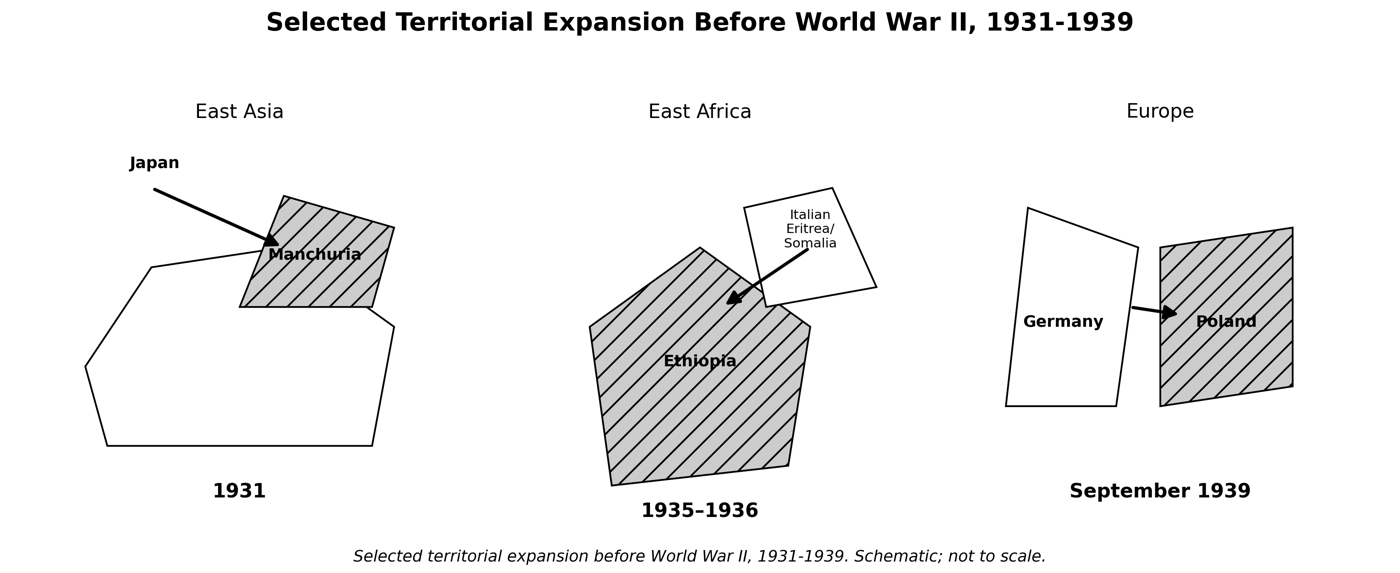
a) Identify the general pattern of expansion shown on the map.
b) Describe one specific event from this unit's evidence represented on the map.
c) Explain how this map challenges a Europe-centered account of World War II's origins.
Scoring note: (c) requires an explicit reference to Japan's 1931 Manchuria seizure predating the 1939 European invasion, not a general statement that "the war was global."
DBQ practice: document use and sourcing (4-document set)
Prompt: To what extent did unresolved World War I grievances, rather than the Great Depression alone, contribute to the outbreak of World War II?
Document 1. Constructed primary-source-style practice text, attributed to a German political commentator, c. 1922: "The burdens placed upon us at Versailles have not faded with time; resentment over reparations and lost territory remains as sharp as it was the day the treaty was signed."
Document 2. Constructed primary-source-style practice text, attributed to an economist writing during the Depression's early years, c. 1931: "Unemployment and collapsed trade have done what the treaty alone could not: they have made desperate men receptive to any leader who promises a way out."
Document 3. Constructed primary-source-style practice text, attributed to a colonial subject in a mandate territory, c. 1925: "We were promised self-determination, yet foreign administrators still govern us in all but name, a betrayal that has not been forgotten."
Document 4. Constructed primary-source-style practice text, attributed to a Japanese military officer describing the 1931 Manchuria action, c. 1932: "Our resource needs and strategic security could no longer wait on the patience of diplomats in Geneva who have shown little interest in our position."
Task A (document use, not summary): For Document 1, do not merely restate that resentment over Versailles remained sharp. State what this document proves about the relationship between unresolved World War I grievances and later political radicalization, and connect it explicitly to the prompt's claim.
Task B (sourcing): For Document 2, explain why the author's position as an economist writing during the Depression's early years, rather than a political historian writing after World War II, shapes what this document can and cannot establish about the relative weight of economic versus treaty-based grievances. State what that position does to the document's reliability for this specific argument.
Task C (outside evidence): Identify one piece of specific evidence from this unit, not drawn from these four documents, that could extend this argument to a case of grievance-driven expansion occurring before the Great Depression began.
Scoring note for Task C: Manchuria is already the subject of Document 4 and does not count as outside evidence here. An acceptable answer instead cites Japan's Twenty-One Demands, presented to China in January 1915, which pressed for expanded Japanese control over Manchuria, Shandong, and other Chinese territory well before the Great Depression began, extending the argument to a case of pre-1929 expansionist pressure genuinely independent of these four documents.
LEQ practice: evidence selection, thesis, and one body paragraph
Prompt: Evaluate the extent to which World War II's origins in Asia differed from its origins in Europe.
90-second evidence dump: Japan seizes Manchuria, 1931, resource/ strategic/nationalist motives. Full-scale Sino-Japanese War, 1937. Germany, Hitler 1933, Depression-era radicalization, Versailles grievances. Appeasement, failed collective security in both contexts. Structural causes vs trigger in Europe (Sarajevo) vs extended sequence in Asia.
Thesis: While both the European and Asian origins of World War II involved expansionist states exploiting weak collective-security responses, the two theaters differed in timing and immediate motivation, since Japan's expansion began in 1931 with Manchuria, driven primarily by resource and strategic considerations tied to its own industrial and imperial position, while Germany's expansion, driven more directly by Depression-era radicalization and unresolved Versailles grievances, escalated later in the 1930s, showing that a single European-centered timeline does not adequately capture the war's actual global origins.
One evidence paragraph: Japan's seizure of Manchuria in 1931 reflected resource needs, strategic security concerns, and nationalist ambitions connected to Japan's own rising industrial and military power, expanding into full-scale war against China by 1937, years before Germany's most aggressive expansionist actions began. Germany's expansion, by contrast, accelerated more directly out of Depression-era economic radicalization following Hitler's 1933 rise to power and lingering resentment over the Treaty of Versailles, escalating through the later 1930s toward the 1939 invasion of Poland. This difference in timing and immediate motivation demonstrates that treating 1939 as the uniform starting point for World War II obscures a genuinely earlier and separately motivated Asian theater of expansion.
Timed evidence recall (10 prompts)
1. Qing dynasty collapses, 1911, China. What does it prove? Revolution ended an old imperial order but produced fragmentation rather than immediate stability.
2. Bolshevik seizure of power, 1917, Russia. What does it prove? Revolution occurred while World War I was still underway, not afterward.
3. Sarajevo assassination and July Crisis, 1914, Austria-Hungary/ Serbia. What does it prove? An immediate trigger escalated because deeper alliance and rivalry conditions already existed.
4. Indian soldiers in WWI, 1914-1918, British Empire. What does it prove? World War I's global scope depended directly on colonial manpower.
5. Great Depression begins, 1929, global. What does it prove? Interwar economic instability worsened sharply, about eleven years after World War I ended.
6. Mandate system, established after 1919, former Ottoman territories. What does it prove? Self-determination rhetoric combined with continued foreign control, provoking direct political response.
7. Japan seizes Manchuria, 1931, East Asia. What does it prove? Expansionist aggression in Asia began years before Germany's 1939 invasion of Poland.
8. Hitler becomes German chancellor, 1933, Germany. What does it prove? Depression-era radicalization contributed directly to authoritarian political change well before World War II began.
9. Atomic bombings of Hiroshima and Nagasaki, August 1945, Japan. What does it prove? A war-ending event simultaneously introduced a new category of military technology.
10. Armenian genocide, World War I era, Ottoman Empire. What does it prove? State-organized mass atrocity occurred years before the Holocaust, not only during World War II.
Comparison practice
Choose two examples of mass atrocity or state violence from this unit, the Armenian genocide, the Holocaust, or Japanese wartime atrocities in China, and compare them using exactly one of the following shared dimensions: the role of deliberate state policy, the use of propaganda or ideological justification, or the scale and target population involved. Write two to three sentences naming the dimension explicitly and explaining how each example differed. A response that summarizes each atrocity separately without naming and applying the shared dimension does not meet this task's requirement.