AP World History study guide · Chapter 10
Unit 8: Cold War Rivalry and Decolonization, c. 1945–1991
Cold War rivalry and decolonization, c. 1945-1991
Postwar superpowers: the United States and Soviet Union
World War II left European colonial and imperial powers financially and militarily weakened, while the United States and Soviet Union emerged as rival superpowers with competing political and economic systems and the industrial-military capacity to project power globally. This shift did not simply replace one set of great powers with another. War weakened European colonial empires directly, and anti-colonial movements gained legitimacy and momentum as a direct consequence, connecting this new bipolar order to the decolonization process covered later in this unit.
Use this evidence. The connection between weakened European colonial powers and gained legitimacy for anti-colonial movements demonstrates that postwar bipolarity and decolonization were linked developments, not separate, unrelated processes.
Chronology check. The United Nations was founded in 1945, after World War II ended; it does not predate the war. The Truman Doctrine and the beginning of the containment era date to 1947, not to World War I, and should not be treated as an earlier policy.
NATO, the Warsaw Pact, and divided Europe
The United States pursued a policy of containment, using economic aid, alliances, and military commitments, including the Marshall Plan, to limit Soviet influence, while the Soviet Union consolidated allied communist governments and security structures across Eastern Europe. NATO formed in 1949 as a Western collective-defense alliance, while the Warsaw Pact formed later, in 1955, specifically following West Germany's integration into the Western alliance system, meaning these two alliance structures did not emerge simultaneously. Not every state accepted this binary alignment: states such as India, Indonesia, Egypt, and Yugoslavia sought room for independent diplomacy outside formal alignment with either superpower bloc, a position that later developed into the Non-Aligned Movement covered further in this unit.
Use this evidence. The six-year gap between NATO's 1949 founding and the Warsaw Pact's 1955 founding demonstrates that Soviet bloc consolidation responded directly to specific Western actions rather than occurring on a parallel, simultaneous timeline.
Chronology check. NATO was founded in 1949 and the Warsaw Pact in 1955; giving both alliances the same founding year misrepresents this six-year gap and its specific trigger.
Korea, Vietnam, Afghanistan, and Cold War proxy conflict
Cold War rivalry contributed to wars and interventions in Korea, Vietnam, Afghanistan, Latin America, and elsewhere, often transforming local political conflicts into contests between superpower-aligned forces. The Korean War became a major Cold War conflict after North Korea's invasion of South Korea, involving United States-led United Nations forces and Chinese intervention, ending in an armistice rather than a formal peace treaty or a decisive victory for either side. The Soviet invasion of Afghanistan generated a prolonged conflict involving Afghan resistance fighters supported by outside states, a war that continued for years after the initial Soviet invasion.
Use this evidence. The Korean War's ending in armistice rather than formal peace demonstrates that Cold War proxy conflicts did not always produce a clear resolution, complicating any simple narrative of victory or defeat in these localized contests.
Chronology check. The Korean War, 1950 to 1953, was not a direct declared war between the United States and the Soviet Union themselves, even though both superpowers backed opposing sides. The Soviet-Afghan War, 1979 to 1989, did not end simply because Soviet forces eventually withdrew; conflict in Afghanistan continued well beyond that withdrawal.
Nuclear weapons reshaped Cold War rivalry even when the superpowers did not fight each other directly. The United States and Soviet Union built increasingly large nuclear arsenals during this period, and deterrence, the idea that mutual destruction was too costly to risk, reduced the incentive for direct superpower war while raising the stakes of any miscalculation and making arms control a central diplomatic concern. Proxy conflict extended well beyond Korea and Afghanistan into Africa and Latin America. The Angolan Civil War drew rival outside powers into supporting different factions after Portuguese colonial rule ended, turning a domestic conflict into another Cold War battleground. In Nicaragua, the Soviet- and Cuban-aligned Sandinista government and the United States-backed Contra forces turned a domestic and regional struggle into a further Cold War arena during the 1980s.
Use this evidence. The nuclear arms race demonstrates that Cold War competition reshaped superpower relations even without direct combat between the superpowers themselves. Angola and Nicaragua demonstrate that proxy conflict extended well beyond the Asian cases most often emphasized, and that local actors in these conflicts pursued their own goals even as superpower support shaped the conflict's scale and duration.
Communist revolution in China and competing paths to land reform
Communist movements drew on Marxist ideas but developed differently depending on local conditions, producing distinct outcomes in industrial Russia, largely agrarian China, and other contexts covered across this unit. The Chinese Communist Party, led by Mao Zedong, took national power in 1949 after decades of civil war, Japanese invasion, and rural mobilization, proclaiming the People's Republic of China and defeating the rival Nationalist government. Mao's government subsequently framed anti-colonial and racial struggles abroad, including within the United States, as part of a broader global fight against imperialism, using propaganda that connected China's revolutionary identity to international movements beyond its own borders.
Use this evidence. Mao's framing of anti-colonial and racial struggles abroad as part of a global anti-imperial fight demonstrates that Chinese communism positioned itself deliberately within a global political narrative, not only a domestic one.
Chronology check. The People's Republic of China was established in 1949; this event should not be confused with the later Cultural Revolution, a distinct and later period in Chinese communist history. Mao's 1963 statement on U.S. racial discrimination should not be read as a neutral, purely descriptive account of American politics, given its explicit propaganda function.
Communist victory in China changed economic and social policy directly. Mao's Great Leap Forward, launched in 1958, attempted to accelerate industrial and agricultural production simultaneously by forcing peasants into large collective communes and promoting small-scale backyard steel production. Coercive implementation, falsified production reporting, and severe policy failure combined to produce a catastrophic famine, killing tens of millions of people before the campaign was abandoned in 1962. Redistributing land and economic resources was not confined to China or to communist revolution alone. Vietnamese communists linked national independence directly to social and economic restructuring. Ethiopia under the Marxist military government of Mengistu Haile Mariam pursued radical land redistribution following the overthrow of the monarchy. Kerala and other Indian states pursued land reform through ordinary electoral politics rather than revolution. Iran's White Revolution redistributed some agricultural land from large estates while Iran itself remained a monarchy aligned with the West, not a communist state at all.
Use this evidence. The Great Leap Forward demonstrates how a communist government's concentrated state power could pursue rapid economic transformation with catastrophic human costs, evidence worth comparing directly to Soviet collectivization's similar pattern and consequences. Comparing Vietnam, Ethiopia, Kerala, and Iran demonstrates that similar land- and resource-redistribution goals could be pursued through revolution, military rule, ordinary electoral politics, or even top-down monarchy; the method used, not only the stated goal, is the dimension that comparison requires.
Decolonization: negotiated independence, partition, and armed struggle
Colonized peoples achieved independence through varied methods, including negotiated transfer, mass civil resistance, guerrilla warfare, and diplomatic pressure, with the specific path depending heavily on local conditions and the colonial power involved. British India became independent in 1947 and was partitioned into India and Pakistan, producing mass migration and significant communal violence as a direct consequence of this partition. Ghana became independent from Britain in 1957 under Kwame Nkrumah, becoming a major symbol of African decolonization and encouraging further independence movements across the continent during the following years.
Use this evidence. Indian partition's mass migration and communal violence demonstrates that decolonization's immediate human costs could be severe even when independence itself represented the end of formal colonial rule.
Chronology check. Indian independence and partition occurred in 1947; this should not be treated as a later Cold War-driven event, since it predates most of the Cold War proxy conflicts covered earlier in this unit. The major wave of African and Asian decolonization spanned roughly the 1950s through the 1970s and should not be treated as a single simultaneous event with one identical independence date across all states.
Decolonization's varied methods fall into recognizable patterns worth comparing directly. India and Ghana achieved independence largely through negotiation and mass political mobilization rather than sustained armed conflict, even though India's partition itself produced severe violence. Other movements fought prolonged armed struggles against colonial rule. Algerian nationalists defeated French colonial rule only after a brutal war ending in 1962. Angola fought a war against Portuguese rule before achieving independence in 1975, after which a civil war involving outside Cold War intervention followed almost immediately. Vietnam fought first against French colonial rule and then became central to a much wider Cold War conflict. Decolonization also produced movements that challenged the boundaries of new or existing states themselves, rather than simply replacing a colonial ruler with a national government: the Muslim League's campaign contributed directly to Pakistan's creation as a separate state from India, and separatist movements including Biafran secessionism within Nigeria pursued independence from a newly independent state rather than from a colonial power.
Use this evidence. Comparing India and Ghana's negotiated independence with Algeria, Angola, and Vietnam's armed independence requires naming the method, colonial ruler, and resulting political structure explicitly rather than asserting that decolonization was simply peaceful or simply violent as a single universal pattern. Separatist movements like Biafra demonstrate a further category: resistance aimed at a new independent state's own boundaries, not only at a colonial power.
Postcolonial states: borders, economies, and Cold War pressure
Newly independent states faced significant challenges after achieving formal political independence, including borders inherited from colonial administration rather than drawn along ethnic or regional lines, heavy dependence on commodity exports, limited infrastructure, and direct Cold War pressure to align with one superpower bloc or the other. Postcolonial leaders sought cooperation and greater bargaining power through Afro-Asian diplomatic conferences and later the Non-Aligned Movement, whose first summit convened at Belgrade in 1961. Non-Aligned states also criticized unequal global economic structures directly, issuing their own economic declaration at the 1973 Algiers summit. This pressure helped prompt the United Nations General Assembly to adopt the Declaration on the Establishment of a New International Economic Order in 1974, calling for developing states to gain greater control over resources, trade terms, and international economic decision-making.
Use this evidence. The 1973 Algiers declaration and the 1974 New International Economic Order resolution together demonstrate that newly independent states pursued economic, not only political, changes to the postcolonial global order they had inherited, working through both their own diplomatic coalition and formal United Nations channels.
New borders created by decolonization produced new states and, in some cases, severe new displacement. The partition of British India created both India and Pakistan. The creation of Israel in 1948 produced war and large-scale displacement in a territory already reshaped by the end of the British Mandate. Newly independent governments frequently took a strong, direct role in guiding economic development rather than relying primarily on private markets: Gamal Abdel Nasser in Egypt, Julius Nyerere in Tanzania, and Sirimavo Bandaranaike in Sri Lanka each pursued state-directed development strategies, including nationalization and public investment, though the specific policies and political systems they used differed. Decolonization also redirected migration flows rather than ending contact between former colonies and former colonial powers. South Asians moved to Britain, Algerians moved to France, and other former colonial subjects relocated to the states that had once ruled them, maintaining economic, family, and cultural links between former colonies and their former imperial metropoles even after formal political independence.
Use this evidence. Comparing Nasser, Nyerere, and Bandaranaike's state-directed development strategies demonstrates a shared method across different regions and political systems, useful evidence for a development-focused comparison. Postcolonial migration to former imperial metropoles demonstrates that political independence could coexist with continued migration and institutional ties to the former colonial center, not a clean break between colonizer and colonized.
Chronology check. The Non-Aligned Movement's first summit convened at Belgrade in 1961; this movement functioned as a diplomatic and political coalition, not a military alliance comparable to NATO or the Warsaw Pact. The Non-Aligned Movement's own economic declaration, issued at Algiers in 1973, is a separate document from the United Nations General Assembly's 1974 Declaration on the Establishment of a New International Economic Order; do not merge these two documents or their dates. Neither document became binding global policy; treating either as enforced international rules overstates its actual institutional authority.
Rights and protest movements against racial and political hierarchy
Civil-rights, anti-apartheid, feminist, student, and anti-authoritarian movements challenged established racial, political, and social hierarchies across multiple regions during this period, often drawing on shared tactics and language even when addressing different specific systems of inequality. In South Africa, the African National Congress and other groups challenged apartheid through protest, organizing, and international campaigning, a struggle Nelson Mandela addressed directly in his 1964 Rivonia Trial speech, where he framed opposition to apartheid around racial equality, political rights, and African nationalism while defending the movement's objectives before the court that would ultimately convict him.
Use this evidence. Mandela's Rivonia Trial speech demonstrates a direct, documented articulation of anti-apartheid goals from within a formal legal proceeding, not merely a later retrospective account of the movement's aims.
Resistance to established power after 1900 ranged across a wide spectrum, from disciplined nonviolence to state repression to political violence by nonstate actors, and these forms should not be collapsed into one undifferentiated category of "resistance." Mahatma Gandhi, Martin Luther King Jr., and Nelson Mandela each used or defended forms of nonviolent mass politics to challenge imperial, racial, or legal hierarchies from outside formal state power. Other governments responded to internal challenges by intensifying repression, coups, and militarized control: Chile under Augusto Pinochet and Uganda under Idi Amin illustrate how established or newly seized state power itself could become the instrument of severe political violence against a government's own population. Still other actors pursued political goals through violence directed at civilians from outside formal state power altogether: Peru's Shining Path and al-Qaeda both used organized violence against civilian targets to pursue distinct political and ideological aims, a pattern different in kind from both nonviolent mass movements and state repression.
Use this evidence. Comparing Gandhi, King, and Mandela's nonviolent methods with Pinochet and Idi Amin's state repression, and with Shining Path and al-Qaeda's nonstate violence against civilians, requires naming who held power, what method they used, and against whom, rather than treating all of these cases as morally or analytically identical simply because each involved conflict with an established or contested political order.
Chronology check. Mandela's 1964 Rivonia Trial speech was delivered during his trial and subsequent lengthy imprisonment, not as a post-apartheid reconciliation speech. Apartheid ended through a negotiated transition culminating in South Africa's first multiracial election in 1994, an event that falls within, not beyond, this unit's c. 1900-to-present scope.
Reform, economic strain, nationalism, and the Soviet collapse
Economic stagnation, political reform, nationalist pressures within constituent republics, costly military commitments, and weakening coercive control together contributed to the Soviet bloc's collapse. External pressure also mattered directly: sustained United States military spending and technological competition added further strain to a Soviet economy already carrying heavy defense costs, while the Soviet war in Afghanistan imposed additional financial and political burdens on top of these existing pressures. These external pressures worked alongside, not instead of, domestic stagnation, reform, nationalism, and declining coercive control; no single factor by itself, including American pressure alone, explains the Soviet system's collapse. Mikhail Gorbachev introduced glasnost, meaning political openness, and perestroika, meaning economic restructuring, in an effort to reform the Soviet system, but these reforms ultimately accelerated rather than contained the pressures leading toward collapse. Mass migration, protest, political reform, and superpower diplomacy preceded the fall of the Berlin Wall in 1989, which was followed by German reunification in 1990. The Soviet Union itself did not dissolve until 1991, when constituent republics asserted sovereignty and central Soviet authority finally collapsed. China followed a different path during this same broader period: Deng-era economic reforms, beginning in 1978, expanded market-oriented economic activity and global economic engagement while Communist Party political control remained firmly in place, demonstrating that economic liberalization did not require political liberalization to proceed.
Use this evidence. The contrast between Soviet collapse and China's Deng-era reforms demonstrates that economic and political liberalization could proceed together, as in the Soviet case, or separately, as in the Chinese case, during the same broader historical period.
Chronology check. The Berlin Wall fell in 1989, German reunification followed in 1990, and the Soviet Union itself did not dissolve until 1991; treating 1989 as the exact date of Soviet dissolution, or as identical to German reunification's date, misplaces these three distinct events by one to two years each.
Cold War competition in newly independent states
Superpower rivalry shaped many newly independent states' political and economic choices, while local nationalist movements and social conflicts also redirected Cold War competition in directions the superpowers themselves had not initiated or fully controlled. Nonaligned governments in Asia, Africa, Latin America, and the Middle East often tried to use superpower competition deliberately, seeking aid, diplomatic flexibility, and development assistance from both sides while avoiding full commitment to either bloc's broader ideological project. This dynamic meant Cold War and decolonization did not simply run alongside each other as separate processes; each one actively reshaped the other's course.
Comparison dimension. When explaining causation across this unit, state the direction explicitly: how Cold War superpower rivalry shaped specific decolonization outcomes, or how specific decolonization movements redirected Cold War competition into new regions and conflicts. A response that describes these two processes without naming which direction of influence it is addressing does not meet this unit's causation task.
Unit 8 practice: Cold War rivalry and decolonization
Multiple-choice practice (24 questions, 6 stimulus sets)
Set A: Questions 1-4
Constructed historian's summary: postwar power shift.
> World War II left Britain, France, and other European colonial > powers financially strained and militarily weakened. At the same > time, the United States and Soviet Union emerged with far greater > global military, economic, and ideological influence. Decolonization > and Cold War bipolarity therefore developed in the same postwar > environment.
Question 1
- A. European colonial powers emerged from World War II stronger than before
- B. The United States and Soviet Union had no connection to postwar global power
- C. Postwar bipolarity and weakened European colonial power were connected developments
- D. Colonial empires remained unaffected by World War II
Show the answer and explanation
Question 2
- A. It was founded before World War II began
- B. It predates the Truman Doctrine by decades
- C. It has no connection to World War II's ending
- D. It was founded in 1945, after World War II ended
Show the answer and explanation
Question 3
- A. The Truman Doctrine and containment era began in 1947, after World War II, not during or before World War I
- B. Truman was not involved in American foreign policy
- C. Containment had no connection to the Soviet Union
- D. World War I ended before containment policy existed
Show the answer and explanation
Question 4
- A. Two entirely unrelated developments occurring by coincidence
- B. A connected development linking postwar bipolarity directly to the decolonization process
- C. Evidence that colonial empires strengthened after the war
- D. A pattern limited entirely to one colonial power
Show the answer and explanation
Set B: Questions 5-8
Timeline: NATO and Warsaw Pact.
| Year | Development |
|---|---|
| 1949 | North Atlantic Treaty Organization (NATO) founded |
| 1955 | West Germany joins NATO |
| 1955 | Warsaw Pact founded by the Soviet Union and allied Eastern European states |
Question 5
- A. Both alliances formed simultaneously in direct response to each other
- B. The Warsaw Pact formed before NATO
- C. Soviet bloc consolidation responded directly to a specific Western action rather than occurring on a parallel, simultaneous timeline
- D. NATO and the Warsaw Pact had no connection to each other
Show the answer and explanation
Question 6
- A. Only NATO member states
- B. States such as India, Indonesia, Egypt, and Yugoslavia
- C. Only Warsaw Pact member states
- D. No states pursued this strategy during the Cold War
Show the answer and explanation
Question 7
- A. Use economic aid, alliances, and military commitments to limit Soviet influence
- B. Directly annex Soviet-controlled territory
- C. End all American involvement in European affairs
- D. Support Soviet economic development
Show the answer and explanation
Question 8
- A. Neither alliance was ever formally founded
- B. NATO formed in 1949 and the Warsaw Pact in 1955, a six-year gap tied to West Germany's integration into the Western alliance
- C. Both alliances formed in 1955
- D. The Warsaw Pact formed decades before NATO
Show the answer and explanation
Set C: Questions 9-12
Constructed historian's summary: Korean War.
> The Korean War began in 1950 after North Korean forces crossed into > South Korea. United States-led United Nations forces supported South > Korea, while China intervened on the North Korean side. Fighting > ended with an armistice in 1953, not a formal peace treaty or > decisive victory for either side.
Question 9
- A. A decisive victory for South Korea and its allies
- B. A decisive victory for North Korea and China
- C. An armistice rather than a formal peace treaty or decisive victory for either side
- D. A formal peace treaty ending all hostilities permanently
Show the answer and explanation
Question 10
- A. The Soviet Union had no involvement in the Korean War
- B. The United States was not involved in the Korean War
- C. China did not participate in this conflict
- D. Both superpowers backed opposing sides without engaging in a direct, formally declared war against each other
Show the answer and explanation
Question 11
- A. A conflict that continued well beyond the eventual Soviet withdrawal, not one that ended simply because Soviet forces left
- B. A conflict that ended immediately upon Soviet withdrawal
- C. A conflict with no outside support for Afghan resistance fighters
- D. A conflict entirely unrelated to Cold War rivalry
Show the answer and explanation
Question 12
- A. Conflicts with no connection to superpower rivalry
- B. Local political conflicts often transformed into contests between superpower-aligned forces
- C. Conflicts that occurred entirely without any local participants
- D. Conflicts limited entirely to direct superpower military engagement
Show the answer and explanation
Set D: Questions 13-16
Constructed historian's summary: Chinese Communist victory.
> In 1949, after decades of civil war and extensive rural mobilization, > the Chinese Communist Party under Mao Zedong defeated the Nationalist > government on the mainland and founded the People's Republic of > China. The victory was rooted heavily in peasant mobilization and > prolonged domestic conflict, distinguishing it from the more > urban-centered revolutionary path associated with Russia in 1917.
Question 13
- A. The founding of the People's Republic of China
- B. Mao Zedong's leadership
- C. The defeat of the Nationalist government
- D. The Cultural Revolution, a distinct and later period in Chinese communist history
Show the answer and explanation
Question 14
- A. Chinese communism had no interest in international politics
- B. Chinese communism positioned itself deliberately within a global political narrative, not only a domestic one
- C. Mao's government made no propaganda claims
- D. This framing had no connection to Cold War politics
Show the answer and explanation
Question 15
- A. The statement served an explicit propaganda function connecting China's revolutionary identity to international movements
- B. Mao never made any statements about the United States
- C. The statement predates the Chinese Communist Party's founding
- D. Racial discrimination did not exist in the United States during this period
Show the answer and explanation
Question 16
- A. Both movements were identical in their methods and outcomes
- B. Neither movement drew on Marxist ideas
- C. How Marxist ideas developed differently depending on local conditions, such as industrial Russia versus largely agrarian China
- D. Only Russia experienced a communist revolution
Show the answer and explanation
Set E: Questions 17-20
Constructed historian's comparison: India and Ghana.
> British rule in India ended in 1947, but independence was accompanied > by partition, mass migration, and severe communal violence. Ghana > became independent in 1957 under Kwame Nkrumah and quickly became an > important symbol of African decolonization. Together the cases show > both the human costs and the wider political momentum that could > accompany the end of colonial rule.
Question 17
- A. Decolonization's immediate human costs could be severe even when independence itself ended formal colonial rule
- B. Indian independence produced no significant consequences
- C. Partition occurred without any migration
- D. Ghana's independence process was identical to India's
Show the answer and explanation
Question 18
- A. India never achieved independence
- B. The Cold War began before India's independence
- C. Cold War proxy conflicts had no connection to any decolonization process
- D. Indian independence occurred in 1947, predating most of the Cold War proxy conflicts covered earlier in this unit
Show the answer and explanation
Question 19
- A. No African or Asian states achieved independence during this period
- B. This wave occurred entirely within a single year
- C. This wave spanned roughly the 1950s through the 1970s, with different states achieving independence at different times through different methods
- D. All states achieved independence through identical methods
Show the answer and explanation
Question 20
- A. An isolated event with no influence beyond Ghana's own borders
- B. The first instance of decolonization anywhere in the world
- C. Unrelated to broader African decolonization
- D. A major symbol of African decolonization that encouraged further independence movements across the continent
Show the answer and explanation
Set F: Questions 21-24
Constructed historian's summary: postcolonial constraints and nonalignment.
> Newly independent states often inherited colonial borders, > commodity-dependent economies, and weak fiscal or administrative > capacity. They also faced pressure to align with either the United > States or the Soviet Union during the Cold War. At the 1961 Belgrade > summit, the Non-Aligned Movement sought greater political autonomy > from both blocs, showing that formal independence did not eliminate > structural or geopolitical constraints.
Question 21
- A. Formal political independence did not automatically resolve significant economic and structural challenges these states faced
- B. Independence immediately resolved all economic challenges
- C. Colonial borders had no lasting effect after independence
- D. Cold War pressure had no bearing on newly independent states
Show the answer and explanation
Question 22
- A. A formal military alliance comparable to NATO
- B. A movement founded after the Cold War ended
- C. A diplomatic and political coalition seeking cooperation and bargaining power outside formal superpower alignment
- D. A movement limited entirely to Latin American states
Show the answer and explanation
Question 23
- A. Newly independent states sought no changes to the global economic order
- B. Newly independent states pursued economic, not only political, changes to the postcolonial global order they had inherited
- C. These proposals became binding global policy immediately
- D. This movement had no connection to the Non-Aligned Movement
Show the answer and explanation
Question 24
- A. No such declaration was ever issued
- B. The declaration applied only to a single state
- C. The declaration predates the Non-Aligned Movement's founding
- D. These proposals did not become enforced international rules, overstating their actual institutional authority
Show the answer and explanation
Short-answer practice
SAQ 1: Constructed secondary-source-style practice text (not a published historian's interpretation). Source: a constructed historian's summary. "Between 1945 and 1991, Cold War rivalry and decolonization developed as interconnected processes, with superpower competition shaping newly independent states' choices while local nationalist movements redirected Cold War competition into new regions."
a) Identify one newly independent state or movement covered in this unit that engaged with Cold War superpower competition.
b) Describe one specific strategy that state or movement used in relation to the Cold War.
c) Explain how one specific Cold War development, in turn, was shaped by decolonization or local nationalist movements.
Scoring note: (c) requires a genuine reversal of causal direction, such as how local conflicts in Korea or Afghanistan redirected superpower competition into specific regions, not a restatement of part (b).
SAQ 2: Primary text. Source: Nelson Mandela, statement from the dock at the Rivonia Trial, Pretoria Supreme Court, 20 April 1964. Mandela told the court, "I do not, however, deny that I planned sabotage," before explaining that he had planned it only after a sober assessment of decades of oppression, not out of recklessness or love of violence.
a) Identify the system of political and racial organization this source addresses.
b) Describe one specific reason Mandela gives in this source for his shift toward sabotage.
c) Explain why this speech, delivered during a formal legal trial rather than as a later retrospective account, provides a particular kind of evidence about the anti-apartheid movement's goals at that specific moment, and why it complicates a claim that anti-apartheid resistance used only nonviolent methods.
Scoring note: (c) requires connecting the trial context to the document's immediacy and legal stakes, not a generic statement that "primary sources are more reliable."
SAQ 3: Non-text source.
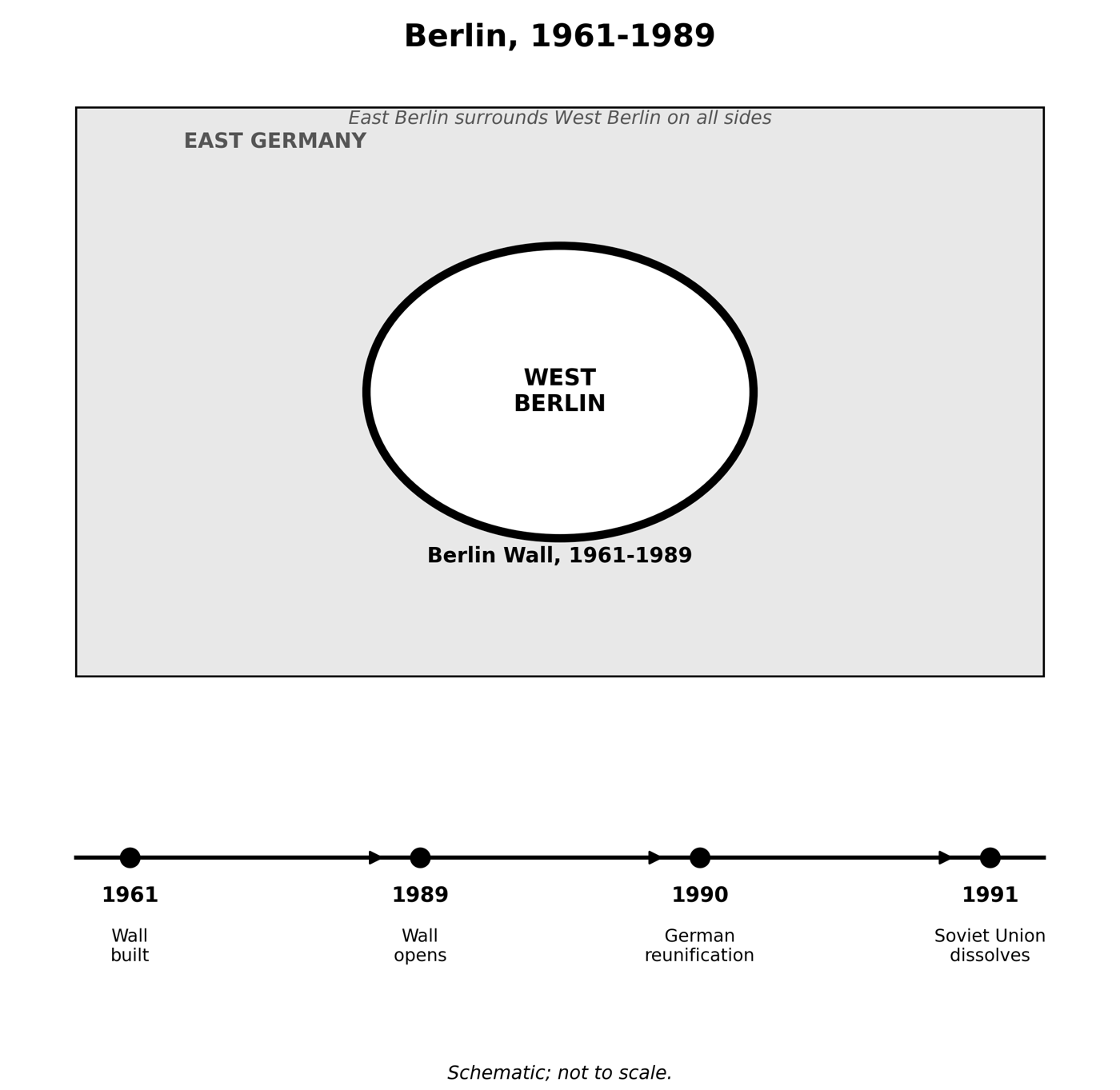
a) Identify the event this map and timeline most directly represent.
b) Describe one specific factor from this unit's evidence that contributed to this event.
c) Explain how this event relates chronologically to German reunification and the Soviet Union's dissolution.
Scoring note: (c) requires correctly sequencing all three events (Berlin Wall 1989, German reunification 1990, Soviet dissolution 1991), not treating them as simultaneous.
DBQ practice: document use and sourcing (4-document set)
Prompt: To what extent did newly independent states successfully use Cold War rivalry to advance their own interests, rather than becoming passive instruments of superpower competition?
Document 1. Constructed primary-source-style practice text, attributed to a Non-Aligned Movement delegate at the 1961 Belgrade summit: "We seek aid and recognition from both blocs without surrendering our right to determine our own path, a balance not every observer believes we can maintain."
Document 2. Constructed primary-source-style practice text, attributed to a U.S. State Department official assessing nonalignment, c. 1962: "These nonaligned governments accept our assistance readily enough, yet resist the political commitments we believe should accompany it."
Document 3. Constructed primary-source-style practice text, attributed to a Ghanaian official describing postcolonial development strategy, c. 1960: "Neither bloc's model fits our circumstances perfectly, so we borrow selectively: state-led industry from one, technical assistance from the other."
Document 4. Constructed primary-source-style practice text, attributed to a Korean War veteran reflecting on the conflict's local stakes, c. 1955: "For the great powers this was a contest of systems, but for those of us fighting on this peninsula, the war was about our own country's future as much as any ideology."
Task A (document use, not summary): For Document 3, do not merely restate that Ghana borrowed selectively from both blocs. State what this document proves about newly independent states' agency in navigating Cold War competition, and connect it explicitly to the prompt's claim.
Task B (sourcing): For Document 2, explain why the author's position as a U.S. State Department official, rather than a nonaligned state's own representative, shapes what this document can and cannot establish about nonalignment's actual effectiveness. State what that position does to the document's reliability for this specific argument.
Task C (outside evidence): Identify one piece of specific evidence from this unit, not drawn from these four documents, that could extend this argument to a case where local actors redirected Cold War competition into a conflict the superpowers had not initiated.
Scoring note for Task C: An acceptable answer might cite the Korean War itself, initiated by North Korea's invasion of South Korea rather than by direct superpower action, or the Soviet-Afghan War's continuation beyond Soviet withdrawal, extending the argument to local dynamics shaping superpower-associated conflicts.
LEQ practice: evidence selection, thesis, and one body paragraph
Prompt: Evaluate the extent to which decolonization movements achieved their original political goals between 1945 and 1991.
90-second evidence dump: Indian independence 1947, partition violence. Ghana 1957, symbol, encouraged further movements. Newly independent states, inherited borders, commodity dependence, Cold War pressure. NAM, NIEO, economic goals largely unrealized. Mandela/apartheid, goals not achieved until after this unit's core period. Formal political independence achieved widely; full structural transformation, uneven.
Thesis: While decolonization movements between 1945 and 1991 succeeded in achieving formal political independence for most colonized territories, as seen in India's 1947 independence and Ghana's 1957 independence, they achieved this core goal unevenly and often without the deeper economic and structural transformation many movements originally sought, since newly independent states continued to face inherited colonial borders, commodity dependence, and Cold War pressure that limited their full political and economic autonomy.
One evidence paragraph: India's 1947 independence achieved the central goal of ending direct British colonial rule, yet this achievement came paired with partition into India and Pakistan, producing mass migration and severe communal violence that most independence leaders had not intended as an outcome of their movement. Newly independent states more broadly, including India, continued to grapple with borders inherited from colonial administration rather than drawn along ethnic or regional lines, alongside continued economic dependence on commodity exports that limited the deeper economic transformation movements such as the Non-Aligned Movement's push for a New International Economic Order had sought. This gap between achieving formal political independence and achieving fuller economic and structural change demonstrates that decolonization's success should be evaluated as partial and uneven rather than as a single completed achievement.
Timed evidence recall (10 prompts)
1. Marshall Plan and containment, beginning 1947, Western Europe. What does it prove? The U.S. used economic aid and alliances deliberately to limit Soviet influence.
2. NATO founded 1949 / Warsaw Pact founded 1955, Europe. What does it prove? Soviet bloc consolidation responded to a specific Western action six years later, not simultaneously.
3. Korean War, 1950-1953, Korea. What does it prove? A local conflict became a major Cold War proxy war ending in armistice, not decisive victory.
4. Chinese Communist victory, 1949, China. What does it prove? Communist revolution could develop through rural mobilization in an agrarian society, differently than in industrial Russia.
5. Indian independence and partition, 1947, South Asia. What does it prove? Decolonization's immediate human costs could be severe even as formal colonial rule ended.
6. Ghanaian independence, 1957, West Africa. What does it prove? One state's independence could symbolically encourage further African decolonization movements.
7. Non-Aligned Movement first summit, 1961, Belgrade. What does it prove? Newly independent states sought diplomatic and economic agency outside formal Cold War alignment.
8. Mandela's Rivonia Trial speech, 1964, South Africa. What does it prove? Anti-apartheid goals were articulated directly and formally within a legal proceeding, not only in later retrospective accounts.
9. Glasnost and perestroika, beginning under Gorbachev, Soviet Union. What does it prove? Reform intended to strengthen the Soviet system instead accelerated its collapse.
10. Deng-era economic reforms, beginning 1978, China. What does it prove? Economic liberalization could proceed without corresponding political liberalization.
Comparison practice
Choose two decolonization or Cold War developments from this unit, such as Indian independence, Ghanaian independence, the Non-Aligned Movement, or a Cold War proxy conflict, and compare them using exactly one of the following shared dimensions: the method used to achieve or pursue the goal, or the degree of success in achieving full political and economic autonomy. Write two to three sentences naming the dimension explicitly and explaining how each example differed. A response that summarizes each example separately without naming and applying the shared dimension does not meet this task's requirement.
Cumulative review: Units 1-8
No new historical content is introduced here. This checkpoint mixes retrieval from all eight units completed so far.
Mixed retrieval (8 items, timed):
1. What does the Battle of Adwa demonstrate about the limits of industrial military advantage? (Unit 6)
2. What does the assassination at Sarajevo demonstrate about trigger versus structural cause? (Unit 7)
3. What does Japan's 1931 seizure of Manchuria demonstrate about World War II's origins? (Unit 7)
4. What does the Armenian genocide demonstrate about mass atrocity before the Holocaust? (Unit 7)
5. What does the NATO/Warsaw Pact founding gap demonstrate about Soviet bloc consolidation? (Unit 8)
6. What does Ghana's 1957 independence demonstrate about decolonization's symbolic effects? (Unit 8)
7. Name one comparison dimension used across this book so far to compare two states, movements, or systems without simply summarizing each separately.
8. Name one chronology error this book has specifically warned against involving two events separated by several years that are easy to confuse as simultaneous.
Cross-unit comparison prompt: Compare Mandela's use of a formal legal proceeding, the Rivonia Trial, to articulate anti-apartheid goals (Unit 8) with Lalla Zaynab's use of petitions and property claims within colonial legal institutions to resist encroachment (Unit 6). Name one dimension these two very different moments of resistance share: both used existing formal institutions, rather than working entirely outside them, to advance a cause against an unequal power structure. Explain, in two to three sentences, one important difference between these two examples despite this shared structural approach.