PART VII · BENCHMARK TEST
Benchmark Test
Introduction
The benchmark is fixed-form. It is not an adaptive test, and its raw score is not an official SAT score conversion. Its purpose is to show whether the mathematics remains usable when everything is mixed: the topic is no longer named, the clock is running, and the next question gives no hint about which chapter it came from.
Take it after the mastery and advanced practice sets are complete. It is two modules of 22 questions under real timing, and its value is in the whole experience: sustaining focus across 70 minutes, pacing through a module, recovering from a hard question, executing the grid-in and calculator habits without thinking.
And that points to the habit that makes all of this work: review. Checking which answers were right and wrong is not review; it is scorekeeping. Real review asks, for every question, wrong or guessed or right but uncertain or right but slow, why it went the way it did, and sorts the answer into one of five kinds.
For every error, identify the cause
Concept: the mathematics itself was missing. Action: return to the chapter tagged to the question and relearn it.
Representation: the mathematics was known but a table, graph, wording, or diagram hid it. Action: revisit that form in the mastery sets.
Route: the method chosen was too long. Action: revisit the relevant Part V route-selection habit.
Execution: the method was right, but the algebra or calculator work failed. Action: drill the accuracy checks until they are automatic.
Target: the work solved a quantity the question did not ask for. Action: re-read the last line before committing an answer.
Sorting errors this way is what makes practice compound. A concept error and an execution error look identical on the answer key, both are simply wrong, but they call for completely different fixes, and treating them the same is how people practice for months without improving. The cycle below is the whole method in one picture.
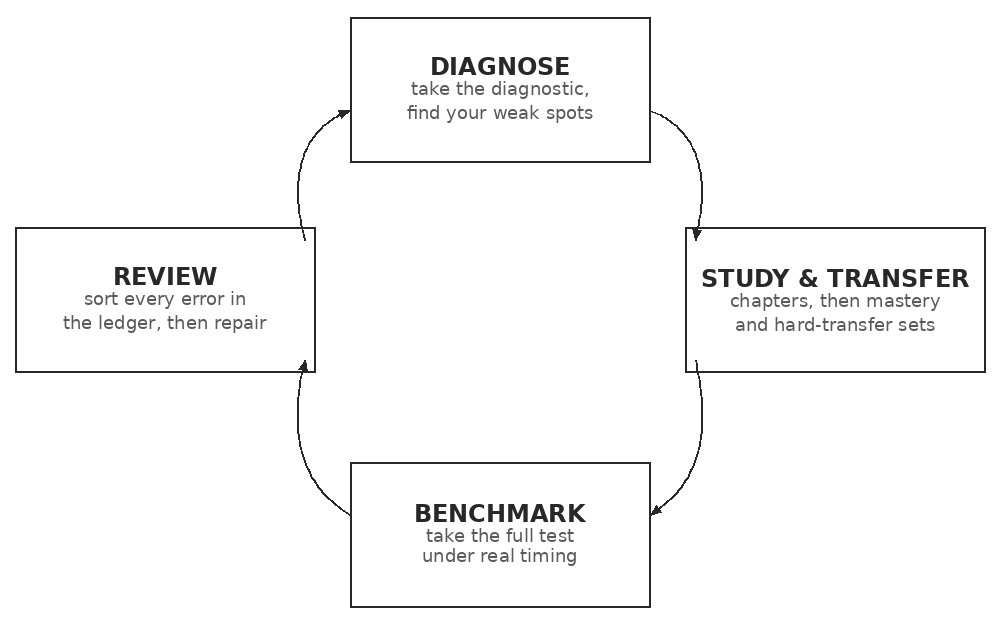
FIGURE 1 The practice cycle: diagnose to find weak spots, study the chapters and work the mastery and advanced practice sets, take the benchmark under real timing, then sort every error by its cause and repair, before returning to fresh mastery work or Bluebook practice rather than retaking this same test.
Work that cycle, and the benchmark lifts everything that came before it. What follows is one complete answer key and set of worked solutions, and a blank answer sheet you can reuse. Take it seriously, review it honestly, and let it do what instruction alone cannot: make everything you have learned reliable on the one morning it has to be.
BENCHMARK TEST
Module 1
Math · 22 questions · 35 minutes
The questions in this module address a range of math skills. Unless stated otherwise, all variables represent real numbers, all figures lie in a plane, and figures are drawn to scale. For multiple-choice questions, choose the best of the four answer choices. For the grid-in questions that follow, work out the answer and record it in the grid.
| 1 |
 Mark for Review |
If 5x − 8 = 27, what is the value of x + 2 ?
 |
11 |
 |
9 |
 |
5 |
 |
7 |
| 2 |
Mark for Review |
A school survey finds that 72 students play a sport, 48 play an instrument, 30 do both, and 110 students were surveyed in total. If a student who plays a sport is selected at random, what is the probability that the student also plays an instrument?
|
5/8 |
|
1/3 |
|
5/12 |
|
3/11 |
| 3 |
Mark for Review |
A gym membership has a fixed starting fee plus a monthly charge. The total cost, in dollars, for m months is given by C(m) = 35m + 50. What does 50 represent in this context?
|
the one-time starting fee |
|
the number of months of access |
|
the total paid after one month |
|
the recurring monthly charge |
| 4 |
Mark for Review |
Two triangles have two pairs of corresponding sides equal, and the angle included between those sides is also equal in both triangles. What conclusion is guaranteed?
|
The triangles are congruent |
|
The triangles are similar but not necessarily congruent |
|
The triangles have equal area but may not be congruent |
|
No conclusion is possible |
| 5 |
Mark for Review |
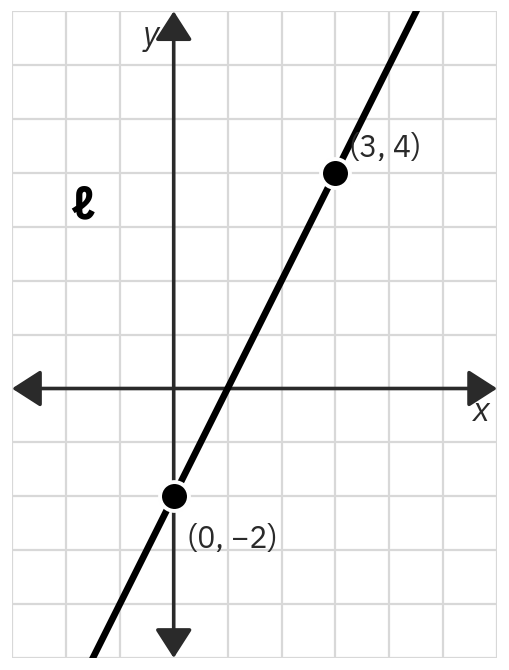
The graph of line ℓ is shown in the xy-plane. What is the slope of line ℓ ?
|
3 |
|
−2 |
|
2 |
|
1/2 |
| 6 |
Mark for Review |
The function f is defined by f(x) = x2 − 3x + 4. What is the value of f(−2) ?
|
2 |
|
6 |
|
−6 |
|
14 |
| 7 |
Mark for Review |
A random sample of voters estimates 54 percent support for a proposal, with a margin of error of 3 percentage points. Which value is plausible for the population percentage?
|
49% |
|
52% |
|
58% |
|
61% |
| 8 |
Mark for Review |
The system of equations 2x + y = 11 and x − y = 1 has solution (x, y). What is the value of x ?
|
3 |
|
7 |
|
4 |
|
5 |
| 9 |
Mark for Review |
The roots of x² - kx + 18 = 0 have sum 9. What is k ?
|
9 |
|
18 |
|
-9 |
|
4.5 |
| 10 |
Mark for Review |
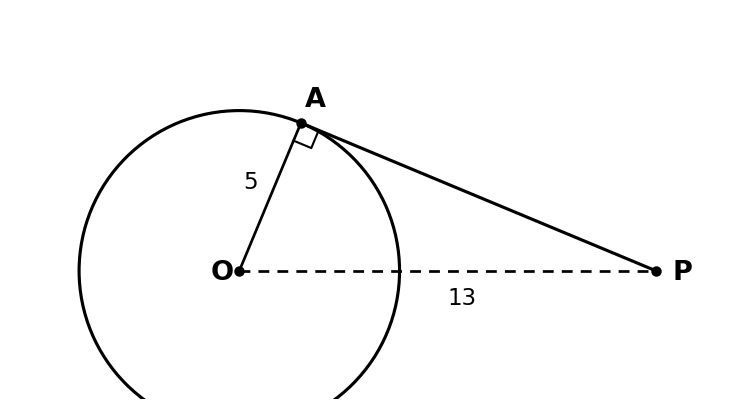
In the figure shown, PA is tangent to the circle at A, and O is the center of the circle. If OP = 13 and OA = 5, what is PA ?
|
13 |
|
18 |
|
8 |
|
12 |
| 11 |
Mark for Review |
A sample contains 200 bacteria, and the number doubles every 5 hours. Which function gives the number of bacteria after t hours?
|
200(2)5t |
|
200(2)t/5 |
|
200(2)t |
|
200 + 5t |
| 12 |
Mark for Review |
A driver earns 90 dollars per day plus 6 dollars for each package delivered. What is the least number of packages the driver must deliver in one day to earn at least 240 dollars?
|
26 |
|
24 |
|
55 |
|
25 |
| 13 |
Mark for Review |
Data set P has a mean of 40. Data set Q is formed by adding 15 to every value in P. Which statement must be true?
|
Q has the same standard deviation as P |
|
Q has a larger standard deviation than P |
|
Q has a smaller standard deviation than P |
|
Cannot be determined without more information |
| 14 |
Mark for Review |
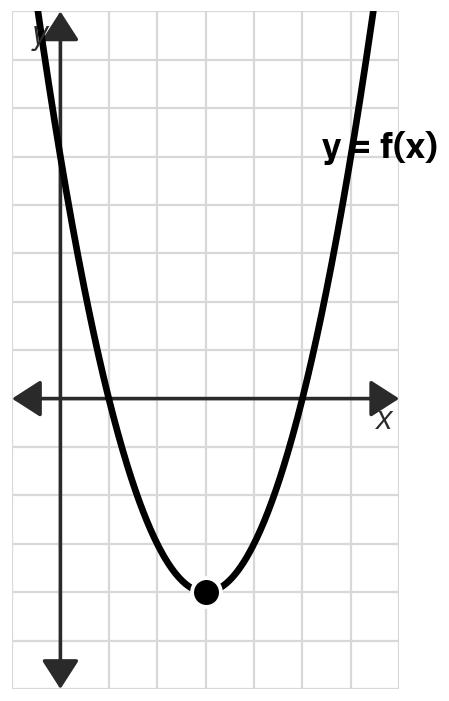
The graph of the function f is shown in the xy-plane. What is the minimum value of f(x) ?
|
5 |
|
−4 |
|
−1 |
|
3 |
| 15 |
Mark for Review |
In the xy-plane, a circle has equation (x − 2)2 + (y + 3)2 = 25. What is the length of the longest chord of the circle?
|
5 |
|
25 |
|
10 |
|
50 |
| 16 |
Mark for Review |
If 3x + 2 = 5x - 6, what is x ?
|
-2 |
|
2 |
|
-0.5 |
|
4 |
Student-produced responses · Questions 17–22
Work out each answer and record it in the grid. Enter an integer, a decimal, or a fraction; a fraction need not be reduced. Mixed numbers such as 3 1/2 must be entered as 7/2 or 3.5. If an answer is a repeating decimal, fill the entire field. Do not enter symbols such as a percent sign, comma, or dollar sign.
| 17 |
Mark for Review |
If (x − 4)/3 = (x + 2)/5, what is the value of x ?
Record your answer in the grid.
| 18 |
Mark for Review |
Over a decade, a town's population increased from 250 to 320. To the nearest whole percent, what was the percent increase?
Record your answer in the grid.
| 19 |
Mark for Review |
What is the product of the two solutions of the equation 2x2 − 7x − 15 = 0 ?
Record your answer in the grid.
| 20 |
Mark for Review |
A linear function has f(3) = 17 and f(7) = 29. What is f(0)?
Record your answer in the grid.
| 21 |
Mark for Review |
In the xy-plane, the line y = 2x + 1 intersects the parabola y = x2 − 2 at two points. What is the sum of the x-coordinates of these two points?
Record your answer in the grid.
| 22 |
Mark for Review |
The equations x + 2y = 9 and 3x + 6y = 27 are both true. What is the value of x + 2y?
Record your answer in the grid.
BENCHMARK TEST
Module 2
Math · 22 questions · 35 minutes
The questions in this module address a range of math skills. Unless stated otherwise, all variables represent real numbers, all figures lie in a plane, and figures are drawn to scale. For multiple-choice questions, choose the best of the four answer choices. For the grid-in questions that follow, work out the answer and record it in the grid.
| 1 |
Mark for Review |
The function f is defined by f(x) = 3x − 7. If f(a) = 11, what is the value of f(2a) ?
|
15 |
|
22 |
|
29 |
|
36 |
| 2 |
Mark for Review |
An exponential function has f(1) = 12 and f(4) = 96. If f(x) = abˣ, what is b?
|
2 |
|
8 |
|
32 |
|
84 |
| 3 |
Mark for Review |
A price is increased by 20 percent, and then that new price is decreased by 20 percent. The final price is what percent of the original price?
|
100 |
|
80 |
|
104 |
|
96 |
| 4 |
Mark for Review |
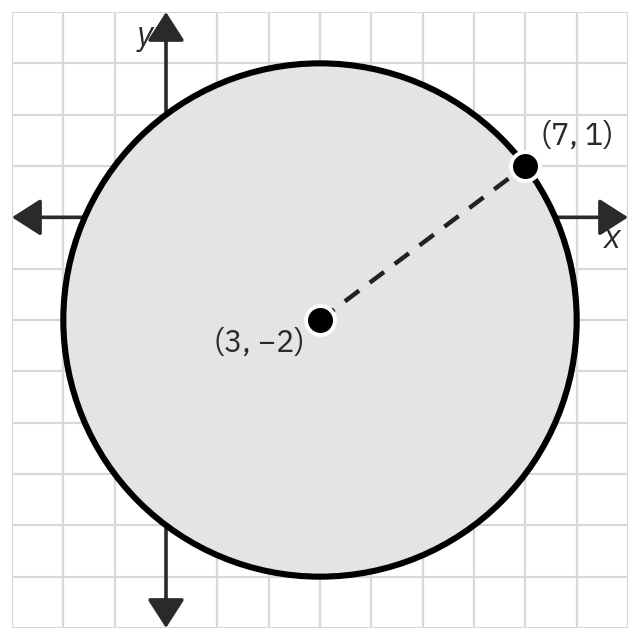
In the xy-plane, a circle has its center at (3, −2) and passes through the point (7, 1). What is the radius of the circle?
|
4 |
|
5 |
|
6 |
|
25 |
| 5 |
Mark for Review |
If |2x − 5| = 9, what is the sum of all possible values of x ?
|
2 |
|
5 |
|
7 |
|
9 |
| 6 |
Mark for Review |
The line y = 6x + c is tangent to y = x². What is c ?
|
−9 |
|
9 |
|
−36 |
|
36 |
| 7 |
Mark for Review |
For x ≠ 3, the expression (x2 − 9)/(x − 3) is equal to 7. What is the value of x ?
|
3 |
|
7 |
|
4 |
|
1 |
| 8 |
Mark for Review |
What is the value of cos(120°)?
|
1/2 |
|
-1/2 |
|
-√3/2 |
|
√3/2 |
| 9 |
Mark for Review |
A data set has a mean of 12. If every value in the set is multiplied by 3 and then increased by 4, what is the mean of the new data set?
|
36 |
|
16 |
|
12 |
|
40 |
| 10 |
Mark for Review |
A table shows a linear function with values f(2) = 11 and f(7) = 31. Another line is y = 3x + 4. At what x-value do the two functions have the same output?
|
7 |
|
4 |
|
1 |
|
−1 |
| 11 |
Mark for Review |
A 20-liter mixture is 40 percent acid. How many liters of water must be added so that the resulting mixture is 25 percent acid?
|
12 |
|
8 |
|
5 |
|
30 |
| 12 |
Mark for Review |
In the equation x2 − kx + 16 = 0, where k is a constant, the equation has exactly one real solution. What is a positive value of k ?
|
4 |
|
8 |
|
16 |
|
64 |
| 13 |
Mark for Review |
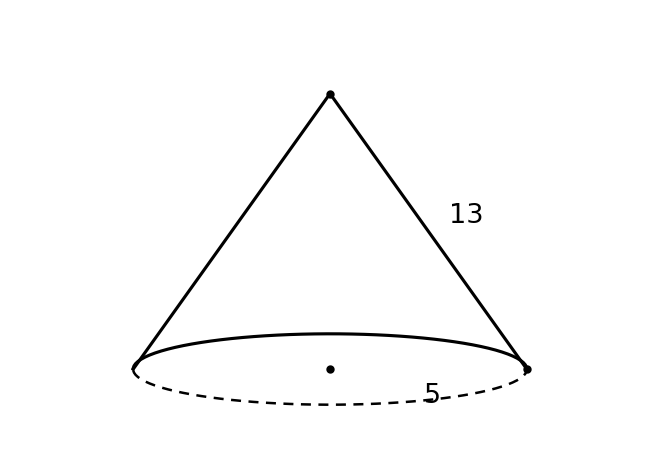
The cone shown has radius 5 and slant height 13. What is its volume, in terms of π?
|
65π |
|
300π |
|
240π |
|
100π |
| 14 |
Mark for Review |
The graph of y = f(x) passes through the point (2, 5). Through which point must the graph of y = f(x − 1) + 3 pass?
|
(1, 2) |
|
(3, 2) |
|
(1, 8) |
|
(3, 8) |
| 15 |
Mark for Review |
A gym charges a one-time registration fee plus a fixed monthly cost. The total amount paid after m months is C = 45 + 30m dollars. A member has paid a total of 285 dollars. For how many months has the member paid?
|
6 |
|
8 |
|
10 |
|
9.5 |
| 16 |
Mark for Review |
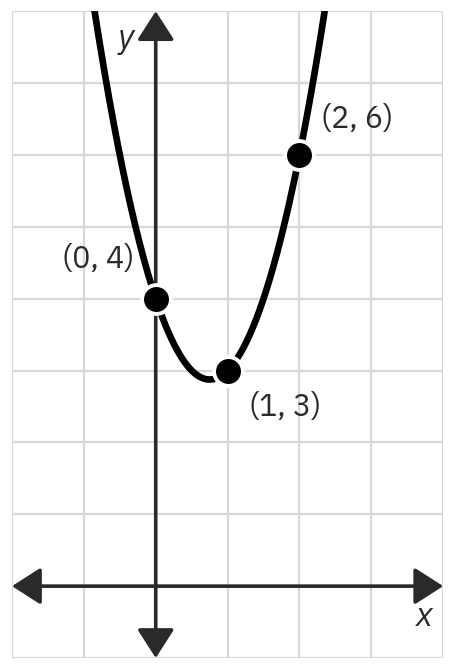
In the xy-plane, the parabola y = ax2 + bx + c passes through the points (0, 4), (1, 3), and (2, 6). What is the value of a + b + c ?
|
4 |
|
6 |
|
3 |
|
13 |
Student-produced responses · Questions 17–22
Work out each answer and record it in the grid. Enter an integer, a decimal, or a fraction; a fraction need not be reduced. Mixed numbers such as 3 1/2 must be entered as 7/2 or 3.5. If an answer is a repeating decimal, fill the entire field. Do not enter symbols such as a percent sign, comma, or dollar sign.
| 17 |
Mark for Review |
A parking garage charges $12 for the first 2 hours and $4 for each additional hour. What is the total charge for 5 hours?
Record your answer in the grid.
| 18 |
Mark for Review |
A 600-milliliter solution is 30 percent solute. How many milliliters of water must be added so the resulting solution is 18 percent solute?
Record your answer in the grid.
| 19 |
Mark for Review |
In the xy-plane, the perpendicular bisector of the segment joining (1, 2) and (7, 10) crosses the x-axis. What is the x-coordinate of that crossing point?
Record your answer in the grid.
| 20 |
Mark for Review |
If 4(2x + 3) - 7 = x + 26, what is the value of x?
Record your answer in the grid.
| 21 |
Mark for Review |
In a survey of 250 employees, the probability that a randomly selected employee works remotely is 0.24. Of the remote workers, 1/3 also work part-time. How many employees work both remotely and part-time?
Record your answer in the grid.
| 22 |
Mark for Review |
The function f is defined by f(x) = x2 + 3x. If f(x) = f(2), what is the negative value of x ?
Record your answer in the grid.
BENCHMARK TEST
Answers, skills map, and solutions
Score the benchmark and identify review priorities
Score both modules against the key, then read the skills map: every question you answered wrong names the exact section of this book that teaches it, turning a raw score into a short, specific study plan. Each solution names the structure that generates the answer, then carries it through cleanly.
▸ Module 1 skills map
Find each question you answered wrong in the table below. Its row names the domain the question belongs to and the section that teaches it; go there first. Review any question you answered wrong, guessed on, or got right but felt uncertain about or spent too long on; a right answer reached slowly or by luck still belongs in your review, not just the rows marked wrong.
| Q |
Key |
Domain |
Section to review |
| 1 |
B · 9 |
Algebra |
Forms, isolating a variable |
| 2 |
C · 5/12 |
Data Analysis |
Probability: conditional probability |
| 3 |
A |
Algebra |
Linear models: the constant term |
| 4 |
A |
Geometry & Trig |
Triangle congruence: SAS |
| 5 |
C · 2 |
Algebra |
Lines: slope from a graph |
| 6 |
D · 14 |
Advanced Math |
Functions, evaluating |
| 7 |
B · 52% |
Data Analysis |
Inference: margin of error |
| 8 |
C · 4 |
Algebra |
Systems: elimination |
| 9 |
A · 7 |
Advanced Math |
Quadratics: sum of roots |
| 10 |
D · 12 |
Geometry & Trig |
Circles: tangent segments |
| 11 |
B |
Advanced Math |
Exponential models: the doubling period |
| 12 |
D · 25 |
Algebra |
Inequalities, modeling a floor |
| 13 |
A |
Data Analysis |
One-variable data: standard deviation and shifts |
| 14 |
B · −4 |
Advanced Math |
Quadratics, reading the vertex |
| 15 |
C · 10 |
Geometry & Trig |
Circles: the equation and the diameter |
| 16 |
D · 4 |
Algebra |
Linear equations in one variable |
| 17 |
13 |
Algebra |
Forms: proportions |
| 18 |
28 |
Data Analysis |
Percentages: percent change |
| 19 |
−7.5 |
Advanced Math |
Quadratics: sum and product of roots |
| 20 |
8 |
Algebra |
Linear functions: table to line |
| 21 |
2 |
Advanced Math |
Nonlinear systems: a line meeting a parabola |
| 22 |
9 |
Algebra |
Systems: underdetermination |
Questions 1–16 are multiple-choice; 17–22 are grid-ins.
▸ Module 1 worked solutions
1 LINEAR EQUATIONS B
One equation, one unknown: x is pinned, so the work is just to strip everything off it. Add 8 to both sides for 5x = 35, then divide by 5 to get x = 7. The last step is the one to slow down for: the question asks for x + 2, not x, so the value is 9. Solving correctly and then answering a different question than the one asked is the easy way to hand back 7.
2 CONDITIONAL PROBABILITY C
The condition given a student plays a sport restricts the denominator to the 72 sport-players, not the full 110. Of those, 30 also play an instrument, so the probability is 30/72 = 5/12. Using the grand total as the denominator, or reversing which group conditions which, are the two traps built into the wrong choices.
3 INTERPRETING A MODEL A
A linear model splits into two pieces, and reading it means knowing what each piece does. In C(m) = 35m + 50, the 35m grows with the months while the 50 stands there from the start: the value of C when m = 0, before a single month is counted. That standing amount is the one-time starting fee.
4 TRIANGLE CONGRUENCE: SAS A
Two sides and the angle they enclose fix a triangle completely: there is exactly one way to close the figure once those three pieces are set, so any triangle meeting the same conditions must be congruent to it. This is the Side-Angle-Side criterion, and it works because the included angle, the one between the two given sides, leaves no freedom for the third side to vary. An angle that is not included, sitting outside the two given sides, does not pin the triangle down the same way and does not guarantee congruence.
5 SLOPE FROM A GRAPH C
Slope is the rate a line climbs, read straight from two clean points the graph hands you. From (0, −2) to (3, 4) the line rises 6 as it runs 3, so the slope is 6/3 = 2. Read the run as the horizontal change and the rise as the vertical; swapping them inverts the slope.
6 FUNCTION EVALUATION D
Evaluating a function is pure substitution, and the signs are the whole game. f(−2) = (−2)2 − 3(−2) + 4; squaring −2 gives +4, and −3 times −2 gives +6, so 4 + 6 + 4 = 14. Wrapping −2 in parentheses before squaring keeps the sign honest.
7 INFERENCE: MARGIN OF ERROR B
A margin of error builds a plausible range around the sample estimate, not a single trusted value. The estimate is 54 percent, and the margin is 3 points, so the plausible range runs from 51 to 57 percent. Only 52 falls inside that interval; the other choices sit outside it in either direction, no square-root sample-size arithmetic required.
8 SYSTEMS BY ELIMINATION C
Two equations, two unknowns, and the y-terms are already opposites, +y and −y, so the system is built for elimination. Adding the equations straight down cancels y: 3x = 12, so x = 4. The question asks only for x, so there is no need to go back for y.
9 QUADRATICS: SUM OF ROOTS A
For any quadratic ax² + bx + c = 0, the two roots sum to -b/a, with no need to find them individually. Here that sum is -(-k)/1 = k, so k = 9 directly. Confusing the sum shortcut with the product shortcut, c/a, is the trap built into one of the wrong choices.
10 CIRCLES: TANGENT SEGMENTS D
A radius drawn to the point of tangency always meets the tangent line at a right angle, which turns OAP into a right triangle with the right angle at A. The hypotenuse is OP = 13, and one leg is the radius OA = 5, so PA = √(13² - 5²) = √144 = 12, a 5-12-13 triple. The step easy to skip is recognizing that the tangent creates a right angle at all; without that, there is no triangle to apply the theorem to.
11 EXPONENTIAL GROWTH B
Doubling is repeated multiplication by 2, and the only quantity that matters is how many doublings have happened: the elapsed time over the period, t/5. So the count is 200(2)t/5. An exponent of 5t would double five times every hour, far too fast; the period belongs underneath t, not multiplying it.
12 LINEAR INEQUALITIES D
“At least 240” sets a floor, written 90 + 6p ≥ 240. Strip the fixed 90: 6p ≥ 150, so p ≥ 25. The least whole number of packages that clears the floor is 25. The phrase at least is what makes it ≥ rather than >, so 25 itself counts.
13 STANDARD DEVIATION AND SHIFTS A
Adding the same constant to every value in a data set slides the whole distribution without changing how spread out it is: the mean shifts by that constant, but the standard deviation, which measures spread around the mean, stays exactly the same. Data set Q is just P shifted 15 units higher, not stretched or compressed, so its standard deviation matches P’s exactly. Assuming a shift in center must also change the spread is the trap this question is built to catch.
14 MINIMUM OF A PARABOLA B
An upward-opening parabola bottoms out at its vertex, and the minimum value of f is that lowest height: the y-coordinate, not the x where it occurs. The vertex sits at (3, −4), so the minimum value is −4. Reading off the x-coordinate, 3, answers where rather than what.
15 CIRCLES IN THE PLANE C
The equation (x − 2)2 + (y + 3)2 = 25 shows r2 = 25, so r = 5. The longest chord any circle holds is a diameter (straight through the center, twice the radius) which is 10. Stopping at the radius, 5, answers a shorter question than the one asked.
16 LINEAR EQUATIONS D
Subtract 3x from both sides: 2 = 2x - 6. Add 6 to both sides: 8 = 2x, so x = 4. Gathering the variable terms on the side where they end up positive avoids a sign error in the last step.
17 PROPORTIONS 13
A single proportion clears by cross-multiplication, trading two denominators for one linear equation: 5(x − 4) = 3(x + 2). Expand and gather: 5x − 20 = 3x + 6, so 2x = 26 and x = 13. The one care is multiplying each numerator by the opposite denominator, not the one beneath it.
18 PERCENT CHANGE 28
Percent change measures the change against where you started, never where you ended. The increase is 320 − 250 = 70, and against the original 250 that is 70/250 = 0.28, or 28 percent. Dividing by 320 answers a different question.
19 PRODUCT OF ROOTS −7.5
For any quadratic ax2 + bx + c = 0, the two roots multiply to c/a; there is no need to find them one at a time. Here that product is −15/2 = −7.5. The shortcut is worth holding: the product of the roots is the constant over the leading coefficient, and their sum is −b/a.
20 LINEAR FUNCTIONS: TABLE TO LINE 8
Two function values pin down a line without ever seeing its equation directly. The slope is (29 - 17)/(7 - 3) = 3, so 17 = 3(3) + b gives b = 8, which is exactly f(0), the y-intercept. Averaging the two given outputs instead of finding the slope first is the shortcut that does not work here.
21 LINE AND PARABOLA 2
Two graphs meet where their outputs agree, so set them equal: x2 − 2 = 2x + 1, which rearranges to x2 − 2x − 3 = 0. The sum of the two x-values is −b/a = 2, and the sum is exactly what the question asks, so the individual roots never need finding.
22 SYSTEMS: UNDERDETERMINATION 9
The second equation is exactly three times the first, 3(x + 2y) = 3(9), so it repeats information rather than adding a second independent condition. That means x and y individually can vary along a whole line of solutions, but the combination x + 2y stays fixed at 9 no matter which solution is chosen, since it is given directly in the first equation. Trying to solve the system for x and y separately is the wasted motion this question is built to catch.
▸ Module 2 skills map
| Q |
Key |
Domain |
Section to review |
| 1 |
C · 29 |
Advanced Math |
Functions: chained evaluation |
| 2 |
A · 2 |
Advanced Math |
Exponential models: growth factor |
| 3 |
D · 96 |
Data Analysis |
Percentages: successive changes |
| 4 |
B · 5 |
Geometry & Trig |
Circles: radius from two points |
| 5 |
B · 5 |
Advanced Math |
Absolute value: equations |
| 6 |
A · -9 |
Advanced Math |
Nonlinear systems: tangency |
| 7 |
C · 4 |
Advanced Math |
Rational expressions, simplifying |
| 8 |
B · -1/2 |
Geometry & Trig |
Unit circle: quadrant signs |
| 9 |
D · 40 |
Data Analysis |
Statistics, transforming a data set |
| 10 |
C · 1 |
Algebra |
Linear functions: table to intersection |
| 11 |
A · 12 |
Algebra |
Mixtures, tracking one ingredient |
| 12 |
B · 8 |
Advanced Math |
Quadratics: the discriminant |
| 13 |
D · 100π |
Geometry & Trig |
Solids: slant height |
| 14 |
D · (3, 8) |
Advanced Math |
Functions: transformations |
| 15 |
B · 8 |
Algebra |
Linear models, solving for the input |
| 16 |
C · 3 |
Advanced Math |
Quadratics, reading a value directly |
| 17 |
24 |
Algebra |
Modeling: threshold rates |
| 18 |
400 |
Algebra |
Mixtures: dilution |
| 19 |
12 |
Geometry & Trig |
Coordinate geometry: perpendicular bisector |
| 20 |
3 |
Algebra |
Linear equations: distributing and solving |
| 21 |
20 |
Data Analysis |
Probability: reverse conditional frequency |
| 22 |
−5 |
Advanced Math |
Functions: equal outputs |
Questions 1–16 are multiple-choice; 17–22 are grid-ins.
▸ Module 2 worked solutions
1 FUNCTION EVALUATION C
Two stages, each feeding the next. First pin a: f(a) = 3a − 7 = 11 gives 3a = 18, so a = 6. Then the question wants f(2a) = f(12) = 3(12) − 7 = 29. The wrong turn is to double the output 11; the 2 rides with a inside the function, not outside it, so it is the input that doubles.
2 EXPONENTIAL MODELS: GROWTH FACTOR A
Two function values three steps apart isolate the growth factor without needing the coefficient a at all: dividing f(4) by f(1) cancels a and leaves b³ = 96/12 = 8, so b = 2. Using the ratio directly without cube-rooting it, or spacing the exponent difference incorrectly, are the two traps the wrong choices are built around.
3 SUCCESSIVE PERCENT CHANGE D
Percentages compound on whatever they act on, so the two changes do not cancel. A 20 percent increase multiplies by 1.20; the following 20 percent decrease multiplies that result by 0.80. Together 1.20 × 0.80 = 0.96, so the final price is 96 percent of the original. The pull toward 100 assumes the moves undo each other, but the decrease acts on a larger amount than the increase did.
4 DISTANCE AND RADIUS B
The radius is the distance from the center to any point on the circle, and the distance formula is the Pythagorean theorem in coordinates. From (3, −2) to (7, 1) the legs are 4 across and 3 up, so r = √(42 + 32) = √25 = 5. Stopping at 25 forgets the square root; that is r2, not r.
5 ABSOLUTE-VALUE EQUATION B
An absolute value equal to 9 opens into two cases: 2x − 5 = 9 and 2x − 5 = −9, giving x = 7 and x = −2, whose sum is 5. There is a faster read: the two solutions sit symmetrically about the point where 2x − 5 = 0, namely x = 2.5, so they must sum to 2 × 2.5 = 5 without solving either.
6 NONLINEAR SYSTEMS: TANGENCY A
A line and a parabola are tangent exactly when they meet at one point instead of two, which is the discriminant-zero case in disguise. Setting the two expressions equal: x² = 6x + c rearranges to x² - 6x - c = 0. A single intersection means the discriminant is zero: 36 + 4c = 0, so c = -9. Losing a sign while isolating c, or stopping at the discriminant expression itself, are the traps the wrong choices are built around.
7 SIMPLIFYING A RATIONAL C
The numerator is a difference of squares, x2 − 9 = (x − 3)(x + 3), and the denominator is (x − 3). For x ≠ 3 they cancel, leaving x + 3. Setting x + 3 = 7 gives x = 4. The cancellation is what turns a forbidding fraction into a one-step equation.
8 UNIT CIRCLE: QUADRANT SIGNS B
120° sits in Quadrant II, with reference angle 180° - 120° = 60°. The reference angle sets the magnitude, cos(60°) = 1/2, and the quadrant sets the sign: cosine is negative throughout Quadrant II, so cos(120°) = -1/2. Forgetting the sign flip, or reaching for sine instead of cosine, are the two traps built into the wrong choices.
9 MEAN UNDER A TRANSFORMATION D
Scaling every value, or adding the same amount to every value, moves the mean in exactly the same way, the mean travels with the data. Multiplying each value by 3 multiplies the mean by 3, and adding 4 to each adds 4 to the mean: 3 × 12 + 4 = 40. Adding the 4 before scaling, or scaling only part of the change, is the easy slip.
10 LINEAR FUNCTIONS: TABLE TO INTERSECTION C
Two function values reconstruct the first line before anything else can happen. The slope is (31 - 11)/(7 - 2) = 4, so 11 = 4(2) + b gives b = 3, and f(x) = 4x + 3. Setting the two lines equal, 4x + 3 = 3x + 4, gives x = 1. Reporting the shared output, 7, instead of the input the question actually asks for is the trap built into one of the wrong choices.
11 MIXTURE PROBLEM A
A mixture problem is bookkeeping on a single ingredient: here the acid, which never changes amount when only water is added. The mixture holds 0.40 × 20 = 8 liters of acid. After adding w liters of water the total is 20 + w, and the acid is now a quarter of it: 8 = 0.25(20 + w). Then 32 = 20 + w, so w = 12. The acid stays fixed at 8 while the total grows; that is the hinge.
12 EQUAL ROOTS B
Exactly one real solution is the discriminant speaking: a quadratic has a single repeated root precisely when b2 − 4ac = 0. Here that is k2 − 4(1)(16) = 0, so k2 = 64 and k = ±8; the positive value is 8. The phrase one real solution is the whole clue, it marks the moment the two roots collapse into one.
13 SOLIDS: SLANT HEIGHT D
The cone volume formula needs the vertical height, not the slant height, and the two are rarely the same number. The radius, vertical height, and slant height form a right triangle, with the slant height as the hypotenuse: h = √(13² - 5²) = √144 = 12. Then V = (1/3)π(5²)(12) = 100π. Using the slant height directly in the volume formula in place of the vertical height is the trap the wrong choices are built around.
14 SHIFTING A GRAPH D
A change inside the function moves the graph horizontally; a change outside moves it vertically. Replacing x with x − 1 shifts every point right by 1, the inside shift runs opposite to the sign you might expect, and adding 3 lifts it up by 3. So (2, 5) travels to (2 + 1, 5 + 3) = (3, 8).
15 SOLVING A LINEAR MODEL B
The model C = 45 + 30m is a one-time fee plus a monthly rate, and a known total pins the months. Set 45 + 30m = 285; strip the fixed 45 to get 30m = 240, so m = 8 months. Forgetting to remove the 45 first inflates the count: the registration fee is paid once, not every month.
16 EVALUATING AT A POINT C
Before solving for a, b, and c separately, notice what a + b + c is: exactly the value of ax2 + bx + c at x = 1. The parabola passes through (1, 3), so a + b + c = 3; read straight off a given point. Grinding out all three coefficients reaches 3 as well, but the structure hands it over in a line.
17 MODELING: THRESHOLD RATES 24
The $4 rate only applies to hours beyond the first 2, so for 5 hours, only 5 - 2 = 3 hours are billed at that rate. The total is 12 + 4(3) = 12 + 12 = 24. Applying the additional rate to all 5 hours instead of just the hours past the threshold is the trap the setup is built around.
18 MIXTURES: DILUTION 400
Adding water never changes how much solute is present, only how spread out it is, so track the solute amount as the fixed anchor. The original solution holds 0.30 × 600 = 180 milliliters of solute. After dilution, that same 180 mL must be 18 percent of the new total: 180 = 0.18 × T, so T = 1,000 mL. The water added is the increase in total volume: 1,000 - 600 = 400 mL. Solving for the new total and stopping there, without subtracting the original volume, is the easy way to misplace the final step.
19 PERPENDICULAR BISECTOR 12
A perpendicular bisector runs through the segment's midpoint at a right angle to it. The midpoint of (1, 2) and (7, 10) is (4, 6), and the segment's slope is 8/6 = 4/3, so the bisector's slope is the negative reciprocal, −3/4. Writing y − 6 = −(3/4)(x − 4) and setting y = 0 gives −6 = −(3/4)(x − 4), so x − 4 = 8 and x = 12.
20 LINEAR EQUATION 3
Distribute the left side: 8x + 12 - 7 = x + 26, which simplifies to 8x + 5 = x + 26. Collecting terms gives 7x = 21, so x = 3. Combining the constants on the left before moving variables keeps this equation short.
21 REVERSE CONDITIONAL FREQUENCY 20
The probability sets the count first: 0.24 × 250 = 60 employees work remotely. The 1/3 figure is conditional on that group, not the full 250, so it applies to the 60 remote workers: 60 × (1/3) = 20. Applying the fraction to the full 250 instead of the 60 remote workers is the requested-object error this item is built to catch.
22 EQUAL OUTPUTS −5
First find the target value: f(2) = 22 + 3(2) = 10. Then solve f(x) = 10, that is x2 + 3x = 10, which rearranges to x2 + 3x − 10 = 0 and factors as (x + 5)(x − 2) = 0. The solutions are −5 and 2; the negative one is −5. The value x = 2 is the input we began from, so the question is really asking for the other input that lands on the same height.
▸ Use the skills map to choose what to review next
Tally the questions you answered wrong by domain across both modules. A cluster in one domain (three wrong in Advanced Math, say) points to where a few hours of focused review will move your score the most. A scatter of single careless errors across domains points instead to the accuracy habits of Part V. This fixed test uses a somewhat harder Module 2 to approximate one possible higher-difficulty route, though not every item in it is harder than every item in Module 1; it cannot reproduce the real adaptive routing, which depends on your own Module 1 performance, so weight what it tells you accordingly. Work the short, specific list the map gives you, then use it to guide your final review.
Reference