SAT Math study guide · Chapter 32
Domain Mastery Sets and Advanced Module 2 Practice
PART VI · DOMAIN MASTERY AND ADVANCED PRACTICE
Domain Mastery and Advanced Practice
Introduction
The content work is complete. What remains is transfer: using the right mathematics when the topic is no longer named, the clock is running, and the next question may arrive as an equation, a table, a graph, a diagram, or a paragraph.
This part uses two kinds of practice, because they do different jobs. First come four domain mastery sets, one for each blueprint area. They are short and deliberately mixed: not a chapter quiz asking whether a method works right after it was taught, but a test of whether the same method can still be recognized once neighboring topics are mixed in. Next comes an Advanced Module 2 practice set, organized around the structures that make strong students slow down: parameters, hidden relationships, representation changes, geometry-algebra combinations, and long contexts.
Neither set reteaches the chapters. Both make the same ideas arrive in less predictable forms. Do not look back at the chapter while working through a set; mark any problem where the first useful move is not clear within about twenty seconds, since that hesitation is information even when the final answer comes out right. When this part is complete, one full-length benchmark test remains, described in the part that follows.
DOMAIN MASTERY AND ADVANCED PRACTICE · 1
Domain mastery set A: Algebra
Purpose: practice Algebra skills in mixed, less predictable forms, including derived targets, parameter systems, underdetermination, and representation switches. Do not look back at the chapters while working through it; mark any item where the first useful move does not come within about twenty seconds.
1. If 5x - 3 = 17, what is the value of 15x - 9? (grid-in)
Answer: 51. Derived-target recognition. Since 5x - 3 = 17, multiply both sides by 3: 15x - 9 = 51. No need to solve for x first.
2. A linear function f satisfies f(2) = 13 and f(6) = 25. What is f(0)? (grid-in)
Answer: 7. Table/value-to-line reconstruction when x = 0 is not given directly. Slope = (25-13)/(6-2) = 3, so 13 = 3(2) + b gives b = 7.
3. For what value of k do the equations 2x + 3y = 12 and 4x + ky = 25 have no solution? (grid-in)
Answer: 6. No solution requires proportional x- and y-coefficients but a different constant. Doubling the first equation gives 4x + 6y = 24, so k = 6 matches the y-coefficient while 24 ≠ 25 confirms no solution.
4. The equations ax + 6y = 10 and 4x + 12y = 20 have infinitely many solutions. What is a? (grid-in)
Answer: 2. Equivalent-system constant rather than only a no-solution parameter. The second equation is exactly twice the first, so 2a = 4.
5. The equations x + y = 18 and 2x + 2y = 36 are both true. Which quantity can be determined uniquely: x, y, x - y, or x + y?
Answer: x + y. Underdetermination. The second equation is the first one doubled, so it repeats rather than adds a condition. Individual x and y values vary freely, but x + y stays fixed at 18.
6. A rental costs $70 plus $0.20 per mile after the first 100 miles. For m ≥ 100, which expression gives the total cost?
Answer: 70 + 0.20(m - 100). Threshold modeling. The charged quantity is miles beyond the threshold, not all miles, so the rate applies only to (m - 100).
7. A contractor charges $80 plus $25 per hour. Only the hourly charge is discounted by 20 percent. What is the total cost for h hours?
Answer: 80 + 20h. Modifier scope. Only the per-hour rate is discounted, not the flat fee: 0.80 × 25 = 20, so the hourly term becomes 20h while the flat $80 is untouched.
8. A graph has a solid boundary y = -2x + 5 and the region above the line is shaded. Write the inequality.
Answer: y ≥ -2x + 5. Reverse representation from graph description to inequality. Shading above the line means y-values greater than or equal to the boundary.
9. For what integer values of x does -3 < 2x + 1 ≤ 9? Give the greatest possible integer. (grid-in)
Answer: 4. Compound inequality with mixed strict/inclusive endpoints. Subtracting 1 gives -4 < 2x ≤ 8, so -2 < x ≤ 4; the greatest integer satisfying this is 4.
10. Line B passes through the points (0, 1), (2, 9), and (4, 17). Line A is y = 2x + 5. What is the x-coordinate of their intersection? (grid-in)
Answer: 2. System in mixed representations rather than two equations already supplied. Line B has slope 4 and intercept 1, so y = 4x + 1; setting 4x + 1 = 2x + 5 gives x = 2.
11. What is the equation of the line perpendicular to x = 4 and passing through (2, -3)?
Answer: y = -3. Horizontal/vertical edge case. The negative-reciprocal rule does not numerically apply to an undefined slope; a line perpendicular to a vertical line is simply horizontal through the given point.
12. If 4(x + 2) = 4x + c, for what value of c does the equation have exactly one solution?
Answer: No value. Solution-count reasoning when the variable cancels. The equation becomes 4x + 8 = 4x + c, which has infinitely many solutions if c = 8 and none otherwise, never exactly one.
DOMAIN MASTERY AND ADVANCED PRACTICE · 2
Domain mastery set B: Advanced Math
Purpose: practice Advanced Math skills in mixed, less predictable forms, including equivalent expressions, parameters, root relationships, nonlinear systems, and domain restrictions.
1. If (x + 4)(x + k) = x² + 11x + 28 for every x, what is k? (grid-in)
Answer: 7. Coefficient matching in an identity. Expanding gives x² + (k+4)x + 4k; matching k + 4 = 11 and 4k = 28 both confirm k = 7.
2. If 4³ˣ = 2ᵏˣ for every value of x, what is k? (grid-in)
Answer: 6. Equivalent exponential forms with a common base. Since 4 = 2², rewrite the left side: 4³ˣ = (2²)³ˣ = 2⁶ˣ. Matching exponents against 2ᵏˣ gives k = 6, with no need to evaluate either side.
3. The roots of 2x² - kx + 12 = 0 have sum 5. What is k? (grid-in)
Answer: 10. Vieta parameter question. Root sum = -b/a = k/2 = 5, so k = 10, with no need to find the roots themselves.
4. A quadratic has roots 2 and 6 and passes through (0, 24). Write it as y = a(x - 2)(x - 6). What is a? (grid-in)
Answer: 2. Roots do not determine vertical scale. 24 = a(-2)(-6) = 12a, closing a recurring quadratic-feature gap.
5. For a quadratic f, f(3) = f(11) and 3 ≠ 11. What is the x-coordinate of the axis of symmetry? (grid-in)
Answer: 7. Equal-output symmetry without solving a full quadratic. Equal-height x-values lie equally far from the axis, so the axis is their midpoint: (3+11)/2 = 7.
6. What is the solution to √(x + 4) = x - 2? (grid-in)
Answer: 5. Radical equation with an extraneous root to catch. Squaring gives x + 4 = x² - 4x + 4, so x² - 5x = 0 and x = 0 or x = 5. Checking both in the original equation: x = 0 gives 2 = -2, false, while x = 5 gives 3 = 3, true. Only x = 5 survives.
7. What is the solution to 3/(x - 2) = 5/(x + 4)? (grid-in)
Answer: 11. Rational equation by cross-multiplying. 3(x + 4) = 5(x - 2) gives 3x + 12 = 5x - 10, so 22 = 2x and x = 11. Neither denominator is zero at x = 11, so the solution is valid.
8. The line y = 6x + c is tangent to y = x². What is c? (grid-in)
Answer: -9. Nonlinear-system tangency in the correct Advanced Math location. Setting x² = 6x + c gives x² - 6x - c = 0; tangency means the discriminant is zero: 36 + 4c = 0.
9. Solve (x + 2)/(x - 3) = 5/(x - 3).
Answer: No solution. Rational equation where algebraic cancellation can hide the original domain. For x ≠ 3, multiplying by (x-3) gives x + 2 = 5, so x = 3, but that value is excluded by the original denominator.
10. For h(x) = √(x - 1)/(x - 4), state the real domain.
Answer: x ≥ 1 and x ≠ 4. Combined radical and denominator restrictions. The radicand must be nonnegative and the denominator cannot be zero.
11. An exponential function satisfies f(2) = 18 and f(5) = 486. If f(x) = abˣ, what is b? (grid-in)
Answer: 3. Growth factor from nonconsecutive points. 486/18 = 27 = b³, so b = 3.
12. If x + 1/x = 5, find x² + 1/x². (grid-in)
Answer: 23. Strategic equivalent-expression construction. Squaring the given relation: x² + 2 + 1/x² = 25, so x² + 1/x² = 23.
DOMAIN MASTERY AND ADVANCED PRACTICE · 3
Domain mastery set C: Problem-Solving and Data Analysis
Purpose: practice the full range of Problem-Solving and Data Analysis, including units, data displays, model fit, conditional probability, and inference. Do not look back at the chapters while working through it; mark any item where the first useful move does not come within about twenty seconds.
1. One foot equals 12 inches. How many square inches are in 3 square feet? (grid-in)
Answer: 432. Squared-unit conversion. A linear conversion factor of 12 must be squared for area: 3 × 12² = 432.
2. A car travels 90 kilometers per hour. What is the speed in meters per second? (grid-in)
Answer: 25. Compound unit conversion. 90 × 1000 / 3600 = 25 m/s, converting both distance and time units in one pass.
3. A is 0.6 percent of B, and B is 25 percent of C. A is what percent of C? (grid-in)
Answer: 0.15 percent. Nested percent with changing reference bases. 0.006 × 0.25 = 0.0015 = 0.15 percent.
4. A is 72 percent of C, and B is 48 percent of C. A is what percent of B? (grid-in)
Answer: 150 percent. Shared-base percent comparison. 0.72C / 0.48C = 1.5, independent of the actual value of C.
5. In a school, 90 students play an instrument. The probability that a randomly selected instrument player also plays a sport is 0.40. How many instrument players also play a sport? (grid-in)
Answer: 36. Conditional probability gives 36/90 = 0.40, so 0.40 × 90 = 36. This is the reverse direction of the usual probability calculation: the probability and conditioned-group size are given, and the missing frequency is recovered.
6. A data set has standard deviation 5. Every value is transformed by y = -2x + 7. What is the new standard deviation? (grid-in)
Answer: 10. Spread transformation. Adding a constant does not change spread, and multiplying scales the standard deviation by the absolute value of the multiplier: |-2| × 5 = 10.
7. A histogram groups values into the intervals shown below. Which can be known exactly from the histogram alone: the number of observations in 20–29, the exact mean, the exact median value, or every individual observation?
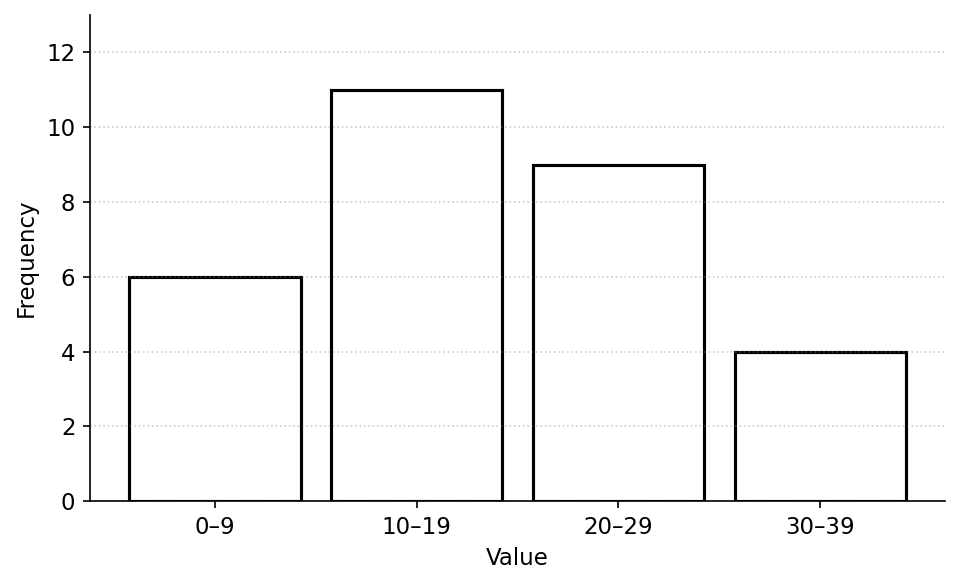
FIGURE 2 A histogram with four equal-width intervals.
Answer: The number of observations in 20–29. Histogram limits. Grouped data reveals exactly how many values fall in each bin, but not their individual values, so the mean and median cannot be recovered exactly.
8. A poll of 400 voters finds a candidate’s support at 52 percent, with a margin of error of 4 percentage points. What is the smallest value in the poll’s confidence interval, as a percent? (grid-in)
Answer: 48. Margin of error as a band around an estimate. The confidence interval spans from the estimate minus the margin to the estimate plus it: 52 - 4 = 48 up to 52 + 4 = 56. The smallest plausible value is 48.
9. For equally spaced x-values, y-values are 5, 11, 19, 29, 41. Which model family is most appropriate: linear, quadratic, or exponential?
Answer: Quadratic. Model choice from second differences. First differences are 6, 8, 10, 12; second differences are constant at 2, the signature of a quadratic model.
10. Among 120 students who play a sport, 78 play an instrument. Among 80 students who do not play a sport, 28 play an instrument. What is P(sport | instrument)? (grid-in)
Answer: 78/106 = 39/53. Conditional probability with denominator switching. The instrument total is 78 + 28 = 106, and 78 of those also play a sport.
11. A random sample of voters estimates 62 percent support for a proposal, with a margin of error of 4 percentage points. Which value is plausible for the population percentage: 54%, 61%, 68%, or 72%?
Answer: 61%. Margin-of-error interpretation rather than unnecessary sample-size arithmetic. The plausible range is 62 ± 4, or 58% to 66%; only 61% falls inside it.
12. A company randomly selects 400 employees and observes whether each voluntarily uses a wellness app. App users report lower stress. What can the study support?
Answer: An association that may generalize to the sampled employee population, but not a causal claim. Random selection versus random assignment. Because app use was observed rather than assigned, the design supports an association within the sampled population, not a cause-and-effect conclusion.
DOMAIN MASTERY AND ADVANCED PRACTICE · 4
Domain mastery set D: Geometry and Trigonometry
Purpose: practice higher-level Geometry and Trigonometry across congruence, tangent circles, slant height, the unit circle, and coordinate geometry. Do not look back at the chapters while working through it; mark any item where the first useful move does not come within about twenty seconds.
1. Two triangles have two corresponding sides equal and the included angle equal. What conclusion is guaranteed?
Answer: The triangles are congruent by SAS. Two sides and the included angle force a unique triangle.
2. Two triangles have two corresponding sides equal and a nonincluded angle equal. Is congruence guaranteed?
Answer: No. SSA is not a general congruence criterion. Two sides and a non-included angle can be satisfied by two genuinely different triangles.
3. Two similar triangles have corresponding side lengths in the ratio 3 : 5. Their areas are in what ratio?
Answer: 9 : 25. Similarity scale factor and area scaling. Areas scale by the square of the side ratio: 3² : 5².
4. A square has diagonal 18. What is its area? (grid-in)
Answer: 162. Hidden 45-45-90 triangle plus area. For a square, area = diagonal²/2 = 324/2 = 162.
5. From point P outside a circle, PA is tangent to the circle at A. If OP = 17 and OA = 8, what is PA? (grid-in)
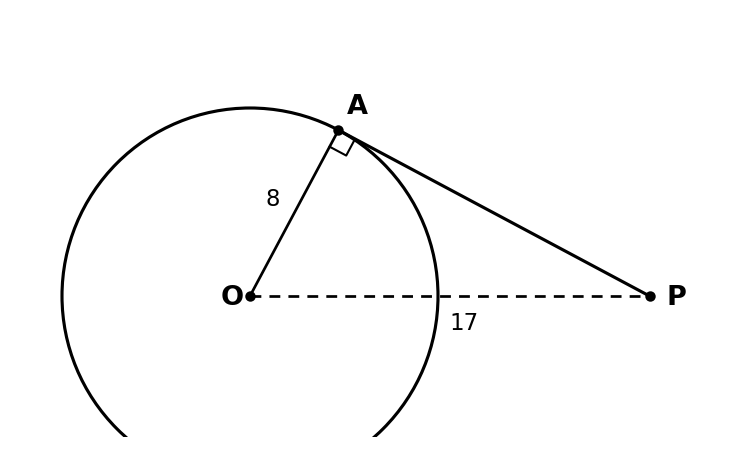
FIGURE 1 A tangent segment PA meets radius OA at a right angle.
Answer: 15. Radius-to-tangent perpendicularity creates a hidden right triangle. PA = √(17² - 8²) = √225 = 15, an 8-15-17 triple.
6. PA and PB are tangents from the same external point. PA = 3x + 2 and PB = 5x - 8. Find x. (grid-in)
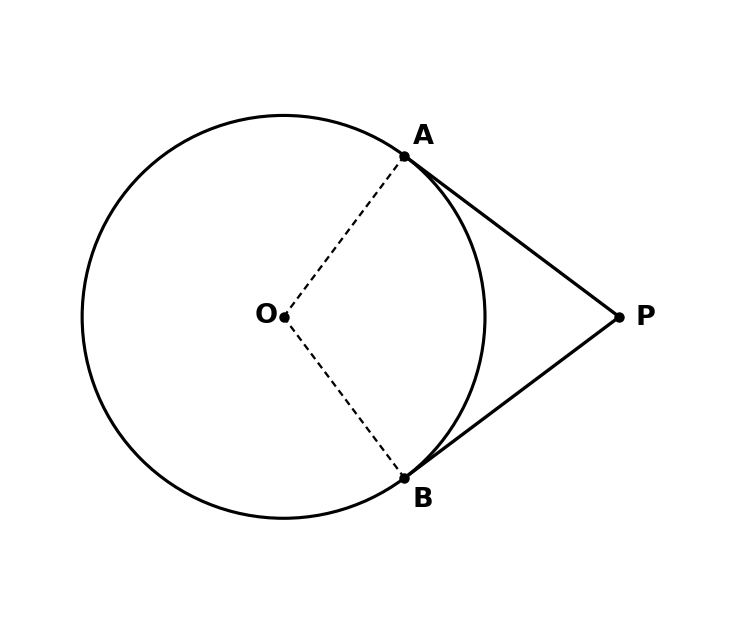
FIGURE 2 Two tangent segments from the same external point are always equal.
Answer: 5. Equal tangent segments from a common external point. Setting PA = PB: 3x + 2 = 5x - 8 gives x = 5.
7. A cone has radius 6 and slant height 10. Its volume is kπ. What is the value of k? (grid-in)
Answer: 96. The vertical height is √(10² - 6²) = 8. Then V = (1/3)π(6²)(8) = 96π, so k = 96.
8. A circle centered at the origin is tangent to a line at (3, 4). What is the slope of the tangent line?
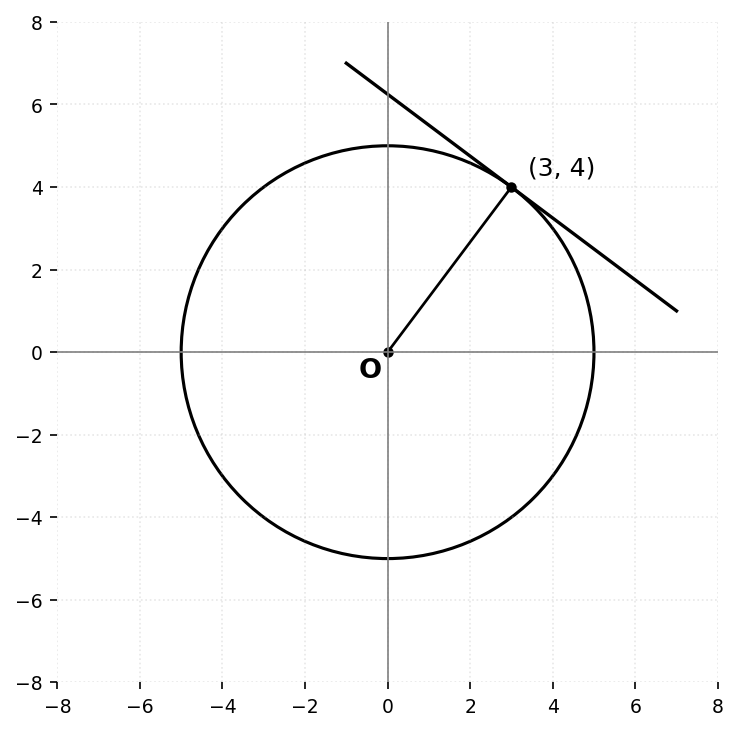
FIGURE 3 The tangent line is perpendicular to the radius at the point of contact.
Answer: -3/4. Coordinate circle plus tangent synthesis. The radius to (3,4) has slope 4/3; the tangent line is perpendicular to it, giving slope -3/4.
9. What are the coordinates of the unit-circle point at 150 degrees?
Answer: (-√3/2, 1/2). Quadrant/reference-angle unit-circle retrieval. 150° has reference angle 30° in Quadrant II, where cosine is negative and sine is positive.
10. The point (-3/5, y) lies on the unit circle in Quadrant II. What is y? (grid-in)
Answer: 4/5. Unit-circle equation plus quadrant sign. y = √(1 - 9/25) = 4/5, positive since Quadrant II has positive y-values.
11. A circle has center (3, -2) and radius 5. Does the point (7, 1) lie on, inside, or outside the circle?
Answer: On the circle. Circle equation and point-position determination. The distance from the center to (7,1) is √(4² + 3²) = √25 = 5, exactly equal to the radius.
12. Two parallel lines are cut by a transversal, forming the triangle shown below. What is the measure of the missing remote interior angle?
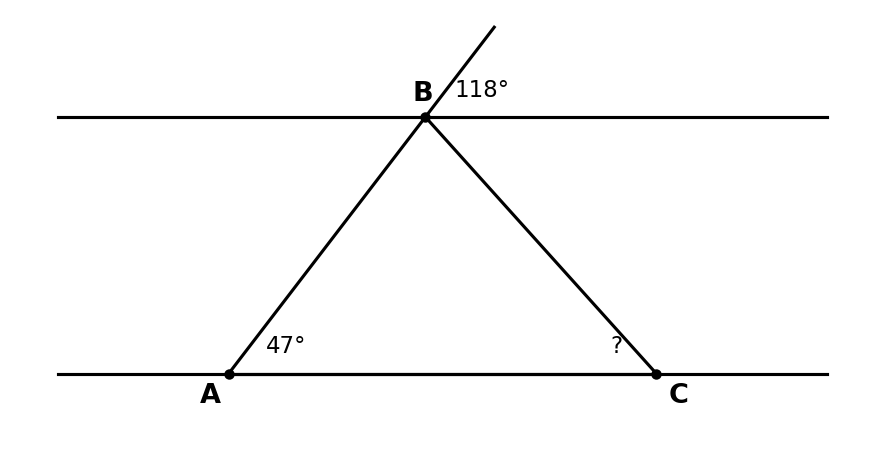
FIGURE 4 An exterior angle of a triangle equals the sum of the two remote interior angles.
Answer: 71°. Chained angle reasoning rather than naming a single theorem. The exterior angle at B equals the sum of the remote interior angles: 118 = 47 + x, so x = 71.
DOMAIN MASTERY AND ADVANCED PRACTICE · 5
Advanced Module 2 practice
This set is organized by mechanism, not chapter, and mixed across domains on purpose: the harder Module 2 gives no signal for which skill a question tests. For each item, name the structure before you compute (a parameter, a derived target, a representation switch), then decide whether hand work, Desmos, or a mix is fastest.
1. For what value of k are 3x + ky = 12 and 6x + 8y = 24 the same line? (grid-in)
Answer: 4. Twice the first equation must match the second, so 2k = 8.
2. The line y = 4x + c is tangent to y = x² - 5. Find c. (grid-in)
Answer: -9. Setting x² - 5 = 4x + c gives x² - 4x - (5+c) = 0; tangency means the discriminant is zero: 16 + 4(5+c) = 0.
3. If 7x - 5 = 30, find 21x - 15. (grid-in)
Answer: 90. The target is exactly 3(7x - 5) = 3(30) = 90; no need to solve for x.
4. A table for a linear function gives (3, 17), (7, 29), and (11, 41). What is the y-intercept? (grid-in)
Answer: 8. Slope = (29-17)/(7-3) = 3; then 17 = 3(3) + b gives b = 8.
5. A table has x = 0, 1, 2, 3 and y = 3, 6, 12, 24. Write the model family and one-step growth factor.
Answer: Exponential; factor 2. A constant ratio between consecutive outputs, here 2, identifies exponential growth rather than a constant difference.
6. The polynomial x² + px + 24 factors as (x + a)(x + b), where a and b are positive integers and a - b = 2. Find p. (grid-in)
Answer: 10. The positive factor pair of 24 differing by 2 is 6 and 4, so p = a + b = 10.
7. The roots of 3x² - 7x + k = 0 have product 4. Find k. (grid-in)
Answer: 12. Product of roots = k/a = k/3 = 4.
8. For f(x) = x² - 10x + 17, if f(3) = f(a) and a ≠ 3, find a. (grid-in)
Answer: 7. The axis of symmetry is x = 5, so the input symmetric to 3 is 2(5) - 3 = 7.
9. Solve (x + 1)/(x - 2) = 3/(x - 2).
Answer: No solution. Algebra gives x = 2, but that value is excluded by the original denominator.
10. A is 40 percent greater than B. B is 25 percent less than C. A is what percent of C? (grid-in)
Answer: 105 percent. A = 1.4B and B = 0.75C, so A = 1.4 × 0.75C = 1.05C.
11. A pump moves 450 liters in 12 minutes. At the same rate, how many liters does it move in 50 seconds? (grid-in)
Answer: 31.25 liters. The rate is 37.5 L/min; 50 seconds is 5/6 of a minute, so 37.5 × 5/6 = 31.25.
12. In a school, 60 students take calculus, 18 of whom are seniors. There are 45 seniors total. Find P(senior | calculus) and P(calculus | senior).
Answer: 18/60 = 0.30; 18/45 = 0.40. The same overlap of 18 students, divided by two different conditioning groups.
13. A random sample of 600 students from a district of 18,000 finds 42 percent use public transportation. What is the best estimate of the number of district students who use public transportation? (grid-in)
Answer: 7,560. Apply the sample proportion to the full population: 0.42 × 18,000 = 7,560.
14. Eighty volunteers are randomly assigned to treatment or placebo. What is the strongest conclusion if the treatment group improves?
Show the answer and explanation
15. Data set B is formed by multiplying every value in data set A by -3 and adding 8. If A has standard deviation 4, what is B’s standard deviation? (grid-in)
Answer: 12. Adding a constant does not change spread; multiplying scales the standard deviation by |-3| = 3, so 3 × 4 = 12.
16. For x = 0, 1, 2, 3, outputs are 2, 7, 14, 23. Which model family is indicated?
Answer: Quadratic. First differences are 5, 7, 9; the constant second difference of 2 is the signature of a quadratic model.
17. Two right triangles have equal hypotenuses and one pair of corresponding legs equal. What conclusion is guaranteed?
Answer: Congruent by HL. The right angle plus matching hypotenuse and one leg is the hypotenuse-leg criterion, valid specifically for right triangles.
18. A circle has center (2, 1). A tangent touches it at (5, 5). What is the slope of the tangent?
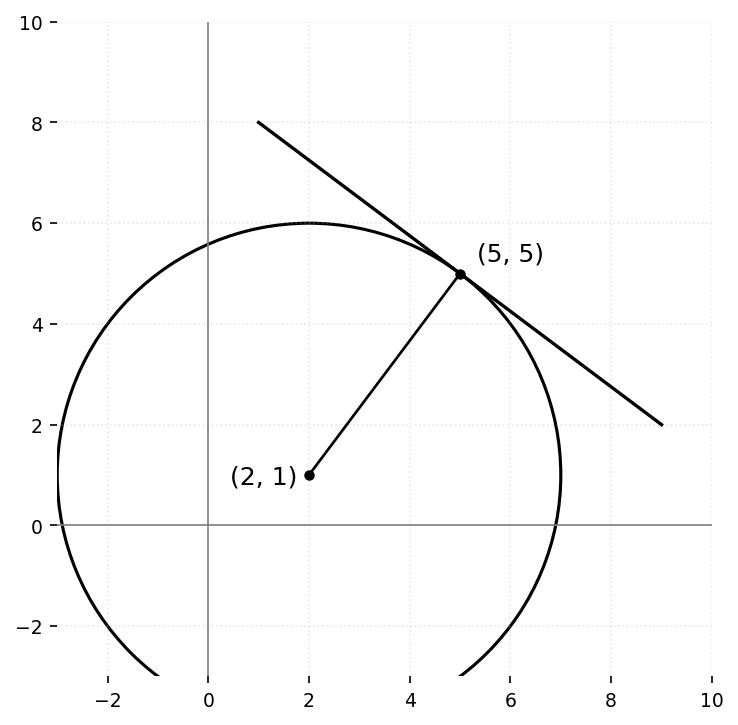
FIGURE 1 A tangent line at (5, 5) is perpendicular to the radius from the center.
Answer: -3/4. Radius slope = (5-1)/(5-2) = 4/3; the tangent is perpendicular to it, giving slope -3/4.
19. A square pyramid has base side 10 and face slant height 13 measured from the midpoint of a base edge to the apex. Find its volume. (grid-in)
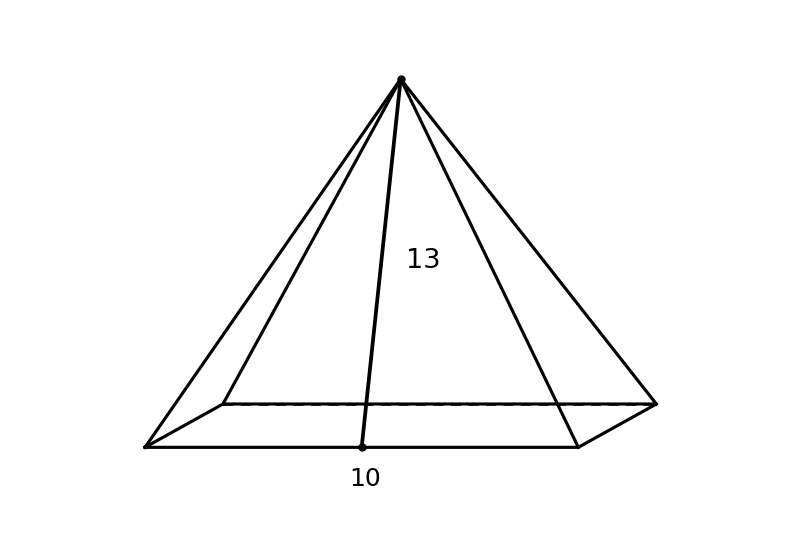
FIGURE 2 A square pyramid with base side 10 and slant height 13 from the midpoint of a base edge to the apex.
Answer: 400. Half-base = 5; vertical height = √(13² - 5²) = 12; V = (1/3)(100)(12) = 400.
20. Find sin(7π/6).
Answer: -1/2. The reference angle is π/6 in Quadrant III, where sine is negative.
21. A streaming service charges a one-time activation fee of $24 and $9 per month. A promotion reduces only the monthly charge by 20 percent for the first 6 months. What is the total paid over the first 6 months? (grid-in)
Answer: $67.20. The discounted monthly charge is 0.80 × 9 = 7.20; six months of that is 43.20, plus the one-time 24 gives 67.20.
22. A quadratic equation has awkward decimal coefficients and the question asks only for the positive numerical root. Which route is most efficient: factor by hand, graph/solve in Desmos, derive the quadratic formula by hand, or expand repeatedly?
Answer: Graph/solve in Desmos. The question asks only for a numerical root, with no structural feature worth preserving by hand, exactly when graphing is fastest.