SAT Math study guide · Chapter 23
Circles
Every circle is governed by a single constant. Its circumference, its area, the slice of a sector, the sweep of an arc: all are that constant scaled by the radius, taken in whole or in part.
For a circle's size, one number, the radius, determines its circumference and area; arcs and sectors then use a fraction of those whole-circle quantities. Layered on top are the angle relationships unique to circles, the alternative way of measuring angles called radians, and the way a circle is written as an equation on the coordinate plane. None of it is heavy once you see that almost every circle question is the same move: take a whole-circle quantity and keep the right fraction of it.
▸ Use circle circumference and area formulas
Two formulas, both on the reference sheet, anchor the circle. The circumference, the distance around, is C = 2πr, equivalently πd since the diameter d = 2r. The area enclosed is A = πr². Notice the shapes of the two: circumference grows with the radius, area with the radius squared, which is why doubling a circle's radius doubles its circumference but quadruples its area.
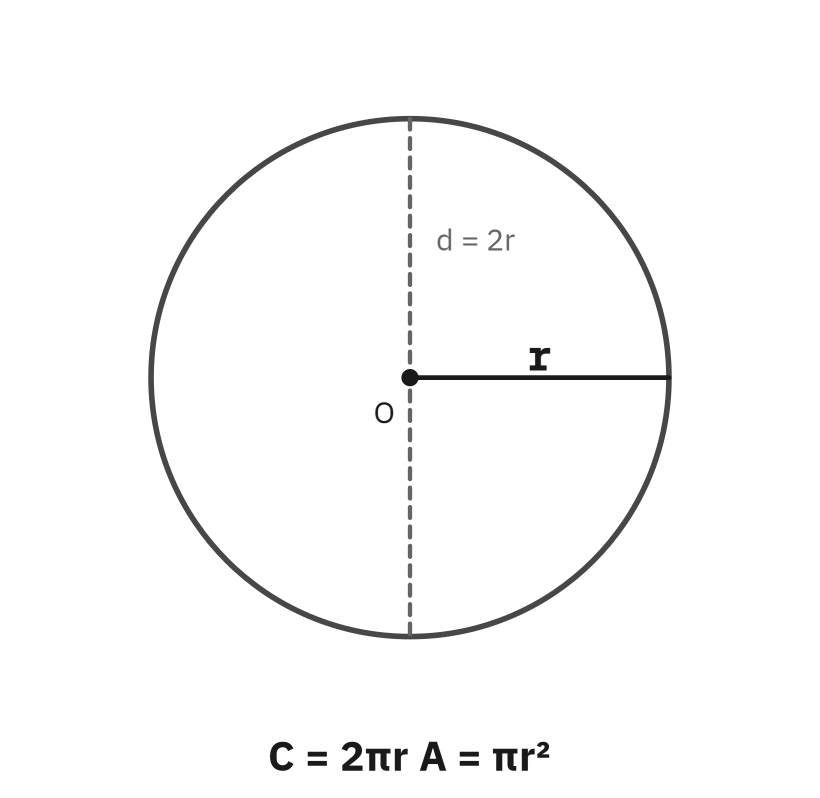
FIGURE 1 Everything about a circle flows from the radius: circumference C = 2πr and area A = πr squared.
WORKED From radius to circumference and area
A circle has radius 5.
Its circumference is 2π times the radius: 2π × 5 = 10π.
Its area is π times the radius squared: π × 5² = 25π.
Answers are usually left in terms of π unless a decimal is requested, exact and tidy.
▸ Find arc length and sector area
Slice a circle with two radii and you get a sector (a wedge of area) bounded by an arc (a piece of the circumference). Each is the same fraction of the whole circle, and that fraction is the central angle over 360 degrees. So an arc is that fraction of the circumference, and a sector is that fraction of the area: one idea, applied to two quantities.
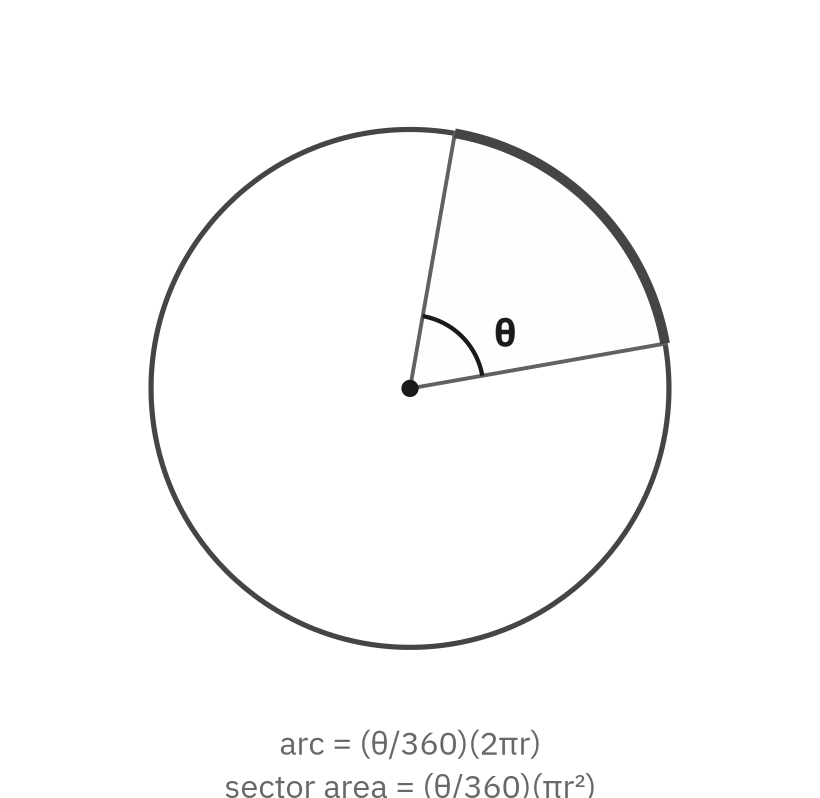
FIGURE 2 An arc and a sector are each the central-angle fraction of the whole: arc of the circumference, sector of the area.
WORKED Find an arc and a sector
A circle of radius 8 has a sector with central angle 90 degrees; that is 90/360 = 1/4 of the circle.
The arc is one-quarter of the circumference: (1/4)(2π × 8) = (1/4)(16π) = 4π.
The sector is one-quarter of the area: (1/4)(π × 8²) = (1/4)(64π) = 16π.
Find the fraction first, then apply it to whichever whole-circle quantity is asked.
▸ Use central- and inscribed-angle relationships
Two kinds of angle open onto a circle's arc. A central angle has its vertex at the center, and its measure equals the measure of the arc it cuts off. An inscribed angle has its vertex on the circle, and it is exactly half the central angle that subtends the same arc. This halving is the key fact, and it has a famous special case: an angle inscribed in a semicircle, one whose endpoints are the ends of a diameter, is always a right angle, because the diameter's arc is 180 degrees and half of that is 90.
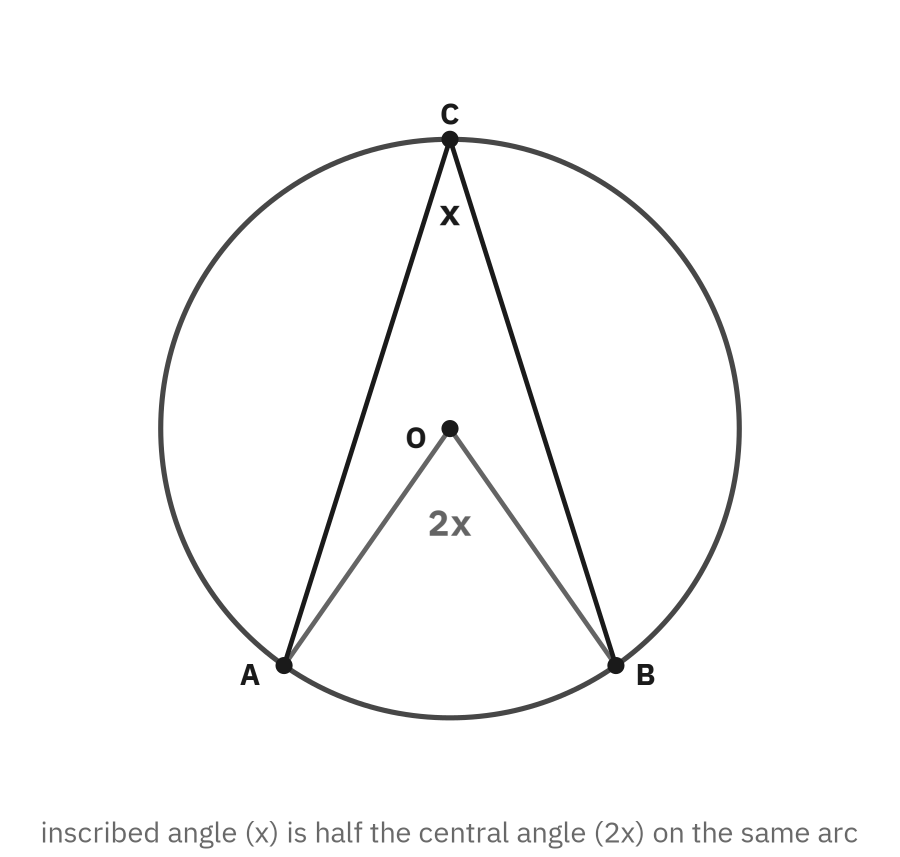
FIGURE 3 An inscribed angle is half the central angle that subtends the same arc; here, x is half of 2x.
WORKED Use the inscribed-angle rule
If a central angle subtending an arc measures 130 degrees, an inscribed angle subtending that same arc measures half as much: 65 degrees.
And a triangle inscribed in a circle with one side a diameter has a right angle opposite that diameter, a quick way to spot a hidden right triangle.
▸ Use radius-tangent and tangent-segment theorems
A tangent line touches a circle at exactly one point, and that single point of contact carries a fact worth memorizing cold: the radius drawn to it is perpendicular to the tangent line. The instant a tangent appears in a figure, that radius, that point, and any other marked point form a right triangle waiting to be used.
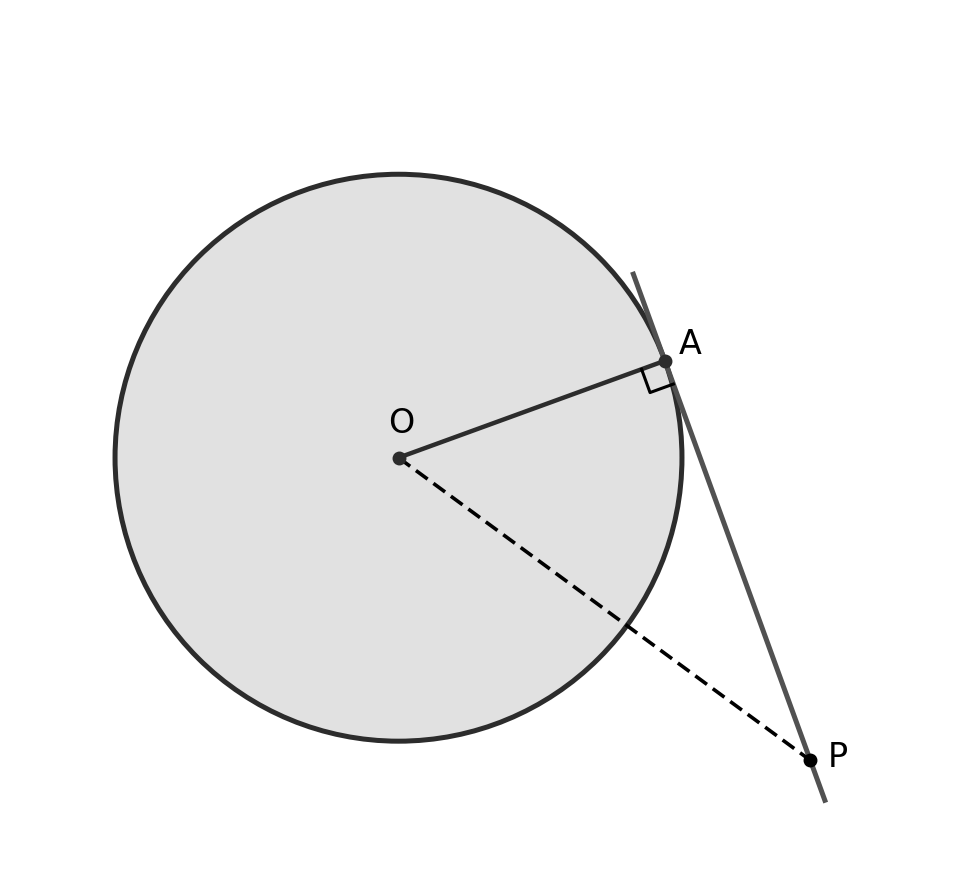
FIGURE 4 Radius OA is perpendicular to the tangent line at A; O, A, and an external point P form a right triangle with the right angle at A.
WORKED Use the tangent right angle to find a length
From external point P, segment PA is tangent to a circle with center O at point A. If OP = 17 and the radius OA = 8, what is PA?
The radius meets the tangent at a right angle, so triangle OAP is right-angled at A, with OP as the hypotenuse:
PA² + OA² = OP² → PA² = 17² − 8² = 289 − 64 = 225 → PA = 15
This is an 8-15-17 triple in disguise; recognizing the tangent right angle is what turns the figure into an ordinary Pythagorean setup.
A second tangent fact follows from symmetry: two tangent segments drawn from the same external point to the same circle are always equal in length. The two right triangles they form share the hypotenuse OP and both have a leg equal to the radius, so they are congruent, and the remaining legs, the tangent segments, must match.
WORKED Equal tangent segments from one external point
From external point P, segments PA and PB are both tangent to the same circle. If PA = 3x + 2 and PB = 5x − 8, what is x?
Equal tangent segments from the same point set the two expressions equal:
3x + 2 = 5x − 8 → 10 = 2x → x = 5
No circle equation or angle measure was needed; the equal-tangents fact alone supplies the equation.
▸ Convert between radians and degrees and relate arc length to angle
Degrees are not the only way to measure an angle. A radian measures an angle by the arc it spans, in units of the radius: an angle of one radian cuts off an arc exactly as long as the radius. Since the full circumference is 2π radii long, a full turn is 2π radians, which means 2π radians = 360 degrees, and the workhorse conversion π radians = 180 degrees.
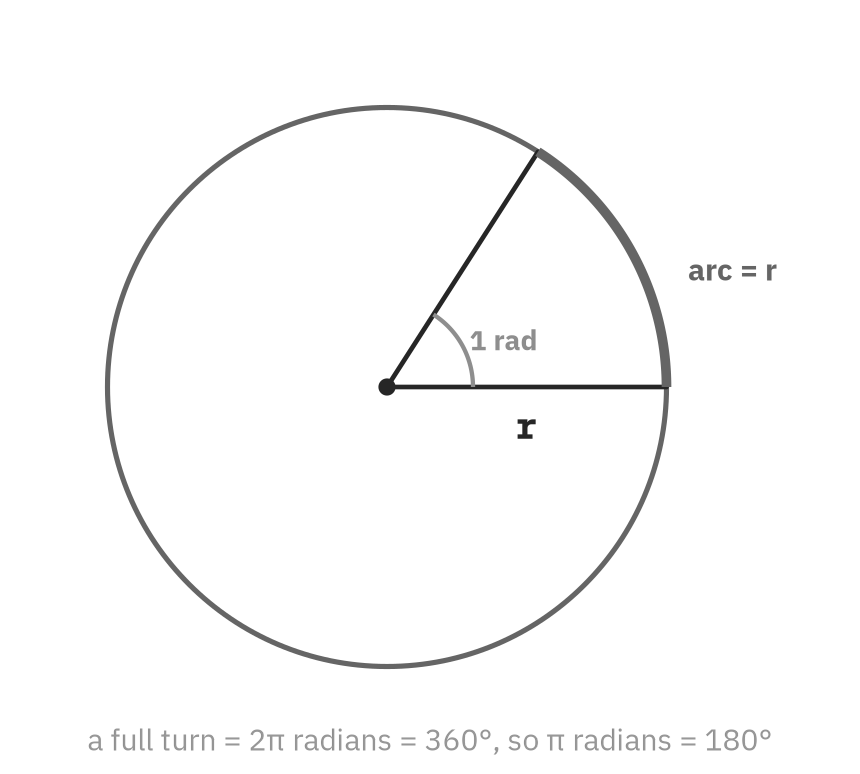
FIGURE 5 One radian spans an arc equal to the radius; a full turn is 2 pi radians, equal to 360 degrees.
Radians and arc length
Convert degrees to radians by multiplying by π/180; radians to degrees by multiplying by 180/π.
Arc length in radians is simply rθ, radius times the angle, with no fraction needed.
Common values: 180 degrees = π, 90 degrees = π/2, 60 degrees = π/3, 45 degrees = π/4.
WORKED Convert and measure with radians
Convert 135 degrees to radians: multiply by π/180, giving 135π/180 = 3π/4 radians.
Convert 5π/6 radians to degrees: multiply by 180/π, giving 5 × 180 / 6 = 150 degrees.
Arc length the radian way: a radius of 6 and an angle of π/3 give an arc of 6 × π/3 = 2π: the same answer as the degree method, with less bookkeeping.
▸ Use the standard equation of a circle
On the coordinate plane, a circle is the set of points a fixed distance from a center, and the distance formula turns that directly into an equation. A circle with center (h, k) and radius r is written
(x - h)2 + (y - k)2 = r2
so the center is read straight off as (h, k), with the signs flipped from what appears inside, and the radius is the square root of the right-hand side. When a circle is given in expanded form instead, completing the square in x and in y restores this standard form and reveals the center and radius.
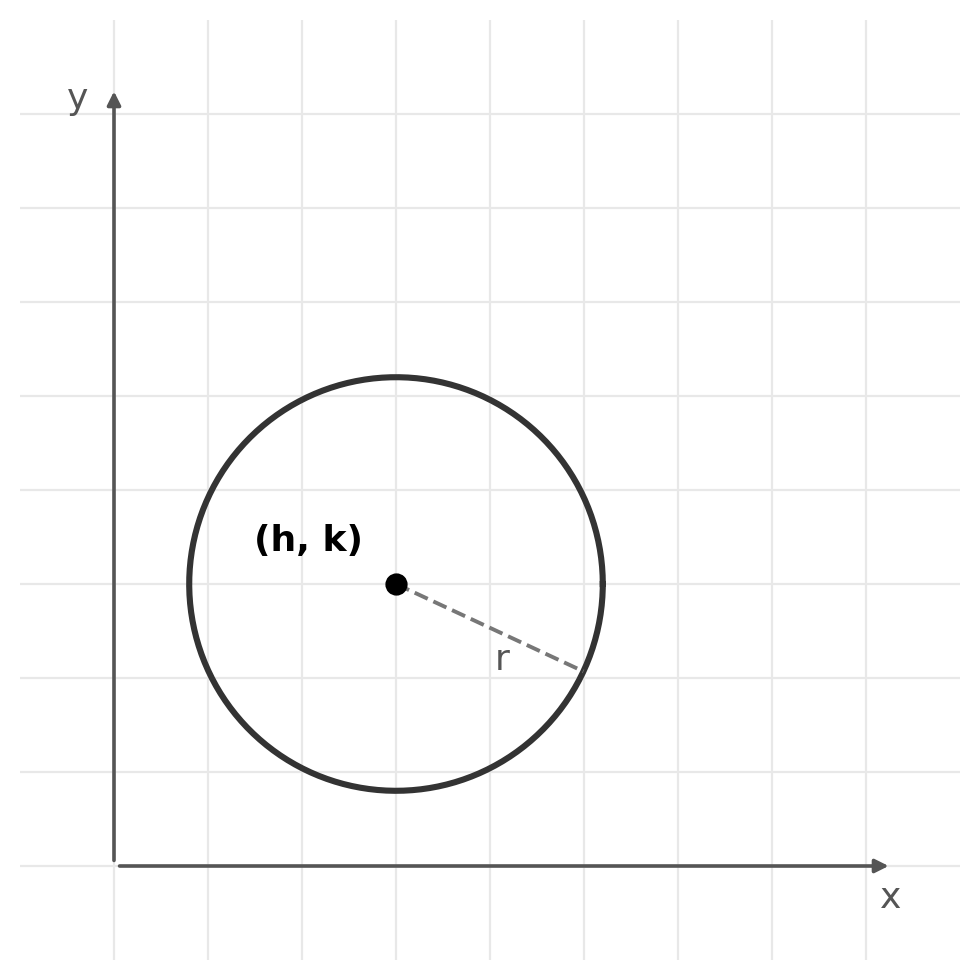
FIGURE 6 A circle of radius r centered at (h, k); every point on it satisfies (x − h) squared plus (y − k) squared equals r squared.
WORKED Read and recover a circle's equation
Read it off: (x - 2)2 + (y + 3)2 = 16 has center (2, -3), note y + 3 means k = -3, and radius √16 = 4.
Recover it: given x2 + y2 - 6x + 8y = 0, group and complete the square in each variable:
(x2 - 6x + 9) + (y2 + 8y + 16) = 0 + 9 + 16,
(x - 3)2 + (y + 4)2 = 25.
The center is (3, -4) and the radius is √25 = 5. Add to both sides whatever you add to complete each square.
▸ Interpret translated and scaled circle equations
Because the standard-form equation stores the center and radius directly, transforming a circle, shifting it or resizing it, is a matter of editing exactly the piece that changed and leaving the rest of the equation alone.
WORKED Shift a circle and rewrite its equation
The circle (x − 3)² + (y + 2)² = 16 is shifted 4 units left. Which equation represents the new circle?
Shifting left changes only the center's x-coordinate; subtract 4 from it and rebuild the x-term, leaving the y-term and the radius untouched:
center (3, −2) → (−1, −2) → (x + 1)² + (y + 2)² = 16
A shift changes only the numbers inside the parentheses, never the right-hand side; the radius, and therefore the circle's size, is unaffected by moving it.
Resizing works the other way: changing the radius touches only the right-hand side, since that side stores r², not r itself.
WORKED Read a resizing from the equation alone
The equation of a circle changes from (x − 1)² + (y − 5)² = 9 to (x − 1)² + (y − 5)² = 25. What changed?
The center terms are identical in both equations, so the center did not move. The right-hand side went from 9 to 25:
r = √9 = 3 → r = √25 = 5
The radius increased from 3 to 5, not by 16; the right side stores the radius squared, so the jump from 9 to 25 is not the change in radius itself, a common misreading of this exact setup.
▸ Practice: circles
Several answers are written in the form kπ; for those, grid the value of k.
1. A sector of a circle of radius 8 has a central angle of 90 degrees. The area of the sector is kπ. What is the value of k? (grid-in)
2. In a circle of radius 10, a central angle of 72 degrees subtends an arc of length kπ. What is the value of k? (grid-in)
3. In a circle, a central angle measures 130 degrees. An inscribed angle that subtends the same arc measures how many degrees? (grid-in)
4. A triangle is inscribed in a circle so that one of its sides is a diameter. What is the measure, in degrees, of the angle opposite that side? (grid-in)
Question 5
- A. π/4
- B. 2π/3
- C. 3π/4
- D. 5π/6
6. A circle has radius 6. A central angle of π/3 radians subtends an arc whose length is kπ. What is the value of k? (grid-in)
7. The equation x2 + y2 - 6x + 8y = 0 describes a circle. What is the radius of the circle? (grid-in)
8. The circle (x + 2)2 + (y - 5)2 = 49 has center (h, k). What is the value of h + k? (grid-in)
9. A circle has a circumference of 12π. Its area is kπ. What is the value of k? (grid-in)
10. A circle of radius 9 has a sector with area 27π. What is the central angle of the sector, in degrees? (grid-in)
11. Points A, B, and C lie on a circle. The arc AB not containing C has a central angle of 80 degrees. What is the measure, in degrees, of inscribed angle ACB? (grid-in)
12. An angle measures 5π/6 radians. What is its measure in degrees? (grid-in)
13. The circle x2 + y2 + 10x - 4y - 7 = 0 has center (h, k). What is the value of h? (grid-in)
Question 14
- A. (x - 3)2 + (y + 1)2 = 5
- B. (x - 3)2 + (y + 1)2 = 25
- C. (x + 3)2 + (y - 1)2 = 25
- D. (x - 3)2 + (y - 1)2 = 25
15. A circle has center O and radius 5. A line tangent to the circle at point P meets a point Q on that line with OQ = 13. What is the length of PQ? (grid-in)
16. From external point P, two segments are tangent to circle O, touching it at points A and B. If the radius OA = 6 and OP = 10, what is the length of PB? (grid-in)
▸ Solutions: circles
1: 16. The sector is 90/360 = 1/4 of the circle. Its area is (1/4)(π × 8²) = (1/4)(64π) = 16π, so k = 16.
2: 4. The arc is 72/360 = 1/5 of the circumference. Its length is (1/5)(2π × 10) = (1/5)(20π) = 4π, so k = 4.
3: 65. An inscribed angle is half the central angle on the same arc: 130/2 = 65 degrees.
4: 90. An angle inscribed in a semicircle is a right angle, since the diameter's arc is 180 degrees and half of that is 90.
Show the answers and explanations
5: C. Multiply by π/180: 135 × π/180 = 135π/180 = 3π/4 radians.
6: 2. Arc length in radians is rθ = 6 × π/3 = 2π, so k = 2.
7: 5. Complete the square: (x - 3)2 + (y + 4)2 = 9 + 16 = 25, so the radius is √25 = 5.
8: 3. The center is read with flipped signs: (h, k) = (-2, 5), so h + k = -2 + 5 = 3.
9: 36. From 2πr = 12π the radius is 6, so the area is π × 6² = 36π and k = 36.
10: 120. The sector area is (θ/360)(π × 9²) = (θ/360)(81π). Setting this to 27π gives θ/360 = 27/81 = 1/3, so θ = 120 degrees.
11: 40. The inscribed angle ACB subtends arc AB, whose central angle is 80 degrees, so the inscribed angle is half: 40 degrees.
12: 150. Multiply by 180/π: (5π/6)(180/π) = 5 × 180 / 6 = 150 degrees.
13: −5. Complete the square: (x + 5)2 + (y - 2)2 = 7 + 25 + 4 = 36, so the center is (-5, 2) and h = -5.
Show the answers and explanations
14: B. Center (3, -1) gives (x - 3)2 + (y + 1)2, and radius 5 gives r2 = 25 on the right. The radius is squared in the equation, which rules out the choice ending in 5.
15: 12. A tangent line is always perpendicular to the radius at the point of tangency, so triangle OPQ has a right angle at P. The Pythagorean theorem applies directly: OQ² = OP² + PQ², so 169 = 25 + PQ², giving PQ² = 144 and PQ = 12, a 5-12-13 triple.
16: 8. Triangle OAP has a right angle at A, since the radius meets the tangent at a right angle. The Pythagorean theorem gives PA² = OP² - OA² = 100 - 36 = 64, so PA = 8. Since two tangent segments from the same external point are always equal, PB = PA = 8 as well, with no separate calculation needed for PB.
▸ Choose the right circle theorem when several could apply
A single circle diagram often carries more than one relationship at once: a central angle, an inscribed angle, a tangent line, and a chord can all appear in the same figure, and the diagram is not guaranteed to be drawn to scale. The reliable habit is to name what is actually given, a center, a tangent point, an arc, before choosing a theorem, rather than picking whichever relationship looks visually obvious. Ask specifically: does an angle have its vertex at the center (central), on the circle itself (inscribed), or outside it (tangent or secant)? That single check selects the correct rule.
A figure shows a central angle of 100 degrees and, separately, an inscribed angle that subtends the same arc. Reading the vertex of each angle first, not the picture’s apparent size, confirms which rule applies: the central angle gives the arc directly, 100 degrees, and the inscribed angle is exactly half of it, 50 degrees, regardless of how large either angle looks when drawn.
▸ Circles: chapter summary
A circle is run entirely by its radius: circumference 2πr, area πr², and every arc and sector just the central-angle fraction, θ/360, of one of those. Central angles equal their arcs; inscribed angles are half as large, with the semicircle giving a free right angle. Radians remeasure angles in radius-lengths, with π radians = 180 degrees and arc length a clean rθ. And on the plane, (x - h)2 + (y - k)2 = r2 names the center and radius directly, recoverable by completing the square. See the fraction, read the center, and the circle gives way.