SAT Math study guide · Chapter 24
Area and Volume
The reference sheet hands you the formulas. The work is choosing the right one, breaking a complicated shape into simple ones, and, when the test runs the formula backward, solving for the piece left blank.
This section is where the reference sheet earns its keep. It gives area formulas for a circle, rectangle, and triangle and volume formulas for a rectangular prism, cylinder, sphere, cone, and pyramid. Other relationships, including parallelogram and trapezoid area, still need to be recognized or derived. That means three skills: matching the figure to its formula, decomposing a complicated shape into simple pieces you can add or subtract, and running a formula backward to find a dimension when the area or volume is given. The main task is choosing the correct formula, decomposing the figure when necessary, and identifying the requested dimension or measure.
▸ Apply area formulas to triangles, quadrilaterals, and circles
Four area formulas cover almost every plane figure. A rectangle is base times height; a triangle is half of that, (1/2)bh, since it fills half its bounding rectangle. A parallelogram is base times height (the perpendicular height, not the slanted side) and a trapezoid, with its two parallel sides, is the average of those sides times the height, (1/2)(b1 + b2)h. In every case the height is the perpendicular distance, which is the one detail worth checking twice.
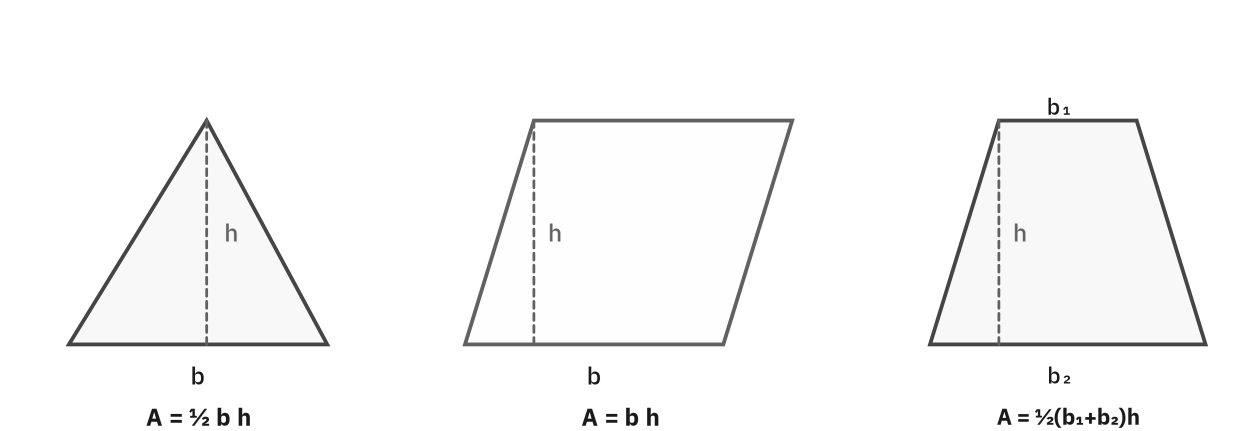
FIGURE 1 The core plane-area formulas. In each, the height h is the perpendicular distance, not a slanted side.
WORKED Apply an area formula
A trapezoid has parallel sides 6 and 14 and height 5. Average the parallel sides, then multiply by the height:
A = (1/2)(6 + 14)(5) = (1/2)(20)(5) = 50.
The average of the bases, 10, times the height 5, gives the same 50, the trapezoid behaves like a rectangle of that average width.
▸ Decompose composite figures to find area
Many figures are not single shapes but combinations: a rectangle with a semicircle on one end, an L-shaped room, a square with a triangle removed. The method never changes: cut the figure into shapes you have formulas for, then add the pieces that are present and subtract the pieces that are cut away. The only skill is seeing the simple shapes inside the complicated one.
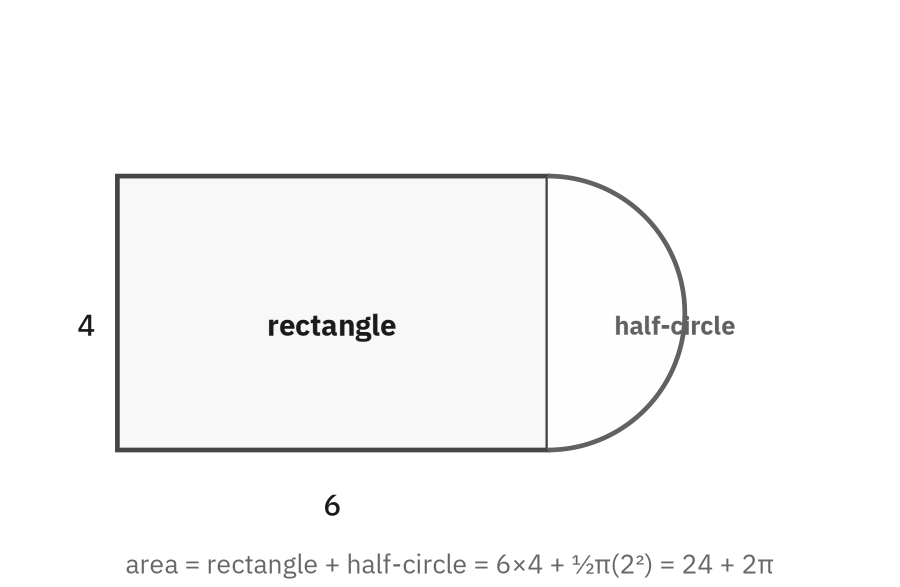
FIGURE 2 A composite figure is a sum of simple ones: this area is a rectangle plus a half-circle.
WORKED Build an area from pieces
A region is a 6-by-4 rectangle with a semicircle of radius 2 on one end. Add the two areas:
rectangle = 6 × 4 = 24, half-circle = (1/2)π(22) = 2π.
So the total area is 24 + 2π. For a shape with a piece removed, you would subtract that piece instead of adding it.
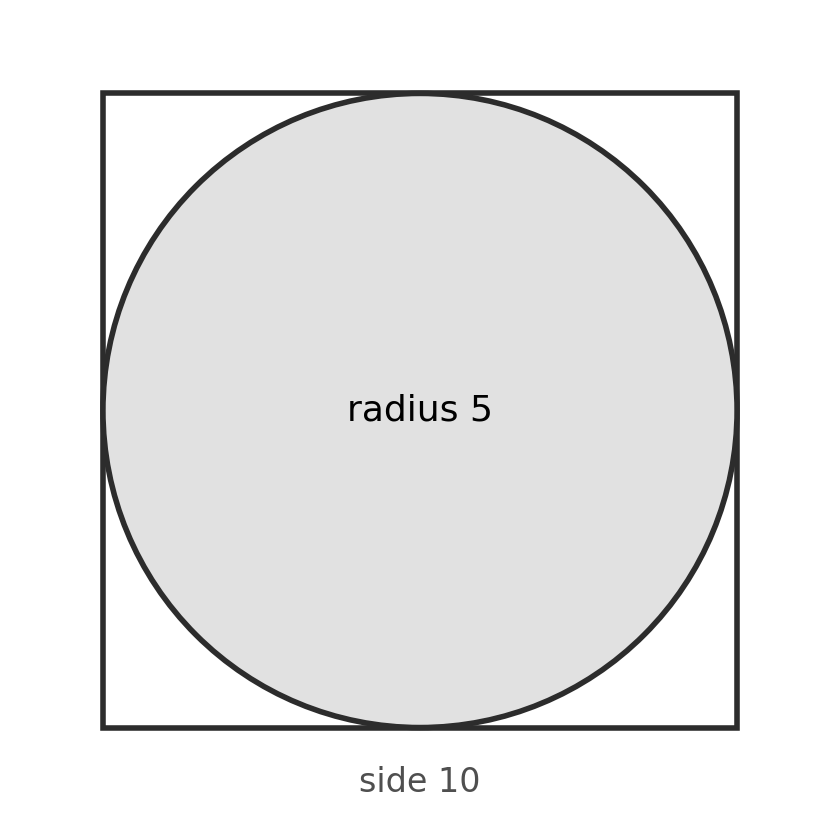
FIGURE 3 A circle inscribed in a square: the shaded region inside the square but outside the circle is the square's area minus the circle's.
WORKED A circle-in-square shaded region
A circle is inscribed in a square of side 10, as shown. What is the area inside the square but outside the circle?
The circle's diameter equals the square's side, so its radius is 5. Subtract the circle's area from the square's:
100 − 25π
Mixing up radius and diameter is the usual trap in this family; the inscribed circle's diameter, not its radius, is what matches the square's side.
▸ Apply volume formulas to prisms, cylinders, cones, spheres, and pyramids
Volume formulas split into two families. For solids with the same cross-section all the way up, prisms and cylinders, the volume is simply the base area times the height: a rectangular prism is lwh, a cylinder is πr²h. For solids that taper to a point, cones and pyramids, the volume is exactly one-third of the matching prism or cylinder: a cone is (1/3)πr²h. The sphere stands alone at (4/3)πr³. Knowing which family a solid belongs to tells you whether the one-third is there.
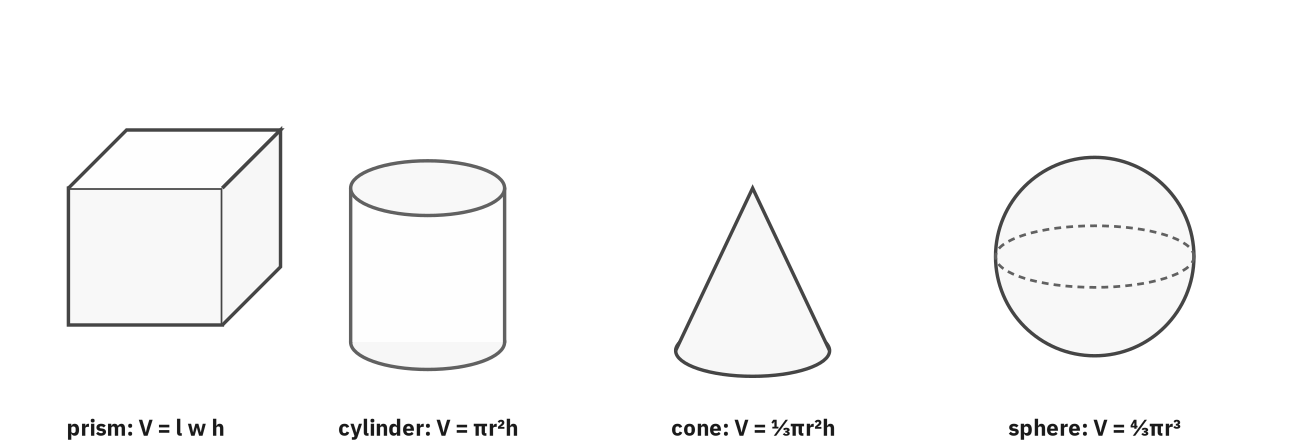
FIGURE 4 Prisms and cylinders are base area times height; cones and pyramids are one-third of that; the sphere has its own formula.
WORKED Compute and compare volumes
A cylinder with radius 3 and height 10 has volume π(32)(10) = 90π.
A cone with the same radius and height holds one-third as much: (1/3)(90π) = 30π.
A sphere of radius 3 has volume (4/3)π(33) = (4/3)π(27) = 36π.
Recognizing the one-third for the tapering cone saves a full recalculation.
A square pyramid uses the same one-third rule, but its most common trap is a labeling one: a pyramid problem often gives the slant height, the distance along a triangular face, rather than the vertical height the volume formula actually needs.
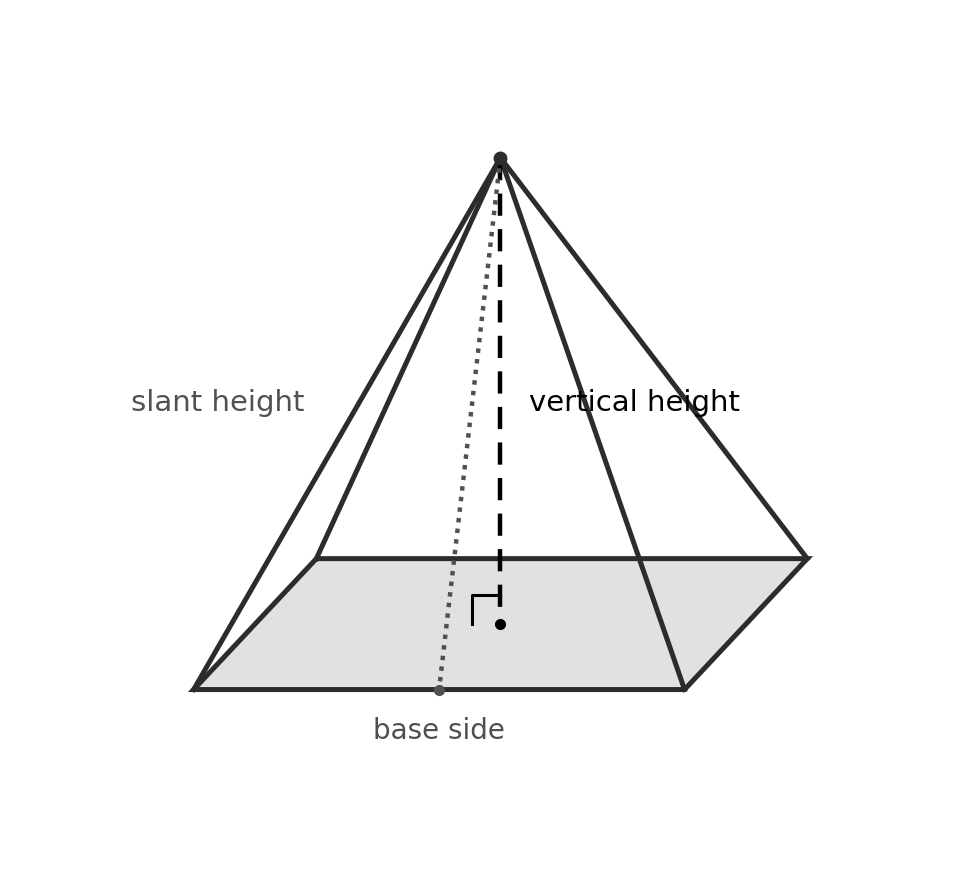
FIGURE 5 A square pyramid's vertical height runs straight down to the base's center; its slant height runs along a face to the base's edge. The two are not the same segment.
WORKED Do not mistake slant height for vertical height
A square pyramid has a base side of 6 and a vertical height of 10. What is its volume?
The volume formula wants the vertical height directly; since it is already given here, no conversion is needed:
V = (1/3)(base area)(height) = (1/3)(36)(10) = 120
Had the problem instead given a slant height of 10, the vertical height would first need to be recovered using the right triangle formed by the vertical height, half the base side, and the slant height, the Pythagorean theorem applied inside the solid, before this same formula could be used.
▸ Decompose an unfamiliar solid into a known base and height
Not every solid arrives as a named prism, cylinder, cone, sphere, or pyramid. A tetrahedron, a solid with four triangular faces, is not on that list, but it still yields to the same one-third rule once its base and height are identified correctly: volume is one-third of the base area times the height, exactly as for any pyramid, since a tetrahedron is simply a pyramid with a triangular base.
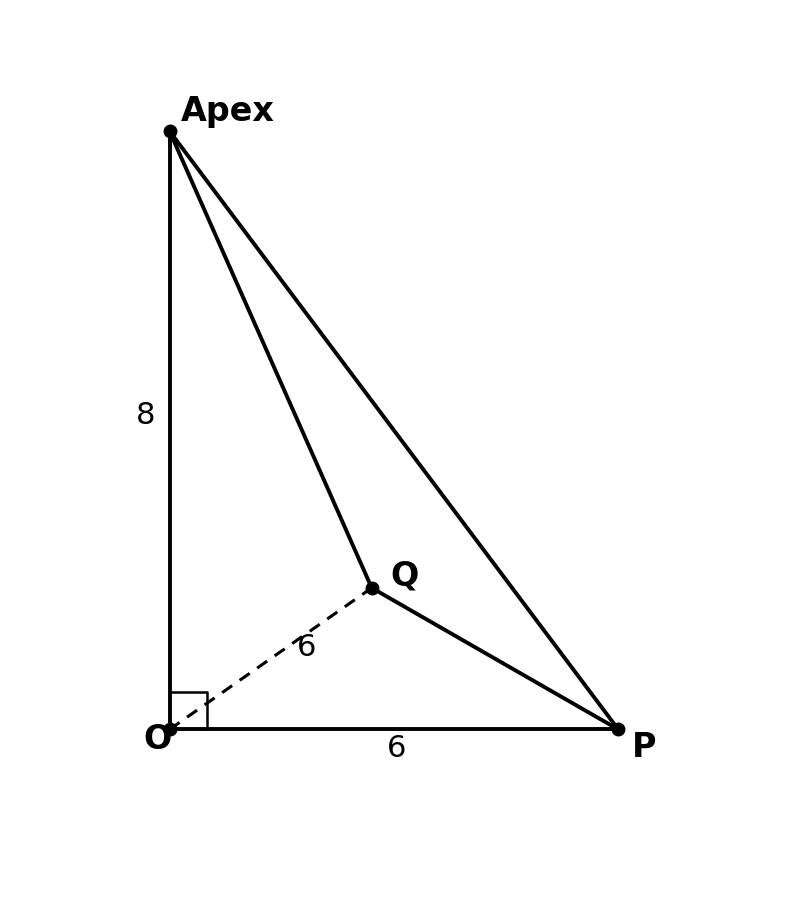
FIGURE 4B A tetrahedron with three mutually perpendicular edges at O. Any two of those edges frame the triangular base; the third is the height above it.
WORKED Volume of a right tetrahedron
Three edges of a tetrahedron meet at vertex O at right angles to each other, with lengths 6, 6, and 8. What is the volume?
Two of the perpendicular edges, the two of length 6, frame a right-triangle base; the third edge, length 8, is then perpendicular to that entire base and serves as the height.
base area = (1/2)(6)(6) = 18 V = (1/3)(18)(8) = 48
Nothing about an unfamiliar solid changes the formula; it only changes how much work identifying the base and height takes before the familiar one-third rule can run. The same three edges could be relabeled to use a different pair as the base, and the volume would come out to 48 either way.
▸ Compute surface area from the faces of a solid
The surface area of a solid is the total area of all its faces, so you find it by adding up the areas of the flat pieces and curved pieces that wrap the solid. A rectangular prism has six rectangular faces in three matching pairs; a cylinder unrolls into two circles (the ends) plus a rectangle (the wrapped side) whose width is the circumference.
WORKED Find a surface area
A cylinder has radius 4 and height 6. Add the two circular ends and the wrapped side:
two ends = 2π(42) = 32π, side = 2π(4)(6) = 48π.
So the total surface area is 32π + 48π = 80π. The side's area is the circumference 2πr times the height.
▸ Track which measure a question actually requests
Surface area and volume describe the same solid from two different questions, how much skin wraps it against how much room is inside it, and a problem’s wording is the only signal for which one is wanted. “How much material,” “how much paint,” or “wrapping paper” point to surface area; “how much it holds,” “capacity,” or “water it can contain” point to volume. The two numbers are rarely close enough that guessing which formula to use is safe.
The same cylinder, radius 4 and height 6, makes the gap concrete: its surface area is 80π, but its volume is π(4²)(6) = 96π. Reaching for the wrong one of these two nearby-looking numbers is a requested-object error, not a computation error, since both formulas would be applied correctly, just to the wrong question.
▸ Solve for dimensions and apply area/volume scale factors
Two higher-order moves complete the section. First, the test often gives the area or volume and asks for a dimension, so you set up the formula and solve for the unknown. Second, recall from the similarity section how scaling propagates: enlarging a solid by a factor k multiplies every length by k, the surface area by k2, and the volume by k3. Tripling a solid's dimensions multiplies its volume by 27, not by 3.
WORKED Run a formula backward
A cylinder has volume 100π and radius 5. Solve the volume formula for the height:
100π = π(52)h = 25π h → h = 100π / 25π = 4.
A sphere with volume 288π: from (4/3)πr3 = 288π, divide to get r3 = 216, so r = 6, the π cancels and a cube root finishes it.
▸ Practice: area and volume
Several answers are written in the form kπ; for those, grid the value of k.
1. A trapezoid has parallel sides of length 6 and 14 and a height of 5. What is its area? (grid-in)
2. A 10-by-8 rectangle has a 3-by-4 rectangle removed from one corner. What is the area of the remaining region? (grid-in)
3. A cylinder has radius 3 and height 10. Its volume is kπ. What is the value of k? (grid-in)
4. A cone has radius 6 and height 5. Its volume is kπ. What is the value of k? (grid-in)
5. A sphere has radius 3. Its volume is kπ. What is the value of k? (grid-in)
6. A cylinder has a volume of 100π and a radius of 5. What is its height? (grid-in)
7. A cube has a volume of 64. What is the total surface area of the cube? (grid-in)
8. Each dimension of a solid is tripled. By what factor is the solid's volume multiplied? (grid-in)
9. A cylinder has radius 4 and height 6. Its total surface area is kπ. What is the value of k? (grid-in)
10. A solid is a cylinder of radius 2 and height 8 with a cone of radius 2 and height 3 on top. The total volume is kπ. What is the value of k? (grid-in)
11. A prism has a triangular base of area 12 and a height of 7. What is the volume of the prism? (grid-in)
12. A sphere has a volume of 288π. What is its radius? (grid-in)
13. A cone and a cylinder have equal radii and equal heights. The cone's volume is what fraction of the cylinder's volume? (grid-in)
Question 14
- A. 2 by 6 by 12
- B. 4 by 9 by 6
- C. 5 by 6 by 8
- D. 3 by 6 by 10
15. A cone has a slant height of 13 and a radius of 5. Its volume is kπ. What is the value of k? (grid-in)
16. Two similar solids have volumes in the ratio 27 : 8. If the smaller solid has a side length of 4, what is the corresponding side length of the larger solid? (grid-in)
▸ Solutions: area and volume
1: 50. Average the parallel sides and multiply by the height: (1/2)(6 + 14)(5) = (1/2)(20)(5) = 50.
2: 68. Find the whole and subtract the cut piece: 10 × 8 - 3 × 4 = 80 - 12 = 68.
3: 90. A cylinder is base area times height: π(32)(10) = 90π, so k = 90.
4: 60. A cone is one-third of the matching cylinder: (1/3)π(62)(5) = (1/3)(180π) = 60π, so k = 60.
5: 36. A sphere is (4/3)πr3 = (4/3)π(27) = 36π, so k = 36.
6: 4. Solve 100π = π(52)h = 25π h for h: h = 100/25 = 4.
7: 96. The edge is the cube root of 64, which is 4. Surface area is six square faces: 6 × 42 = 6 × 16 = 96.
8: 27. Volume scales by the cube of the length factor: 33 = 27.
9: 80. Two ends plus the wrapped side: 2π(42) + 2π(4)(6) = 32π + 48π = 80π, so k = 80.
10: 36. Cylinder π(22)(8) = 32π, cone (1/3)π(22)(3) = 4π; together 36π, so k = 36.
11: 84. A prism is base area times height regardless of base shape: 12 × 7 = 84.
12: 6. From (4/3)πr3 = 288π, the π cancels: r3 = 288 × (3/4) = 216, so r = 6.
13: 1/3. A cone is one-third of a cylinder with the same radius and height, so the ratio is 1/3.
Show the answers and explanations
14: B. The cube's volume is 63 = 216. Checking the boxes, only 4 × 9 × 6 = 216 matches.
15: 100. The slant height, radius, and vertical height of a cone form a right triangle, with the slant height as the hypotenuse: h² = 13² - 5² = 169 - 25 = 144, so h = 12, a 5-12-13 triple. The volume formula needs the vertical height, not the slant height: V = (1/3)πr²h = (1/3)π(25)(12) = 100π, so k = 100. Using the slant height directly in the volume formula is the trap this question is built around.
16: 6. Volume scales with the cube of the linear scale factor, so recovering the linear ratio from a volume ratio means taking a cube root: ∛27 : ∛8 = 3 : 2. Applying that ratio to the smaller solid’s side length: 4 × (3/2) = 6. Applying the volume ratio directly to the side length, skipping the cube root, is the error this question is designed to catch.
▸ Area and volume: chapter summary
Area and volume reward formula judgment over memorization, since the formulas are given. For plane figures, match the shape (triangle as half a rectangle, trapezoid as the average of its bases times height) and decompose composite regions by adding and subtracting simple pieces. For solids, prisms and cylinders are base area times height, cones and pyramids are one-third of that, and the sphere is (4/3)πr3. Run any formula backward to find an unknown dimension, and remember that volume scales by the cube of a length factor. Pick the right formula, break the figure into parts, and solve for what is asked.