SAT Math study guide · Chapter 26
Special Right Triangles and the Unit Circle
The same right-triangle ratios extend to unit-circle coordinates and to geometric contexts such as angles of elevation.
The right-triangle chapter built the fluency: because two right triangles sharing an acute angle are always similar, the angle alone fixes every ratio of the sides. That fact, the angle decides the ratios, is worth carrying forward as this section pushes it further.
Sine, cosine, and tangent are simply the three ways to pair those sides.
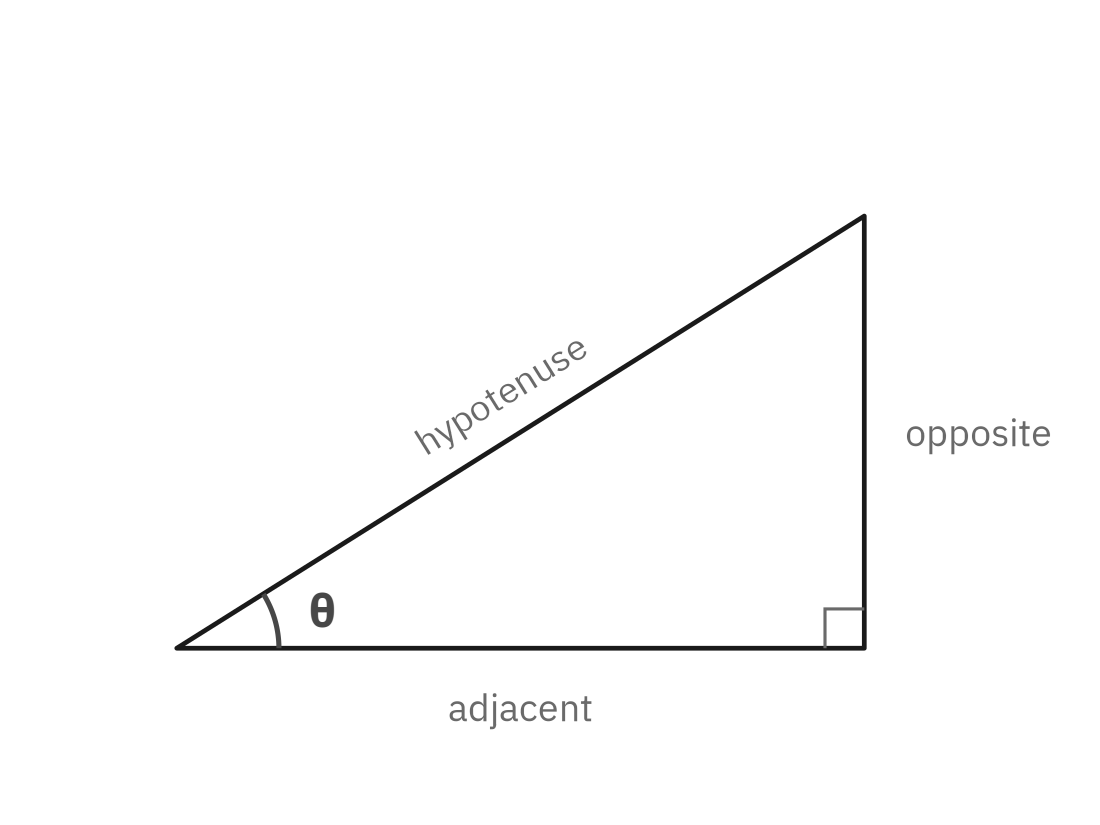
FIGURE 1 Relative to the marked angle, the sides earn names: opposite, adjacent, and the hypotenuse. The angle alone fixes their ratios.
As a quick refresher: from angle θ, one leg is opposite, one is adjacent, and the hypotenuse faces the right angle:
sin θ = opp / hyp cos θ = adj / hyp tan θ = opp / adj
SOH-CAH-TOA is that pairing compressed into six letters, nothing more.
▸ Use 45-45-90 and 30-60-90 ratios
As a quick refresher, two right triangles are worth recognizing on sight, with no calculator needed:
The half-square, a square cut along its diagonal, gives the 45-45-90 ratio 1 : 1 : √2.
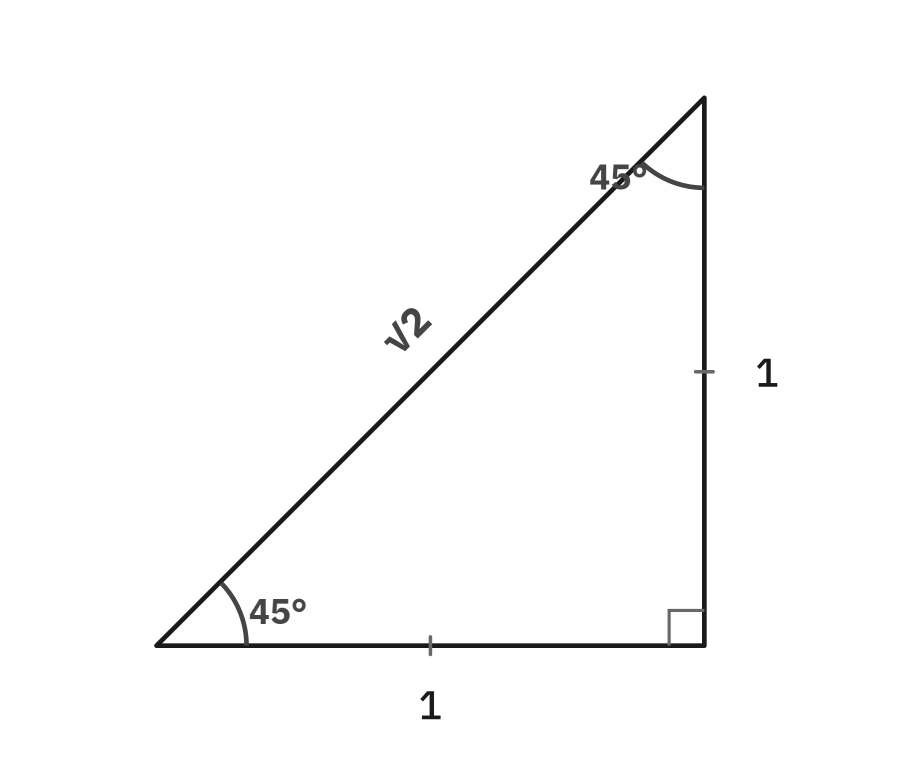
FIGURE 2 The 45-45-90 triangle: equal legs, hypotenuse √2 times a leg. Its angles force the side ratio 1 : 1 : √2.
The half-equilateral, an equilateral triangle cut down the middle, gives the 30-60-90 ratio 1 : √3 : 2.
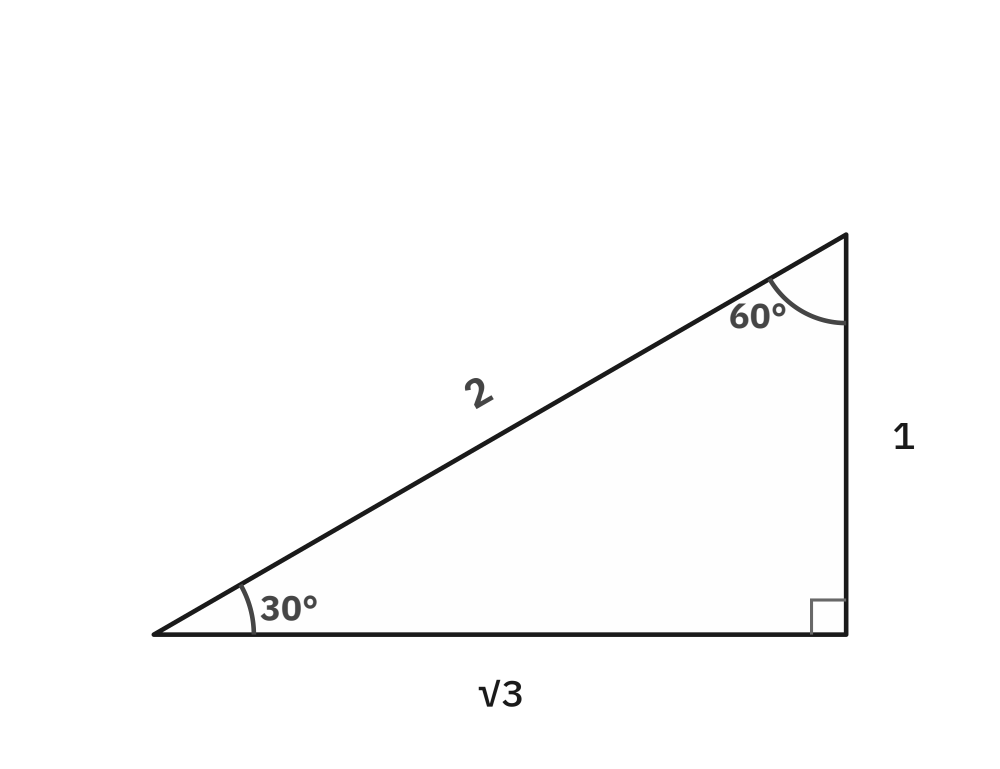
FIGURE 3 The 30-60-90 triangle: side ratio 1 : √3 : 2, with the shortest side opposite the smallest angle.
Reading ratios by picture rather than by memorized table is worth the habit: reach for the triangle before the calculator, since it hands back the cleaner exact form, √3/2, rather than a decimal like 0.866…
WORKED A radical perimeter hides a special triangle
A square of side s is cut along its diagonal. One of the resulting right triangles has perimeter 10 + 5√2. What is s?
Cutting a square along its diagonal is exactly the half-square construction: legs s and s, hypotenuse s√2. The perimeter is their sum.
s + s + s√2 = 10 + 5√2 → s(2 + √2) = 5(2 + √2) → s = 5
The radical is not a separate quantity to isolate; it is part of the same factor multiplying s on both sides. Recognizing 10 + 5√2 as 5(2 + √2), the constant matched to the constant and the radical term to the radical term, turns the equation into a one-step division instead of a fight with an unfamiliar radical equation.
▸ Use complementary-angle sine and cosine relationships
One more relationship is worth a refresher: a right triangle's two acute angles are complementary, since the third angle is 90°. If one is θ, the other is 90° − θ, and the same leg is opposite one angle and adjacent to the other.
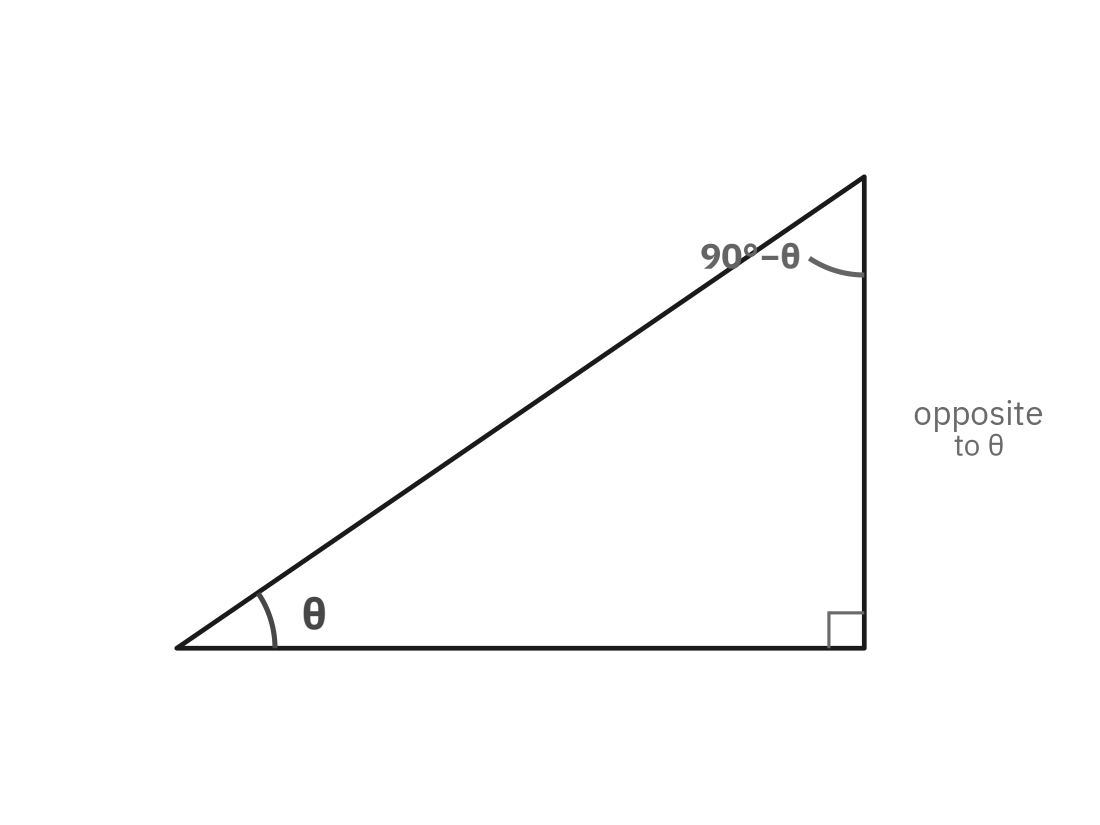
FIGURE 4 The same leg is 'opposite' to θ and 'adjacent' to 90°−θ. That single fact is why sine and cosine trade places across complementary angles.
Which means:
sin θ = cos(90° − θ) and cos θ = sin(90° − θ)
This is why a question that states cos(x°) = sin(58°) is not asking for a calculator at all. It is asking whether you know the two angles are partners. If both are acute, then x and 58 must add to 90, so x = 32. The whole item is just the complementary relationship in disguise.
▸ Connect radian measures to unit-circle coordinates
The Circles chapter already built the full radian system: the conversion π = 180°, and arc length as rθ. The one addition here is where radians and the trig ratios meet, which the unit circle below makes visual.
▸ Build right triangles on the coordinate plane for trig ratios
Right-triangle ratios reach further than triangles. Place a circle of radius 1 at the origin and walk a point counterclockwise from the positive x-axis through an angle θ. Drop that point straight down to the x-axis, and you have built a right triangle whose hypotenuse is the radius 1.
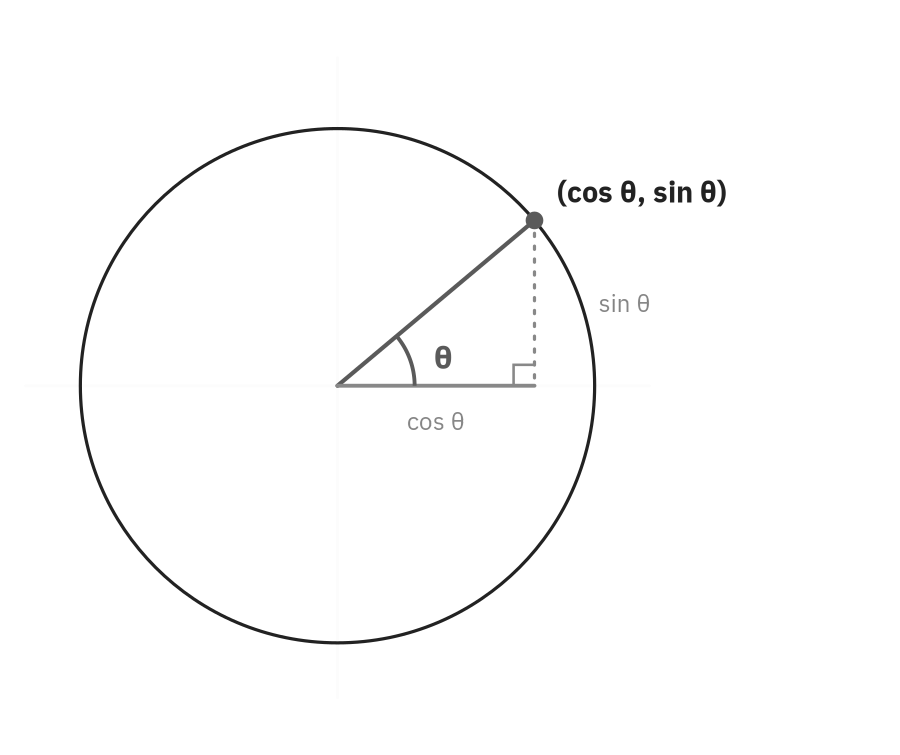
FIGURE 5 A point on the unit circle sits at (cos θ, sin θ): the same opposite-and-adjacent legs, now read as coordinates.
The horizontal leg is the adjacent side, so it has length cos θ; the vertical leg is opposite, so it has length sin θ. The point's coordinates are therefore (cos θ, sin θ). Nothing new was defined, the same two legs you already named are simply being read as a horizontal and a vertical distance. This is the quiet doorway between the trigonometry of triangles and the trigonometry of the whole plane.
That is only the first quadrant of the story. Walk the point past 90° and it keeps producing coordinates, (cos θ, sin θ), the whole way around the circle; each quadrant simply changes which way the two legs point. A leg pointing left of the origin is negative; one pointing below it is negative too. Track only that, and every quadrant’s signs fall out for free.
Signs of sine and cosine by quadrant
Quadrant I, 0° to 90°: cos θ and sin θ both positive.
Quadrant II, 90° to 180°: sin θ positive, cos θ negative.
Quadrant III, 180° to 270°: cos θ and sin θ both negative.
Quadrant IV, 270° to 360°: cos θ positive, sin θ negative.
Every angle outside the first quadrant has a twin inside it: its reference angle, the acute angle between its terminal side and the x-axis. The reference angle sets the size of cos θ and sin θ; the quadrant sets the sign. The reference angle of 150° is 30°; of 210°, also 30°; of 300°, 60°. Pair that reference angle with the special-triangle ratios already in hand, attach the quadrant’s sign, and an angle anywhere on the circle reduces to arithmetic you have already done.
WORKED Find cos 120°
120° sits in Quadrant II, 30° past the 90° mark, so its reference angle is 180° − 120° = 60°.
The reference value is cos 60° = 1/2. Quadrant II makes cosine negative, so cos 120° = −1/2.
The same move runs in radians without a fresh rule: 120° is 2π/3, and π − 2π/3 = π/3 is the reference angle in radian form, 60° again. Desmos can confirm any of this, but the angle mode must match the angle you typed: switch Desmos to degree mode before graphing y = cos(x) and reading a degree value, or convert to radians first and stay in radian mode. Graphing y = cos(x) with no mode specified is ambiguous, since Desmos may read x in radians by default. On a question with no graphing step offered, the quadrant and the reference angle are the route there regardless.
▸ Find a trig ratio directly from a point’s coordinates
The unit circle used a radius of 1 to make the coordinates equal (cos θ, sin θ) exactly, but the same right triangle forms for a point at any distance from the origin, and the ratios still work without ever finding that distance. For a point (x, y) on the terminal side of an angle θ in standard position, tan θ is simply y/x, the vertical distance over the horizontal one, the same ratio that defines slope.
Point (3, 4) lies on the terminal side of angle θ, measured from the positive x-axis. What is tan θ?
tan θ = y / x = 4 / 3
No radius, hypotenuse, or triangle needs to be drawn: tan θ is already the slope of the segment from the origin to (3, 4). Finding sin θ or cos θ from the same point does require the distance to the origin, √(3² + 4²) = 5, giving sin θ = 4/5 and cos θ = 3/5; tangent alone skips that step because it is a ratio of the two coordinates to each other, not to the radius.
▸ Apply special-triangle and unit-circle relationships in mixed problems
Most word-problem trigonometry arrives through a line of sight. You look up at the top of something, and the angle your gaze makes with the level ground is the angle of elevation; look down, and it is the angle of depression. Either way, the line of sight, the ground, and the object's height frame a right triangle, and one angle plus one side unlocks the rest.
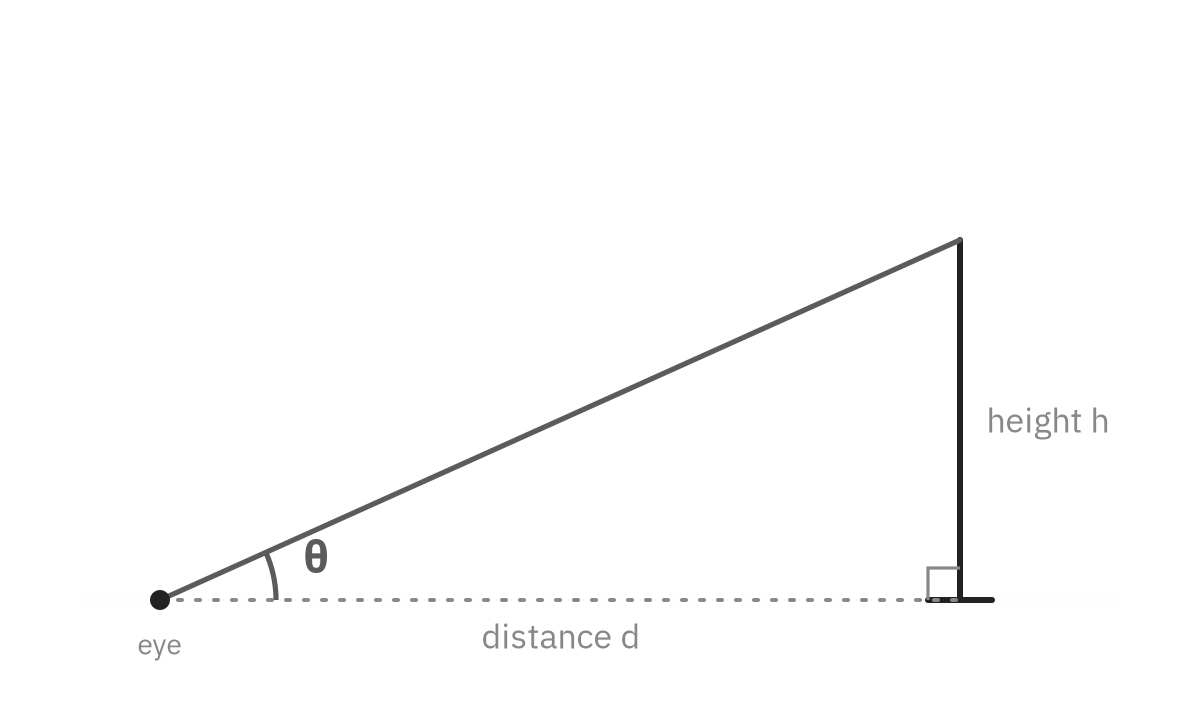
FIGURE 6 An angle of elevation builds a right triangle from the line of sight, the level ground, and the height. One angle and one side determine the others.
Suppose you stand 40 feet from the base of a flagpole and the angle of elevation to its top is 30°. The height is the side opposite the angle, and the 40 feet is the side adjacent, so the ratio that pairs them is tangent:
tan 30° = h / 40 → h = 40 · tan 30° = 40 / √3 = 40√3 / 3 ≈ 23.1 ft.
Notice the exact form 40√3/3 carries the answer more honestly than the rounded 23.1, and notice too that the whole setup was one decision: which ratio pairs the side I have with the side I want? That single question handles the great majority of these.
▸ Use answer choices to check the target
Trigonometry questions tend to be engineered around a small set of predictable confusions, and the choices usually display them. When two options are reciprocals of each other, the question is testing opposite-against-adjacent: whether you reached for tangent or its flip. When a sine value and a cosine value both appear, the item is often about the complementary partner, 90° - θ. When a clean radian value sits beside a degree value, the conversion 180° = π is the real subject. When both θ and 90° − θ appear among the choices, check which angle the requested ratio actually uses. Read the spread of choices as a description of what the question is actually about, then answer that.
▸ Practice: special triangles and the unit circle
Question 1
- A. 7√3
- B. 14
- C. 7√2
- D. 3.5
2. If cos(x°) = sin(58°) and 0 < x < 90, what is the value of x? (grid-in)
Question 3
- A. 8/17
- B. 15/17
- C. 8/15
- D. 15/8
Question 4
- A. 2π/3
- B. 3π/4
- C. 4π/3
- D. 5π/6
Question 5
- A. -1/2
- B. 1/2
- C. -√3/2
- D. √3/2
Question 6
- A. (-√3/2, -1/2)
- B. (-1/2, -√3/2)
- C. (√3/2, 1/2)
- D. (-√3/2, 1/2)
7. The point (-3/5, y) lies on the unit circle in Quadrant II. What is the value of y? (grid-in)
Question 8
- A. 60°, positive
- B. 60°, negative
- C. 30°, positive
- D. 30°, negative
Question 9
- A. (-√3/2, 1/2)
- B. (1/2, -√3/2)
- C. (√3/2, 1/2)
- D. (-1/2, √3/2)
10. An observer stands 40 feet from the base of a pole. The angle of elevation to the top of the pole is 30°. What is the height of the pole, in feet, to the nearest tenth? (grid-in)
Question 11
- A. Always, for any real α and β
- B. Only when both α and β are acute
- C. Only when α = β
- D. Never; the relationship is coincidental
12. What is the value of sin 210°? (grid-in, enter as a decimal or fraction)
▸ Solutions: special triangles and the unit circle
Show the answers and explanations
1: B. The angle of 30° places this in a 30-60-90 triangle, where the side opposite the 30° angle is the short leg and the hypotenuse is exactly twice it. Twice 7 is 14. Choice 7√3 is the other leg, the one a hand reaches for when it pictures the long side rather than the hypotenuse.
2: 32. Sine and cosine trade places across complementary angles, so cos(x°) = sin(58°) means x and 58 are partners that add to 90. Then x = 90 - 58 = 32. No calculator enters the problem.
Show the answers and explanations
3: A. The legs 8 and 15 give a hypotenuse of √(64+225) = √289 = 17. The smaller acute angle sits opposite the shorter leg, 8, so its sine is opp/hyp = 8/17. Choice 15/17 is the cosine of that same angle, the complementary swap again.
4: B. Multiply by π/180: 135 · π/180 = 3π/4 after dividing top and bottom by 45. The other choices are the radian measures of 120°, 150°, and 240°, each a plausible value for a hand that reduces the fraction carelessly.
5: A. 120° sits in Quadrant II, 30° past the 90° mark, so its reference angle is 180° - 120° = 60°. The reference value is cos 60° = 1/2. Quadrant II makes cosine negative, so cos 120° = -1/2.
6: A. The angle 7π/6 is 210°, in Quadrant III, with reference angle 210° - 180° = 30°. The reference values are cos 30° = √3/2 and sin 30° = 1/2, and Quadrant III makes both negative: (-√3/2, -1/2).
7: 4/5. Every point on the unit circle satisfies x² + y² = 1. With x = -3/5: y² = 1 - 9/25 = 16/25, so y = ±4/5. In Quadrant II, the vertical coordinate is positive, so y = 4/5.
Show the answers and explanations
8: B. The reference angle of 300° is the acute angle to the x-axis: 360° - 300° = 60°. Since 300° falls in Quadrant IV, where sine is negative, the sine of 300° is negative.
9: A. 150° sits in Quadrant II with reference angle 180° - 150° = 30°. The reference values are cos 30° = √3/2 and sin 30° = 1/2. Quadrant II makes cosine negative and sine positive: (-√3/2, 1/2).
10: 23.1. The height is opposite the angle of elevation, and the horizontal distance is adjacent, so tangent pairs them: tan 30° = h/40, giving h = 40 · tan 30° = 40/√3 = 40√3/3 ≈ 23.1 feet.
Show the answers and explanations
11: B. The identity sin α = cos(90° - α) comes from a right triangle’s two acute angles being complementary, so it only forces α + β = 90° when both angles are acute. Outside that range, other angle pairs can also satisfy sin α = cos β, so the restriction matters.
12: -1/2. 210° sits in Quadrant III with reference angle 210° - 180° = 30°. The reference value is sin 30° = 1/2, and Quadrant III makes sine negative: sin 210° = -1/2.
▸ Special triangles and the unit circle: chapter summary
One acute angle fixes the shape of a right triangle, and a fixed shape fixes every ratio of its sides. Sine, cosine, and tangent are those three ratios named; the special triangles let you read them exactly; the complementary relationship is two corners sharing one leg; radians are the same angles measured by their arcs. Carry the one idea, the angle decides the ratios, and the rest stops being a list to memorize and becomes a picture you can rebuild whenever you need it.