SAT Math study guide · Chapter 25
Coordinate Geometry Across Lines, Distance, and Circles
Place a figure on the grid and its shape becomes arithmetic. Distance, midpoint, and slope are the three instruments that read geometry straight off the coordinates.
The domain ends where two of its halves meet. Coordinate geometry sets a figure down on the grid you have used since the Algebra domain, and at that moment its geometry (lengths, midpoints, the angles between its sides) turns into something you can compute from the points alone. You no longer measure; you calculate. Three instruments do nearly all of it: distance gives a length, midpoint gives a center, and slope gives a direction. Master those three and you can take a heap of coordinates and read off, with certainty, whether a figure is a parallelogram, a right triangle, or a circle of a given radius. This is the synthesis the whole domain has been building toward.
▸ Use the distance formula and the Pythagorean theorem
The distance between two points is the Pythagorean theorem in disguise, and seeing why makes the formula unforgettable. Drop a horizontal segment and a vertical segment between the two points and you have built a right triangle: the horizontal leg is the difference in the x-coordinates, the vertical leg the difference in the y-coordinates, and the distance you want is the hypotenuse. So the theorem gives it directly.
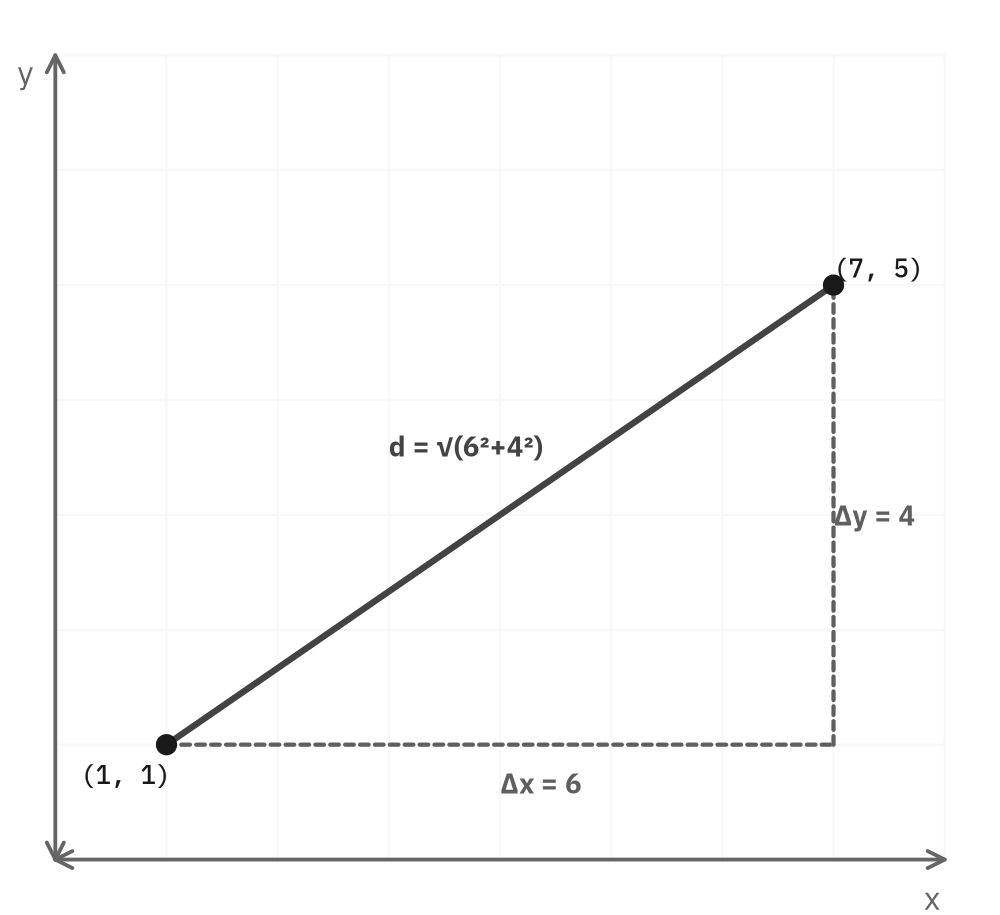
FIGURE 1 The distance between two points is the hypotenuse of a right triangle whose legs are the coordinate differences.
d = √((x2 - x1)2 + (y2 - y1)2)
WORKED Compute a distance
Find the distance between (1, 1) and (7, 5). The legs are the coordinate differences, 7 - 1 = 6 and 5 - 1 = 4:
d = √(62 + 42) = √(36 + 16) = √52 = 2√13.
It is just the Pythagorean theorem with the legs handed to you by subtraction.
▸ Find a midpoint by averaging coordinates
The midpoint, the point exactly halfway between two others, is even simpler, because halfway in two dimensions is just halfway in each one separately. So you average the two x-coordinates and average the two y-coordinates. That is the entire idea.
midpoint = ((x1 + x2)/2, (y1 + y2)/2)
WORKED Find a midpoint, and reverse it
The midpoint of (1, 1) and (7, 5) averages each coordinate: ((1 + 7)/2, (1 + 5)/2) = (4, 3).
The same idea runs backward. If the midpoint of a segment is (3, 5) and one endpoint is (-1, 2), the other endpoint is as far past the midpoint as the first falls short, so double the midpoint and subtract the known endpoint:
(2 × 3 - (-1), 2 × 5 - 2) = (7, 8).
Averaging finds the center; doubling-and-subtracting recovers an endpoint.
▸ Use slope for parallel and perpendicular relationships
Slope, met first in the Algebra domain, becomes a geometric instrument here: it measures the direction a segment points, as rise over run, (y2 - y1)/(x2 - x1). Two facts about direction unlock most coordinate figures. Parallel lines point the same way, so they have equal slopes. For two nonvertical, nonhorizontal perpendicular lines, the slopes are negative reciprocals and their product is -1. A vertical line is perpendicular to a horizontal line, which is the edge case where the product rule does not apply. A slope of 2 is perpendicular to a slope of -1/2; a slope of 3/4 to a slope of -4/3.
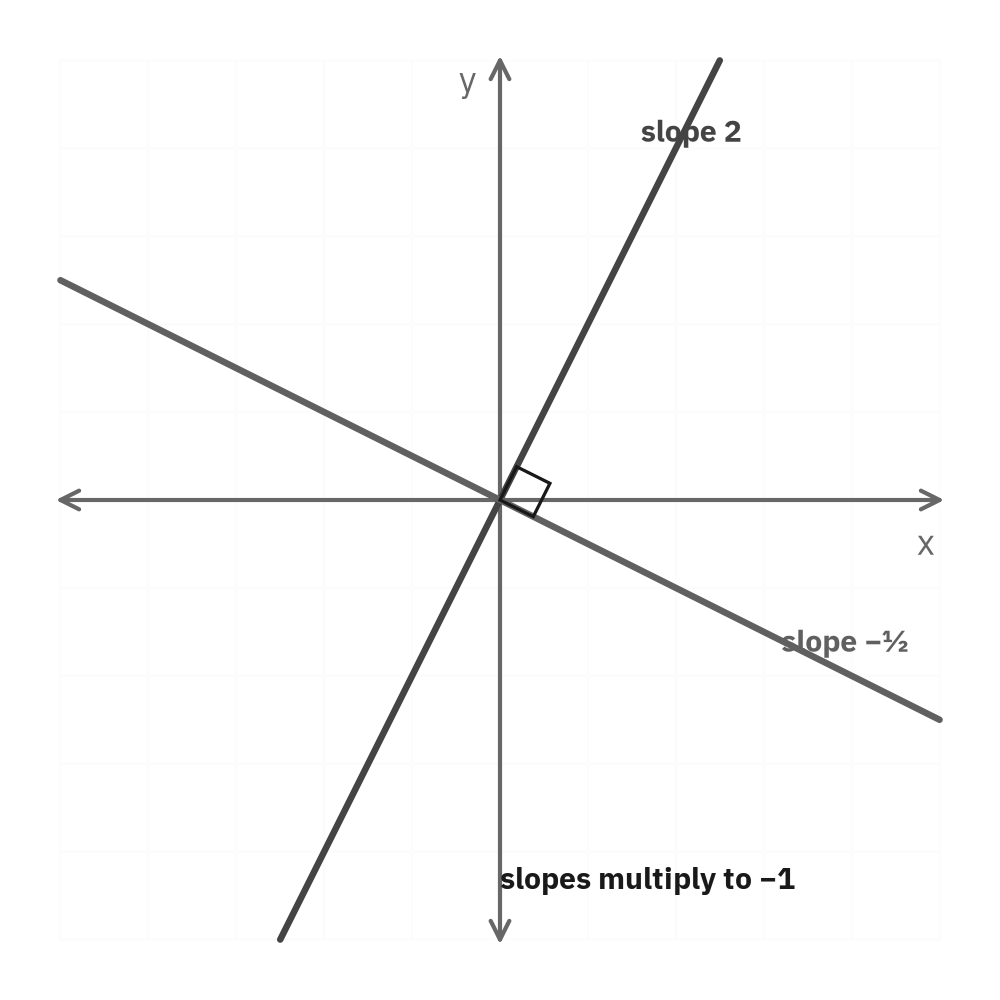
FIGURE 2 Parallel lines share a slope; perpendicular lines have slopes that are negative reciprocals, multiplying to −1.
▸ Use coordinates to recover geometric information
Now the three instruments combine, and this is where the test concentrates its harder questions. Given the vertices of a figure, you classify it by computing the right quantities: slopes tell you which sides are parallel (a parallelogram) or perpendicular (a right angle), and distances tell you which sides are equal (an isosceles triangle, a rhombus, a square). The strategy is to decide what you need to prove and compute exactly that: equal slopes for parallel sides, a slope product of -1 for a right angle, equal distances for equal sides.
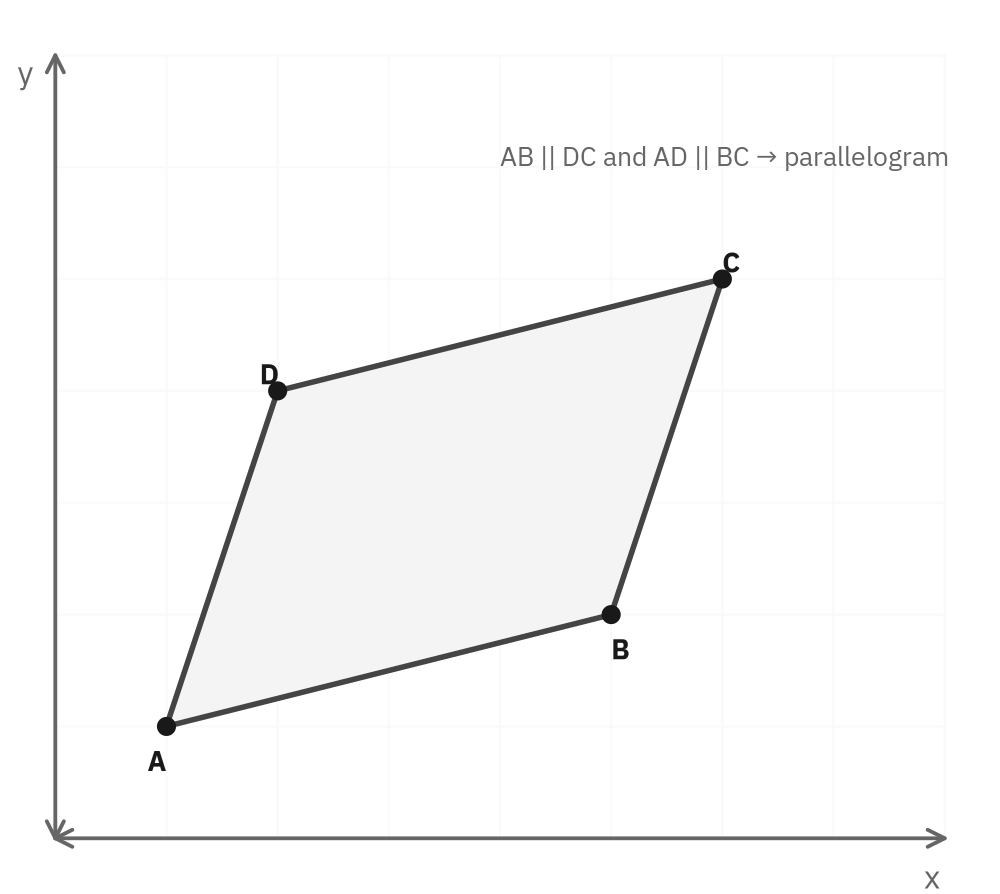
FIGURE 3 Computing the four side slopes shows opposite sides are parallel, so this quadrilateral is a parallelogram.
WORKED Classify a figure
A quadrilateral has vertices A(1, 1), B(5, 2), C(6, 5), D(2, 4). Test for a parallelogram by comparing opposite sides' slopes.
Slope of AB is (2 - 1)/(5 - 1) = 1/4; slope of DC is (5 - 4)/(6 - 2) = 1/4: equal, so AB and DC are parallel.
Slope of AD is (4 - 1)/(2 - 1) = 3; slope of BC is (5 - 2)/(6 - 5) = 3: equal, so AD and BC are parallel.
Both pairs of opposite sides are parallel, so the figure is a parallelogram. To check further for a rectangle, you would test whether adjacent slopes multiply to -1.
▸ Connect line equations, distances, and circle equations
Coordinate geometry also closes the loop with the equations you already know. A line through two plotted points is found by computing its slope and reading an intercept; a circle is the set of points a fixed distance, its radius, from a center, which is why (x - h)2 + (y - k)2 = r2 is just the distance formula set equal to the radius. That single view answers a family of questions: a point lies on a circle when its distance from the center equals the radius, inside when the distance is less, and outside when it is greater. The instruments of this section and the equations of the earlier ones are the same ideas, seen from two sides.
WORKED Test a point against a circle
Does (6, 8) lie on the circle x2 + y2 = 100, centered at the origin with radius 10?
Find the point's distance from the center: √(62 + 82) = √(36 + 64) = √100 = 10.
The distance equals the radius, so the point lies exactly on the circle, a 6-8-10 right triangle hiding in the coordinate plane.
▸ Practice: coordinate geometry
1. What is the distance between the points (-2, 3) and (4, 11)? (grid-in)
2. The midpoint of a segment has endpoints (1, -4) and (9, 8). What is the sum of the coordinates of the midpoint? (grid-in)
3. A line has slope 3/4. What is the slope of a line perpendicular to it? (grid-in)
4. The midpoint of segment AB is (3, 5). If A = (-1, 2), what is the sum of the coordinates of point B? (grid-in)
Question 5
- A. inside the circle
- B. on the circle
- C. outside the circle
- D. cannot be determined
6. A triangle has vertices (0, 0), (4, 0), and (0, 3). What is the area of the triangle? (grid-in)
7. Three vertices of a parallelogram ABCD, in order, are A(1, 1), B(5, 2), and C(6, 5). What is the sum of the coordinates of the fourth vertex D? (grid-in)
8. A triangle has vertices P(1, 2), Q(5, 2), and R(3, 6). The length of side PR can be written as √k. What is the value of k? (grid-in)
9. A line passes through the point (2, 1) and is perpendicular to the line y = (1/2)x + 3. What is the slope of this line? (grid-in)
10. The point (h, 0) lies on the circle (x - 3)2 + (y - 4)2 = 25. What is a positive value of h? (grid-in)
11. The distance between the points (a, 0) and (0, a) is 6√2, where a is positive. What is the value of a? (grid-in)
12. The endpoints of a diameter of a circle are (2, -1) and (8, 7). What is the radius of the circle? (grid-in)
13. The points (1, 2), (3, k), and (5, 10) all lie on the same line. What is the value of k? (grid-in)
Question 14
- A. -5/2
- B. 2/5
- C. 5/2
- D. -2/5
Question 15
- A. 0
- B. undefined
- C. 1
- D. -1
Question 16
- A. 0
- B. undefined
- C. 7
- D. -7
17. A segment has endpoints (2, 3) and (8, 7). What is the slope of its perpendicular bisector? (grid-in)
▸ Solutions: coordinate geometry
1: 10. The coordinate differences are 4 - (-2) = 6 and 11 - 3 = 8, so the distance is √(62 + 82) = √100 = 10.
2: 7. Average each coordinate: midpoint = ((1 + 9)/2, (-4 + 8)/2) = (5, 2), and 5 + 2 = 7.
3: −4/3. Perpendicular slopes are negative reciprocals: flip 3/4 to 4/3 and change the sign, giving -4/3.
4: 15. Double the midpoint and subtract A: B = (2 × 3 - (-1), 2 × 5 - 2) = (7, 8), and 7 + 8 = 15.
Show the answers and explanations
5: B. The point's distance from the center is √(62 + 82) = √100 = 10, exactly the radius, so the point lies on the circle.
6: 6. Two sides lie on the axes, so they are the perpendicular legs of length 4 and 3: area = (1/2)(4)(3) = 6.
7: 6. In a parallelogram the diagonals share a midpoint, so D = A + C - B = (1 + 6 - 5, 1 + 5 - 2) = (2, 4), summing to 6.
8: 20. The differences are 3 - 1 = 2 and 6 - 2 = 4, so PR = √(22 + 42) = √20, giving k = 20.
9: −2. The given line has slope 1/2, so a perpendicular line has the negative reciprocal slope, -2.
10: 6. Setting y = 0: (h - 3)2 + 16 = 25, so (h - 3)2 = 9 and h - 3 = ±3. The positive solution is h = 6.
11: 6. The distance is √(a2 + a2) = √(2a2) = a√2. Setting a√2 = 6√2 gives a = 6.
12: 5. The center is the midpoint of the diameter, (5, 3). The radius is the distance to an endpoint: √((8 - 5)2 + (7 - 3)2) = √(9 + 16) = 5.
13: 6. The slope from (1, 2) to (5, 10) is (10 - 2)/(5 - 1) = 2. At x = 3, the y-value is 2 + 2(3 - 1) = 6, so k = 6.
Show the answers and explanations
14: C. Perpendicular slopes are negative reciprocals: flip -2/5 to -5/2 and change the sign, giving 5/2.
15: A. Both points share x = 4, so the line is vertical, with undefined slope. A line perpendicular to a vertical line is horizontal, and every horizontal line has slope 0. The usual negative-reciprocal rule does not apply here, since there is no defined slope to invert.
16: B. Both points share y = 7, so the line is horizontal, with slope 0. A line perpendicular to a horizontal line is vertical, and a vertical line has undefined slope. Multiplying 0 by any number still gives 0, which is why this case cannot be solved by the usual negative-reciprocal formula.
17: -3/2. A perpendicular bisector needs only the segment’s slope, not its midpoint, to fix its own slope. The segment’s slope is (7 - 3)/(8 - 2) = 4/6 = 2/3, so the perpendicular bisector has the negative reciprocal slope, -3/2. The midpoint would only be needed if the question asked for the bisector’s full equation.
▸ Coordinate geometry: chapter summary
On the coordinate plane, geometry becomes arithmetic through three instruments: distance, the Pythagorean hypotenuse of the coordinate differences; midpoint, the average of the coordinates; and slope, the direction, with parallel lines sharing it and perpendicular lines turning it into its negative reciprocal. Combine them to classify any figure (equal slopes for parallel sides, negative-reciprocal slopes for nonvertical/nonhorizontal perpendicular lines, with vertical and horizontal lines handled as the special case, equal distances for equal sides) and recall that a circle's equation is simply the distance formula set to its radius. Decide what you must show, compute exactly that, and the coordinates tell you the shape.