Algebra: reading a relationship
More than a third of this test is linear, and the rest of it quietly leans on the same thinking. Linear reasoning also supports later work with functions, data, coordinate geometry, and modeling. Data questions turn on a rate. Even a good deal of the geometry comes down to a slope or a distance read off a line. Strong linear fluency supports work across the other three domains and deserves substantial practice time.
But there is a deeper reason to slow down here, and it is the one this course cares about most. Algebra is where you learn to read a relationship: to look at an equation, a line, or a table and see at once what it is telling you, and, just as important, what it is not. Most of the questions that separate a strong performance from a perfect one are not asking you to compute something hard. They are asking whether you noticed exactly what a relationship does and does not fix. That habit starts here.
One idea sits underneath everything that follows: a linear relationship is a constant rate of change. Whatever the story (a cost that grows with quantity, a distance that grows with time, a tank that empties at a steady pace) linear means the change per step never varies. That single property is what makes a line a line, and reading it is what every question in this domain is, in some disguise, testing.
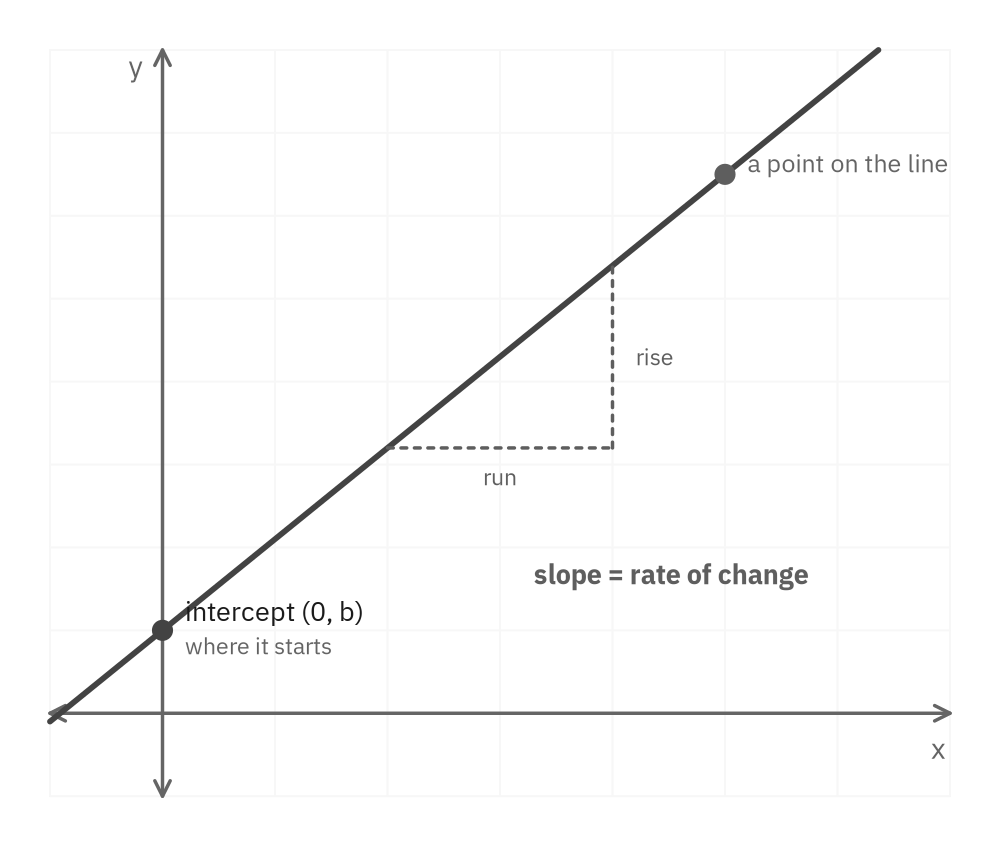
Figure 1. Every linear relationship carries two facts: a rate (the slope) and a starting value (the intercept). Name both and you have named the line.
A line holds exactly two pieces of information, and nearly everything in this domain is a question about one of them. The first is its rate, the slope: how much the output moves for each one-unit step in the input. The second is its starting value, the y-intercept: where the relationship sits when the input is zero. Name those two and the line is completely determined. Read a question with care and you will almost always find it is asking about the rate, the start, or what the two of them force when a second relationship joins in.
The same core questions recur throughout Algebra. What does this relationship fix, and what does it leave free? Which form of the relationship puts the feature I want in plain sight? And is the thing being asked for a value, a relationship, a region, or a meaning? Those are four genuinely different kinds of answer, and quietly sliding from the one that was asked to a neighbor is where careful work goes one step wrong.
In this domain
Linear equations in one and two variables: the same line can be written several ways, and each form makes a different feature easier to read. You learn to turn a relationship to whichever form shows what you need.
Linear functions, rate of change and initial value: slope and intercept as a real rate and a real starting value, the way the word problems actually use them, units and all.
Systems of two linear equations: what a system of two linear facts forces together, when it forces a single answer, and when it forces nothing at all.
Linear inequalities in one and two variables: the answer stops being a single point and becomes a region with edges that have to be read exactly.
None of this rewards memorizing more procedures. It rewards a single fluency: recognizing a linear relationship no matter which form it is written in, practiced until it becomes automatic. With that fluency, harder linear questions become variations of the same relationships rather than new procedures.
Linear equations in one and two variables
An equation is not fixed to one written form. The same relationship can be rearranged into whichever form shows what you need, and this lesson teaches you to move between those forms on command.
Most students get comfortable with one way of writing a line and struggle when handed another. The test knows this, and it presents the same line in different forms to see whether you can still recognize it. So the goal here is not a new procedure; it is fluency: reading and writing a linear relationship in every form, and moving between them on demand. We build it from the ground up, starting with the simplest object of all, one equation in one variable.
Solve linear equations in one variable
A typical linear equation in one variable has one solution, found by undoing operations in reverse order. When the variable terms cancel, the equation may instead have no solution or infinitely many solutions, as shown below. The arithmetic is rarely the hard part; the care is in doing each operation to both sides and in not rushing past a distributed term or a sign. Take a typical one with a distribution and the variable on both sides.
Worked: solve
Distribute first, then gather the variable on one side and the constants on the other.
Every step kept both sides equal. Substituting back into the original gives , which is the only check worth the two seconds it takes.
Fractions look more forbidding than they are. The single move that tames them is to multiply every term by the least common denominator, which clears the fractions in one stroke and leaves an ordinary linear equation behind.
Worked: solve
The denominators are 3, 2, and 4; their least common multiple is 12. Multiply every term by 12.
The fractions are gone after one multiplication, and what remains is an equation you already know how to solve.
Hand, Desmos, or hybrid: an equation with several fractions and no obviously clean common denominator can also be graphed directly. Enter each side as its own function and click where the two graphs cross. The x-coordinate of that point is the solution, found without clearing a single fraction by hand.
Classify linear equations by one, no, or infinitely many solutions
Something worth understanding deeply happens when the variable terms are identical on both sides: the variable drops out entirely, and the constants are left to settle the matter. This produces three outcomes you will meet again, larger, when two equations share a page.
If the leftover constants agree, the equation is true no matter what is, so it has infinitely many solutions. Expand and you get : a statement about nothing, true for every . If instead the constants disagree, no value can rescue them: becomes , which asks 8 to equal 5, so there is no solution at all. And if the variable does not cancel, the usual case, exactly one value works.
This is exactly why a question can hide a whole solution-count decision inside a single parameter. Consider . Expanding gives , so the variable cancels and the outcome rides entirely on : when the two sides match and every works, and for any other value of the constants conflict and nothing works. Notice what cannot happen: this equation can never have exactly one solution, because the variable has already cancelled. Reading that before reaching for algebra is the whole skill.
How many solutions a linear equation has
The variable does not cancel: exactly one solution.
The variable cancels and the constants agree: infinitely many.
The variable cancels and the constants disagree: none.
Solve literal equations for a variable of interest
Sometimes the answer a question wants is not a number but an expression: a formula rearranged to put a chosen letter by itself. The discipline is the same inverse-operation untying as before, with one shift in mindset. Treat the letter you want as the unknown and every other letter as if it were a known number. Nothing about the method changes; only your attention does.
Worked: solve for
Isolate the term, then divide. Treat as though it were a fixed number.
This is the same line, rewritten to display its slope and its starting height directly.
Worked: solve for
Undo the multiplication by and by ; that is, multiply by 2 and divide by .
There is no number to find. The rearranged formula is the answer, and the test will sometimes ask for exactly this.
Translate consecutive-integer and spacing constraints
One family of word problems hides a linear equation behind counting language rather than a stated relationship. Consecutive integers, one after another, are , , , and so on. Consecutive even or odd integers, spaced two apart instead of one, are , , . Naming the first integer and writing the rest relative to it turns a sentence into an equation you already know how to solve.
Worked: three consecutive integers sum to 90
Let the smallest integer be , so the three integers are , , and . Their sum is given:
The three integers are 29, 30, and 31. Answering with alone, 29, is a requested-object error if the question asks for the largest of the three, which is 31. The equation's solution and the question's answer are not automatically the same number.
The same care handles a variable trapped inside a fraction. To solve for , multiply both sides by 2 to free the numerator, giving , and then add 3: . Each step is an ordinary inverse operation; the only discipline is keeping track of which letter is the target.
Occasionally what the question wants is not one letter's value but the ratio between two of them.
Worked: find if
Gather every -term on one side and every -term on the other, exactly as before.
Dividing both sides by , then by 3, leaves the ratio directly:
Solving for or for alone would need a value the equation never supplies; it only ever pinned down their ratio, so that ratio is the only honest thing it can hand back.
Interpret slope in a linear equation in two variables
Move to two variables and the lesson returns: one linear equation in and does not fix the variables; it fixes a line, a whole relationship, and every point on that line is a legal pair. What the test then probes is whether you can read that line's two defining features. The first is its slope, the rate at which changes for each one-unit step in , and there are three places you might have to read it from.
From two points, the slope is the change in over the change in , taken in the same order for both.
Worked: slope through and
Subtract the coordinates in a consistent order: second point minus first on top, the same order on the bottom. Reversing one but not the other is the classic slip, and it flips the sign.
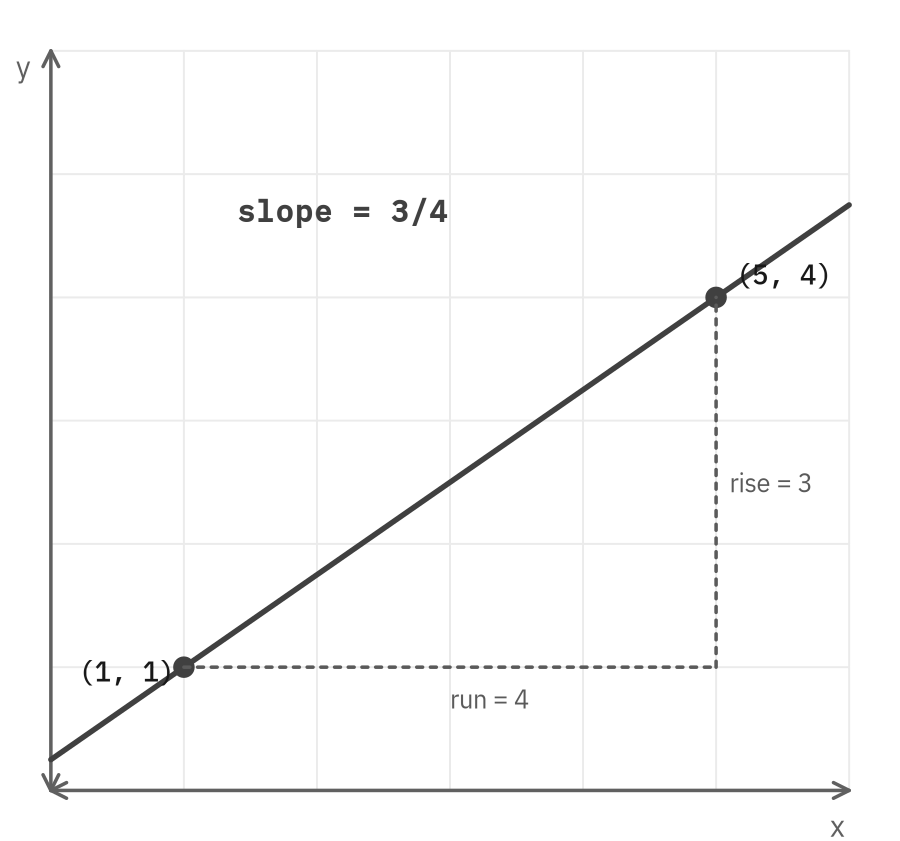
Figure 2. Slope from two points: the vertical change over the horizontal change, here 3 over 4.
From a graph, the slope is the same idea read off the grid: pick two points the line passes through cleanly, then count the rise and the run between them.
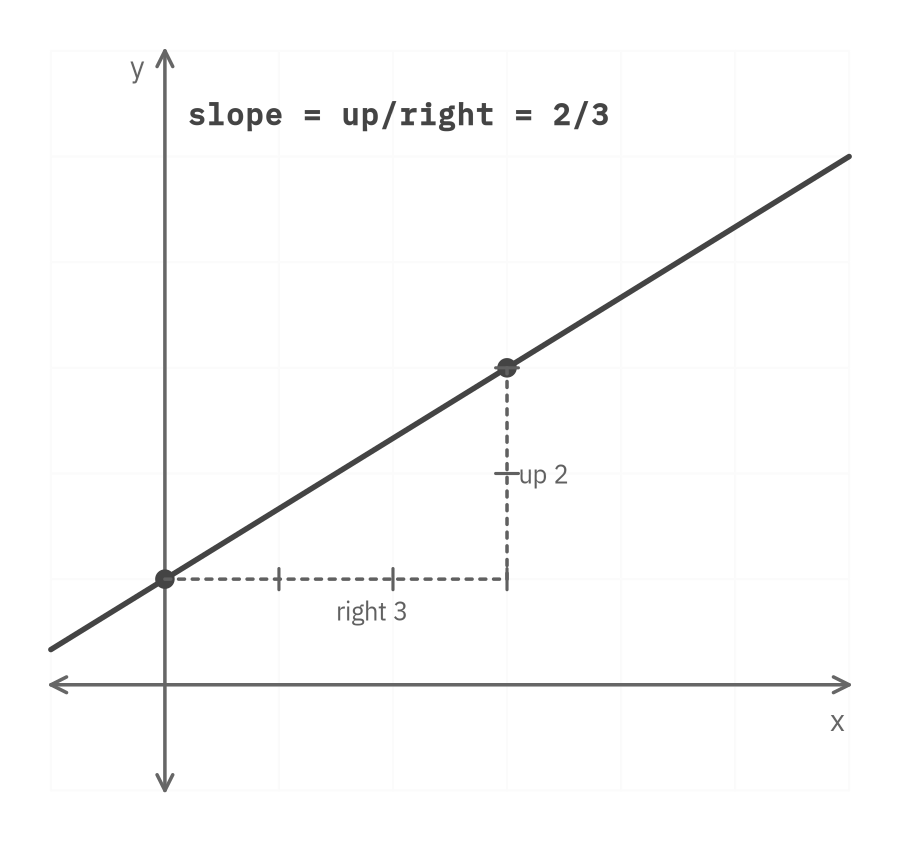
Figure 3. Reading slope from a graph: count the up-step and the right-step between two lattice points.
From an equation, solve for and the slope is simply the coefficient of . Given , isolating gives , so the slope is and, as a bonus, the constant is the y-intercept. One rearrangement surrendered both features at once.
The sign and size of a slope tell a quick story: positive slopes rise to the right, negative slopes fall, a slope of zero is a flat horizontal line of the form , and a vertical line has no defined slope at all. That last case matters because a vertical line, , cannot be written as ; there is no slope to put in the box. Forcing it into that form is a genuine error, not a technicality.
Find x- and y-intercepts of a linear equation
The second defining feature of a line is where it crosses the axes, and each crossing is found by the same simple idea: an axis is the place where the other coordinate is zero. To find the y-intercept, set ; to find the x-intercept, set .
Worked: intercepts of
Set for the y-intercept: , so , the point .
Set for the x-intercept: , so , the point .
Standard form makes this almost effortless, which is one reason the form exists.
Choose a linear form that exposes slope or intercepts
A line can be written three common ways, and the reason to know all three is that each puts a different feature in plain sight. None is more correct; each simply answers a different question without a struggle.
Three forms of a line
Slope-intercept, , shows the slope and the y-intercept at a glance.
Point-slope, : what you write the instant you know one point and the slope.
Standard, , makes both intercepts easy and keeps the coefficients whole; it is the form systems arrive in. It also hands over the slope without rearranging: for , the slope is always , read straight from the two coefficients.
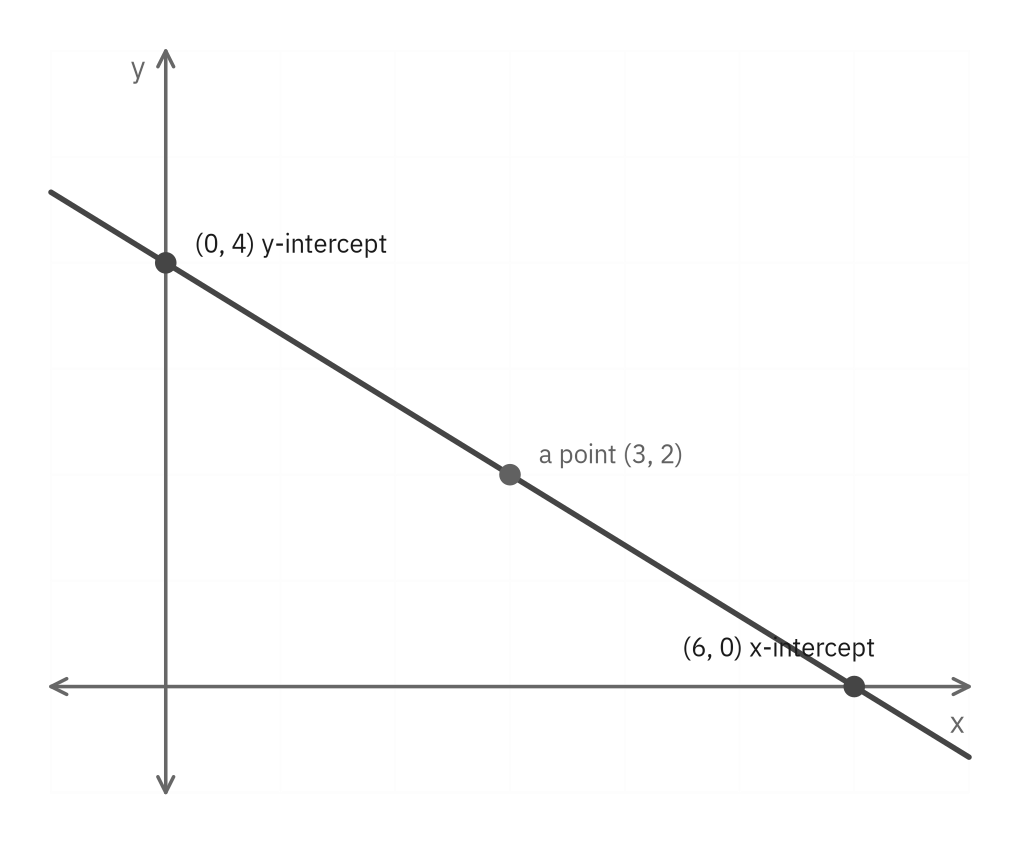
Figure 4. One line, three features. Slope-intercept surfaces the y-intercept; standard form yields both intercepts; point-slope is built from any point on it.
Because the forms describe the same line, the real skill is converting between them without hesitation, in both directions. Going from standard to slope-intercept is just solving for , which you have already done above. Going the other way, you clear fractions and move the variables to one side.
Worked: convert to standard form
Multiply through by 3 to clear the fraction, then collect the variables on the left.
The line never moved; only its form changed, and now its coefficients are whole numbers.
Point-slope collapses to slope-intercept with a single distribution: from , expand the right side to , then add 2 to read . Three forms, one line, and you can now stand in any of them and walk to either of the others.
Create a linear equation from points, slope, or context
Reading a line is half the fluency; writing one from a description is the other half, and it is the same skill run backward. The form to reach for is point-slope, because almost every description hands you a point and a slope, or something you can turn into them.
Worked: through with slope 3
Drop the point and slope straight into point-slope, then simplify if a particular form is wanted.
Worked: through and
First the slope, from the two points; then point-slope with either point.
Use slope to identify parallel and perpendicular lines
Two of the most common conditions a question attaches are parallel to and perpendicular to another line, and both are really statements about slope. Parallel lines never meet because they climb at exactly the same rate: equal slopes. When both slopes are defined and nonzero, perpendicular lines have negative-reciprocal slopes: a slope of 2 pairs with , and their product is . Horizontal and vertical lines are the edge case described below.
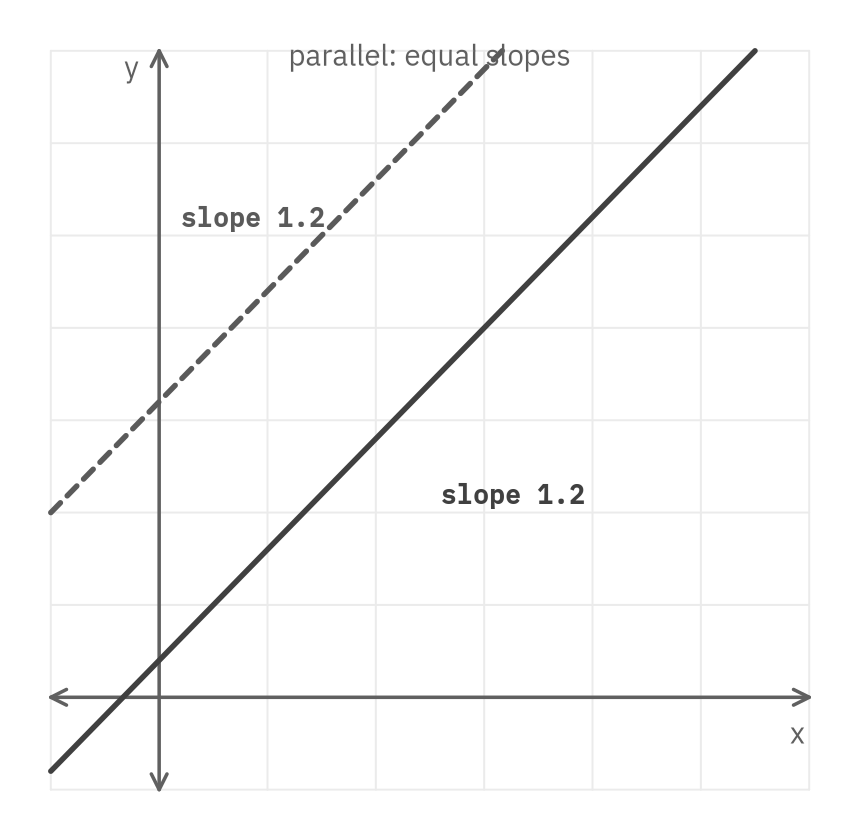
Figure 5. Parallel lines share a slope; only their starting heights differ.
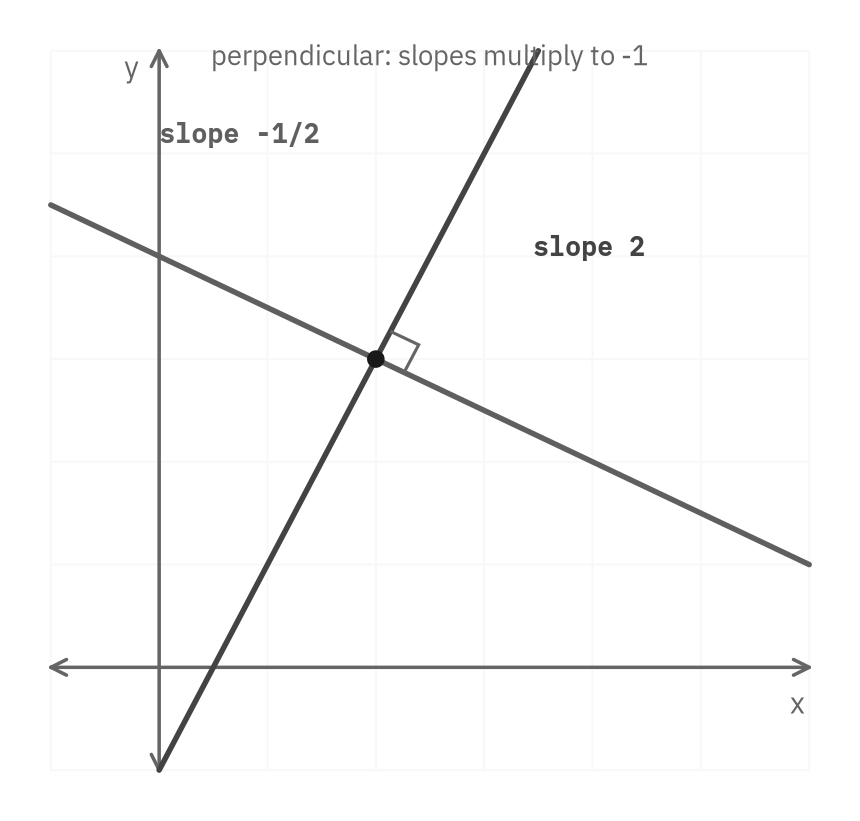
Figure 6. Perpendicular slopes are negative reciprocals: here 2 and , whose product is .
Worked: through , parallel to
Parallel means the same slope, 3. Use point-slope with the given point.
Worked: through , perpendicular to
The given slope is 2, so the perpendicular slope is its negative reciprocal, .
One edge case completes the picture. A horizontal line (slope 0) and a vertical line (no slope) are perpendicular to each other, even though the negative-reciprocal rule cannot be applied to a slope that does not exist. When you see a horizontal or vertical line in a perpendicular question, handle it by picture rather than by formula.
Connect linear equations, graphs, slope, intercepts, and points
Put it together. Handed a single equation, you should be able to surface every feature it holds without graphing anything. Take . Solving for gives , so the slope is and the y-intercept is ; setting in the original gives the x-intercept . Asked whether this line is parallel to , you check that line's slope (solving gives , slope ), and since the slopes match while the lines are different, they are parallel. Every one of those facts came from the same line, simply turned to the light that showed each feature. That turning, done without hesitation, is what this lesson trains.
Chapter summary
A line carries a rate and a starting place, and it can be written in whichever of three forms makes the feature you want easy to see. Everything here (solving, rearranging, reading a slope, finding an intercept, building an equation from a point and a condition) is one fluency: moving between the forms of a single relationship without ever losing the relationship itself. Build that, and a great many questions that look like different problems turn out to be the same line, asked about from a different side.