Quadratic Equations: Real Solutions and the Discriminant
Before solving a quadratic, one number tells you how many real solutions it has. And once a parabola is drawn, its shape is evidence about the equation behind it.
Two readings of a quadratic occupy this lesson, and they are mirror images of each other. The first runs from the equation to its graph: a single quantity built from the coefficients tells you, before you solve anything, how many real solutions exist and therefore how many times the parabola meets the x-axis. The second runs the other way, from a graph back to its equation: the shape and position of a drawn parabola are evidence about the signs and values of its coefficients. Learn to travel both directions and a whole class of questions answers itself without heavy algebra.
Use the discriminant to count real solutions
Inside every quadratic sits a quantity called the discriminant, the expression . It is the part of the quadratic formula that lives under the square root, and on its own it settles the single most common question asked about a quadratic: how many real solutions does it have? The sign of the discriminant gives the answer in three clean cases.
What the discriminant tells you
Positive (): two distinct real solutions.
Zero (): exactly one real solution (a repeated root).
Negative (): no real solutions.
Worked example: count the solutions without solving
: the discriminant is , so two real solutions.
: , so one repeated solution.
: , so no real solutions.
Connect the discriminant to x-intercepts
The discriminant is not an abstract bookkeeping number; it is a description of where the parabola sits relative to the x-axis. A real solution of is exactly an x-intercept of the graph, so the count of real solutions is the count of times the curve crosses the axis.
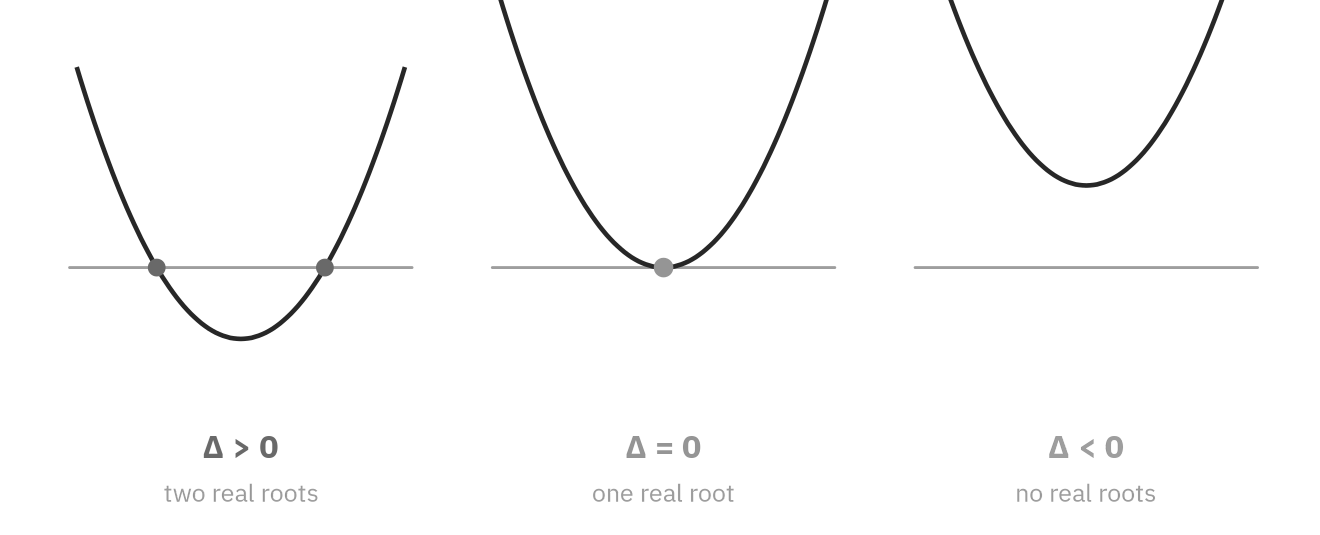
Figure 1. The discriminant reads the parabola's relationship to the x-axis: two crossings, one touch, or no contact.
When the discriminant is positive, the parabola passes cleanly through the axis at two points. When it is zero, the parabola just touches the axis at its vertex: the tangency you first met with the line and parabola in the systems lesson, now seen for a single quadratic. When it is negative, the parabola floats entirely above the axis (or entirely below it), never making contact. The number and the picture are two ways of saying the same thing.
Rearrange to standard form first
The discriminant only reads coefficients that are already sitting in standard form, . When a parameter question hands you an equation with terms on both sides, or a parameter buried inside more than one coefficient, the first move is always to collect everything onto one side before naming , , and . Skipping this step is the most common way to compute a discriminant that answers a different equation than the one that was asked.
Worked example: rearrange, then apply the discriminant
For what value(s) of does have exactly one real solution?
Move every term to one side first: . Now , , and . One solution needs the discriminant zero: , so . Computing the discriminant from the original, unrearranged equation would have used the wrong sign on .
Find a constant that produces a specified number of roots
Because the discriminant decides the number of solutions, a question can hand you a quadratic with an unknown coefficient and ask which value produces a given number of solutions. These are discriminant questions in disguise: set to match the condition and solve for the parameter.
Worked example: a parameter for exactly one solution
For what values of does have exactly one real solution?
One solution means the discriminant is zero. Here , , , so and , giving or .
At either value the parabola sits tangent to the x-axis.
The same setup handles the other two conditions by changing only the comparison. For two real solutions the discriminant must be positive: , which holds when or . For no real solutions it must be negative: , which holds for . The single expression governs all three cases; the inequality you attach to it picks the outcome.
Worked example: solving for the other coefficient
For what values of does have no real solutions?
No real solutions means a negative discriminant: , so and .
Any greater than 4 lifts the parabola entirely above the axis.
Infer zeros, extrema, and sign from a graph
Now run the arrow backward. A drawn parabola is a stack of clues about the equation that produced it, and each visible feature pins down a fact about a coefficient. Reading them off is a matter of knowing where each coefficient shows up on the picture.
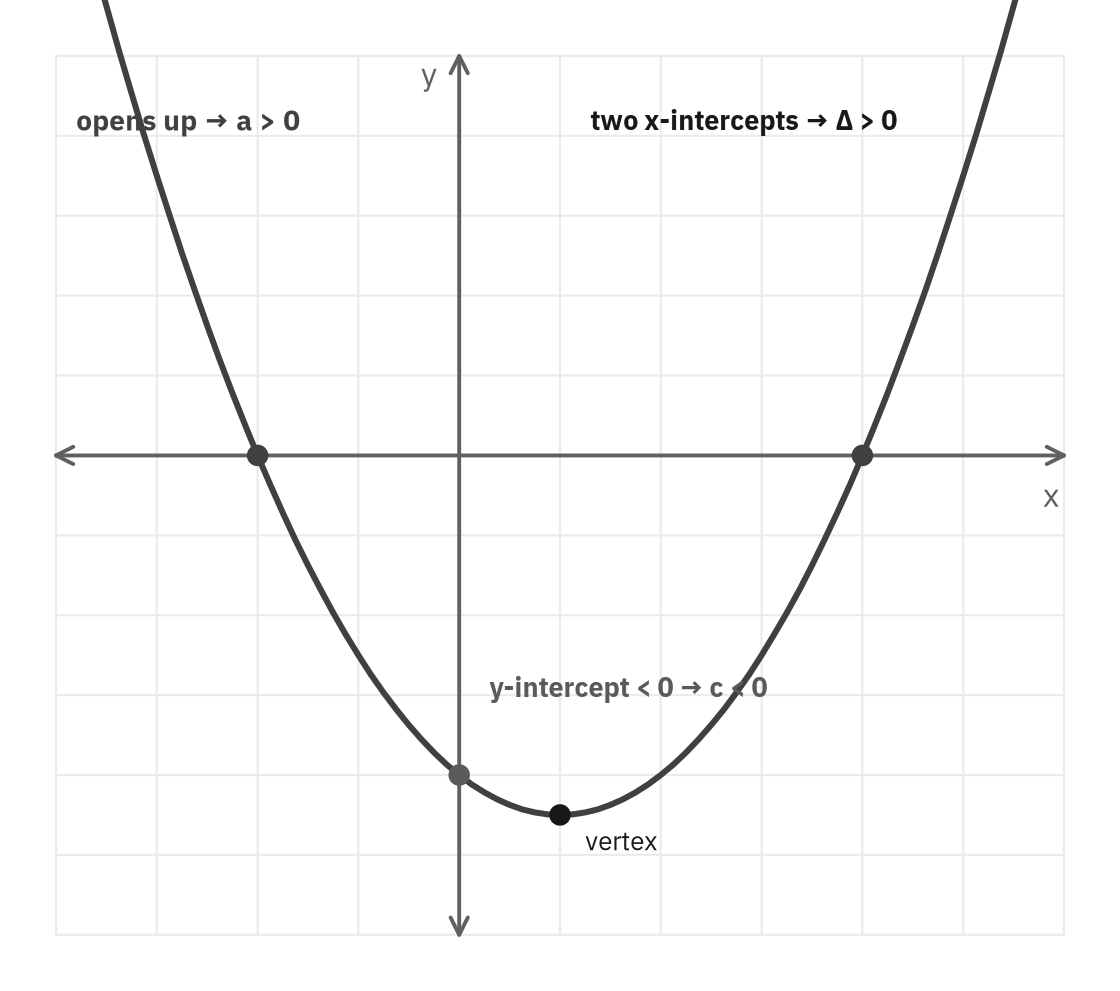
Figure 2. A parabola is evidence: its opening fixes the sign of , its x-crossings fix the sign of the discriminant, its y-intercept fixes the sign of .
What a parabola's graph tells you
Opening direction gives the sign of : up means , down means .
Number of x-intercepts gives the sign of the discriminant: two, one, or none.
The y-intercept gives the value (and sign) of , since it is the height at .
The vertex and axis give the location of the turning point and the line .
Worked example: deduce the coefficients from a graph
A parabola opens downward, crosses the x-axis at two points, and meets the y-axis above the origin. What do you know?
Opening down: . Two x-intercepts: the discriminant is positive. Meets the y-axis above the origin: .
Three facts about the equation, read entirely off the picture with no formula at all.
Match a graph to an equation
A common version of this reading asks you to match a graph to one of several candidate equations, and the fastest path is to use the most distinctive feature first. If the graphs differ in which way they open, the sign of settles it in one glance. If they share an opening but differ in roots, read the x-intercepts and check them against each factored form. If they share roots, the y-intercept or the vertex breaks the tie. You rarely need to test every feature; one or two decisive ones usually eliminate all but the right equation.
Worked example: pick the equation from the graph
A parabola opens upward and crosses the x-axis at and . Which equation could it be?
Upward opening needs a positive leading coefficient, and the roots demand factors and : .
Any candidate that opens downward, or whose factors give different roots, is eliminated at once.
Determine solution count without solving
When a question asks only for the number of real solutions or for a parameter that controls that number, use the discriminant before solving for the roots. Computing is a few seconds of arithmetic and answers the question completely, while solving outright does more work and exposes more chances for error. And when a graph is in front of you, treat it as the evidence it is: the opening, the crossings, and the intercept hand you the signs of the coefficients directly. Read first; solve only if the question truly asks for the solutions themselves.
Summary
The discriminant is a single number that counts a quadratic's real solutions before you solve it (two when it is positive, one when it is zero, none when it is negative), and that count is exactly how many times the parabola meets the x-axis. Run the same connection backward and a drawn parabola becomes evidence: its opening gives the sign of , its crossings give the sign of the discriminant, its intercept gives . Whether you are handed an equation with a parameter or a graph with no equation at all, the move is to read the structure rather than grind through a solution.