Quadratic Forms and Features
A quadratic can be written in standard, factored, or vertex form. Each form exposes a different feature of the same parabola, so choose the form that displays the quantity being asked for.
A quadratic is any expression built around an term, and its graph is always the same shape: a parabola, a single smooth curve with one turning point. This is the workhorse of the Advanced Math domain, and nearly every quadratic question is really a request to read one of its landmarks: where it crosses the axes, where it turns, which way it opens. What makes these questions quick or slow is the form the quadratic is written in, because a quadratic wears three standard forms and each one keeps a different landmark in plain sight.
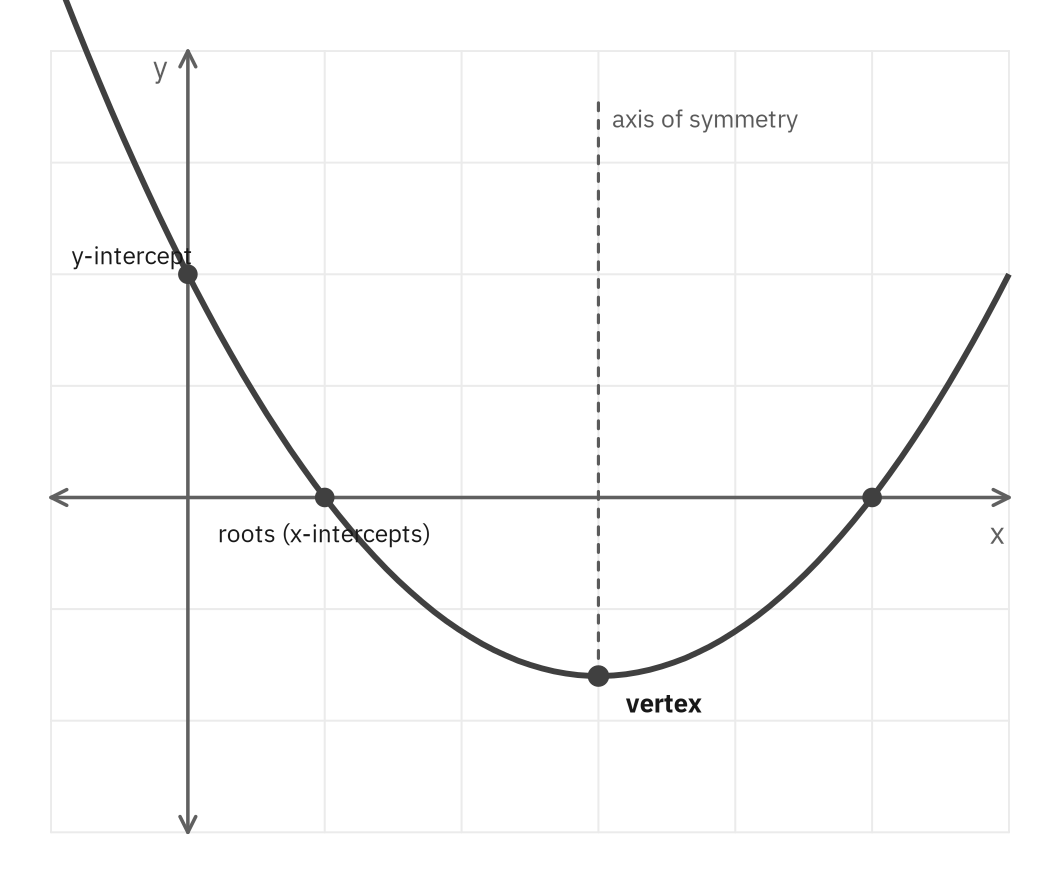
Figure 1. The landmarks of a parabola: the roots where it crosses the x-axis, the vertex where it turns, the y-intercept, and the axis of symmetry.
Connect standard, factored, and vertex forms
Keep one parabola in mind as we go, the curve , and watch the same curve take three different forms. Each is the natural answer to a different question, and learning which is which is the core of this lesson.
Three forms of a quadratic
Standard form, , shows the y-intercept () and which way the curve opens (the sign of ).
Factored form, , shows the roots and , where the curve crosses the x-axis.
Vertex form, , shows the vertex , the turning point, and so the maximum or minimum.
Read standard form: coefficients and y-intercept
Standard form, , is how quadratics most often arrive, and it volunteers two features immediately. The constant is the y-intercept, because setting leaves exactly . The sign of tells you which way the parabola opens: upward when is positive, downward when negative. The third feature, the axis of symmetry, takes one short formula, the vertical line , and from it the vertex follows.
Worked example: read in standard form
Here , , . The y-intercept is , the point . Since , the parabola opens upward. The axis of symmetry is .
These three facts came straight off the coefficients, with one tiny formula for the axis.
Read factored form: zeros
Factored form, , hands you the roots, the inputs where the curve meets the x-axis, with no work at all, because each factor is zero exactly at its root. Getting there means factoring the quadratic; once it is factored, the zero-product idea reads off the crossings.
Worked example: the same curve in factored form
factors into , so the curve crosses the x-axis at and . This is the very same parabola as before, rewritten to show where it meets the axis.
The reverse is just as useful: if you are told a parabola's roots, you can build its factored form. A parabola with roots and is for some leading coefficient ; taking and expanding gives . Roots in, equation out. Notice that the roots alone never fix ; you need one more point on the curve to pin it down.
Complete the square to reach vertex form
Vertex form, , puts the turning point on the surface, and with it the maximum or minimum value, which is simply . To convert standard form into vertex form you complete the square: you adjust the constant so that the x-terms become a perfect square. The picture is literal; you are completing an actual square.
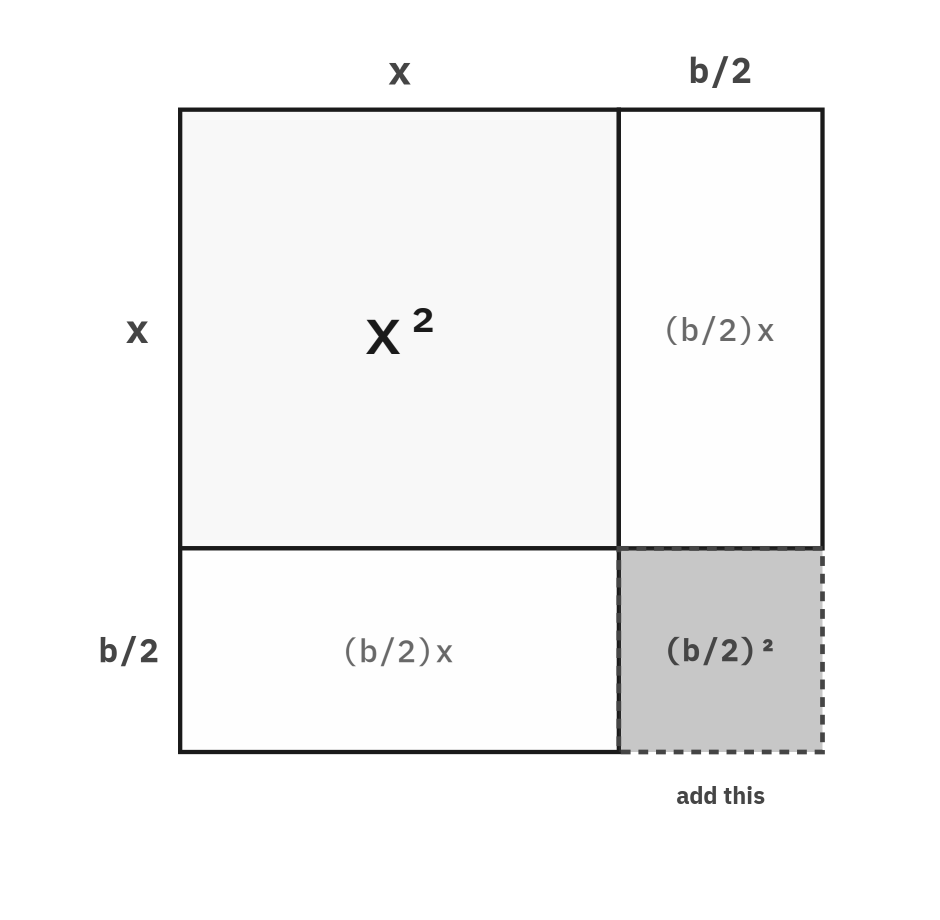
Figure 2. Completing the square: is most of a square of side ; adding finishes it.
The mechanism is to take half of the coefficient of , square it, and add and subtract that amount so nothing changes in value while a perfect square appears.
Worked example: complete the square on
Half of is , and . Add and subtract 9:
.
The vertex is . The same parabola, a third time, now showing its turning point.
When the leading coefficient is not 1, factor it out of the x-terms first, complete the square inside, and carry the factor back through.
Worked example: with a leading coefficient,
Factor 2 from the x-terms: . Half of 4 is 2, and ; add and subtract it inside:
.
The vertex is . The accounts for the 4 added inside the doubled parentheses.
Find the vertex and decide maximum or minimum
There are two routes to the vertex, and either is fine. From vertex form you read it directly. From standard form, find the axis and substitute it back to get the y-coordinate. For the running example, the axis was , and , giving the vertex , agreeing with the completed square, as it must.
Whether the vertex is a lowest point or a highest one is decided entirely by the sign of . An upward-opening parabola () bottoms out at its vertex, so the vertex is a minimum. A downward-opening one () peaks there, so the vertex is a maximum. This is exactly how the test asks for a largest or smallest value.
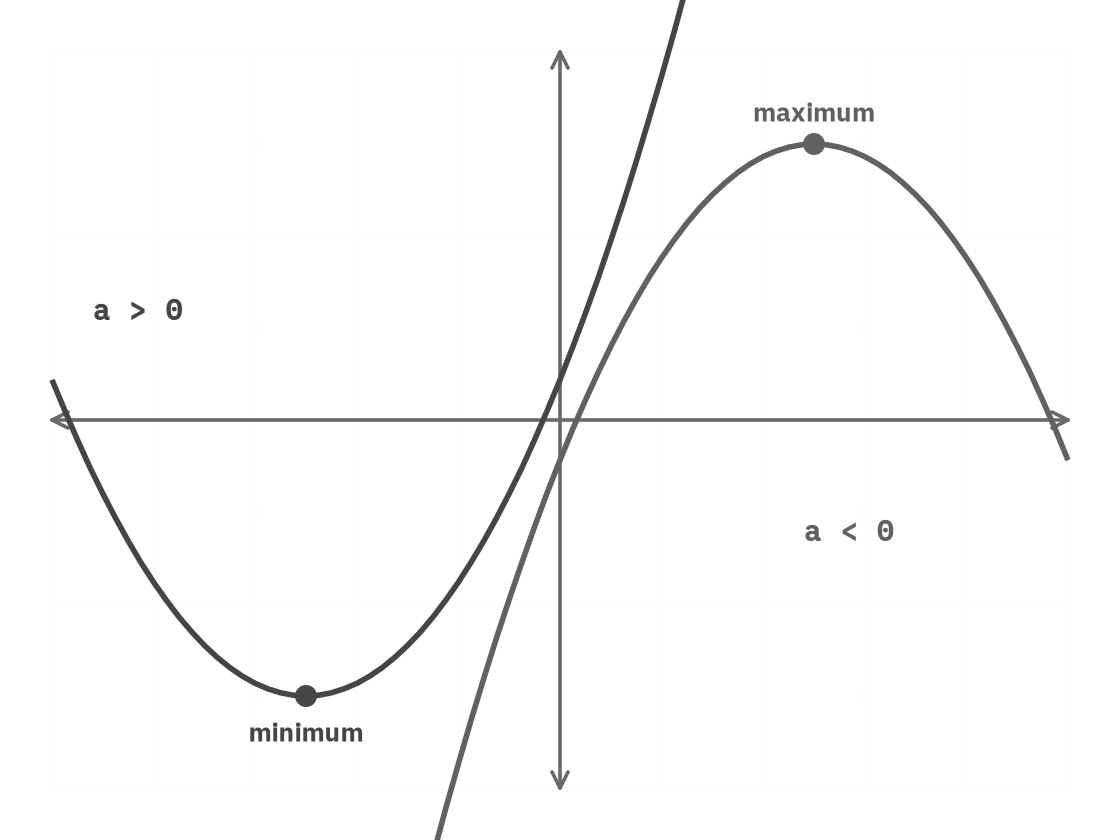
Figure 3. The sign of determines the opening direction: gives an upward-opening parabola with a minimum; gives a downward-opening parabola with a maximum.
Worked example: a maximum value
has , so it opens downward and its vertex is a maximum. Axis: . Then .
The maximum value is 4, reached at .
Use the axis of symmetry to connect roots and vertex
Every parabola is mirror-symmetric about its axis, and that single fact connects all the landmarks. The two roots sit at equal distances on either side of the axis, so the axis, and the vertex's x-coordinate, is exactly their midpoint. For the running curve, the roots 1 and 5 average to 3, which is the axis, without any formula at all. Symmetry also means that any two points at the same height share that midpoint, a quick way to locate the axis when you know two points with equal y-values.
Use root sum and product without solving
A quadratic's coefficients already know its roots' sum and product, before any solving happens. For with roots and :
and .
When a question asks only for the sum or the product, reaching for the quadratic formula or factoring is wasted motion; the coefficients hand the answer over directly.
Worked example: sum and product without solving
What is the sum of the solutions to ? What is their product?
Sum . Product .
Neither root was ever found individually; the two coefficient ratios delivered both requested values directly.
A harder version hides this same relationship inside a condition on the roots themselves, most often that they are integers satisfying some extra property. Reading the constant term as a product to be factored, rather than a number to plug into a formula, is the key move.
Worked example: parameterized roots from a factor pair
The roots of are positive integers that differ by 2. What is ?
The product of the roots is , so the two roots are a factor pair of 24 that differs by 2. Testing pairs: 4 and 6 work, since and .
The sum of the roots is (since , ), so .
The parameter never had to appear in a quadratic formula at all; it fell out of the factor pair that the product and the condition both pointed to.
Choose the form that reveals the requested feature
All three forms describe one curve, so the skill is not memorizing three separate objects but choosing among them. If a question asks where the parabola crosses the x-axis, reach for factored form. If it asks for the y-intercept or which way it opens, standard form already shows it. If it asks for the maximum or minimum, or the vertex, complete the square to reach vertex form. The quadratic never changes; you simply turn it to the form that has already done the work the question is asking for.
Quadratics in real-world contexts
A quadratic modeling question dresses the same vertex-and-roots skills in a physical setup (height over time, area against a fixed perimeter, revenue against price) and asks you to translate the scenario before any of the algebra above applies.
Worked example: maximum height of a launched object
A ball is launched from a platform, and its height in feet after seconds is given by . What is the maximum height the ball reaches?
The context supplies nothing new mathematically; it only tells you which feature to find. "Maximum height" means the vertex's y-coordinate, so find the vertex's input first: . Then evaluate the height at that time: .
The maximum height is 69 feet. Reporting , the time, instead of , the height, is the requested-quantity trap this context is built to set: the question asks for a height, and time is only the intermediate step that gets you there.
Hand, Desmos, or hybrid: graphing and clicking the vertex reads off directly, skipping the formula entirely. Structural reasoning is faster when the coefficients are this clean; the graph route pays off more once the coefficients turn messy or decimal.
Worked example: maximum area under a fixed perimeter
A rectangular garden is enclosed by 40 feet of fencing. What is the maximum possible area of the garden?
Translate first: if the width is , the perimeter condition gives length , so the area is a quadratic in the one variable : .
This opens downward, so its vertex is a maximum. Find it the same way as any other quadratic: and .
The maximum area is 100 square feet, reached at a 10-by-10 square. The translation step, turning a perimeter constraint into a single-variable area function, is the only part of this problem that is not already familiar quadratic work.
Summary
A quadratic graphs as a parabola, and the parabola's landmarks (roots, vertex, intercept, axis) are all present in any way you write the quadratic. What changes is how visible each one is: standard form shows the y-intercept and the opening, factored form shows the roots, and vertex form, reached by completing the square, shows the turning point and the maximum or minimum. Symmetry binds them, placing the axis exactly between the roots and under the vertex. Read the question, name the landmark it wants, and turn the quadratic to the form that already holds it.