Right triangles and trigonometry
The right triangle is where two of the domain's deepest tools live: the Pythagorean theorem ties its sides together, and trigonometry ties those sides to its angles.
This unit combines several tested relationships in one figure: side lengths through the Pythagorean theorem, special-triangle ratios, and trigonometric ratios. The Pythagorean theorem relates its three sides, so any two give the third. Trigonometry goes further, linking the sides to the angles, so a side and an angle give everything. Layered on top are a few memorable shortcuts, the common triples and the two special triangles, that let you skip computation entirely when you recognize them. We build from the theorem outward to the trigonometry, and a great many geometry questions resolve, in the end, to spotting a right triangle and choosing the right tool.
Apply the Pythagorean theorem
In any right triangle, the square of the hypotenuse (the side opposite the right angle, and always the longest) equals the sum of the squares of the two legs: , with the hypotenuse. Given any two sides, this finds the third. Just keep in its place: it is the hypotenuse alone, so when you solve for a leg you subtract.
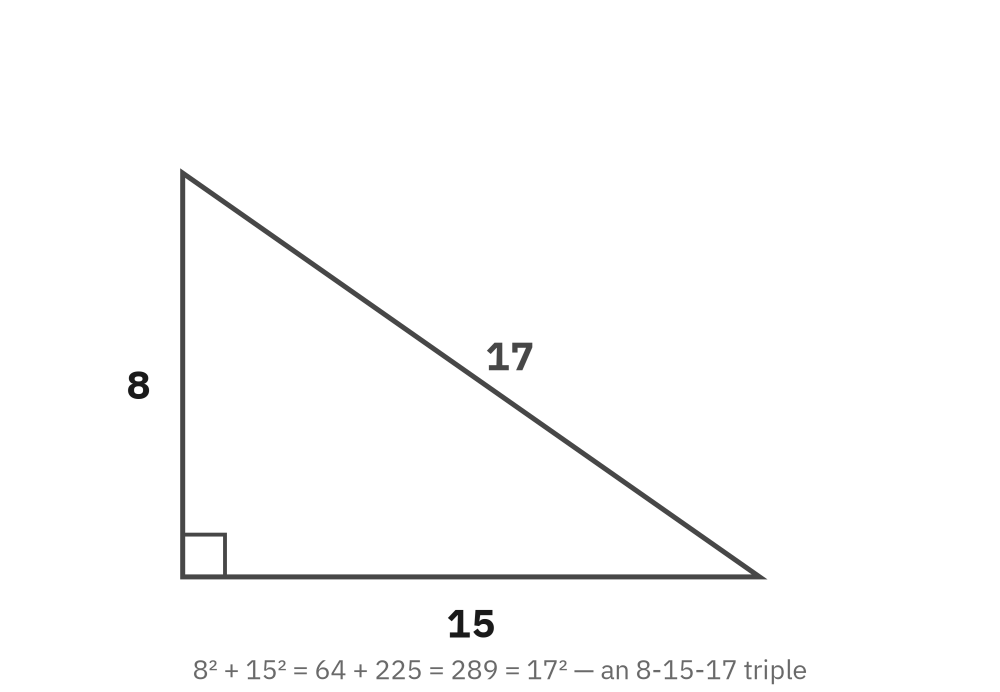
The hypotenuse squared equals the sum of the squares of the legs. These three sides, --, satisfy it exactly.
Worked: find a side two ways. Find the hypotenuse of a right triangle with legs and :
Find a leg of a right triangle with hypotenuse and one leg : now subtract, since you are solving for :
Recognize common Pythagorean triples
Some right triangles have whole-number sides, and recognizing these triples on sight saves all the squaring and square-rooting. Four are worth knowing cold, and because any multiple of a triple is itself a triple, each stands for a whole family.
Pythagorean triples worth recognizing
3-4-5, and its multiples --, --, --, and so on.
5-12-13, and --, and so on.
8-15-17 and 7-24-25.
Spot a multiple and you skip the arithmetic: legs and are , so the hypotenuse is .
Use 45-45-90 and 30-60-90 side ratios
Two right triangles recur so often that their side ratios are printed on the reference sheet, and knowing them turns many problems into a single multiplication. The 45-45-90 triangle (an isosceles right triangle, the half of a square along its diagonal) has sides in the ratio : the two legs are equal, and the hypotenuse is a leg times . The 30-60-90 triangle, the half of an equilateral triangle down its altitude, has sides in the ratio , where the short leg faces the angle, the long leg (short leg times ) faces the angle, and the hypotenuse (twice the short leg) faces the right angle.
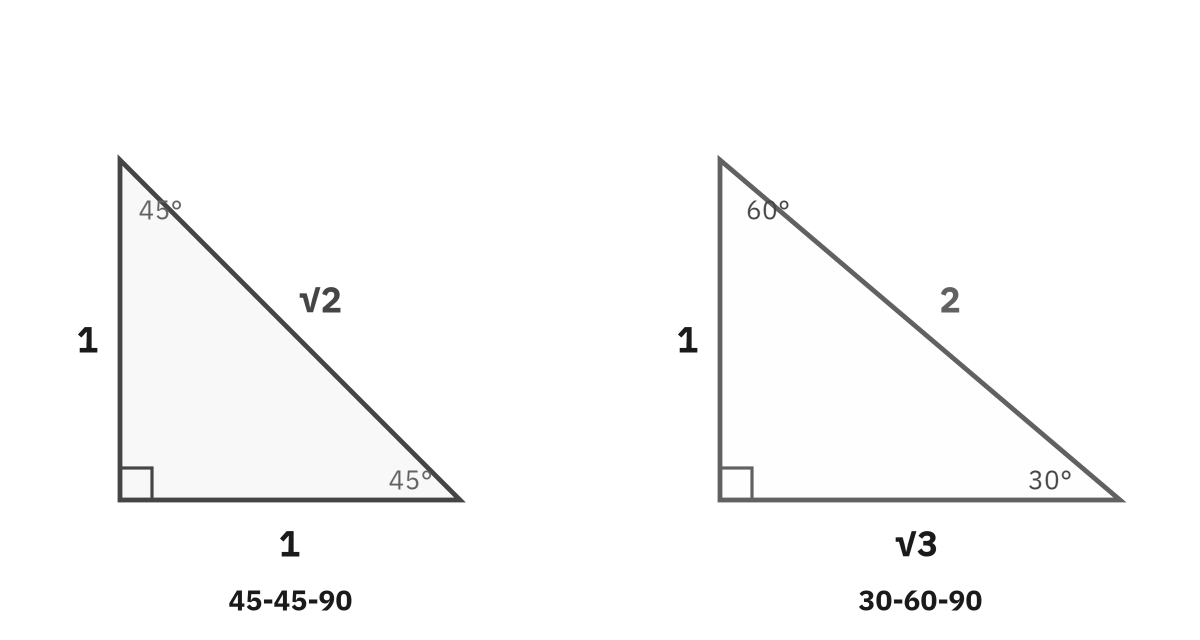
The two special right triangles and their side ratios: for the 45-45-90, and for the 30-60-90.
Worked: use the special ratios.
A square's diagonal: a square with side splits into two 45-45-90 triangles, so its diagonal is a leg times , namely .
A 30-60-90: if the short leg (opposite the angle) is , then the hypotenuse is and the long leg is .
An equilateral altitude: the altitude of an equilateral triangle is the long leg of a 30-60-90 whose short leg is half the side. For side , the altitude is .
Use sine, cosine, and tangent in right triangles
Trigonometry connects an acute angle of a right triangle to the ratios of its sides, packaged in the mnemonic SOHCAHTOA. For an acute angle , name the three sides by their role: the hypotenuse, the side opposite (across the triangle from it), and the side adjacent to (the leg touching it). Then the three ratios are:
- (SOH)
- (CAH)
- (TOA)
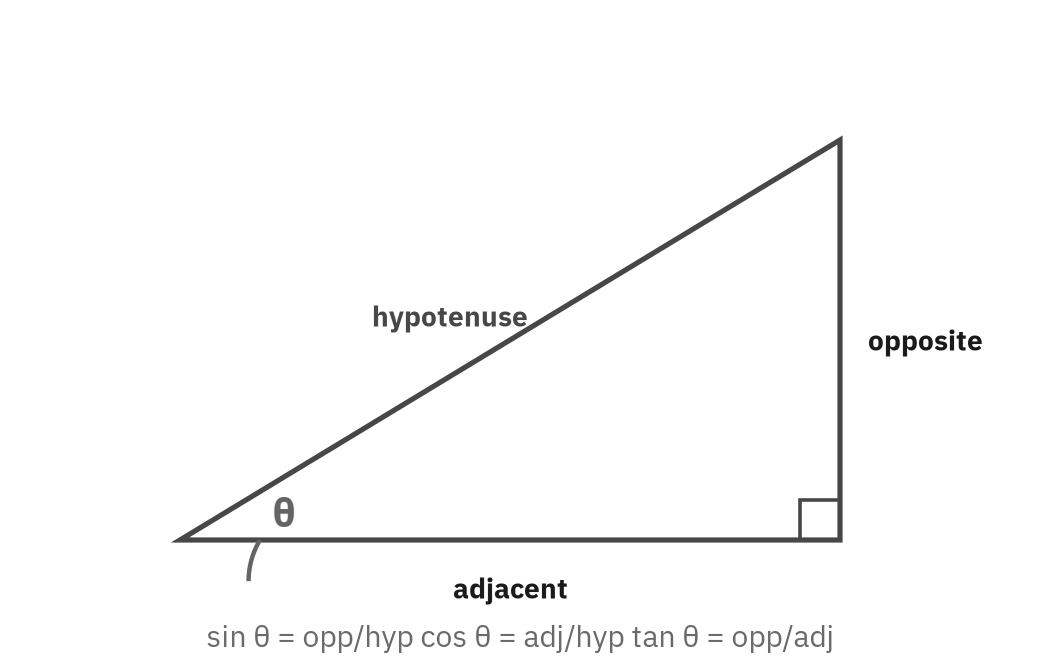
Naming the sides relative to the angle gives the three ratios: SOH, CAH, TOA.
With a ratio and one side, you find another side; with two sides, you find the ratio, and from it the angle. On the test the angle is often one of the special values, so the special-triangle ratios and the trig ratios reinforce each other: is just the 30-60-90 triangle read as a ratio.
Worked: find a side with a ratio. A right triangle has an acute angle of and a hypotenuse of . Find the side opposite the angle.
Sine is opposite over hypotenuse, and , so the opposite side is half the hypotenuse:
If instead you are told and the hypotenuse is , the opposite side is .
Use complementary-angle trig relationships
The two acute angles of a right triangle always sum to ; they are complementary, and this produces an identity the test returns to often. The side opposite one acute angle is the side adjacent to the other, so the sine of one angle equals the cosine of the other. Written out: , and likewise .
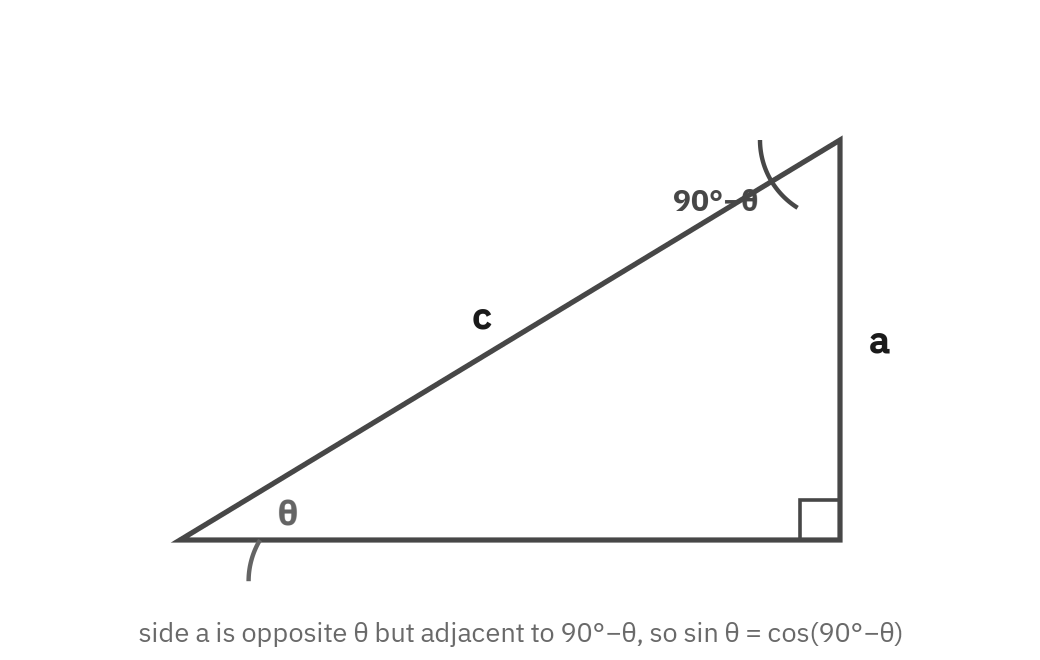
The side opposite is adjacent to its complement, so .
Worked: use the complementary identity. , because and are complementary.
So if , the two angles must be complementary:
This complementary relationship holds whenever both angles are acute, which covers every angle inside a right triangle. When both angles are acute, implies , and setting the two angles' sum to and solving is safe. If a problem ever allows a non-acute angle, do not assume complementarity without checking the stated domain first.
Finding the hidden right triangle
Many questions never use the word "triangle." A ladder against a wall, a rectangle's diagonal, two points on a coordinate grid, and the diagonal through a box all contain right triangles waiting to be drawn. Sketch the right angle, label the sides you know, and then choose the tool: Pythagoras for two sides and a missing third, a special-triangle ratio when you see a , , or angle, and sine, cosine, or tangent when an angle and a side are involved. For a rectangular box with dimensions , , , apply the theorem twice to get the space diagonal .
Worked: a hidden right triangle. A rectangle has a diagonal of and one side of . The diagonal cuts the rectangle into two right triangles with the diagonal as hypotenuse, so the other side is and the perimeter is . In the same spirit, two points on a coordinate grid that share an - or -coordinate give a horizontal or vertical leg, and the distance between the points is the hypotenuse. A common slip is to subtract the squares when finding the hypotenuse, or to add them when finding a leg; keep asking which side is the longest one, and let that side stand alone on one side of the equation.
Chapter summary
The right triangle answers to two tools. The Pythagorean theorem, , finds a third side from two (adding for the hypotenuse, subtracting for a leg) and the triples and the two special triangles let you skip that work when you recognize the pattern. Trigonometry then links sides to angles: sine is opposite over hypotenuse, cosine adjacent over hypotenuse, tangent opposite over adjacent, with the special angles giving clean values. And because a right triangle's acute angles are complementary, the sine of one is the cosine of the other. Find the right triangle in the figure, pick the tool that uses what you know, and the rest is arithmetic.