Triangle similarity and congruence
Two figures of the same shape carry the same angles and proportional sides, and that one fact converts a length you know into a length you want.
Two figures can be related in two strengths. Congruent figures are identical: same shape and same size, so every matching part is equal. Similar figures are the same shape at possibly different sizes; one is a scaled copy of the other. Similarity is the workhorse, because it lets a figure you can measure stand in for one you cannot: knowing the shape is preserved, a single proportion turns a known length into an unknown one. Almost every question in this unit reduces to recognizing a pair of similar triangles and writing the proportion that links them.
Distinguish congruent from similar triangles
In congruent figures, corresponding sides and corresponding angles are all equal; one can be slid, turned, or flipped onto the other exactly. In similar figures, corresponding angles are still equal, but corresponding sides are merely proportional: each side of one is the same constant multiple, the scale factor, of the matching side of the other. Congruence is the special case of similarity in which the scale factor is .
Establish triangle similarity with angle-angle
For triangles, similarity is unusually easy to establish. Because the angles of a triangle must sum to , knowing two pairs of equal angles forces the third pair to match as well, so two triangles with two pairs of equal angles are automatically similar. This is the AA (angle-angle) criterion, and it is the tool you will reach for most, because equal angles are everywhere: shared angles, vertical angles, and the equal angles created by parallel lines all hand you the pairs you need.
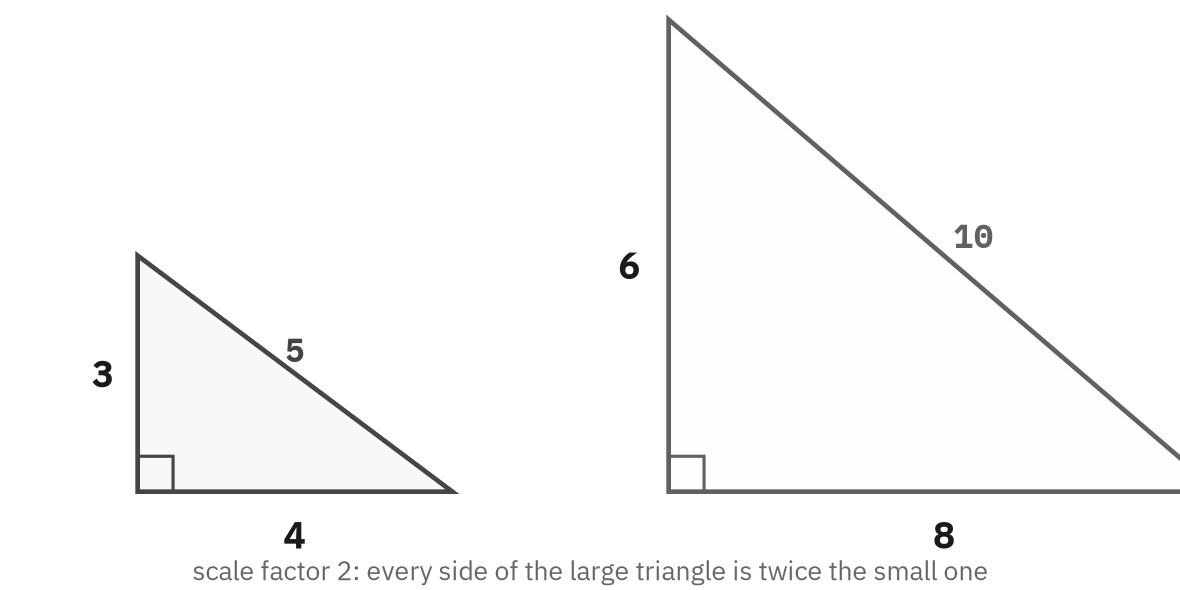
Similar triangles have equal corresponding angles and proportional corresponding sides. Here every side of the larger triangle is twice its match.
Once two triangles are known to be similar, their corresponding sides are locked into a single ratio. Writing that ratio as an equation, being careful to match each side with its true counterpart, is what produces the answer.
Use similarity proportions to find missing lengths
The mechanics are always the same: identify which sides correspond, set their ratios equal, and solve. The one discipline that matters is correspondence, pairing each side with the side that plays the same role in the other triangle, which the equal angles tell you. Get the pairing right and the proportion solves itself.
Worked: solve for a side by proportion. Triangle is similar to triangle , with corresponding to . Given , , and , find .
Corresponding sides share one ratio, so :
The shape is fixed; only the size scales, here by a factor of from to .
Worked: measure indirectly with shadows. A -foot person casts a -foot shadow while a flagpole casts a -foot shadow at the same time. The sun's rays make equal angles, so the two right triangles are similar.
feet.
Indirect measurement is just similar triangles applied to a real-world setup.
Use the altitude to the hypotenuse to relate three similar triangles
Drawing the altitude from the right angle of a right triangle down to the hypotenuse splits the original triangle into two smaller right triangles. All three triangles, the original and the two pieces, share their angles pairwise, so all three are similar to each other by angle-angle. That shared similarity forces a proportion between the two segments the altitude creates and the altitude itself: if the altitude splits the hypotenuse into pieces of length and , the altitude satisfies ; the altitude is the geometric mean of the two segments. This is not a separate fact to memorize; it is the same similar-triangle proportion used everywhere else in this unit, applied to a specific figure.
Worked: find an altitude from the segments it creates. In a right triangle, the altitude to the hypotenuse divides it into segments of length and . What is the length of the altitude?
Apply the relationship directly: , so .
Use proportional segments created by a line parallel to a triangle side
One configuration appears so often it deserves its own recognition: a line drawn parallel to one side of a triangle, cutting the other two sides. Because the parallel line creates equal corresponding angles, it carves off a smaller triangle similar to the whole, and the two sides it crosses are divided in the same ratio.
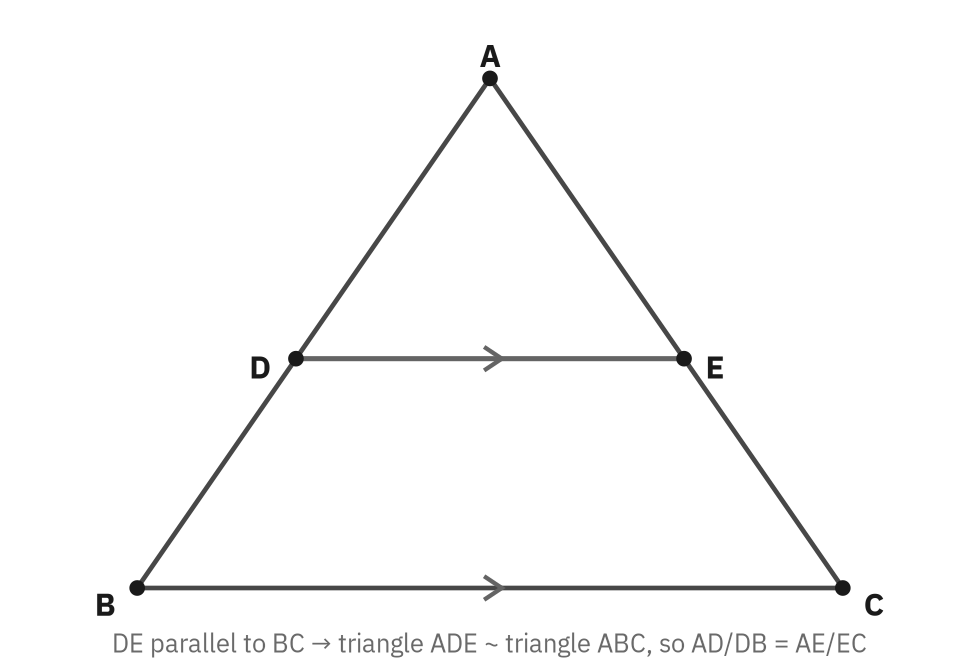
A line parallel to one side cuts the other two sides proportionally, and creates a smaller triangle similar to the original.
Worked: use a parallel side-divider. In triangle , lies on and on with . If , , and , find .
The parallel line splits the two sides in equal ratios, :
A special case is the midsegment: a segment joining the midpoints of two sides is parallel to the third and exactly half its length.
Watch which ratio you build. The part-to-part ratio matches , and the part-to-whole ratio matches and . Mixing a part-to-part ratio with a part-to-whole ratio is the most common error here.
Recognize similarity in a bow-tie configuration
A second configuration is easy to miss because the two triangles overlap rather than nest. Two segments cross at a point, forming an X, or bow tie. If the two outer segments are parallel, the crossing point creates vertical angles, and the parallel lines create equal alternate-interior angles, so the two triangles are similar by AA even though they point in opposite directions.
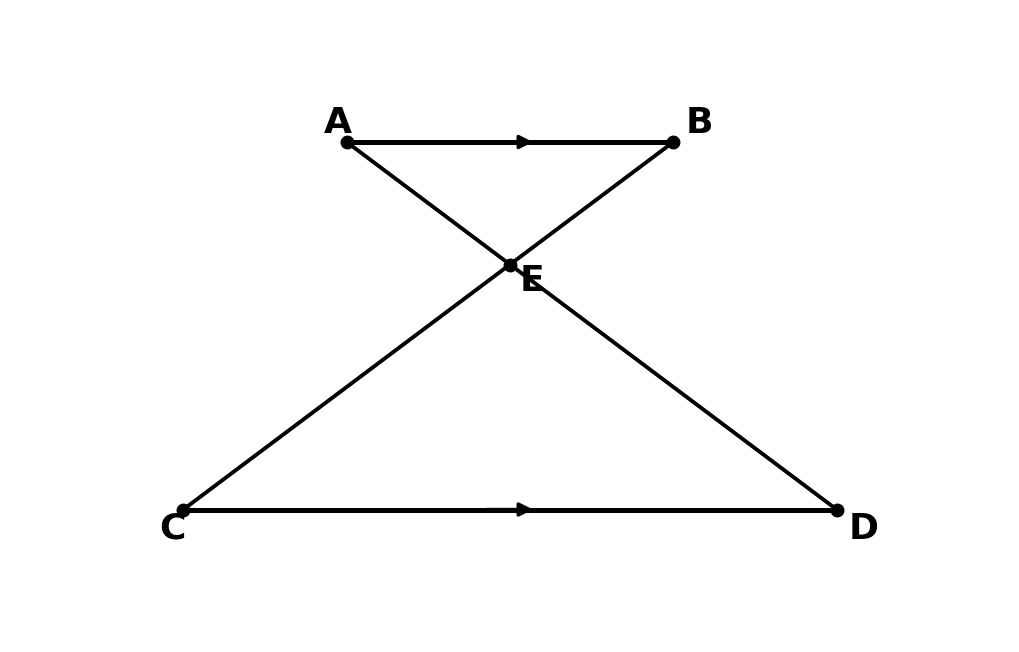
Segments and cross at . is parallel to , so triangle is similar to triangle , even though the triangles point away from each other.
Worked: solve a bow-tie similarity. Segments and intersect at , with . If , , and , what is ?
The vertical angles at and the parallel sides give triangle similar to triangle , with and the corresponding sides that set the ratio.
The two triangles share only the point ; nothing about them nests or overlaps in area the way the parallel-side-divider configuration does, which is exactly why the bow tie is easy to miss. Checking that the two parallel sides, not the two crossing segments, are the ones set proportional is the detail this configuration is built to test.
Apply linear and squared scale factors to perimeter and area
Scaling a figure changes its measurements in a patterned way that the test loves to probe. Lengths (sides, perimeters, diagonals) scale by the factor itself. But area scales by , because area is a product of two lengths, and volume, a product of three, scales by . So doubling every side doubles the perimeter but quadruples the area.
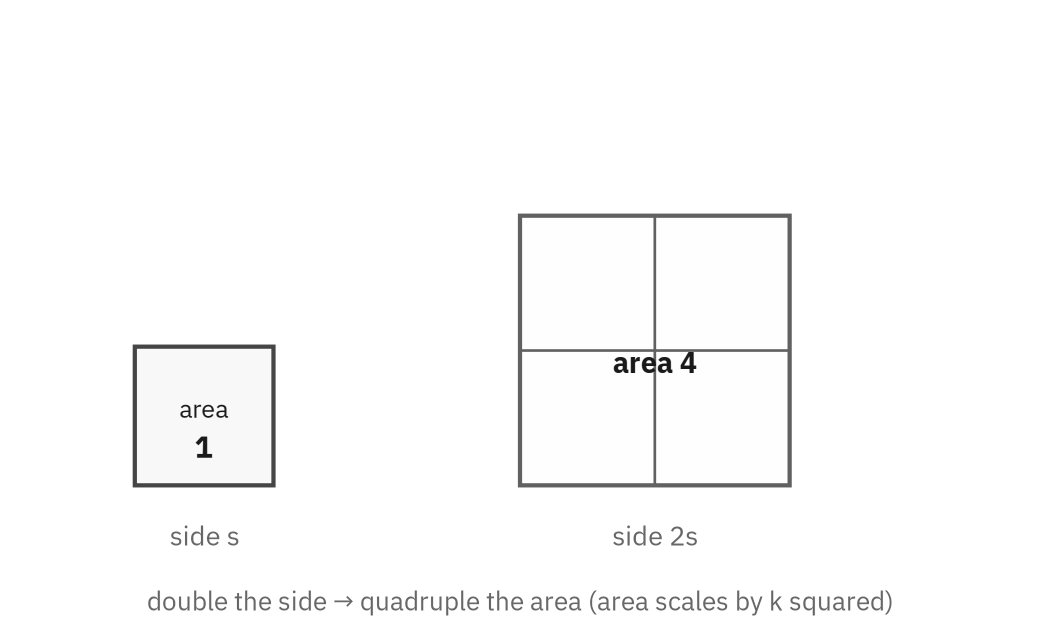
Lengths scale by , but area scales by : doubling the side multiplies the area by four.
How similarity scales measurements
Lengths (sides, perimeter): multiply by the scale factor .
Areas: multiply by .
Volumes: multiply by .
Reversing this: if areas are in ratio , the sides are in ratio .
Determine when given information proves similarity or congruence
Some geometry questions do not ask for a length or an angle at all; they ask which additional fact would be enough to force a relationship: a pair of triangles similar, a quadrilateral a parallelogram, a triangle isosceles. Treat each answer choice as a proposed condition and ask what it unlocks, not whether it merely looks consistent with the figure.
Similarity needs only two pairs of equal angles, the AA criterion already in hand. Congruence is stricter: it forces both the shape and the size to match, so it takes a full side measurement, not just an angle. Five combinations are guaranteed sufficient:
- SSS: three pairs of equal sides.
- SAS: two sides and the angle between them.
- ASA: two angles and the side between them.
- AAS: two angles and a non-included side.
- HL, for right triangles specifically: matching hypotenuse and one leg.
Two combinations that look similar are traps: AAA proves similarity only, since it fixes shape but not size, and SSA proves neither: two sides and a non-included angle can describe two genuinely different triangles, so it forces nothing on its own. Parallel lines crossed by a transversal create the equal angle pairs that often supply the angle piece of any of these conditions.
Worked: test a proposed condition. In triangle , lies on and lies on . Which additional fact is sufficient to conclude that is parallel to ?
The condition that actually forces the parallel relationship is , the side-splitting ratio from earlier in this unit; matching that ratio is what guarantees and never meet at a different angle.
A choice claiming and merely "look parallel" in the figure, or that some unrelated pair of sides is equal, is not sufficient: it may be consistent with the drawing without forcing the relationship the way a genuine condition must.
The habit to build is refusing appearance as evidence. A pair of sides that looks equal, an angle that looks right, a point that looks centered: none of these count unless the problem states them or an earlier step derives them. A sufficiency question is really asking whether a fact proves a relationship or merely happens to be drawn alongside it.
Chapter summary
Congruent figures match exactly; similar figures match in shape, with equal angles and proportional sides. For triangles, two equal angles are enough, the AA criterion, and from similarity a single proportion of corresponding sides finds any unknown length, whether in an abstract figure, a shadow, or a parallel line cutting a triangle into proportional pieces. Remember how scale propagates: lengths by , areas by , volumes by , and run that backward through a square root when areas are given. Spot the similar pair, match the sides honestly, and write the ratio.