SAT Reading & Writing study guide · Chapter 37
Practice Test Module 2: 27 Questions With Complete Explanations
Module 2
Twenty-seven questions, thirty-two minutes. This is the higher-difficulty second module. It still contains a range of difficulty, and on the real test the form a student receives depends on performance in Module 1.
Question 1
Dr. Amara Osei had spent eleven years earning the credentials that let her speak on coral bleaching: a doctorate, two postdoctoral fellowships, a seat on the international panel. Reporters treated her as the authority she was, and when her team’s paper finally appeared, the press expected a verdict. What they got instead was a sentence that gave ground in every clause. The reef could recover, the paper said, under conditions it did not expect to hold. Her endorsement of the recovery plan was qualified.
As used in the text, what does the word “qualified” most nearly mean?
A. certified
B. limited
C. reluctant
D. withheld
Question 2
The salon at Gordon Square was famous for its hospitality. Vanessa hosted three evenings a week, and the guests who came remembered the food and the arguments in equal measure. But the letters from that winter record something none of them saw. For nearly two months, with no one to advise her and no one told, she entertained the possibility that the paintings should be destroyed.
As used in the text, what does the word “entertained” most nearly mean?
A. hosted
B. amused
C. considered
D. welcomed
Question 3
Hollis bought the mill in 1974 for almost nothing, and for two decades he was the only person in town who saw anything in it at all. His neighbors thought him sentimental. He rebuilt the waterwheel himself, over four winters, and when tourists began stopping he was gracious about it, though he never once charged them. By the time he sold, the property had appreciated more than tenfold.
As used in the text, what does the word “appreciated” most nearly mean?
A. risen in worth
B. been admired
C. been valued
D. been understood
Question 4
Captain Vieira had led the regiment for six years, and the men obeyed him without hesitation or complaint. When he retired to Lisbon he brought almost nothing back with him: a sword, a set of maps, and a small landscape painted by an officer under his command. He thought it a modest thing and hung it in a back room. At auction, forty years after his death, it commanded a price that would have bought the regiment’s horses twice over.
As used in the text, what does the word “commanded” most nearly mean?
A. fetched
B. demanded
C. ordered
D. controlled
Question 5
The prosecution’s case had been building for months, and by spring the detectives were confident enough to make an arrest. Then the lead witness recanted. The file began to thin: motions were withdrawn, evidence returned, witnesses drifting out of reach, and the district attorney privately expected it to be dead by autumn. What she had not counted on was the clerical hold. Filed for unrelated reasons, it froze the docket where it stood. The case did not recover. But for eleven months, its decline was arrested.
As used in the text, what does the word “arrested” most nearly mean?
A. taken into custody
B. reversed
C. halted
D. slowed
Question 6
Tharp’s rift valley persuaded no one at first. Heezen, who had dismissed her draft, spent two years trying to prove it an artifact of her method. He plotted earthquake epicenters across the same stretch of ocean, expecting them to fall anywhere but the valley. They fell inside it, almost without exception. The map he had set out to discredit became the map he spent the rest of his career defending.
Which choice best describes the function of the underlined portion in the text as a whole?
A. It provides an example of the oceanographic methods that were available to researchers in the 1950s.
B. It explains why earthquake data was regarded as reliable evidence at the time.
C. It illustrates the professional hostility that Tharp encountered from her colleagues at the time.
D. It describes the test Heezen designed to discredit the map, which produced the result that changed his position.
Question 7
Text 1 A critic argues that Zora Neale Hurston’s use of dialect in Their Eyes Were Watching God was a deliberate literary instrument. Hurston had trained as an anthropologist and transcribed speech she had recorded in the field; the novel’s shifts between dialect and lyrical narration are calculated, not incidental.
Text 2 Whitfield observes that Hurston’s contemporaries, Richard Wright among them, read the dialect as pandering to white readers. Whitfield argues that this reading tells us more about the anxieties of the Harlem Renaissance’s male critics than about Hurston’s method, and that the novel’s narration is technically sophisticated in ways Wright never troubled to acknowledge.
Based on the texts, how would the author of Text 2 most likely respond to the underlined claim in Text 1?
A. By agreeing with it, and adding that Hurston’s contemporaries failed to recognize the sophistication it describes.
B. By disagreeing, on the grounds that Wright’s criticism has been too readily dismissed.
C. By agreeing, while cautioning that Hurston’s anthropological training has been overstated.
D. By arguing that the question of Hurston’s technique matters a good deal less than the question of the audience she was writing for and the one that read her.
Question 8
When Mount Tambora erupted in 1815, the following summer failed across the Northern Hemisphere. Crops froze in New England in June. Grain prices tripled in Switzerland. In Yunnan, three successive rice harvests were lost, and a province long known for rice began to grow opium instead, a change that historians trace well beyond the cold years themselves. Historians once treated 1816 as a curiosity: a year of odd weather and gloomy poetry. What they find in it now is a demonstration that a single geological event can redirect the economy of a region long after the weather has returned to normal.
Which choice best states the main idea of the text?
A. The eruption of Mount Tambora in 1815 caused widespread crop failures across the Northern Hemisphere in the summer of 1816, from New England to Switzerland.
B. Yunnan’s shift from rice to opium demonstrates how quickly agricultural regions adapt to climate shocks.
C. Historians have revised their view of 1816, a year once dismissed as a meteorological curiosity.
D. The eruption’s consequences outlasted the cold weather that caused them, reshaping a regional economy long after the harvests recovered.
Question 9
The Antikythera mechanism was raised in 1901 from a wreck off a Greek island, and for fifty years it sat in a museum cataloged as corroded bronze. Derek de Solla Price began X-ray work on it in 1951 and published his reconstruction in 1974, arguing that it modeled the motions of the sun and the moon. Imaging done in 2006, with a scanner built for the purpose, found gear trains Price had never counted. The surviving gears model the cycles of the sun and the moon securely, and whether the mechanism also carried the five planets remains a matter of reconstruction. The inscriptions the same scan uncovered described something else entirely: not how the mechanism worked, but how it was to be used.
According to the text, what did the inscriptions uncovered in 2006 describe?
A. the motions of the sun and the moon
B. how the mechanism was to be operated
C. the gear trains Price had not counted
D. the five planets known to antiquity
Question 10
POLLINATOR VISITS AND FRUIT SET IN FOUR GREENHOUSE GROUPS
| GROUP | MEAN POLLINATOR VISITS PER HOUR | FLOWERS PRODUCING FRUIT (%) |
|---|---|---|
| A | 2.1 | 38 |
| B | 4.0 | 51 |
| C | 6.2 | 64 |
| D | 6.1 | 65 |
Researchers in a greenhouse experiment recorded pollinator visits and fruit set across four groups of the same plant species, each exposed to a different pollinator community. The team argues that greater pollinator activity is associated with higher fruit set, though the relationship is not perfectly linear.
Which choice most effectively uses data from the table to support the researchers’ claim?
A. Group D recorded the highest percentage of flowers producing fruit, at 65 percent.
B. Fruit set rose steadily from Group A to Group C as pollinator visits increased, but Group D’s visit rate and fruit set were both nearly identical to Group C’s.
C. Group C received more pollinator visits per hour than Group D, yet Group C’s fruit set was lower, showing that visits do not affect fruit set.
D. Groups C and D received far more pollinator visits than Groups A and B, proving that pollinator activity determines fruit set in this species.
Question 11
A historian argues that the sharp rise in literacy in eighteenth-century Scotland was driven less by the parish school system, which had existed for decades without producing such a rise, than by the sudden availability of cheap printed matter after 1750: chapbooks, almanacs, and broadsides that gave newly taught readers something they actually wanted to read. Schooling, on this account, supplied the skill; the presses supplied the reason to keep it.
Which finding, if true, would most directly support the historian’s claim?
A. Parish schools in Scotland were funded by local landowners, whose contributions rose steadily after 1750.
B. Scottish literacy rates rose fastest in precisely those decades that immediately followed the expansion of the parish school system across the country.
C. In Scottish counties where chapbook sales remained low after 1750, literacy rose no faster than it had before.
D. By 1790, Scottish chapbooks were being exported in large numbers to England and Ireland.
Question 12
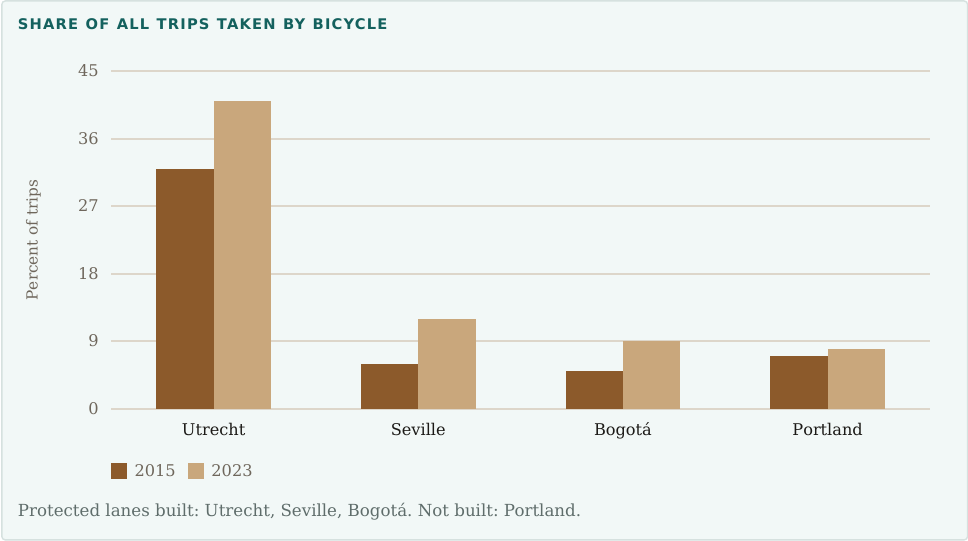
A transport researcher argues that building protected bicycle lanes, rather than simply promoting cycling through advertising and events, is associated with the larger increases in bicycle use among the cities shown. Utrecht, Seville, and Bogotá all built protected lanes during the period shown; Portland did not. To support the argument, the researcher notes that among the four cities studied, ______
Which choice most effectively uses data from the graph to complete the statement?
A. Utrecht, which built protected lanes, recorded the highest share of bicycle trips in both years, at 32 percent and then 41 percent.
B. Portland, the only city that did not build protected lanes, showed the smallest increase, rising just one percentage point.
C. Bogotá, which built protected lanes, saw its share of bicycle trips rise from 5 percent in 2015 to 9 percent in 2023.
D. Seville, which built protected lanes, saw its share of bicycle trips double between 2015 and 2023, from 6 percent to 12 percent.
Question 13
Cuttlefish change color using pigment sacs under direct neural control, and they can match the pattern of a checkerboard in about a second. Yet every test of cuttlefish vision has found the animals to be colorblind: they carry a single type of photoreceptor. One proposed explanation points to the pupil, which is W-shaped and spreads incoming light so that different wavelengths come into focus at different depths. An animal that could change the shape of its eye could compare those depths. This would mean that cuttlefish ______
Which choice most logically completes the text?
A. perceive color exactly as vertebrates do, by an unfamiliar route.
B. rely on texture rather than color when they camouflage themselves.
C. possess a second type of photoreceptor which the tests conducted so far have simply failed to detect, given how few animals have been examined.
D. may distinguish colors by a mechanism that does not depend on photoreceptor variety.
Question 14
Cuckoo chicks hatch earlier than their host’s eggs and push the remaining eggs from the nest, so a reed warbler that accepts a cuckoo egg raises no offspring of its own that season. Rejection of foreign eggs is more common in warbler populations exposed to cuckoos than in populations where cuckoos have never been recorded. This pattern suggests that egg rejection in reed warblers ______
Which choice most logically completes the text?
A. is learned by individual birds after a failed nesting season.
B. is triggered in an individual bird by the sight of a cuckoo near its nest.
C. carries a cost that outweighs its benefit in cuckoo-free regions.
D. is found more often in populations that live where cuckoos are present.
Question 15
The Voyager engineers had to decide what a species should send into permanent exile, knowing no one would ever confirm receipt. They settled on a record. Pressed into its grooves, alongside greetings in fifty-five languages, were the sounds they judged worth ______ a kiss, a mother’s first words to her newborn, thunder, and a heartbeat.
Which choice completes the text so that it conforms to the conventions of Standard English?
A. keeping:
B. keeping
C. keeping;
D. keeping and
Question 16
For thirty years the archive kept the letters in the order the family had left them, which is to say in no order at all. Sorting them fell to a single graduate student, who worked through that winter without heat. The ______ handwriting was the least of her problems; four of them had shared a first name.
Which choice completes the text so that it conforms to the conventions of Standard English?
A. sisters’s
B. sisters
C. sister’s
D. sisters’
Question 17
Bruce Heezen dismissed Marie Tharp’s first draft as “girl talk,” a remark she recorded without comment in her notes and never mentioned again. The rift valley ______ she had drawn from thousands of soundings taken aboard ships she was not permitted to board, would within a decade be cited as decisive evidence for continental drift.
Which choice completes the text so that it conforms to the conventions of Standard English?
A. that
B. , which
C. which
D. , that
Question 18
A seventeenth-century scholar signed away her library, and the traditional account holds that she wrote nothing afterward. The account rests on an absence of evidence rather than evidence of an absence. A study of letters attributed to her that she wrote after her library was ______ that she went on working in the months that remained to her.
Which choice completes the text so that it conforms to the conventions of Standard English?
A. sold, suggests
B. sold; suggests
C. sold suggests
D. sold: suggests
Question 19
The collection of letters that Ida B. Wells sent from England during her 1893 speaking tour, together with the clippings and handbills she gathered from the meetings she addressed, ______ now held at the University of Chicago.
Which choice completes the text so that it conforms to the conventions of Standard English?
A. are
B. is
C. were
D. have been
Question 20
The expedition had been warned twice, once in Sacramento and again at the last settlement on the river, that the pass closed early. They went anyway, and they went late. By the time the surveyors reached the summit in September, the snow ______ the last of the trail markers, and the maps they had carried up from the coast were of no further use to anyone.
Which choice completes the text so that it conforms to the conventions of Standard English?
A. buried
B. has buried
C. had buried
D. buries
Question 21
The Rosenwald Collection had been shut to readers for nearly forty years, and its catalog survived only on index cards, in a cabinet no one had opened since the war. Walking into the reading room for the first time since the restoration, ______
Which choice completes the text so that it conforms to the conventions of Standard English?
A. the height of the ceiling surprised Okonkwo.
B. the ceiling’s height was surprising to Okonkwo.
C. the considerable height of the reading room’s ceiling was what surprised Okonkwo most.
D. Okonkwo was surprised by the height of the ceiling.
Question 22
The sourdough starters sold commercially are dominated by a single species of yeast, chosen because it behaves the same way in every kitchen it enters. A starter kept in a house drifts instead, under the flour, the feeding, and the warmth it is given, toward a mixture of its own. ______ two bakers working from the same recipe in the same city can produce loaves that taste nothing alike.
Which choice completes the text with the most logical transition?
A. For example,
B. However,
C. As a result,
D. Similarly,
Question 23
The influenza of 1918 killed more people in a year than the war had killed in four, and yet it left a faint and indirect mark on the fiction of the decade that followed. Novelists who had buried their families at home wrote about the front instead. It is tempting to read this as forgetting. ______ the silence was not a failure of memory. Survivors described the epidemic constantly, in letters and in diaries. They simply did not put it into books.
Which choice completes the text with the most logical transition?
A. However,
B. Therefore,
C. Indeed,
D. In addition,
Question 24
American towns installed electric streetlights in large numbers between 1890 and 1910, and municipal records from the period are full of confident claims that the lamps had cut crime. Historians who have examined arrest data from those towns report no matching drop. What they do find is a change in reporting: lit streets produced more witnesses, and more witnesses produced more complaints. ______ the towns that installed lamps recorded crime rising, not falling.
Which choice completes the text with the most logical transition?
A. Nevertheless,
B. However,
C. Consequently,
D. By contrast,
Question 25
Student’s notes:
Wangari Maathai founded the Green Belt Movement in Kenya in 1977. The movement paid rural women a small sum for every tree seedling that survived, rather than for every seedling planted. By 2004, participants had planted more than thirty million trees. Maathai received the Nobel Peace Prize in 2004. The Nobel committee cited her linking of environmental work to democracy and peace.
The student wants to explain how the Green Belt Movement worked. Which choice most effectively uses relevant information from the notes to accomplish this goal?
A. Wangari Maathai, who founded the Green Belt Movement in Kenya in 1977 and led it for the rest of her life, received the Nobel Peace Prize in 2004, the first African woman ever to be awarded it.
B. The Green Belt Movement paid rural women for each tree seedling that survived rather than for each one planted; by 2004, participants had planted more than thirty million trees.
C. The Nobel committee, in awarding Maathai the Peace Prize in 2004, cited her linking of environmental work to democracy and to peace itself.
D. By 2004, participants in the Green Belt Movement had planted more than thirty million trees across Kenya, an achievement without parallel in the region.
Question 26
Student’s notes:
The Antonine Wall, built across Scotland around AD 142, was made of turf laid on a stone base.
Hadrian’s Wall, begun two decades earlier and a hundred miles to the south, was made of stone.
The Antonine Wall was abandoned after roughly twenty years.
Hadrian’s Wall remained garrisoned for about two hundred and fifty.
Archaeologists disagree about whether the Antonine Wall’s material had anything to do with its abandonment.
The student wants to introduce the debate to an audience unfamiliar with it, without taking a side. Which choice most effectively uses relevant information from the notes to accomplish this goal?
A. Unlike Hadrian’s Wall, which was built of stone and held for some two hundred and fifty years, the Antonine Wall was built of turf and abandoned after about twenty; archaeologists still disagree about whether the two facts are related.
B. The Antonine Wall was abandoned after twenty years because it was built of turf rather than of stone, as Hadrian’s Wall to the south had been.
C. The Antonine Wall, built across Scotland around AD 142, was made of turf laid on a stone base, and ran for some thirty-seven miles.
D. Archaeologists disagree about whether the Antonine Wall’s material had anything to do with its abandonment, though it is known that Hadrian’s Wall was begun two decades earlier and a hundred miles to the south of it.
Question 27
Student’s notes:
Ada Lovelace published a set of notes on Charles Babbage’s Analytical Engine in 1843.
Her Note G contains a step-by-step method for computing Bernoulli numbers on the machine.
Babbage had earlier sketched short calculation sequences for the machine but never published them.
The Analytical Engine was never built.
Some historians call Note G the first published computer program.
The student wants to emphasize how Lovelace’s contribution differed from Babbage’s earlier work. Which choice most effectively uses relevant information from the notes to accomplish this goal?
A. Ada Lovelace invented computer programming in 1843, when she wrote the first program ever set down for Charles Babbage’s Analytical Engine.
B. Although Babbage had sketched calculation sequences for the machine, Lovelace’s Note G, published in 1843, was the first such method to appear in print.
C. Lovelace’s Note G, published in 1843, set out a step-by-step method for computing Bernoulli numbers on a machine that was never actually built.
D. Some historians call Lovelace’s Note G the first published computer program, though the Analytical Engine for which it was written was never actually constructed in her lifetime or afterward.
Module 2: Answers
Every question, with the reasoning behind the right answer and behind each of the three wrong ones. Read the wrong answers even on the ones you got right; a right answer reached for the wrong reason is worth a second look.
Question 1 · WORDS IN CONTEXT
The key decision: Secondary meaning in context
MEANING IN CONTEXT
qualified. The sense you know: certified, credentialed. A second common sense: limited, hedged.
CORRECT ANSWER
B. limited
The credential sense is established so firmly in the first sentence that the reader arrives at the last one already primed for it. But the sentence says her endorsement was qualified rather than that she was. Qualified here narrows the endorsement rather than certifying the person. Reluctant and withheld both overshoot in the same direction. She did endorse, and she endorsed it under stated conditions.
COMPARE THE OTHER CHOICES
A. certified
sentence 1 plants the credential sense at length: a doctorate, two fellowships, a seat on the panel, and the word “authority”
C. reluctant
“gave ground in every clause” reads as reluctance; but a hedged endorsement is still an endorsement, and reluctance is a feeling the text never reports
D. withheld
“the press expected a verdict … what they got instead” frames the paper as a refusal, which invites “withheld”; the final sentence says she endorsed the plan
Question 2 · WORDS IN CONTEXT
The key decision: Secondary meaning in context
MEANING IN CONTEXT
entertained. The sense you know: amused, hosted. A second common sense: considered, held open.
CORRECT ANSWER
C. considered
Two of the four choices are the literal activity of the paragraph’s first half, which is why they are there. The turn comes at “none of them saw”: what follows is private, and hosting and amusement are both public. Welcomed is the fine distinction. Entertaining a possibility means holding it open for consideration, with no attitude toward it implied.
COMPARE THE OTHER CHOICES
A. hosted
“Vanessa hosted three evenings a week” puts the hosting sense on the page in the same paragraph, two sentences before the word
B. amused
“famous for its hospitality” and guests who “remembered the food and the arguments” prime the amusement sense
D. welcomed
the closest wrong answer: to welcome a possibility is to be glad of it, but “with no one to advise her and no one told” describes a burden she carried alone rather than a prospect she was pleased by
Question 3 · WORDS IN CONTEXT
The key decision: Secondary meaning in context
MEANING IN CONTEXT
appreciated. The sense you know: valued, admired. A second common sense: rose in worth.
CORRECT ANSWER
A. risen in worth
The passage spends sixty words on the human senses of the word and then uses the financial one. The wrong answers are senses the text has made available. The tell is “more than tenfold,” which is a measure, and only one of the four choices can be measured.
COMPARE THE OTHER CHOICES
B. been admired
“when tourists began stopping” supplies admirers directly
C. been valued
“his neighbors thought him sentimental” and “he was gracious about it” run an entire paragraph on the theme of who valued the mill and who did not
D. been understood
“he was the only person in town who saw anything in it” is a statement about understanding, and it is the sentence a reader is most likely to carry to the blank
Question 4 · WORDS IN CONTEXT
The key decision: Secondary meaning in context
MEANING IN CONTEXT
commanded. The sense you know: ordered, led. A second common sense: obtained, fetched.
A. fetched
The passage installs the military sense of the word and then hands it to an object that has no authority over anyone. B is close enough in meaning to feel safe, and wrong because it puts agency in the painting. The painting obtained a price at auction. It demanded nothing.
COMPARE THE OTHER CHOICES
B. demanded
the fine distinction, and the most tempting wrong answer: a painting cannot ask for anything. To command a price is to obtain it rather than to request it
C. ordered
“led the regiment,” “the men obeyed him,” and “under his command” plant the military sense three separate times before the word appears
D. controlled
the same military priming as C, in its abstract form
Question 5 · WORDS IN CONTEXT
The key decision: Secondary meaning in context
MEANING IN CONTEXT
arrested. The sense you know: taken into custody. A second common sense: halted where it stood.
CORRECT ANSWER
C. halted
The text pre-loads the custody sense in its first sentence, then spends the rest of the paragraph making that sense unusable. Arrested here modifies decline rather than a person. The decisive phrase is froze the docket where it stood: frozen is not slowed, and the sentence that follows rules out any recovery, which closes off reversed.
COMPARE THE OTHER CHOICES
A. taken into custody
sentence 1 plants the custody sense outright: “confident enough to make an arrest”
B. reversed
“what she had not counted on” frames the hold as a rescue; killed only by “the case did not recover”
D. slowed
“the file began to thin” describes gradual decay, so “slowed” feels adjacent; killed by “froze the docket where it stood”
Question 6 · TEXT STRUCTURE & PURPOSE
The key decision: Content and function
CORRECT ANSWER
D. It describes the test Heezen designed to discredit the map, which produced the result that changed his position.
The underlined sentence is the attempt to disprove the map. Its function in the text as a whole is to set up the reversal that follows, in which the epicenters fall inside the valley and the map’s opponent becomes its defender.
COMPARE THE OTHER CHOICES
A. It provides an example of the oceanographic methods that were available to researchers in the 1950s.
the sentence does name a method, and the text is not about what methods were available
B. It explains why earthquake data was regarded as reliable evidence at the time.
earthquake data is what he plotted, and the text never argues that the data was regarded as reliable
C. It illustrates the professional hostility that Tharp encountered from her colleagues at the time.
the hostility is real and is stated elsewhere in the text, and this sentence reports a test rather than an attitude
Question 7 · CROSS-TEXT CONNECTIONS
The key decision: Direction of agreement or disagreement
CORRECT ANSWER
A. By agreeing with it, and adding that Hurston’s contemporaries failed to recognize the sophistication it describes.
Whitfield’s closing phrase, technically sophisticated in ways Wright never troubled to acknowledge, both endorses Text 1’s claim and explains why it was missed. B is the tempting reversal. Length of discussion is not the same as sympathy.
COMPARE THE OTHER CHOICES
B. By disagreeing, on the grounds that Wright’s criticism has been too readily dismissed.
Whitfield discusses Wright at length, and a reader who takes “tells us more about the anxieties” as engagement rather than dismissal will reverse his position
C. By agreeing, while cautioning that Hurston’s anthropological training has been overstated.
agreement is right, and “anthropological training” is on the page in Text 1; Whitfield never mentions it
D. By arguing that the question of Hurston’s technique matters a good deal less than the question of the audience she was writing for and the one that read her.
Text 2 does raise audience, but it raises it to explain the critics rather than to subordinate technique
Question 8 · CENTRAL IDEAS & DETAILS
The key decision: Whole-passage main point
CORRECT ANSWER
D. The eruption’s consequences outlasted the cold weather that caused them, reshaping a regional economy long after the harvests recovered.
The final sentence carries the claim; everything before it is evidence for that claim. A and C are each true of a part of the text, which is what makes them dangerous. Note that D rewords the final sentence rather than echoing it, so the item cannot be solved by matching vocabulary.
COMPARE THE OTHER CHOICES
A. The eruption of Mount Tambora in 1815 caused widespread crop failures across the Northern Hemisphere in the summer of 1816, from New England to Switzerland.
true, and it is what the first three sentences are about; it is the setup rather than the point
B. Yunnan’s shift from rice to opium demonstrates how quickly agricultural regions adapt to climate shocks.
the Yunnan detail is the most vivid thing on the page, but “quickly” and “adapt” are imported words, and the text stresses duration rather than speed
C. Historians have revised their view of 1816, a year once dismissed as a meteorological curiosity.
true, and it is the literal content of sentence 5; it mistakes the framing for the idea
Question 9 · CENTRAL IDEAS & DETAILS
The key decision: Whole-passage main point
According to the text, what did the inscriptions uncovered in 2006 describe?
CORRECT ANSWER
B. how the mechanism was to be operated
The wrong answers are all things the text states. The item is not asking what the scan found; it is asking what the inscriptions described. Three facts are competing to attach themselves to that noun, and only the final clause settles it. Detail questions become hard when the passage supplies several true answers to a question it did not ask.
COMPARE THE OTHER CHOICES
A. the motions of the sun and the moon
this is Price’s reconstruction, stated in sentence 2, and it is the only description of the device’s subject matter offered before the blank
C. the gear trains Price had not counted
the gear trains are the other thing the 2006 scan found, named in the same sentence as the scanner
D. the five planets known to antiquity
the planets appear earlier in the passage, and the final clause is about what the inscriptions explained, and they are the most recent fact before the final sentence
Question 10 · COMMAND OF EVIDENCE
The key decision: Pattern versus single endpoint
Which choice most effectively uses data from the table to support the researchers’ claim?
CORRECT ANSWER
B. Fruit set rose steadily from Group A to Group C as pollinator visits increased, but Group D’s visit rate and fruit set were both nearly identical to Group C’s.
The claim names two things at once: an association, and a relationship that is not perfectly linear. B is the only choice that reports both halves. It tracks the rise across A, B, and C, and it also names the near-identical values between C and D, exactly the irregularity the claim admits to.
COMPARE THE OTHER CHOICES
A. Group D recorded the highest percentage of flowers producing fruit, at 65 percent.
true, and a single endpoint; it says nothing about the rise the claim is actually built on
C. Group C received more pollinator visits per hour than Group D, yet Group C’s fruit set was lower, showing that visits do not affect fruit set.
the reversal between C and D is real and tiny, a difference of one tenth of a visit; it contradicts the broader rising pattern the rest of the table shows, and treating so small a reversal as proof that visits do not matter overreads it
D. Groups C and D received far more pollinator visits than Groups A and B, proving that pollinator activity determines fruit set in this species.
an association read across four groups cannot prove what determines an outcome; the table was never built to rule out every other difference between the groups
Question 11 · COMMAND OF EVIDENCE
The key decision: Evidence that directly settles the claim
Which finding, if true, would most directly support the historian’s claim?
CORRECT ANSWER
C. In Scottish counties where chapbook sales remained low after 1750, literacy rose no faster than it had before.
C is the only choice comparing places with and without the proposed factor: where the proposed cause was absent, the effect was absent too. D is topically perfect and logically empty. The claim carries its own reasoning, which is what makes a finding that discriminates necessary rather than a merely relevant one.
COMPARE THE OTHER CHOICES
A. Parish schools in Scotland were funded by local landowners, whose contributions rose steadily after 1750.
lands on 1750, the hinge date of the whole argument
B. Scottish literacy rates rose fastest in precisely those decades that immediately followed the expansion of the parish school system across the country.
is about literacy rising, which is the outcome in question, but it supports the rival explanation
D. By 1790, Scottish chapbooks were being exported in large numbers to England and Ireland.
confirms chapbooks existed and traveled, and says nothing about whether they changed anyone’s literacy
D. By 1790, Scottish chapbooks were being exported in large numbers to England and Ireland.
matches every content word in the claim (chapbooks, after 1750, large numbers) while saying nothing about literacy
Question 12 · COMMAND OF EVIDENCE
The key decision: Level versus change
CORRECT ANSWER
B. Portland, the only city that did not build protected lanes, showed the smallest increase, rising just one percentage point.
The wrong answers are true statements about the graph. That is how a quantitative item is built: reading the chart correctly is necessary and nowhere near sufficient. Only B gives the clearest comparison in the graph, by naming the one city that lacked the proposed factor and showing it had the smallest increase.
COMPARE THE OTHER CHOICES
A. Utrecht, which built protected lanes, recorded the highest share of bicycle trips in both years, at 32 percent and then 41 percent.
true, and Utrecht did build lanes; but it reports a value rather than a change, and Utrecht was already highest in 2015 before the lanes existed
C. Bogotá, which built protected lanes, saw its share of bicycle trips rise from 5 percent in 2015 to 9 percent in 2023.
true and accurately read from the chart; it simply does not bear on the comparison the claim requires
D. Seville, which built protected lanes, saw its share of bicycle trips double between 2015 and 2023, from 6 percent to 12 percent.
true, dramatic, and about a lane-building city; a doubling from 6 percent is a six-point rise that discriminates nothing on its own
Question 13 · INFERENCES
The key decision: Inference strength
CORRECT ANSWER
D. may distinguish colors by a mechanism that does not depend on photoreceptor variety.
The passage sets a contradiction and then proposes a way out of it. D is the only choice that states the way out without adding to it. C is the answer a reader gives who has stopped reading after sentence 2, and it is contradicted directly.
COMPARE THE OTHER CHOICES
A. perceive color exactly as vertebrates do, by an unfamiliar route.
the overstatement is the failure; the passage offers a route to color discrimination rather than a claim that the experience matches a vertebrate’s
B. rely on texture rather than color when they camouflage themselves.
“match the pattern of a checkerboard” puts pattern on the page in the first sentence, so texture feels like a live alternative
C. possess a second type of photoreceptor which the tests conducted so far have simply failed to detect, given how few animals have been examined.
the obvious way to resolve the paradox, and the text closes it off in sentence 2: the tests reported have found a single type
Question 14 · INFERENCES
The key decision: Supported inference
CORRECT ANSWER
D. is found more often in populations that live where cuckoos are present.
The passage reports that rejection of foreign eggs is more common where cuckoos are present than where they have never been recorded. That is a difference between populations, and the answer states it as one.
COMPARE THE OTHER CHOICES
A. is learned by individual birds after a failed nesting season.
sentence 1 establishes a failed season as a salient event, supplying a ready learning mechanism
B. is triggered in an individual bird by the sight of a cuckoo near its nest.
it supplies a mechanism the passage never reports; nothing here describes what an individual bird sees or when
C. carries a cost that outweighs its benefit in cuckoo-free regions.
sentence 1 establishes a heavy cost to accepting, which primes cost-benefit reasoning
Question 15 · BOUNDARIES
The key decision: Clause boundaries
RULE TO APPLY
The colon pays a promise.
CORRECT ANSWER
A. keeping:
A colon introduces a list only when what precedes it can stand alone. The difficulty here is that the clause is inverted, so the subject arrives last and the reader is not certain the sentence has finished. Test it by uninverting: the sounds they judged worth keeping were pressed into its grooves. That is a complete sentence, so the colon is licensed and the semicolon is ruled out by the promise.
COMPARE THE OTHER CHOICES
B. keeping
the inverted sentence (“Pressed into its grooves … were the sounds”) hides the fact that a complete clause has already closed, so running straight on feels continuous
C. keeping;
a semicolon looks formal and correct before a list, and this is the most tempting wrong answer; it requires an independent clause on both sides, and a list of four nouns is not one
D. keeping and
a conjunction with nothing to join, since what follows the blank is a list rather than a second sentence
Question 16 · BOUNDARIES
The key decision: Plural possessive form
RULE TO APPLY
Plural, possessive, or both.
CORRECT ANSWER
D. sisters’
The evidence that decides this item arrives after the blank, in the clause following the semicolon: four of them had shared a first name. There are four sisters. The item is hard because the reader is asked to hold the blank open until the end of the sentence, and because the sentence before it has quietly introduced a singular.
COMPARE THE OTHER CHOICES
A. sisters’s
an over-correction by a student who has learned that possession takes an apostrophe and an s
B. sisters
a bare plural reads as an attributive noun and sounds unremarkable aloud
C. sister’s
the preceding sentence is about “a single graduate student,” which primes the singular; and the singular possessive is locally grammatical, so nothing in the sentence itself objects to it
Question 17 · BOUNDARIES
The key decision: Paired punctuation
RULE TO APPLY
Supplementary material takes a mark at each end.
CORRECT ANSWER
B. , which
A nonrestrictive clause takes a pair of commas, and that cannot introduce one. The closing comma is already on the page, so the blank must supply the opening one. The length of the sentence is the point: the ear cannot hold the subject across the intervening clause, so the rule has to be applied rather than heard.
COMPARE THE OTHER CHOICES
A. that
across thirty words of intervening material the clause reads as essential, which is what the sentence length is designed to cause
C. which
the closing comma is already visible before “would,” so a reader assumes the pair is complete and takes bare “which”
D. , that
“that” with a comma looks like a compromise between the two live readings
Question 18 · BOUNDARIES
The key decision: Clause boundaries
RULE TO APPLY
Nothing separates a subject from its verb.
CORRECT ANSWER
C. sold suggests
No punctuation separates a subject from its verb, however long the subject grows. Strip the sentence to its bones and it reads: a study suggests that she continued working. The rule is easy and the item is hard, because every distractor here is a reward for listening instead of parsing. That is how these items are built.
COMPARE THE OTHER CHOICES
A. sold, suggests
the subject runs sixteen words before the verb arrives, and the ear demands a breath at that point; this is the most tempting answer in the set
B. sold; suggests
a semicolon requires an independent clause on each side, and “that she continued working” falls short of one; the length of the sentence makes it feel like two
D. sold: suggests
a colon looks like a way to introduce the finding, and the sentence does report a finding
Question 19 · FORM, STRUCTURE, AND SENSE
The key decision: True subject-verb agreement
RULE TO APPLY
The verb agrees with the subject.
CORRECT ANSWER
B. is
The subject is collection. Together with is a supplementary phrase rather than a coordinator, so it does not make the subject plural. The holding is a present fact, which rules out the past-tense options.
COMPARE THE OTHER CHOICES
A. are
four plural nouns sit between the subject and the blank: letters, clippings, handbills, meetings
C. were
the passage is otherwise in the past tense throughout: sent, gathered, addressed
D. have been
splits the difference, offering a plural verb with a past lean
Question 20 · FORM, STRUCTURE, AND SENSE
The key decision: Event order and tense
RULE TO APPLY
Tense sits where the events sit.
CORRECT ANSWER
C. had buried
C is the best choice because the sentence explicitly presents the burying as already completed before the surveyors reached the summit; past perfect marks that anterior completed event. “By the time” is a strong clue here, but the timeline itself, not the phrase alone, is what requires the earlier tense.
COMPARE THE OTHER CHOICES
A. buried
simple past matches “reached” in the same sentence and sounds entirely natural read aloud; this is the most tempting wrong answer
B. has buried
present perfect connects the burying to now, and the sentence does feel like it is delivering news
D. buries
present tense picks up the habitual sense of “the pass closed early” two sentences earlier
Question 21 · FORM, STRUCTURE, AND SENSE
The key decision: Modifier attachment
RULE TO APPLY
An opening phrase attaches to the next noun.
CORRECT ANSWER
D. Okonkwo was surprised by the height of the ceiling.
An opening participle attaches to whatever noun follows the comma. Three of these choices put the ceiling there, and ceilings do not walk into rooms. Only D supplies a person. Note that the three wrong answers are all perfectly grammatical sentences on their own. What breaks them is the phrase in front, which is why the sentence before it is long: it gives the ear something else to hold.
COMPARE THE OTHER CHOICES
A. the height of the ceiling surprised Okonkwo.
A leaves the opening modifier attached to the height of the ceiling rather than to Okonkwo
B. the ceiling’s height was surprising to Okonkwo.
sounds the most careful of the four, and carefulness is what a student reaches for under time pressure
C. the considerable height of the reading room’s ceiling was what surprised Okonkwo most.
the cleft construction feels emphatic and deliberate, as though the writer chose it on purpose
Question 22 · TRANSITIONS
The key decision: Sequence versus consequence
CORRECT ANSWER
C. As a result,
The last sentence is what follows from the drift described in the sentence before it. The contrast in this paragraph is between the two kinds of starter, and it has already been drawn; the blank is not where it lives.
COMPARE THE OTHER CHOICES
A. For example,
the final sentence is concrete and the two before it are general, which is the shape an example usually takes
B. However,
the passage has just drawn a contrast between commercial and household starters, and a reader still holding that contrast reaches for a contrast marker
D. Similarly,
the two preceding sentences are parallel in structure, which primes a marker of likeness
Question 23 · TRANSITIONS
The key decision: The final transition relationship
CORRECT ANSWER
A. However,
Everything before the blank builds toward a conclusion the writer is about to reject. The tell is “it is tempting,” which announces an attractive reading in order to refuse it. The blank must carry the refusal. C agrees with a sentence that was never making a claim.
COMPARE THE OTHER CHOICES
B. Therefore,
the three sentences before the blank build an argument, and “therefore” is what a reader expects an argument to arrive at
C. Indeed,
if “it is tempting to read this as forgetting” is mistaken for an assertion rather than a temptation, the next sentence looks like a confirmation of it
D. In addition,
the paragraph is accumulating evidence, and the blank sits between two pieces of it
Question 24 · TRANSITIONS
The key decision: The final transition relationship
CORRECT ANSWER
C. Consequently,
Sentence 3 supplies an explicit causal chain: more witnesses produce more complaints. The final sentence is that chain’s result rather than a contrast with it. The item turns on noticing that the paragraph pivoted from contrast to causation one sentence earlier.
COMPARE THE OTHER CHOICES
A. Nevertheless,
a concession, and nothing in the paragraph is being conceded; the reporting change and the rising figures point the same way
B. However,
sentence 2 sets up a contrast (“no drop at all”), and a reader still holding it reaches for a contrast marker
D. By contrast,
survives the same misreading as B
Question 25 · RHETORICAL SYNTHESIS
The key decision: Goal fit
The student wants to explain how the Green Belt Movement worked. Which choice most effectively uses relevant information from the notes to accomplish this goal?
CORRECT ANSWER
B. The Green Belt Movement paid rural women for each tree seedling that survived rather than for each one planted; by 2004, participants had planted more than thirty million trees.
The goal calls for function, not celebration. Only B says what the movement in fact did. It paid for survival rather than for planting, and that was the design. The 30-million-tree figure is a result, while the pay-for-survival rule describes the operating mechanism. D is the tempting answer, because thirty million trees is the sentence everyone wants to write, and it answers a question nobody asked.
COMPARE THE OTHER CHOICES
A. Wangari Maathai, who founded the Green Belt Movement in Kenya in 1977 and led it for the rest of her life, received the Nobel Peace Prize in 2004, the first African woman ever to be awarded it.
combines two supported notes with two unsupported additions, that she led the movement for the rest of her life and was the first African woman ever to win the prize, neither stated anywhere in the notes; even if an added fact is true in the outside world, Rhetorical Synthesis is judged from the supplied notes, and this is biography where the goal asked for a mechanism
C. The Nobel committee, in awarding Maathai the Peace Prize in 2004, cited her linking of environmental work to democracy and to peace itself.
true and quotable, but it explains why the work was honored rather than how it was done
D. By 2004, participants in the Green Belt Movement had planted more than thirty million trees across Kenya, an achievement without parallel in the region.
the most impressive fact in the notes, and the one a student reaches for when asked to say something about the movement; it is the result of the mechanism rather than the mechanism
Question 26 · RHETORICAL SYNTHESIS
The key decision: Goal constraint
The student wants to introduce the debate to an audience unfamiliar with it, without taking a side. Which choice most effectively uses relevant information from the notes to accomplish this goal?
CORRECT ANSWER
A. Unlike Hadrian’s Wall, which was built of stone and remained garrisoned for about 250 years, the Antonine Wall was built of turf and abandoned after about twenty; archaeologists still disagree about whether the two facts are related.
The goal has two conditions and each wrong answer satisfies one of them. B gives the contrast and takes a side. C stays neutral and never reaches the debate. D reaches the debate and supplies an irrelevant comparison. Only A lays out the material difference, the outcome difference, and the fact that the connection between them is contested.
COMPARE THE OTHER CHOICES
B. The Antonine Wall was abandoned after twenty years because it was built of turf rather than of stone, as Hadrian’s Wall to the south had been.
it is the crispest sentence available and it uses four of the five notes; it also settles the disagreement the notes describe, which the goal forbids
C. The Antonine Wall, built across Scotland around AD 142, was made of turf laid on a stone base, and ran for some thirty-seven miles.
accurate, neutral, and drawn straight from note 1; it introduces the wall rather than the debate
D. Archaeologists disagree about whether the Antonine Wall’s material had anything to do with its abandonment, though it is known that Hadrian’s Wall was begun two decades earlier and a hundred miles to the south of it.
it names the debate, which is half the goal, and then pairs it with the one contrast that has no bearing on it: the walls’ dates rather than their materials
Question 27 · RHETORICAL SYNTHESIS
The key decision: Goal fit
The student wants to emphasize how Lovelace’s contribution differed from Babbage’s earlier work. Which choice most effectively uses relevant information from the notes to accomplish this goal?
CORRECT ANSWER
B. Although Babbage had sketched calculation sequences for the machine, Lovelace’s Note G, published in 1843, was the first such method to appear in print.
The goal names a comparison with Babbage, so the answer has to contain Babbage. One choice sets the unpublished sketches against the published method. The others describe Note G accurately and never mention the work it is being distinguished from.
COMPARE THE OTHER CHOICES
A. Ada Lovelace invented computer programming in 1843, when she wrote the first program ever set down for Charles Babbage’s Analytical Engine.
the most emphatic option, and emphasis is half the stated goal; the notes already attribute earlier unpublished calculation sequences to Babbage, so A’s claim that Lovelace invented programming and wrote the first program ever goes beyond the supplied record
C. Lovelace’s Note G, published in 1843, set out a step-by-step method for computing Bernoulli numbers on a machine that was never actually built.
every word is true and drawn from the notes, but it never says what was distinctive and ends on a fact that undercuts the emphasis
D. Some historians call Lovelace’s Note G the first published computer program, though the Analytical Engine for which it was written was never actually constructed in her lifetime or afterward.
hedged, accurate, and uses two notes; “never built” bears on the machine rather than on what made her contribution distinctive