SAT Reading & Writing study guide · Chapter 36
Practice Test Module 1: 27 Questions With Complete Explanations
FULL-LENGTH PRACTICE TEST
Module 1
Twenty-seven questions, thirty-two minutes. Like the real first module, this one mixes easy, medium, and hard questions, and on the real test your work here determines which second module arrives. Give the easy-looking ones the same care as the hard ones.
Question 1
Unable to find a flight school in the United States willing to admit her, Bessie Coleman learned French, sailed for Paris, and earned her pilot’s license there in 1921. She came home to a country that still would not train her and began flying anyway, at exhibitions that drew crowds of thousands. Her career was ______ by a mechanical failure in 1926, five years after it began.
Which choice completes the text with the most logical and precise word or phrase?
A. cut short
B. enhanced
C. prolonged
D. celebrated
Question 2
Beneath a forest floor, fungal threads link the roots of trees standing hundreds of feet apart. Along these threads a tree in full sun can pass sugars to a seedling in deep shade, and carbon from a dying tree has been traced into the neighbors it is linked to. Whatever else is happening underground, the relationship is not purely competitive but substantially ______.
Which choice completes the text with the most logical and precise word or phrase?
A. accidental
B. hierarchical
C. cooperative
D. transactional
Question 3
Vasa was one of the most heavily armed warships of its time when it left the Stockholm shipyard in 1628, and it capsized twenty minutes later, in calm water, within sight of the crowd assembled to watch it sail. The inquiry named no single culprit: a stability test before launch had already shown it listing dangerously, and officials sailed anyway under pressure to deliver on schedule. The disaster was not an accident so much as a ______ outcome.
Which choice completes the text with the most logical and precise word or phrase?
A. unfortunate
B. predictable
C. deliberate
D. surprising
Question 4
Hokusai changed his name more than thirty times across his career, and each change was a fresh start rather than a fresh brand. At seventy-five he wrote that nothing he had drawn before seventy was worthy of notice. Fifteen years later, near his death, he was recorded wishing for five more years to become a ______ artist.
Which choice completes the text with the most logical and precise word or phrase?
A. genuine
B. famous
C. wealthy
D. prolific
Question 5
The iron pillar at Delhi has stood in the open for sixteen hundred years without rusting through, and metallurgists long treated this as a puzzle about purity. It is not. The iron is unusually high in phosphorus, which in most contexts is an impurity that can make iron brittle and is removed at some cost. Here it takes part in forming a thin surface film that has slowed the corrosion. The pillar has endured not despite its ______ but because of it.
Which choice completes the text with the most logical and precise word or phrase?
A. age
B. exposure
C. flaw
D. design
Question 6
In 1887 Nellie Bly had herself committed to the asylum on Blackwell’s Island by feigning insanity, and she stayed ten days. Her account, published in the New York World, described rotten food, ice baths, and women confined for speaking languages the staff could not understand. Within a month a grand jury took up the matter. The city raised the asylum’s budget by nearly a million dollars.
Which choice best states the main purpose of the text?
A. To describe the conditions Bly encountered during her ten days on Blackwell’s Island.
B. To present a case in which an undercover account produced a concrete institutional change.
C. To argue that feigning insanity is a legitimate method of investigation for a reporter.
D. To explain how grand juries respond when newspapers publish reports of institutional abuse.
Question 7
Lichens were classified as plants for most of the nineteenth century. In 1867 Simon Schwendener proposed that a lichen was not one organism but two, a fungus and an alga living as one body. The suggestion was met with contempt, and one botanist dismissed it as a romance. Schwendener was right, and within twenty years the profession had quietly conceded as much. A century later a third partner, a yeast, was found in many of the species examined.
Which choice best describes the function of the underlined portion in the text as a whole?
A. It offers an example of the vocabulary that nineteenth-century botanists used when they wished to dismiss a colleague’s work without engaging with its substance.
B. It explains why lichens had been classified as plants in the first place.
C. It records the hostility Schwendener’s proposal met, against which the passage then measures his vindication.
D. It anticipates the discovery of the third partner described in the final sentence.
Question 8
Text 1 The tulip mania of the 1630s is the standard illustration of a speculative bubble. Prices for rare bulbs climbed to absurd heights and then collapsed inside a single week, ruining thousands of ordinary Dutch households. The episode shows how quickly an entire society can lose its judgment.
Text 2 Goldgar’s work in the notarial archives turns up very few ruined fortunes and almost no bankruptcies traceable to the crash. The trade ran through a small circle of merchants and craftsmen who could absorb what they lost. The story of national ruin comes mostly from moralizing pamphlets written afterward, by authors with a lesson to sell.
Based on the texts, how would the author of Text 2 most likely respond to the underlined claim in Text 1?
A. By agreeing, and adding that the moralizing pamphlets of the period confirm how widespread the ruin was.
B. By agreeing in part, while noting that bulb prices never collapsed at all in the way Text 1 describes.
C. By arguing that speculative bubbles occur far more often than Text 1 is willing to acknowledge.
D. By accepting that prices rose and fell sharply while denying that the losses reached beyond a small circle.
Question 9
The chinampas of the Valley of Mexico were rectangular plots raised from lake mud and anchored by willow trees, and a single plot could yield several harvests a year. Canals threaded between the plots kept the soil consistently moist, and each spring farmers renewed it by dredging fresh silt from the lake bed onto the surface. A system that looks rudimentary from a distance was, by the measure that matters, among the most productive agricultures anyone has built.
Which choice best states the main idea of the text?
A. The chinampas were raised from lake mud and anchored with willow trees.
B. The chinampas were kept fertile by silt that farmers dredged from the lake bed each spring.
C. The chinampas achieved extraordinary productivity through a design that appears primitive.
D. Farmers in the Valley of Mexico dredged fresh silt from the lake bed onto their fields each spring to keep the soil fertile.
Question 10
Mansa Musa left Mali for Mecca in 1324 with a caravan that contemporaries counted in the thousands. He gave away gold in Cairo so freely that its price there fell sharply, and later chroniclers say it took years to recover. On the journey home, short of funds, he borrowed from Cairene lenders at whatever rates they asked, and the price of gold in the city rose again. The lasting record of the pilgrimage is not in Mali’s chronicles but on European maps, where from 1375 Musa appears seated, holding a nugget.
According to the text, what happened to the price of gold in Cairo during Mansa Musa’s return journey?
A. It rose.
B. It fell, and chroniclers say it took years to recover.
C. It stayed as it had been since his arrival.
D. It fell again as he borrowed from local lenders.
Question 11
Hildegard of Bingen composed, alongside her music and her visions, an invented vocabulary she called the Lingua Ignota. A linguist argues that it was built for singing rather than for speech. The vocabulary runs to roughly a thousand words, almost all of them nouns, and it is weighted heavily toward the objects and orders of creation that her hymns address. It has essentially no grammar of its own, and no text survives that is written entirely in it.
Which finding, if true, would most directly support the linguist’s claim?
A. The Lingua Ignota is written in an alphabet of twenty-three invented letters, several of them plainly adapted from the Latin forms Hildegard used every day.
B. Surviving Lingua Ignota words appear almost exclusively as substitutions inside the sung portions of Hildegard’s liturgical texts.
C. Hildegard corresponded in ordinary Latin with popes and emperors throughout her life.
D. Several other medieval writers are known to have invented private vocabularies.
Question 12
A critic argues that Aurelio Sant’s characters reveal themselves not through what they say but through what they decline to notice. Sant’s prose, on this reading, is crowded with things the narrator registers plainly and the characters walk past without comment. The gap between what is lying on the table and what the people at the table are willing to discuss is where Sant does nearly all of his work.
Which quotation from “The Ledger” most effectively illustrates the claim?
A. “The letter lay open on the table between them for the length of the meal. He asked her twice about the weather.”
B. “He told her plainly that he had never wanted the house, and that he had said so from the beginning, and that she had not once listened.”
C. “She thought about the house constantly that winter, and could not have said why.”
D. “Everything in the room was as he remembered it: the clock, the chair, the long window.”
Question 13
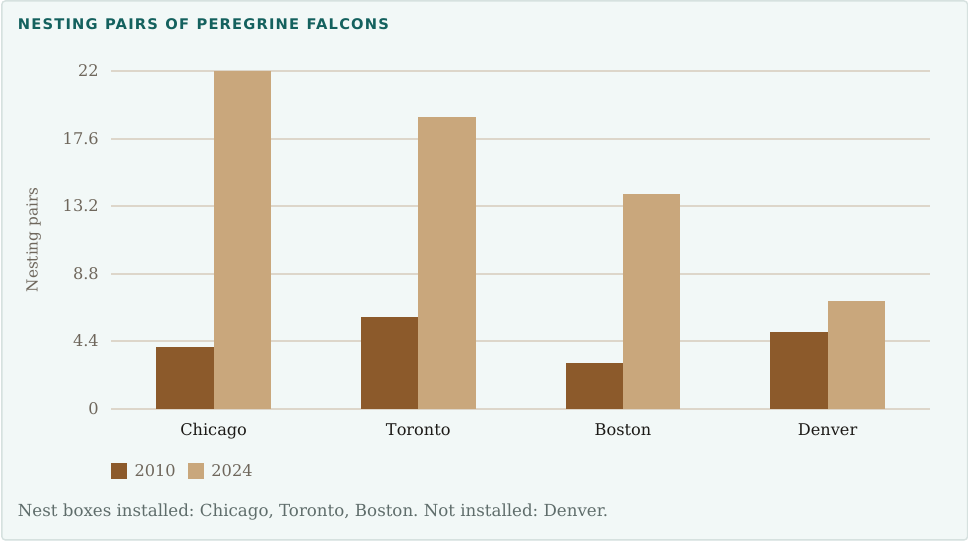
Peregrine falcons nest on cliff ledges, and the ledges of tall buildings will serve them just as well. A biologist argues that urban peregrine populations have recovered further in those cities that mounted nest boxes on their high-rise buildings than in cities that only protected the birds by law. To support this, the biologist notes that among the four cities shown, ______
Which choice most effectively uses data from the table to complete the statement?
A. Denver, which installed no nest boxes, still recorded more nesting pairs in 2010 than Chicago or Boston did.
B. Chicago, which installed nest boxes, grew from four nesting pairs to twenty-two, the largest increase recorded by any single city shown.
C. each of the three cities that installed nest boxes gained more nesting pairs over the period than Denver, which installed none.
D. Boston, which installed nest boxes, had the fewest nesting pairs of any city shown at the start of the period, with three.
Question 14
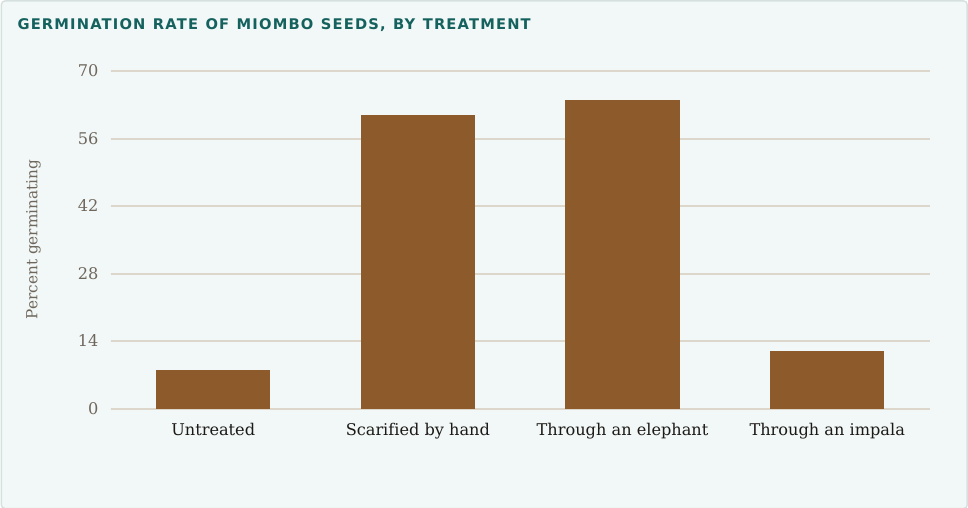
The seeds of the miombo tree have a coat too tough to admit water. A botanist argues that they germinate best after passing through the gut of a large browsing animal, because the long passage abrades the coat in much the way a file would. To support this account, the botanist observes that among the treatments shown, ______
Which choice most effectively uses data from the table to complete the statement?
A. seeds passed through an elephant germinated at sixty-four percent, a rate close to that of seeds abraded by hand.
B. untreated seeds germinated at only eight percent, a rate far below that of every treatment involving passage through the gut of an animal, large or small.
C. seeds passed through an impala germinated at twelve percent, a higher rate than untreated seeds achieved.
D. seeds abraded by hand germinated at sixty-one percent, a rate far above that of the untreated seeds.
Question 15
Tardigrades survive drying out by replacing the water in their cells with a sugar-like glass that holds their proteins motionless. The process reverses, and a rehydrated tardigrade is moving again within minutes. But the glass does not repair damage; it postpones it. In one experiment, breaks accumulated in the DNA at a similar rate across the animals tested, in rough proportion to how long each was dry, and what differed between individuals was how much of that damage they mended once water returned. This suggests that the limit on how long a tardigrade can survive desiccation ______
Which choice most logically completes the text?
A. is set by how quickly it can form the protective glass.
B. is set by how much damage it can repair once water returns.
C. is set by the rate at which breaks accumulate while it is dry.
D. is set by how completely the glass immobilizes its proteins.
Question 16
In an old folk tale, an early aviator is said to have thrown himself from a tower wearing a pair of wings, and to have stayed in the air for some minutes before coming down. The flight is remembered. The landing is remembered better. He had built himself wings but no ______ he broke both legs on the stones below.
Which choice completes the text so that it conforms to the conventions of Standard English?
A. tail;
B. tail,
C. tail
D. tail and
Question 17
Chaulmoogra oil had been used against leprosy for centuries, but it could not be injected: it separated in the blood and blistered the skin. The chemist who solved that problem ______ was twenty-three years old, and she died the following year, before her method could be published under her own name.
Which choice completes the text so that it conforms to the conventions of Standard English?
A. Alice Ball,
B. , Alice Ball,
C. , Alice Ball
D. Alice Ball
Question 18
Fanny Mendelssohn published under her brother’s name for most of her working life, an arrangement that was her father’s idea rather than Felix’s. Decades later, Queen Victoria chose one of these songs as a favorite without knowing who had actually written it. The queen praised the piece she loved ______ praised Felix for having written it, until he corrected her.
Which choice completes the text so that it conforms to the conventions of Standard English?
A. , and
B. ;
C. ,
D. and
Question 19
The waiver a reader signs at the Bibliothèque nationale is not a formality. Curie’s notebooks are still radioactive, and they will remain so for roughly another fifteen hundred years. Consulting them requires protective equipment ______ the library keeps them in a vault it does not advertise.
Which choice completes the text so that it conforms to the conventions of Standard English?
A. , therefore
B. therefore
C. , therefore,
D. ; therefore,
Question 20
Zheng He’s fleet carried more than twenty thousand men on a single voyage, and the ships were provisioned to stay two years at sea. Running an expedition on that scale meant charting the route, victualling the crews, and ______ the diplomatic gifts that were a central purpose of the voyage.
Which choice completes the text so that it conforms to the conventions of Standard English?
A. assembling
B. to assemble
C. the assembly of
D. they assembled
Question 21
Sudan has more pyramids than Egypt does, and almost no one outside the field knows it. The Nubian pyramids at Meroë are steeper and considerably smaller than ______, and there are far more of them than Egypt raised across a comparable span of centuries.
Which choice completes the text so that it conforms to the conventions of Standard English?
A. Egypt
B. Egypt did
C. those in Egypt
D. that of Egypt
Question 22
The galleon went down in 1622 within sight of the Florida coast, and the salvage crews of the 1980s worked the site through four seasons before they gave it up. Among the objects finally brought up from the wreck ______ a set of navigational instruments, a chest of coins, and a small bronze figure that nobody has yet been able to identify.
Which choice completes the text so that it conforms to the conventions of Standard English?
A. was
B. has been
C. is
D. were
Question 23
A bowerbird does not build his bower to live in. He spends weeks arranging berries, beetle wings, and scraps of blue plastic along its walls, and he rearranges them every day. The female visits several bowers, studies them, and only then chooses. ______ a male’s arrangement is judged, and judged closely, before it does him any good at all.
Which choice completes the text with the most logical transition?
A. However,
B. Consequently,
C. Nevertheless,
D. Similarly,
Question 24
A joik is not a song about a person or a place. It is understood, by those who sing it, to be the person or the place: the thing itself, rendered in sound. A joik has no beginning and no proper end, and a singer does not so much perform one as enter it. ______ turning a joik into a song with verses and a chorus is not a translation at all. It is a replacement.
Which choice completes the text with the most logical transition?
A. For example,
B. Nevertheless,
C. Accordingly,
D. By contrast,
Question 25
The caves at Lascaux opened to the public in 1948, and within a decade the paintings had begun to fade. Heat, humidity, carbon dioxide from the breath of visitors, and the microbial growth that followed did in fifteen years what seventeen thousand years of sealed darkness had not. The caves were closed in 1963, and a replica built nearby now receives the visitors the originals cannot. ______ the closure came too late to undo what the first fifteen years had started.
Which choice completes the text with the most logical transition?
A. Consequently,
B. In short,
C. Likewise,
D. Even so,
Question 26
Student’s notes:
Washington Roebling, chief engineer of the Brooklyn Bridge, was disabled by decompression sickness in 1872. His wife, Emily Warren Roebling, then studied cable construction, stress analysis, and catenary curves. For eleven years she carried his instructions to the site and answered the engineers’ technical questions herself. When officials moved to replace him, she defended his role to officials and continued representing him in project matters. The bridge opened in 1883, and she was the first person to cross it.
The student wants to explain the extent of Emily Roebling’s technical role in the project. Which choice most effectively uses relevant information from the notes to accomplish this goal?
A. Emily Warren Roebling was the first person to cross the Brooklyn Bridge when it opened in 1883, eleven years after her husband was disabled.
B. When officials moved to replace her husband as chief engineer of the Brooklyn Bridge, Emily Roebling defended his role to officials, and he was permitted to keep the post.
C. Washington Roebling, the chief engineer of the Brooklyn Bridge, was disabled by decompression sickness in 1872 and never returned to the site.
D. Having studied cable construction, stress analysis, and catenary curves, Emily Roebling carried the instructions to the site for eleven years and answered the engineers’ technical questions herself.
Question 27
Student’s notes:
Nan Madol is a city of nearly one hundred artificial islets off the coast of Pohnpei, built between about 1200 and 1600.
Its walls are made of basalt columns stacked like logs, some of them weighing more than twenty tons.
The basalt was quarried on the far side of the island.
No one has demonstrated how the columns were moved; local tradition holds that they flew.
Archaeologists have proposed rafts, but experiments with rafts have not carried columns of that weight.
The student wants to emphasize what remains unexplained about Nan Madol’s construction. Which choice most effectively uses relevant information from the notes to accomplish this goal?
A. Nan Madol, built off the coast of Pohnpei between about 1200 and 1600, is made up of nearly one hundred artificial islets raised from the reef.
B. The basalt columns of Nan Madol, some weighing more than twenty tons, were quarried on the far side of the island, and no method has yet been demonstrated for moving the heaviest of them.
C. Local tradition on Pohnpei holds that the basalt columns flew to the site under the direction of two brothers who founded the dynasty.
D. Archaeologists have proposed that rafts were used to carry Nan Madol’s basalt columns from the quarry, and trials with rafts have not yet carried stones of that weight.
Module 1: Answers
Every question, with the reasoning behind the right answer and behind each of the three wrong ones. Read the wrong answers even on the ones you got right; a right answer reached for the wrong reason is worth a second look.
Question 1 · WORDS IN CONTEXT
The key decision: Secondary meaning in context
MEANING IN CONTEXT
cut short
CORRECT ANSWER
A. cut short
The sentence names a mechanical failure and a year, and the career stops there. Celebrated is the tempting word, and even an easy item has one. It is true of Coleman and false of the blank.
COMPARE THE OTHER CHOICES
B. enhanced
the exhibitions “drew crowds of thousands,” so a reader skimming for tone finds success on the page
C. prolonged
“five years after it began” supplies a span, and a span invites the idea of duration
D. celebrated
the crowds again; the career was celebrated, which is true and is not what the blank is asking
Question 2 · WORDS IN CONTEXT
The key decision: Secondary meaning in context
MEANING IN CONTEXT
cooperative
CORRECT ANSWER
C. cooperative
The passage describes resources moving toward whoever needs them, with nothing returning. That is an exchange whose terms are not yet understood. Transactional is the answer to watch, because it is nearly right and fails on a single implication.
COMPARE THE OTHER CHOICES
A. accidental
nothing in the passage says the trees intend any of this, so “accidental” feels like the cautious choice
B. hierarchical
“a tree in full sun” giving to “a seedling in deep shade” has the shape of a hierarchy, strong to weak
D. transactional
sugars moving from one party to another reads as an exchange, and “transactional” is the closest wrong answer: an exchange implies something given back, and the dying tree gets nothing
Question 3 · WORDS IN CONTEXT
The key decision: Secondary meaning in context
MEANING IN CONTEXT
predictable
CORRECT ANSWER
B. predictable
The passage sets up a contrast with “accident” and asks what the alternative was. Deliberate is the tempting word. Sailing anyway is deliberate, and the capsizing followed from that decision unintended. Predictable is the only word that names a consequence a known warning already pointed to, one nobody wanted but nobody prevented either.
COMPARE THE OTHER CHOICES
A. unfortunate
“disaster” and a ship on the bottom of the harbor make “unfortunate” true, mild, and useless
C. deliberate
officials chose to sail despite a known warning, so intention is on the page in some form; but nobody intended the ship to sink, and this is the most tempting wrong answer
D. surprising
“in calm water, within sight of the crowd” frames the sinking as a shock, but the passage’s own warning, a stability test that had already shown dangerous listing, means the outcome conflicts with genuine surprise
Question 4 · WORDS IN CONTEXT
The key decision: Secondary meaning in context
MEANING IN CONTEXT
genuine
CORRECT ANSWER
A. genuine
A is correct because Hokusai’s recorded late-life aspiration was to become a “true artist”; genuine best captures that sense of authentic artistic mastery. Prolific is the closest wrong answer because it is true of Hokusai and irrelevant to the sentence.
COMPARE THE OTHER CHOICES
B. famous
“fresh brand” is raised and dismissed in the first sentence, which puts fame in the reader’s mind where the passage rejects it
C. wealthy
a career of thirty names and a friend to write to suggests a working life with a market in it
D. prolific
more than thirty names across a long career implies enormous output, and “prolific” is the fact of him
Question 5 · WORDS IN CONTEXT
The key decision: Secondary meaning in context
MEANING IN CONTEXT
flaw
CORRECT ANSWER
C. flaw
The construction because of X, where X should have harmed it, requires X to be something that should have hurt the pillar and instead saved it. Exposure should have hurt it, but exposure is what the film reacts with rather than what the film is. The passage names the phosphorus an impurity that can make iron brittle. The thing that should have been a defect is the thing that preserved it.
COMPARE THE OTHER CHOICES
A. age
sixteen hundred years is the most striking number on the page, and age is the obvious thing a monument endures despite
B. exposure
“stood in the open” opens the passage and exposure is what should have destroyed it, which makes the not-despite-but-because construction fit perfectly
D. design
the passage is about how the pillar was made, and “design” is what one usually credits when a made thing lasts
Question 6 · TEXT STRUCTURE & PURPOSE
The key decision: Content and function
CORRECT ANSWER
B. To present a case in which an undercover account produced a concrete institutional change.
Purpose is not subject matter. The conditions are what the passage contains; the point is what happened because of them. A is the answer that mistakes the largest part for the whole.
COMPARE THE OTHER CHOICES
A. To describe the conditions Bly encountered during her ten days on Blackwell’s Island.
the conditions occupy the longest sentence in the passage, and a reader summarizing by volume will choose them
C. To argue that feigning insanity is a legitimate method of investigation for a reporter.
the feigning is the first thing the passage reports, and it is the most arresting detail
D. To explain how grand juries respond when newspapers publish reports of institutional abuse.
the grand jury and the budget are the last two sentences, so they are most recent in mind
Question 7 · TEXT STRUCTURE & PURPOSE
The key decision: Content and function
CORRECT ANSWER
C. It records the hostility Schwendener’s proposal met, against which the passage then measures his vindication.
A function answer names a job rather than a topic. The contempt sets up the next sentence, Schwendener was right, which then has something to land against. Remove it and the vindication has no weight. A is the standard error on this skill: it describes what the sentence says instead of what it does.
COMPARE THE OTHER CHOICES
A. It offers an example of the vocabulary that nineteenth-century botanists used when they wished to dismiss a colleague’s work without engaging with its substance.
“a romance” is a quoted word, and a quoted word draws attention to the language rather than to the argument
B. It explains why lichens had been classified as plants in the first place.
the misclassification is the passage’s opening fact, and the underlined sentence sits close enough to feel like its explanation
D. It anticipates the discovery of the third partner described in the final sentence.
the yeast is the passage’s parting surprise, and the underlined sentence is about being wrong, which is what the yeast proves everyone still was
Question 8 · CROSS-TEXT CONNECTIONS
The key decision: Direction of agreement or disagreement
CORRECT ANSWER
D. By accepting that prices rose and fell sharply while denying that the losses reached beyond a small circle.
Text 2 leaves the prices alone and attacks the casualties. The archives turn up few ruined fortunes and almost no bankruptcies, and the trade ran through a circle small enough to absorb the fall. That is a denial of the reach of the episode rather than of the collapse.
COMPARE THE OTHER CHOICES
A. By agreeing, and adding that the moralizing pamphlets of the period confirm how widespread the ruin was.
the pamphlets are in Text 2, where they explain why the false version survived rather than confirming it
B. By agreeing in part, while noting that bulb prices never collapsed at all in the way Text 1 describes.
the natural shape of a rebuttal is to deny the whole story, and Text 2 never disputes that prices fell
C. By arguing that speculative bubbles occur far more often than Text 1 is willing to acknowledge.
it sounds like the sort of claim a revisionist historian makes, and Text 2 makes no claim at all about how often bubbles occur
Question 9 · CENTRAL IDEAS & DETAILS
The key decision: Whole-passage main point
CORRECT ANSWER
C. The chinampas achieved extraordinary productivity through a design that appears primitive.
The wrong answers are true and are stated in the text. The last sentence is the one making a claim; the rest is the evidence for it. D collects two of those details at once and still misses the point.
COMPARE THE OTHER CHOICES
A. The chinampas were raised from lake mud and anchored with willow trees.
the passage’s opening clause, and the most concrete thing in it
B. The chinampas were kept fertile by silt that farmers dredged from the lake bed each spring.
one mechanism from the passage, standing in for the whole system it supports
D. Farmers in the Valley of Mexico dredged fresh silt from the lake bed onto their fields each spring to keep the soil fertile.
the same mechanism as B, restated with more of the sentence wrapped around it
Question 10 · CENTRAL IDEAS & DETAILS
The key decision: Whole-passage main point
According to the text, what happened to the price of gold in Cairo during Mansa Musa’s return journey?
CORRECT ANSWER
A. It rose.
The passage runs a price down and then back up, and the question asks about the second move. D shows how the tempting answer is built. It names the right event, the borrowing, and reverses its effect. Borrowing gold back out of a market raises its price.
COMPARE THE OTHER CHOICES
B. It fell, and chroniclers say it took years to recover.
the passage’s most memorable fact, and the one a reader carries forward; it belongs to the outbound journey rather than the return
C. It stayed as it had been since his arrival.
“took years to recover” still describes persistence, which can read as stability if you stop reading there
D. It fell again as he borrowed from local lenders.
the borrowing is correctly attached to the return, and the direction is wrong; this is the most tempting wrong answer
Question 11 · COMMAND OF EVIDENCE
The key decision: Evidence that directly addresses the claim
Which finding, if true, would most directly support the linguist’s claim?
CORRECT ANSWER
B. Surviving Lingua Ignota words appear almost exclusively as substitutions inside the sung portions of Hildegard’s liturgical texts.
The claim is about use, so the evidence has to be about use. B is the only choice that puts the words somewhere: inside the sung lines. A describes the language; the claim is not about what it looked like.
COMPARE THE OTHER CHOICES
A. The Lingua Ignota is written in an alphabet of twenty-three invented letters, several of them plainly adapted from the Latin forms Hildegard used every day.
an invented alphabet is the most exotic fact available and feels like the strongest evidence that something unusual was intended
C. Hildegard corresponded in ordinary Latin with popes and emperors throughout her life.
true, relevant to Hildegard, and it establishes only that she had a language for speech already, which is not the claim
D. Several other medieval writers are known to have invented private vocabularies.
it makes the invention less strange, which a reader may mistake for making the argument stronger
Question 12 · COMMAND OF EVIDENCE
The key decision: Quotation evidence for the claim
Which quotation from “The Ledger” most effectively illustrates the claim?
CORRECT ANSWER
A. “The letter lay open on the table between them for the length of the meal. He asked her twice about the weather.”
The claim needs two things in one quotation: something the narrator puts in plain view, and a character who steps around it. D supplies the first and not the second. C supplies an absence of understanding rather than an avoidance. Only A has the letter open on the table and a man asking about the weather.
COMPARE THE OTHER CHOICES
B. “He told her plainly that he had never wanted the house, and that he had said so from the beginning, and that she had not once listened.”
the claim is about characters revealing themselves, and B is the only quotation in which a character says what he means; it illustrates the method the claim rules out
C. “She thought about the house constantly that winter, and could not have said why.”
an inner life the character cannot account for, which sounds like something unnoticed; but the not-noticing here is of her own motive rather than of a thing sitting in the room
D. “Everything in the room was as he remembered it: the clock, the chair, the long window.”
the narrator registering detail is half the claim, and D does it beautifully; nothing in it is being walked past, because nothing is asking to be noticed
Question 13 · COMMAND OF EVIDENCE
The key decision: Level versus change
CORRECT ANSWER
C. each of the three cities that installed nest boxes gained more nesting pairs over the period than Denver, which installed none.
The claim compares cities that mounted nest boxes with cities that only protected the birds by law, so the evidence has to compare them too. One choice reports every nest-box city against the city without boxes. The others report one city, and a single city cannot separate the boxes from everything else about that city.
COMPARE THE OTHER CHOICES
A. Denver, which installed no nest boxes, still recorded more nesting pairs in 2010 than Chicago or Boston did.
true, accurately read, and a comparison of levels in the first year rather than of change over time
B. Chicago, which installed nest boxes, grew from four nesting pairs to twenty-two, the largest increase recorded by any single city shown.
the largest increase in the table, correctly read, and about a nest-box city; one city on its own cannot show what the boxes did, because nothing is held against it
D. Boston, which installed nest boxes, had the fewest nesting pairs of any city shown at the start of the period, with three.
true, and a level at the start of the period, which says nothing about what happened afterwards
Question 14 · COMMAND OF EVIDENCE
The key decision: Evidence that distinguishes explanations
CORRECT ANSWER
A. seeds passed through an elephant germinated at sixty-four percent, a rate close to that of seeds abraded by hand.
The claim has two halves: that a large animal works, and that it works because it abrades. Only A joins them, by setting the elephant beside the hand file and showing the two produce the same result. D holds one end of the comparison and never reaches for the other.
COMPARE THE OTHER CHOICES
B. untreated seeds germinated at only eight percent, a rate far below that of every treatment involving passage through the gut of an animal, large or small.
B shows that untreated seeds germinated less often than seeds that passed through animal guts, but it does not test the botanist’s specific abrasion mechanism or distinguish large-animal passage from other gut effects
C. seeds passed through an impala germinated at twelve percent, a higher rate than untreated seeds achieved.
true, and it is about gut passage, which is the claim’s subject; a four-point rise in a small animal is the result the claim does not need
D. seeds abraded by hand germinated at sixty-one percent, a rate far above that of the untreated seeds.
true, and it names the comparison the claim depends on without making it
Question 15 · INFERENCES
The key decision: The comparison group
CORRECT ANSWER
B. is set by how much damage it can repair once water returns.
The passage separates what accumulates while the animal is dry from what happens after water comes back, and it states that the rate of accumulation was similar across the conditions tested. What varies is the mending, so the ceiling is set by how much harm an animal can undo.
COMPARE THE OTHER CHOICES
A. is set by how quickly it can form the protective glass.
the glass is the mechanism the passage spends its first two sentences on, so speed of glass formation feels like the variable in play
C. is set by the rate at which breaks accumulate while it is dry.
the last fact before the blank concerns accumulation, and it is the natural thing to reach for; the passage has just said that this rate was similar across the conditions tested
D. is set by how completely the glass immobilizes its proteins.
immobilization is what the glass does, and doing it more completely sounds like doing it better
Question 16 · BOUNDARIES
The key decision: Clause boundaries
RULE TO APPLY
CORRECT ANSWER
A. tail;
Two complete sentences meet at the blank: he had built wings but no tail, and he broke both legs. Only a mark that can join sentences will do, and among these four only the semicolon can.
COMPARE THE OTHER CHOICES
B. tail,
a bare comma between two statements that plainly belong together
C. tail
nothing at all, which produces a run-on that the sentence’s brisk rhythm conceals
D. tail and
“and” without a comma joins two complete sentences, which it cannot do alone
Question 17 · BOUNDARIES
The key decision: Paired punctuation
RULE TO APPLY
Supplementary material takes a mark at each end.
CORRECT ANSWER
B. , Alice Ball,
The clause who solved that problem has already picked out one person, so her name adds information rather than identifying her. Information of that kind is set off on both sides. One comma is never enough.
COMPARE THE OTHER CHOICES
A. Alice Ball,
the closing comma alone, which looks complete because a comma is visible
C. , Alice Ball
the opening comma alone, which is the mirror error and just as invisible to the ear
D. Alice Ball
no commas at all, which reads as though the name were needed to identify her; it is not, because “the chemist who solved that problem” has already done that
Question 18 · BOUNDARIES
The key decision: Compound predicate
RULE TO APPLY
One subject, two verbs, no comma.
CORRECT ANSWER
D. and
This is a compound predicate rather than a compound sentence. One subject, the reviews, governs both verbs: praised and praised. There is no second subject anywhere, so there is no second clause, so nothing needs joining. Find the subject of the words after the blank. If there is not one, no comma and no semicolon belongs.
COMPARE THE OTHER CHOICES
A. , and
the first half runs long enough to feel like a complete sentence, and a comma before “and” is the default whenever one does; this is the most tempting wrong answer
B. ;
a semicolon feels safe because the sentence feels like two sentences
C. ,
a bare comma between what look like two statements about the reviews
Question 19 · BOUNDARIES
The key decision: Clause boundaries
RULE TO APPLY
However, therefore, moreover.
CORRECT ANSWER
D. ; therefore,
Two complete sentences meet at the blank, so they need a mark that can join sentences. Therefore is an interrupter rather than a joining word: it explains the relationship without carrying the grammatical weight. Only seven words can join two sentences with a comma, and therefore is not among them. The semicolon does the joining; the comma after it sets off the interrupter.
COMPARE THE OTHER CHOICES
A. , therefore
a comma before a connecting word is the shape most sentences take, and “therefore” is doing the work of a connector here
B. therefore
no mark at all, which produces a run-on that the logical flow of the sentence conceals
C. , therefore,
the disguise, and the most tempting wrong answer: setting “therefore” off with a comma on each side looks like careful punctuation, and it is, but it does not join anything
Question 20 · FORM, STRUCTURE, AND SENSE
The key decision: Parallel structure
RULE TO APPLY
Items in a list take the same form.
CORRECT ANSWER
A. assembling
The three items in the series have to match: charting, victualling, assembling. Parallelism is decided by the first two items in the list rather than by whatever sounds smoothest at the end.
COMPARE THE OTHER CHOICES
B. to assemble
an infinitive reads as purposeful and is the form a writer reaches for when listing tasks
C. the assembly of
a noun phrase matches “the route” and “the crews” in shape, which is a false echo of parallelism
D. they assembled
a full clause, which sounds like a natural way to finish a long sentence out loud
Question 21 · FORM, STRUCTURE, AND SENSE
The key decision: Like-with-like comparison
RULE TO APPLY
Compare like with like.
CORRECT ANSWER
C. those in Egypt
A comparison has to hold the same kind of thing on each side. The Nubian pyramids are being compared with Egyptian pyramids rather than with Egypt itself, and the plural those carries the noun across.
COMPARE THE OTHER CHOICES
A. Egypt
the country stands in for its pyramids, which is how the comparison is spoken aloud and not how it is written
B. Egypt did
a verb where the comparison needs a noun, and nothing in the sentence is being compared with an action
D. that of Egypt
singular, and the pyramids on the other side of the comparison are plural
Question 22 · FORM, STRUCTURE, AND SENSE
The key decision: Inverted subject-verb agreement
RULE TO APPLY
Inverted sentences: the subject comes after the verb.
CORRECT ANSWER
D. were
The sentence is inverted: the subject comes after the verb. The postverbal subject is a three-part compound: a set of instruments, a chest of coins, and a bronze figure. The compound subject is plural, so were is required. The difficulty is entirely in the inversion, which puts a singular noun where the ear expects the subject.
COMPARE THE OTHER CHOICES
A. was
the noun sitting closest to the blank is “a set,” which is singular, and the ear agrees with whatever it heard last; this is the most tempting wrong answer
B. has been
singular and present-perfect, splitting the difference between A and C
C. is
present tense, which the museum framing of the sentence quietly invites
Question 23 · TRANSITIONS
The key decision: Result versus contrast
CORRECT ANSWER
B. Consequently,
The female inspects and chooses; therefore the arrangement is judged. The blank is a result rather than a turn. The contrast in this paragraph was settled in its first sentence.
COMPARE THE OTHER CHOICES
A. However,
the passage opens by denying something (“not to live in”), which leaves a contrast hanging in the air
C. Nevertheless,
the same misread as A, in a more emphatic register
D. Similarly,
the middle sentences are parallel in construction, which primes a marker of likeness
Question 24 · TRANSITIONS
The key decision: Consequence versus contrast
CORRECT ANSWER
C. Accordingly,
What follows the blank is the consequence of what precedes it: if a joik is the thing itself and has no fixed shape, then reshaping it destroys it. D is the strongest pull, because there is a real contrast nearby, and it sits on the wrong side of the blank.
COMPARE THE OTHER CHOICES
A. For example,
the final sentences are concrete and the ones before them are abstract, which is the shape an example takes
B. Nevertheless,
the passage is built on a series of denials, and a reader carrying that rhythm forward reaches for a concessive
D. By contrast,
a contrast is being drawn, but it is drawn between the joik and the verse-song inside the last sentence rather than across the blank
Question 25 · TRANSITIONS
The key decision: The final transition relationship
CORRECT ANSWER
D. Even so,
The last sentence concedes something against the two remedies just described: they were done, and they were not enough. That is concession rather than consequence and not summary. In short would be right if the sentence restated the paragraph; instead it qualifies it.
COMPARE THE OTHER CHOICES
A. Consequently,
the paragraph is a chain of consequences, and the reader is by now expecting another link
B. In short,
the final sentence has the cadence of a summary, and three sentences of narrative have just ended; “in short” is the most tempting wrong answer here
C. Likewise,
the closure and the replica are two remedies in sequence, which primes a marker of addition
Question 26 · RHETORICAL SYNTHESIS
The key decision: Goal fit
The student wants to explain the extent of Emily Roebling’s technical role in the project. Which choice most effectively uses relevant information from the notes to accomplish this goal?
CORRECT ANSWER
D. Having studied cable construction, stress analysis, and catenary curves, Emily Roebling carried the instructions to the site for eleven years and answered the engineers’ technical questions herself.
The goal names a technical role, so the answer has to contain technical work. One choice names what she studied and what she did with it. The others are true, and they describe a meeting, a ceremony, and her husband’s illness.
COMPARE THE OTHER CHOICES
A. Emily Warren Roebling was the first person to cross the Brooklyn Bridge when it opened in 1883, eleven years after her husband was disabled.
the most quotable fact in the notes, and the one everyone remembers; crossing a bridge first is an honor rather than a technical role
B. When officials moved to replace her husband as chief engineer of the Brooklyn Bridge, Emily Roebling defended his role to officials, and he was permitted to keep the post.
about Emily, and about the bridge, and it describes an act of advocacy rather than of engineering; this is the closest wrong answer
C. Washington Roebling, the chief engineer of the Brooklyn Bridge, was disabled by decompression sickness in 1872 and never returned to the site.
true, and it is about the wrong Roebling
Question 27 · RHETORICAL SYNTHESIS
The key decision: Goal fit
The student wants to emphasize what remains unexplained about Nan Madol’s construction. Which choice most effectively uses relevant information from the notes to accomplish this goal?
CORRECT ANSWER
B. The basalt columns of Nan Madol, some weighing more than twenty tons, were quarried on the far side of the island, and no method has yet been demonstrated for moving the heaviest of them.
The goal asks for what is unexplained, which requires naming both the difficulty and the failure of every answer to it. D is the tempting answer. It identifies one proposed method and its failed trials, but it does not state the broader unresolved point as directly as B: no demonstrated method explains transport of the heaviest columns.
COMPARE THE OTHER CHOICES
A. Nan Madol, developed principally from about 1200 to 1500 CE off the coast of Pohnpei, is made up of nearly one hundred artificial islets raised from the reef.
accurate, complete, and it describes the city instead of the problem
C. Local tradition on Pohnpei holds that the basalt columns flew to the site.
the strangest sentence available, and strangeness reads as mystery; it reports a tradition rather than a gap in the evidence
D. Archaeologists have proposed that rafts were used to carry Nan Madol’s basalt columns from the quarry, and trials with rafts have not yet carried stones of that weight.
it is about construction, it uses the notes, and it stops one clause short: it gives the proposal and names one proposed method, where the goal asks for the transport problem as a whole, which is where the mystery lives