Circles: equation, circumference, area, and arcs
A circle centered at with radius has the equation . Two habits prevent most errors. First, the signs inside the parentheses are opposite to the center: is centered at . Second, the right side is , so the radius is its square root: here , not .
The key measurements of a circle of radius are:
- circumference:
- area:
- arc length: the circumference times the fraction of the circle the central angle represents,
A frequent error is to mix up the circumference and area formulas, or to leave the radius unsquared. Remember that circumference is a length (units, no square) and area is a surface (square units).
Worked example: arc length
A circle has radius , shown below. Find the length of an arc with a central angle of .
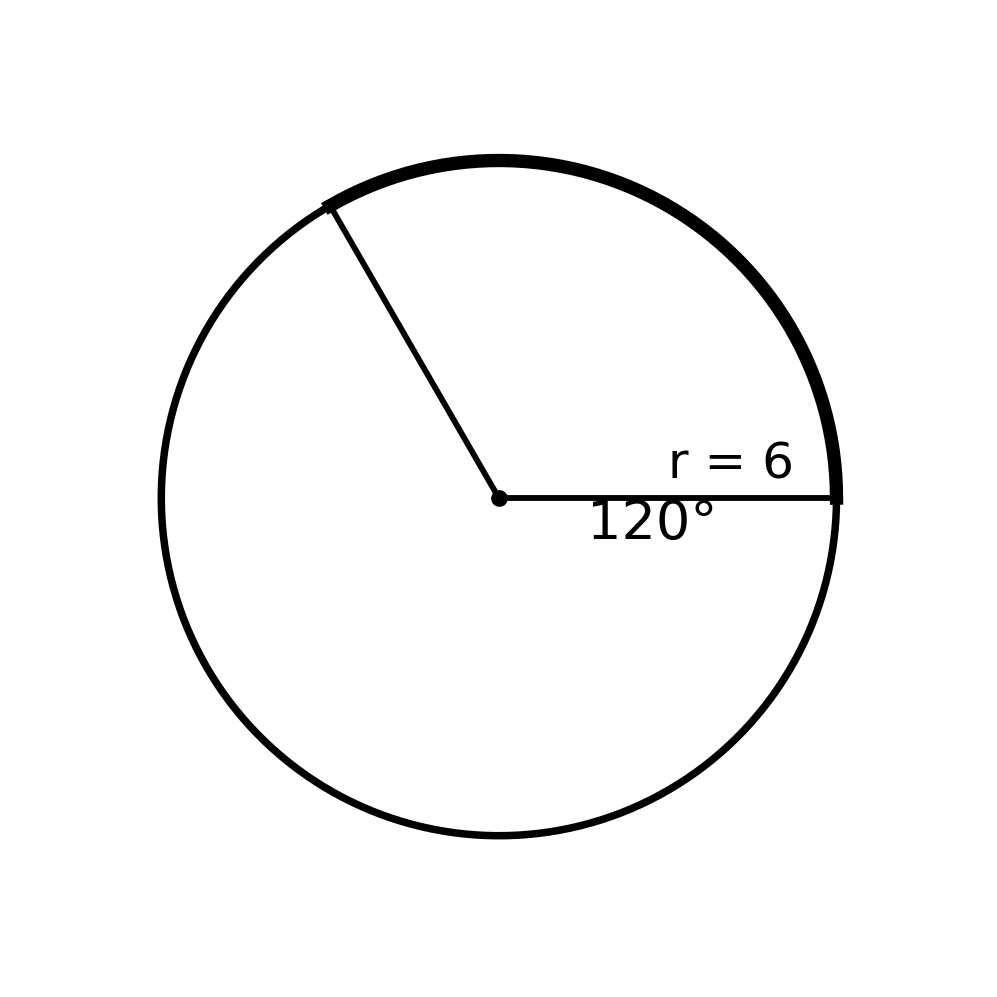
Convert the angle to a fraction of the full circle, then multiply by the circumference. is of the circle, so
Arc length .
In radians the same arc is . Either way works; choose the one that gives cleaner arithmetic. Fractions of the circle to know: , , .
Completing the square to find center and radius
When a circle is given in expanded form, complete the square on the -terms and the -terms separately. Move the constant to the right side, add the same squares to both sides, and read off the center and radius.
Worked example: center and radius
Find the center and radius of .
Group the terms: . Half of is , whose square is . Half of is , whose square is . Add and to both sides:
The center is and the radius is . The most common slips are forgetting to add the new squares to the right side, and reporting as the radius.
Tangent lines
A tangent line touches a circle at exactly one point, and it is always perpendicular to the radius drawn to that point. This single fact answers most tangent questions without needing the tangent line's equation at all. The angle between the radius and the tangent is , whatever the size of the circle. To find the slope of a tangent line, find the slope of the radius to the point of tangency and take the negative reciprocal.
Ellipses
An ellipse centered at the origin has the standard form , with the two squared terms added. The numbers and come from taking the square root of the denominators, not the denominators themselves. The larger denominator sits under the variable along which the major axis runs: for , the larger denominator is under , so the major axis is vertical.
The foci lie along the major axis, a distance from the center, where (using the larger denominator as ). To write an equation from a description, work backward: a horizontal major axis of length means and goes under ; a minor axis of length means and goes under . The equation is .
Worked example: the foci of an ellipse
Find the foci of the ellipse .
Recognize. This is a standard-form ellipse with and . Since , the major axis lies along the -axis. The foci satisfy .
Set up and solve. , so . The foci are and .
Check. is less than , as required: the foci must lie inside the ellipse along its major axis.
Common error. Using , the hyperbola relationship, instead of for an ellipse.
Hyperbolas
A hyperbola centered at the origin has the form , with the two squared terms subtracted. Here and again come from square roots of the denominators. A vertical hyperbola has the form . The variable with the positive squared term identifies the direction of the transverse axis: positive gives a horizontal hyperbola, and positive gives a vertical one.
The foci of a hyperbola satisfy . For , , so and the foci are .
| Conic | Standard form (centered at the origin) | Foci relationship |
|---|---|---|
| Circle | center only | |
| Ellipse | (plus sign) | |
| Hyperbola | (minus sign) |
Identifying a conic is the first step, not the last. If an equation is not in standard form, rearrange it first. For example, becomes after dividing by , an ellipse. Likewise becomes , a hyperbola. A circle is the special case in which the and coefficients are equal and positive.
Parabolas in vertex form
A parabola written has vertex . Because of the minus sign, has , so the vertex is . From standard form , the vertex has . For , and , so the vertex is .
Where this appears as a model
A circular region described in context is a circle problem once you identify the radius. A sprinkler that reaches feet in every direction waters an area of square feet. Watch for diameters (halve to get the radius) and for questions asking for a distance around (circumference) rather than a region (area).
Strategy checklist
- Identify the conic first from the signs and coefficients of the squared terms.
- For circles, reverse the signs inside the parentheses for the center, and take a square root of the right side for the radius.
- For expanded circle equations, complete the square on both variables and add each new square to both sides.
- For ellipses and hyperbolas, take square roots of the denominators to get and , then use (ellipse) or (hyperbola).
- For tangents, use the perpendicular radius.
- For arcs, find the fraction of the circle first, then multiply by .