ACT Math study guide · Chapter 23
Circles and Conic Sections
A circle centered at (h, k) with radius r has the equation (x − h)² + (y − k)² = r². When an equation is given in expanded form instead, completing the square on both the x-terms and y-terms recovers the center-radius form. The circumference is 2πr, the area is πr², and an arc's length is the circle's circumference multiplied by the fraction of the circle the central angle represents.
An ellipse and a hyperbola both follow a standard form built from a² and b². An ellipse, x²/a² + y²/b² = 1, has its two squared terms added. A hyperbola, x²/a² − y²/b² = 1, has its two squared terms subtracted. In both forms, a and b come from taking the square root of the denominators, not the denominators themselves.
A tangent line touches a circle at exactly one point, and it is always perpendicular to the radius drawn to that point. This single fact answers most tangent-line questions directly, without needing the tangent line's equation at all.
Where this appears as a model: a circular region described in context. A sprinkler that reaches 8 feet in every direction waters an area of about 201 square feet, found from πr² once the reach is recognized as the radius.
▸ Arc length
Worked Example A circle has radius 6, shown below. Find the length of an arc with a central angle of 120°.
Convert the angle to a fraction of the full circle, then multiply by the circumference.
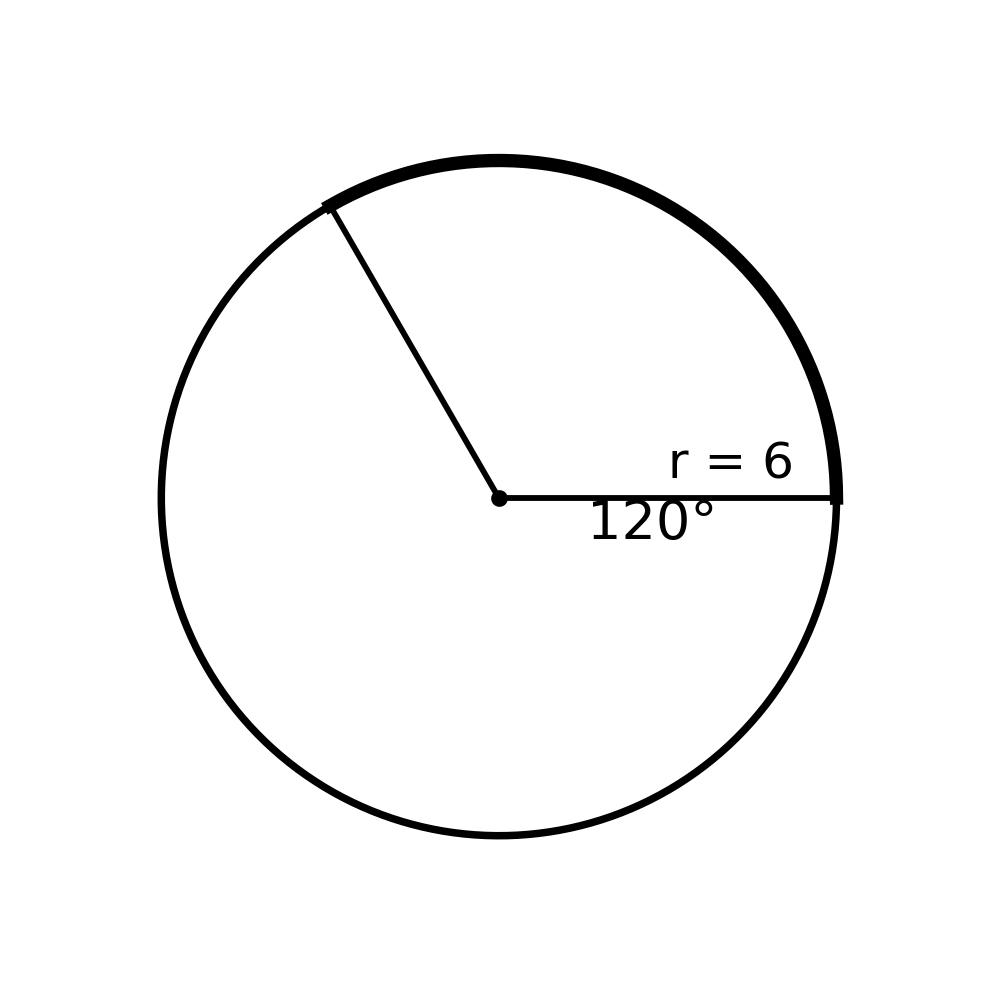
120° is 120/360 = 1/3 of the circle
Arc length = (1/3)(2π)(6) = 4π
▸ Center and radius by completing the square
Worked Example Find the center and radius of x² + y² − 6x + 4y − 3 = 0.
Complete the square separately on the x-terms and the y-terms.
(x² − 6x) + (y² + 4y) = 3
(x − 3)² − 9 + (y + 2)² − 4 = 3
(x − 3)² + (y + 2)² = 16
Center (3, −2), radius 4
Worked Example Find the foci of the ellipse x²/25 + y²/9 = 1.
Recognize. This is a standard-form ellipse with a² = 25 and b² = 9, and a² > b², so the major axis lies along the x-axis. The foci satisfy c² = a² − b².
Set up.
c² = 25 − 9 = 16
Solve.
c = 4
Foci: (4, 0) and (−4, 0)
Check. c = 4 is less than a = 5, which is required since the foci must lie inside the ellipse along its major axis.
Best route. Hand computation. Desmos can graph the ellipse to visually confirm the foci's approximate location, but it does not compute c automatically.
Common error. Using c² = a² + b², the hyperbola relationship, instead of c² = a² − b² for an ellipse.
▸ Practice
Question 1
- A. (−4, 1), r = 3
- B. (4, −1), r = 3
- C. (−4, 1), r = 9
- D. (4, −1), r = 9
Question 2
- F. 6π
- G. 9π/2
- H. 3π
- J. 12π
Question 3
- A. 25π
- B. 5π
- C. 2.5π
- D. 10π
Question 4
- F. Circle
- G. Parabola
- H. Ellipse
- J. Hyperbola
Question 5
- A. (−2, 7)
- B. (2, 7)
- C. (2, −7)
- D. (−2, −7)
Question 6
- F. 45°
- G. 60°
- H. It depends on the circle's radius
- J. 90°
Question 7
- A. center (−4, 1), r = 7
- B. center (4, −1), r = 49
- C. center (4, −1), r = 7
- D. center (−4, −1), r = 7
Question 8
- F. 22π
- G. 11π
- H. 44π
- J. 121π
Question 9
- A. 9π
- B. 81π
- C. 18π
- D. 162π
Question 10
- F. 3π
- G. 8π
- H. 12π
- J. 24π
Question 11
- A. a = 3, b = 4
- B. a = 4, b = 3
- C. a = 16, b = 9
- D. a = 9, b = 16
Question 12
- F. 36
- G. 42
- H. √42
- J. 6
Question 13
- A. (−3, 2)
- B. (3, −2)
- C. (3, 2)
- D. (−3, −2)
Question 14
- F. a = 4, b = 5
- G. a = 5, b = 4
- H. a = 25, b = 16
- J. a = 16, b = 25
Question 15
- A. center (6, −3), r = 8
- B. center (−6, 3), r = 64
- C. center (6, 3), r = 8
- D. center (−6, 3), r = 8
Question 16
- F. 15π
- G. 30π
- H. 60π
- J. 225π
Question 17
- A. 36π
- B. 6π
- C. 12π
- D. 18π
Question 18
- F. 5π
- G. 10π
- H. 2.5π
- J. 20π
Question 19
- A. a = 4, b = 7
- B. a = 7, b = 4
- C. a = 49, b = 16
- D. a = 16, b = 49
Question 20
- F. a = 3, b = 5
- G. a = 5, b = 3
- H. a = 9, b = 25
- J. a = 25, b = 9
▸ Answers and Explanations
Show the answers and explanations
1: A. Completing the square: (x+4)²+(y−1)²=8+16+1=9, so the radius is 3. Choice B reverses the sign of both center coordinates.
2: H. 90° = π/2 radians; arc length = 6 × π/2 = 3π. Choice F doubles the correct arc length, a result of using the full radian equivalent of 180° instead of 90°.
3: D. Circumference = 2πr = 2π(5) = 10π. Choice A applies the area formula (πr²) instead of the circumference formula (2πr).
4: H. Both terms are added and have different denominators when written in standard form, matching the pattern of an ellipse. Choice F mistakes the equation for a circle, overlooking that the coefficients of x² and y² are different, which requires an ellipse instead.
5: A. Vertex form y = a(x − h)² + k gives vertex (h, k); here h = −2 (from x + 2 = x − (−2)) and k = 7. Choice B drops the negative sign on the x-coordinate of the vertex.
6: J. A tangent line is always perpendicular to the radius at the point of tangency. Choice F reports an unrelated standard angle instead of applying the tangent-radius perpendicularity property.
7: C. The equation is already in center-radius form: center (4, −1), radius √49=7. Choice A reverses the sign of both center coordinates.
8: F. 2πr=2π(11)=22π. Choice G omits the factor of 2 in the circumference formula, using πr instead of 2πr.
9: B. πr²=π(9)²=81π. Choice F omits the squaring in the area formula, using πr instead of πr².
10: G. 120°=2π/3 radians; arc length=12×2π/3=8π. Choice F comes from using an incorrect fraction of the circle's circumference for this central angle.
11: B. In standard form x²/a²+y²/b²=1, a²=16 gives a=4, and b²=9 gives b=3. Choice A swaps which denominator corresponds to a and which to b.
12: J. Completing the square: (x−2)²+(y+5)²=7+4+25=36, so the radius is √36=6. Choice F reports r² instead of taking the square root to find r.
13: C. x=−(−6)/2(1)=3; y=3²−6(3)+11=9−18+11=2. Choice A mishandles the double negative in the vertex x-formula, computing x=−3 instead of x=3.
14: G. In standard form x²/a²−y²/b²=1, a²=25 gives a=5, and b²=16 gives b=4. Choice F swaps which denominator corresponds to a and which to b.
15: D. The equation is already in center-radius form: center (−6, 3), radius √64=8. Choice F reverses the sign of both center coordinates.
16: G. 2πr=2π(15)=30π. Choice F omits the factor of 2 in the circumference formula, using πr instead of 2πr.
17: A. πr²=π(6)²=36π. Choice B omits the squaring in the area formula, using πr instead of πr².
18: F. 45°=π/4 radians; arc length=20×π/4=5π. Choice G doubles the correct arc length, a result of using the full radian equivalent of 90° instead of 45°.
19: B. In standard form x²/a²+y²/b²=1, a²=49 gives a=7, and b²=16 gives b=4. Choice F swaps which denominator corresponds to a and which to b.
20: F. In standard form x²/a²−y²/b²=1, a²=9 gives a=3, and b²=25 gives b=5. Choice G swaps which denominator corresponds to a and which to b.
Identifying a conic's type is the first step, not the last. A complete treatment also includes locating the foci, determining orientation directly from the equation's coefficients, and writing an equation from a description instead of only reading one.
A vertical hyperbola centered at the origin has the form y²/a² − x²/b² = 1. For a hyperbola, the variable with the positive squared term identifies the direction of the transverse axis: positive x² gives a horizontal hyperbola, and positive y² gives a vertical hyperbola.
Question 1
- A. (±6,0)
- B. (±8,0)
- C. (±10,0)
- D. (±64,0)
Question 2
- F. (±3,0)
- G. (±4,0)
- H. (±5,0)
- J. (±7,0)
Question 3
- A. Horizontal, since 4<25
- B. Vertical, since 25>4
- C. Horizontal, since the x² term is listed first
- D. Cannot be determined without a graph
Question 4
- F. x²/9+y²/25=1
- G. x²/25+y²/9=1
- H. x²/100+y²/36=1
- J. x²/5+y²/3=1
Question 5
- A. Ellipse
- B. Circle
- C. Hyperbola
- D. Parabola
Show the answers and explanations
1: B. For an ellipse, c²=a²−b²=100−36=64, so c=8, giving foci at (±8,0). Choice A reports b=6 directly instead of solving for c; Choice C reports a=10 directly; Choice D reports c²=64 without taking the square root.
2: H. For a hyperbola, c²=a²+b²=16+9=25, so c=5, giving foci at (±5,0). Choice G uses c²=a²−b² instead, the ellipse relationship, giving the wrong value of 4.
3: B. The major axis lies along whichever variable has the larger denominator. Since 25>4 and 25 sits under y², the major axis is vertical. Choice A compares the denominators but reverses which one indicates the major axis direction.
4: G. A horizontal major axis of length 10 means a=5, so a²=25 belongs under x²; a minor axis of length 6 means b=3, so b²=9 belongs under y², giving x²/25+y²/9=1. Choice F places the larger denominator under y² instead, which would describe a vertical major axis.
5: C. Dividing both sides by 36 gives x²/4−y²/9=1. A minus sign between the two squared terms, with both variables present, is the defining feature of a hyperbola. Choice A selects the conic that would result if the sign between the terms were positive instead of negative.