ACT Math study guide · Chapter 22
Right Triangles and Trigonometry
The Pythagorean theorem, a² + b² = c², relates the two legs of a right triangle to its hypotenuse, the side opposite the right angle. Sine, cosine, and tangent relate an acute angle to the ratio of two sides: sine is opposite over hypotenuse, cosine is adjacent over hypotenuse, and tangent is opposite over adjacent.
Two special right triangles come up repeatedly: 45-45-90 and 30-60-90. In a 45-45-90 triangle, the legs are equal, and the hypotenuse is a leg times √2. In a 30-60-90 triangle, the hypotenuse is twice the short leg, and the long leg is the short leg times √3.
The unit circle assigns a point (cosθ, sinθ) to every angle θ. At the four axis angles, the coordinates are exact: (1, 0) at 0°, (0, 1) at 90°, (−1, 0) at 180°, and (0, −1) at 270°. The standard angles 30°, 45°, and 60° also produce exact values worth knowing directly, without a calculator.
Where this appears as a model: a real object with only some measurements given. A 13-foot ladder leaning against a wall with its base 5 feet from the wall reaches a height of 12 feet, found using the Pythagorean theorem once the ladder, wall, and ground are recognized as a right triangle.
▸ The Pythagorean theorem
Worked Example A right triangle has legs of 5 and 12, shown below. Find the hypotenuse.
Apply the Pythagorean theorem directly.
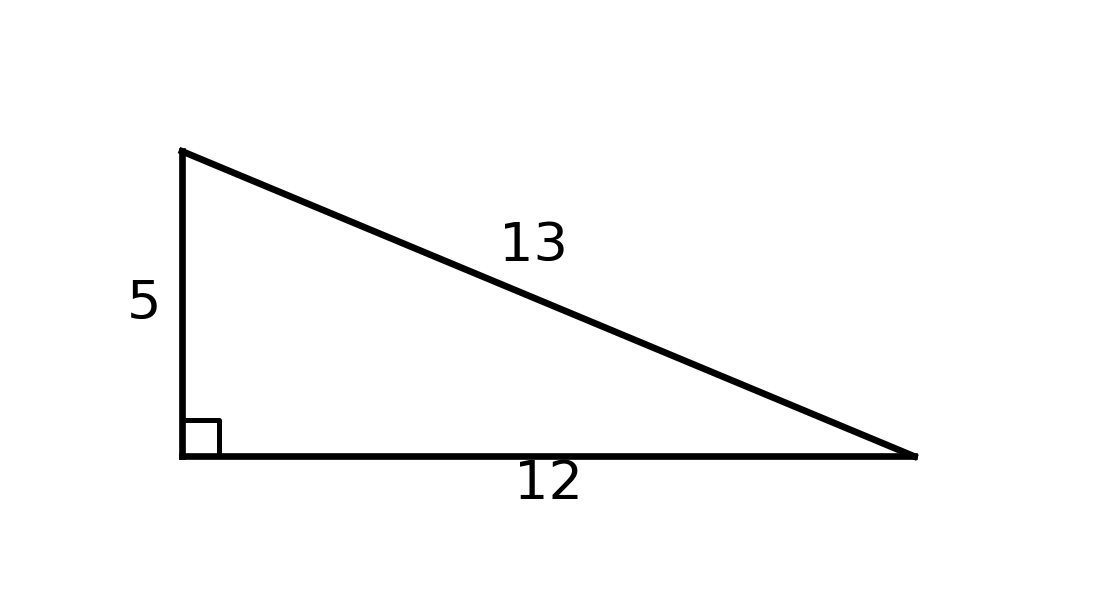
√(5² + 12²) = √169 = 13
▸ Standard unit-circle values
Worked Example Find tan(30°).
Tangent is sine divided by cosine at that angle.
sin(30°) = 1/2, cos(30°) = √3/2
tan(30°) = (1/2) ÷ (√3/2) = 1/√3 = √3/3
This chapter covers the right-triangle and exact-value foundation. ACT Math also draws on trigonometric identities and general triangles that don't have a right angle, both of which build directly on the sine, cosine, and tangent relationships taught here. That material is developed in its own chapter later in this Part, once this foundation is solid.
▸ Practice
Question 1
- A. 12/15
- B. 9/12
- C. 12/9
- D. 9/15
Question 2
- F. 6√2
- G. 12
- H. 6√3
- J. 9
Question 3
- A. 10 and 10√3
- B. 10√3 and 10
- C. 20 and 20√3
- D. 10 and 20
Question 4
- F. 1/2
- G. √3/2
- H. 1
- J. √2/2
Question 5
- A. 9
- B. 15
- C. 13
- D. 25
Question 6
- F. 5/12
- G. 12/5
- H. 5/13
- J. 12/13
Question 7
- A. 41
- B. 45
- C. 39
- D. 49
Question 8
- F. 7√2
- G. 21
- H. 14
- J. 10.5
Question 9
- A. 1/2
- B. √2/2
- C. √3/2
- D. 1
Question 10
- F. 1/2
- G. √3/2
- H. √2/2
- J. 1
Question 11
- A. 0
- B. 1
- C. √2
- D. √2/2
Question 12
- F. 9
- G. 21
- H. 19
- J. 25
Question 13
- A. (0, 1)
- B. (1, 0)
- C. (0, −1)
- D. (−1, 0)
Question 14
- F. 4/3
- G. 3/4
- H. 5/4
- J. 4/5
Question 15
- A. 41
- B. 29
- C. 25
- D. 31
Question 16
- F. 13√2
- G. 19.5
- H. 13√3
- J. 26
Question 17
- A. 1/2
- B. √3/2
- C. 1
- D. √2/2
Question 18
- F. 16
- G. 24
- H. 32
- J. 48
Question 19
- A. √3/2
- B. √2/2
- C. 1/2
- D. 1
Question 20
- F. (1, 0)
- G. (0, −1)
- H. (0, 1)
- J. (−1, 0)
▸ Answers and Explanations
Show the answers and explanations
1: D. The hypotenuse is √(9²+12²)=15; cosine is adjacent (9) over hypotenuse (15), giving 9/15. Choice A reports 12/15 instead of 9/15, using the opposite side for cosine instead of the adjacent side.
2: F. In a 45-45-90 triangle, the hypotenuse is a leg times √2: 6√2. Choice G doubles the leg directly instead of multiplying by √2.
3: A. The short leg is half the hypotenuse (10); the long leg is the short leg times √3 (10√3). Choice B swaps the short leg and long leg values.
4: F. cos(60°) = 1/2, a standard unit-circle value. Choice G reports sin(60°) instead of cos(60°).
5: B. By the Pythagorean theorem, the adjacent side is √(17²−8²) = √225 = 15. Choice A comes from an arithmetic slip while applying the Pythagorean theorem.
6: F. Tangent is opposite over adjacent: 5/12. Choice G inverts the ratio, reporting adjacent over opposite instead of opposite over adjacent.
7: A. √(9²+40²)=√1681=41. Choice B comes from an arithmetic slip while applying the Pythagorean theorem.
8: H. The hypotenuse is twice the short leg: 2×7=14. Choice F applies the 45-45-90 hypotenuse rule (multiply by √2) instead of the 30-60-90 rule (multiply by 2).
9: C. sin(60°)=√3/2, a standard unit-circle value. Choice A reports cos(60°) instead of sin(60°).
10: G. cos(30°)=√3/2, a standard unit-circle value. Choice F reports sin(30°) instead of cos(30°).
11: B. tan(45°)=1, since the opposite and adjacent sides are equal in a 45-45-90 triangle. Choice A reports a different standard value instead of tan(45°), where the opposite and adjacent sides are equal.
12: G. √(29²−20²)=√441=21. Choice F comes from an arithmetic slip while applying the Pythagorean theorem.
13: A. At 90° on the unit circle, the point is (0, 1). Choice B swaps the x- and y-coordinates, reporting the point at 0° instead of 90°.
14: G. Tangent is opposite over adjacent: 15/20=3/4. Choice F inverts the ratio, reporting adjacent over opposite instead of opposite over adjacent.
15: B. √(20²+21²)=√841=29. Choice A comes from an arithmetic slip while applying the Pythagorean theorem.
16: J. The hypotenuse is twice the short leg: 2×13=26. Choice F applies the 45-45-90 hypotenuse rule (multiply by √2) instead of the 30-60-90 rule (multiply by 2).
17: D. sin(45°)=√2/2, a standard unit-circle value. Choice A reports a different standard value instead of sin(45°).
18: H. √(40²−24²)=√1024=32. Choice F comes from an arithmetic slip while applying the Pythagorean theorem.
19: C. cos(60°)=1/2, a standard unit-circle value. Choice A reports sin(60°) instead of cos(60°).
20: J. At 180° on the unit circle, the point is (−1, 0). Choice F drops the negative sign on the x-coordinate.