ACT Math study guide · Chapter 60
Geometry and Trigonometry Timed Practice
Geometry accounts for roughly 17-20% of the current scored Math blueprint and spans several visually different skill families, including similarity, right-triangle trigonometry, coordinate geometry, circles, conics, transformations, and geometric measurement. This focused mini-section intentionally overweights those skills so they can be practiced under time pressure. It runs 20 questions in 22 minutes, matching a compressed slice of official section timing.
Work this section in one sitting, under real timing, before checking anything. Afterward, look back at each miss and name the actual cause instead of only the wrong answer: a theorem you didn't recognize, a diagram detail you misread, a setup or calculation slip, the wrong requested object, or time lost before exiting a stuck question.
▸ Questions
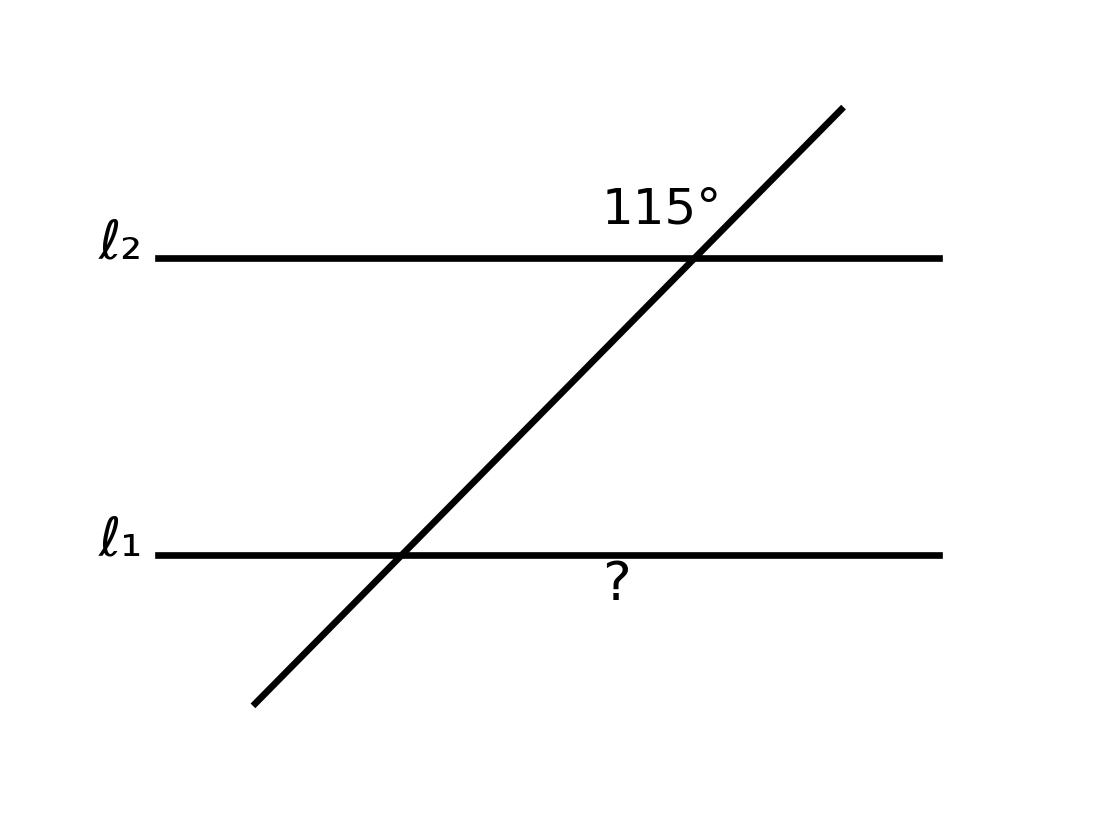
1. A transversal crosses two parallel lines, creating a 115° angle on one line. Find the corresponding angle measure on the other line.
A) 115° B) 155° C) 65° D) 25°
2. A triangle has interior angles of 48° and 77°. Find the measure of the exterior angle at the third vertex.
F) 55° G) 77° H) 125° J) 48°
3. Find the distance between (−3, 4) and (5, −2).
A) 3.74 B) 14 C) 10 D) 5.29
4. Two similar triangles have a scale factor of 3:7. The smaller triangle has a perimeter of 24. Find the larger triangle's perimeter.
F) 10.29 G) 168 H) 56 J) 72
5. A figure is dilated by a scale factor of 2.5. Find the ratio of the new area to the original area.
A) 12.5 B) 2.5 C) 5 D) 6.25
6. In a right triangle, one angle measures 35°, and the side adjacent to it measures 12. Find the length of the side opposite that angle, rounded to the nearest hundredth.
F) 8.40 G) 9.83 H) 12.00 J) 6.88
7. A central angle measures 84°. Find the measure of an inscribed angle that intercepts the same arc.
A) 84° B) 168° C) 21° D) 42°
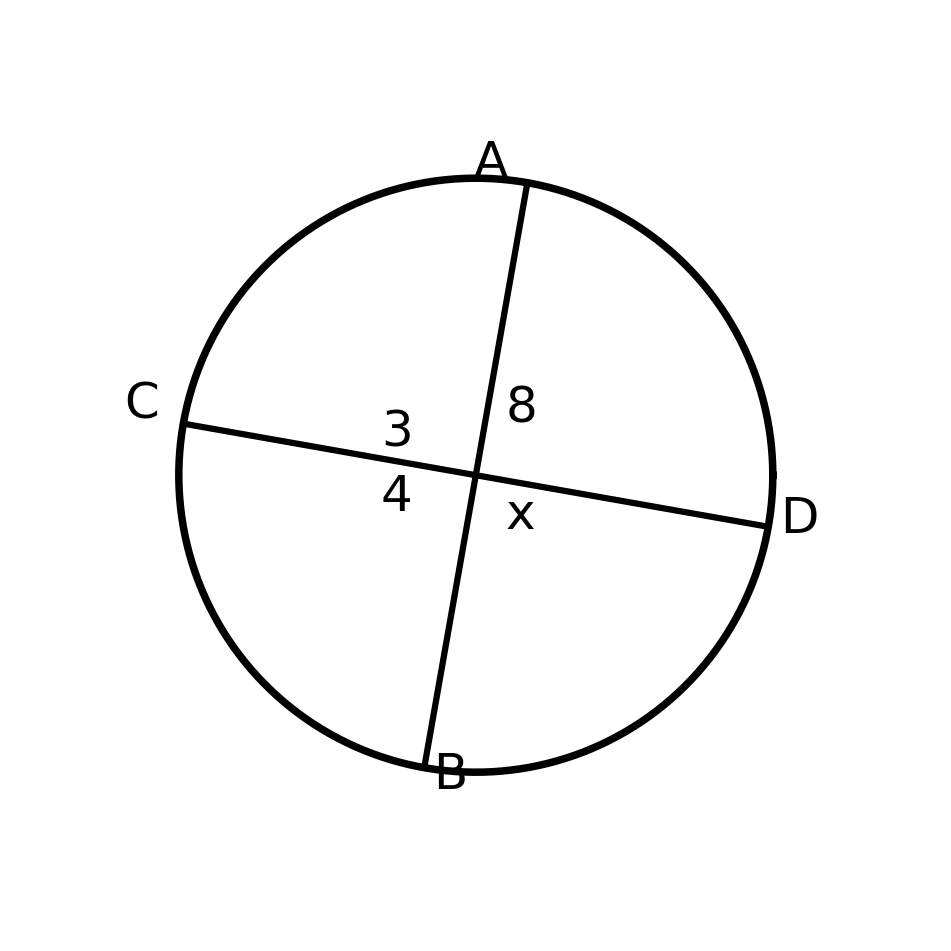
8. Two chords intersect inside a circle. The segments of one chord measure 3 and 8; the segments of the other measure 4 and x. Find x.
F) 10.67 G) 9 H) 7 J) 6
9. A tangent and a chord meet at the point of tangency, forming an angle of 63°. Find the measure of the intercepted arc.
A) 31.5° B) 126° C) 63° D) 117°
10. Point (5, −3) is reflected over the y-axis, then translated 2 units up. Find the final image.
F) (−3, −5) G) (−5, −1) H) (−5, −3) J) (5, −1)
11. A figure is dilated by a scale factor of 1.5 centered at the origin. A vertex is located at (4, −6). Find its image.
A) (6, −6) B) (6, −9) C) (4, −9) D) (5.5, −4.5)
12. Point (−2, 5) is rotated 180° about the origin. Find the image.
F) (2, −5) G) (−2, −5) H) (5, −2) J) (2, 5)
13. A cylindrical tank has radius 4 feet and height 10 feet. Find its volume in cubic feet, rounded to the nearest whole number.
A) 126 B) 503 C) 1257 D) 2011
14. A rectangular prism has length 8 cm, width 5 cm, and volume 200 cm³. Find its height.
F) 5 G) 40 H) 25 J) 8
15. A cone has a diameter of 12 inches and a height of 9 inches. Find its volume in cubic feet, rounded to the nearest hundredth. (1 cubic foot = 1,728 cubic inches)
A) 0.20 B) 1.36 C) 0.79 D) 339.29
16. A triangle has sides 8 and 11 with an included angle of 50°. Find the length of the third side, rounded to the nearest hundredth.
F) 19.00 G) 8.48 H) 7.08 J) 13.60
17. A triangle has sides 6, 9, and 11. Find the measure of the angle opposite the side of length 11, rounded to the nearest tenth of a degree.
A) 33.0° B) 45.0° C) 92.1° D) 54.8°
18. Find the center and radius of the circle x² + y² − 6x + 4y − 12 = 0.
F) center (−3, 2), r = 5 G) center (3, −2), r = 25 H) center (−3, 2), r = 25 J) center (3, −2), r = 5
19. A circle is inscribed in a square with side length 10, tangent to all four sides. Find the area inside the square but outside the circle, rounded to the nearest hundredth.
A) 21.46 B) 100.00 C) 78.54 D) 50.00
20. A regular hexagon is inscribed in a circle of radius 8. Find the hexagon's perimeter.
F) 96 G) 48 H) 83.14 J) 24
▸ Answers and Explanations
1: A. Corresponding angles formed by a transversal crossing parallel lines are equal: 115°. Choice C reports the supplementary angle (180−115=65°) instead of the equal corresponding angle.
2: H. An exterior angle equals the sum of the two remote interior angles: 48°+77°=125°. Choice F reports the supplementary angle (180−125=55°) instead of applying the exterior angle rule directly.
3: C. Distance = √[(5−(−3))²+(−2−4)²] = √[64+36] = √100 = 10. Choice A comes from taking the square root before squaring the differences, computing √(8+6) instead of √(8²+6²).
4: H. Similar figures scale every length by the same factor: 24×(7/3)=56. Choice F inverts the scale factor, multiplying by 3/7 instead of 7/3.
5: D. Area scales by the square of the linear scale factor: 2.5²=6.25. Choice A applies the scale factor directly instead of squaring it for the area ratio.
6: F. opposite = adjacent × tan(angle) = 12×tan(35°) ≈ 8.40. Choice G uses cosine instead of tangent, computing 12×cos(35°) instead of 12×tan(35°).
7: D. An inscribed angle is half the central angle intercepting the same arc: 84÷2=42°. Choice A reports the central angle itself, forgetting to halve it.
8: J. When two chords intersect inside a circle, the products of their segments are equal: 3×8=4×x, so x=24/4=6. Choice G adds and subtracts the segment lengths (3+8−4=7) instead of setting the two products equal.
9: B. A tangent-chord angle equals half the intercepted arc, so the arc is twice the angle: 63°×2=126°. Choice A halves the angle instead of doubling it to find the arc.
10: G. Reflecting (5,−3) over the y-axis gives (−5,−3). Translating 2 units up gives (−5,−1). Choice H completes the reflection correctly but forgets to apply the translation afterward.
11: B. A dilation by scale factor k multiplies both coordinates by k: (4×1.5, −6×1.5)=(6,−9). Choice A scales only the x-coordinate, leaving y unchanged.
12: F. A 180° rotation about the origin flips the sign of both coordinates: (−2,5)→(2,−5). Choice J reflects over the y-axis instead of rotating 180°, flipping only the sign of x.
13: B. Volume = πr²h = π(4)²(10) ≈ 503. Choice A omits the squaring in the volume formula, using πrh instead of πr²h.
14: F. Volume = length × width × height, so height = 200/(8×5)=200/40=5. Choice H divides by the width alone (200/5=40) instead of the full base area.
15: A. Volume = (1/3)πr²h = (1/3)π(6)²(9) ≈ 339.29 cubic inches. Converting: 339.29÷1,728 ≈ 0.20 cubic feet. Choice D reports the volume in cubic inches without converting to the requested cubic feet.
16: G. By the Law of Cosines: c²=8²+11²−2(8)(11)cos(50°) ≈ 71.87, so c≈8.48. Choice F omits the −2ab·cos C term entirely, computing √(8²+11²) as if this were a right triangle.
17: C. By the Law of Cosines solved for the angle: cosθ=(6²+9²−11²)/(2·6·9)≈−0.037, so θ≈92.1°. Choice D finds the angle opposite the side of length 9 instead of the side of length 11, computing the wrong angle entirely.
18: J. Completing the square: (x−3)²+(y+2)²=12+9+4=25, giving center (3,−2) and radius 5. Choice H reverses the sign of both center coordinates.
19: A. Square area=10²=100. Circle area=π(5)²≈78.54. Difference=100−78.54≈21.46. Choice C reports the circle's area alone instead of subtracting it from the square's area.
20: G. For a regular hexagon inscribed in a circle, each side equals the radius, since the six triangles formed by the radii are equilateral: side=8, perimeter=8×6=48. Choice F doubles the radius before using it as the side length, instead of recognizing the side already equals the radius.